Original citation:
Saward, Michael. (2014) Shape-shifting representation. American Political Science Review, 108 (04). pp. 723-736.
Permanent WRAP url:
http://wrap.warwick.ac.uk/78081 Copyright and reuse:
The Warwick Research Archive Portal (WRAP) makes this work of researchers of the University of Warwick available open access under the following conditions. Copyright © and all moral rights to the version of the paper presented here belong to the individual author(s) and/or other copyright owners. To the extent reasonable and practicable the material made available in WRAP has been checked for eligibility before being made available.
Copies of full items can be used for personal research or study, educational, or not-for-profit purposes without prior permission or charge. Provided that the authors, title and full bibliographic details are credited, a hyperlink and/or URL is given for the original metadata page and the content is not changed in any way.
Publisher statement:
© Cambridge University Press. 2014. http://dx.doi.org/10.1017/S0003055414000471 A note on versions:
The version presented here may differ from the published version or, version of record, if you wish to cite this item you are advised to consult the publisher’s version. Please see the ‘permanent WRAP url’ above for details on accessing the published version and note that access may require a subscription.
Shape-shifting representation Michael Saward
‘Sadly, it is not the only Romney, as his campaign for the White House has made abundantly clear, first in his servile courtship of the tea party in order to win the nomination, and now as the party’s shape-shifting nominee. From his embrace of the party’s radical right wing, to subsequent portrayals of himself as a moderate
champion of the middle class, Romney has raised the most frequently asked question of the campaign: “Who is this guy, really, and what in the world does he truly
believe”’ (Editorial,The Salt Lake Tribune, 22 October 2012)
Political representatives often need to be, or at least to appear to be, different things to different people.1 How they appear to others may be subject to their own choices, or deeply constrained by the choices of others or wider circumstances. This fact can work itself out in complex real-world patterns – at one extreme, representative claimants may put themselves across (or be put across) as different things to different people at different times in different spaces. As a comment on real-world politics, these ideas are not especially radical (as the quote fromThe Salt Lake Tribune suggests), but political science barely acknowledges their importance. There are strong grounds for arguing that, though he or she is not only a contemporary phenomenon, the shape-shifting representative is a crucial and perhaps the quintessential political figure in this era of increased media intensity, density and differentiation (Helms 2012). Developing the theory of shape-shifting representation, and placing it front and centre in analyses of political representation, can prompt a new level of analytical and empirical purchase on the challenge of explaining and evaluating representation’s vitality and complexity.
An absent presence: shape-shifting in historical and contemporary scholarship
The shape-shifting representative is a political actor who claims (or is claimed) to represent by shaping (or having shaped) strategically his persona and policy positions for certain constituencies and audiences. This figureispresent in classical, theoretical and empirical studies of representation, but only as a somewhat unnerving figure in the shadows. His or her troubling presence may reflect an abiding unease at the root of modern political theory, arguably above all in Machiavelli’sThe Prince. A prince, argues Machiavelli, ‘should have a flexible disposition, varying as fortune and
circumstance dictate’ (2004, 75). His power and his hold over his subjects may be in danger without cunning flexibility; he must ‘learn from the fox and the lion, because the lion is defenceless against traps and a fox is defenceless against wolves.
Therefore one must be a fox in order to recognize traps, and a lion to frighten off wolves’.
The figure of the Sovereign in Hobbes’sLeviathan(1969 [1651]) is a ‘representer’ with few restrictions on what he may do for or to his subjects. He is unpredictable, a vengeful and potentially deadly figure – a ‘monster’ indeed (Kristiansson and Tralau
2014)– who may adopt forms or shapes favouring the reinforcement of legitimate sovereign control. From Locke (1924, 163) onwards (‘to think that men are so foolish that they take care to avoid what mischiefs can be done them by polecats and foxes, but are content, nay, think it safety, to be devoured by lions’), the critical unease with which the Hobbesian vision has been greeted reflects the disturbing array of roles or actions that the Sovereign may adopt or perform, and the consequent and ever-present danger he poses. Mythological shape-shifting often involved human-animal and animal-animal transformations, a fact echoed directly in the classical writers’ invocation of monstrosity and animal cunning.
From these deeper roots one can detect an underlying distrust of shape-shifting representatives which persists today. Arguably, a modern prioritising of a negative normative framing of interpretations of shape-shifting in for example Machiavelli and Hobbes leads to the common sidelining of shape-shifting leadership or representation. Crucially, the persistent influence of this negative normative frame can be detected in contemporarydefinitions and analytical approachesto the study of representation, promoting definitions and typologies (valuing for example ‘isolated’ and separated’ concepts – Rehfeld 2009, 221),even wherethe presence of the skewing normative frame is barely any longer visible. Contemporary normative frames stress singular and consistent roles of political actors or leaders, refusing for example to separate in any way means from ends. Is this framing defensible? Must the moral representative always be rigidly consistent? Being moral, or doing what needs to be done, may requireinconsistency– shape-shifting – in a number of contexts. And good and moral ends may demand more flexible means, perhaps multiple role-playing.
For all its acknowledged virtues, the contemporary classic on political representation, Hanna Pitkin’sThe Concept of Representation(1967), adopts an analogous framing to the same ultimate effect – sidelining shape-shifting from representation theory via a negative normative filtering of representation’s meaning. In her thorough and complex account, Pitkin notes that the concept has been given many different meanings by different political philosophers. She finds beneath the great
disagreements evidence of a common, underlying ‘correct definition’: ‘the making presentin some senseof something which is neverthelessnotpresent literally or in fact’ (1967, 8-9). Two points are especially noteworthy here. First, Pitkin seeks one, best or proper definition of representation. And second, a framing bias towards singular and consistent representation is crucial to this one definition.
This normative framing – asking what is ‘the proper relation between representative and constituents’ (1967, 4) – in itself renders more urgent the perceived need to locate the one, correct definition. The proper relation unduly influences or frames the correct definition. For Pitkin, a good or proper representative, conforming to
(1967, 146). Nonetheless, she clearly favours a representative consistently pursuing one course or role, even if that view is as much a product of the style and framing of argument as its content.
Normative prejudgement, in this or another form, may be defensible. But it too hastily discounts alternative reasonable frames. The classic writers also provide accounts where shape-shifters may demonstrate or embody crucial leadership virtues; shape-shifting may reflect intelligent, prudent and flexible leadership, able to change strategies as circumstances demand. Machiavelli’s prince may be a figure of unfixed and uncertain morality, for whom the maintenance of power is paramount. But Machiavelli does not prize amoral rulership for its own sake; its value lies in its capacity to achieve ends at least some of which are widely desirable: ‘Everyone realizes how praiseworthy it is for a prince to honour his word and to be
straightforward rather than crafty in his dealings; none the less contemporary experience shows that princes who have achieved great things have been those who have given their word lightly …’ (2004, 73). For Hobbes, of course, the
overwhelming justification for the great scope and reach of the Sovereign’s writ is the maintenance of order, or more viscerally the avoidance of bloody civil war.
Machiavelli further argues that ‘Those who simply act like lions are stupid. So it follows that a prudent ruler cannot, and must not, honour his word when it places him at a disadvantage and when the reasons for which he made his promise no longer exist’ (2004, 74). Shape-shifting may for example be essential to achieving great outcomes.
The most explicit contemporary account which in part escapes the impact of negative framing of definitions and therefore restrictive, singular understandings of roles is Eulauet. al.’s account of the ‘politico’:
One can think of representation as a continuum, with the Trustee and Delegate orientations as poles, and a midpoint where the orientations tend to overlap and, within a range, give rise to a third role. Within this middle range the roles may be taken simultaneously, possibly making for conflict, or they may be taken serially, one after another as conditions call for. …. we shall speak of representatives who express both orientations, either simultaneously or serially, as Politicos. In general, then, the Politico as a representational role type differs from both the Trustee and the Delegate in that he is more sensitive to conflicting alternatives in role assumption, more flexible in the way he resolves the conflict of alternatives, and less dogmatic in his representational style as it is relevant to his decision-making behaviour. (1959, 750)
One can almost hear the voice of Machiavelli - the prince ‘should have a flexible disposition, varying as fortune and circumstance dictate’. A representative who pursues one role or type with consistency, perhaps pursuing a clear moral vision, may in reality be dogmatic, insensitive or inflexible. The politico is a theoretical forbear of the shape-shifting representative. Eulauet.al.break through that part of the normative framing which dictates a consistent pursuit of a single role as being desirable
normatively and (implicitly) correct in definitional terms. This important work – little acknowledged in recent years – begins to puncture overly restrictive framing.
roles, trustee and delegate. The separation and opposition of the two defines the entire relevant field of representation (they form its two ‘poles’), on this account. This is unduly restrictive binary thinking, despite the partial breakthrough that the figure of the politico represents.
Important recent work by Mansbridge (2003; 2011) and Rehfeld (2009; 2011) productively unpacks, indeed to breaking point, the pivotal place of the
trustee-delegate binary framing of representation. In different ways – notably theorising from empirical developments (Mansbridge) or defining representation separately from its democratic value (Rehfeld) – these writers also challenge restrictively skewed normative framing. Yet the focus on distinct, separate and isolable roles or types persists; Rehfeld (2009, 221) for example places great weight on ‘isolating’
representation’s component parts. Although ‘amalgams’ of a greater array of distinct types are entertained by breaking down the notions of trustee and delegate into varied component parts (Rehfeld 2009, 222), the strict separation and statis of the concepts constrains productive further analysis of innovative blurring and hybridising of roles in and through practice.
In short, leading classical and contemporary theories provide resources to extend our thinking about representation by taking fully on board representation’s movement as well as stasis. To account for the central but neglected figure of the shape-shifting representative, we need to exploit and develop these openings by (a) conceiving of representation as a dynamic and productive practice in context, rather than a phenomenon restricted to a grid of preconceived and acontextual categories; (b) suspending normative prejudgement in defining representation; (c) embracing the complexities of dynamic temporal and spatial aspects of representation; (d) considering the deeply relational and co-constitutive character of multiple representative roles, and (e) introducing normative assessmentofshape-shifting representation (normative prejudgement, not normativity itself, is the problem).
To grasp the nature and importance of shape-shifting representation, the overarching task is to generate new concepts to extend the analytical and empirical purchase of our studies of representation. After defining and defending preferred conceptions of representation, I shall build on sophisticated recent accounts of representative types or roles (and typologies) to trace an analytical path fromrepresentative rolesto
positioningtopatterns of representative shape-shiftingas critical concepts for analysing representation. The final section will turn to the normative question of the democratic legitimacy of claims to representation in the context of shape-shifting representation.
Dynamic representation: from roles to subject-positions
Representation roles
persisting and distinct features of the political world; ‘ideal-types’ are more abstract generalisations of such isolable, persisting and distinct features ; ‘roles’ reflect isolable, persisting and distinct practices in the political world (ways of doing representation); and (d) ‘views’ and ‘conceptions’ of representation are more
explicitly situated (historical or contemporary) perspectives on what representation is or what it is for.2
The argument for identifying and analysing the importance of shape-shifting
representation is built upon the performative and constructivist definition of political representation as the contingent product of ‘representative claims’3. According to this perspective, representation exists primarily by virtue of its being done – practiced, performed, claimed. Representative roles and relations gain a presence in our politics because myriad actors make claims to speak for others (and for themselves).
Representation is a performative product in two linked senses: it is performed in the theatrical sense (i.e. it is both done and shown to be done (Schechner 2002)) and in the speech-act sense (it is a speech or other act which establishes, or contributes to establishing, a state of affairs) (Austin 1975; Butler 1997). A performative account initially emphasises roles over types or forms because role emphasises the crucial place ofpractice, or acts, in constituting representation. Political actors do not simply occupy or exemplify (for example) types or forms which exist independently of their actions; types do not have a practical existence outside their enactment as roles by agents. Inherent to the act of claiming – implicitly or explicitly4– to represent a constituency is a constituting or reinforcing the social availability of that role.
The representative claim framework emphasises the situated or contextual dynamics of producing relations of representation, rather than a wholesale break with a stress on typology-construction (e.g. in the work of Mansbridge and Rehfeld). The emphasis on roles and practices highlights three features of representative politics which provide crucial underpinnings for the concept of the shape-shifting representative. First, it stresses representation’s variability: it is a protean phenomenon that can be formal and informal, electoral and non-electoral, national and trans-national, potentially happening in multiple spaces and possessing many guises. Second, it stresses representation’s contingency and dynamism: there’s a lot ‘going on’ in representation, a constant process of making, receiving, accepting or rejecting representative claims. And third, this approach highlights representation’s aesthetic and cultural character: would-be representatives need to ‘make representations’ (in the sense of artistic portrayals or depictions, such as candidates for office constant use of phrases such as ‘hard-working families’, ‘strivers’ or ‘battlers’) of their constituents to try to get the latter to recognise themselves in the claims being made (Saward 2010).5
2Accounts of types, roles etc. may also be distinguished according to whether they
are products of inductive or deductive observation, or normative or explanatory intentions. My comments are intended to be indicative and not definitive.
3The representative claim is defined in Saward (2010, 38) as ‘a claim to represent or
to know what represents the interests of someone or something’.
4The actual words used in a representative claim may vary, but not just any discursive
act will be a representative claim. Such a claim will always assert or imply a relation between two or more entities whereby one stands or speaks for other(s).
5Although the constitutive character of representation is prominent in recent accounts
Representation, on this account, is produced through the performance of roles. Consider a quite wide (though not exhaustive) snapshot of accounts of major representative roles (or types or forms that are best reinterpreted as roles) in the literature:
1. trustees and delegates (and politicos)
2. functional roles played in governmental systems6 3. promissory, surrogate, gyroscopic (Mansbridge 2003)
4. descriptive and substantive representation (e.g. Celis et.al. 2008) 5. a politics of ideas and a politics of presence (Phillips 1995)
6. liberal and republican models of representation (Bellamy and Castiglione 2013)
7. conceptions of roles of the ‘good representative’ (Dovi 2008) 8. formal or positional governmental roles (prime minister, member of
parliament, etc.) 9. principals and agents
10. likeness and distinction (Chabal and Daloz 2006)
11. indicative and responsive (with the latter category divided into ‘directed’ and ‘interpretive’) (Pettit 2009)
12. modes of ‘informal’ representation: e.g. stakeholder (Macdonald 2008), advocate, champion.
An extensive literature discusses the derivations and applications of these examples, often spinning off Pitkin’s (1967) extensive analysis. They vary greatly in their founding assumptions, political motivations, cultural and geographical reach,
institutional focus, empirical applications, and so on. But note that several categories in this rich list are primarily performative, ways of doing or carrying out
representation, whether in specific, perhaps policy-to-policy terms (such as trustee, delegate, or directed-responsive), or in more general orientational terms (such as liberal, republican, gyroscopic, substantive, or likeness). Others are more distinctly nominal (functional roles, such as senator or mayor), relational (principal and agent, ideas and presence, for example) or characteristic (such as descriptive).
However,despitethose multi-dimensional variations each entry on the list can best be conceived as a representative role that can in principle be combined (in a number of ways, as we shall see) with a range of other entries. Arguably, even relational or characteristic categories of representation are parasitic on a performative or role-oriented conception of (for example)acting asa principal or a descriptive
representative. A representative claimant plays theroleof delegate, champion, descriptive representative, good or moral representative, and so on. In the practice of
aesthetics (Ankersmit 2002), it has deeper roots in the account of Bourdieu (1991) and, according to Disch in particular, in Pitkin’s modern classicThe Concept of Representation. Arguably, it goes all the way back to Hobbes: ‘For it is the unity of the representer, not the unity of the represented, that maketh the person one.’
6According to Parkinson (2012), these are: (1) representing experiences, opinions,
and interests to other representatives; (2) making, checking, accepting, and
a would-be representative such roles can be mixed and matched outside and across their original theoretical or political points of derivation. For example: a
representative may claim a descriptive likeness to the majority of members of his constituency (‘I grew up in this town, and I know you can all recognise me as one of your own’), to be a trustee of constituency interests (‘You can rely on me to do what’s right for the town, even when that’s not easy’), and claim the mantle of a good
representative on the basis that he makes all of his decisions in a public and visible way (‘With me, what you see is what you’ll get’). In principle, a wide range of plausible examples can be gleaned by working the above list.
From role to subject-position
These points add up to a reframing of representative roles as factors ofmobilityrather thanoccupancy, reflexive positioning rather than comparatively fixed positions. If we were to insist on describing shape-shifting representation as a ‘role’, it would be a meta-role, a role of roles deploying shifting shades and aspects of a range of representative roles. The shape-shifting representative is not just one more role-character alongside (e.g.) the trustee, the delegate, the surrogate, or the gyroscopic representative. The ‘role’ of the shape-shifting representative is highly distinct; in theory and in practice it disrupts, conjoins, de- and re-attaches other, more familiar, roles. The shape-shifting representative is – they are – the linking mechanism, the creator of representative personas, the forger of hybrid roles of speaking and acting for, moving in and among a range of familiar roles.
However, importantly, these ‘roles’ function most clearly asresourcesfor representative claim-making. Indeed, it is at this point that the notion of a ‘role’ becomes seriously strained, inadequate in its implied fixed or static status next to the need for concepts which can capture the more dynamic – and, I argue, for that reason more realistic – mobility and positioning work (betwixt and between ‘roles’) that is central to claims of representation. Despite its superiority to ‘types’ or ‘forms’, the concept of role ultimately fails to capture the full importanceof the very attribute which placed it above those alternatives; it can capture active practice of
representationwithinthe bounds of particular roles, but not for example when the performance of representative claimsbreaksthose bounds, as a regular if not routine political phenomenon. Its more or less neutral, descriptive overtones deflect
analytical attention from the very constitution of those roles through representative claim-making, and why this or that role is salient or prominent in a time and place. It cannot capture the wider subtleties of representative practice that are crucial to a more rounded understanding.
For these reasons, I propose displacing the concept of role in favour ofpositioning. Social psychologists made this productive move several years ago, arguing that ‘the concept of positioning can be used as a dynamic alternative to the more static concept of role’ (Harré and van Langenhove 1991, 393). According to Henriksen (2008, 41), positioning theory’s emphasis on ‘interactivity, movement and fluidity’ has major advantages over ‘role-theory as a static tool for understanding social interaction’. Just as the claim-making conception stresses representation’s dynamism, so roles become (in principle) malleable resources for would-be representatives whoposition
positions him or herself as a subject with respect to constituents, supporters, or listeners; in other words, they adoptsubject-positions. Subject positions are
intersubjective, culturally and discursively constituted stances that are (differentially) available for adoption by actors. For example, the subject position of descriptive or sociological likeness, and another of trusteeship, is available to potential Western representative claimants (at least) as a social resource. If Chabal and Daloz (2006) are right, for example, a claim such as ‘I can speak for you because I am like you an ordinary person, doing the things you do and concerned with the things that concern you’ expresses a local cultural resource within which a Swedish politicians may fruitfully position herself.
Subject-positioning occurs due to, and against a background of, a complex array of available resources in specific cultural-political landscapes (such as national, religious or linguistic communities). It fosters analysis of both stability and dynamic change, depending on how actors or subjects (are able to) deploy available cultural resources. Unlike with the concept of role, neither stable subject-positioning nor dynamic multi-or re-positioning is downgraded. Further, it introduces into wmulti-ork on representation an interactive dynamism: claims by representatives position themselves and their
audience, and claims by the represented position both them and the representative. Representatives do not so much have or occupy roles as ‘pause at’ or ‘move through’ available subject-positional resources, which in turn they play a part on creating or reshaping. It is the relational and changeable array of such resources which defines the dynamic playground of political representation, including the situated capacities of would-be representatives to shape-shift, i.e. to reposition themselves among the array. Consider for example Fenno’s view of ‘trustee’ and ‘delegate’ not as
representative roles but as resources for congressmen to use to justify their actions to constituents. Notions of trusteeship and delegacy are deployed in representatives’ ‘presentational and explanatory activity’ (2003, 168):
If [House] members never had to legitimate any of their policy decisions back home, they would stop altogether talking in delegate or trustee language … Unconnected to the explanatory part of the process, the concepts have little behavioural content (2003, 161-2).
Positioning and patterns of representation: shape shifting
I defined the shape-shifting representative as a political actor who claims to represent by shaping strategically (or having shaped) his persona and policy positions for
certain constituencies and audiences. She does so by projecting images conforming to (adopting or adapting) familiar and hybrid representative resources, such as likeness or delegacy, and thus adopting (well or badly, for good or bad strategic reasons) subject positions such as delegate, or ‘champion’ of marginalised interests). Variably constrained and enabled by her political-cultural context, she and her advisors attend to how she appears in different spaces and different times, and to modes of mediation of her style and persona, with an eye to strategic advantage for herself, and perhaps her party, faction, sponsors and constituents.7
7Representative claims are not only made by would-be representatives themselves.
Bringing shape-shifting representation into focus can add an important dimension to recent advances in the theory of representation. To take the cutting-edge work of its type, note a further aspect of the dissection and reassembling of classic notions of trustee and delegate representation in Mansbridge (2003; 2011) and Rehfeld (2009; 2011). This work reinvigorates and expands our grasp of types of representation. Rehfeld writes of the sets of ideal-types debated by the two: ‘These ideal-types are meant to be just that – descriptions of conceptual points that are not necessarily realized in any pure form. In practice, representatives act in a way that mixes these forms’ (2009, 220). This is the standard position, where the type-defining ‘conceptual point’ allows us to retain analytical ‘pure forms’. The latter, perhaps by their purity, remain the key analytical building-blocks in understanding representation, and are presented as such in this exchange as elsewhere in the literature.
This is the approach I wish to turn around. It is not simply that the real world of representative politics complicates the ways in which ideal-types may be manifested. The ‘mix’ – which most writers on representation would accept as a reality – is not a secondary fact to be noted in passing, but rather can be the key theoretical starting point; it is the mix which oftendefinesthe contingent, perhaps fleeting, roles, forms or types of which it is composed (as a network can define its nodes). This happens through subject-positioning. To consider the matter abstractly, representative role X (trustee, delegate, or champion etc.) gains its characterasX by virtue of situated juxtaposition to roles or potential roles Y and Z. X-ness, as a position that the subject may adopt, perhaps because X-ness works well in context (it is a good, available resource in that context) is constituted by its not Y-ness, and not Z-ness. For example, key to positioning oneself as a ‘delegate’ is either (a) the ever-present potential to have positioned oneself otherwise (e.g. as a ‘trustee’), or (b) one’s incapacity to position otherwise. In other words, whether a given actor in a given context occupies consistentlyortraverses them, these positions are relational: co-defined or co-constituted in practice and in context.8
Patterns
Actual or potential movement through an array of culturally sensitive subject-positions – shape-shifting – is critical to grasping the empirical and theoretical dynamics of representation. Crucially, this shape-shifting createspatternsof
representation. It is not so much the separate types of representation that can provide purchase in explaining representative practices as thepatternsof the worldly
combination and recombination of subject-positions. The most productive way in which to capture shape-shifting representation is through a novel shift in emphasis from role to contingent positioning and patterning. Together these concepts give us
be seen as potential claimants to representation, though individuals acting in the group or organisation’s name do the literal claiming.
8Mansbridge (2011) and Rehfeld agree that representation is relational, by which they
the practice and the outcomes of representation, where ‘role’ runs together practice and outcome.
Consider a hypothetical example: a leader of a national trade union who claims to represent the substantive interests of his country on the basis of his union role speaking for significant numbers of workers. As that claim is challenged, he may shift to claiming substantive representation of likeness to common people, not least by telling his story of rising through the union ranks from the shop floor. The decline of the trade union base prompts him to gain party support and to stand and win a
parliamentary seat. Here, he adopts an outsider stance as champion of particular groups of low-wage and vulnerable workers, moving away from the ‘likeness’ claims. Being a promise-keeping, unwavering good representative of the constituencies he cultivates becomes the core claim around which he functions. We have here a sequential pattern of subject positions: the actor offers himself as a representative by virtue of (a) substantive policy positions, then (b) on the basis on likeness or
similarity to constituents, then (c) in terms of the champion of particular interests, and finally (d) in terms of his moral consistency. Deploying concepts of positioning and patterning by would-be representatives presses us to take such dynamic
trajectories seriously. Consider further the former president of Brazil, Luiz Inácio Lula da Silva, or more commonly Lula. From local union official to national union official, to co-organiser of the Workers Party to congressman, to multiple times presidential candidate to two-term president, Lula is noted for shifts from radicalism to reformism, and in styles of self-presentation. Of course, shape-shifting is not just sequential; as we shall see, time and space are more complexly deployed in the
politics of representation. Such patterns and patterning of representation are crucial to our efforts to gain robust theoretical and empirical understanding of political
representation.
‘As Fortune and Circumstance Dictate’: Constraint and enablement
Are we dealing primarily with shapes or shifters, constraining structures or enabling agency? Some actors may experience little choice as to which representative
positions they adopt or in which they are placed – ‘delinquent youth’, perhaps. Others may have much more choice as to whether they appear as a ‘champion’ of certain interests, for example. Regarding subject positions as relationally defined opens up important questions of power and choice for would-be representatives, whether they occupy stable positions or shapes or move among them more actively. To explore patterns of shape-shifting representation, we need to understand two key dimensions to this issue: structural options for shape-shifting, on the one hand, and the degree to which would-be representatives activate the agentic opportunities available to them. The variations in shaping of representative roles which these two dimensions produce are set out in Figure 1.
Figure 1 – Shapes and shifters
Degree of desire to activate agentic autonomy for shape-shifting [to what extent does an actor wish to exploit shape-shifting options…?]
Structural options for shape-shifting [to what extent is an actor free to shape-shift…?]
greater
↨
fewer
SHAPE-RETAINER SHAPE-SHIFTER
[image:12.595.92.512.73.146.2]SHAPE-ACCORDER SHAPE-CONFINED
Figure 1 captures key lines of variation of constraint and enablement. With respect to structural options for shape-shifting, aspects of socio-economic and political context will frame the extent and type of subject-positions that representative claimants might be able to shape themselves for. For example, political parties in the US remain (despite the recent rise in more overtly partisan congressional politics) more fluid ideologically than their European counterparts. This fact can foster greater opportunities to shape-shift among US party politicians. Further, a pluralistic and multicultural society may offer greater options to greater numbers of claimants for moving among representative roles. On the other hand, actors may experience
different degrees of desire (or, good reasons to) choose whether to shape-shift, i.e. the extent to which they activate opportunities for shape-shifting. So, for example, a context where an actor has little wish or need to shape-shift and there are few structural options for shape-shifting may lead to a ‘shape-accordance’pattern of representation.
A context where there are more structural options but strategic reasons for an agent not to shape-shift among representative roles may lead to a ‘shape-retained’pattern of representation (e.g. a strong party leader who revels in her reputation for spotless consistency). The shape-retained pattern bears a close relation to Mansbridge’s (2009) ‘selection model’, while emphasising the degree of choice exercised by the would-be representative in how her representing is to be characterised and performed. This point underscores the utility of the shape-shifting approach; a representative may act in accordance with constituent preferences, whether by ‘selection’ or ‘sanction’ (Mansbridge 2009), but using a model that allows for consideration of the degree of choice he or she may have had in so doing adds important dimensions of theoretical nuance and empirical examination. Being a representative of sort A is one thing, but understanding how and why it is not-B (or not-now-B, or not-here-B) can help us to begin to deepen our grasp via situated and relational analysis.
An agent who would wish to shape his or her representative claims to differing or changing representative roles, but faces fewer enabling structural resources, may give rise to a ‘shape-confined’pattern of representation. Similarly, a shape-confined pattern may arise where competitors or opponents claim that an actor stands for this or that goal or group, and the actor herself is unable to combat the claim effectively. Consider a challenge faced by President Obama five months before the US presidential election of 2012:
promoted last time around and has struggled to live up to.’ (Peter Baker, ‘Obama finds campaigning rules clock’,New York Times, 27 May 2012)
On this account, Obama recognised the dangers of shape-confinement – struggling to overcome strong characterisations of himself, not least from his opponents – and seeking the political space to shape-shift. The ‘shape-shifting’pattern in its strictest sense may arise where structural options for, and agentic choices and strategies favouring, shape-shifting among representative roles are both greater. To the question, what matters most, shapes or shifters, structure or agency, the answer is: it depends. Attention to specific contexts and strategies is crucial.
The positions mapped in Figure 1 reinforce the idea that subject-positions such as delegate, champion and so on are adopted or traversed by actors, freely or reluctantly. This is one part of what it means to highlight positioning and patterns rather than roles in analysing political representation. It is not simply that representatives may play a particular role; it is that certain contextual constraints and strategic opportunities and choices may lead to that ‘role’ being played in the context of positioning and
patterning behaviour. Sometimes the shape-shifting is done by representatives out of strength, at others out of weakness; sometimes it is effectively imposed on
representatives by others. The category of role tends to obscure agent choices and capacities – are they, for example, shape-confined or shape-retaining? The answer to thatquestion is crucial to grasping the nature and force of their representative claims. There is only one box labelled shape shifter (in Figure 1), but each of the other three categories starts from the assumption that shape-shifting is normal, a core ingredient in the dynamics of politics across contexts.9
Dimensions and patterns of shape-shifting representation
Although just one of the four poles in figure 1 is denoted ‘shape-shifter’ strictly speaking, they all share a common conceptual space. They bleed into each other, and develop their texture only by virtue of the ever-presence of the others (i.e. relational). They all acknowledge the crucial place of (potential or actual) shape-shifting at the heart of our ideas and practices of representation. But what sort of shape-shifting? The two key dimensions to shape-shifting are the temporal and the spatial, key aspects in examining political representation which, despite for example the classic work of Fenno (2003) and Eulau et.al. (1959), play little role in contemporary theories. I will comment on each in turn.
Among theorists of representation there is an underlying, and largely unspoken, assumption that representatives play one distinct representative role at a time.
Likewise, there is a common linear assumption about time – that any given moment in a passage of time is in principle equal in political significance and intensity to any other – in representative politics. Where issues of temporality are considered at all, they tend to be large-scale epochal ones, for example Pitkin’s (1967) view of the period of the ‘fascist theory of representation’. A focus on shape-shifting
9The types represented in Figure 1 are quite independent of questions of who may be
representation brings these assumptions into question. On one level, we have the importance of representatives being able to ‘mark moments’, to heighten or intensify the significance of particular times or junctures. We are familiar with the importance of election days and nights, for example, as key components of political ‘timescapes’ (Goetz and Meyer-Sahling 2009). But more significant are the ways in which shape-shifting representative practice upsets common assumptions of temporal linearity and singularity. The shape-shifting representative may, for example:
1. offer representative claims on the basis of being one thing at one time, and other thing at another time – e.g. a delegate at one time and a trustee at another.
2. offer multiple representative claims at the same time, or in overlapping periods of time, to different (or even the same) audiences.
3. offer claims to be, at one or at overlapping periods of time, one sort of representative (e.g. a descriptively representative delegate of a particular group) while in fact acting as a different sort (e.g. pursue a view of the common good while not subject to sanction)
Similar issues arise with respect to space and the closely linked notion of identity. Common assumptions among empirical and conceptual analysis of representation include the view that the electoral district and the nation-state (and little else) are the fixed and given ‘containers’ of the primary issues, interests and identities that may call for or require political representation.10 Closely allied with this is the common view that the identity of the constituency or constituents is given (especially with regard to electoral representation).
Sometimes these assumptions will be accurate, but they do not go far enough. The significance of space(s) and place(s) and identities associated with them is a question of subjective and intersubjective perception, not an objectively given property of a system. Even a stable nation-state structure requires constantevocation– through speeches, ceremonies, rituals, symbols, and so on (Rai 2010). And different
‘containers’ of interests may be available for evocation by would-be representatives, many of them non-contiguous in their distribution: religious groups, cultural or identity groups, social classes, even non-human interests and intergenerational or future generation interests. A politically salient sense of what spaces and identities there are and how and why they matter (or need representing) is manipulable, with multiple possibilities in practice.
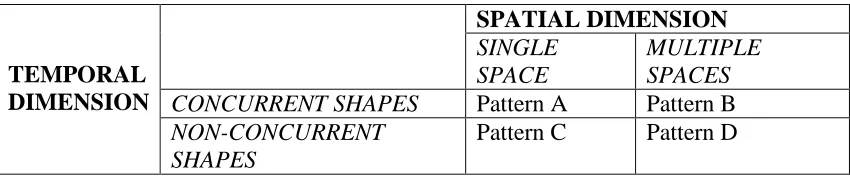
So we can combine an opened-up sense of both time and space to get a sense of the key dimensions of shape-shifting representation. A representative claimant may claim to be playing representation role A in one place (or to and for one group), and role B in another, at the same time. He may play roles C and D to a common or overlapping potential audience at the same time, perhaps by using dog-whistle tactics - ‘telling one group of voters one thing, while allowing or encouraging another group to believe another’ (Goodin and Saward 2005). He may claim the reality of a little thought-of space in order to (try to) render it politically significant to his advantage –
10Notwithstanding extensive and growing numbers of studies of democracy in the
witness the Northern League in Italy, and in particular its leader Umberto Bossi, and his invocation of ‘Padania’ as a would-be separate state from the rest of Italy
(Giordano 1999).
Taking these two key dimensions, Figure 2 sets out four basicpatternsof shape-shifting representation – I shall refer to these four as ‘level 1 patterns’. Recall that shape-shifting refers to processes of positioning and repositioning the persona and the nature of his or her claims to audiences or constituencies. Where (in more
conventional terms) roles reinforce roles, the argument here is that positioning creates and recreates patterns of representative practice. Each of the patterns A – D in Figure 2 are simplified snapshots of what in fact will be points on a spectrum, where for example the spectrum on the temporal dimension would cover varying degrees of (and shifts among) concurrency and non-concurrency of shape-shifting.
[image:15.595.86.511.415.504.2]The example of the trade union leader as a shape-shifting representer outlined above offered a sequential shape-shifting. This is an instance of Pattern D, where the actor shifts from claiming national-level representation to more specific spaces and groups (thus multiple spaces) through non-concurrent shaping of his persona (i.e. moving from one persona to another in a sequence). The example of President Lula of Brazil may exemplify Pattern D: sequential positions on policy and ideological orientation were adopted by Lula largely within and for citizens within one political space (the nation-state of Brazil).
Figure 2 – Patterns of shape-shifting representation
TEMPORAL DIMENSION
SPATIAL DIMENSION SINGLE
SPACE
MULTIPLE SPACES
CONCURRENT SHAPES Pattern A Pattern B
NON-CONCURRENT SHAPES
Pattern C Pattern D
The movement from roles to shapes and patterns of shape-shifting sets in train a continuing process of conceptual elaboration. If, as I have argued, shape-shifting representation ought to become the primary unit of analysis of political representation, then we need to pinpoint also the succeeding steps in the argument. Let us identify, then, three consequent keylevelsof patterning of shape-shifting representation.
Level 1 patterning – pattern A or B or C or D. The representative claimant positions herself, or is positioned, with respect to a number of representative ‘roles’, and in so doing retains a particular (though complex) pattern of concurrency and spatial reference.
representative persona). Consider for example a member of parliament who is in favour of developing green energy technologies nationally, but in whose own constituency a major campaign opposed to the creation of a local wind farm has become popular. When he campaigns in his constituency, he softens his message, saying this is not right for us, here. When campaigning elsewhere, he positions himself differently. This can be seen as a shift from Pattern A to Pattern B: from consistent positioning in all political spaces to differential positioning in different political spaces.
Level 3 patterning – A to B to C, or B to C to D, and so on. Here, the level of complexity of the patterning increases further.
In principle, of course, there will be a great many possible levels of patterning. Which patterns are discovered empirically will depend a good deal on political cultures of representation and the political positions that are being pursued or contested by representatives. For empirical analysis, this reconceptualization of political representation - from the prioritisation of roles to the prioritisation of patterns – can be expected to give rise to a number of distinct research questions. For present purposes, the key point is that detailed research can be expected to reveal an array of specific patterns, and their detection should tell us a good deal about the dynamics of political representation across geographical and political-cultural contexts. One might object that would-be representatives merely perform ad hoc or opportunistic shape-shifting. But on my approachshape-retaining, for example, may be just as ‘ad hoc’ or ‘opportunistic’ as shape-shifting proper. Further, we are not searching here for moral patterns – terms such as ‘opportunistic’ unduly prejudge representation and overlook important structural reasons for, and patterns of, shape-shifting. Such objections beg the question: why takethisopportunity to shift, or indeed shape-retain, in this context, where another actor may not (be able to)? What are the
patterns of constraint, enablement, and shape-shifting?
A number of questions may guide the generation of hypotheses about such patterns, not least for example:
1. Are identifiable patterns of shape-shifting representation correlated with different political actors (heads of state, members of parliament, interest group leaders, protest group leaders, and so on)?
2. Do specific countries or political cultures foster or in some way require distinctive adherence to certain patterns of representative claim-making? 3. Is there a relationship between shape-shifting or shape-retaining from a
position of strength (or weakness) and a specific pattern (or level of pattern) of shape-shifting?
4. On a reasonable measure of political visibility, what pattern(s) in what contexts foster greater or lesser degrees of political transparency?
ready availability of sufficient knowledge, or sources of knowledge, in addition to the problem that not enough people avail themselves of it. Amid contemporary
tendencies to ‘narrowcasting’ media, people get their information from limited sources, even when many further sources are feasibly available to them. Trends in access to and accessibility of knowledge of politics may underpin capacities for shape-shifting representation. With imperfect and differentiated distributions of perceptibility come opportunities to manipulate perceptions of political time, space and identity. Capacities and opportunities for shape-shifting representation (and for example for shape-retaining representation) may increase where dense and divided modes of knowledge mediation form particular regimes of political visibility.11
Systemic representation
There remains a crucial issue with respect to space: where representation is understood to happen within a polity. Is it, for example, an instruction or practice relevant only to formal elective office? Recent innovations in thinking about political representation have, following one thread in Pitkin’s work (1967), shifted their
analytic and normative focus away from strictly dyadic relationships between represented and representative, and towards systemic views. Two factors underlie this move. First, in terms of defining representation, it is recognised that a range of actors, for example unelected as well as elected ones, may succeed in making effective representative claims (Rehfeld 2006; Saward 2010, 82-110; Montanaro 2012). Second, in terms of normative democratic criteria, it is the overall systemic quality of representation (however that quality itself is assessed) which counts, however much dyadic instances of representation still matter, normatively. However, we need to question this new conventional wisdom and further unpack this
distinction. It acts as cover for further important distinctions concerning the
[image:17.595.84.486.513.587.2]‘systemic’, and may obscure what is at stake in the linkages and mutual dependencies between dyadic and systemic representation. Consider Figure 3.
Figure 3 – Dimensions of systemic representation
REPRESENTATION’S DOMAIN
DEMOCRATIC LEGITIMATION Dyadic Systemic
Systemic-governmental A B
Systemic - societal C D
Thesystemic-governmentalview holds that representation happens in the executive and legislature of a state, and perhaps in governmental and quasi-governmental international bodies. Thesystemic-societalview holds that representation occurs across society, including in governmental bodies but also for example in interest groups, social movements, and businesses. In terms of democratic legitimation, one
11One might further expect that key empirical hypotheses concerning developments
in (at least) established modern liberal democracies facilitating shape-shifting
can look to specified qualities of representative dyads within (Box A) or within and beyond (Box B) the governmental system. Without entering into a full defence here, I hold that boxes C and D in Figure 3 are the relevant ones to consider where the
analysis of the quality of political representation is at issue.
Writers who advocate a ‘systemic’ view of representation, notably Pitkin, Urbinati and Mansbridge, especially as far as normative judgements are concerned, tend to assume that systemic = systemic-governmental. The key line of defence of this view includes the argument that so-called ‘informal’ representation – often located outside the state, often nonelective or informally or partially elective though still based on claim-making and reception –ispolitical representation and is potentially democratic representation.12 Representation is claimed or enacted by a wide array of local, national and international groups and individuals, elected or chosen or not-elected and rejected. Even democratic representation need not to be understood as confined to a set of statal institutions, but rather understood more broadly (and indeed more complexly) as a set of practices more or less present in a wide array of diffuse
locations, including transnational contexts. On this basis, analysts should work with a systemic-societal basis of representation’s domain, along with a dyadic+systemic view of representation’s democratic quality. The key point is that the shape-shifting representative has in principle a wide and complex societal playground (I return to the more strictly normative aspect of the argument below). Indeed, this framing rightly suggests that (shape-shifting) representation occurs throughout social, including personal and group, lives as well as in more conventionally political contexts. As Lloyd writes, ‘Humans are representing animals … Human life […] is largely a cycle of making and interpreting representations’ (cited in Slezak 2002). I acknowledge this fact and focus on the more clearly political aspects of shape-shifting
representation.
A further crucial issue on the relationship between the dyadic and the societal-systemic arises in the specific context of shape-shifting representation. The ‘system’ in this potentially very broad systemic account is not a consistent, singular or clearly bounded set of spaces, actors or institutions. Nor do ‘dyadic’ examples of
representation exist in isolation from each other. Rather, shape-shifting representation itselfforges or enactsthe particular manifestations or experiences of the (societal-)systemic. An instance of shape-shifting representation will characteristically involve a pattern of representative dyads. These patterns, in turn, enact the systemic. Urbinati (2011, 46) has written of the ‘…intricate network of interdependency between
12It might be objected that states/governments still decide issues exclusively – they
authoritatively allocate values not in the sense that they monopolise the authority to do so, but rather that their version of authority is decisive. In response, however, one can note the proliferation of more or less effective decision points and practices beyond and across states: devolved decision-making (for example through
representatives and the represented’. Unstable patterns of such networked
interdependency result from (among other things) the activities and claims of shape-shifting representers. The latter, for example, may succeed in claiming to speak for several overlapping constituencies with respect to different sets of interests. That makes for a pattern of dyads that become in effect a patterned system of
representative claim-making and reception. In this respect, the very distinction between the dyadic and the systemic views of representation begins to blur, or even to break down. The numbers, character and timing of representative claims and their reception do not map at all neatly either onto a series of discrete dyads or a single clearly bounded conception of a system of representation. Shape-shifting
representation challenges fundamentally such neat distinctions, just as it challenges unduly tight separations between types or roles of representation.
Patterns of shape-shifting representation shape in turn the character and boundaries of the larger representative system. Their claims to (patterns of) roles may suffer varied fates: fading, transforming, lingering, or being rendered effective or ineffective. Whichever fate they meet, their representative claims rest not on something that they are, but rather on what theydo, and what constructions of the systemic- societal domain, persistent or ephemeral, their actions weave.
Applying the framework: Democratic legitimation and the shape-shifting representative
I have noted that a conventional normative framing of analysis of representation prejudges representations meaning and value assingle‘proper’ rolesconsistently performed – the (definitional) singularity and the (normative) consistency born of different but mutually reinforcing normative assumptions. The more dynamic and relational approach via subject-positioningdelaysnormative questions about representationin order tofoster more productive empirical investigation and
theoretical understanding. It is an approach that ‘brings the politics back in’ to both empirical and theoretical work. It does not, however, rule out normative assessment of representation.
Democratic legitimation of representation is a contingent product of the complex political play of claim and reception, an account of which requires that we draw on different traditions of thinking about democratic legitimacy. Democratic legitimation is most readily discussed in the context of electoral representation – free and fair voting is a relatively clear way for constituencies to signal acceptance or rejection of representative claims – but non-elective modes of representation may also achieve democratic legitimacy. The comments in this section pertain in principle to both elective and non-elective representative claims.13
On what I call theprocedural temporalview, democratic legitimation is a specifically situated state of affairs whereby an instance of representation is regarded as
13Montanaro (2012) offers a detailed account of the democratic assessment of
democratically acceptable by, or is not rejected by, an appropriate constituency.14 Pitkin’s non-objection principle an important root of this point (see Runciman 2007), though acceptance is in principle more detectable and explicit than non-objection, and rejection likewise compared to objection. A range of norms may be used by members of an appropriate constituency. It starts with and from events, claims and phenomena of representation. And second,substantive-snapshotview, democratic legitimacy is a specific normative standard derived from a context-independent theory of legitimacy, allowing for more or less acontextual answers to the legitimacy question - so long as our concepts and theories are sharp enough and applied appropriately. Such
substantive criteria may be understood or applied as a ‘regulative ideal’.
We need to combine elements of both approaches. To the question ‘Are there actions which we can observe which infer or constitute legitimation?’ (Barker 2001), my response is that democratic legitimation of representation concerns on-going acceptance of representative claims by specific appropriate constituencies (the procedural-temporal) under certain conditions (the substantive snapshot). Thus we work from a procedural-temporal view in the first instance – in this or that specific context, does the appropriate constituency accept representative claims made on its behalf? How does the degree of acceptance change over time? More substantive elements enter our considerations as we step back from the fact or otherwise of acceptance to examine the conditions under which acceptance is given or withheld. Here, less case-specific criteria enter our assessments.
As we work from the inside out – from the situated procedural to the substantive - we also move from a more specific focus on dyadic instances of representation to more systemic-societal considerations. Bearing these points in mind – parallel shifts from the inside out, from dyadic to systemic, from cases to conditions – how might we specify the guiding questions to assess the democratic legitimacy of representative claims? I will first set out the approach that should apply to all representative claims. I will then consider particular issues that may arise in cases of shape-shifting
representation.
1. For a specific dyad – a claim that A represents B - is there a sufficient degree of acceptance by the appropriate constituency?15
2. Are the conditions within which that acceptance is given conducive to open and uncoerced choices by member of the appropriate constituency?16
3. If we zoom out from specific instances and look at many such instances across society, to what extent are conditions conducive to uncoerced and open
14For a definition of the ‘appropriate constituency’, see Saward (2010, 145-151). 15The difficulties of specifying what a ‘sufficient degree’ may mean do not invalidate
this approach. As a general guide, acceptance, or at least non-rejection, by most or all members of the appropriate constituency without undue burdens being placed upon dissenters is an appropriate starting point.
16In practice we are dealing with a spectrum of possibilities here. A choice or
acceptance may be uncoerced, but arguably none are entirely unconstrained in some way. Following Simmons’ discussion of consent, acceptance must be given
acceptance acts replicated across a diverse range of dyadic claims – at a systemic-governmental level or more broadly on a systemic-societal level? The observer’s priority even at this more systemic level should be on acts of acceptance or rejection by situated actors. This may necessarily involve detailed and perhaps difficult interpretations of specific cases where the relevant acts are not immediately detectable (see Scott 2012).
Moving further away from representative dyads, whether discrete or multiple, we may also reasonably argue that fast-track (or short-cut) judgements about the democratic legitimacy of representative claims on a systemic level may be made by applying further general conditions to supplement those of case-based open and uncoerced judgements. These further general conditions are defined by these additional questions:
4. To what extent is there a plurality of sites, moments or opportunities for representative claim-making and reception (the extent of openness to many claims and their contestation)?
5. To what extent is there uncoerced equal access to subject-positional resources for claim-making in the given context?
6. To what degree is there variation in the nature and bases of representative claims in the given context (the extent of openness to different sorts of claims, by different sorts of claimant)?
7. To what extent is there reflexivity, in the sense that claim-makers are responsive, and contestation is encouraged (cf Disch 2011)?
This set of more general conditions can reasonably be used as a second-best proxy for assessments of society-wide democratic legitimacy of representative politics.
Plurality, equal access, variability and reflexivity are key democratic ingredients in fields or systems of representation. A number of commentators regard the promotion of similarly-conceived conditions as essential to the democratic or just character of representation (e.g. Hayward 2009, Jung 2009, and Garsten 2009). A greater prospect of democratic legitimation of a system of representation is broadly associated with: more representative claims of more types and styles in a context of open contestation in a dense but open-ended network of claims. Lesser prospects of democratic
legitimation of a system of representation would be associated with: the dominance of a particular source or type of representative claim, with few openings for new types of claim from marginalised interests, and little opportunity for contestation of claims. Where opportunities for open and uncoerced constituency assessment of
representative claims are not available, a further reasonable proxy judgement is to favour actors working to bring those conditions about, and who base their
representative claims on the fact they are fostering openness, plurality, etc.
representative claims accept those claims (contingently or otherwise), then it is the fact of acceptance (or rejection) and not the provenance of the preferences involved that matters. For example, as a voter I may regard health policy as the most vital issue, and my preferences on health policy as a voter may have been shaped
significantly by the arguments of candidate or party A. To the extent thatthe context is one of pluralism, contestation, and alternative sources of information, the
provenance of my preferencedoes not matter. From a slightly different angle: in most contexts citizen preferences will be co-constituted in some form, and to some degree, by citizens and elites. This fact is insignificant compared to the conditions of plurality, contestation, and so on. I can accept asmypreference an idea produced by another so long as I have had the opportunity to do otherwise.
Let us now examine specificallyshape-shifting representationin the light of this summary account of the democratic legitimation of representative claims.
As we have seen, the shape-shifting representative can operate across society (including making claims intended to carry beyond a polity’s borders). His claims can take a great variety of hybrid and even seemingly contradictory forms. Here, the prevalence and dynamics of shape-shifting representation pose particular challenges. First, in addition to being involved in more-or-less discrete dyadic representative relationships, shape-shifting representers forge, or attempt to forge, patterns of
multiple dyads which may be serial or non-sequential. As such, their actions may blur distinctions between different dyadic relationships, and between dyadic and systemic relationships. Shape-shifting may obscure or disrupt the basis upon which
constituencies may accept or reject representative claims – it may, for example, undermine a clear sense of just what claims are to be accepted or rejected. By the same token, it may make representative claims more difficult to contest, in that shape-shifters may make a slippery, moveable and complex set of claims that are difficult to ‘pin down’.
Secondly, shape-shifting representation carried the danger of crowding out other representative claimants. This possibility may in practice pose a threat to a key aspect of the desirability of openness to variable claims made by different sorts of claimant. If the number of those who make representative claims (especially consequential ones) is smaller as a consequence of shape-shifters making a wide range of claims, this may reduce the opportunities for other would-b representative figures to voice their own claims, thus reducing the plurality of types of claimant.
A troubling as these two issues may be, they do not amount to a damning of shape-shifting representation. The difficulties with the first issue may mean that,
specifically in cases of shape-shifting, certain systemic conditions may be particularly important to judgements about democratic legitimacy. A systemic perspective, encompassing conditions of openness across societies, may bring shape-shifters into public focus more than a perspective that examines discrete dyadic relationships. The second problem that may attend shape-shifting especially may be balanced by the fact that shape-shifting may be a phenomenon that facilitates more representative claims of greater variety, addressing hitherto dormant but important social interests.17 There
17It may be argued that a claimant being open about, and taking responsibility for, his
may be a trade-off here: shape-shifting may threaten to reduce the number of representativeclaimantsin a given context, but equally it may facilitate a greater number ofclaims. The latter, in turn, may also help to foster uncoerced constituency assessments and their enabling conditions: plurality, equality, variability and
reflexivity.
So while some modes of shape-shifting representation may make some legitimacy judgements more difficult, and may crowd out some potentially representative actors, there is nothingintrinsicallygood or bad about shape-shifting representation. Shape-shifting may be a phenomenon borne of political freedom and its exercise, and genuine efforts to knit together compromises between opposing interests; further, an absence of shape-shifting may in some circumstances represent a form of politics that is static and overly predictable. Overall, there is no strong case that norms of
democratic legitimacy require that single representative claimants stick to single or small numbers of representative roles.
Admitting to being or aspiring to be a shape-shifting representer may paint a claimant as deceitful and manipulative, whereas to act in accordance with a more familiar type – a delegate or a surrogate, for instance – may be more acceptable. Such implicit moral judgements may even underpin both the absence and the haunting presence of the shape-shifter in theories of representation. It is true that shape-shifting
representation is often regarded as negative in itself – see theSalt Lake Tribune’s emphatic case for not endorsing the candidacy of Mitt Romney for US president in 2012. But there are plenty of contrasting examples. Consider a recent comment by Bill Keller in theNYRB: ‘Nelson Mandela was, at various times, a black nationalist and a nonracialist, an opponent of armed struggle and a practitioner of armed struggle, a close partner of the South African Communist Party and, in his presidency, a close partner of South Africa’s powerful capitalists. In other words, he was whatever served his purpose of ending South Africa’s particularly fiendish brand of minority rule’.18
Conclusion
The shape-shifting representative may be an elected politician, a transnational
governmental political actor, a social movement leader or dissident, a religious leader, a business or labour leader, or an artistic figure with a public profile (musician, film-maker, and actor). He adjusts and modifies his claims and seeks to influence the perceptions of constituencies and audiences (cf Goffmann 1990 [1959]). He positions himself in and among the array culturally available subject positions, perhaps
his industry only, but his judgment; and he betrays, instead of serving you, if he sacrifices it to your opinion’. Burke suggests that the content and framing of his representative activity may shift and change, but only in order to remain consistent with a larger ideal of what it means to represent. No doubt in many instances such openness will add to acceptance of claims by would-be constituents, but it remains the case that acceptance is the ultimate and most appropriate (democratic) arbiter.
18Alongside criteria of democratic legitimation, theorists may provide aides to citizen
strategically shape-retaining as well as shape-shifting as such, in order to make representative claims. He is not so much this-or-that type of representative, playing this or that type of representative role, but rather a liminal figure, more or less mobile betwixt and between subject-positions. He reinforces traditional representative stances and resources through invocation, and fosters the emergence of new and hybrid ones through creative claim-making and constituent information and cultivation. When successful, he conjures and summons publics.
In his claim-making, the shape-shifting representative takes care who he speaks to, and who he claims to speak for, at given moments. He watches how his words and claims transmit, and how and to whom they may be repeated. In this activity, the representative positions that he adopts or traverses are (as part of the same process) themselves adapted and reconfigured. His posture may at times be one of imposture, but it may be an imposture born of necessity in a differentiated and densely
mediatised political world. The shape-shifting representative is an especially distinctive character in twenty-first century politics. To embrace the dynamics underlying political representation, political theory needs to embrace this enigmatic and sometimes troubling figure.
References
Ankersmit, F.R. (2002),Political Representation(Stanford: Stanford University Press)
Archibugi, D., Koenig-Archibugi, M., and Marchetti, R. (2012) (eds),Global Democracy(Cambridge: Cambridge University Press)
Austin, J. (1975),How To Do Things With Words(second edition), eds. J.O. Urmson and M. Sbisa (Oxford: Clarendon Press)
Bakhtin, M. (1981),The Dialogic Imagination, ed. M. Holquist, trans. by C. Emerson and M. Holquist (Austin: University of Texas Press)
Barker, R. (2001),Legitimating Identities(Cambridge: Cambridge University Press)
Bellamy, R. and Castiglione, D. (2013), ‘Three models of democracy, political
community and representation in the EU’, inJournal of European Public Policy20, 2, 206-223
Bourdieu, P. (1991),Language and Symbolic Power(trans. by J.B. Thompson) (Cambridge: Harvard University Press)
Butler, J. (1997),Excitable Speech: politics of the performative(London and New York: Routledge)