University of Warwick institutional repository: http://go.warwick.ac.uk/wrap
A Thesis Submitted for the Degree of PhD at the University of Warwick
http://go.warwick.ac.uk/wrap/71178
This thesis is made available online and is protected by original copyright. Please scroll down to view the document itself.
The Perceived Effectiveness of the Implementation of
Task-Based Language Teaching and Mediation
Procedures for the Teaching of Business
Presentations at a Thai University
By
Wuttiya Payukmag
A thesis submitted in partial fulfilment of the
requirements for the degree of
Doctor of Philosophy in English Language Teaching and
Applied Linguistics
Centre for Applied Linguistics, The University of Warwick
TABLE OF CONTENTS
TABLE OF CONTENTS ... i
LIST OF FIGURES ... viii
LIST OF TABLES ... viii
ACKNOWLEDGEMENTS ... x
DECLARATION ... xi
ABSTRACT ... xii
ABBREVIATIONS ... xiii
CHAPTER 1 INTRODUCTION ... 1
CHAPTER 2 LITERATURE REVIEW ... 9
2.1 Task-based language teaching... 9
2.1.1 Definitions, rationale, and the use of tasks in three types of intervention .. 9
2.1.1.1 Definitions of ‘task’ ... 10
2.1.1.2 Definitions and rationale for TBLT ... 14
2.1.1.3 Tasks used in three types of intervention ... 16
2.1.2 Task design and sequencing ... 17
2.1.2.1 Triadic Componential Framework ... 19
2.1.2.2 Task dimensions and task difficulty ... 21
2.1.3 Task components and task types ... 26
2.1.4 Task-based language teaching implementation ... 30
2.1.4.1 Options for the pre-task phase ... 31
2.1.4.2 Options for the during-task phase ... 33
2.1.4.3 Options for the post-task phase ... 34
2.1.5.1 Integrating task-based learning into a business
English programme (Stark, 2005) ... 36
2.1.5.2 Effectively implementation of a collaborative task-based syllabus in EFL large-sized business English classes (Chen, 2005) ... 37
2.1.6 Justification for selection of TBLT as a teaching approach in this study .. 39
2.1.7 Selection of TBT model to be implemented in this study ... 41
2.2 Mediation practice ... 49
2.2.1 Concepts of mediation according to DA practices ... 50
2.2.2 Distinction between mediation and corrective feedback ... 55
2.2.3 Conduct of mediation in different DA approaches ... 58
2.2.4 DA studies in second and foreign language learning to guide mediation practice in this study ... 62
2.2.5 Interpreting learners’ difficulties and understanding ... 68
CHAPTER 3 METHODOLOGY ... 72
3.1 Research design: case studies and mixed methods ... 73
3.1.1 Overview of the investigation of ‘effectiveness’ of TBLT and mediation and research design ... 73
3.1.2 Features, design and procedures of the case study in this study ... 77
3.1.3 Mixed methods data collection ... 83
3.2 Qualitative data collection ... 87
3.2.1 Observations ... 88
3.2.2 Interviews ... 91
3.2.3 Research journal ... 95
3.3 Quantitative data collection ... 96
3.3.1 Justification of using questionnaires in this study ... 96
3.3.2 Content and procedures for designing the questionnaires ... 99
3.3.3 Content of pre-intervention questionnaire ... 104
3.3.4 Content of post-intervention questionnaire ... 106
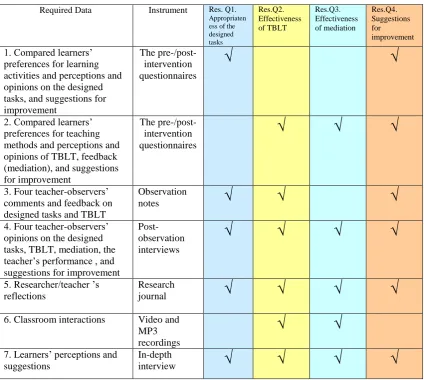
3.4 Data collection in relation to the research questions ... 108
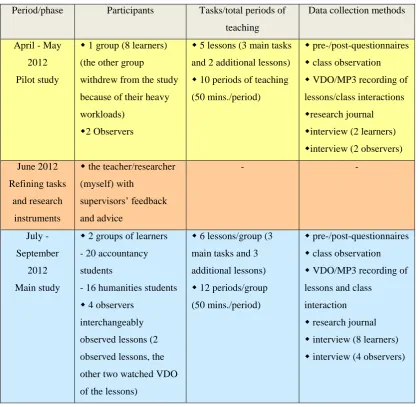
3.5 Fieldwork data collection ... 112
3.5.1 Piloting the tasks, TBLT and mediation procedures ... 113
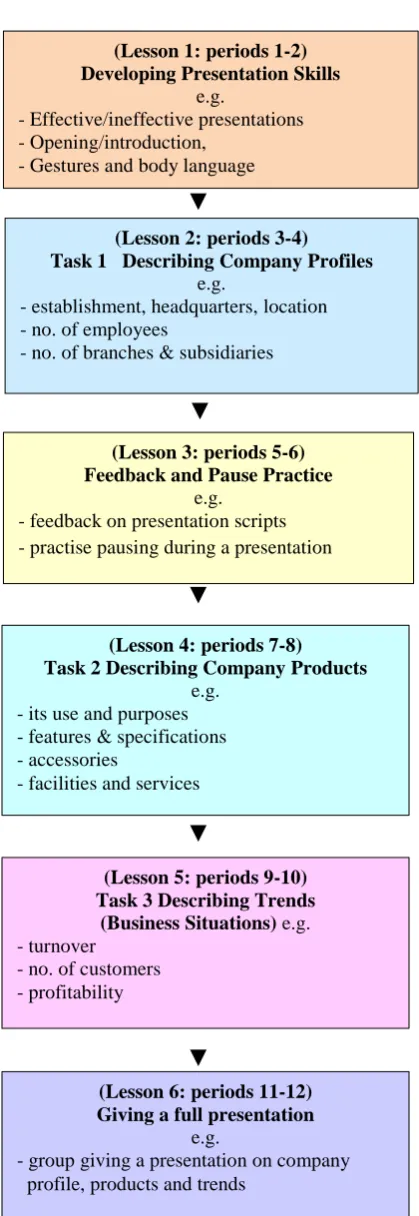
3.5.2 Implementation of tasks, TBLT and mediation during the main study .. 116
3.5.3 Data collection during main study ... 123
3.6 Data analysis methods ... 126
3.6.1 Direct analysis of quantitative data ... 127
3.6.2 Direct analysis of qualitative data ... 128
3.6.3 Direct analysis of class interactions ... 129
3.6.4 Synthesis and interpretation of data across all sources ... 130
3.7 Summary of data elicitation and analysis and criteria for selecting data for presentation ... 133
CHAPTER 4 RESULTS OF THE PRE-/ POST-INTERVENTION QUESTIONNAIRE ANALYSIS ... 137
4.1 Analysis of the pre-intervention questionnaire ... 137
4.1.1 Reliability of the pre-intervention questionnaire ... 137
4.1.2 Respondents and their English proficiency ... 138
4.1.3 Teaching focus ... 140
4.1.4 Oral presentations ... 142
4.1.6 Feedback/error correction (mediation) ... 144
4.2 Analysis of the post-intervention questionnaire ... 146
4.2.1 Reliability of the post-intervention questionnaire ... 146
4.2.2 Respondents by faculty ... 147
4.2.3 Students’ overall feelings and opinions about lessons and teaching ... 147
4.2.4 Students’ opinions and perceptions of designed tasks, feedback (mediation) and TBLT ... 149
4.2.5 Students’ opinions on improvement of English skills ... 151
4.2.6 Students’ opinions on improvement of oral presentations ... 152
4.2.7 Students’ opinions on individual/pair/group work ... 152
4.2.8 Students’ opinions on feedback (mediation) ... 153
4.2.9 Examination of the difference in students’ mean ratings ... 155
4.3 Correlation analysis of the pre- and post-intervention questionnaires ... 155
4.3.1 Teaching focus ... 156
4.3.2 Oral presentations ... 158
4.3.3 Participation mode ... 159
4.3.4 Feedback/error correction (mediation) ... 161
CHAPTER 5 FINDINGS ... 163
5.1 Teaching and learning factors, and time constraints ... 163
5.1.1 Evaluation of this task-based course in relation to institutional requirements and the relevant course of English for Communication 3 . 164 5.1.2 Limited learner English proficiency and knowledge of business practices ... 167
5.1.4 The use of mother tongue in class ... 172
5.1.5 Time constraints ... 175
5.2 Relevance and content coverage ... 177
5.2.1 The usefulness and applicability of the course ... 177
5.2.2 Content coverage ... 178
5.2.2.1 Need for guidelines for presentation planning ... 179
5.2.2.2 Need for the exclusion of describing services from products .... 180
5.2.2.3 Need for individual practice ... 181
5.2.2.4 Need for teaching of more grammar ... 183
5.2.3 Task materials ... 183
5.2.3.1 The usefulness of materials ... 184
5.2.3.2 Concerns over features of pre-task listening and the authenticity of website materials ... 186
5.3 Task complexity and difficulty ... 189
5.3.1 Task complexity and difficulty as reflected in class mediation ... 190
5.3.2 Participants’ perceptions of areas of difficulty ... 198
5.3.3 Participants’ perceptions of factors contributing to task difficulty ... 198
5.3.4 Re-evaluation of task complexity and difficulty based on Robinson’s (2001) and Skehan’s (1998) criteria for grading and sequencing tasks . 203 5.4 Language focus ... 204
5.4.1 Implementation of mediation in language focus ... 208
5.4.1.1 The analysis of mediation interactions ... 208
5.4.1.2 Participants’ attitudes towards and concerns about mediation ... 219
5.4.2 Peer feedback on written scripts ... 225
5.4.4 Participant concerns about insufficient and implicit grammar teaching
and recommendations ... 231
5.4.4.1 Observer comments on language focus ... 232
5.4.4.2 Learners’ opinions on language focus ... 236
5.5 Peer engagement ... 237
5.5.1 Peer evaluation on presentation skills ... 237
5.5.2 Preference for group work over individual work, and issues of unwillingness and unequal contribution to task completion ... 238
5.5.3 Provision of insufficient time and assistance during group work ... 243
CHAPTER 6 DISCUSSION ... 252
6.1 Teaching and learning factors and time constraints ... 252
6.1.1 Evaluation of this task-based course in relation to institutional requirements and the relevant course of English for Communication 3 . 252 6.1.2 Limited learner English proficiency and knowledge of business practices ... 253
6.1.3 Lack of learner familiarity with TBLT approach and mediation procedures ... 255
6.1.4 The use of mother tongue in class ... 255
6.1.5 Time constraints ... 257
6.2 Relevance and content coverage, and task materials ... 258
6.2.1 Relevance and content coverage ... 258
6.2.2 Task materials ... 260
6.3 Task complexity and difficulty ... 265
6.4 Language focus ... 266
6.4.2 Peer feedback on written scripts and the teacher corrective feedback .... 271
6.4.3 Participant concerns over insufficient grammar coverage and implicit instruction ... 273
6.5 Peer engagement ... 280
CHAPTER 7 IMPLICATIONS AND CONCLUSION ... 283
7.1 Summary in responses to research questions ... 283
7.2 Pedagogical implications: guidance for implementing tasks, TBLT and mediation procedures ... 289
7.3 Pedagogical implications: a proposal for adaptation of Willis’ framework (1996) for business presentations course ... 297
7.4 Limitations of this study and directions for future research ... 300
7.5 Conclusion ... 302
REFERENCES ... 303
APPENDICES ... 314
Appendix A Consent letters, and participation and recording consent form ... 314
Appendix B Aljaafreh and Lantolf’s regulatory scale ... 317
Appendix C Questionnaires used for investigating learners’ preferences for learning activities and teaching methods ... 318
Appendix D Pre-/post-questionnaire constructs ... 319
Appendix E Interview guide ... 321
Appendix F Class observation form ... 323
Appendix G Reliability analysis of the pre-/post-intervention questionnaires .... 325
Appendix H t-test ... 330
Appendix I Correlations analysis of the pre-/post-intervention questionnaires . 333 Appendix J Examples of NVivo nodes ... 338
LIST OF FIGURES
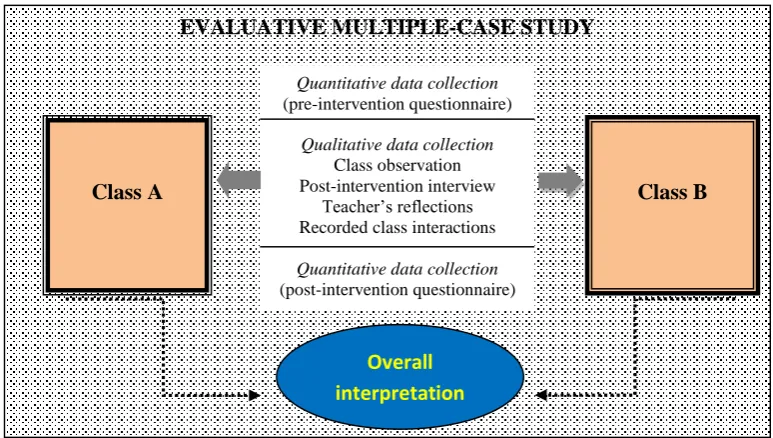
Figure 1 Plan for data collection ... 85
Figure 2 Lessons and learning tasks ... 118
Figure 3 Example of data analysis ... 131
Figure 4 Steps of data elicitation and analysis... 135
Figure 5 Script on describing trends, written by AC Starbucks Group ... 196
Figure 6 Script on company profile, written by AC Mandarin Group ... 209
Figure 7 Script on company profile, written by AC Sony Group ... 214
Figure 8 Presentation introduction, written by HM Mandarin Group ... 218
Figure 9 Presentation introduction, developed by one AC group ... 229
Figure 10 Guidance for future implementation ... 296
LIST OF TABLES Table 1 Task complexity (Robinson, 2001, 2007) and task difficulty (Skehan, 1998) ... 25
Table 2 Categories of tasks (Nunan, 2004; Ellis, 2003) ... 29
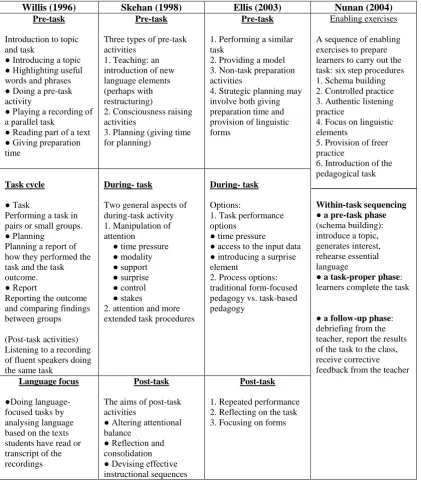
Table 3 Options for task-based implementation ... 32
Table 4 Focus on form during task-based lessons ... 47
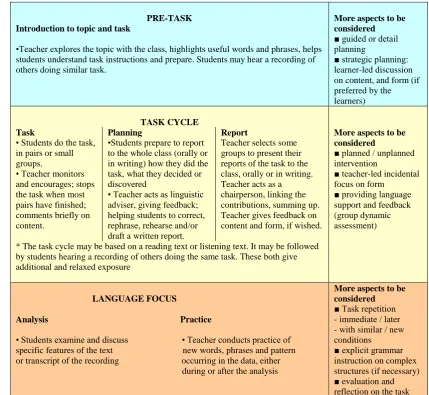
Table 5 Willis’ TBLT framework (with considerations of this study context) ... 49
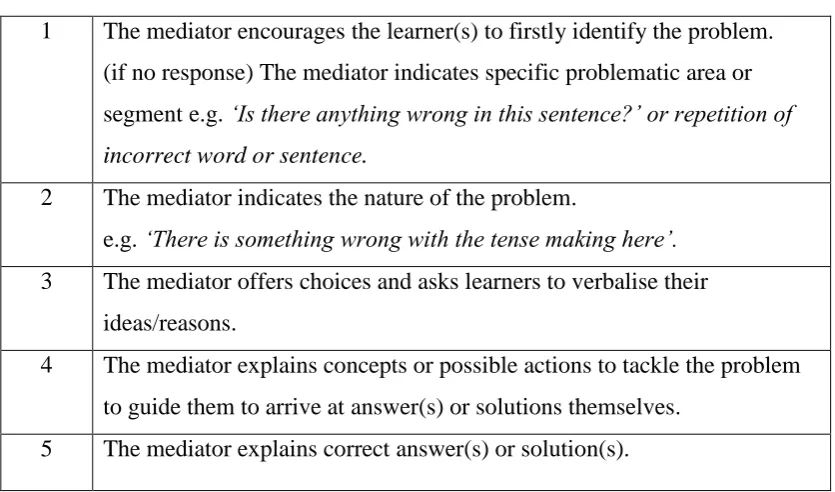
Table 6 Mediation inventory (adapted from Aljaafreh and Lantolf’s, 1994) ... 68
Table 7 Types of data and data collection methods ... 87
Table 8 Types of data for the questionnaire design ... 100
Table 9 Data collection in response to each research question ... 108
Table 10 Timeline of Data collection ... 113
Table 11 Summary of data collection ... 123
Table 12 Summary of key issues and participants’ comments and recommendations for future adjustment ... 247
LIST OF STATISTICAL TABLES
Table 4.1.2a Number of respondents by faculty and gender ... 138
Table 4.1.2b Students’ English proficiency (self-assessment) ... 138
Table 4.1.2c Relationship between students’ English proficiency and TOEIC scores ... 139
Table 4.1.3 Learners’ preferences for and familiarity with focused areas/skills ... 141
Table 4.1.4 Learners’ preferences for and familiarity with oral presentations ... 142
Table 4.1.5 Learners’ preferences for and familiarity with working in groups / pairs / individually... 144
Table 4.1.6 Learners’ preferences for and familiarity with feedback/error correction (mediation) ... 145
Table 4.2.2 Number of respondents by faculty ... 147
Table 4.2.3 Students’ feelings and opinions about lessons and teaching ... 148
Table 4.2.4 Students perceptions of and opinions about the implementation of designed tasks, feedback and TBLT ... 149
Table 4.2.5 Students’ perceptions of and opinions about improvement of skills ... 151
Table 4.2.6 Students’ perceptions of and opinions about improvement of oral presentations ... 152
Table 4.2.7 Students’ perceptions and opinions on individual/pair/group work ... 153
Table 4.2.8 Students’ perceptions of and opinions about feedback (mediation) ... 154
Table 4.3.1 Correlations between teaching focus variables ... 156
Table 4.3.2 Correlations between oral presentations variables ... 158
Table 4.3.3 Correlations between participation modes variables ... 160
ACKNOWLEDGEMENTS
The completion of this thesis would not have been possible without the support and
encouragement of my supervisors, Dr Claudia Harsch and Dr Keith Richards. Their
prompt and constructive feedback helped me progress into the next levels of subject
knowledge and research methodology. In addition to regular tutorials, whenever I
needed further advice or had gotten stuck or lost, they offered additional tutorials for
me to discuss areas of difficulties, and suggested possible solutions. I am deeply
grateful for their guidance, as well as the knowledge and expertise they have shared
with me over the course of my four years at the University of Warwick.
I would also like to extend my appreciation to the funding support for my PhD study
given by The University of the Thai Chamber of Commerce; my colleagues who
kindly devoted their time observing the lessons and giving me feedback on the spot;
and the students who actively participated in this research. I am also thankful to Asst.
Prof. Pornpan Boonpattanaporn, Asst. Prof. Narumol Chantrasupawong, Dr Parichat
Wongsuwan and Aj. Kannika Nitayapakdee for allowing me to use some of the
language handouts they developed.
I would like to dedicate this thesis to my family, especially my parents—with love
DECLARATION
I declare that this thesis is my own work and has not been submitted for a degree,
ABSTRACT
Keywords: TBLT, mediation, business presentations, university students, Thailand
This case study investigates the impact of task-based language teaching (TBLT) and
mediation procedures on the teaching of business presentations at a university in
Thailand. A task-based course was developed, which took into account national and
institutional education policies regarding the development of business-related
knowledge and skills and the limited English proficiency and knowledge of the
business world possessed by the learners. Three core tasks, namely Describing
Company Profiles, Describing Products, and Describing Trends were designed
utilising Willis’ framework (Willis, 1996).
The course was delivered over the course of six sessions to two groups of students (n
= 22 and 25 respectively). Mixed methods data collection techniques were employed
to examine 1) the appropriateness of the designed tasks, 2) the effectiveness of
TBLT, 3) the effectiveness of mediation procedures integrated in task
implementation and 4) suggestions for the improvement of tasks, TBLT and
mediation practices. The data was collected through pre- and post-intervention
questionnaires, observer and student interviews, research journals, class observation
notes, and audio and video recording of class interactions from four observers and
the two groups of students mentioned above.
The qualitative analysis of data focused on participant perceptions of TBLT and
mediation as well as on participant recommendations. The findings indicate both
positive feedback and the existence of a number of critical issues. Participants were
generally satisfied with the use of a wide range of materials and the usefulness of
course content. The most significant participant concerns were related to teaching
and learning conditions, content relevance and coverage, task complexity and
difficulty, task materials, language focus (i.e. vocabulary and grammar teaching),
peer feedback and teacher feedback, peer engagement as well as teacher mediation.
Implications are also discussed, particularly the greater incorporation of explicit
grammar teaching and the increase in number of teaching hours to allow for
ABBREVIATIONS
AC Accountancy students
AEC Asian Economic Community
ASEAN Association of South East Asian Nations
CD Compact Disc
CLT Communicative Language Teaching
CR Consciousness-raising
CTBS Collaborative Task-based Syllabus
DA Dynamic Assessment
EFL English as a Foreign Language
ELT English Language Teaching
EP Enrichment Program
Eng.3 English for Communication 3
ESP English for Specific Purposes
G-DA Group Dynamic Assessment
HM Humanities students
ICELP International Center for Enchantment of Learning Potential
M Mean (statistics)
MLE Mediated Learning Experience
MP3 Moving Picture Experts Group Layer-3 (audio recorder)
Osv Observer
Post28 Post-Intervention Questionnaire (item 28)
PPP Presentation, Practice, Production
Pre02 Pre-Intervention Questionnaire (item 02)
SCT Socio-Cultural Theory
SLA Second Language Acquisition
TBI Task-based Instruction
TBL Task-based Learning
TBLL Task-based Language Learning
TBLT Task-based Language Teaching
TBT Task-based Teaching
TOEIC Test of English for International Communication
TSLT Task-supported Learning and Teaching
VDO Video
CHAPTER 1
INTRODUCTION
The mismatch between the demand for developing Thai learners’ job-related
knowledge and language skills and the provision and practices of English language
teaching in Thailand has inspired me to explore teaching methods that would better
accommodate the specific needs of Thai learners. Lack of capacity to communicate
in English and insufficient, out-of-date professional knowledge and skills put the
Thai workforce in a challenging position in a regional job market growing
increasingly more competitive. The cooperation initiatives of the ASEAN
(Association of South East Asian Nations) Economic Community, or AEC, which
include free movement of skilled labour (The ASEAN Secretariat,
http://www.asean.org/communities/asean-economic-community), have brought benefits to Thai workers, but also concerns, particularly related to language abilities.
It seems language is a major barrier to job application and communication at work.
The conference ‘ASEAN Towards 2015 and Beyond’ revealed that the lack of
managerial and language skills is the main weakness for most Thai workers. This is
in line with results of surveys showing that the English proficiency of Thai learners
at all levels of education falls well below an acceptable standard. Primary and
secondary level learners failed to acquire adequate writing skills (Office of
Educational Testing, 1999a, 1999b, cited in Wongsothorn et al, 2002), and university
learners demonstrated unsatisfactory performance in English (Wiriyachitra, 2002).
Another survey of Thais’ English language proficiency, based on average TOEFL
scores of Asian populations, indicated that Thailand was ranked 54th, while
proficiency of Thai learners, along with other contextual challenges faced by
teachers and learners, have always been discussed among Thai and foreign educators
teaching in Thailand. Various problems have been identified, such as large class
sizes; lack of budget and resources, teachers’ lack of confidence in spoken and
written English, over-emphasis on listening and reading in university entrance
examinations, teacher-centred instruction, and so on (Biyaem, 1997; Wiriyachitra,
2002; Wongsothorn et al, 2002).
Attempting to resolve the shortcomings of both professional and English skills of
Thai learners, the Thai government has urged all educational sectors to put teaching
of English – and other foreign languages – into immediate plans for educational
reform. One of the key programmes of the reform is to promote improvement in Thai
teachers’ subject knowledge and teaching methods by considering new methods in
teaching practices, classroom management and professional development (Bureau of
International Cooperation and activeMinds Consulting, 2008). In the higher
education sector specifically, the development of high quality and standards in
academic and professional services to enhance up-to-date knowledge and skills
required in manufacturing and services sector are highlighted in education policies
and plans (ibid.). In response to this, universities have reformulated their policies and
geared their teaching towards developing learners’ language and professional skills.
The shift in integrating both language and professional skills to assist learners in
achieving the required communication and work skills has led to changes in
tertiary-level curricula. In particular, at the Business English Department of the University of
the Thai Chamber of Commerce, of which I am a member of the teaching staff, the
1, 2 and 3 have been designated compulsory subjects for all students. The content
area of the study reported here relates to the module on presentation skills, a part of
the English for Communication 3 course, in which Get Ready for Business Book 2
(Vaughan and Zemach, 2009) is used as a set coursebook. However, most teachers
comment that the coursebook offers only basic language and skill practice for the
presentation module, which is insufficient if fundamental knowledge and
presentation skills are expected from new graduates in their future jobs. Specific
contextual situations, particularly learners’ limited knowledge of English language
and business practices and the teachers’ familiarity with grammar-oriented and
lecture-based teaching methods rather than communicative approaches, also signal a
demand for the adjustments in teaching methods.
As in the results of surveys of Thai learners’ English proficiency, reported above, the
majority of learners’ English abilities at my institution range between elementary
and pre-intermediate levels. At the outset of my research, I shared with all the
teachers involved similar opinions on the limitations of learner proficiency and
business knowledge, which would inform the design and implementation of tasks
and teaching in the study itself and represent an opportunity to try out mediation
techniques, which I will elaborate below. In terms of teaching methods adopted at
my institution, especially in English for Communication classes, lecture-based
teaching has always been a common practice, with the emphasis on introducing and
explaining new business concepts and relevant language, including vocabulary and
grammatical structures. As a result, there is little chance for communication practice.
To reiterate, Thai learners’ lack of skills in language, everyday communication and
insufficient integration of business content and practices in curricula, calls for
attention at both national and institutional levels. I believe that the incorporation of
task-based language teaching (TBLT) and mediation into the teaching of business
presentations has the potential not only to fulfil the learning needs of Thai learners,
but also to offer a unified approach involving TBLT and mediation that represents an
alternative methodology that may help lessen or resolve challenges faced by Thai
teachers, as well as those in other contexts. In other words, it is hoped that this
task-based course will benefit learners and teachers in three respects: 1) the enhancement
of learners’ business presentation knowledge and skills for their future careers; 2) the
improvement of learners’ understandings of business and language concepts and
usage; and 3) the provision of insights on practical and impractical aspects of TBLT
and mediation.
The first aim, of enriching learners’ business presentation skills, responds to the
demands in the job markets as noted in the Thai education policy agenda.
Presentations can be varied in terms of topics, styles and arrangements (e.g. internal,
external, formal, informal). For new graduates, it is likely that presenting basic
company backgrounds and some descriptions of main products in informal settings
would be expected. This corresponds with the content of various business English
coursebooks, which mostly focus on presenting the company profile and products.
The coursebooks I consulted included Effective Presentations (Comfort, 1995),
Business Objectives (Hollett, 1996) and Communicating in Business (Sweeney, 2004). Lecturers at the School of Business Administration also confirmed that these
topics are of importance. Although the content areas may not be identical to those
their presentation skills and knowledge of useful expressions frequently used in most
presentations will enable learners to apply the skills and knowledge they have learnt
when drawing on other content areas. Therefore, the tasks designed specifically for
this study focus on developing these skills by covering three key topics for
presentations: 1) Describing Company Profiles, 2) Describing Products, and 3)
Describing Business Situations (Trends). After this study, these tasks will be refined
(if needed) and compiled into an elective module or a training session offered to
learners after their completion of English for Communication 3.
The second aim, the improvement of learners’ communication and understanding of
business and language concepts and usage, can be achieved by engaging learners in
TBLT and mediation. A review of the literature on TBLT has led to my decision to
follow TBLT practice and procedures because of its emphasis on communication
and meanings over the learning of structures (e.g. Willis, 1996; Skehan, 1998;
Bygate et al, 2001; Ellis, 2003). TBLT encourages learners to work towards a goal,
i.e., the task expected outcomes, which fits well with the requirements of business
presentations teaching. In each task, e.g. Describing Company Profiles and
Describing Company Products, the expected task outcomes, which are learners
developing a script and giving a presentation based on their script, will be clearly
explained to students. It will require a lot of effort to try to achieve these
pre-determined outcomes. In terms of mediation, a review of literature has led to my
belief that combining mediation and TBLT would be useful, especially for learners
who have limited English proficiency and business knowledge. Mediation provided
during interactions between the teacher (myself) and learners helps the teacher
on their own, and then with the teacher’s prompts and suggestions (Haywood and
Lizd, 2007; Poehner, 2008, 2009; Grigorenko, 2009; and Lantolf and Poehner, 2011,
2005). This has the potential to facilitate in-depth learning of business concepts and
language functions.
Importantly, incorporating both TBLT and mediation into task implementation can
offer teachers insights on the practicality of these methods, as both practical and
impractical aspects of TBLT and mediation will be explored in this study. The
observers and learners’ feedback, as well as my reflections after implementation, can
provide teachers with fundamental points in considering whether to adopt or
integrate tasks, TBLT and mediation in their own classroom teaching or not. Thus,
teachers who are looking for alternative approaches may find the results reported in
this study beneficial.
This study covers different areas than that of McDonough and Chaikitmongkol
(2007) – a prominent task-based study in the Thai context that reported learners and
teachers’ positive reactions and attitudes to TBLT. They examined whether a TBLT
course promoted independent learning and addressed realistic academic needs.
Feedback received from both groups indicated that time was needed for the
adjustment to TBLT, that learners had expectations of receiving more support and
feedback, and that materials could have been managed better. The main differences
between the present study and McDonough and Chaikitmongkol (2007)’s are that
this study integrates mediation into task implementation as described above and that
the design of different tasks is centred around business presentations rather than
various content areas such as Thai culture, social and environmental problems and
Chaikitmongkol recommend a wide range of areas to focus on in future research, and
three of them are particularly relevant to this study. These include 1) how TBLT can
be adapted to optimise learning outcomes in a wide variety of instructional contexts;
2) how second language teachers perceive their roles in task-based approaches and
how their perceptions influence their classroom practices; and 3) what teacher can do
to help learners recognise the learning opportunities available in task-based courses.
In the first and third aspects, the combination of TBLT and mediation in task-based
teaching would offer new perspectives on a balance between communication practice
and linguistic focus through interactions and mediation. Encouraging learners to find
out mistakes and answers through mediation should promote learner autonomy. In
response to the second aspect, inviting teachers to observe lessons in this study
enables the investigation of their perceptions of TBLT and mediation practices.
To reiterate, the principal aim of this research is to examine the effectiveness of
TBLT and mediation as perceived by learners, observers, and myself. This includes
seeking their suggestions for future improvement of the tasks and teaching. With
these purposes in mind, four research questions have been formed to guide this
project:
1. Are the designed tasks appropriate for the teaching of basic business
presentations in a Thai university context?
2. To what extent is the implementation of TBLT perceived by relevant parties
to be effective for the teaching of business presentations?
3. What evidence is there, if any, that mediation procedures can be successfully
4. What suggestions, if any, do learners and teacher-observers have for the
improvement of tasks, TBLT and mediation practices?
To answer these questions, a mixed-method evaluative multiple case study will be
carried out by inviting learners and teacher-observers to give feedback and
recommendations for improvement through questionnaires, class observation and
interviews. As both teacher and researcher, I will keep a research journal to record
problems that emerge, successes and areas that should be improved. All lessons will
also be recorded to enable the analysis of learners’ engagement, interaction and
responses during the tasks and mediation phases.
This thesis is organised as follows: after this Introduction, Chapter Two (Literature
Review) provides a summary of relevant literature and previous studies of both
TBLT and mediation practice based on various DA studies. Chapter Three (Research
Methodology) presents theoretical foundations of multiple case study and
mixed-methods data collection, and data collection and data analysis procedures. Chapter
Four (Results of Pre- and Post-Intervention Questionnaire Analysis) summarises
findings from the questionnaires. Chapter Five reports research findings, and
important issues are discussed in the Chapter Six (Discussion). Chapter Seven
(Implications and Conclusion) discusses the implications of this study with
CHAPTER 2
LITERATURE REVIEW
Introduction
This literature review focuses on task-based language teaching (henceforth, TBLT),
and mediation practice, which concepts constitute the two main areas under the
purview of the study. The areas connect with each other as mediation procedures will
be integrated within TBLT implementation. Details of concepts, characteristics,
rationale and applications of TBLT and of mediation practice are covered in Section
1 and in Section 2 respectively.
2.1 Task-based language teaching
The following review covers seven important aspects of TBLT: 1) a summary of
definitions, rationale, and the use of tasks in three types of intervention; 2) task
design and sequencing; 3) task components and task types; 4) TBLT
implementation; 5) TBLT in business teaching contexts; 6) the justification for
selection of TBLT as a teaching approach, and 7) the selected TBLT model used in
this study.
2.1.1 Definitions, rationale, and the use of tasks in three types of intervention
Varying definitions of ‘task’ have led to misunderstandings and uncertainties
amongst teachers about what approaches are adopted in TBLT (Littlewood, 2007;
Ellis, 2009a). As TBLT is not the only form of intervention to employ tasks in
teaching, the discussion also takes into account task-referenced learning and
2.1.1.1 Definitions of ‘task’
Widespread interest in TBLT has produced not only an extensive literature on the
subject but also different perceptions of what counts as a task (Littlewood, 2007). A
key distinction has been made between tasks and exercises (Nunan, 1999; Ellis,
2003). Based on the Hong Kong curriculum for English (1999, cited in Littlewood,
2007), Littlewood (2007, p. 247) comments that the status of activities is unclear and
suggests that tasks refer to activities that provide purposeful contexts for learning
and using English for meaningful communication while exercises are ‘activities in
which [learners] focus upon and practise specific elements of knowledge, skills and
strategies needed for the task’. In this sense, according to Littlewood (2007),
activities contain an element of ‘meaningful communication, but the purpose is also
to practise specific linguistic elements’.
Inconsistent use of terms and acronyms associated with task-based learning, such as
TBLT, TBL, TBT, TBI, and TBLL has also created varying interpretations of what
constitutes a ‘task’ and what task-based teaching entails. Shehadeh (2005) notes that
some of the differences in definition are due to academics having approached tasks
from different perspectives and for different purposes. Bygate et al (2001), for
example, suggest viewing tasks in the context of use rather than in terms of how they
have been investigated. Ellis (2003) agrees with this view pointing out that although
what constitutes a task is context dependent a generalised definition is still needed to
identify essential commonalities in tasks. However, whether the task is considered
‘an activity’, ‘a piece of classroom work’, or ‘a workplan’ there are three key
1) a focus on meaning (not language or form);
2) real-world language use;
3) goal-oriented nature of tasks with a need to work towards outcome.
Most educators seem to agree that an emphasis on meaning is an important aspect of
task (Nunan, 1989; Skehan, 1998; Bygate et al, 2001; Ellis, 2003; Willis and Willis,
2007). But the question arises as to what is meant by a focus on meaning. Willis and
Willis (2007) distinguish between a focus on meaning, a focus on language, and a
focus on form (or ‘forms’ as defined by Long (1988). They clarify that a focus on
meaning is indicated when the learners are concerned with communication, while a
focus on language occurs when the learners pause to think how best to express what
they want to say with teachers’ facilitation if needed, and a focus on form is
discernible when isolated lexical or grammatical forms are taught.
Ellis (2003) suggests that a task should engage learners in using language
pragmatically rather than in displaying language aimed at developing second
language proficiency through communicating. Nunan (2004) offers a slightly
different perspective, which places an emphasis on both meaning and form and is
premised upon the understanding that meaning and form are highly interrelated. This
interconnectedness implies that grammatical knowledge will help learners to express
different communicative meanings. Nevertheless, since knowledge about language is
essential in order to achieve successful communication, it seems clear that both
meaning and form need to be enhanced.
Willis and Willis (2007) illustrate how the task relates to real world activities at three
levels. At the level of meaning, learners engage in producing meanings by using
under discussion. At a discourse level, learners practise discourse used in everyday
life when expressing ideas and initiating arguments. The highest level of activity is
reached when learners engage in an activity that resembles one occurring in the real
world. It could be difficult to design a task to achieve this level, but level 1
(meaning) and level 2 (discourse) should be aimed at, in order to create a useful and
motivating task.
Another key aspect of task is that goal and outcome are likely to be connected. Ellis
(2003) argues that a task should have a clearly defined communicative outcome. The
non-linguistic outcome of the task serves as the goal of the activity, whereas the
stated outcome of a task serves as the means for determining the completion of the
task. Willis and Willis (2007) and Skehan (1998) distinguish between goal and
outcome in which learners use the target language for communicative purpose (goal)
and task completion is set up as an outcome in this regard. All tasks must have
specified objectives that require learners to achieve something so that they are
goal-oriented.
From a pedagogic viewpoint, it is apparent that Ellis’ definition of task includes
more aspects than those of the others, as it requires learners to be engaged in
cognitive processes and practice in the four language skills. In his view, cognitive
processes such as selecting, classifying, reasoning and evaluating information are
believed to influence a range of linguistic resources needed for task completion but
not the choice of forms, which are determined by the user. In addition, a task can
involve any of the four language skills and may require dialogic or monologic
language use. As such, Ellis claims that they are not different from exercises. In
However, if the term ‘exercises’ is specifically concerned with ‘practice’, I find
myself in disagreement with Ellis’ idea because tasks involve various forms of
learning. The term ‘activities’ rather than ‘exercises’ seems to be more related to
‘tasks’, and I prefer to use the former term to refer to a group of activities that the
learners carry out, in order to achieve the assigned tasks.
Samuda and Bygate (2008) argue that it is inadequate to define task as a workplan
because this refers only to the teacher’s pedagogical intentions, rather than what
actually happens in real practice. If a task involves real-world processes of language
use and engages cognitive processes as proposed, the processes that occur when
learners engage in it must also be specified. In other words, ‘task’ should refer to
both dimensions of workplan and of process. Under these circumstances, task is
redefined as a holistic type of pedagogical activity and the general features of a task
for second language learning are summarised (Samuda and Bygate, 2008: 13). These
features of a task are given below:
1. It involves holistic language use.
2. It requires a meaningful target outcome or outcomes.
3. It necessarily involves some individual and group processes.
4. It depends on there being some input material.
5. It is made up of different phases.
6. It is important for teachers – and at some point for learners – to know
what is being targeted in the language learning purpose.
7. The conditions under which it is implemented have an impact on process
8. It can be used for different pedagogic purposes at different stages of
learning.
In order to design good tasks, teachers need to consider various factors, as stated in
the aspects of task as a workplan and task as a process discussed above. Some of
these aspects can be pre-planned when designing tasks.
2.1.1.2 Definitions and rationale for TBLT
Most methodologists view TBLT as an integral element of the curriculum and
instruction. Samuda and Bygate (2008) define TBLT as covering aspects from
curriculum to assessment. In their view, TBLT refers to contexts where tasks are the
central unit of instruction driving the classroom, defining curriculum and syllabus,
and determining modes of assessment. It has also been pointed out that ‘a task-based
approach sees the learning process as one of learning through doing – it is by
primarily engage in meaning that the learners’ system is encouraged to develop’
(Skehan, 1996:20).
There are three main reasons to justify task-based instruction as an effective
approach. Firstly, task-based instruction involves holistic language learning. Van den
Branden (2006) states that task-based syllabuses do not segment language into
different elements but take holistic, functional and communicative ‘tasks’ as the
basic unit for the design of activity. From a task-in-process point of view, Samuda
and Bygate (2008) point out that in order to complete the task the learners have to
engage in a number of different phases in which different strategies are used. From
these two aspects, it can be concluded that task-based instruction emphasises holistic
learning of language content as well as learning strategies. Secondly, in relevance to
language in meaningful contexts that link to real-world situations. By definition,
tasks have some relationship with real-world language needs. Due to this, Long and
Crookes (1992) suggest conducting a needs analysis to identify the real-world target
tasks before designing pedagogical tasks.
Another reason relates to second language acquisition (SLA) research. Willis (1996)
states that the vaunted value of TBL is the opportunity for exposure to rich
comprehensible input e.g. teacher talk, listening to recordings and reading texts and
real use of language. When learners use the language to express meanings, they have
chances to experiment and test hypotheses. In attempting to achieve outcomes, they
engage in the task themselves, so they have the motivation to listen and read.
Furthermore, a focus on language in the final stage of Willis’ framework will prevent
fossilisation and challenge individuals to improve. During the consciousness-raising
activities, the learners are free to work individually and at their own pace. Thus, they
do not feel they are being forced to learn or practise pre-selected structures planned
by a teacher or those listed in a textbook. Indeed, ‘tasks are supposed to elicit the
kinds of communicative behaviour (such as the negotiation for meaning) that
naturally arises from performing real-life language tasks because these are believed
to foster language acquisition according to the SLA theories’ (Van den Branden,
2006:9).
In brief, the three main reasons discussed above reflect the fact that TBLT promotes
holistic meaningful language use, in which pedagogic tasks are designed to resemble
real-life situations. This makes this approach different from conventional approaches
in some ways. Significantly, it marks a shift from the learning and practising of
learner-led learning. If tasks are effectively designed and implemented in teaching, it could
be said that task-based instruction promotes learner-led, self-directed learning as
several skills have the potential to be developed.
2.1.1.3 Tasks used in three types of intervention
As stated previously, the use of tasks is varied, and there are at least three forms of
teaching intervention identified by methodologists (Samuda and Bygate, 2008; Ellis,
2003). The first aspect is task-based language teaching (TBLT) as described in the
first part of this section. In TBLT, tasks are seen as the central unit of instruction not
as linguistics elements. This does not mean that TBLT rejects the learning of
linguistic forms, but instead of focusing solely on a study of forms as in traditional
syllabuses, TBLT incorporates a focus on form in which the forms are studied in
meaningful contexts. Ellis (2003) considers TBLT as a strong version of
communicative language teaching in which a course is designed around tasks, and
tasks are treated as unit of teaching.
The second feature is task-referenced learning and teaching, which is associated
more with an outcomes-based approach than task-based teaching in terms of its
concept and function. Bygate (2000) characterises the term ‘task-referenced’ for
contexts in which tasks are used for assessment and setting achievement targets that
are unlikely to be used in teaching. Curriculum and achievement are defined around
a set of pre-determined target tasks. Learners are assessed on ‘competencies’ or
‘attainment targets’; therefore, teaching is not restricted only to task-based approach,
Another form of instruction is task-supported learning and teaching (TSLT), which
is regarded as a weak form compared to TBLT. It resembles TBLT in that tasks are
used as a key element but not as a single element; instead, they are used alongside
other activities from conventional approaches. Thus, they are only one of several
elements in the syllabus. Furthermore, in TSLT it is not necessary that tasks should
be used for assessment purposes (Samuda and Bygate, 2008). Ellis (2003) notes that
TSLT and TBLT are distinguished in terms of function. Tasks in TSLT are used for
providing communicative practice of linguistic items, whereas in TBLT tasks are
used as a means for the learners to learn a language by experiencing how these occur
in communication.
2.1.2 Task design and sequencing
Tasks can be designed and sequenced in various ways based on their theoretical
foundations, and the purposes for which they are intended. Each proposal has its own
focus and set of proposed criteria. Robinson (2001) concludes that there are three
theories that form the foundations for task classification and sequencing: skills
hypothesis, capacity hypothesis, and cognition hypothesis. Regarding skills
hypothesis, Robinson (2001:21) concludes that there is a proposal for adding a
‘processing dimension’ to the linguistic criteria used in grading and sequencing tasks
so as to facilitate the skills learning of content identified in a language-based needs
analysis. Johnson (1996, cited in Robinson, 2001:21) claims that functions,
structures and linguistic units need to be presented to learners in sequences of
activities (called tasks) that facilitate the automatisation of declarative knowledge of
the forms. In order to shift learners’ attention from forms to tasks, more demanding
Skehan (1998: 97) contends that ‘more demanding tasks require more attentional
resources […] with the result that less attention is available for focus on form’.
Briefly, more complex tasks require more attention to content, and thus lead to less
attention on form. Therefore, tasks should be sequenced from less to more
cognitively intensive for allocation of attention to language form. According to this
theory, tasks are sequenced by considering levels of difficulty. Robinson (2001:22)
explains that a ‘cognition hypothesis assumes behaviour descriptions of target tasks
for populations of learners are the starting point for pedagogic design, and task
complexity is the sole basis of task sequencing’. As there is a clear distinction
between concepts of the last two theories, tasks can be sequenced using two sets of
variables. The levels of difficulty according to the capacity hypothesis are
determined by three factors: code complexity, cognitive complexity, and
communicative stress, whereas task complexity specified by the cognition
hypothesis is increased when resource-dispersing and resource-directing variables
increase in complexity.
Because this research involves task design and implementation and learners’
perceptions of the designed tasks and TBLT, it will combine the capacity hypothesis
and the cognitive hypothesis theories as general guidelines for task design and
sequencing. Thus, aspects of task difficulty (Skehan, 1998) and task complexity
(Robinson, 2001) will be combined within a single framework. It is expected that
coverage of one aspect that focuses on both linguistic and cognitive factors (task
difficulty) and another on cognitive variables (task complexity) will result in
discussion of relevant concepts and frameworks proposed by Robinson (2001) and
Skehan (1998) with the latter including some aspects suggested by Candlin (1987).
2.1.2.1 Triadic Componential framework
According to the Triadic Componential Framework (Robinson, 2001), task
performance and learning are influenced by three main groups of factors: task
complexity, task conditions and task difficulty. Although they are bound to affect
performance outcomes, only variables of task complexity can be decided and
planned in advance by a task designer. The other elements of task conditions and
task difficulty are considered unpredictable, as they are affective and involve ability
variables that depend on individuals rather than on tasks such as motivation, anxiety,
aptitude, and proficiency. Robinson (ibid.) points out that one challenge in
specifying criteria for sequencing tasks is the need to avoid definitions and scope of
task complexity as well as task difficulty, as these are too wide and loosely defined.
This is exacerbated by the fact that the two terms are often used interchangeably.
Another problem arises over which factors actually influence task complexity and
task difficulty as there seems to be a wide range of factors involved i.e. cognitive,
affective, linguistics, interactional, experiential, and others. To remove any possible
ambiguity, Robinson (2001) distinguishes between the two terms and describes their
influence on task performance separately.
Task complexity comprises resource-directing (e.g. +/-few elements,
+/-here-and-now) and resource depleting (e.g. +/-planning, +/-prior knowledge). These elements,
which can be designed before the course starts to increase or lessen cognitive
demands of tasks, require different levels of attentional focus, working memory and
cognitive demands than the others. It has also been shown by several studies that
availability of planning time has beneficial effects on learner performance (Foster
and Skehan, 1996; Ortega, 1999; Philp et al, 2006) so this factor also needs to be
borne in mind. Robinson (2001:30) further states that ‘the cognitively simpler, less
resource demanding task will involve a lower error rate, and/or be completed faster,
and be less susceptible to interference from completing tasks than the more complex
task’.
Task conditions or ‘interactive demands of tasks’ are not concerned with any learner
factors or task factors but with participation as to whether information goes one way,
or two ways, and whether a solution is closed or open. Participant variables
particularly gender, familiarity with one another and power are also influential
factors. However, Robinson (2001) suggests that task conditions are unlikely to be a
useful basis for sequencing decisions because they tend to be specified on the basis
of a needs analysis. Although a small-scale needs analysis may be conducted before
the course in this project to investigate the learners’ learning and teaching
preferences including aspects of their background, the results will not be used to
determine criteria for task sequencing.
Robinson (2001) distinguishes between task difficulty and task complexity by
concluding that while task complexity helps explain ‘within’ learner variations in
performance on any two tasks, task difficulty helps explain variations in task
performance ‘between any two learners’. This is because different learners have
different perceptions of the demands of the tasks, which are largely determined by
both their affective and ability variables. Different levels of anxiety, confidence and
(1997) suggest that although it is difficult for teachers to predict the effects of tasks
on these affective variables, the latter are important to on-line methodological
decisions. Teachers should take these factors into account when pairing or grouping
students. As this study will incorporate all relevant cognitive demands, language
demands and performance conditions for task design and sequencing, the decision
criteria will be based on the task complexity proposed by Robinson (2001) and task
difficulty proposed by Skehan (1998). In light of Robinson’s observation that
affective and ability variables cannot be predicted, task difficulty (as in Triadic
framework) will not be considered.
2.1.2.2 Task dimensions and task difficulty
In terms of a relationship between syllabus and tasks, Candlin (1987) points out that
each syllabus type (e.g. a syllabus of learning, of content, of actions) has its own
demands on the design and operation of learning tasks. Learning demands are based
on the assumption that learners differ from one another in terms of intelligence,
language ability, motivation, and needs. These differences will impose conditions on
task design that should enhance their learning. Content demands, which refer to both
knowledge and procedures required for the development of communicative
competence need to be specified when designing the tasks. Action demands concern
arrangements of a variety of classroom activities that encourage learners to respond,
explore, experiment, and to take part in purposeful communication with their
classmates.
Candlin (1987) and Skehan (1998) consider task difficulty to be based on linguistic
and cognitive dimensions. Candlin (1987) proposes criteria for task design and
particularity and generalisability, code complexity and interpretive density, content
continuity, and process continuity. Other researchers (Robinson, 2001; Skehan,
1998; Long, 1989) hold that although the criteria proposed by Candlin (1987) are
useful in some ways, they do not suggest clear guidelines to syllabus and task
designers on the designing and sequencing of tasks.
In order to provide clearer guidelines, Skehan (1998) proposes criteria for an
analysis of task difficulty that include some elements suggested by Candlin (1987)
but groups them into higher-order categories. The new categories consist of code
complexity, cognitive complexity, and communicative stress. It is claimed that the
three categories reflect the language, the thinking and the performance conditions
needed for a task (Skehan, 1998). Code complexity or ‘code complexity and
interpretative density’ in Candlin’s definition concerns linguistic complexity and
variety, vocabulary load and variety, and redundancy and density. Density refers to
complexity of operations, which need to be performed on such a code. Cognitive
complexity divides into cognitive familiarity and cognitive processing or cognitive
load. Skehan (1998) distinguishes between these two cognition aspects. Cognitive
familiarity involves a capacity to access ‘packaged’ solutions to tasks whereas
cognitive processing is understood as the need to work out solutions to novel
problems ‘on-line’.
Skehan (1998:100) clarifies the term cognitive familiarity by saying that ‘the task
requires existing, well-organised ‘chunks’ of knowledge to be retrieved and
mobilised for task performance. It is assumed that attentional resources are not
particularly stretched, and there is scope for a focus on form (VanPattern, 1994 cited
predictability (availability of organised background knowledge), discourse genre
(availability of macrostructures), and the task, which refers to jigsaw tasks,
decision-making tasks, and riddles in which unfamiliar tasks are less predictable than familiar
ones.
It is further noted that ‘[for cognitive processing] elements of tasks are easy to
handle, but there is significant difficulty in manipulating them to achieve a solution
that the task requires’ (ibid, 1998). The involvement of cognitive processing signifies
that there is less attention left to focus on form. The first area of cognitive processing
concerns information organisation, referring to naturalness with which information
relevant to task is structured. On the other hand, the amount of computation relates
to the degree of transformation or manipulation of information that is necessary for a
task to be completed. Another aspect of cognitive processing is clarity and
sufficiency of information. It concerns directness with which information is made
available for learners together with the extent to which inferences need to be made.
Finally, information type is based on contrasts such as concrete-abstract,
static-dynamic, contextualised-decontextualised (Brown et al, 1984 cited in Skehan, 1998).
The third category that influences task difficulty is communicative stress. Candlin
(1987) states that more stressful tasks are those with pressure that comes from
interlocutors such as their native-like proficiency, superior knowledge or
proficiency. According to Skehan (1998), communicative stress is caused by time
limits and time pressure, speed of presentation, number of participants, length of text
used, types of response, and opportunities to control interaction. He notes that the
urgency of tasks needing completion and learner perception of pressure are factors,
Skehan (1996) argues that the difficulty of tasks can be analysed using two general
categories, namely language factors and cognitive factors. Language factors consist
of syntactic complexity and range as well as lexical complexity and range. These two
elements mainly concern ranges of structures and vocabulary. The cognitive factors
comprise four elements. Familiarity of material in the task is based on whether the
task requires learners to produce well-organised language from memory in
ready-organised chunks or whether it requires to be drawn on new or less-ready-organised
material. Nature of material refers to whether it is abstract or concrete as when
real-world referents are involved or whether learners have to deal with generalizations.
Reasoning operations required is based on conditions in which the task requires a
number of mental operations for its completion with material involved needing to be
transformed or manipulated in some way. The final factor is a degree of structuring
contained. This raises the question as to whether there is inherent structure involved
because of the requirements of a task e.g. a narrative in which beginning, middle and
end are reasonably clear, or a description based on some clear underlying schema
(Skehan, 1996:23).
As the groups of learners participating in the study have little prior knowledge about
business practices, it is essential that tasks and teaching materials used for TBT in
this project are designed and graded carefully according to the description of the
language factors and cognitive factors delineated above. Task-based lessons should
be sequenced from easy/simple structures and vocabulary to more difficult/complex
ones, and from the less demanding tasks to the higher
reasoning-demanding ones. Because the content of the course is partly determined by a
predicted. It is therefore possible that syntactic and lexical complexity as well as
other cognitive elements can be analysed and sequenced according to the levels of
difficulty.
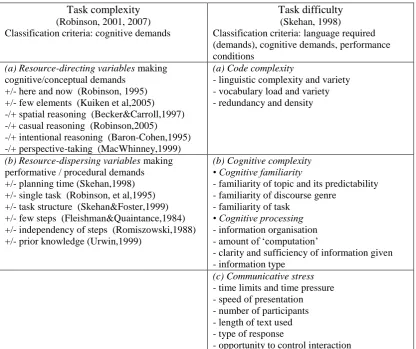
Task complexity (Robinson, 2001, 2007) Classification criteria: cognitive demands
Task difficulty (Skehan, 1998)
Classification criteria: language required (demands), cognitive demands, performance conditions
(a) Resource-directing variables making cognitive/conceptual demands
+/- here and now (Robinson, 1995) +/- few elements (Kuiken et al,2005) -/+ spatial reasoning (Becker&Carroll,1997) -/+ casual reasoning (Robinson,2005)
-/+ intentional reasoning (Baron-Cohen,1995) -/+ perspective-taking (MacWhinney,1999)
(a) Code complexity
- linguistic complexity and variety - vocabulary load and variety - redundancy and density
(b) Resource-dispersing variables making performative / procedural demands +/- planning time (Skehan,1998) +/- single task (Robinson, et al,1995) +/- task structure (Skehan&Foster,1999) +/- few steps (Fleishman&Quaintance,1984) +/- independency of steps (Romiszowski,1988) +/- prior knowledge (Urwin,1999)
(b) Cognitive complexity • Cognitive familiarity
- familiarity of topic and its predictability - familiarity of discourse genre
- familiarity of task • Cognitive processing - information organisation - amount of ‘computation’
- clarity and sufficiency of information given - information type
(c) Communicative stress - time limits and time pressure - speed of presentation - number of participants - length of text used - type of response
[image:41.595.114.531.180.529.2]- opportunity to control interaction
Table 1 Task complexity (Robinson, 2001, 2007) and task difficulty (Skehan, 1998)
Although various researchers have proposed different ways of grading and
sequencing tasks (e.g. Ellis, 2003; Nunan, 2004), this research intends to combine
aspects of task complexity (Robinson, 2001) and task difficulty (Skehan, 1998) as a
framework for task design and sequencing. This is because selecting the two models
will lead to an emphasis on both cognitive and linguistics criteria shown in Table 1
above. The table demonstrates how Robinson (2007) incorporates cognitive factors
2.1.3 Task components and task types
There are various components of tasks and task types. Nijmegen &Holland (1985,
cited in Candlin, 1987) summarise criteria for ‘good’ language learning tasks in
terms of nine vital qualities, which require that tasks are balanced, motivating,
co-operative, strategic, differentiated, focused, open, structured, and critical. To be
motivating, tasks need to be interesting, challenging, rewarding, valuable, and
require participation. To be focused, tasks must be unambiguous, targeted, and
relevant to the needs and goals of learners. This reflects the fact that tasks are not
designed without specific purposes or goals and highlights the importance of
learning goals, which must be relevant to learner needs and learner goals as
described in the ‘focused’ criterion.
Researchers agree that goals are one of the components of tasks with others being
input, roles, settings, monitoring, and procedures (Candlin, 1987; Ellis, 2003; Nunan,
2004). However, there also seems to be general agreement among researchers that
only three of these are essential, namely, goals, input, and procedures. Nunan
(2004:41) believes that goals are important since they provide a link between tasks
and a broader curriculum. He concludes that ‘goals are general intentions behind any
learning task, [that] may relate to a range of general outcomes such as
communicative, affective or cognitive, or may describe teacher or learner
behaviour’. It is possible that a complex task may have more than one goal. Candlin
(1987) uses slightly different terms, for instance, ‘outcomes’ referring to goals and
‘actions’ referring to procedures, but they carry the same meanings. Ellis (2003)
defines goals as the general purposes of the tasks arguing that goals can be specified