warwick.ac.uk/lib-publications
Original citation:
Scoboria, A., Wade, Kimberley A. , Lindsay, D. S. , Azad, T., Strange, D., Ost, J. and Hyman, I. E.. (2016) A mega-analysis of memory reports from eight peer-reviewed false memory implantation studies. Memory, 25 (2). pp. 146-163.
Permanent WRAP URL:
http://wrap.warwick.ac.uk/83729 Copyright and reuse:
The Warwick Research Archive Portal (WRAP) makes this work by researchers of the University of Warwick available open access under the following conditions. Copyright © and all moral rights to the version of the paper presented here belong to the individual author(s) and/or other copyright owners. To the extent reasonable and practicable the material made available in WRAP has been checked for eligibility before being made available.
Copies of full items can be used for personal research or study, educational, or not-for profit purposes without prior permission or charge. Provided that the authors, title and full bibliographic details are credited, a hyperlink and/or URL is given for the original metadata page and the content is not changed in any way.
Publisher’s statement:
“This is an Accepted Manuscript of an article published by Taylor & Francis in Cognition and Emotion on 28/11/2016 available online:
http://dx.doi.org/10.1080/09658211.2016.1260747 A note on versions:
The version presented here may differ from the published version or, version of record, if you wish to cite this item you are advised to consult the publisher’s version. Please see the ‘permanent WRAP URL’ above for details on accessing the published version and note that access may require a subscription.
A Mega-analysis of Memory Reports from Eight Peer-reviewed
False Memory Implantation Studies
Alan Scoboria (University of Windsor)
Kimberley A. Wade (University of Warwick)
D. Stephen Lindsay (University of Victoria)
Tanjeem Azad (Kent State University)
Deryn Strange (John Jay College of Criminal Justice)
James Ost (University of Portsmouth)
Ira E. Hyman, Jr. (Western Washington University)
In Press, Memory, November 9, 2016. This is not the official copy of record; the final published version may differ slightly.
Abstract
Understanding that suggestive practices can promote false beliefs and false memories for
childhood events is important in many settings (e.g., psychotherapeutic, medical, legal). The
generalizability of findings from memory implantation studies has been questioned due to
variability in estimates across studies. Such variability is partly due to false memories having
been operationalized differently across studies and to differences in memory induction
techniques. We explored ways of defining false memory based on memory science and
developed a reliable coding system that we applied to reports from eight published implantation
studies (N=423). Independent raters coded transcripts using seven criteria: accepting the
suggestion, elaboration beyond the suggestion, imagery, coherence, emotion, memory
statements, and not rejecting the suggestion. Using this scheme, 30.4% of cases were classified
as false memories and another 23% were classified as having accepted the event to some degree.
When the suggestion included self-relevant information, an imagination procedure, and was not
accompanied by a photo depicting the event, the memory formation rate was 46.1%. Our
research demonstrates a useful procedure for systematically combining data that are not
amenable to meta-analysis, and provides the most valid estimate of false memory formation and
associated moderating factors within the implantation literature to date.
A Mega-analysis of Memory Reports from Eight Peer-reviewed False Memory Implantation Studies
Memories are precious. They bond relationships, contribute to a sense of identity, and
shape current decisions and future planning (Bluck, Alea, Habermas & Rubin, 2005; Brown,
Schweickart, & Svob, 2016; Conway & Loveday, 2015; Pillemer, 1998). Memories may also
seem eternal, like cherished photographs in an album we peruse from time to time. Our
memories play major roles in making us who we are. Our beliefs about our personal histories
both reflect and constitute central aspects of ourselves. Practitioners (e.g., police officers,
medical personnel, career guidance counsellors, historians, political scientists), in a variety of
everyday settings routinely rely on individuals’ autobiographical memory reports sometimes
basing extremely consequential decisions on individuals’ reports of their personal histories.
Yet remembering the past is a complex phenomenon that is subject to error (Schacter,
2013). The malleable nature of human memory has led some researchers to argue that our
memory systems are not oriented toward flawlessly preserving our past experiences. Indeed,
many researchers now agree that remembering is, to some degree, reconstructive (Brewer, 1986).
Current theories propose that our capacity to flexibly recombine remembered information from
multiple sources—such as distributed memory records, inferences, and expectations—helps us to
solve current problems and anticipate future events (Johnson & Sherman, 1990; Newman &
Lindsay, 2009; Suddendorf & Corballis, 1997; Szpunar, Addis, McClelland, & Schacter, 2010).
One implication of having a reconstructive and flexible memory system is that people can
develop rich and coherent autobiographical memories of entire events that never happened
(Bernstein & Loftus, 2009).
The existence of illusory autobiographical memories and false beliefs about the personal
psychological scientists to understand the mechanisms that underlie the development of mistaken
beliefs and illusory recollections and to address critical questions. For example, are there reliable
ways to differentiate between accurate and inaccurate autobiographical reports? If so, are there
ways to correct mistaken memories or to erase or at least disempower illusory memories?
In this article, we revisit questions about the conditions under which participants in
studies of false autobiographical memory come to believe in and remember fictitious childhood
experiences. The study of false memories for autobiographical events in adults originally
stemmed from concerns that suggestive therapeutic practices might foster the development of
false childhood memories, particularly memories of abuse (Lindsay & Read, 1994; Loftus, 1993;
Patihis, Ho, Tingen, Lilienfeld, & Loftus, 2014). We now know that suggestive techniques can
indeed lead people to develop detailed false autobiographical memories (Loftus & Bernstein,
2005). Such false memories can affect people in a variety of ways, leading to changes in views
of the self and views of others, and to changes in social behavior such as pursuing legal charges
against a parent. Yet some memory-trauma therapists continue to use ‘memory recovery’
techniques that may put clients and their families at risk (Cara, 2014). Moreover, recent studies
of mainstream clinicians and lay therapists show that many still hold inaccurate views about how
memory works (Ost, Easton, Hope, French, & Wright, in press; Patihis et al., 2014).
The most powerful procedure that researchers use to study the development of false
childhood memories is variously called the ‘lost-in-the-mall’ (Loftus & Pickrell, 1995),
‘familial-informant false narrative’ (Lindsay, Hagen, Read, Wade, & Garry, 2004), or ‘memory
implantation’ (Wade, Garry, Read, & Lindsay, 2002) methodology. These studies typically
merge suggestive techniques with social pressure to lead participants to report believing and
adult participants are told that the researchers are interested in how people recall childhood
events. The participants are then presented with descriptions of a set of childhood events that
were ostensibly provided by trustworthy family members (such as parents or siblings). Amongst
these events is one false event created by the researchers (familial informants usually verify that
to their knowledge the participant never experienced this event in childhood). Over two or three
sessions – typically over the course of a week – participants are encouraged to recall the
childhood events using various memory recovery techniques employed in
trauma-memory-oriented therapy (e.g., guided visualization). Researchers then assess the extent to which
participants form false memories by the final interview session. This method remains the most
rigorous experimental procedure for studying the creation of false autobiographical memories,
and in this paper we use the term false memory to refer to the outcomes of this specific
methodology, unless otherwise noted. We use the term false belief to identify the development of
a belief that the suggested event occurred in the past, whether or not the person experiences a
vivid memory of the event.
The primary goal of memory implantation studies has been to establish which suggestive
procedures enhance or inhibit false memory formation. To answer this question, researchers must
determine when a false memory is present and estimate the frequency with which people form
false memories under different conditions. To this end, researchers have proposed operational
definitions for deciding when false memories have or have not developed. Independent judges
typically read transcripts of participants’ memory reports and determine whether they have
developed false memories according to a set of guidelines specific to the study. If judges
disagree on a categorization they may categorise the response in the more conservative category
of their memory and other variables related to the subjective experience of remembering (such as
the extent to which they mentally relive the event as they bring it to mind, with varying degrees
of sensory/perceptual, valence, and emotional qualities). Researchers sometimes use these
subjective ratings to validate the judges’ categorizations.
Although memory implantation studies have used these general procedures, the absolute
rate of false-memory creation has varied dramatically across studies and across conditions.
Among published studies involving healthy young adults, the rate of false recall has ranged from
0%1 (Pezdek, Finger & Hodge, 1997) to 65% (Lindsay, Hagen, Read, Wade, & Garry, 2004). It is likely that several different factors contribute to differences in the rate of false memories
across studies. For example, the nature of the suggested event and the persuasiveness of the
research assistant probably play roles. Another likely contributor, and a primary focus of this
paper, is variation across studies in how false memories were operationalized.
In the study we report here, we developed and implemented a new coding scheme for
determining whether or not participants reported false memories. By using a single measurement
tool to assess over 400 memory-report transcripts from eight published studies, we developed an
improved estimate of the frequency with which false memories occurred. We also gained insight
into the relative power of different suggestive techniques for creating false memories. Both of
these outcomes will improve our understanding of the suggestive procedures and the
mechanisms that underlie illusory memories and false beliefs.
1The 0% memory formation reported by Pezdek, Finger & Hodge (1997) resulted when individuals were
intentionally presented with a low plausibility event (receiving an enema) and interviewed by a sibling rather than a trained researcher; see Scoboria, Mazzoni, Kirsch & Relyea (2004), for personal plausibility ratings for ‘enema’ and other events. Low plausibility is associated with inhibition, but not elimination, of false belief and memory
Approach to Combining the Studies
At first glance, it may appear that using meta-analytic procedures would be a valid
approach to arrive at combined estimates of memory formation across studies. Indeed,
meta-analysis often affords powerful explorations of relationships between variables. But when
combining studies it is critical that the dependent variables were measured in a sufficiently
similar manner so that they can either be combined directly or placed onto standardized scales.
For a variety of reasons this cannot be accomplished with memory implantation studies.
The coding systems used to determine the prevalence and strength of false memories
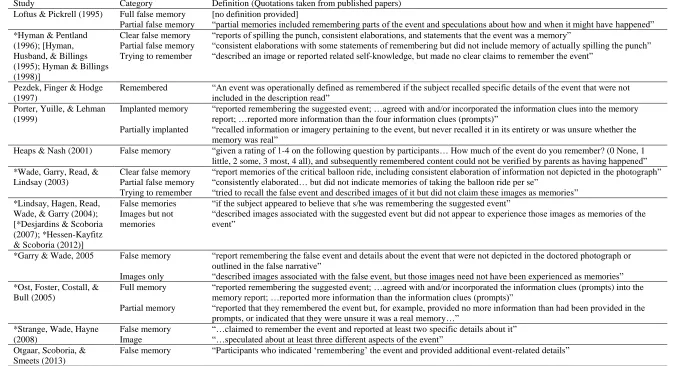
have varied widely across memory implantation studies. Table 1 provides a summary of the
various ways in which researchers have operationalized false memory. It is clear from the table
that the operationalizations draw on different dimensions. For example, some researchers only
required that participants state that they remember the event, other researchers required that
individuals provide details that extend beyond the suggested material, and still other researchers
required that participants make a rating above a criterion on a self-report scale, to classify reports
as false memories. Studies that have common dimensions often vary in the degree to which each
dimension is emphasized. Furthermore, the highest category, often called ‘full’ or ‘clear’ false
memories, is not defined consistently. The problem is compounded by the differential use of
intermediate categories, such as ‘images without memories’ or ‘partial false memories’.
These concerns are present even before we consider that multiple independent judges in
different locations were tasked with categorising participants’ false memory reports. Judges do
not always agree, for instance, on how to classify participants’ reports, and the exact procedures
used for handling disagreements may lead to more or less conservative criteria being applied.
judges applied the coding scheme consistently. In short, false memories in memory implantation
studies have been defined and measured in a variety of ways, which makes it difficult to
determine just how prevalent they are across studies.
Given the variation in coding schemes across studies, meta-analysis is not an appropriate
approach for combining data from memory implantation studies. Indeed, there is currently no
valid method for combining summary statistics originating from scales that differ in ways that
are unknown. An alternative is to re-code the original data using a single validated system and to
conduct a ‘mega-analysis’ of the resulting dataset. Mega-analysis involves the combination of
participant level data from multiple studies and hence stands as a meta-analysis of individual
data, which Olkin (1995) argued is the highest form of empirical evidence when combining
studies. Providing that researchers have used the same dependent measures and are willing to
share the raw data, mega-analysis has the advantage of accruing larger samples, thereby
enhancing statistical power and permitting examination of research questions that cannot be
addressed in individual, smaller studies. Mega-analysis has been increasingly used in areas such
as genetics, neuroimaging, and treatment of psychopathology (e.g., de Maat et al., 2008;
Hallahan, et al., 2011; see Sternberg et al., 2006, for a study of the effects of family violence on
child behavior, in which combining data from multiple studies permitted asking of new
questions). Bernstein, Scoboria, and Arnold (2015) published a mega-analysis (8 studies;
combined N = 1,369) of a different method that involves providing suggestions about false
childhood food experiences. In the present study, we examined transcripts from false memory
implantation studies at the participant level of analysis.
We grounded our definition of false memory in established theories of remembering
(e.g., Brewer, 1996; Conway & Pleydell-Pearce, 2000; Jacoby, Kelley, & Dywan, 1989;
Johnson, Hashtroudi, & Lindsay, 1993; Ross, 1989; Rubin, 2006; Tulving, 1983). The
experience of remembering a past event is the result of multiple cognitive systems and processes.
Inputs from numerous sources (e.g., records of prior perceptual processing, of prior thoughts,
feelings, general knowledge, beliefs, goals, feelings of familiarity, etc.) give rise to an experience
of remembering the past. One key component is recollection,which involves the subjective
experience of mentally reliving a past event. Mental representations experienced as recollections
contain information about perception, place, actions, persons, and so forth. Another key
component is belief in occurrence: remembering also entails the belief that an event genuinely
occurred in one’s personal past (Brewer, 1996; Scoboria, Talarico, & Pascal, 2015). It is possible
to believe that one experienced a particular event in the past without recollecting it (e.g., you
believe that you were born although you don’t recollect the event). It is also possible to
experience vivid recollections that are not believed to represent genuine past events (Scoboria et
al., 2014). Thus definitions of false memory should address both belief about the occurrence of
the suggested event and the subjective experience of recollecting the event.
To develop our coding scheme for defining ‘false memory’, we began with these
observations and with themes previously used in the literature. We chose seven concepts: [1]
verbal statements of ‘remembering’; [2] acceptance of suggested information, which indirectly
indicates a degree of belief in the occurrence of the event; [3] elaboration beyond suggested
information, which indicates extension of a suggestion beyond acceptance of and compliance
with suggested material; [4] presence and quality of mental imagery; [5] coherence of memory
Each of these dimensions could, we believed, be reliably assessed from the information available
in transcripts of participants’ memory reports. We do not claim that these concepts represent a
comprehensive list of the dimensions associated with remembering. Rather, we suggest that they
adequately reflect current thinking about the characteristics of autobiographical memories, and
that they are sufficient to determine the presence or absence of implanted memories.
Statements of remembering. Some studies have used statements such as “I remember” to
designate the presence of an implanted memory. Yet this criterion, alone, is insufficient. Just as
the statement ‘I confess’ should not be used to infer that someone genuinely believes that he or
she committed a crime (Kassin, 2012), the statement ‘I remember’ should not be used to infer
that someone is indeed experiencing vivid recollection or belief that the event occurred in the
past. Issues such as experimental demand and compliance with the research procedure may
produce verbal reports that do not reflect peoples’ beliefs or recollective experiences about the
past.
A related concern is that people vary in the ways in which they talk about their memories,
partly due to differences in how they have learned to communicate about the past (Fivush,
Habermas, Waters, & Zaman, 2011). Variability in linguistic usage leads to instances in which
recollection may be present although the person does not appear to report recollection, or vice
versa (see Otgaar et al., 2013). In short, verbal statements of remembering may be a starting
point for identifying false memories, but alone are not adequate for determining that an event is
remembered.
Acceptance of the suggested event. At the start of false memory studies, participants
typically initially indicate that they do not remember the suggested event. When a false event is
Often such people say something like, “That must have happened to my brother,” as a way to
account for the belief that the informant wrongly claimed that the event happened to them. Such
participants are unlikely to develop a memory of the false event unless they somehow come to
accept that the suggested event occurred (Hyman & Kleinecht, 1999). People will not search for
event-consistent thoughts and images or interpret them as memories of an event until they find it
at least slightly plausible that the event could have transpired (Mazzoni, Loftus, & Kirsch, 2001;
Scoboria, Mazzoni, Jarry, & Shapero, 2012). The first step of the journey toward a false memory
is some degree of acceptance that the suggested event could have happened. This may range
from minimal acceptance of the possibility that the event may have occurred, to complete belief
that the event definitely occurred (Pezdek, Blandon-Gitlin, Lam, Hart & Schooler, 2006; Thomas
& Loftus, 2002; see Scoboria et al., 2004, for more on the relationship between plausibility and
autobiographical belief). The fact that acceptance is not explicitly stated as a criterion in some
studies may reflect the questionable assumption that statements of remembering imply that
someone has accepted the event.
Elaboration beyond the suggestion. Many prior definitions of false memory require that
participants elaborate beyond the details provided in the suggestion. Participants often embellish
their reports with additional, event-relevant information and this elaboration provides some
indication that participants are making an effort to remember and that they are not merely
complying with experimenter demand. The source monitoring framework posits that people
evaluate event-relevant information that comes to mind during attempts to remember to
determine the extent to which that information resembles a genuine memory (Johnson et al.,
1993; Lindsay, 2008). Thoughts and images that arise from inference or imagination often retain
markers of effortful cognitive operations), but sometimes internally generated information is
misattributed to past experience. Various aspects of the implantation procedure, such as telling
participants that a family member provided the events, may encourage participants to lower their
criteria for accepting internally generated thoughts and images as genuine memories (Wade &
Garry, 2005).
Self-generated event details can also lead to activation of additional relevant material in
memory (Greenwald & Banaji, 1989) and to more frequent false memories (Hyman et al., 1995).
Conversely, when people fail to retrieve sufficient information or retrieve event-inconsistent
details, they may reject the event (Dodson & Schacter, 2001; Ghetti & Alexander, 2004;
Lampinen & Odegaard, 2006). Hence elaboration beyond the details of the suggestion is an
important facet of memory formation.
Imagery. In many implantation studies participants are encouraged to create perceptual
imagery for the false event. Imagery has long been associated with remembering (Brewer, 1996;
Greenberg & Knowlton, 2014; Johnson, Foley, Suengas, & Raye, 1988), and the presence and
strength of imagery is an important dimension to consider when examining memory formation.
Theories of memory formation that build upon the source monitoring framework (Johnson et al.,
1993) posit that some suggestive practices foster the creation of imagery which may
subsequently be misattributed to memory (Hyman & Kleinknecht, 1999; Lindsay & Read, 1994).
Recent findings support the view that the mental simulation of events recruits overlapping neural
networks, regardless of whether those events are attributed to memory, to imagination, or to
some other source (Addis, Pan, Vu, Laiser & Schacter, 2009; Schacter, Camberlain, Gaesser, &
the imagery must also be attributed to prior experience (erroneously in the case of false
memories).
Narrative coherence. Rubin (2005) proposed that narrative is a key property of
remembering that serves to organize autobiographical memory. Memories are frequently
expressed in a narrative form, with a beginning and end, characters, settings, events, and so forth.
Narrative is also the means by which memories for events are typically communicated. Thus the
degrees to which memory reports appear to be complete, coherent, and thematically consistent
are important dimensions of both the subjective and social aspects remembering (Brewer, 1986;
Pillemer, 1998).
People are also unlikely to accept suggested events as genuine past experiences if the
events do not coincide with broader self-narratives. When people attempt to recall a past event, if
a memory does not come quickly to mind they may try to identify the broad lifetime period and
context that likely surrounded the event (Brown et al., 2016; Conway & Pleydell-Pearce, 2001;
Neisser, 1987). These more general details may then cue recollection for a specific episode. The
more inconsistent an event is with one’s current self-views, however, the less likely a person is to
accept thoughts, images and feelings that come to mind as evidence of remembering (cf. Ross,
1989). Suggested events must make sufficient sense in relation to a person’s current perceptions
of their past. When people view an event as being consistent with their personal history, their
internal representation of the event is more likely to feel coherent. Moreover, when they talk
about the event, others will judge it to be coherent as well. Thus narrative coherence should be a
marker of the extent to which people accept, integrate, and elaborate on the suggested material to
Emotion. Given that people experience emotional states when experiencing events, it is
not surprising that people also recall past emotional states and experience emotional reactions
when recalling events (Christianson & Safer, 1996). Based on findings that emotional intensity at
retrieval is associated with strength of autobiographical memories (Talarico, LeBar, & Rubin,
2004), we opted to code intensity of emotion in reports as an additional indicator of the
development of false memories.
No rejection of the suggested event. Participants in memory implantation studies are
encouraged to construct vivid imagery while narrating aloud in order to retrieve unremembered
events. In some cases individuals may provide an otherwise compelling report, but also make
statements that indicate that they reject having any memory for the suggested event. It is obvious
that such cases should not be categorized as false memories.
Analytic approach
To conduct the mega-analysis we solicited transcripts from published peer-reviewed false
memory implantation studies. We developed and validated a system for coding false event
narratives, and then applied the system to the transcripts from the studies. This approach
permitted us to examine four novel outcomes. First, the combined dataset allowed us to take a
data-driven approach to defining the presence of false memories. Second, we were able to
combine memory formation rates across studies in a more valid manner. Third, the statistical
power afforded by the larger dataset enabled us to examine the convergence between coded false
memories and participants’ self-report ratings. Finally, we were able to explore what study
characteristics were associated with false memory formation.
Method
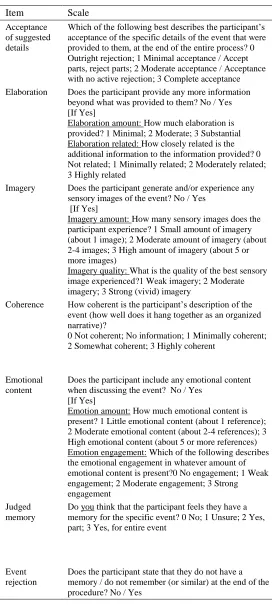
Using the themes described above, we developed and validated a coding system for
deciding when participants had experienced features associated with remembering. We created
seven primary items (statements of remembering, acceptance, elaboration, imagery, coherence,
emotion, and no rejection of the suggested event). For each dimension, raters used a 4-point
rating scale, ranging from ‘not present’ to ‘highly present’. For three items (imagery, emotion,
elaboration), raters first indicated whether the phenomenon was present or not, followed by
4-point scaled questions about the amount and quality of the feature (imagery amount, imagery
quality, emotion amount, emotion intensity, elaboration amount). We created an item to assess
whether a memory was present based on the entire transcript (judged memory; rated no,
yes/partial, yes/complete). The no rejection of suggested event item was rated as yes (rejected) or
no (not rejected). We worded all items with an eye towards conceptual clarity and created an
accompanying set of definitions for each item.
Two assistants from the first author’s lab were trained in the use of the system. The raters
worked with the authors to code event transcripts of true and false events from unpublished
studies. We completed three cycles of coding and revising item wording until the raters provided
consistent judgments. The same raters then independently coded a new set of 68 unpublished
false memory transcripts (taken from pilot work and unfinished studies). We calculated the
percentage of ratings that were identical between raters and examined frequencies for ratings that
differed by two or more points on the scales, because these represent instances in which the
raters read the transcript quite differently. We retained items with agreement above 70% and for
which discrepancies between item ratings were less than two scale points in at least 90% of
cases. See Table 2 for the final items.
We approached researchers in Canada, New Zealand, the United States of America, and
the United Kingdom who had published peer-reviewed memory implantation studies involving
adult participants. We asked them to provide the anonymized, final-session transcripts for the
false events from their published studies. The transcripts no longer existed for four published
studies so we were unable to include data from these studies in our analyses (see the discussion
below for further information about these studies). Ultimately we obtained transcripts from eight
published studies involving a total of 423 participants: Desjardins and Scoboria (2007; N = 43;
suggested event, trouble with teacher); Garry and Wade (2005; N = 44; hot air balloon ride);
Hessen Kayfitz and Scoboria (2011, N = 81; hot air balloon ride); Hyman and Pentland (1996; N
= 64; spilled punch bowl on parents of the bride at a wedding); Lindsay et al. (2004; N = 45;
trouble with teacher); Ost et al. (2005; N = 26; one of eight events); Strange et al. (2008; N =
100; hot air balloon ride); Wade et al. (2002; N = 20; hot air balloon ride). The distribution of
gender across the total sample was 71.2% female, 25.9% male, 2.8% gender not recorded. Age
was recorded for 65% of the sample; M = 20.7, range 17 to 42, SD = 2.9 (age was not available
for the Hyman, Lindsay, or Ost studies but they too used university undergraduates as
participants). We compared samples on the available demographic characteristics and found no
statistically meaningful differences.
To ensure that each item in the coding scheme was rated independently, we (AS, KW,
SL/TA) trained separate pairs of raters to code each item. For example, one pair in AS’s research
lab rated Elaboration, and another pair in KW’s lab rated Coherence, and so on. Pairs were
trained in the use of an item and coded practice events using unpublished false memory
transcripts until they achieved consistency of 75% or greater. Each pair then independently rated
93.6%, amount 88.2%, relation 92.8%; Acceptance – 84.4%; Imagery – presence 90.7%, amount
87.8%, quality 82.0%; Emotion – presence 94.2%, amount 72.0%, intensity 100%; Coherence –
76.7%; Judge remembered – 79.7%; Statements of remembering, 100%; No rejection, 100%.
Inconsistent ratings were resolved via discussion and in rare cases of continued disagreement the
more conservative rating was selected.
Defining ‘False Memory’
We explored criteria for defining when false memories were present. We began with the
following two assumptions as discussed above. First, participants must accept the suggestion to
some degree. Second, as participants move from saying ‘I do not remember that’ to ‘Now I
remember…’, they must report additional imagery or otherwise elaborate beyond the suggested
material. Of course, the extent to which these characteristics need to be present to define a
participant’s report as a memory remains an open question.
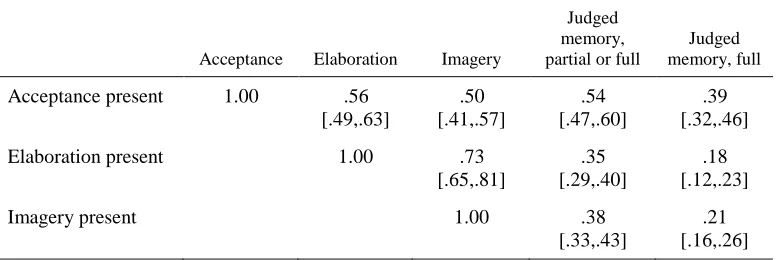
Correlations and 95% confidence intervals between judges’ acceptance, elaboration,
imagery, and judged memory ratings are provided in Table 3. Acceptance showed the highest
relationship with judgments of memory, consistent with the idea that a degree of acceptance of
the suggestion is a necessary dimension in memory formation. The high correlation (.73)
between ratings of imagery and elaboration suggests that these concepts reflect highly
overlapping aspects of the reports. In light of these relationships and the preceding discussion,
we developed definitions of “false autobiographical memory” that focussed on the extent to
which participants accepted the suggested event.
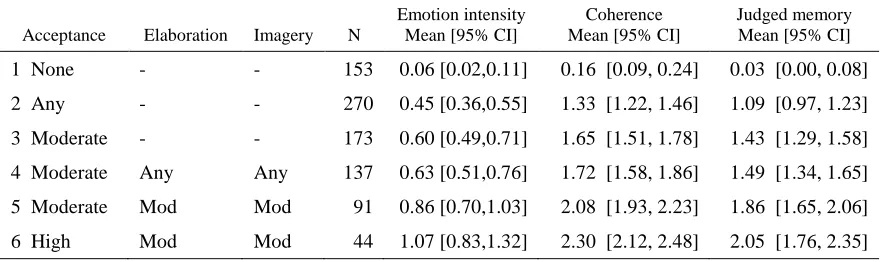
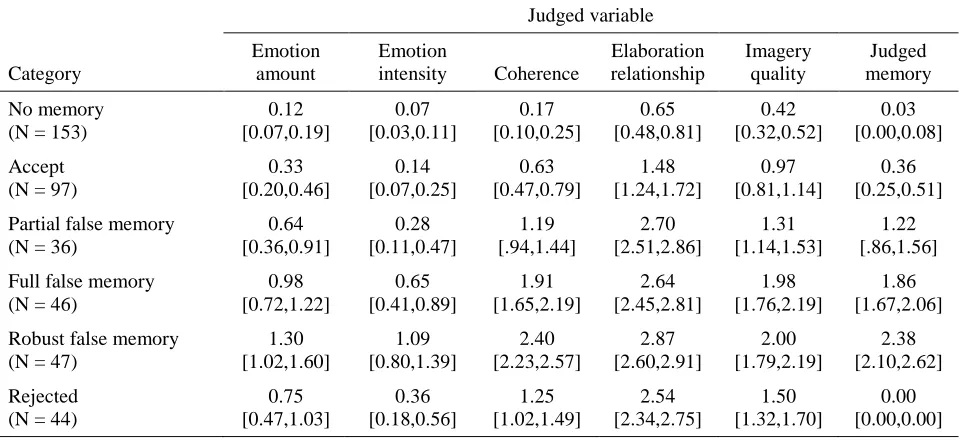
Next we examined various combinations of the acceptance, elaboration, and imagery
variables, and the associated mean ratings on other judged variables (emotion engagement,
frequencies for each combination. The first row includes cases for which acceptance of the
suggestion was coded as zero. The ratings for all variables in this group were extremely low. The
second row includes cases in which any level of acceptance was present, and subsequent rows
incorporate higher levels of acceptance and introduce different levels of elaboration and imagery.
The item means indicated a difference between any acceptance and moderate acceptance
of the event. Based on this observation and the idea that memories typically include a degree of
acceptance of the event plus a memory-like image and elaboration beyond the suggested
material, we placed the minimal criterion for presence of a memory as moderate acceptance plus
any level of both elaboration and imagery (Table 4, row 4). For the cases classified as memories,
increasing the thresholds for elaboration and imagery from any to moderate resulted in notable
increases in scores. Thus we used this threshold to differentiate between two groups of false
memories. The first group was named “partial false memory” (moderate acceptance with any
elaboration and any imagery) to reflect strong acceptance but lesser presence of other key
features associated with memory. The second group was named “full false memory” (moderate
acceptance with moderate elaboration and moderate imagery, row 5), to indicate that all key
features were present. We defined those cases judged with a high level of acceptance of the
suggestion and moderate imagery and elaboration as “robust false memory” (row 6). In previous
studies, false memories were classified as either partial or full. Combining the full and robust
categories would be similar to the full memories from earlier studies. One advantage of this
mega-analysis is the finding that false memories represent a continuum in terms of acceptance
and elaboration. With the mega-analysis, we were able to differentiate that even within the group
of false memories typically classified as full memories, there are many that display a much
partial, full, or robust false memory, if the participant stated at the end of the interview that s/he
did not have a memory of the event, we coded the event as ‘rejected.’ This resulted in the
following categories: rejected, no memory, accepted (to some degree), partial false memory, full
false memory, and robust false memory.
Results and Discussion
False memory formation across studies
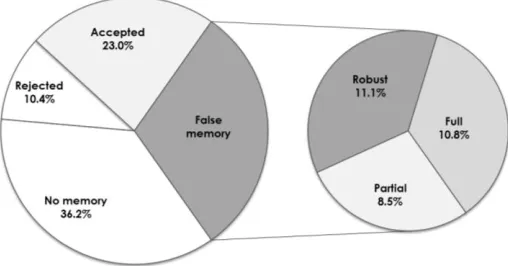
When we categorized the 423 memory reports according to the scheme described above
(see Figure 1), 11.1% of the sample met the criteria for Robust memory, 10.8% met the criteria
for Full memory, and 8.5% met the criteria for partial false memory, resulting in a combined
false memory rate of 30.5%. Of the remainder, 23.0% were judged as having accepted the
suggestion as true to some degree but did not meet the criterion for remembering. Another 10.4%
were judged as having strong mental representations but the participant explicitly rejected having
a memory. For 36.2% there was no evidence of acceptance of the suggestion or memory
formation. Thus, approximately one-third of participants showed evidence of a false memory,
and more than half showed evidence of believing that the event occurred in the past.
Statements of remembering the suggested event
As we noted previously, relying on participants’ verbal utterances of remembering (e.g.,
“I remember being lost…”) to determine remembering is problematic. For this reason, we did not
include statements of remembering in our definition of false memories. We did, however,
calculate the percentage of participants in each memory category who made clear statements of
remembering. In the Full and Robust categories, 91.2% (n = 85) of cases included a statement of
remembering. Of the eight cases that did not include such a statement, in six cases the participant
such. For the remaining two cases, the participants shifted into describing the event in the
historical present at some point in the narrative (e.g., “I bump into the table with my shoulder,
and the bowl moves…”), which has been associated with the experience of remembering
(Pillemer, 2003).
In the Partial memory category, 36.1% (n = 13) of participants made statements about
remembering. Some participants spoke vaguely, which may have made their transcripts more
difficult to classify. Other participants explicitly expressed an incomplete sense of remembering,
and often indicated that they were retrieving fragments of memories or were vividly seeing
isolated details in their mind. As such, they went beyond speculation to express a partial sense of
remembering. Thus some of these cases may reflect full memories, but due to their ambiguity
they were appropriately coded into the more conservative category.
For the Acceptance category, 8.2% (n = 8) of cases made statements of remembering. Of
these, two participants were uncertain if the memory originated in the suggested event or another
experience; another two could be interpreted as either indicating imagining or remembering; and
for four cases the transcripts presented a mixture of both memory claims and denial of memory.
In the No Memory category, no cases were rated as providing statements of remembering.
There are three points to note here. First, participants’ statements of remembering
corresponded well, but not perfectly, with our criteria for defining false memories. Participants
categorized as having full or robust false memories almost always made statements about
“remembering” the event. Second, our criteria appropriately and conservatively allocated
participants with vague or fragmented memory representations into the partial memory group.
Finally, a notable minority of participants did not make explicit statements of remembering but
Relationship of additional judged items to false memory status
Judges rated the characteristics of the 423 reports on six additional items that were not
used to determine the false memory categories: emotion amount, emotion intensity, coherence,
elaboration relationship (how closely the additional information was to the original event),
imagery quality, and judged memory (whether the rater thought that the participant ‘felt like’
they had a memory). Table 5 presents descriptive statistics for these items, by the false memory
categories defined above. We use 95% confidence intervals to discuss differences on these items
between the memory categories (Cumming, 2013). We focus on the ‘No-memory’ to ‘Robust’
memory categories first, then examine the ‘Rejected’ category separately below. We found a
strong convergence between the memory categories and the judges’ ratings on all six items. For
example, reports that were categorized as Robust false memories scored higher on the six items
than reports categorized as Full. The rank order of the categories was consistent across all items,
with means going from lowest to highest value from the No memory to the Robust category;
although some items did not significantly differ across categories. Contrasting the contiguous
groups, the Full and Robust categories were differentiated only by the coherence and judged
memory items. The Partial and Full categories were differentiated by the coherence, imagery
quality, and judged memory categories. The Accept and Partial categories were differentiated by
coherence, elaboration relationship, imagery quality, and judged memory. Finally, the No
memory and Accept categories were differentiated by all items except emotion engagement.
To summarize, mean ratings for all items increased numerically across the No-memory to
Robust categories, respectively. Coherence ratings differentiated all categories, and Imagery
Rejected category. Participants in the Rejected memory category (10.4% of the sample)
were coded as having vivid mental representation for the suggested event, but ultimately rejected
remembering the event. Not surprisingly, Judged Memory ratings for these participants were
invariably zero. This group’s ratings for elaboration relationship resembled those who were
deemed to have Full or Robust memories, which is consistent with the argument that these
reports look like vivid memories to an observer. Emotion and imagery quality in the Reject
category resembled the Partial category, whereas coherence ratings for the Rejected category
were lower than those for the Partial category. The pattern of ratings in the rejected category is
interesting in that they highlight the difficulty that judges face in 1) determining when someone
is remembering an event, and 2) determining the underlying psychological basis for such
memory statements.
Participants’ subjective ratings for suggested events
We now turn to participants’ responses to self-report items, which can serve as another
method for validating judges’ ratings. In memory implantation studies, participants are often
asked to rate the phenomenological characteristics of their memory reports, such as the extent to
which they see the event in their mind or relive the original emotions associated with the event.
These ratings enable participants to convey their subjective sense of remembering. The
self-report items used most frequently across the eight studies included: visual imagery, auditory
imagery, emotional intensity, narrative coherence, remember/know, prior instances of rehearsal,
confidence in memory, and belief in the accuracy of memory. We contrasted our memory
categories using the self-report items that were completed by at least 50% of the combined
[3] Reliving (58.6%). Figure 2 shows the mean rating for these items according to memory
category.
Remember/know and reliving. Remember/know was measured on a 7-point scale, and
assessed the degree to which participants’ episodic recollection was associated with an event
versus knowing that an event happened without associated recollection; recent research has
found that this item is an excellent marker of subjective recollective experience (Scoboria et al.,
2014). Reliving assesses the extent to which the event representation is associated with an
experience of reliving the event, and was also measured on a 7-point scale. Reliving and
Remember/know ratings were lowest in the Reject and No Memory groups, were somewhat
higher (differing from the scale floor) in the Accept and Partial groups, and were notably higher
in the Full and Robust groups. We calculated standardized effect sizes to contrast the No
Memory group to the combined Accept/Partial groups (R/K, d = 0.38 [95% CI .11, .65]2; Reliving, d = 0.57 [.26, .89]), No Memory to the combined Full/Robust groups (R/K, d = 1.29
[.97, 1.61]; Reliving, d = 1.34 [.99, 1.69]), and the combined Accept/Partial groups to the
combined Full/Robust groups (R/K, d = 0.92 [.60, 1.24]; Reliving, d = 0.76 [.39, 1.12]). The
agreement between the coded ratings and these subjective ratings provides evidence of
convergent validity for our coding system.
Rehearsal. The rehearsal item assesses how frequently participants thought or talked
about an event in the past on a 7-point scale. Because the suggested event is novel, ratings on this
item should be low. This was the case, except that the Robust memory group showed a weak
endorsement of the item. Those in the Robust memory group may have given slightly higher
ratings due to having thought about the event more during the study.
Study characteristics and false memory
Within the memory implantation literature over time we see the emergence of increasingly
powerful techniques for fostering false memories. We examined the correlation between the
judged ratings and factors that varied across conditions within and between the eight studies.
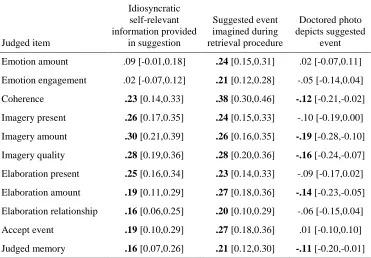
Table 6 shows the judged items and how each item correlated (and associated 95% confidence
intervals) with three factors that showed statistically meaningful relationships: [1] Providing
participants with idiosyncratic self-relevant information (e.g., including details in suggestions
such as the name of an actual teacher), [2] Encouraging participants to imagine the suggested
event during testing sessions, and [3] Using doctored photographs to depict the suggested event.
We also examined whether providing participants with both a narrative and a photo was related
to memory rates, and did not find any meaningful correlations (range - .07 to .05). Whether
significant or not these correlations must be interpreted with caution due to the presence of
multiple confounds. Nonetheless, they offer some intriguing leads, as detailed below.
Providing self-relevant information. Desjardins and Scoboria (2007) proposed that studies
with higher false memory rates provide participants with idiosyncratic self-related information
within the suggestion, and they reported a study that yielded support for that hypothesis. We
coded whether idiosyncratic information was (6 studies, N = 1743) or was not (5 studies, N =
249) provided to participants. The presence of idiosyncratic information correlated positively
with all of the judged categories except for emotional experience. The correlations ranged from
.16 (elaboration relationship, judged memory) to .30 (imagery amount). Idiosyncratic
self-relevant information appears to enhance visual imagery, increase elaboration on suggested
material, and foster a cohesive narrative. The false memory rate (Robust, Full, and Partial
combined) was 39.6% [95% CI: 32, 47] when self-relevant information was present, and 24.0%
[19, 30] when it was not; propdiff = .24 [.07, .24].
Instructing participants to imagine. Many researchers have discussed the influence of
imagination and of vivid imagery on memory formation (Hyman & Pentland, 1996; Mazzoni &
Memon, 2003). We coded whether participants were (6 studies, N = 265) or were not (3 studies,
N = 158) encouraged to systematically imagine the suggested event during the study procedure.
Instructions to generate imagery correlated positively with all of the judged variables. Most of
the correlations fell between r = .21 and .28, indicating weak but reliable relationships. The
correlation with the Coherence item was somewhat higher at r = .38. The false memory rate was
37.3% [95% CI 32, 43] when imagery was present in the procedure, and was 19.0% [13, 25]
when it was not; propdiff = .19 [.10, .26]. The imagery procedures used in implantation studies
tend to be fairly elaborate. Participants are typically given instructions for context reinstatement
and then guidance in imagining specific details of events. Thus we cannot determine exactly
which aspects of these procedures contribute to false memory formation.
Providing photographs depicting suggested events. There is evidence that the medium in
which the suggested event is presented can also influence the rate of false recall. For instance,
Garry and Wade (2005) found higher rates of false memory formation when participants were
presented with a description of the false event rather than a doctored photograph of the false
event. Garry and Wade concluded that such photos may serve to constrain imagination during
efforts to recall the event, thus leading to lower memory formation. We coded whether
participants viewed (4 studies; N = 170) or did not view (6 studies; N = 253) a photo that
allegedly depicted the specific suggested event. Consistent with their argument, weak but
= -.19) and Imagery Quality (r = -.16). The false memory rate was 25.9% [95% CI 20, 32] when
a photo depicted the event and 33.6% [28, 40] when no such photo was presented; propdiff = .08
[.00, .16]. One caveat worth noting is that only one event (hot air balloon ride) and the same or a
similar photo has been used in all of the studies that have provided a doctored photo of the event.
Combining self-relevant information, imagination, and photos. To examine the combined
power of these techniques (providing self-relevant information, encouraging imagining,
presenting a suggested narrative without a photo depicting the event), we contrasted study
conditions in which all three procedures were present (3 studies; N = 89) against all other
observations (7 studies; N = 334). The false memory rate was 46.1% [95% CI 36, 56] when the
three conditions were present and 26.3% [22, 31] for when they were not; propdiff = .20, [.09,
.31]. As Figure 3 shows, the main difference is that participants in the studies that met those
conditions were more often judged to have formed ‘Full’ false memories.
These three suggestive techniques — self-relevant information, imagination, and narratives
without photos — might work in concert as follows: The presence of self-relevant information
may enhance a participant’s belief that the suggested event occurred, encouraging efforts to
recall it. Self-relevant information may also provide participants with an effective memory cue.
This may create an environment that is ripe for thoughts, images, and feelings to come to mind,
and may bias participants toward accepting them as memories. Participants may embellish those
mental experiences as they repeatedly imagine the suggested event. Moreover, if participants are
provided with a verbal description of the suggested event, rather than a doctored photo that
depicts precisely how the event occurred, they also have free rein to imagine. Together these
processes may encourage participants to develop perceptually rich and vivid mental experiences
results must be interpreted with caution, because participants were not randomly assigned to
these different suggestive conditions and there were confounding differences between the studies
that did versus did not combine suggestive techniques.
False Autobiographical Belief
To this point, our examination of the data has emphasized false memories. However,
many theories of false memory formation state that false autobiographical beliefs are a step along
the path to the development of a false recollection. Coming to believe an event is a genuine part
of the past is sufficient to lead to changes in views of the self and behavior (e.g., Mazzoni &
Kirsch, 2002). The findings in Bernstein et al. (2015) indicate that once an event is sufficiently
believed to have occurred, development of recollection does not contribute further to behavioral
outcomes. In other words, belief in the occurrence of an event may be sufficient to influence
behavior, whether or not there is also an accompanying episodic recollection.
Given the relevance of the development of false autobiographical belief to understanding
the effects of suggesting events, we report here on subjective autobiographical belief ratings that
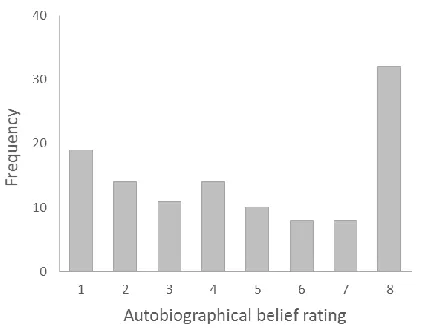
were taken in two of the samples (N = 116; Desjardins & Scoboria, 2007; Hessen Kayfitz &
Scoboria, 2012). The average belief in occurrence rating (1 to 8 point scale) following the
implantation procedure across all individuals was 4.71 (95% CI 4.23, 5.19). The average belief
rating did not differ statistically across the false memory categories discussed above (none,
accepted, partial, full, robust, rejected). As can be seen in the frequency distribution in Figure 4,
the distribution of scores was not normal. While 50% of individuals rated autobiographical belief
above the scale midpoint, 28% reported autobiographical belief at the top of the scale. This
pattern indicates that implantation procedures promote a notable degree of false belief formation
procedures. The level of autobiographical belief results from the procedure regardless of the
degree of development of false recollection, which varies across the false-memory categories as
discussed above in the analysis of reliving and remember-know ratings (see Scoboria, Wysman,
& Otgaar, 2012, for further discussion).
Summary
In this mega-analysis, we systematically applied the same coding system to over 400
memory reports from previously published false memory implantation studies. This method
afforded us the statistical power necessary to ask more refined questions that have only been
speculated about in prior work. Setting methodological differences between the eight target
studies aside, across studies 30.4% of participants were classified as having developed a false
memory, and 53.3% were judged to have accepted the suggested event as genuine to some
degree (inclusive of those classified as having developed a false memory). The presence of
idiosyncratic self-related information, an imagination procedure during the suggestion, and to a
lesser extent presenting the suggestion without a photo depicting the specific event, were each
associated with high memory formation rates. Given all three of these conditions we found a
false memory rate of 46.1% and an acceptance rate of 69.7%.
Consistent with models of false memory formation (Hyman & Kleinknecht, 1999;
Mazzoni & Kirsch, 2002; Scoboria, Mazzoni, Kirsch, & Relyea, 2004), our analysis shows that if
a false event is suggested, if evidence is provided that the event occurred, if resistance to
considering the possibility that the event occurred can be overcome, and if imagination is
employed, then false autobiographical memories often arise. Furthermore, suggestive practices
appear to instill a degree of belief in false events in about two-thirds of study participants, and
studies have largely been concerned with illusory autobiographical memories, on an applied
level false autobiographical beliefs may be more important. Bernstein et al. (2015) recently
presented evidence that it may be changes in autobiographical belief that underpin changes in
suggestion-related attitudes and behavioral intentions.
Our purpose here is not to review the extant body of research relevant to false memories,
and we remind readers that the memory implantation methodology emphasized here is just one
method in a rich body of research on memory errors. Distinct experimental methods,
correlational studies, case reports, and anecdotal reports converge to show that people can come
to remember false memories for personally meaningful past events. While the implantation
method remains the most compelling experimental method for demonstrating and manipulating
the formation of rich autobiographical false memories, a complete understanding of the
processes that contribute to memory formation must be based in a wider reading of the literature.
For that purpose, we direct readers to Schacter, Chamberlain, Gaesser, and Gerlach (2012),
Laney and Loftus (2013), and Loftus (2005) for reviews.
One important finding here is that a memory report can look like a genuine memory to
observers, even if the person does not explicitly report remembering the event. Indeed, 10% of
participants in our combined sample appeared to have strong episodic mental representations of
the suggested event, but ultimately reported that they did not remember it. This finding is
important for at least two reasons. First, people may not experience recollection even though
their reports meet coding criteria, and conversely, people may experience recollection when their
reports do not meet the criteria (see also Otgaar, Scoboria, & Smeets, 2013). The disconnect
between a participant’s reported subjective experience and the criteria being applied can lead to
events as recollected may not coincide with participants’ subjective experience of remembering.
Given these complications, the elicitation and classification of reports (and the underlying
cognitive states that contribute to them) must be examined carefully. Most memory implantation
studies have mechanisms built in to ensure that false memory estimates are appropriate. For
instance, many studies have distinguished between participants who report images only and
those who report memories. In most studies, independent judges are trained to look for clear
evidence of remembering, and disputes between judges are usually classified into the more
conservative category. Finally, some studies, including this one, have documented convergence
between the judges’ memory categorizations and participants’ self-ratings. Together, these
procedures help to minimize the likelihood of coding error. Methodologically, our findings
reinforce the importance of obtaining clear and elaborate statements from participants about what
they remember and what they believe about suggested events (see Smeets, Telgen, Ost, Jelicic, &
Merckelbach, 2009, for an excellent example of the value of clarifying memory claims).
One conclusion that can be made based on this study and on similar work is that it can be
difficult to objectively determine when someone is recollecting the past, versus reporting other
forms of knowledge or belief or describing mental representations that have originated in other
sources of experience. Even under highly controlled laboratory conditions, memory researchers
struggle to define and observe memory. How, then, can we expect therapists, forensic
investigators, medical personnel, human resource staff, or jurists to be any better at this task?
Potential limitations
Study selection. We included published false memory implantation studies with adults
conducted in English that we could obtain at the time that we conducted the project. We chose to
that examined the development of false memories in children due to the need to consider
developmental differences with child participants, and because few studies that used the
implantation procedure with children were available when we began the project. Beyond the
eight studies included here, we were unable to obtain information from four published studies for
which the researchers indicated that the transcripts no longer existed (Heaps & Nash, 2001;
Hyman, Husband, & Billings, 1995; Loftus & Pickrell, 1995; Porter, Yuille, & Lehman, 1999).
The total N from those studies was 221 (range 20 to 77); and the false memory rates reported
ranged from 20% to 56% (weighted average 39.5%).
Of course, publication bias is likely to have affected the effect sizes we report here. We
were not aware of any unpublished false memory implantation studies that met our criteria and
for which transcripts existed at the time of our analysis. Nonetheless, to minimise selection bias,
we included all of the participants who took part in the eight target studies in our analyses,
regardless of the condition to which they were assigned. The target studies also varied in their
intention to promote false memory development; for instance, some conditions served as controls
and other conditions were expected to produce minimal development or even inhibit false
memory formation. For this reason, one should not interpret the percentages of memories
classified as partial, full, and robust as representing some limit in the level of false memory
creation.
The retrieval of genuine events. Some participants in implantation studies who appear
to have false memories may be retrieving genuine memories of past experiences (e.g., perhaps
the participant really did experience a hot-air balloon ride). But there are several reasons to
believe that such cases are rare. First, the critical events used in memory implantation studies are
indicate that the event never occurred. Other critical events are so peculiar and distinctive – such
as putting slime in a teacher’s desk (Lindsay et al., 2004) or spilling a bowl of punch on a bride
(Hyman & Pentland, 1996) – that it is not plausible that many participants had experienced those
events. Even if some participants had experienced a similar event the suggested false event is
unlikely to perfectly match in terms of the exact age and manner with any genuine childhood
experience. Second, several studies using different procedures have addressed this issue directly
by showing that people can develop distorted beliefs and memories about highly implausible or
impossible events (Braun, Ellis, & Loftus, 2002; Mazzoni, Loftus & Kirsch, 2001; Mazzoni &
Memon, 2003; Spanos, Burgess, Burgess, Samuels, & Blois, 1999). One procedure used to
address such concerns in memory implantation studies is to ask participants’ family members
whether, to their knowledge, the participants ever experienced the false event(s). All eight of the
studies included in our analysis included this step for verifying that the false event never
occurred. While it is an important step, we acknowledge that parents/siblings can only provide
information that is, to the best of their knowledge, true. We cannot assume that just because an
informant indicates that their child never experienced an event that in fact their child never had a
related experience. Finally, research suggests that people incorporate details from a variety of
cognitive processes, such as imagination, guided-imagery, and genuine memories, to construct
memories of suggested events (Wade et al., 2002). It is simply incorrect to state that false
memories are entirely false (Lindsay & Read, 1995; Read & Lindsay, 1994) and many false
memories are likely to be built from elements of genuine experiences (Hyman et al., 1995).
We reiterate that a complete understanding of errors in autobiographical memory requires
a broader reading of the literature. The memory implantation procedure focused on in this paper
that are recalled. For example, Goff and Roediger (1996) described a method for inducing false
memories for actions performed in the laboratory, and their approach has been further adapted by
others (e.g., Clark, Nash, Fincham, & Mazzoni, 2013; Nash, Wade, & Lindsay, 2009; Seamon,
Philbin, & Harrison, 2006; Thomas & Loftus, 2002). One important trade-off between the
implantation procedure and laboratory procedures is ecological validity, because the events used
in controlled laboratory studies do not resemble autobiographical memories in their full
complexity. We also emphasize that our focus is on the development of false memories, and not
on the issue of retrieval of true memories.
Implications
This research demonstrates the value of identifying situations in which formal or informal
meta-analytic reviews are inappropriate for making summary statements about the state of
knowledge within a literature. We offer an example of how to conduct integrative analyses in
which measurement is reconceptualised in a theoretically informed way that allows data to be
combined across diverse studies. In contrast, Brewin and Andrews (2016) recently reviewed
false memory implantation research in what we perceive to be an example of what should not be
done when attempting to summarize this literature. While they stated that they were not
attempting to conduct a meta-analysis, they did report summary estimates of, for example, false
memory formation rates. By averaging across studies and conditions, Brewin and Andrews
concluded that the false memory formation rates across extant studies is no higher than 15%.
They did acknowledge a number of potential moderating variables, but they then ignored the
influence of such moderators on memory formation and, crucially, implied that their 15%
estimate is a universal limit that generalizes to real-world cases. Our perspective is more modest
analyzed here was substantially higher than 15%. But our broader point is that the likelihood of
false memories depends on interactions between many variables. Under some conditions, false
memories of various kinds are very rare, and under others they are very common. Psychologists
are a long way from having a complete understanding of how the relevant variables interact to
determine the likelihood and nature of false-memory experiences, but mega-analyses such as this
may help us develop such an understanding. (For further discussion of Brewin and Andrew’s
analyses and conclusions, see Lindsay & Hyman, in press; Nash, Wade, Garry, Loftus, & Ost, in
press; McNally, in press; Otgaar, Merckelbach, Jelicic, & Smeets, in press; Pezdek &
Blandon-Gitlin, in press; Scoboria & Mazzoni, in press; Smeets, Merckelbach, Jelicic, & Otgaar, in press).
To conclude, research on false memory formation originated in criticisms of the notion
that suggestive therapeutic practices were specifically and reliably linked to the recovery of
genuine memories (Lindsay & Read, 2001). Despite a substantial body of evidence that
suggestive practices promote the development of false memories, these notions remain prevalent
in North America (Patihis et al., 2014) and in the UK (Ost et al., 2013). Our results firmly
support the assertion that suggesting false events can produce false memory in a substantial
percentage of people. On the one hand, it is likely to be more difficult to lead people to develop
false beliefs or memories of childhood sexual abuse than of, say, a childhood prank. On the other
hand, participants in the studies reviewed here were undergraduate students and the suggestive
pressures brought to bear were brief and relatively mild. With stronger techniques combining the
factors we investigated, more people may be led to create false memories of negative
experiences. Moreover, people struggling with psychopathology who seek help for their
symptoms may be particularly vulnerable to suggestions, and some trauma-memory-oriented
recall, elaborate explanations of memory repression and memory recovery, exposure to
autobiographies in which memory has been ‘successfully recovered’, and so forth), often with
greater frequency and over longer periods of time. We are hopeful that the use of dangerously
suggestive practices has declined over the last two decades, but some treatment providers
continue to use these practices (see Cara, 2014, for a recent case). Memory implantation research
has already contributed to changing practice and policy by psychotherapists and by individuals
who conduct forensic interviews. Our results reinforce how important is it to continue educating
References
Addis, D.R., Pan, L., Vu, M.A., Laiser, N., Schacter, D.L. (2009). Constructive episodic simulation
of the future and the past: Distinct subsystems of a core brain network mediate imagining
and remembering. Neuropsychologia, 47, 2222–2238.
doi:10.1016/j.neuropsychologia.2008.10.026
Bernstein, D., & Loftus, E.F. (2009). How to tell if a particular memory is true or false.
Perspectives on Psychological Science, 4, 370-374.
Bernstein, D., Scoboria, A., & Arnold, R. (2015). The consequences of suggesting false
childhood food events. Acta Psychologica, 156, 1-7.
Bluck, S., Alea, N., Habermas, T., & Rubin, D. C. (2005). A tale of three functions: The
self-reported uses of autobiographical memory. Social Cognition, 23, 91-117. doi:
10.1521/soco.23.1.91.59198
Braun, K.A., Ellis, R., & Loftus, E.F. (2002). Make my memory: How advertising can change
our memories of the past. Psychology and Marketing, 19, 1-23.
Brewer, W. F. (1986). What is autobiographical memory? In D. Rubin (Ed.), Autobiographical
memory (pp. 25-49). Cambridge: Cambridge University Press.
Brewer, W. F. (1996). What is collective memory? In D. C. Rubin (Ed.), Remembering our past:
Studies in autobiographical memory (pp. 96-66). New York: Cambridge University
Press.
Brewin, C.R., & Andrews, B. (in press). Creating memories for false autobiographical events: A