University of Warwick institutional repository: http://go.warwick.ac.uk/wrap
A Thesis Submitted for the Degree of PhD at the University of Warwick
http://go.warwick.ac.uk/wrap/56278
This thesis is made available online and is protected by original copyright. Please scroll down to view the document itself.
Library Declaration and Deposit Agreement
1. STUDENT DETAILS
Please complete the following:
Full name: ………. University ID number: ………
2. THESIS DEPOSIT
2.1 I understand that under my registration at the University, I am required to deposit my thesis with the University in BOTH hard copy and in digital format. The digital version should normally be saved as a single pdf file.
2.2 The hard copy will be housed in the University Library. The digital version will be deposited in the University’s Institutional Repository (WRAP). Unless otherwise indicated (see 2.3 below) this will be made openly accessible on the Internet and will be supplied to the British Library to be made available online via its Electronic Theses Online Service (EThOS) service.
[At present, theses submitted for a Master’s degree by Research (MA, MSc, LLM, MS or MMedSci) are not being deposited in WRAP and not being made available via EthOS. This may change in future.]
2.3 In exceptional circumstances, the Chair of the Board of Graduate Studies may grant permission for an embargo to be placed on public access to the hard copy thesis for a limited period. It is also possible to apply separately for an embargo on the digital version. (Further information is available in the Guide to Examinations for Higher Degrees by Research.)
2.4 If you are depositing a thesis for a Master’s degree by Research, please complete section (a) below. For all other research degrees, please complete both sections (a) and (b) below:
(a) Hard Copy
I hereby deposit a hard copy of my thesis in the University Library to be made publicly available to readers (please delete as appropriate) EITHER immediately OR after an embargo period of ………... months/years as agreed by the Chair of the Board of Graduate Studies.
I agree that my thesis may be photocopied. YES / NO (Please delete as appropriate)
(b) Digital Copy
I hereby deposit a digital copy of my thesis to be held in WRAP and made available via EThOS.
Please choose one of the following options:
EITHER My thesis can be made publicly available online. YES / NO(Please delete as appropriate)
OR My thesis can be made publicly available only after…..[date] (Please give date)
YES / NO(Please delete as appropriate)
OR My full thesis cannot be made publicly available online but I am submitting a separately identified additional, abridged version that can be made available online.
YES / NO (Please delete as appropriate)
3. GRANTING OF NON-EXCLUSIVE RIGHTS
Whether I deposit my Work personally or through an assistant or other agent, I agree to the following:
Rights granted to the University of Warwick and the British Library and the user of the thesis through this agreement are non-exclusive. I retain all rights in the thesis in its present version or future versions. I agree that the institutional repository administrators and the British Library or their agents may, without changing content, digitise and migrate the thesis to any medium or format for the purpose of future preservation and accessibility.
4. DECLARATIONS
(a) I DECLARE THAT:
I am the author and owner of the copyright in the thesis and/or I have the authority of the authors and owners of the copyright in the thesis to make this agreement. Reproduction of any part of this thesis for teaching or in academic or other forms of publication is subject to the normal limitations on the use of copyrighted materials and to the proper and full acknowledgement of its source.
The digital version of the thesis I am supplying is the same version as the final, hard-bound copy submitted in completion of my degree, once any minor corrections have been completed.
I have exercised reasonable care to ensure that the thesis is original, and does not to the best of my knowledge break any UK law or other Intellectual Property Right, or contain any confidential material.
I understand that, through the medium of the Internet, files will be available to automated agents, and may be searched and copied by, for example, text mining and plagiarism detection software.
(b) IF I HAVE AGREED (in Section 2 above) TO MAKE MY THESIS PUBLICLY AVAILABLE
DIGITALLY, I ALSO DECLARE THAT:
I grant the University of Warwick and the British Library a licence to make available on the Internet the thesis in digitised format through the Institutional Repository and through the British Library via the EThOS service.
If my thesis does include any substantial subsidiary material owned by third-party copyright holders, I have sought and obtained permission to include it in any version of my thesis available in digital format and that this permission encompasses the rights that I have granted to the University of Warwick and to the British Library.
5. LEGAL INFRINGEMENTS
I understand that neither the University of Warwick nor the British Library have any obligation to take legal action on behalf of myself, or other rights holders, in the event of infringement of intellectual property rights, breach of contract or of any other right, in the thesis.
Please sign this agreement and return it to the Graduate School Office when you submit your thesis.
An Effective Services Framework for Sharing
Educational Resources
by
Shanshan Yang
A thesis submitted in partial fulfilment of
the requirements for the degree of
Doctor of Philosophy in Computer Science
Contents
List of Figures v
List of Tables vii
Acknowledgements ix
Declarations x
Abstract xii
Chapter 1 Introduction 1
1.1 Background and problems ……… 2
1.2 Research purpose and questions ……… 4
1.3 The concept of e-learning services ……….... 5
1.4 Methodology ………. 7
1.5 Thesis organisation ……… 10
Chapter 2 Literature Review 12 2.1 Educational resources ………..…………. 13
2.1.1 Definitions ……….…………... 13
2.1.2 Learning objects and their repositories ………. 15
2.2 Service technologies ………. 26
2.2.1 The concepts ………. 26
2.2.2 Features of services ……….. 29
2.2.3 Service standards ………. 30
2.2.4 Services applications in different domains ……….. 34
2.2.5 Cloud computing ………..…… 35
2.3 Diversity in education ……….. 37
2.3.1 Learning as individuals ………. 37
2.3.2 Learning and teaching processes within an institution ………. 38
2.4 Sharing educational resources ……….……….. 41
2.4.1 Problems in sharing educational resources ……… 41
2.4.2 Methods to develop services ………. 44
2.4.3 Developments on e-learning services ……… 46
2.4.4 Discussion ………. 48
2.5 Summary ……… 49
Chapter 3 E-learning Resources to Share 51 3.1 Introduction ……….. 52
3.2 Phase 1: Developing processes ………. 53
3.2.1 Methodology ………. 53
3.2.2 Data analysis ………. 53
3.2.3 Findings ……… 55
3.2.4 Discussion ………. 64
3.3 Phase 2: Developing data flows ……… 65
3.3.1 Methodology ……… 65
3.3.2 Data analysis ………. 65
3.4 Phase 3: Developing e-learning services ……….. 71
3.4.1 Methodology ……… 71
3.4.2 Data analysis ………. 71
3.4.3 Findings ……… 72
3.4.4 Discussion ………. 81
3.5 Current applications as services ……… 82
3.6 E-learning data representations ………. 86
3.7 Summary ……… 93
Chapter 4 Educational Services Architecture to Share Resources 95 4.1 Introduction ……… 96
4.2 Educational services architecture ………... 96
4.3 Services principles ……….. 100
4.4 Technologies to implement the architecture ………..…. 103
4.4.1 Network and web server ……….…… 103
4.4.2 Service registry ………..……….…… 104
4.4.3 Service bus ……….……….…… 105
4.4.4 Data converters ……….……….. 107
4.4.5 Adapters ……….…………. 108
4.4.6 Evaluation on current technologies ……….………… 109
4.5 Technologies to develop e-learning services ……….…………. 110
4.6 Technologies to process educational data ……….…………. 113
4.7 Summary ……….………… 115
Chapter 5 Users’ Experience on Sharing Educational Resources 117 5.1 Introduction ………..…... 118
5.2 Phase 1: Understand the current practice ………... 120
5.3 Phase 2: Experience with service approach and current approach ……... 128
5.3.1 Methodology…. …………...……….…… 129
5.3.2 Current prototype and service prototype ……….……….. 130
5.3.3 Findings ……….. 135
5.4 Phase 3: Reflection on both approaches ……….….. 138
5.4.1 Methodology ……….………….. 138
5.4.2 Improvements of the service approach ……….….…. 140
5.4.3 Limitations on the service approach ……….….…. 142
5.5 Discussion ………. 144
5.6 Summary ………. 149
Chapter 6 Experience on developing educational services 151 6.1 Introduction ……….... 152
6.2 Challenges during the services development ...……..……….. 157
6.3 Technical contributions on our framework……….……….. 167
6.4 Limitations on service technologies …..….………... 168
6.5 Summary……….……... 170
Chapter 7 Conclusions and Future work 172 7.1 Achievements ………. 173
7.2 Contributions ……….. 175
7.3 Limitations and further work ……….. 177
References 180
List of Figures
1.1 The concept of e-learning services ……… 6
2.1 Educational resources with other factors ………. 14
2.2 Service oriented architecture ……… 27
2.3 A sample of SOAP ………... 31
2.4 A sample of WSDL ……….. 32
3.1 Learning and teaching processes ……….. 56
3.2 Processes and data flows model ……… 67
3.3 Services and data flows model ……….. 74
3.4 Structure of SCORM ………. 87
3.5 Structure of IMS Content Package ……… 88
3.6 Structure of IMS Learning Design ……… 89
3.7 Structure of RDCEO ………. 90
3.8 Structure of IEEE LOM ………. 91
4.1 Educational services architecture ……….. 96
5.1 Service registry as presented in ST ……….………. 132
5.2 Repositories as presented in ST ……….………. 132
5.3 Search results as presented in ST ………. 133
5.4 Repositories as presented in CT ………..……… 133
6.1 JPlag inputs ……….……….…. 153
6.2 Sherlock inputs ……….………...…………. 153
6.3 JPlag outputs ………. 154
6.4 Sherlock outputs ………...……… 154
6.5 Plagiarism services and their clients ………..……...……… 162
List of Tables
1.1 Overview of research methodology ………. 7
2.1a Developments on learning objects and their repositories ……… 19
2.1b Developments on learning objects and their repositories ……… 20
2.2 Developments on learning management systems ……… 22
2.3 Developments on e-assessment tools ………..……… 24
2.4 Developments on the sharing of educational resources ……..………… 41
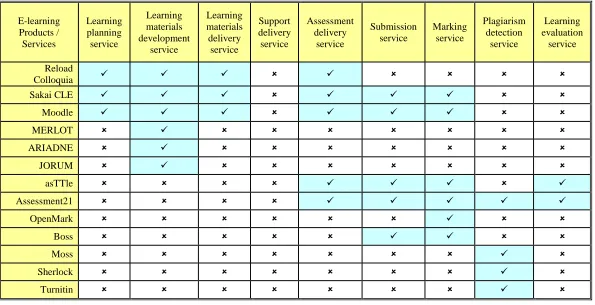
3.1 Mapping current e-learning products with our services ……… 85
3.2 Standards to represent e-learning data ……….. 92
4.1 Overview of service development products ………..…….. 113
5.1 Overview of methodology in experiment 2 ………...…………. 119
5.2 Comparison between ST and CT ………. 134
5.3 Findings for hypothesis 1 ……… 135
5.4 Findings for hypothesis 2 ……… 137
5.5a Comparison between current approach and service approach …………. 145
Acknowledgements
First of all, I would like to express my deep thanks to my supervisor, Dr. Mike Joy, for his expert guidance, positive criticism, support, and patience throughout the whole study. Without his encouragement, the completion and success of this thesis would not be possible. Special sincere goes to my advisor Dr. Nathan Griffiths, for his detailed and constructive feedback.
Special thanks also go to Dr. Liz Burd and Dr. Jane Sinclair for accepting the requests to be the examiners of my thesis, and providing valuable suggestions for improving my research. I also wish to thanks all contributors who have involved with the experiments throughout this research. Their inputs have helped me to gain valuable data and deep understandings on my work, as well as improving my skills in team working, communications, and project management.
I also would like to thank my colleagues and friends in the Department of Computer
Declarations
This thesis is presented in accordance with the regulations for the degree of Doctor of Philosophy. The contents of this thesis are a result of my own work, and it contains nothing that is based on collaborative research. It has been composed by myself and no
part of the work contained in this thesis has been submitted for any degree or qualification at any other university. Parts of the thesis have been published previously in book chapter, journal and conference papers, as follows.
Initial ideas in Chapter 1 and Chapter 2
S. Yang, M.S. Joy, “SOA Services in Higher Education”, Proceedings of the 7th
International Conference on Education and Educational Technology, Venice, Italy,
pp. 145-150 (2008).
Educational components of the framework in Chapter 3
S. Yang, M.S. Joy, “Designing E-Learning Services: A Case Study”, International
S. Yang, M.S. Joy, “Designing E-learning Services”, Proceedings of the
International Conference on E-Learning in the Workplace, New York, US, pp. 69-73
(2009).
Technical components of the framework in Chapter 4
S. Yang, M.S. Joy, “Service Advertisement and Discovery”, Book Chapter In:
Agent-Based Service-Oriented Computing, Springer, London, pp. 21-46 (2010).
S. Yang, M.S. Joy, T.H. Laine, “An Educational Services Architecture to Share
E-learning Resources”, Proceedings of the 3rd International Conference on Computer
Supported Education, Noordwijkerhout, Netherland, pp. 372-375 (2011).
Evaluation of the framework in Chapter 5
S. Yang, M.S. Joy, J.R.C. Nurse, “Experiences on Sharing E-Learning Resources
Using Service Technologies”, Proceedings of the 14th International Conference on
Computers and Advanced Technology in Education, Cambridge, UK, to appear
Abstract
Nowadays, the growing number of software tools to support e-learning and the data they rely upon are valuable resources, supporting different aspects of the complex learning and teaching processes, including designing learning content, delivering learning activities, and evaluating students’ learning performance. However, sharing these educational resources efficiently and effectively is a challenge: there are many resources, these have not been described accurately and in general they do not inter-operate, and it is common for the tools to rely on different technologies. This thesis explores a solution – a novel educational services framework – to improve the sharing of current e-resources, by applying the latest service technologies in the context of higher education. Our findings suggest that the proposed framework is effective to deal with the technical and educational issues in resource discovery, interoperability and reusability, however, there are still technical challenges remaining for implementing this service framework.
Chapter 1
Introduction
1.1
Background and problems
Educational resources (or e-learning resources, e-resources for short) refer to e-learning applications and their data that support different aspects of the complex learning and teaching processes, including designing learning contents, delivering learning activities,
and evaluating learning performance (Meyer et al., 2007). The typical data these applications handle include e-learning materials, assessment submissions and marks (Zhou et al., 2009). In practice, e-learning data and applications are mixed and cooperate together, and there are many varieties, as the functions and formats are different in each resource (Bean, 2010). For example, there are different types of e-learning materials, such as slides, videos and web texts, and there are different applications to process them, such as tools to create and modify them, tools to store and search them, and platforms to run them. The sharing of e-learning resources means redistribution, remix and reuse of currently available e-learning applications and their supported data (OKF, 2012).
Nowadays, e-learning has become increasingly popular. The number of software applications and the data they rely upon are growing (Butcher, 2006). These various applications can bring benefits to us, as they provide more options to meet different requirements. The rapid development of the Internet has potential to allow these resources to be accessible online (Su et al., 2007). However, sharing these educational resources efficiently and effectively is a challenge: a crucial problem that the field currently faces is that there is not enough sharing going on, hence people cannot fully benefit from these quality resources. There are many e-learning resources available, however they have not been described accurately, and in general they do not interoperate, data cannot be exchanged at all between resources. Furthermore, it is
common for the tools to rely on different implementation technologies, which further exacerbates the problem. There is also lack of management of these shared resources,
Below we review the resource sharing issues from both a university angle and a resource angle. Typical examples that are relevant within a university are listed first.
Data such as students’ records cannot be passed around easily between systems in
multiple departments and centrally managed university systems.
A highly recommended learning management system that has been deployed in one
department cannot be easily reused in other departments as the technical description of the system may not be available or accurate.
Teachers cannot discover and reuse quality e-learning materials for their students as
they are not aware of other repositories they can use in the UK and elsewhere.
Although many educational tools have been developed, they have still not been
described and organised properly, and some of them are not widely available and accessible for most learners and educators. Making selections to suit each user’s needs is not straightforward.
By only considering the sharing of a typical type of resource – e-learning materials – the following problems arise in resource description and discovery.
Users can only get access to a limited amount of reusable e-learning materials.
Discovering large amounts of e-learning materials takes a long time.
It is difficult to choose suitable learning materials.
It is difficult to select an appropriate learning platform to run these discovered
learning materials as the description of such platform is poor, for example the formats of learning materials may be incompatible with certain learning platforms.
Service Oriented Architecture and Web Service, which have become popular among academia and industry, offer a potential solution, largely due to their ability to facilitate discoverability, interoperability and reusability. Instead of the traditional methods for system design and coding, service software can be developed by wrapping and reconnecting existing applications (Fridayet al., 2004).
In this thesis, we explore a novel service oriented framework as a potential solution for these issues, to improve the sharing of current e-learning resources (Chung and Chao, 2007). By wrapping existing educational software as e-learning services, this allows resources to be outwardly described and linked, so that they can be better found,
accessed and reused, without much work being required for reimplementation (Erl, 2007).
1.2 Research purpose and questions
The aim of our research is to provide a deeper understanding on the topic of sharing current e-learning resources, by indentifying problems in current practices, developing solution to address them via service technologies, and evaluating how well the problems have been solved via our solution. We have only applied service technologies in this research, to explore how well this technology can cope with better reusing and sharing of current e-resources, developing better e-learning resources is beyond the scope of this research. The main question this research is attempting to answer is:
How to improve the sharing of current educational resources?
Our work is divided into 3 phases and guided by the following 5 research questions:
The second phase is to propose a solution to cope with the sharing problems – an educational services framework. This framework contains both educational and technical components. To indentify the educational components – e-learning services and their data flows – we have asked the question: What educational resources should
be shared and how to identify them (RQ2)? To indentify the technical components –
Educational Service Architecture – we have asked the question: How can identified educational resources be shared (RQ3)?
The third phase is to evaluate our solution from users and service developers’ perspectives, to find out that ifThe sharing if educational resources been improved via
our services framework (RQ4)? and What challenges are there while developing
educational services (RQ5)?
1.3
The concept of e-learning services
The word ‘service’ is used in multiple contexts, and there are many definitions. The generic definition of service in dictionaries relates to ‘the performance of work (a function) by one for another’ (Oxford English Dictionary, 2006). From an industrial perspective, IBM defines a service as ‘a provider/client interaction that creates and captures value’ (IBM ESB, 2012). In academia, Chung states that ‘a Service is the non-material equivalent of tangible goods’ (Chung, 2007) which, in this context, can be interpreted as a repeatable task, e.g. booking a hotel room.
In the educational domain, many processes support a university’s learning and teaching activities (Hazemi and Hailes, 2002). For example, the process of delivering a module, which might involve tasks such as designing the module, delivering the course content, assessing students, and evaluating students’ learning progress (Bierhoff, 2007). Resources support these tasks can be considered as e-learning services, and more than one service may be available to complete each task. Most of these tasks can (in principle) be performed by software provided by different e-learning vendors. Data such as course specifications, learners’ information and assignment data are reused and shared within and for communication between these services. The diagram 1.1 below illustrates the relationships between users, requirements, services and their providers.
Figure1.1: The concept of e-learning services Users
Requirements
Services
Providers Hotels
User B
Requirement Requirement Requirement
E-Services Human Services
Physical Services
1.4
Methodology
Due to the ‘proof of concept’ nature of our work, by indentifying what e-learning resources should be shared and how to share them, we will apply qualitative research strategies throughout the thesis (Miles and Huberman, 1994). Additionally, due to the limitations on time, human support and literature resources, we have applied the case study style of research to collect data for research questions 2, 4 and 5. We select a typical UK institution – The University of Warwick – as a single case to focus on throughout the whole research. Our findings would be strengthened and more reliable if we could apply two or more case studies across a number of universities, however, we might duplicate results by doing this, and access in other institutions to research
resources, such as staff, students and documents, would be restricted (Yin, 2009).
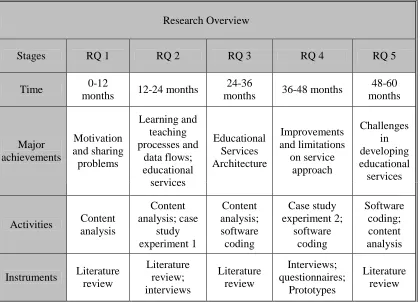
Research Overview
Stages RQ 1 RQ 2 RQ 3 RQ 4 RQ 5
Time 0-12
months 12-24 months
24-36
months 36-48 months
[image:23.612.122.542.346.648.2]Table 1.1 above outlines the research we have conducted. Our work involves research both in technology and education, and contains 5 stages, each one is guided by a research question. In the rest of this section, we will discuss each research question in detail, the research activities we have performed to answer that question, together with the overall achievements.
RQ 1: What limitations do we have in sharing current educational resources?
We have conducted a literature survey to explore the current developments in sharing educational software and their support data. The survey reviews varied educational
requirements in the context of higher education, current developments on e-learning resources, together with gaps and weaknesses in sharing these e-resources. These investigations reflect on what is happening, as well as the significant gaps and limitations, in the area of sharing and reusing current e-learning resources, and so motivate us to conduct the rest of research throughout the thesis.
RQ 2: What educational resources should be shared and how to identify them?
This research question focuses on the educational components in our service solution: educational resources could be shared as services and their relationships. Our solution is a novel educational services model that shows how current e-resources can be shared, and a case study has been used to identify these services and their relationships. We have also evaluated current e-learning applications that can be wrapped as services, and standards to represent their supporting e-learning data.
RQ 3: How can identified educational resources be shared?
workflow example, we then discuss the service principles our architecture has followed, and finally we discuss the state of the art on the implementation technologies that could develop educational services and components of our architecture.
RQ 4: Has the sharing of educational resources been improved via our services
framework?
In order to evaluate the effectiveness of our proposed services framework from the user angle, we have implemented part of our service framework, to study whether or not our service approach can improve the description and management of e-learning materials
within their repositories, and have compared the service approach with the approach that uses current technologies. This study provides direct evidence from users to suggest improvements that the service approach can bring in resource discovery, reusability and interoperability, as well as to suggest limitations of the current prototype.
RQ 5: What challenges are there while implementing the services framework?
1.5
Thesis organisation
In order to answer these research questions, our thesis is structured as the followings.
Chapter 2 deals with research question 1, beginning with reviewing the nature of learning and teaching, follow by current developments of e-learning resources and service technologies. This chapter also identifies gaps and problems in sharing current educational resources within existing research, hence provides motivation to conduct this research.
Chapter 3 describes the findings from experiment 1, where research question 2 is considered. We have indentified a set of e-learning resources that can be shared and reused within a typical educational institution via a case study. The experiment design, the methodology we have applied, as well as the findings, are presented.
Chapter 4 covers the development of the technical components of our services framework, to cope the limitations on resource discovery, reuse and interoperability. Research question 3 is addressed. We reflect on the implementation technologies that develop the e-learning services and the components of our architecture
Chapter 5 is the evaluation chapter, and answers research question 4. We have conducted our second case study experiment, which contains three distinct research phases, and the methodologies and findings are discussed. Evidence has been collected
to support the advantages and disadvantages of our proposed service approach as well as the current approach.
on service technologies to implement our framework.
Chapter 2
Literature Review
This chapter provides a foundation for our research, based on a thorough literature survey. It covers the terminologies, general development, limitations and gaps surrounding the area of sharing educational resources, which would motivate our
2.1
Educational resources
This section covers the concepts and current developments in educational resources. We
first begin with introducing our working definitions of educational resources, and then present the current developments, and consider in turn learning objects and their repositories, learning management systems and e-assessment tools. Finally we evaluate the weaknesses in current research, and highlight the areas we are going to address in later chapters.
2.1.1 Definitions
In the context of educational technology, educational resources (ER for short) are often understood as ‘Learning Objects’ that are stored in a digital repository as text or video files, which can be reused by many learners and educators. Tuomi (2005) argues that ER actually means something wider, and that educational software and information that are used for discussion, assessments, student support (such as help, feedback and advice) as part of the learning process, could also be viewed as resources. The Organisation for Economic Cooperation and Development (OECD) has also defined ER as ‘anything that can be used to organise and support learning experiences’, and includes the following components (OECD, 2007).
Learning contents: Materials published for learning or reference, such as courseware in MIT OCW, learning objects in ARIADNE, collections of references in Wikis.
Tools: Software for development and delivery of resources, such as Moodle and Blackboard.
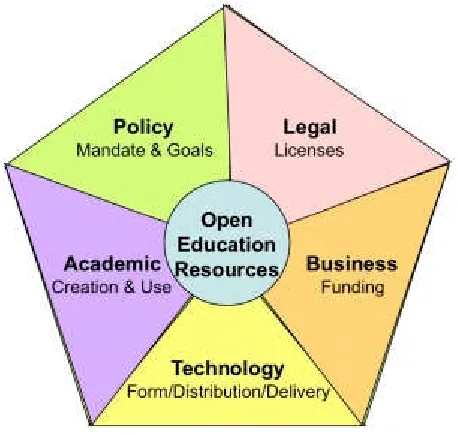
Our research has also considered both open and commercial educational resources. The term ‘Open Educational Resources’ (OER) was first defined by the United Nations Educational, Scientific and Cultural Organization (UNESCO) in 2002, as ‘the open provision of educational resources, enabled by information and communication technologies, for consultation, use and adaptation by a community of users for noncommercial purposes’, for the purpose of ‘promoting access, equity and quality in the spirit of the Universal Declaration of Human Rights’ (UNESCO, 2009). In 2005, The OECD has launched a further study on ER, and further clarified open ER as ‘digitised materials offered freely and openly for educators, students and self-learners to use and reuse teaching, learning and research’. The OECD (2007) has defined an idea
[image:30.612.214.443.340.558.2]status of openness, as that ‘the resources should be published in a format everyone can open without having to buy proprietary software’.
Figure 2.1: Educational resources with other factors (Stacey and Rominger, 2006)
e-learning resources in the domains of education (‘academic’ in figure 2.1) and technology, and have considered educational resources as learning and teaching supported technologies, which are classified as follows.
E-learning contents:these refer to digitised data or information that are accessible on computers for the purpose of supporting the learning experience. Typical examples include learning objects, students’ records, collections of references in Wikis.
E-learning applications: these refer to systems and tools that support daily learning and teaching activities, delivery of learning contents, such as learning
management systems and marking tools.
In practice, e-learning data and applications are mixed and collaborate together. Factors like copyright licenses, funding, institutional policies, network connections, computer hardware, are beyond the scope of our research.
2.1.2 Learning objects and their repositories
Learning objects are a typical example of educational resources. These should contain quality material, and together with their repositories form perhaps one of the most widely developed educational resources in the e-learning community. The following are some of the popular ones.
MIT OCW
MERLOT
Multimedia Educational Resources for Learning and Online Teaching (MERLOT) was developed by California State University in 1997, and funded by the US National Science Foundation. MERLOT is different from MIT OCW as OCW owns and maintains learning contents in its repository, whereas MERLOT only provides the descriptions and locations of learning resources they refer to, hence MERLOT is a typical ‘referatory’. By 2007, it has collected e-materials in 24 universities, 13 professional societies, and 10 digital libraries across North America. Another outstanding feature of MERLOT is that it provides peer reviews on each item of material, similar to those on Amazon. The review criteria include quality of content,
potential effectiveness and ease of use (Merlot, 2012).
ARIADNE
Alliance of Remote Instructional Authoring and Distribution Networks for Europe (ARIADNE) is a gateway for the foundation of the European Knowledge Pool. Similar to MERLOT, ARIADNE offers links and descriptions of e-learning materials in various European languages across the disciplines of science and social science, in order to promote collaboration between European educators and learners. The first stage of the ARIADNE European projects is to develop a network of learning repositories across the member institutions in the Netherlands, Belgium, France, Spain and Greece. The ARIADNE II projects aim to develop tools and methodologies to better create, manage and reuse web based educational resources. ARIADNE is alive since a number of ongoing projects are still taking place to develop e-resources in the subject areas of natural history, environmental cultural heritages and agricultural sciences (ARIADNE, 2012).
JORUM
now able to be discovered through ARIADNE.
OpenLearn
OpenLearn is a repository developed by the Open University in the UK. It has provided 5400 hours of open access learning contents online, and contains two sections: LearningSpace offers materials for learning online, and LabSpace allows contents to be reused and modified further (OpenLearn, 2012).
CORE
China Open Resources for Education (CORE) was established in 2003, after an MIT
OCW Conference was hold in Beijing. By 2007, 12 leading Chinese-speaking universities and other 210 member universities had made 750 courses available online. At the beginning, the CORE project was involved by translating MIT OCW materials to Chinese and made them available within Chinese universities. Since 2006, the main focus has shifted to help member universities to publish their own OER and bring Chinese contents to the rest of the world. Discussions are going on in the translation process because of ‘the cultural and pedagogical differences’ between the east and west (CORE, 2012).
Tables 2.1a and 2.1b below summarise the repositories we have discussed. The entries in the table refer to the informationpublicly advertised on the relevant web sites, since we are concerned with a user perspective on the type and availability of material in the repositories, and we can reasonably assume that the user is English speaking. As we can see, not all the information is publicly available to describe each category for each repository, and they are still very difficult to compare.
CORE is just described in Chinese. Of course, these ‘unknown’ entries can be filled in by enquiring directly from the repository managers, or translating the website in the case of CORE, but a user would be unlikely to do so.
Some entries are difficult to compare. For example, considering the material type for ARIADNE, it is unclear why so many types are listed. Does it mean that ARIADNE has more e-learning content than other repositories, or is it that the classification is more fine-grained? Poor descriptions of these repositories have prevented many people from discovering, understanding and comparing the materials there. Hence, it could be difficult for many users to select the suitable resources to use or share, as the
Table 2.1a: Developments on learning objects and their repositories
Learning objects and
repositories Location Languages Subjects Material Type
MIT OCW US
English, Spanish, Portuguese, Thai, Persian, Turkish, Chinese, Korean
Business, Energy,
Engineering, Fine Arts, Health and Medicine, Humanities, Mathematics, Science, Social Science, Society, Teaching and Education
Lecture notes, reading lists, problem sets, video, audio lectures, projects, labs, assignments, tools, animation.
MERLOT US All
Academic Support, Arts, Business, Education,
Humanities, Mathematics and Statistics, Science and Technology, Social Sciences, Workforce Development
Assignment, case study, ePortfolio, learning object, journal article, open-textbook, presentation slides, quiz/test, simulation, tutorial, workshop and training material.
ARIADNE West
Europe All Unknown
Image, presentation, web page, reference material, activities and labs, lesson plan, text, simulation, course, tutorial,
Table 2.1b: Developments on learning objects and their repositories
Learning objects and
repositories Location Languages Subjects Material Type
JORUM UK English
Architecture, Biological Sciences,
Business, Arts and Design, Languages and Literature, Education, Engineering, Historical and Philosophical studies, Law, Linguistics, Mathematical and Computer Sciences, Medicine and Dentistry, Physical Sciences, Social studies, Medicine,
Technologies, Veterinary Sciences, Agriculture et al.
Simple text files, references to external contents, learning objects, content packages, open courseware
OpenLearn-Learning
Space UK English
Arts and Humanities, Business and Management, Childhood and Youth, Computing and ICT, Education, Engineering and Technology, Environment, Languages, Law,
Mathematics and Statistics, Psychology, Social Science
Unknown
2.1.3 Learning management systems
The learning management systems, which support the development and delivery of e-learning contents, are also actively under development, and have become increasingly
powerful. Some typical ones are presented below.
Moodle
Moodle is one of the most popular Open Source learning management systems, which was originally developed by Martin Dougiamas to support e-learning activities. It contains features for e-assessment submission, markings, online discussions, online quizzes and Wikis. It also supports different formats of learning and assessment materials, such as SCORM and IMS QTI (Moodle, 2012). According to the provider’s specification, institutions use it as platform to conduct their full online courses, or to support part of their daily face to face courses (known as blended learning).
Sakai CLE
Sakai is another well known Open Source LMS. It includes many of the features common to LMSs, such as document authoring and delivery, assignment upload, online testing, marking, discussion, and live chat. This software tool is expanding its collaborative learning features for research and group projects. Sakai is a Java-based application which was released in 2005, and by 2008, over 250 institutions across the world had experienced this product (Sakai, 2012).
Blackboard
Table 2.2 below briefly compares the LMSs we have mentioned from a technical perspective. Again, each resource is different, and not all of the information that describes these systems is discoverable from the providers’ websites, for instance, how each LMS can integrate with other e-learning applications if needed, whether any documented API has been provided, or whether there is an available adapter which can be plugged in to enable system integration.
Learning management
systems Fee Installation
E-learning standards
Moodle Free Installed on local servers
SCORM IMS standards Local standards
Sakai Free Installed on local servers
IMS standards Local standards
Blackboard Commercial
Installed on local servers or hosted by Blackboard
Local standards
Table 2.2: Developments on learning management systems
2.1.4 E-assessment tools
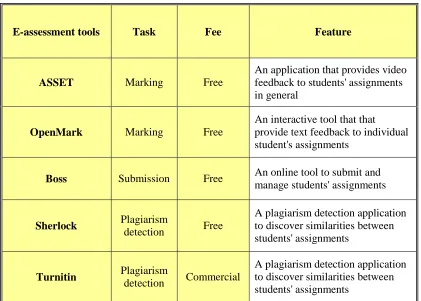
ASSET
ASSET is an e-assessment tool developed by the University of Reading. It aims to allow staff to record video media to provide feedback on their students’ assignments. However, the videos are designed for a group of students in general, rather than for individuals (Asset, 2012).
OpenMark
feature of this tool is providing marks and feedback on written assessments. Each student can also have multiple attempts, so that if their first answer is incorrect, they can have an immediate second, or third attempt, and this behaviour is configurable (OpenMark, 2012).
BOSS
BOSS is an Open Source submission tool that allows students submit their assignments online and allows staff to mark submissions and manage their students’ learning records efficiently. The software also supports the marking of computer programming assignments (Joyet al., 2005).
Sherlock
Sherlock is an Open Source plagiarism detection application that determines similarities between essays and computer source code files. It is available as part of the BOSS Online Submission System or as a stand-alone application (Sherlock, 2012).
Turnitin
Turnitin is a commercial plagiarism detection tool that can check for the originality of essays against material on the Internet. The provider has stated that it can not only be used to check for students’ submissions, but also to suggest students how to avoid plagiarism and improve their writing in the future (Turnitin, 2012).
E-assessment tools Task Fee Feature
ASSET Marking Free
An application that provides video feedback to students' assignments in general
OpenMark Marking Free
An interactive tool that that provide text feedback to individual student's assignments
Boss Submission Free An online tool to submit and
manage students' assignments
Sherlock Plagiarism
detection Free
A plagiarism detection application to discover similarities between students' assignments
Turnitin Plagiarism
detection Commercial
[image:40.612.119.540.69.370.2]A plagiarism detection application to discover similarities between students' assignments
Table 2.3: Developments on e-assessment tools
2.1.5 Evaluation of current educational resources
To our knowledge, limitations remain on the descriptions of current educational resources: most e-resources have not been described and compared properly (Liu and Fan, 2007; Kashfi and Razzazi, 2006). Hence, it is difficult for users to discover, understand and choose them.
resource. For example, missing or unclear information includes accepted formats for processing assignments in the e-assessment tools (see Table 2.3), and the material types in repositories OpenLearn and CORE (see Table 2.1). More fundamentally, potential users may not even know these resources exist at all.
Even if information is available to describe resources, it may be difficult to compare them. For instance, there is information available to describe types of materials contained in each repository, however, different repositories use their own words, some users might wonder how the ‘problem sets’ in MIT OCW are different from the ‘workshop and training materials’ in MERLOT or the ‘activities and labs’ in
ARIADNE (see Table 2.1). Hence, it could be difficult for users to choose the resources to use, as the similarities and differences amongst them are not obvious.
Even if meaningful information is available to describe current e-resources, the suitability for different types of users may not be clear. Educators and learners might be interested in the educational values of these resources, such as the topic area each tool can support, levels of difficulties, previous user feedback, and so on. Resource developers and educational administrators might be interested in the commercial and technical aspects of these resources, such as the cost to use the plagiarism detection tool Turnitin (see Table 2.3), how an LMS such as Moodle can be installed in their own university, and how an LMS can integrate with other existing systems within their university (see Table 2.2).
support the users’ learning and teaching experience (Arch-int et al., 2005). We will cover these in Chapter 3.
2.2
Service technologies
Service technologies have potential to support the discovery, reusability and interoperability of current educational resources (Ren et al., 2010). This section introduces what service technologies are about, and discusses current developments and applications.
2.2.1 The concepts
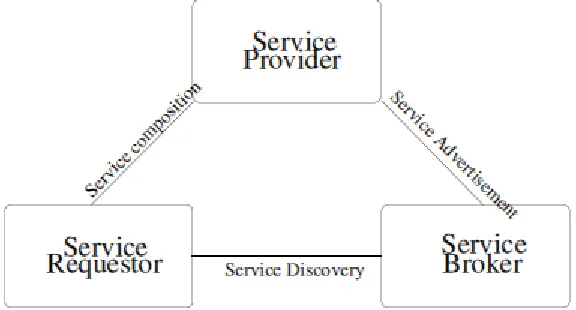
Service Oriented Computing (SOC) and its enabling technology Service Oriented Architecture (SOA) have become popular among academia and industry (Huhns and Singh, 2005). They represent a new paradigm for software development: instead of the traditional way of system design and coding, the service software is developed by reusing and reconnecting existing applications (Wang et al., 2004). SOA is ‘a system architecture in which a collection of loosely coupled services (individual software components) communicate with each other using standard interfaces and message exchanging protocols’ (Tsaiet al, 2007). Software components are grouped as services
which can be dynamically discovered and integrated over a network to achieve a common task or process (Yang and Joy, 2010).
function (Sauders et al., 2006), and the interface enables the interoperability between the services and users. The interface describes what the service is, using a standard definition language such as Web Service Description Language (WSDL), reads the users’ and/or other services’ requests and sends the responses back to them, and considers security issues while communicate with users and other services (Bierhoff et al., 2007).
Figure 2.2: Service oriented architecture (Yang and Joy, 2011a)
Most authors consider that a basic SOA consists of three different entities: service providers and requesters and a service broker (registry), and the relationships between
It is commonly agree that an SOA implements the following principles:
Discoverability means that information about each application is described and
stored in a service registry, so that potential users are able to search and compare available systems by querying the registry (Luciaet al.,2008). Advertising service information is normally considered at the same time as service discovery. Current research in service discovery focuses on how services are described, or specified, or published from a technical view, such as what standards people should adopt, or what architecture could be used effectively (Papazoglou and van den Heuvel Heuvel, 2007).
Interoperabilityrefers to the ability of multiple systems to operate with each other,
using different technologies, platforms and programming languages. Inter-system communication is based on standard message exchange mechanisms supported by service technologies (Erl, 2007).
Reusability means that a given functionality within a system can be called many
times and in different contexts without reimplementation (Catherall, 2005). Service technology allows existing systems to be better shared, hence making them easier to reuse (Zhouet al., 2009).
Composability: Service composition deals with combining small services into
larger ones to meet a specified goal (Verjus and Pourraz, 2007).
2.2.2 Features of services
Services can be viewed as repeatable tasks with functionality within a specific process (Quartel et al., 2007), and Bloomberg states that a service is ‘a chain of value creating
activities or events, which forms a process’ (Blomberg and Evenson, 2006). It is commonly agreed that all services should be ‘well defined’ (Nokano, 2007) and the
following is a list of their core features (Yang and Joy, 2009).
Self contained (or coarse grained). A service ‘maintains its own state’ (Jia et al.,
2007), services are ‘independent of the state or context of other services’ (Papazoglou and van den Heuvel, 2007), and ‘other has no control or authority over them’ (Verjus and Pourraz, 2007). A service can be accessed from any operating platform, using any appropriate communication device or programming language (Tsaiet al., 2007).
Loosely coupled. Loose coupling can be interpreted as a way that a user
communicates with the services which does not depend on the implementation of the service (Mohammadet al., 2006). It also means that new services can be added and existing services can be upgraded depending on the users’ requirements. Lukichev (2007) notes the importance of developing loosely coupled components, and loose coupling is seen as a significant service feature (Jia et al., 2007, Tsaiet al., 2007).
Accessible. In an SOA, services are offered by varied service providers, and may
be distributed and accessible over a network (Nakano, 2007). Furthermore, non-networked applications can be converted into networked services (Papazoglou and van den Heuvel, 2007), and the network could be either local or Internet based (Mohammadet al., 2006).
Interoperable. This is about exchanging messages between services. Many
definitions exist – for example, Janssen defines it as ‘the ability of two or more systems or components to exchange information and to use the information that has been exchanged’ (Marijn and Hans, 2007), and O’Brien stresses the need for communicating entities to operate on shared information ‘according to an agreed-upon operational semantics’ (Mohammad et al., 2006). It is commonly agreed that interoperability is one of the unique features for services, and is arguably essential (Martin et al., 2007), and message exchange is also considered as core (Katsionis and Virvou, 2008).
Reusable. This refers to the ability for services to be recalled repeatedly in order to
lower costs and increase efficiency. This feature is regarded as an important advantage and exists in many service descriptions (Dustdar and Juszczyk, 2007).
2.2.3 Service standards
Web service technology is one of the most well known technologies to implement a service-oriented architecture. It is commonly agreed that three basic standards are currently in use for web service discovery, interoperability and reusability (Campo et al., 2005), each with its own specific role:
SOAP: Communication – how services can be used WSDL: Description – how services can be published UDDI: Discovery – how services can be discovered
Fundamental to the efficacy of these standards is the use of a common communications language (Singh and Huhn, 2005), and XML is used by each. The communications protocol is defined by SOAP, and WSDL includes support for passing information
and find sufficient information for their deployment – an essential prerequisite if web services are to be meaningful. These standards have been developed by organisations including the World Wide Web Consortium (W3C) (SOA, 2012), OASIS (OASIS, 2012) and the Open Group (OG, 2012) since 2000.
SOAP
In the context of web services, SOAP (Simple Object Access Protocol) is regarded as the standard message protocol for exchanging XML data over the Internet. SOAP is a stateless paradigm which enables complex interactions between services through request/response exchanges and other unidirectional messages. However, SOAP lacks
support for the transmission of semantic data, such as routing and firewall traversal (Curberaet al., 2002). A SOAP message is essentially an XML element with two XML child elements, a head and a body. These contain descriptions of the message content and how to process it, encoding rules (for application-specific data types), and the representations of remote procedure calls and responses. This information is then wrapped into an envelope, and is bound to a transport protocol for the purposes of the actual information exchange. The following (Figure 2.3) is an example of a SOAP message for invoking a web service for getting a stock price, which is cited from the W3C School website (WS, 2012; Vermaet al., 2005).
< ? x m l v e rs i on = '1 . 0 ' ?> <soap : Envelope
xmlns : soap= 'http://www. w3. org/2001/12/soap-envelop e'
soap: encodingStyle= 'http://www. w3.org/2001/12/soap-encoding'> < s oa p :B od y x m l n s : m= 'h t t p :/ / w ww. e x a m p l e . or g / st o c k '>
<m: GetStockPrice>
<m: StockName>IBM</m: StockName> < / m : Ge t St o c k P ri c e>
WSDL
WSDL (Web Service Description Language) formally provides a model for describing interfaces for web services (Degwekar et al., 2007). A WSDL description specifies the location of the service, the operations for invoking and consuming the web service, and supports binding for defining message formats and protocol details. The following (Figure 2.4) is a typical structure of a WSDL document, which is cited from W3C School (WW, 2012; Curbera,et al., 2002):
< d e f i n i t i on s>
< t yp e s > d e f i n i t i o n o f t yp e s < / t yp e s >
<messa ge>d efinition of a messa ge</message> < p o rt T yp e > <operation>definition of a operation</operation> < / p o rt T yp e > <binding>definition of a binding</binding> < s e r v i c e>
< p o r t > d e f i n i t i o n o f a p o r t < / p o r t > < / s e r vi c e>
< / d e f i n i t i on s>
Figure 2.4: A sample of WSDL (WW, 2012)
A typical WSDL document contains the following elements. The type element specifies the complex data types for a message, which describe the data being communicated between the web service and the requester. A set of messages and their directions (input or output) form the operations the service exposes. A set of operations then forms a port type, for each of which the concrete protocol and data format specifications are referred
to as a binding. The association of a network address with a binding defines a port, and a collection of ports defines a service. In a single WSDL file multiple services can be described (Bean, 2010).
UDDI
UDDI (Universal Description, Discovery and Integration) is a registry of web service descriptions, allowing users (such as businesses) to publish descriptions of themselves and their services (together with technical information about service interfaces), and clients (such as customers) to identify appropriate service descriptions and create bindings to them (using SOAP) (UDDI, 2012). Wang et al. (2004) summarise a UDDI registry as being ‘similar to a CORBA trader and can be considered as a DNS service for business applications’. It serves as a generic data model for providing detailed web service specifications including business entities, technical access information, natural language descriptions, keyword-based classification scheme and relevant technical
specifications (Curberaet al., 2002).
The initial idea of maintaining a central registry for publicly available web services by large vendors, such as IBM or Microsoft, has been abandoned because a single repository cannot meet all the needs for different specific SOA systems (Yu, et al., 2006). Version 3 of the UDDI specification is over 400 pages long and contains over 300 function calls. This complexity (for end users) has led to the closure of the public UDDI Business registry and has hindered its widespread adoption, and has led to speculation that future registries will be private (Wu, 2007). As Chappell (2002) remarks: ‘the public registry UDDI is too complex for end users since UDDI specification is more driven by its primary members than feedback from the real world end users’. However, Baresi and Miraz (2006) also suggest that the central registry will continue to be important since not all companies will have the facilities for servicing requests locally, and Wu (2007) considers that ‘most private registries would focus on a specific, closed domain’.
update the registry and how to make queries. The information encoded by UDDI is of three possible types — white pages (names, contact information), yellow pages (categories of information based on service types) and green pages (technical data) (Curbera, 2002). A recent development is UDDIe, an extension to UDDIe which incorporates service leasing and replication. UDDIe includes the ability to search for services based on blue pages (user defined properties associated with a service). Support for service leases, by which a service is restricted to storage in the registry for a limited period of time, enhances the dynamic capabilities of the registry (ShaikhAli et al., 2003).
2.2.4 Service applications in different domains
In addition to e-learning, service technologies have been applied in a number of domains, including biomedicine, government and business (Kontogianniset al., 2007).
Some researchers have studied the idea of sharing resources using service technologies. For instance, Zheng and Bouguettaya (2005) have suggested applying ontologies and services to describe biological systems. Gonzalez and Balasooriya (2007) have stated a number of technical problems while they are attempting to share biomedical resources. Janssen and Scholl (2007) have suggested that interoperability between governmental organisations needs to be improved. Web services can cope with this at a technical level. However, social, legal and political factors might affect the practices.
Technologies have been developed to share resources using service technologies. For example, Caceres et al. (2006) have proposed a technical approach to describe the semantics of each healthcare application, in order to support the discovery of healthcare services. Vittorini et al. (2007) have proposed a service to analyse biomedical data
technical framework to link e-government systems together as services, and have mentioned benefits of having this, including saving time, cost, ease of modifying applications, and knowledge of services not required by users.
Research in business services is more advanced (Krishnan and Bhatia, 2007), and instead of service description and discovery, most of the work is related to technologies to support service composition, to cope with the changes of dynamic business processes (Chen and Huang, 2006). For example, Xiao’s approach (2007) on change impact analysis for business applications, Dai and Liu’s service framework (2006) to link dynamic collaborative applications in e-business environments. Bertoli and his
colleagues’ approach (2007) focuses on support business service composition, as does Zimmermann’s approach (2005).
2.2.5 Cloud computing
Cloud computing is another popular technology that has received lots of interest in academia and industry after web service technologies had been introduced. It uses the Internet (all that a user needs is a Web Brower) to allow users to simply access to different types of computing resources (we name themservicesnow), including storage space, software applications, and programming environments. It is simple because users do not need to be aware of the underlying infrastructure and location (Furht and Escalante, 2010).
Jeff Kaplan describes cloud computing as ‘a broad array of web-based services aimed at allowing users to obtain a wide range of functional capabilities on a pay-as-you-go basis’ with minimum hardware/software investments and professional skills required. Cloud computing is the ‘realization of the earlier ideals of utility computing without the technical complexities or complicated deployment worries’ (Vaqueroet al., 2010).
The US National Institute of Standards (NIST) views cloud computing as ‘a model for enabling ubiquitous, convenient, on demand network access to a shared pool of configurable computing resources that can be rapidly provisioned and released with minimal management effort or service provider interaction’ (Sitaram and Manjunath,
2011).
2.3
Diversity in education
This section reviews the nature of learning and teaching from the perspectives of both
individuals and institutions.
2.3.1 Learning as individuals
Learning and teaching is complex. It varies between individuals in different contexts. A number of theories have been introduced to address the diversity in individual learning, including Constructivism, Learning Styles, and Bloom’s Taxonomy.
Constructivism
Constructivists see learning as the results of mental construction. This learning theory is suggested to use to explain various phenomena in adult learning and development, as they view each learner as a unique individual with unique needs and backgrounds. Constructivism also stresses one of the learning principles: ‘learners need enough
previous knowledge and understanding to enable them to learn new things. They need help making links with new and previous knowledge explicit’ (Pritchard, 2005).
Learning styles
Bloom’s taxonomy
In 1956, Bloom developed a classification of levels of instructional objectives, which is widely considered in understanding the expectations of learning outcomes (Scott, 2003). He identifies six levels of concrete measurements, which are presented below, where knowledge is the lowest level, and evaluation is the highest level (Anderson et al., 2001).
Knowledge: remember data or information from previous learning materials.
Comprehension: understand the facts and ideas by translating, comparing and
interpreting. States a problem in own words.
Application: use a procedure to solve problems in new given situation
Analysis: break information into parts by identifying causes, inferences or
distinguishes.
Synthesis: puts parts together to form a whole meaning or structures.
Evaluation: make judgments on idea or material, based on criteria and standards.
These concepts have stressed the nature of diversity on learning and teaching. Educational experts argue that learners are different in terms of their backgrounds, the ways they learn, and their expected learning outcomes. These varieties suggest that people’s requirements are different, before, during, and after each learning activities are taken place. Charlesworth et al. (2007) also suggest that educators should apply different learning resources to meet different learners’ needs.
2.3.2 Learning and teaching processes within an institution
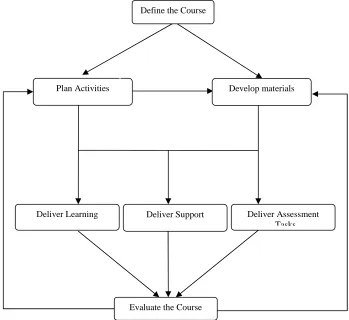
In the literature, educational experts have discussed individual learning and teaching processes in depth. For example, Alan Clarke (2001) has mentioned the processes of designing learning materials, learning activities and assessing learning outcomes in his work. Butcheret al.(2006) also addressed the processes of designing learning materials and assessment activities. In Biggs and Tang’s constructive alignment (2007), the authors have highlighted the need for delivering assessment tasks and learning activities. Inglis et al. (1999) and Forsyth et al. (1995) have explored the need for evaluating modules whilst they are being taught. Littlejohn and Pegler (2007) have classified the differences between academic and non-academic support. We summarise the processes that people have addressed as follows:
Design learning materials
Arrange learning activities
Arrange assessment activities
Evaluate the course
We have also studied a number of items of practical documentation across different departments in a typical UK institution – the University of Warwick – as a case study. The key documents include staff handbooks, student handbooks, undergraduate module guides, undergraduate assessment handbooks, tutor handbooks, postgraduate handbooks and others. These handbooks suggest rules and activities students and staff should follow in a variety of departments across the five faculties, including business, computer science, history, economics, and polities. The main daily needs in learning and teaching are highlighted below (DCS, 2005; DPIS, 2006; DH, 2006; WBS, 2007; DE, 2007):
Designing quality learning and assessment
Supervising projects and dissertations
Conducting examinations
Developing skills
Learning support
Personal tutoring
However, there are limitations in the current literature, and people have not stated all the major learning and teaching needs. In practice, most research and practical literature have only addressed these processes separately, there are few useful studies which examine how those tasks relate to each other, what educational information has been
exchanged between, and how (Yang and Joy, 2009). These have motivated us to gain a comprehensive understanding of educational processes in current practice, in terms of the sequences of daily learning and teaching activates (learning processes) and their data flows. A number of education experts have also addressed this gap. For example, Palomino-Ramírez et al. (2008) have discussed the learning flows and data flows problem, and have mentioned that there is not such specification available currently, and that typical e-learning development organisations such as the IMS ‘does not support the dataflow between e-learning tools’ (Charlesworthet al., 2007).
2.4 Sharing educational resources
The sharing of e-learning resources in our research refers to redistribution, remix and reuse of current available educational related data and applications. Our research involves investigating the varieties of educational requirements and learning supported
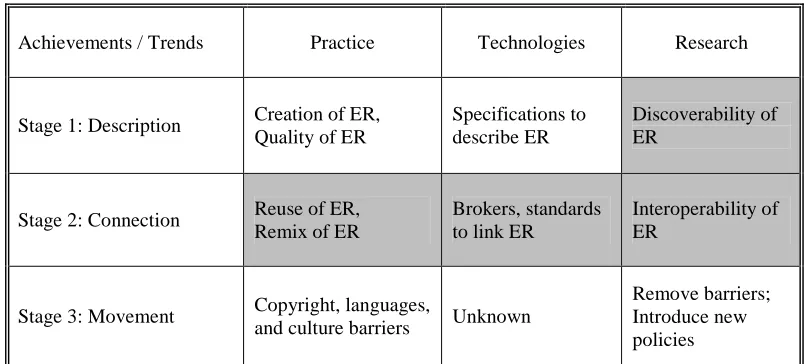
technologies, and providing the best possible matches and/or mappings between them. We argue that the sharing of ER contains 3 stages, the following (Table 2.1) summaries their developments in terms of research, practices and technologies. Texts in grey highlight areas we focus on in particular in the thesis.
Achievements / Trends Practice Technologies Research
Stage 1: Description Creation of ER, Quality of ER
Specifications to describe ER
Discoverability of ER
Stage 2: Connection Reuse of ER, Remix of ER
Brokers, standards to link ER
Interoperability of ER
Stage 3: Movement Copyright, languages,
and culture barriers Unknown
[image:57.612.126.529.275.457.2]Remove barriers; Introduce new policies
Table 2.4: Developments on the sharing of educational resources
2.4.1 Problems in sharing educational resources
The following issues in resource discovery, reuse and interoperability are highlighted in the literature. We have classified them as below.
Educational problems