warwick.ac.uk/lib-publications
Original citation:Geng, Yifan and Wharton, Sue. (2016) Evaluative language in discussion sections of doctoral theses : similarities and differences between L1 Chinese and L1 English writers. Journal of English for Academic Purposes, 22 . pp. 80-91.
Permanent WRAP URL:
http://wrap.warwick.ac.uk/75219
Copyright and reuse:
The Warwick Research Archive Portal (WRAP) makes this work by researchers of the University of Warwick available open access under the following conditions. Copyright © and all moral rights to the version of the paper presented here belong to the individual author(s) and/or other copyright owners. To the extent reasonable and practicable the material made available in WRAP has been checked for eligibility before being made available.
Copies of full items can be used for personal research or study, educational, or not-for-profit purposes without prior permission or charge. Provided that the authors, title and full bibliographic details are credited, a hyperlink and/or URL is given for the original metadata page and the content is not changed in any way.
Publisher’s statement:
© 2016, Elsevier. Licensed under the Creative Commons Attribution-NonCommercial-NoDerivatives 4.0 International http://creativecommons.org/licenses/by-nc-nd/4.0/
A note on versions:
The version presented here may differ from the published version or, version of record, if you wish to cite this item you are advised to consult the publisher’s version. Please see the ‘permanent WRAP URL’ above for details on accessing the published version and note that access may require a subscription.
1
Evaluative language in discussion sections of doctoral theses: similarities and differences between L1 Chinese and L1 English writers
Yifan Geng
School of International Studies
University of International Economics and Business Beijing
China.
Sue Wharton (corresponding author) Centre for Applied Linguistics
University of Warwick Coventry
UK
1
Evaluative language in discussion sections of doctoral theses: similarities and
differences between L1 Chinese and L1 English writers
Introduction
Previous research (e.g. Bitchener & Basturkmen, 2006, Chatterjee, 2008) has shown
that the discussion section of the doctoral thesis is a challenging part-genre (Dudley
Evans, 1998) to write. The doctoral thesis as a whole is a high-stakes genre, in which
writers must negotiate a dual identity: simultaneously as a student presenting
him/herself for examination, and as an expert demonstrating his/her credentials for
membership of a disciplinary elite (Carter, 2011; Carter & Blumenstein, 2011;
Koutsantoni, 2006; Paltridge & Starfield, 2007; Swales, 2004). The discussion section
is arguably the part of the thesis in which these two identities come into conflict
most acutely, since it is here that a writer is required to comment evaluatively on
his/her own work and also set it in the context of other work in the same field, with
the overall goal of showing the reader why the contribution of the doctoral research
is significant.
A discussion section requires skilful deployment not only of citation for attribution,
in order to demonstrate the writers’ display of knowledge, but also of citation for
evaluation, in order to demonstrate that the writer has succeed, to some extent, in
transforming knowledge and creating new knowledge (Parkinson, 2011). To make
the case for the significance of their own results, writers need to position themselves
and negotiate their own voice in the context of utterances made by others in the
research community. Bitchener & Basturkmen (2006) and Chatterjee (2008) both
show how this task is cognitively and linguistically challenging to thesis writers who
are, after all, attempting the genre for the first time. Bitchener & Basturkmen (2006)
discuss supervisors’ perceptions of where the difficulties lie; supervisors emphasise
the need for students to make sufficient links to previous literature when
interpreting their results, and to negotiate knowledge claims against the backdrop of
2
body of research on the doctoral thesis as a genre, comparatively little focus on the
deployment of evaluative language in the part-genre of the discussion.
Research on evaluative language in academic texts has tended, rather, to focus
either on published research articles (e.g. Bruce, 2014) or on student writing at
earlier stages of education. Within this second category, researchers have often
conducted comparisons of argumentative discourse produced by L1 and L2 writers,
and have tended to conclude that L2 student writers rely on a smaller range of
epistemic expressions and grammatical resources to realise interpersonal positioning
(Chen, 2010; Gabrielatos & McEnery, 2005; Hyland & Milton, 1997; McEnery & Kiffle,
2002).
Hyland and Milton (2007), comparing epistemic markers in argumentative essays by
Hong Kong and UK undergraduates, found that the ten most frequently occurring
markers accounted for three quarters of the total markers in the Hong Kong corpus.
The Hong Kong corpus contained more markers of certainty, whereas the UK corpus
contained more markers of probability and tentativeness. Similarly, Chen (2010)
found that L1 Chinese student writers were more likely than L1 English writers to
employ the item sure, but less likely to employ items such as possible (-ly) or
probably.
McEnery & Kiffle (2002), studying the writing of Master students, found that L1
Eritrean writers relied on a narrower range of epistemic markers than did L1 English
writers, tending to overuse modal verbs and adverbs of possibility. Gholami, Nejad,
& Pour (2014), studying the writing of Iranian undergraduates, concluded that they
used a low frequency of emphatics and attitude markers in conclusion sections of
argumentative essays. Hinkel (2003) notes that a group of Asian student writers used
notably more amplifiers and emphatics in their argumentative essays than did their
L1 English counterparts.
The widely-held view that L2 students use a smaller repertoire of interpersonal
3
research into the writing of students at pre-doctoral stages of education. For
students in an English medium doctoral programme and writing a thesis in English,
the situation is different: they are likely to be experienced in English academic
writing whatever their L1 is. In Swales’ (2004) terms, they are likely to be at least
‘narrowly English proficient’ and quite probably ‘broadly English proficient’.
The current research investigates the use of evaluative language in a corpus of
doctoral discussions written by L1 Chinese and L1 English writers. Its first research
question, based on the corpus as a whole, is: What patterns of textual evaluation are
salient in this part-genre? Its second research question, based on a comparison of
the L1 Chinese and L1 English sub-corpora, is: are there any systematic differences in
the patterns of textual evaluation which the two groups employ?
Research design
To answer these questions, we compiled a corpus consisting of twelve discussion
sections of theses in the discipline of Applied Linguistics, all successfully examined in
the same university department during a relatively short time span. The writers had
all participated in research activities organised by the department (methods
seminars, critiques of research papers etc.) but had not received specific training in
doctoral thesis writing outside of the supervision process itself.
Six of the discussion sections were from theses by L1 Chinese writers and six from L1
English writers. The assignment of a writer as an L1 Chinese or L1 English speaker
was based on a Chinese- or Anglophone- sounding name as well as educational and
other general background information mostly found in the Acknowledgments of the
theses. The resulting corpus contains 118, 971 words. The average word length per
text is 9,914, with 4,849 words in the shortest text and 13, 620 in the longest (see
Appendix for details of each text).
This is a small, specialised corpus designed to answer a specific research question
4
representativeness, balance and sampling of the corpus should all be determined by
the research question it is used to address. A small corpus was appropriate for the
‘qualitative, contextually informed analyses’ (Flowerdew, 2004: 18) which formed
the basis of our corpus annotation. As will be discussed below, texts in the corpus
were annotated manually at clause level and across clauses, with instantiations of
interpersonal meaning being highlighted and categorised via a qualitative,
interpretive process. This process of analysis and annotation was labour intensive,
requiring sensitive consideration of co-text and discussion between analysts.
Therefore a relatively small corpus was essential. Illustrations of our interpretations
of sections of text are given below as we explain our analytical framework and
discuss our results.
Approach to analysis
As was argued above, the discussion section of a doctoral thesis relies heavily on
evaluative language, since its purpose is to critically discuss the researcher’s findings
and how they fit into the wider field, making and sustaining arguments across
sections of text (Bunton, 1999). A suitable framework for investigating evaluative
language in such a context is Martin & White’s (2005) Appraisal Theory, which
examines ‘what is at stake interpersonally both in individual utterances and as the
text unfolds cumulatively’ (White, 2001: 8) and which presents interpersonal
meaning-making as primarily a matter of negotiating a position vis a vis prior
utterances and the actual or potential responses of others in a given communicative
context.
The Appraisal framework deals separately with language users’ attitudinal
positionings (via the Attitude sub-system) and positionings regarding propositional
meanings (via the Engagement sub-system). The Attitude sub-system categorises
expressions of attitude into Affect (expressions of emotion) Judgement (evaluations
of human behaviour) and Appreciation (evaluations of things or phenomena).
The Engagement sub-system categorises propositional statements on the basis of
5
monogloss) and then, if the possibility of dialogue is acknowledged, on the basis of
whether space for dialogue is opened up (expansive heterogloss) or shut down
(contractive heterogloss). A full description of the Appraisal framework is outside the
scope of this article, and readers are referred to Martin & White (2005).
A number of previous studies have used the Appraisal framework to investigate the
interpersonal dimension of academic language. Hood (2005) found that published
writers and Hong Kong student writers demonstrated different preferences for
Attitude options in the introductions of their respective texts; student writers tended
to rely on Judgement (e.g. ‘[they] neglect to observe…’) and Affect (e.g. ‘they usually
feel…depressed’), which constructed their texts as more personal and subjective
than the published texts, which relied more on Appreciation (e.g. ‘Peer review is a
useful technique’) (p. 27). Liu & Thompson (2009) contrasted Attitude choices in two
essays, one in English and one in Chinese, written by the same L1 Chinese
undergraduate student. They found fewer Judgement items in the Chinese text, and
suggested that this reflected an emphasis on ‘the use of language and rhetoric to
achieve social harmony’ (Liu & Thompson, 2009: 7).
Swain’s (2010) analysis of Attitude and Engagement in high and low score discussion
essays by L2 English undergraduates suggested that use of Engagement, rather than
use of Attitude, was the factor which best differentiated the high from the low
scoring group. The high score set contained a greater amount and wider range of
Engagement resources, as well as a better balance between expansive and
contractive options. Similar findings are reported by Brooke (2014) who notes that
higher rated undergraduate EFL writers create argumentation by using more
interpersonal resources for attribution and authorial endorsement or
disendorsement. Wu (2007), who compared the deployment of Engagement
resources in high and low rated essays by Singapore undergraduates, found a greater
prevalence of expansive engagement in high rated essays and a greater prevalence
of contractive options in low rated essays. Particularly, writers of lower rated essays
seemed to rely on Proclaim-Pronounce (a category which explicitly marks the
6
Disclaim: Counter/Deny (two categories which present the authorial voice as
rejecting a contrary proposition). In contrast, the higher rated essays made frequent
use of these categories as a strategy to introduce alternatives in order to reject
them.
It seems clear from previous research that the Engagement sub-system of the
Appraisal framework is a fruitful basis for the investigation of evaluative language in
discussions of doctoral theses. In the next section, we give an outline of this
subsystem and explain how we annotated our corpus. In our presentations of
results, we explain the categories of this sub-system in much more detail, while
simultaneously discussing examples from our own coded data.
Analytical framework and text annotation
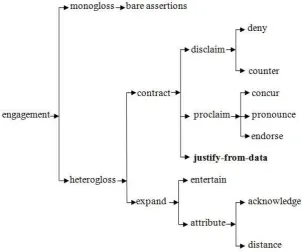
In outline, our framework is as follows:
Figure 1 Analytical framework used in this study, adapted from Martin & White
(2005)
Readers already familiar with Martin & White (2005) will notice that our diagram
includes an option, Justify-from-Data, which is not part of their original framework.
This is a category which emerged from our corpus investigation, and we propose
that it may be specific to the part-genre of discussion sections of doctoral theses in
the field examined. This category, as well as other categories shown in the above
figure, will be explained and exemplified with reference to our own coded data after
we have presented our approach to text annotation.
Texts in our corpus were annotated according to the above categories using UAM
Corpus Tool, a software programme which allows the user to define an annotation
scheme and then apply categories from the scheme to user-selected stretches of
7
framework is, of course, an interpretive act which involves a number of decisions.
The first of these was to decide whose interpersonal meanings we wished to code.
Following our research questions, we were interested only in instances of language
which expressed the writer’s own evaluations and interpersonal meanings. Stretches
of language which expressed the interpersonal positioning of any other voice – for
example, that of cited literature – were outside the scope of our study and were not
selected for coding.
A second decision involved the selection of text span for coding. Interpersonal
meanings are rarely carried by individual lexical items, so for each identification of
text realizing a category we highlighted that span of text which seemed to us to do
the most work in realizing the interpersonal meaning. In this sense our methodology
differed from that used by Hyland (2005, 2010) or Biber (2006) in their larger scale
corpus-based studies of evaluation in academic writing. Hyland (2005, 2010) worked
from an ‘a priori’ list of some 300 evaluative language items identified from previous
research; Biber (2006) focused on three pre-determined categories of evaluative
language (modal and semi-modal verbs, stance adverbs and stance complement
clauses). In our own research, in contrast, we selected any and all stretches of
language which expressed the writer’s evaluations in context.
Being conscious of the interpretive nature of our selections and analyses, we
discussed all stretches of language where we were in doubt about appropriate
coding. The first analyst made notes on any problematic items in a separate word file
before sending them to the second analyst for comment; points were then discussed
in a meeting. The following extract from notes is an example. It concerns a doubt
about how to interpret authorial position towards cited literature:
8
In the meeting which followed, both authors used UAM CorpusTool to retrieve this
example and looked at co-text to see if they could observe the text writer’s clear
alignment with Benson (2001). The discussion helped us to realise that it would
sometimes be necessary to look at long stretches of co-text before alignment or
disalignment with a cited source could be discerned.
UAM corpus tool contains a number of features which helped us to take a principled
approach to assigning interpersonal language features to categories in the
Engagement system, and to maintain consistency in our coding. The results of
annotation can be viewed in a variety of ways, for example all instances of a
particular analytical category, or all instances of a particular lexical item which
appear in any analytical category. Figures 1 to 3 in the Supplementary Data file,
show some examples.
By viewing our results in different ways and discussing them, we were able to
constantly revisit our coding decisions and alter our decisions regarding the coding
of individual segments if we found inconsistencies. Through this recursive process of
coding, checking and re-coding, including detailed discussion on points of doubt and
decisions of principle, we were able to arrive at a robust and consistent series of
annotations.
In the section below, we discuss patterns found in our corpus while simultaneously
giving illustrations of how the various categories of evaluative meaning were
realized. By giving examples of coded data, we seek to show our interpretations of
the categories. By commenting qualitatively on how texts in our corpus ‘typically’
made use of these categories of evaluative language, we address our first research
9 Results and discussion
The corpus as a whole
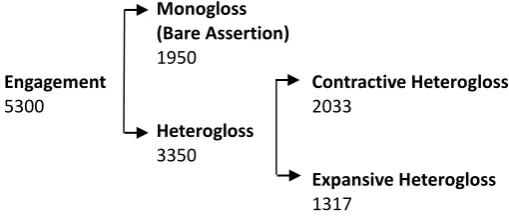
The corpus of 12 texts yielded a total of 5300 occurrences of Engagement
realisations, with the highest number in one text of 658, the lowest 183, and the
average 442 (see Appendix for more details of each text). Overall, there was one
occurrence of an engagement realisation every 22.4 words. This rate of occurrence is
comparable with that found in Hyland’s (2010) metadiscourse research on a much
larger corpus, and is therefore a good indication that our smaller corpus was
adequate in size for our research questions.
The broad distribution of Engagement resources in our corpus was as follows:
Figure 3 Engagement in the whole corpus
The first point of interest is the relatively high proportion of Monogloss (bare
assertion) realisations. Monogloss does not construe a background of diverse
viewpoints for the proposition being advanced; it construes a reader who holds the
same viewpoint or who will accept the proposition advanced as unproblematic.
Given the dialogic purpose of Discussion sections, the relatively high proportion of
Monogloss is counter-intuitive. However, qualitative examination of instances
indicates that most are metalanguage, such as a summary of a section,
cross-references to results that have been presented, e.g.:
1. This chapter brings together the data findings and explores Chinese
students' conceptions relatable to learner autonomy theory in the literature.
(Text 2: 261)
Also frequent are statements of ‘fact’ about the writer’s context which the
10
2. As China is undergoing a rapid transition from a planned socialist
economy to a market socialist economy, some values from the West are being
incorporated into the Chinese traditional value systems and some notions of
LC are also promoted in the recent educational reform. (Text 4: 238)
Less frequent, though interesting from a genre perspective, are propositions about
research or teaching which the reader construes as unlikely to be disputed by the
readership of the thesis, as in this example:
3 …the effects of exams on learner motivation depend on how
teachers present them in the classroom. (Text 5: 209).
Regarding Heterogloss, the number of contractive realisations, (n=2033), which
acknowledge alternative voices but shut down the possibility of dialogue, is roughly
1.5 times more than that of expansive features (n=1317) which open up the
possibility of dialogue. This is in contrast to what might have been expected given,
for example, Becher’s (1990) categorization of ELT/Applied Linguistics as a
soft-applied discipline, in which knowledge is “qualitative and reiterative” (Becher, 1990,
p. 335) and therefore tends to openly acknowledge other points of view.
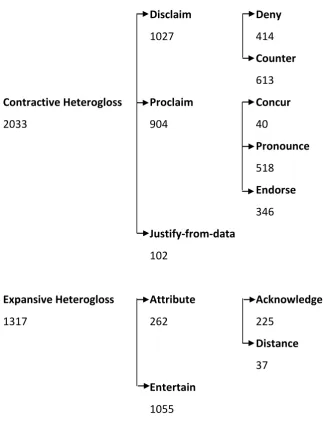
The following figure gives a more detailed distribution of Heteroglossic
sub-categories in our corpus:
Figure 4 Heterogloss Features in the Whole Corpus
Within contractive Heterogloss, the subcategory of Disclaim (n=1027) contains
slightly more instances than that of Proclaim (n=904). Disclaim involves the specific
resources of Deny and Counter. These options invoke prior utterances or alternative
views – but unlike expansive Heterogloss, they introduce such positions in order to
refute or replace them. According to Martin & White (2005: 120) Deny is often
realized by negation, and Counter by ‘conjunctions and connectives such as
11
used together in order to allow a writer to make very nuanced claims as to the value
of their findings, as in the example below:
4. The findings in this area of ‘reasons’ are therefore not generalizable
and require further investigation, although they are of some interest in
shedding light on an unexplored area. (Text 1: 210)
The subcategory Proclaim involves the resources Concur and Pronounce. Concur is
concerned with formulations such as naturally, obviously, whereby writers explicitly
construe a position as generally shared (Martin & White, 2005). In our corpus, such
realisations tend to reference positions which could be construed as shared within
the specialist readership of the thesis, rather than more generally. As such, they are
interesting indicators of writers’ assessments of community consensus.
5. This tension between the administration's edict to teachers to "follow
the textbook" and teacher autonomy naturally affected the students in the
classroom. (Text 8: 253)
Pronounce refers to formulations that explicitly present a position as convincing,
thus refuting any challenging position. Such formulations include ‘explicitly authorial
interventions’ (e.g. I contend…, The facts of the matter are that…) and ‘intensifiers
with clausal scope’ (e.g. really, indeed) (Martin & White, 2005: 127). An example
from this corpus is:
6. The importance of the inclusion of learner perspectives in the teacher
appraisal process certainly has relevance. (Text 9: 324)
By choosing this realization the writer emphasizes their commitment to the
proposition while simultaneously indicating awareness that others in the community
12
The option Endorse differs from Concur and Pronounce in that it engages with an
external voice which is presented as highly credible. By endorsing the external
utterance, the authorial voice is positioned as in alignment with it and as sharing
some responsibility for it. Typical realizations of Endorse given in Martin & White
(2005: 134) are formulations such as ‘the report demonstrates/shows/proves that...’.
However, in our corpus, realisations of endorse did not tend to rely on the reporting
verbs suggested in Martina & White. Rather, it was through a reading of co-text that
we could establish that the authorial voice was clearly associated with the attributed
voice, as shown by the following example:
7. Kyriacou (1987) argues that identifying incompetence has a negative
impact on teachers who may want to use the feedback to discuss problems,
and this is interesting when related to Hannah’s perspective [5.3.2.3]. (Text 9:
316)
In example 7 the authorial voice indicated its support for Kyriacou’s (1987)
proposition by the positive evaluation interesting and thus the writer positioned
him/herself as aligned with the attributed voice. In our corpus, the single main use of
Endorse was to indicate authorial alignment with cited literature, as in the above
example.
The option Justify from Data, which we have placed within the contractive
subcategory, is perhaps the most interesting in that it was generated inductively
from our corpus and so may be specific to the part-genre which we have
investigated. The category captures a position adopted by thesis writers as they
referred to their research data within the discussion sections. We found that
reference to own research data (usually data from interviews, questionnaires, and
teaching journals) in the discussion sections was an option used to close down
dialogue about the proposition being advanced, with the research data being used as
a basis to convince the reader. Our category has some elements in common with
13
of newspaper editorials. In the following example, the writer uses research data to
support his/her preceding proposition:
8. Students reported they were rather confused by the whole thing. As
one student commented: ‘I write the hook [name of a specific writing
technique] in the Mr. Sun’s class, he said no, you can’t write this on it, so I
think maybe it’s not a part of academic writing.’ (Text 8: 254)
Turning now to a discussion of Expansive Heterogloss in our corpus, we note that
Entertain occurred 1055 times and Attribute only 262 times. For our writers, then,
Entertain was the preferred means of opening up dialogic space for other potentially
diverse views. For Martin & White (2005: 105) typical realizations of Entertain
contain modal auxiliaries, adjuncts, and attributes of possibility; this was also true in
our corpus. Entertain was frequently used by writers as they made ‘generalised’
claims based on their own research, for example:
9. A failure to recognise teachers’ past achievements, experiences and
challenges is likely to alienate them and/or reduce their commitment
towards a new reform agenda. (Text 7)
Within the Attribute subsystem, it is interesting to note that in our corpus the ratio
of Distance (n=37) to Acknowledge (n=225) is about 1:6. Distance is a dialogic
expansive option which marks the authorial voice as disaligned from the attributed
position. Examples of Distance in Martin & White (2005) revolved mainly around
reporting verbs such as claim, however, in our data realizations of Distance were
more varied and more dependent on context. In our corpus, both L1 Chinese and L1
English writers typically used Distance in very similar ways – to argue against a
finding from previous research in order to promote their own research. In the
following example from an L1 Chinese writer, the author discussed new findings
about the use of CLT approach (Communicative Language Teaching) in Chinese
universities.
10. As indicated in the literature review (see 2.3), a basic reason for the
14
ideas advocated by CLT such as ‘learning-by-doing’ and equality between
teacher and learner are in contradiction with Chinese teaching and learning
culture, deeply influenced by Confucianism. Butthe findings showed that
CLT is considered by certain participants as being fundamentally harmonious
with the essence of Confucianism. In addition, unlike what was indicated in
the literature review that the constraints of CLT are mainly at cultural level,
the findings suggested that the major constraints of CLT seem to be more at
technical and ideological levels instead. (Text 6: 242)
The author first referred to previous researcher Hu (2002) who argued the
contradiction between the principles of CLT and Chinese teaching and learning
culture; however, the author explicitly showed her disalignment from Hu’s (2002)
view by use of Counter (But). She then promoted her own finding via Pronounce (the
findings showed that…), which reduced the dialogic space for others questioning the
authorial proposition. The author continued to refer to previous literature that
attributed the constraints of CLT to Chinese culture, but did this in order to distance
herself from this view, as signaled by the semantic contrast (unlike). She then
presented the opposite view that the constraints of CLT are more at technical and
ideological levels but construed this authorial view as “located in some individual
subjectivity, in some individual assessment of likelihood or of the available evidence”
(White, 2001, p.6) by means of Entertain (the findings suggested that…). In contrast
to the smaller dialogic space for alternative views created by Pronounce as used in
the first part of the example this use of Entertain expanded such space for potential
disagreement.
In the corpus overall,uses of Distance to disalign from previous literature were more
likely to be co-articulated with contractive resources (Pronounce and Endorse) than
expansive resources (Entertain) when these writers positioned their own different
findings or views against the previous ones from which they disaligned. This
15
to close down the dialogic space by increasing the “interpersonal cost of any
rejection/doubting” of authorial propositions in the ongoing communication (White,
2001, p. 5).
Acknowledge, like Distance, references an external voice; but whereas Distance
positions the writer as disaligned with that external voice, Acknowledge positions
the writer as neutral towards it. In the following example, again referring to previous
literature, the writer references an external voice but his/her own position vis à vis
that voice is not made explicit:
11. However, except for Daoud and Celce-Murcia (1979), who propose a
post-use evaluation using the same checklist as for pre-use evaluation,
others do not provide concrete suggestions for in-use and post-use
evaluation. (Text 1: 199)
In our corpus, then, the options of Endorse, Attribute and Acknowledgewere all
used by writers to position themselves vis à vis cited literature. As was seen in Figure
7, Endorse is the most frequently used of the three, followed by Attribute and then
Distance. This sparse use of Distance in the current corpus may imply a relatively low
number of different findings between the 12 authors’ own and other research;
alternatively, it may imply that the writers are hesitant about explicitly criticizing
published findings due to the potential risk of being challenged or refuted by the
reader.
In the sections above, we have examined evaluative language in our data in some
detail, using the Appraisal framework. In this way we have begun to build at least a
partial picture of the discussion section of a doctoral thesis in ELT/Applied Linguistics
16
Our (admittedly small) dataset shows that writers use more Monogloss than may
have been supposed. This arises partly through the use of cross reference or the
assertion of ‘simple’ facts, but it also includes the use of bare assertions to reference
views that the authors judge likely to be shared within their community. In these
cases, Monoglossic realisations can be interpreted as functioning as invoked
evaluation.
When writers in our corpus opened up dialogic space, they used more Entertain
realisations than Attribute realisations. This may be due to their desire to focus on
discussion of their own research (rather than to over-reference the research of
others) combined with their awareness that readers would expect strong claims to
be expressed with a degree of dialogic awareness.
Comparisons between sub-corpora
Having looked at the overall picture of evaluative language in the sub-genre
investigated, we now turn to compare the two sub-corpora of L1 Chinese and L1
English writers to see whether there are any systematic differences between them.
To do this we first normalised raw counts to frequencies per 1,000 words.
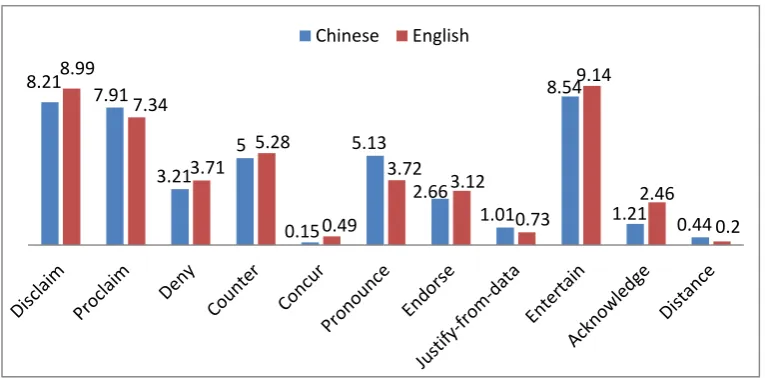
The figures below present comparison at different levels of delicacy; Figure 5 looks
at Engagement overall, Figure 6 divides Engagement into Monogloss and
Heterogloss, and Figure 7 compares all sub-categories of Heterogloss.
In this section we discuss similarities and differences between the normalised
frequencies in the two sub-corpora, but it is important to note from the outset that
none of the differences that we found proved to be statistically significant. The
17
Figure 5 Normalised frequencies (per 1000 words) of Engagement features across
two sub-corpora
Figure 6 Normalised frequencies (per 1000 words) of Monogloss and Heterogloss
features across two sub-corpora
Figure 5 shows that overall, the L1C sub-corpus contains slightly more instances of
Engagement than the L1E sub-corpus. Then as can be seen from Figure 6,
heteroglossic options were more often used than the monoglossic option (Bare
Assertion) across both sub-corpora, although the difference between the number
per 1,000 words of Bare Assertion and Heterogloss in the L1C corpus (n=9.5) is
smaller than such difference in the L1E corpus (n=13.67). This result suggests that the
L1 English writers seemed to be slightly more conscious of engaging with alternative
voices than did the L1 Chinese writers.
Figure 7 Normalized Frequencies (per 1,000 words) of Sub-categories of Heterogloss
across Two Sub-corpora
Figure 7 above shows that, within the contractive subsystem, Disclaim was preferred
to Proclaim by both the L1 Chinese and L1 English writers, which is in contrast with
previous research which suggests that L1 Chinese writers are particularly likely to
make strong, assertive statements (Chen, 2010; Hu & Cao, 2014; Hyland & Milton,
1997). It is however in line with research into other types of academic writing, for
example Lancaster’s (2011) finding that Disclaim rather than Proclaim was the more
frequently used contractive option in the data (four argumentative texts in
18
As for expansive resources, Entertain was the most frequently employed option by
both the L1Chinese and L1 English writers. This is again in contrast with the
suggestion from previous research that Chinese writers tend to intensified assertions
in argumentative essays. However, it is in line with tendencies observed in some
broader research, for example Fryer’s (2013) finding that Entertain had the highest
frequency of occurrence in medical research articles and showed the highest density
in discussion sections of those articles, or Swain’s (2010) identification of Entertain
as the most widely used option in discussion essays written by undergraduate
students.
The number of Distance categorisations per 1,000 words in the L1C sub-corpus
(n=0.44) is more than twice that in the L1E sub-corpus (n=0.2). The finding that the L1
Chinese writers used more Distance, thus explicitly disalinging from sources, appears
surprising in the light of previous research (e.g. Hood, 2004; Bitchener &
Basturkmen, 2006) which argues that Chinese students are in general reluctant to
critique. The L1 Chinese writers’ preference for Pronounce indicates that, compared
with their counterparts, they seemed to be more inclined to directly intervene in the
text by presenting themselves as responsible for the new proposition being
advanced. It is worth noting that Wu (2007), who compared higher and lower rated
essays, also found a difference regarding Pronounce, with a preference for it being a
characteristic of the lower-rated set.
A final interesting point of comparison is in the techniques used by each group to
bring in external support for their assertions. Figure 7 shows that the L1 Chinese
writers used more Pronounce, Justify-from-data, and Distance than did the L1
English writers, but the former group used less of the rest of heteroglossic options
than did the latter group. The L1 Chinese writers’ more frequent use of
Justify-from-data suggests that they seemed to prefer using reference to the research
19
12. None use the checklist method discussed in section 6.2.1. This might
be attributed to many teachers not being aware of the existence of published
lists of criteria. All but T3 in the interviews reported thatthey had not taken
any training course in textbook evaluation. (Text 1: 199)
In contrast, the L1 English writers’ more frequent use of Endorse seems to indicate
that this group of writers preferred referring to literature for the support of authorial
assertions.
13. In a discussion of the difficulties inherent in attempting complex
change,Fullan (1991a) suggests that“the answer seems to be to break
complex changes into components and implement them in a divisible and/or
incremental manner" (p. 72). This seems tobe in line with teacher C’s
suggestion in 5.4.1 that for TOC it is preferable to implement the teaching
part before changing the assessment aspects. (Text 7: 277)
All the comparisons discussed above have shown differences in using some
Engagement options by the two groups of writers – but, as was stated above, none
of the differences proved to be statistically significant. We tested for statistical
significance using the Mann-Whitney U test, in accordance with two principles
suggested by Gries (2014): the type of study being conducted and the type of
variables involved. The study compares two independent data sets; there is no
relationship between the observations of the use of Appraisal options in each of the
L1C and L1E sub-corpora or between the two sub-corpora. Therefore, our research is
a type of study which is designed to describe the ‘differences among texts and text
varieties’ (Biber & Jones, 2009: 1290). Each text is treated as ‘an observation’, and
the ‘rates of occurrence’ of linguistic features are interval variables that can be
20
distribution of data was not assumed, making a non-parametric test appropriate.
(Field, 2009; Oakes, 1998). The Mann-Whitney U test satisfies all our requirements,
and so a two-tailed test (p<0.05) was run on all data sets.
Test results for Engagement overall showed that the normalized frequency of
Engagement in the L1C sub-corpus (Mdn = 44.39) did not differ significantly from that
in the L1E sub-corpus (Mdn = 43.37), U = 16.00, p = 0.818, r = -0.09 (see Table 1 in
Supplementary Data file). This result is at odds with many previous studies which
observed differences in using interpersonal language by L1Chinese and L1English
writers, albeit at lower education levels (e.g. Chen, 2010; Hinkel, 1997, 2003; Hyland
& Milton, 1997). It suggests that, as language proficiency increases and experience in
academic education accumulates, L1 Chinese writers, at least those in this study,
have taken good command of making interpersonal meanings in thesis writing.
The statistical test also confirmed that there is no significant difference in the use of
Bare Assertions and Heterogloss by the L1 Chinese writers and the L1 English writers,
U = 10.00 and 17.00, p = 0.240 and 0.937, r = -0.37 and -0.05, respectively (see Table
2 in Supplementary Data file). As noted above, Swain’s (2010) research showed that
non-native undergraduates generally experienced more difficulty with effective
deployment of Engagement resources. However, the L1 Chinese doctoral students in
our study seemed to show similar rhetorical behaviour in using Engagement to their
L1 English counterparts, particularly in terms of the relative frequency. Furthermore,
the similar use of Heterogloss seems to indicate both groups of writers’ awareness of
engaging with the reader and construing dialogic divergences in their texts.
Conclusion
Our overall conclusion, that the difference in the patterns of use of Engagement
resources by the two groups is not statistically significant, refutes the view that
21
(2011: 308) argument against the assumption that all Chinese students have some
‘key traits of ‘Chineseness’’ such as ‘preserving and maintaining public image’. In
fact, the finding that the L1 Chinese writers in this research employed a large
amount of Entertain counters previous views which have ascribed Chinese writers’
tendency to overuse of strong assertions to the notion that Chinese rhetoric favours
such a style (e.g. Chen, 2010). The evidence from our own small and context-specific
dataset suggests that at the highest level of education, writers’ first language may
not exert as much impact on academic writing as it arguably does when writers are
at a lower level. The L1 Chinese writers in our study had developed a good command
of resources to evaluate others’ research and to make their own propositions in a
way that their academic discourse community finds acceptable. The L1 Chinese and
the L1 English groups both wrote their theses in the same discipline and in the same
academic department. It would seem that through this process, both groups became
‘academically literate’ (Lea & Street, 1998: 158) in terms of deploying interpersonal
language.
Previous research has also suggested that local institutional culture may influence
writers’ deployment of interpersonal resources; for example Li & Wharton (2012)
found that context, rather than discipline, was an influencing factor in writers’
metadiscourse choices. Dahl (2004) argues that patterning of textual metadiscourse
is influenced both by disciplinary culture and by L1 writing culture, but also shows
that disciplinary culture can transcend national culture in research writing in
disciplines such as Medicine with a stable and homogeneous knowledge base and
structure for research reporting. Our study intentionally selected theses from a
single discipline in order to avoid the possible complication of the influence of
different disciplinary epistemologies. It therefore cannot be generalized to other
disciplines, but it does indicate that the discipline under study may have been a
homogenizing factor.
Given the limitations of our own study, a number of future research possibilities
might be suggested. For example, future research could examine other aspects of
22
from other disciplines in Social Science. It may also be interesting to compare
Appraisal features in doctoral theses by L1 English and L1 Chinese writers in the
same discipline as investigated here, but from different institutions, in order to see
whether institutional provenance seems to be an influencing factor.
When we began this research, our underlying assumption was that we would
discover that L1 Chinese and L1 English writers were using at least some aspects of
evaluative language differently. Our finding that this was not the case challenges
‘deficit’ assumptions, and lends support to those who argue that the challenges of
academic literacy, and of specific genre proficiency, are not a matter of language
proficiency or language experience per se. Rather, our findings suggest that
competence in this area of language use is developed via the PhD journey as
undertaken within a specific institutional context.
PhD students are, after all, typically exposed to a large amount of generic modelling
and associated critical discussion. They read past theses, write documents (such as
interim research reports) that are in some senses thesis-like, and discuss drafts with
their supervisors and other academic staff. Supervisors discuss language choices in
drafts with all students, not only with those writing in their L2. We would suggest
that this process, undergone by all twelve writers in our corpus, has led all of them
to an appropriate genre-specific command of evaluative language.
References
Becher, T. (1990). The counter-culture of specialisation. European Journal of
Education, 25(3), 333-346.
Biber, D., & Jones, J. (2009). Quantitative methods in corpus linguistics. In A. Lüdeling
& M. Kytö (Eds.), Corpus linguistics (Vol. 2): An international handbook (pp.
23
Bitchener, J., & Basturkmen, H. (2006). Perceptions of the difficulties of postgraduate
L1 thesis students writing the discussion section. Journal of English for
Academic Purposes,5, 4-18. http://dx.doi.org/10.1016/j.jeap.2005.10.002
Brooke, M. (2014). Attribution and authorial (dis)endorsement in high- and
low-rated undergraduate ESL students’ English academic persuasive essays.
English Linguistics Research, 3(1), 1-11. doi:10.5430/elr.v3n1p1
Bruce, I. (2014). Expressing criticality in the literature review in research article
introductions in applied linguistics and psychology. English for Specific
Purposes,36, 85-96. http://dx.doi.org/10.1016/j.esp.2014.06.004
Bunton, D. (1999). The use of higher level metatext in Ph.D theses. English for
Specific Purposes,18, S41-S56.
Carter, S. (2011). Doctorate as genre. Higher Education Research and Development,
30(6), 725-736.
Carter, S., & Blumenstein, M. (2011). Thesis structure: Student experience and
attempts towards solution. In K. Krause, M. Buckridge, C. Grimmer & S.
Purbrick-Illek (Eds.) Research and development in higher education:
Reshaping higher education, 34 (pp. 95–107). Gold Coast: Higher Education
Research and Development Society of Australasia, Inc.
Chen, H. (2010). Contrastive leaner corpus analysis of epistemic modality and
interlanguage pragmatic competence in L2 writing. Arizona Working Papers
in SLA & Teaching,17, 27-51. Retrieved from
http://www.coh.arizona.edu/AWP/Volumes.htm
Chatterjee, M. (2008). Textual engagement of a different kind? Bridging Discourse:
ASFLA 2007 Online Proceedings (pp. 1-15). Australia: Australian Systemic
Functional Linguistics Association.
Dahl, T. (2004). Textual metadiscourse in research articles: A marker of national
culture or of academic discipline? Journal of Pragmatics,36, 1807-1825.
Dudley-Evans, T. (1998). Introduction. In I. Fortanet, S. Posteguillo, J. Palmer, & J. Coll
(Eds.), Genre studies in English for academic purposes (pp. 9-14). Castellón de
la Plana: Publicacions de la Universitat Jaume I.
Field, A. (2009). Discovering statistics using SPSS (3rd ed.). London: SAGE Publications
24
Flowerdew, L. (2004). The argument for using English specialized corpora to
understand academic and professional language. In U. Connor & T. Upton
(Eds.), Discourse in the professions: Perspectives from corpus linguistics (pp.
11-36). Amsterdam: John Benjamins Publishing Company.
Gabrielatos, C., & McEnery, T. (2005). Epistemic modality in MA dissertations. In
Fuertes Olivera, Pedro A. (Ed.), Lengua y sociedad: Investigaciones recientes
en lingüística y filologíano. 61(pp. 311-331). Valladolid: Universidad de
Valladolid.
Gholami, J., Nejad, S., & Pour, J. (2014). Metadiscourse markers misuses: A study of
EFL learners’ argumentative essays. Procedia - Social and Behavioral Sciences,
98, 580-589. doi:10.1016/j.sbspro.2014.03.454
Gries, S. (2014). Basic significance testing. In R. Podesva & D. Sharma (Eds.), Research
methods in linguistics (pp. 1-19). Cambridge: Cambridge University Press.
Retrieved from
http://www.linguistics.ucsb.edu/faculty/stgries/research/ToApp_STG_BasicSi
gnTesting_ResMethLing.pdf
Lancaster, Z. (2011). Interpersonal stance in L1 and L2 students’ argumentative
writing in Economics: Implications for faculty development in WAC/WID
programs. Across the Disciplines, 8(4). Retrieved from
http://wac.colostate.edu/atd/ell/lancaster.cfm
Liu, X., & Thompson, P. (2009). Attitude in students’ argumentative writing: A
contrastive perspective. University of Reading Language Studies Working
Papers,1, 3-15.
Hinkel, E. (1997). Indirectness in L1 and L2 academic writing. Journal of Pragmatics,
27, 361-386.
Hinkel, E. (2003). Adverbial markers and tone in L1 and L2 students’ writing. Journal
of Pragmatics,35, 1049-1068.
Hood, S. (2004). Appraising research: Taking a stance in academic writing
(Unpublished doctoral thesis). University of Technology, Sydney.
Hood, S. (2005). Managing attitude in undergraduate writing: A focus on the
25
academic writing: Contextualized frameworks (pp. 24-44). New York, NY:
Continuum.
Hu, G., & Cao, F. (2011). Hedging and boosting in abstracts of applied linguistics
articles: A comparative study of English- and Chinese-medium journals.
Journal of Pragmatics,43, 2795-2809. doi:10.1016/j.pragma.2011.04.007
Hunston, S. (2002). Corpora in applied linguistics. Cambridge: Cambridge University
Press.
Hyland, K. (2010). Metadiscourse: Mapping interactions in academic writing. Nordic
Journal of English Studies,9(2), 125-143. Retrieved from
http://hdl.handle.net/10722/130125
Hyland, K., & Milton, J. (1997). Qualification and certainty in L1 and L2 students’
writing. Journal of Second Language Writing,6(2), 183-205.
Koutsantoni, D. (2006). Rhetorical strategies in engineering research articles and
research theses: Advanced academic literacy and relations of power. Journal
of English for Academic Purposes,5, 19-36. doi:10.1016/j.jeap.2005.11.002
Lea, M., & Street, B. (1999). Student writing in higher education: An academic
literacies approach. Studies in Higher Education, 23(2), 157-172. Essex:
Addison Wesley Longman Limited.
http://dx.doi.org/10.1080/03075079812331380364
Li, T., & Wharton, S. (2012). Metadiscourse repertoire of L1 Mandarin
undergraduates writing in English: A cross-contextual, cross-disciplinary study.
Journal Of English For Academic Purposes, 11(4), 345-356.
http://dx.doi.org/10.1016/j.jeap.2012.07.004
Martin, J. R., & White, P.R.R. (2005). The language of evaluation: Appraisal in English.
New York, NY: Palgrave Macmillan.
McEnery, T., Xiao, R., & Tono, Y. (2006). Corpus-based language studies: An
advanced resource book. New York, NY: Routledge.
Paltridge, B., & Starfield, S. (2007). Thesis and dissertation writing in a second
language: A handbook for supervisors. New York, NY: Routledge.
Parkinson, J. (2011). The Discussion section as argument: The language used to prove
knowledge claims. English for Specific Purposes,30, 164-175.
26
Petrić, B. (2007). Rhetorical functions of citations in high- and low-rated master’s
theses. Journal of English for Academic Purposes,6, 238-253.
doi:10.1016/j.jeap.2007.09.002
Pilcher, N., Cortazzi, M., & Jin, L. (2011). Different waves crashing into different
coastlines? Mainland Chinese learners doing postgraduate dissertations in
the UK. In L. Jin & M. Cortazzi (Eds.), Researching cultures of learning:
International perspectives on language learning and education (pp. 292-313).
Hampshire: Palgrave MacMillan.
Swain, E. (2010). Getting engaged: Dialogistic positioning in novice academic
discussion writing. In E. Swain (Ed.), Thresholds and potentialities of systemic
functional linguistics: Multilingual, multimodal and other specialised
discourses (pp. 291-317). Trieste: EUT Edizioni Università di Trieste. Retrieved
from http://hdl.handle.net/10077/3647
Swales, J. (2004). Research genres: Explorations and applications. Cambridge:
Cambridge University Press.
White, P. (2001). Engagement. In Appraisal: An overview. Retrieved from
http://grammatics.com/appraisal/AppraisalGuide/Framed/Frame.htm
White, P. (2012). Exploring the axiological workings of ‘reporter voice’ news stories—
Attribution and attitudinal position. Discourse, Context & Media,1, 52-67.
Wu, S. M. (2007). The use of engagement resources in high- and low-rated
undergraduate geography essays. Journal of English for Academic Purposes,
27 Appendix: Texts in the corpus
Word length
of text
Number of
Engagement features
Engagement features
per 1,000 words
Writer’s first
language
Text 1 6059 292 48.2 Chinese
Text 2 13041 658 50.5 Chinese
Text 3 8127 371 45.7 Chinese
Text 4 9376 393 42.0 Chinese
Text 5 12779 552 43.2 Chinese
Text 6 4849 183 37.7 Chinese
Text 7 7875 381 48.4 English
Text 8 12733 529 41.5 English
Text 9 10232 555 54.2 English
Text 10 13620 610 44.8 English
Text 11 10775 378 35.1 English
28 Tables and Figures
Figure 1 Analytical framework used in this study, adapted from Martin & White (2005)
Figure 2 Extract from analyst notes
“The freedom in learning that learners can exercise has always been a major concern of many autonomy advocates (e.g. Benson, 2001; 2006a). For example,
Benson (2001) emphasised important aspects of such freedom as being the free
choice of the learning contents and of the learning process.”
[Analyst comment] An example of Engagement: Proclaim: Endorse?
29 Monogloss
(Bare Assertion) 1950
Engagement 5300
Contractive Heterogloss 2033
Heterogloss 3350
[image:31.595.88.343.140.248.2]Expansive Heterogloss 1317
30 Disclaim
1027
Deny
414
Counter
613
Contractive Heterogloss
2033
Proclaim
904
Concur
40
Pronounce
518
Endorse
346
Justify-from-data
102
Expansive Heterogloss
1317
Attribute
262
Acknowledge
225
Distance
37
Entertain
[image:32.595.87.411.101.535.2]1055
31
[image:33.595.90.395.305.460.2]Figure 5 Normalised frequencies (per 1000 words) of Engagement features across two sub-corpora
Figure 6 Normalised frequencies (per 1000 words) of Monogloss and Heterogloss features across two sub-corpora
Figure 7 Normalized Frequencies (per 1,000 words) of Sub-categories of Heterogloss across Two Sub-corpora
45.16 44.04
Engagement
L1 Chinese L1 English
17.83
27.33
15.18
28.85
Monogloss (Bare Assertion) Heterogloss
L1 Chinese L1 English
8.21
7.91
3.21 5
0.15
5.13
2.66
1.01 8.54
1.21 0.44
8.99
7.34
3.71 5.28
0.49 3.72
3.12
0.73 9.14
2.46 0.2
[image:33.595.89.472.534.723.2]