warwick.ac.uk/lib-publications
Original citation:
O'Regan, David D., Hine, Nicholas, Payne, Mike C. and Mostofi, Arash A.. (2012)
Linear-scaling DFT+U with full local orbital optimization. Physical Review B (Condensed Matter and
Materials Physics), 85 (8). 085107.
Permanent WRAP URL:
http://wrap.warwick.ac.uk/78156
Copyright and reuse:
The Warwick Research Archive Portal (WRAP) makes this work by researchers of the
University of Warwick available open access under the following conditions. Copyright ©
and all moral rights to the version of the paper presented here belong to the individual
author(s) and/or other copyright owners. To the extent reasonable and practicable the
material made available in WRAP has been checked for eligibility before being made
available.
Copies of full items can be used for personal research or study, educational, or not-for-profit
purposes without prior permission or charge. Provided that the authors, title and full
bibliographic details are credited, a hyperlink and/or URL is given for the original metadata
page and the content is not changed in any way.
Publisher statement:
© 2012 American Physical Society
A note on versions:
The version presented here may differ from the published version or, version of record, if
you wish to cite this item you are advised to consult the publisher’s version. Please see the
‘permanent WRAP URL’ above for details on accessing the published version and note that
access may require a subscription.
Linear-scaling DFT+U with full local orbital optimization
David D. O’Regan,1, 2,∗ Nicholas D. M. Hine,1, 3 Mike C. Payne,1 and Arash A. Mostofi3
1
Cavendish Laboratory, University of Cambridge, J. J. Thomson Avenue, Cambridge CB3 0HE, United Kingdom
2
Theory and Simulation of Materials, École Polytechnique Fédérale de Lausanne, 1015 Lausanne, Switzerland
3
The Thomas Young Centre and the Department of Materials, Imperial College London, London SW7 2AZ, United Kingdom
(Dated: 13 February 2012)
We present an approach to the DFT+U method (Density Functional Theory + Hubbard model)
within which the computational effort for calculation of ground state energies and forces scales linearly with system size. We employ a formulation of the Hubbard model using nonorthogonal projector functions to define the localized subspaces, and apply it to a local-orbital DFT method including in situ orbital optimization. The resulting approach thus combines linear-scaling and systematic variational convergence. We demonstrate the scaling of the method by applying it to nickel oxide nano-clusters with sizes exceeding7,000atoms.
PACS numbers: 71.15.Mb, 71.15.Ap, 31.15.aq
I. INTRODUCTION
The success of the Kohn-Sham formulation of density
functional theory (DFT)1,2 is largely owed to its
capa-bility of accurately and reliably reproducing the ground-state properties of quantum-mechanical systems. Two factors that limit the applicability of DFT are the com-putational expense of treating large systems, and the difficulties encountered in simulating so-called “strongly-correlated” systems. The realistic study of many techno-logically and biotechno-logically important structures requires the explicit treatment of very large system sizes, yet the asymptotic scaling of conventional DFT algorithms is cu-bic in the number of atoms, so that the feasible size
limit for routine calculations is typically around 1,000
atoms even on powerful high-performance computing ar-chitectures. Only by using DFT codes for which the ef-fort increases linearly with system size, recently reviewed
in Ref. 3 and examples of which include ONETEP4–6,
OPENMX7,8, and CONQUEST9,10, we may routinely
bring first-principles simulation to bear on pertinent technological, environmental and medical problems. Fur-thermore, for many functional materials, most typically comprising open-shell first-row transition metal or lan-thanoid ions, DFT with local or semi-local functionals performs very poorly, failing to obtain qualitative agree-ment with experiagree-mental observations in the most severe cases. Many methods have been developed to overcome
this deficiency, and here we focus on the DFT+U11
tech-nique due to its widespread adoption and its amenability to linear-scaling implementation.
In this article, we present a computational method-ology to tackle the obstacles of large system size and strong correlation effects simultaneously. Working in the framework of a linear-scaling implementation of DFT in order to tackle the issue of system size, we fully detail a
DFT+U implementation, including self-consistent
total-energies and forces, and demonstrate computational scal-ing tests on a strongly interactscal-ing oxide system of over
7,000atoms. Previous linear-scaling or otherwise
large-scale implementations of DFT+U, examples including
Refs. 12–14, have relied on a basis of fixed user-defined or numerically pre-solved atomic orbitals. A notewor-thy advantage of our approach is that we allow for the optimization of the orbitals representing the Kohn-Sham
density-matrixin situ, that is during the process of
total-energy minimization, with respect to an underlying,
sys-tematic plane-wave basis4,15. In this manner, we move
beyond the fixed-orbital approximation to linear-scaling
DFT and DFT+U. Using this approach, truly
first-principles simulations may be carried out on systems comprising both strong electronic interactions and large spatial disorder, examples including layered transition-metal and lanthanoid oxide structures, catalytic surfaces, molecular magnets and organometallic biomolecules.
The article is organized as follows. We describe
the DFT+U technique and its generalization to the
nonorthogonal case in Section II, after which we intro-duce linear-scaling DFT and define the notation and
sparse matrix algebra for linear-scaling DFT+U in
Sec-tion III. MinimizaSec-tion of the DFT+U total-energy with
respect to the density-matrix is detailed in Section IV. The method is applied to nickel oxide clusters exceeding
7,000atoms in Section V, and linear-scaling performance
is demonstrated. Following some concluding remarks, we detail the method used to preserve the density-matrix idempotency and normalization in Appendices A and B,
and to compute the DFT+U ionic forces in Appendix C.
II. DFT+U METHOD FOR NONORTHOGONAL
PROJECTORS
The use of approximations such as the local
spin-density approximation (LSDA)16, for the
exchange-correlation (XC) functional in Kohn-Sham DFT, is ap-propriate and highly successful in systems where the
compared with the Coulomb interactionU acting on it.
In such systems, usually comprising elements whose 3d
or 4f atomic-like states are either completely empty or
filled, the LSDA typically provides a good qualitative de-scription of both the ground-state density and the insu-lating gap. In strongly correlated systems such as
Mott-Hubbard insulators17, however, these states are localized,
partially occupied, and do not fall in the regime ofU ≪t.
In such cases, the LSDA may thus perform very poorly
unless it is corrected. The DFT+U method11
reintro-duces the explicit Coulomb interaction terms, and thus the appropriate derivative discontinuity with respect to electronic occupation number, to the approximate XC functional.
In the DFT + Hubbard U method (DFT+U)11, a
number of spatially localized subspaces, sites labeled I,
wherein the U ≪ t regime is not expected to hold, are
selected for supplementation with explicit Coulomb cor-relations beyond the LSDA level, retaining the bare, in-expensive XC functional for the remainder of the system. The strongly interacting subspaces are spanned by sets of
localized orbitals, termed the Hubbard projectors{ϕ(mI)}.
The selection of Hubbard projectors is a topic of interest in itself and possible choices include localized Wannier functions built from the Kohn-Sham eigenfunctions
ac-cording to maximal localization18,19, energy
downfold-ing20 or maximal Coulomb repulsion21 criteria, or
in-deed a total-energy minimization criterion in combina-tion with a self-consistency scheme, as we have proposed in a related article, Ref. 22. In the description of our linear-scaling method, here we assume only that the pro-jectors are confined to a spatial region, real-valued, and expressed in the same underlying, systematic basis as the orbitals representing the Kohn-Sham density-matrix (in the present case a truncated set of plane waves).
In the tensorial representation, developed in order to maintain the tensorial invariance of subspace
occupan-cies, moments, ionic forces and the total-energy23,
local-ized Hubbard projector duals are defined by24
Omm(I)′ =hϕ (I)
m|ϕ
(I)
m′i; |ϕ
(I)mi=|
ϕ(mI)′iO (I)m′m
, (1)
where, by definition, Omm(I)′′O
(I)m′′m′
=δmm′, such that
an individual metric tensor O(I) is generated and used
for each subspace. The occupancy matrix is then most conveniently expressed as a mixed tensor (specifically a tensor with one contravariant index and one covariant index), following Refs. 23 and 25, so that its trace is a tensorial invariant, as per
n(I)(σ)mm′ =hϕ
(I)m|ˆρ(σ)|ϕ(I)
m′i. (2)
Here, ρˆ(σ) is the single-particle density-matrix for
elec-trons of spinσ, formally defined by
ˆ
ρ(σ)=X i
|ψi(σ)ifi(σ)hψ(iσ)|, (3)
where fi(σ) is the occupancy of the Kohn-Sham orbital
|ψi(σ)i. Using this definition, we can cast the
rotationally-invariant DFT+U functional of Refs. 26 and 27 into a
more general, tensorially invariant form – that is invari-ant under arbitrary linear combinations of the Hubbard projectors for a given site, following Ref. 23. Specifically, we use a tensorially invariant generalization of the
widely-used, simplified DFT+U functional of Ref. 28, where the
energy functional is given by EDF T+U = EDF T +EU,
with
EU = X
Iσ
U(I)
2
n(I)(σ)mm−n(I)(σ)mm′n(I)(σ)mm′
, (4)
andU(I)is the screened subspace-averaged Coulomb
re-pulsion. The DFT+U penalty functional approximately
emulates the exact exchange-correlation functional by in-troducing a derivative discontinuity in the total-energy with respect to the occupancy matrix, in effect mately enforcing the unrestricted Hartree-Fock
approxi-mation within the subspacesI.
III. LINEAR-SCALING DFT+U
We now describe the steps necessary to perform
DFT+U calculations with linear-scaling expense. We
have previously demonstrated the features of projector
self-consistency22 and tensorial invariance23, in our
im-plementation of the method in the ONETEP code4,5,
however the method described in this article is applicable
to linear-scaling DFT methods3 generally. The method
is rigorously general to the case of nonorthogonality of both the local orbitals and the Hubbard projectors.
A. Framework and notation
Linear-scaling DFT revolves around the optimization not of the eigenstates of the Kohn-Sham Hamiltonian, but of the density-matrix of Eqn. 3 expressed in terms of a
set of nonorthogonal local orbitals,{|φαi}(known in the
ONETEP code as Nonorthogonal Generalized Wannier
Functions, NGWFs15), that is
ˆ
ρ(σ)=|φαiK(σ)αβhφβ|, (5)
where the tensor K is known as the density kernel and
is generally non-diagonal. The exponential spatial
local-ization of the density matrix for insulating materials29,
ρ(σ)(r,r′) =hr|ρˆ(σ)|r′i ∼exp (−γ|r−r′|), (6)
must be exploited to achieve linear-scaling, by strictly limiting the spatial extent of the local orbitals and trun-cating the density kernel to an appropriate length-scale. The contravariant duals of the local orbitals are
3
orbitals is the inverse of the covariant metricS, so that
Sαβ=hφα|φβi, Sαβ=hφα|φβi= S−1 αβ
. (7)
We emphasize that the metric S on the local orbitals,
generally a large matrix containing information about
the entire system, and the individual metric O(I) on
each DFT+U subspace, a small matrix (usually5×5for
3d-type subspaces) and a localized quantity, are distinct
even in cases where the Hubbard projectors are selected as a proper subset of the local orbitals.
The occupation matrix for each subspace is expressed in terms of local orbital matrix elements by inserting the expansion of the density-matrix, Eq. 5, into the natu-ral occupancy representation of Eq. 2. Making use of the transformation rules for Hubbard projectors given by Eq. 1, we find that
n(I)(σ)mm′ =O (I)mm′′
hϕ(mI)′′|φαiK(σ)αβhφβ|ϕ(mI)′i. (8)
We denote the overlap between Hubbard projectors
{|ϕ(mI)i}and local orbitals{|φαi} by
Vβm(I)=hφβ|ϕ(mI)i; Wmα(I) =Vαm(I)†=hϕ(mI)|φαi, (9)
which may be very sparse matrices, particularly for a
low density of subspaces. The DFT+U correction to
the total-energy, given by Eqn. 4, is then computed with linear-scaling cost using the sparse matrix trace
EU = X
I,σ
U(I)
2 Tr
OW KV 1−OW KV(I)(σ)
. (10)
We have assumed throughout, for notational clarity, that identical Hubbard projectors are used for each spin
chan-nel, although the generalization toσ-dependent Hubbard
projectors, and thusσ-dependentO,V, andW matrices,
is straightforward.
B. Efficient use of matrix sparsity
The DFT+Ufunctional of Eqn. 10, does not depend on
the inter-site occupancy matrices generated using Hub-bard projectors for different subspaces, although the
gen-eralization to inter-site occupancies, DFT+U+V, has
been introduced in Ref. 30. In DFT+U, these non-local
occupancies do not contribute to EU and thus should
not be computed unnecessarily. On the other hand, it is undesirable from the point of view of both ease of im-plementation and computational efficiency to explicitly
store separateV(I),W(I)andO(I)matrices for each site,
thereby necessitating individual matrix products for each site before explicit summation in, for example, Eqn. 10.
Our solution is to embed these small transformation
matrices into large, though very sparse,V,W andO
ma-trices for the entire system, where they then fit seamlessly into the hierarchical, parallelized, sparse algebra routines
found in a contemporary linear-scaling DFT code5,6. The
overlapOmatrix is block-diagonal in either its covariant
or contravariant form, the dimension of each block being the number of projectors spanning the subspace on the
site in question, typically 5(7)for a subspace of 3d(4f)
orbital symmetry. The Hubbard interaction parameters
are also placed into a sparse matrixU for the entire
sys-tem, of the same sparsity of O, although, in practice,
diagonal in the simplest case of a scalar parameter on
each site. TheV matrix has the row sparsity of the
or-bital overlap matrixS, depending on the orbital cutoff
radii, and the column sparsity ofO;W is its transpose.
Let us take as an example the computation of the oc-cupancy matrix given by Eqn. 8. We henceforth sup-press the spin index for notational simplicity, on the understanding that the density kernel, its derivatives and derivatives with respect to it are generally spin-dependent. Working from left to right, temporarily plac-ing a site index before each projector index to clarify to which subspace it belongs, we first consider the product
(OW)(I)mβ′ = X J
O(I)m′(J)m′′W(J)m′′β (11)
=O(I)m′(I)m′′W(I)m′′β,
which is a matrix with the same sparsity pattern asW
due to the block-sparsity of theO matrix. Next, taking
the product with the density kernel on the right, as per
(OW K)(I)m′α= (OW)(I)mβ′Kβα, (12)
we see that this matrix has the sparsity of W K, dense
in the row index when no density-kernel truncation is applied. When kernel truncation is enforced, however,
the number of values which α can take is reduced and
the effort needed for the sum overβ is diminished.
On the final step, where we compute
n(I)(mJ′)m= (OW K)(I)m′αVα(J)m, (13)
we accumulate extraneous information on the inter-subspace non-locality of the density-matrix. Were we to compute this matrix in full and then consider its square, we would find that
X
K
n(I)(mK′)mn(K)(Im)m′ 6=n (I)m′
(I)mn
(I)m
(I)m′, (14)
the former being generated in the full matrix product, while only the latter is required in Eqn. 4. This problem is resolved by always truncating the occupancy matrix
n(I)(mI′)m= (OW K)(I)m′αVα(I)m (15)
to the block-diagonal sparsity pattern asOin advanceof
computing such products, eliminating the off-site occu-pancies. In practice, the unnecessary elements are never actually computed, and no wasted effort is incurred, since the sparse algebra system computes only elements in the
Matrix sparsity thus plays an important role in the
construction of our linear-scaling DFT+U method, as it
permits DFT+U calculations involving a large number
of subspaces to be carried out efficiently. We hereafter suppress the site index, both to clarify the notation and to reflect the fact that the matrix operations are
imple-mented in practice in terms of calls to sparse algebra
subroutines which take the matrices V,W,O andU as
arguments, and not their site-indexed counterparts.
IV. OPTIMIZATION OF THE
DENSITY-MATRIX
In order to minimize the total-energy with respect to the density-matrix with linear-scaling cost, while afford-ing it the variational freedom of a systematically improv-able basis, it is performed in two nested conjugate gra-dients minimization loops. We first describe the inner loop, in Section IV A, a methodology common to many contemporary linear-scaling codes, where the energy is minimized with respect to the density kernel for a fixed set of local orbitals.
In the outer loop, the local orbitals{|φαi}which span
the Hilbert space available to the density-matrix are op-timized in order to minimize the total-energy. This tech-nique is used to obviate the choice of a fixed local orbital basis, and numerous variations have been previously
de-scribed4,15,31–37. The orbitals are assumed to be
trun-cated to some region, in order to allow for linear-scaling cost, and refined with respect to the underlying basis,
for a fixed density kernel Kαβ, in a manner which is
furthermore compatible with a linear-scaling method for optimizing local orbitals for unoccupied states recently proposed in Ref. 38. We return to discuss the orbital optimization technique in Section IV B.
Recent success with the DFT+U method and its
gen-eralization to inter-site interactions, DFT+U+V30,
en-courages us to think of DFT+U as a true method for
first-principles energetics39–42. We have therefore
imple-mented the DFT+U forces terms, as well as the
total-energy minimization scheme, in the ONETEP code of
which the capability of accurately optimizing geometries
has been previously demonstrated43. We describe the
required methodology in Appendix C.
A. Kernel Optimization
Minimization of the energy with respect to the density kernel is typically carried out, in practice, using a
gener-alization of the Li-Nunes-Vanderbilt (LNV) technique44,
which simultaneously drives the density-matrix to idem-potency while it evolves towards commutativity with its corresponding Kohn-Sham Hamiltonian. In this section however, for clarity, we assume that the energy may be straightforwardly minimized with respect to the density kernel. We return to the adaptations to the density kernel
optimization method required for idempotency preserva-tion in Appendix A.
The DFT+U contribution to the Hamiltonian is thus
simply given by the derivative of the DFT+U energy
term of Eqn. 4 with respect to an arbitrary density kernel, that is
HβαU =
U
2
n∂nm m
∂Kαβ −
∂nm′ m
∂Kαβn m
m′−n m′
m
∂nm m′
∂Kαβ o
. (16)
In order to simplify this derivative, we begin by noting that the partial derivative of the occupation matrix with respect to the density kernel is given by
∂nm′ m
∂Kαβ =
∂ ∂Kαβ
h
Om′m′′Wm′′γKγδVδm i
(17)
=Om′m′′Wm′′γδγαδδβVδm
=Om′m′′Wm′′αVβm.
The trace of this derivative over Hubbard projectors gives the covariant, local-orbital representation of the sum of projections over subspaces, which is a Hermitian tensor by construction, given by
∂nmm
∂Kαβ =VβmOmm ′′
Wm′′α≡Pβα. (18)
It follows that the products of the occupancy matrix and its derivative, each always computed in terms of the Hub-bard projector indices, in practice, since there they have
the block-diagonal sparsity pattern ofO, are given by
∂nmm′′′
∂Kαβn m′′
m= (OW) m′
α(P KV)βm and (19)
nmm′′′
∂nm′′ m
∂Kαβ = (OW KP) m′
αVβm′. (20)
As a result, the DFT+U term in the covariant
Hamilto-nian, denoted byHU, may be succinctly expressed as
HβαU = ∂EU
∂Kαβ =
U
2 (P−2P KP)βα. (21)
The DFT+U contribution to the total-energy is
effi-ciently computed, correspondingly, using the trace
EU =U
2 (P K−P KP K) α
α . (22)
The DFT+U Hamiltonian and total-energy terms are
added to their uncorrected DFT counterparts, giving
Hαβ=HαβDF T +HαβU andE=EDF T+EU, respectively,
and similarly for the independent-particle, or
“band-structure” energyEIP =EIP
DF T +EUIP, where EDF T 6=
EIPDF T =HαβDF TKβα andEU 6=EUIP =HαβU Kβα.
For a refinement of the auxiliary density kernel Kαβ,
5
with the contravariant metric tensor on the orbitals, that is their inverse overlap matrix evaluated at the point at which the gradient itself is computed, to give
Gαβ= S−1αγ
Hγδ S−1 δβ
. (23)
The inner product of two second-order tensors, X and
Y, is defined with respect to the metric S on the local
orbitals, so that
hX|YiS =XαβYβα=XαβSβγYγδSδα. (24)
This allows us to define the search direction norm
kGkS = hG|Gi1S/2, and the conjugacy condition
hGi+1|GiiS = 0, and thus to minimize the total-energy
by iteratively updating the density kernel according to
Kiαβ+1→Kiαβ+λi+1Gαβi+1, (25)
where the optimal step lengths{λi}are computed using
an appropriate non-linear conjugate gradients algorithm.
B. Orbital optimization
We now consider the optimization of the local
or-bitals, specifically the DFT+U contribution to
total-energy variations with respect to the expansion coeffi-cients of the orbitals in the underlying variational ba-sis. We again assume that the energy may be directly minimized in this section, for simplicity, returning to the alterations necessary for idempotency preservation under local-orbital optimization in Appendix B. This procedure occurs in the outer of the two energy minimization loops
in the ONETEP code used here, however the results
of this section apply to any technique which optimizes its representation functions for minimal energy, such as those described in Refs. 4, 15, 31–37.
It is clear from Eqn. 22 that the derivative of the total-energy with respect to the expansion of the local orbitals on the grid (or, in general, the basis) may explicitly
de-pend only on the matrix elements of the projection P,
defined in Eqn. 18, so that
∂EU
∂φα(r)
= ∂EU
∂Pβγ ∂Pβγ ∂φα(r)
. (26)
Since this derivative involves the expansion of the Hub-bard projections on the grid, it incurs changes beyond simple linear mixing of the orbitals. Evaluating this, we
first take the action of the DFT+U Hamiltonian
contri-bution on the subspace projections, that is
∂EU
∂Pβγ = U
2
∂
∂Pβγ[(P K−P KP K)
α
α ] (27)
=KγδHδǫUPǫβ; Pαβ= P−1
αβ
.
The Hubbard projection operators depend explicitly on the covariant orbitals which overlap with their corre-sponding Hubbard projectors (and Hubbard projector
duals) and this dependence may be expressed as
∂Pβγ ∂φα(r)
= ∂
∂φα(r) h
VβmOmm′Wm′γ
i
(28)
=δβαϕm(r)Omm ′
Wm′γ+VβmOmm ′
ϕm′(r)δ α γ.
Combining this result with Eqs. 26 and 27, we may
com-pute the DFT+U term in the local-orbital gradient,
∂EU
∂φα(r)
= 2KαδHδǫUPǫβVβmOmm ′
ϕm′(r) (29)
= 2KαδVδm′′Hm ′′m′
ϕm′(r),
where formally, though never explicitly in practice,
HUmm′ =Omm′′Wm′′αSαβHβγU SγδVδm′′′Om ′′′m′
. (30)
Due to the subspace-localized nature of the DFT+U
cor-rection in the tensorial representation23, only those
lo-cal orbitals|φδiin Eqn. 29 which explicitly overlap with
the Hubbard projectors|ϕm′icontribute and thus require
summation over.
Since, crucially, we require a covariantly transform-ing orbital update in order to improve upon those func-tions, to preserve their tensorial character, the above con-travariant gradient must be multiplied with the covariant metric tensor in order to provide the necessary covariant
DFT+U orbital search direction term, given by
gαU(r) = 2SαβKβδVδm′′Hm ′′m′
ϕm′(r). (31)
This contribution may then be combined with the
un-corrected DFT search direction, giving the total|gαi =
|gDF Tα i+|gαUi. The inner product and norm of first-order
tensors, or orbitals,|xiand|yi, are defined such that
hx|yiS=hxα|yαi=hxα|Sαβ|yβi; (32)
kxkS=hx|xi1S/2, (33)
and, using these definitions, the total-energy may be min-imized by iteratively updating the orbitals, where the
{µi}are computed using one of many available non-linear
conjugate gradients algorithms, according to
|φiα+1i → |φiαi+µi+1|gαi+1i. (34)
At each such orbital update step, in practice, we carry out a complete re-optimization of the density kernel, ac-cording to the procedure of Sub-section IV A.
V. APPLICATION TO NICKEL OXIDE
NANO-CLUSTERS
We performed scaling tests on NiO nano-clusters of varying size, comparing the computational effort required
for DFT+U and uncorrected DFT calculations. An
an-tiferromagnetic insulator, NiO is a well known example
æ æ
æ
æ
à à
à
à
0 2000 4000 6000 8000
0 2 4 6 8 10
Number of atoms
Total
time
on
300
cores
H
hours
L
à DFT+U
æ DFT
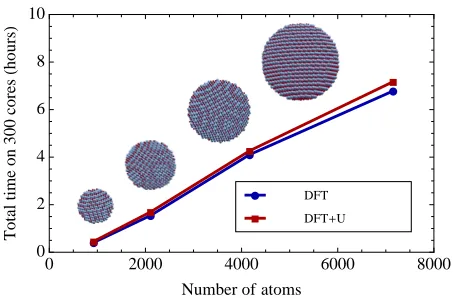
FIG. 1. (Color online) Scaling of the energy minimization algorithm for NiO nanoclusters of increasing size. Timings are for three density kernel optimization steps and one orbital optimization step, comparing DFT and DFT+U calculations. Simulations were performed on300Intel Westmere2.67Ghz
cores connected using quad data rate Infiniband.
reproduce the correct insulating gap and local magnetic
moments (of between 1.64 µB and 1.9 µB28) due to a
poor description of 3d orbital localization. The gap, of
approximately 4 eV, is of predominantly Mott-Hubbard
type since it persists above the Néel temperature46,
al-beit with a significant charge-transfer component47. It
is thus successfully recovered by a number of methods, which either include many-body Coulomb correlation
ef-fects explicitly, such as LDA+DMFT48, or introduce an
appropriate derivative discontinuity with respect to oc-cupancy at the single-particle level, examples including
unrestricted Hartree-Fock46 and the self-interaction
cor-rected local density approximation49. The correct
de-scription of the physics of NiO was an early success for
DFT+U, the method of interest here, and this has been
repeated using numerous functional forms11,28,30,50–52.
The method described in this article has previously
been successfully applied to bulk NiO23. For a
demon-stration of computational scaling, we have chosen spheri-cal nano-clusters of NiO with even numbers of nickel ions, so that an open-shell singlet multiplicity, analogous to the bulk antiferromagnetic ground state, could be tentatively assumed. We may expect that a transition to a ferrimag-netic or ferromagferrimag-netic state occurs below some critical cluster size, as it has been predicted for very small iron
oxide clusters of interest for data-storage technology53,54.
Run-time parameters included a 500 eV equivalent
plane-wave cutoff energy, a spin polarized density
ker-nel cutoff at25a0, the LSDA exchange-correlation
func-tional16, nine local orbitals (NGWFs) for each nickel ion
and four each for oxygen, all with 7.5 a0 cutoff radii,
and norm-conserving pseudopotentials55. Atomic
Hub-bard projectors of hydrogenic form were used. Since cal-culations on nano-clusters of varying sizes are expected to exhibit differing convergence behavior, the energy min-imization algorithm was simply run for a fixed number
! !
!
!
" "
"
"
# #
#
#
$ $
$
0 2000 4000 6000 8000
0.000 0.002 0.004 0.006 0.008 0.010 0.012 0.014
Number of atoms
Time
on
300
cores
!
hours
"
$ Forces F
# Hamilt.!ΑΒ"
" Hamilt.!mm'"
! Energy E
FIG. 2. (Color online) Computational time spent in subrou-tines associated with the DFT+U functionality in the tests shown in Fig. 1. Specifically timings shown are for comput-ing the DFT+U energy of Eqn. 4, the Hamiltonian matrix of Eqn. 21 in its Hubbard projector and local orbital represen-tations, and the ionic forces given by Eqn. C6.
of iterations. One orbital optimization step and three density kernel steps, with three penalty-functional idem-potency corrections iterations at each of the latter, were allowed. Orbital overlap matrix inversion was carried out using a sparse matrix implementation of Hotelling’s
al-gorithm56and a cubic supercell of length three times the
diameter of each nano-cluster was used, up to a
maxi-mum supercell length of approximately300 a0.
A. Scaling of computational effort for DFT+U
Algorithmic timing data for ONETEP energy
mini-mization of NiO nano-clusters, containing up to 7,153
atoms across300Intel Westmere2.67Ghz cores, is shown
in Fig. 1. A reasonable linear fit was obtained for the timing; with a slightly negative fitted time intercept at
450−500 atoms indicating a very efficient initialization
of the pre-requisite data in these calculations. The NiO nano-clusters in question do not represent a favorable
case for the DFT+U method, since approximately half
of the ions host correlated subspaces. Nonetheless, we ob-served a very small increase in computational time when
the DFT+U functionality was invoked, at approximately
5−6%, and preservation of linear-scaling performance.
Timings for generating the DFT+U Hamiltonian and
its contribution to the total-energy and forces, for those calculations which fell within memory resources, are
de-picted in Fig. 2. This indicates that no direct DFT+U
functionality appreciably deviates from linear-scaling be-havior. We note, in particular, that the total time spent
in these DFT+U specific subroutines makes up only a
small fraction of the increase in cost incurred by DFT+U,
at less than1%of the total computational time.
In order to understand where the dominant
[image:7.595.322.559.54.201.2] [image:7.595.57.285.58.207.2]di-7
!
!
!
!
"
"
"
"
#
#
#
#
$
$
$
$
%
% %
% &
&
&
&
0 2000 4000 6000 8000
0 10 20 30 40 50 60 70
Number of atoms
Matrix
filling
factor
!
!
"
& NGWF"Hubbard overlap
% NGWF"Pseudo overlap
$ DFT#U Hamiltonian
# DFT Hamiltonian
" Density kernel
! NGWF overlap
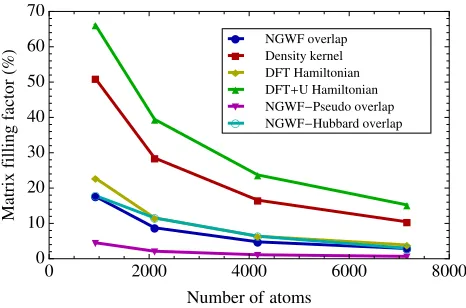
FIG. 3. (Color online) Nano-cluster size dependence of fill-ing factors of principal matrices affectfill-ing the computational cost of linear-scaling DFT and DFT+U. These, namely, are the overlap between orbitals, the density kernel, the Hamilto-nian matrices conventional for DFT and for DFT+U, and the overlap matrices between the local orbitals and the non-local pseudopotential projectors and Hubbard projectors.
rectly in the DFT+U subroutines themselves, we direct
the reader to Fig. 3, where the system dependent sparse matrix filling is quantified. In a conventional DFT cal-culation, the sparsity of the Hamiltonian matrix is domi-nated by the orbital representation of the non-local pseu-dopotential, proportional to the product of the overlap matrix between the orbitals and the non-local pseudopo-tential projectors with its transpose. In essence, pairs of orbitals which overlap with a common non-local projec-tor contribute to the energy, and the same holds for the
Hubbard projectors of DFT+U. While non-local
pseu-dopotential projectors tend to have cutoff radii not in
excess of approximately2 a0, Hubbard projectors of3d
symmetry may require greater cutoff radii (for hydro-genic orbitals of effective nuclear charge in the typical
range for transition-metals, Z = {8,9,10,11}, the
nor-malization spillage at2a0is{9.3,4.6,2.1,0.9}%). In our
calculations the projector cutoff radius is set equal to
that of the local orbitals,7.5 a0.
This increased Hamiltonian filling has consequences additionally for the calculation of energy gradients, as indicated in Fig. 4, which shows the fractional change in time spent in carrying out certain energy minimiza-tion operaminimiza-tions. Most notably, it takes close to twice
as much effort to calculate its expansion on the psinc
grid due to the inclusion of Hubbard projectors in the Hamiltonian. The dominant part of the overall expense of the calculations is from operations on large matrices, however, so that grid expansion of the Hamiltonian is not significant for large systems. The incurred increase in the
filling of the Hamiltonian matrix in DFT+U over DFT,
and also in the expense of computing its products with quantities such as the density kernel and its expansion on the underlying, systematic plane-wave basis, is thus largely responsible for the observed, albeit moderate,
in-! !
! !
"
" "
"
# #
# #
$ $
$ $
0 2000 4000 6000 8000
1.0 1.2 1.4 1.6 1.8 2.0
Number of atoms
Fractional
time
increase
with
DFT
!
U
$ Local potential integral
# LNV optimisation
" Hamiltonain on grid
! NGWF gradient
FIG. 4. (Color online) Fractional change in time expended on energy-minimization operations when the DFT+U function-ality is activated. Namely, these are calculation of the local orbital (NGWF) gradient, expansion of the Hamiltonian in the basis, kernel optimization using the LNV method, and calculation of the matrix elements of the local potential.
crease in computational expense indirectly introduced by
DFT+U, from1%to 5−6%.
VI. CONCLUDING REMARKS
We have detailed a linear-scaling implementation of
the DFT+U method for treating strongly-correlated
sys-tems from first-principles. The formalism is generally appropriate to methods which minimize the energy with respect to the single-particle density-matrix, and allows for the optimization of both nonorthogonal Hubbard
pro-jectors22 and ionic positions.
The preservation of linear-scaling performance on
metal-oxide nano-clusters in excess of 7,000 atoms is
demonstrated. For systems of this type, with a high den-sity of correlated sites, the increase in computational
pre-factor remains rather modest. The DFT+U
functional-ity, furthermore, incurs negligible cost in large systems comprising only a small number of Hubbard subspaces.
Ground state calculations employing our method have previously been demonstrated on both bulk and
molec-ular strongly interacting systems22,23, with further
ex-amples on large-scale systems such as dilute magnetic
semiconductor (Ga,Mn)As57 and disordered VO
258,
[image:8.595.58.291.53.207.2] [image:8.595.320.555.53.206.2]ACKNOWLEDGMENTS
All figures are reproduced with permission from Ref. 59. We are grateful to Emilio Artacho and Adrian Ionescu for helpful discussions. D.D.O’R acknowledges the support of EPSRC and the National University of
Ireland. N.D.M.H and A.A.M. acknowledge the
sup-port of EPSRC (Grant EP/G05567X/1), and A.A.M fur-ther acknowledges support from RCUK. M.C.P. acknowl-edges the support of EPSRC (Grants EP/G055904/1,
EP/F032773/1). Calculations were performed on the
Cambridge HPCS Darwin computer.
Appendix A: Preservation of density-matrix purity under kernel optimization
In the LNV method44, the Kohn-Sham density kernel
is related to the auxiliary density kernel via one iteration of the McWeeny purification transform, that is
Kαβ= (3LSL−2LSLSL)αβ. (A1)
In our treatment of DFT+U, we go a step further and
provide the more general expressions needed for the
HSMP60 variant of the LNV method, in which the
den-sity kernel K˜ is expressed as a purified and normalized
auxiliary density kernel, explicitly
˜
Kαβ= N
SγδKδγ
Kαβ (A2)
= N(3LSL−2LSLSL) αβ
Sγδ(3LSL−2LSLSL)δγ
,
whereN is the correct occupancy for the spin channel in
question. The kernel renormalization introduces terms in the gradient proportional to an effective chemical poten-tial, projecting out any first-order changes to the electron
number, driving the density kernelK˜ towards both
nor-malization and idempotency as the energy is minimized.
To locate the derivative of the DFT+U energy term
with respect to the auxiliary density kernel, stressing that it is computed strictly using the purified and renormal-ized density kernel, we make use of the chain-rule for matrix derivatives to write
∂EU
∂Lαβ =
∂EU
∂Kγδ
∂Kγδ
∂Lαβ, (A3)
where we carefully note that the partial derivative with respect to a doubly contravariant tensor is a doubly co-variant tensor with indices once permuted to allow for the complex case. It may be readily shown, using Eqn. A1, that the latter term is given by
∂Kγδ ∂Lαβ = 3 δ
γ
αSβǫLǫδ+LγǫSǫαδβδ
(A4)
−2
δγαSβǫLǫζSζηLηδ
+LγǫSǫαSβζLζδ+LγǫSǫζLζηSηαδδβ
.
The derivative of the DFT+U energy with respect to
the purified density kernelK may be broken into
prod-ucts of derivatives, and rearranged as follows
∂EU
∂Kγδ =
∂ ∂K˜ζǫ
h
EU
˜
Ki∂K˜
ζǫ
∂Kγδ (A5)
=HǫζU N
(SηθKθη)
δζγδδǫ− K ζǫ
(SικKκι)
Sδγ
.
We may next write the gradient with respect to the den-sity kernel in terms of a preconditioned contribution to the Hamiltonian, denoted by
˜
HδγU =HδγU −µUSδγ; µU =
HǫζUKζǫ
(SικKκι)
, (A6)
whereµU is identified as the DFT+U correction to the
chemical potential, since
∂EU
∂Kγδ =
N
(SηθKθη) (
HδγU −
HǫζUKζǫ
(SικKκι)
Sδγ )
(A7)
= N
(SηθKθη) ˜
HδγU.
It is worth noting that, just as the DFT+U
independent-particle energy correction, EUIP = HαβU K˜βα, does not
equal the energy termEU, so the energy correction
en-tering into the computation ofµU is not identical to the
DFT+U correction to the total-energy.
The required DFT+U energy gradient is provided by
the product of the preconditioned term in the Hamilto-nian and the derivative of the density kernel with respect to its auxiliary counterpart, given by
∂EU
∂Lαβ =
N
(SικKκι) ˜
HδγU
∂Kγδ
∂Lαβ. (A8)
Finally, combining Eqs. A4 and A8, and recalling
Eqn. 23, we arrive at the DFT+U contribution to the
contravariant density kernel gradient,
GαβU = S−1αγ ∂EU
∂Lδγ S
−1δβ
(A9)
= N
Sγδ(3LSL−2LSLSL)δγ
×
3S−1HL˜ +LHS˜ −1 −2LHL˜
−2S−1HLSL˜ +LSLHS˜ −1
αβ
.
Appendix B: Preservation of density-matrix purity under orbital optimization
9
which drives the trace of the density-matrix to the correct occupancy of the system. The energy derivative with respect to covariant orbitals may be decomposed as
∂EU
∂φα(r)
= ∂EU
∂K˜βγ
∂K˜βγ ∂Kδǫ
∂Kδǫ ∂Sζη
+∂K˜ βγ
∂Sζη !
∂Sζη
∂φα(r)
+ ∂EU
∂Pβγ ∂Pβγ ∂φα(r)
. (B1)
The terms contained in parentheses in Eqn. B1 may be evaluated, respectively yielding
∂K˜βγ ∂Sδǫ =
N
(SθιKιθ)
− K
βγ
(SκλKλκ)
Kǫδ
, (B2)
∂K˜βγ ∂Kδǫ =
N
(SθιKιθ)
δδβδǫγ− K βγ
(SκλKλκ)
Sǫδ
, and
∂Kδǫ ∂Sζη = 3
LδζLηǫ−2Lδζ(LSL)ηǫ−2 (LSL)δζLηǫ.
The covariant metric explicitly depends only on the co-variant orbitals, so that
∂Sζη
∂φα(r)
=δαζφη(r) +δαηφζ(r). (B3)
Contraction of the DFT+U term in the Hamiltonian
and the terms in Eqn. B2 provides a tensorQ˜ which
rep-resents a contribution to the local orbital gradient purely due to mixing among the orbitals, given by
˜
Qηζ =HγβU ∂K˜
βγ
∂Kδǫ
∂Kδǫ ∂Sζη
+∂K˜ βγ
∂Sζη !
(B4)
= N
(SθιKιθ)
3LHL˜ −2LHLSL˜ −2LSLHL˜
−µUK
ηζ
.
To conclude, by combining Eqs. 29, B1, and B4, the
contravariant gradient of the DFT+U energy with
re-spect to the orbitals is given by
∂EU
∂φα(r) = 2
˜
KαζVζm′′H˜m ′′m′
ϕm′ + ˜Qαζφζ
(r), (B5)
which is then transformed to the required covariant form, in the same manner as per Eq. 31, giving
gαU(r) = 2SαβK˜βζVζm′′H˜m ′′m′
ϕm′(r) (B6) + 2SαβQ˜βζφζ(r).
Appendix C: Ionic forces
We may assume that the ground-state density is lo-cated for a given ionic configuration before the forces are computed, so that the total-energy is variationally mini-mized with respect to both the orbital expansion coeffi-cients and the matrix elements of the density kernel. The
DFT+U correction then contributes to the ionic forces
only via the spatial dependence of the Hubbard
projec-tion operators, that is for the ion labeledj,
Fj
U =−
∂EU
∂Rj =−
∂EU
∂Pαβ ∂Pαβ
∂Rj . (C1)
The lattermost derivative may be expressed in terms of gradients of the covariant projectors and contravariant subspace metric tensors, specifically
∂Pαβ ∂Rj =
X
I
∂Pαβ
∂ϕ(mI)(r)
∂ϕ(mI)(r)
∂Rj (C2)
+ ∂Pαβ
∂Omm′
∂Omm′ ∂Rj ,
where, in the tensorial representation23,
∂Omm′
∂Rj =−O
mm′′∂Om′′m′′′′
∂Rj O
m′′′m′
, (C3)
vanishes in the conventional case that the Hubbard pro-jectors are rigidly translated with their host ions.
We note, next, that the Hubbard projectors are usu-ally considered to be associated with one atomic site only,
and so the subspace indexIneed only run over subspaces
centered on ionj. We may thus suppress the summation
symbol in Eqn. C1, for notational clarity, since the gener-alization to multiple subspaces per ion is straightforward. Denoting the spatial derivative of the Hubbard projectors by the three-component vector
X(αmj) =X
I∩j
hφα|∇|ϕ(mI)i (C4)
=X
I∩j ˆ
drφα(r)
ˆ
dG (−iG)e−iG.rϕ(mI)(G)
,
the remaining terms in Eqn. C2 may be expressed as
∂Pαβ ∂Rj =
ˆ ∂
∂ϕ(mj)(r) h
Vαm′Om ′m′′
Wm′′β
i ! (C5) × ∂ ∂R X
I∩j ˆ
dGe−iG.rϕ(mI)(G)
dr
=
ˆ
φαOmm ′′
Wm′′β+Vαm′O m′m
φβ
(r)
×X
I∩j ˆ
dG (−iG)e−iG.rϕ(mI)(G)
dr
=X(αmj)Omm′′Wm′′β+Vαm′Om′mX(j)†
mβ.
Combining the latter result with Eqs. 27 and C1, we
conclude that the tensorially consistent DFT+U
contri-bution to the ionic forces is succinctly given by the sparse matrix trace, noting the resemblance to Eqn. 29,
Fj
U =−2 ˜KβαVαmHm ′m
X(j)†
mβ. (C6)
This may be used, for example, to perform DFT+U
∗ david.oregan@epfl.ch
1
P. Hohenberg and W. Kohn, Phys. Rev.,136, B864 (1964).
2
W. Kohn and L. J. Sham, Phys. Rev.,140, A1133 (1965).
3
D. R. Bowler and T. Miyazaki, (2012), Rep. Prog. Phys. (in press), arXiv:1108.5976.
4
C.-K. Skylaris, P. D. Haynes, A. A. Mostofi, and M. C. Payne, J. Chem. Phys.,122, 084119 (2005).
5
N. D. M. Hine, P. D. Haynes, A. A. Mostofi, C.-K. Skylaris, and M. C. Payne, Comp. Phys. Comms.,180, 1041 (2009).
6
N. D. M. Hine, P. D. Haynes, A. A. Mostofi, and M. C. Payne, J. Chem. Phys.,133, 114111 (2010).
7
T. Ozaki and H. Kino, Phys. Rev. B,72, 045121 (2005).
8
T. Ozaki, Phys. Rev. B,82, 075131 (2010).
9
D. R. Bowler, R. Choudhury, M. J. Gillan, and
T. Miyazaki, Phys. Status Solidi B,243, 989 (2006).
10
D. R. Bowler and T. Miyazaki, J. Phys.: Condens. Matter, 22, 074207 (2010).
11
V. I. Anisimov, J. Zaanen, and O. K. Andersen, Phys. Rev. B, 44, 943 (1991); V. I. Anisimov, I. V. Solovyev, M. A. Korotin, M. T. Czyżyk, and G. A. Sawatzky,ibid., 48, 16929 (1993).
12
M. Wierzbowska, D. Sánchez-Portal, and S. Sanvito, Phys. Rev. B,70, 235209 (2004).
13
M. J. Han, T. Ozaki, and J. Yu, Phys. Rev. B,73, 045110 (2006).
14
S. Sanna, B. Hourahine, U. Gerstmann, and T. Frauen-heim, Phys. Rev. B,76, 155128 (2007).
15
C.-K. Skylaris, A. A. Mostofi, P. D. Haynes, O. Diéguez, and M. C. Payne, Phys. Rev. B,66, 035119 (2002).
16
J. P. Perdew and A. Zunger, Phys. Rev. B,23, 5048 (1981).
17
N. F. Mott, Proc. Phys. Soc.,A 62, 416 (1949).
18
W. Ku, H. Rosner, W. E. Pickett, and R. T. Scalettar, Phys. Rev. Lett.,89, 167204 (2002).
19
V. V. Mazurenko, S. L. Skornyakov, A. V. Kozhevnikov,
F. Mila, and V. I. Anisimov, Phys. Rev. B, 75, 224408
(2007).
20
A. Yamasaki, M. Feldbacher, Y.-F. Yang, O. K. Andersen, and K. Held, Phys. Rev. Lett.,96, 166401 (2006).
21
T. Miyake and F. Aryasetiawan, Phys. Rev. B,77, 085122 (2008).
22
D. D. O’Regan, N. D. M. Hine, M. C. Payne, and A. A. Mostofi, Phys. Rev. B,82, 081102 (2010).
23
D. D. O’Regan, M. C. Payne, and A. A. Mostofi, Phys. Rev. B,83, 245124 (2011).
24
We employ the Einstein convention, where pairs of identi-cal indices are summed over unless in parentheses.
25
E. Artacho and L. Miláns del Bosch, Phys. Rev. A, 43,
5770 (1991).
26
V. I. Anisimov, F. Aryasetiawan, and A. I. Lichtenstein, J. Phys.: Condens. Matter,9, 767 (1997).
27
A. I. Liechtenstein, V. I. Anisimov, and J. Zaanen, Phys. Rev. B,52, R5467 (1995).
28
M. Cococcioni and S. de Gironcoli, Phys. Rev. B, 71,
035105 (2005).
29
C. Brouder, G. Panati, M. Calandra, C. Mourougane, and N. Marzari, Phys. Rev. Lett.,98, 046402 (2007).
30
V. L. Campo Jr. and M. Cococcioni, J. Phys.: Condens. Matter,22, 055602 (2010).
31
T. Ozaki, Phys. Rev. B,67, 155108 (2003).
32
T. Ozaki and H. Kino, Phys. Rev. B,69, 195113 (2004).
33
T. Ozaki and H. Kino, J. Chem. Phys.,121, 10879 (2004).
34
F. Mauri, G. Galli, and R. Car, Phys. Rev. B,47, 9973
(1993).
35
F. Mauri and G. Galli, Phys. Rev. B,50, 4316 (1994).
36
J. Kim, F. Mauri, and G. Galli, Phys. Rev. B,52, 1640 (1995).
37
P. Ordejón, D. A. Drabold, R. M. Martin, and M. P.
Grumbach, Phys. Rev. B,51, 1456 (1995).
38
L. E. Ratcliff, N. D. M. Hine, and P. D. Haynes, Phys. Rev. B,84, 165131 (2011).
39
D. A. Scherlis, M. Cococcioni, P. Sit, and N. Marzari, J. Phys. Chem. B,111, 7384 (2007).
40
H. J. Kulik and N. Marzari, J. Chem. Phys.,129, 134314
(2008); J. Chem. Phys, 133, 114103 (2010); J. Chem.
Phys.,134, 094103 (2011).
41
H. Hsu, K. Umemoto, M. Cococcioni, and R. Wentzcov-itch, Phys. Rev. B,79, 125124 (2009).
42
B. Himmetoglu, R. M. Wentzcovitch, and M. Cococcioni, Phys. Rev. B,84, 115108 (2011).
43
N. D. M. Hine, M. Robinson, P. D. Haynes, C.-K. Skylaris, M. C. Payne, and A. A. Mostofi, Phys. Rev. B,83, 195102 (2011).
44
X.-P. Li, R. W. Nunes, and D. Vanderbilt, Phys. Rev. B,
47, 10891 (1993); R. W. Nunes and D. Vanderbilt, 50,
17611 (1994); M. S. Daw,47, 10895 (1993).
45
C. A. White, P. Maslen, M. S. Lee, and M. Head-Gordon, Chem. Phys. Lett.,276, 133 (1997).
46
M. D. Towler, N. L. Allan, N. M. Harrison, V. R. Saunders,
W. C. Mackrodt, and E. Aprà, Phys. Rev. B, 50, 5041
(1994).
47
G. A. Sawatzky and J. W. Allen, Phys. Rev. Lett., 53,
2339 (1984).
48
X. Ren, I. Leonov, G. Keller, M. Kollar, I. Nekrasov, and D. Vollhardt, Phys. Rev. B,74, 195114 (2006).
49
A. Svane and O. Gunnarsson, Phys. Rev. Lett., 65, 1148 (1990).
50
S. L. Dudarev, G. A. Botton, S. Y. Savrasov, C. J.
Humphreys, and A. P. Sutton, Phys. Rev. B, 57, 1505
(1998).
51
O. Bengone, M. Alouani, P. Blöchl, and J. Hugel, Phys. Rev. B,62, 16392 (2000).
52
W. E. Pickett, S. C. Erwin, and E. C. Ethridge, Phys. Rev. B,58, 1201 (1998).
53
S. López, A. H. Romero, J. Mejía-López, J. Mazo-Zuluaga, and J. Restrepo, Phys. Rev. B,80, 085107 (2009).
54
K. Palotás, A. N. Andriotis, and A. Lappas, Phys. Rev.
B,81, 075403 (2010).
55
Norm-conserving pseudopotentials, relativistically cor-rected and with a non-linear core correction for nickel, were generated using the Opium code available at http://opium.sourceforge.net.
56
T. Ozaki, Phys. Rev. B,64, 195110 (2001).
57
D. D. O’Regan, M. C. Payne, and A. A. Mostofi, In prepa-ration (2012).
58
C. Weber, D. D. O’Regan, N. D. M. Hine, M. C. Payne, G. Kotliar, and P. B. Littlewood, (2012) arXiv:1202.1423.
59
D. D. O’Regan, Optimised Projections for the Ab Initio Simulation of Large and Strongly Correlated Systems, 1st ed., Springer Theses, Vol. XVI (Springer, Berlin, Heidel-berg, 2012) p. 225.
60