warwick.ac.uk/lib-publications
Original citation:
Weber, Cedric, O'Regan, David D., Hine, Nicholas, Littlewood, Peter B., Kotliar, Gabriel and
Payne, Mike C. (2013) Importance of many-body effects in the kernel of hemoglobin for
ligand binding. Physical Review Letters, 110 (10). 106402.
Permanent WRAP URL:
http://wrap.warwick.ac.uk/78090
Copyright and reuse:
The Warwick Research Archive Portal (WRAP) makes this work by researchers of the
University of Warwick available open access under the following conditions. Copyright ©
and all moral rights to the version of the paper presented here belong to the individual
author(s) and/or other copyright owners. To the extent reasonable and practicable the
material made available in WRAP has been checked for eligibility before being made
available.
Copies of full items can be used for personal research or study, educational, or not-for-profit
purposes without prior permission or charge. Provided that the authors, title and full
bibliographic details are credited, a hyperlink and/or URL is given for the original metadata
page and the content is not changed in any way.
Publisher statement:
© 2013 American Physical Society
http://dx.doi.org/10.1103/PhysRevLett.110.106402
A note on versions:
The version presented here may differ from the published version or, version of record, if
you wish to cite this item you are advised to consult the publisher’s version. Please see the
‘permanent WRAP URL’ above for details on accessing the published version and note that
access may require a subscription.
C´edric Weber,1, 2 David D. O’Regan,2, 3 Nicholas D. M. Hine,2, 4
Peter B. Littlewood,2, 5 Gabriel Kotliar,6 and Mike C. Payne2
1
King’s College London, Theory and Simulation of Condensed Matter (TSCM), The Strand, London WC2R 2LS
2Cavendish Laboratory, J. J. Thomson Av., Cambridge CB3 0HE, U.K. 3
Theory and Simulation of Materials, ´Ecole Polytechnique F´ed´erale de Lausanne, Station 12, 1015 Lausanne, Switzerland
4
Department of Materials, Imperial College London, Exhibition Road, London SW7 2AZ, U.K.
5Physical Sciences and Engineering, Argonne National Laboratory, Argonne, Illinois 60439, U.S.A. 6Rutgers University, 136 Frelinghuysen Road, Piscataway, NJ, U.S.A.
We propose a mechanism for binding of diatomic ligands to heme based on a dynamical orbital selection process. This scenario may be described asbonding determined by local valence fluctua-tions. We support this model using linear-scaling first-principles calculations, in combination with dynamical mean-field theory, applied to heme, the kernel of the hemoglobin metalloprotein central to human respiration. We find that variations in Hund’s exchange coupling induce a reduction of the iron 3ddensity, with a concomitant increase of valence fluctuations. We discuss the comparison between our computed optical absorption spectra and experimental data, our picture accounting for the observation of optical transitions in the infrared regime, and how the Hund’s coupling reduces, by a factor of five, the strong imbalance in the binding energies of heme with CO and O2 ligands.
Metalloporphyrin systems, such as heme, play a cen-tral role in biochemistry. The ability of such molecules to reversibly bind small ligands is of great interest, par-ticularly in the case of heme which binds diatomic lig-ands such as oxygen and carbon monoxide. Heme acts as a transport molecule for oxygen in human respiration, while carbon monoxide inhibits this function. Despite intensive studies [1–3], the binding of the iron atom at centre of the heme molecule to O2 and CO ligands
re-mains poorly understood. In particular, one problem obtained with density functional theory [4] (DFT) ap-proaches to ligand binding of heme is that the difference in the binding energy (∆∆E) of carbheme and oxy-heme is very large, and the theory predicts an unrealistic binding affinity to CO, several orders of magnitude larger than to O2[5,6].
Recent progress has been made to cure this problem using DFT+U for molecular systems [7,8], with which it was found that the inclusion of many body effects in the calculations reduced the imbalance between O2 and CO
affinities [9]. Inclusion of conformal modifications, such as the Fe-C-O binding angle [10], or the deviation of the Fe atom from the porphyrin plane, were also shown to affect CO and O2 binding energies.
A general problem encountered by DFT is the strong dependence of the energetics and the spin state on small changes in the geometry. In particular, traditional DFT fails to describe the correct high-spin ground state of heme molecules. DFT+U provides an improved descrip-tion [7,11], but is known to overestimate magnetic mo-ments and gives often artificial and non physical spin-symmetry-broken states. Moreover, the rotationally-invariant DFT+Umethodology does not capture well the effect of the Hund’s coupling J, which is known to be large in iron based systems. It was recently shown that the effect of strong correlations are not always driven by
the Coulomb repulsionU alone, but in some cases act in combination with the Hund’s couplingJ [12–14]. Under-standing the effect of strong correlations in heme, and in particular how the symmetry of the highest occupied molecular orbital (HOMO) is affected by U and J, is important in the context of describing the CO binding, which was shown to be strongly dependent on the HOMO symmetry [15].
Recent progress has been made in this direction by dy-namical mean field theory [16] (DMFT), combined with DFT (DFT+DMFT) which can refine the description of the charge and spin of correlated ions, and describes in a remarkable way the strong correlations, induced by both
U andJ. Also, DFT can only describe a static magnetic moment associated with a spin symmetry broken state, and requires the inclusion of the spin-orbit interaction to explain a change of spin states [17]. This is not necessary at the DMFT level, which describes both static and fluc-tuating magnetic moments within the same framework.
In this work, we extend the DFT+U analysis by means of the combination of state-of-the-art linear scal-ing DFT [18] with DMFT, and apply this methodology to heme. The methodology builds upon our earlier works [19] and is described in detail in the supplementary ma-terial.
Although DFT+DMFT has been widely used to study solids, in this study we apply our real-space DFT+DMFT implementation to a moderately large molecule, extending the scope of applicability of DMFT to biology in an unprecedented manner. DMFT allows the quantum and thermal fluctuations, missing in zero-temperature DFT calculations, to be recovered. More-over, it includes within the calculation both the Coulomb repulsionU and the Hund’s coupling J. Which ofU or
bind-2
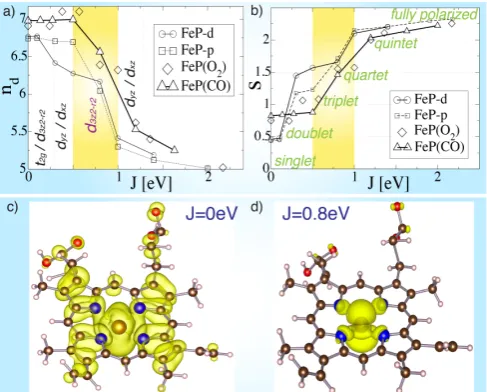
FIG. 1: Orbital selection scenario: Dependence of a) the iron 3d subspace occupancynd and b) the effective spin quantum numbers on the Hund’s couplingJ, for both unli-gated and liunli-gated heme models. The physically relevant re-gion 0.5 eV< J <1 eV is highlighted in yellow. Isosurfaces of the real-space representation of the electronic spectral density of the HOMO of FeP-d for c)J = 0 eV and d)J = 0.8 eV. The large central sphere shows the location of the iron atom, and the four blue spheres indicate nitrogen atoms.
ing, that we address in this work. Methods are available to obtainU andJ parameters appropriate to DMFT [20], but in this work we focus on the dependence of the results with the Hund’s couplingJ, and we verify that our calcu-lations are not sensitive to the Coulomb repulsionUor to the temperatureT[21]. The key question that we address in this work is: to what extent does the Hund’s coupling, so far neglected in all studies applied to heme, affect the binding of heme to O2and CO ligands, and in particular
doesJ reduce the strong affinity for CO binding? If not specified otherwise, we use a similar value U = 4 eV to those previously computed for DFT+U [7], and ambient temperature T = 294K. The methodology is described in detail the supplementary material. Ionic geometries were obtained for four different configurations: unligated deoxyheme, FeP-d; the heme-CO complex carboxyheme, FeP(CO); the heme-O2complex oxyheme, FeP(O2); and
a theoretical planar version of deoxyheme, FeP-p.
We first discuss the dependence of the iron 3d sub-space occupancyndon the Hund’s coupling parameterJ
(Fig. 1.a). We emphasize that the expectation value of the occupancy nd of the iron 3d sub-shell is not
con-strained to integer values in DFT and DFT+DMFT, since the iron occupation is a local observable, and hence does not commute with the Hamiltonian and is not con-served and there are valence fluctuations.
In the typical region of physically meaningful values of the Hund’s coupling for iron 3delectrons,J ≈0.8 eV, [22] we find a very sharp dependence of the electronic density onJ. In fact,J ≈0.8 eV places heme directly in the
tran-sition region between low-spin states and the nd = 5 e
fully-polarized state obtained for large Hund’s coupling. We note that our results are weakly dependent on the choice of the Coulomb repulsion U (see sup. material).
In Fig. 1.b, we show the effective quantum spin num-ber, which is associated to the norm of the angular spin vector S by the usual relation |S| = ps(s+ 1). The spin s shows characteristic plateaux as a function of the Hund’s coupling at the semi-classically allowed val-ues of the magnetization (corresponding to pure doublet, triplet, quartet, and quintet states). A fully-polarized state is recovered for sufficiently large Hund’s coupling, as expected.
AtJ = 0.8 eV, and almost irrespective of ligation and doming, we find that heme has a spin expectation value of s ≈ 1.5 corresponding to a quartet state in a semi-classical picture. Our results indicate that the true many-body wave-function of FeP-d is thus an entangled super-position of triplet and quintet states. The prosuper-position that heme might be in an entangled state was pointed out early [23] in the context of a Pariser-Parr-Pople model Hamiltonian, and is confirmed by our DMFT calcula-tions. In particular, this accounts for the striking differ-ences obtained experimentally for very similar porphyrin systems, e.g. it was found that unligated FeP is a triplet [24] in the tetraphenylporphine configuration, a triplet with different orbital symmetry in the octaethylporphine configuration [25], and a quintet in the octamethyltetra-benzporphine configuration [26]. The strong dependence of the spin state with respect to small modifications in the structure is consistent with an entangled spin state.
In our calculations, we find that both oxyheme and carboxyheme adopt a low spin state forJ <0.25eV and larger multiplicities in the physical region ofJ ≈0.8eV, while in both cases the spin state is very close in character to that of unligated deoxyheme. Significantly, we observe only subtle differences between FeP(O2), FeP(CO) and
FeP-d forJ = 0.8 eV, while the DFT and DFT+U treat-ment yields ground-states for carboxyheme and oxyheme of pure closed-shell and open-shell singlet configurations, respectively [6,7,9].
Moreover, we find that the symmetry of the highest occupied molecular orbital (HOMO) of FeP-d, as esti-mated from the real-space spectral density of the promi-nent feature below the Fermi level, is highly dependent on the Hund’s couplingJ. In particular, for J = 0 eV, the HOMO is an admixture of orbital characters (see ver-tical labels in Fig.1.a). However, the Hund’s coupling drives a rather complex orbital selection, such that for the region of greatest interest, J ≈0.8 eV, the HOMO predominantly exhibits d3z2−r2 symmetry. The orbital
selection process also induces a pinning of the Fermi den-sity to the quantum impurity, such that it is delocalized forJ = 0 eV (see Fig.1.c), while forJ = 0.8 eV (Fig.1.d) it is instead localized to the iron 3dsub-shell.
0 0.5 1 1.5 2 2.5 J [eV] 2.5 3 3.5 4 Λ FeP-d FeP-p doublet
to fully polarized
quintet 37%
23% 9% 30%
Sz=0.5,n d=7
Sz=0,n d=6
Sz=0,n d=8 Other J=0eV 13% 13% 9% 6% 41% 13% 6% J=0.8eV
Sz=0.5,n d=7
Sz=0.5,n d=5
Sz=1.5,n d=5
Sz=1,n d=6
Sz=0,nd=6
Sz=2,n d=6
other
[image:4.595.79.275.52.129.2]a) b) c)
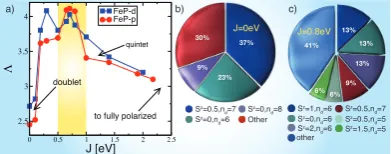
FIG. 2: Valence fluctuations: a) Von Neumann entropy Λ obtained by DFT+DMFT for FeP-p (circles) and FeP-d (squares). Histograms of the dominant electronic configura-tions for FeP-d for b)J= 0 eV and (c)J = 0.8 eV. The pie wedge labelled other contains configurations with a weight smaller than 3%. The iron 3dspinSzand iron 3doccupancy
ndof the dominant configurations is indicated.
in FeP(O2) [27]. Indeed, the bent geometry of FeP(O2)
can be explained by a favorable interaction between the p*-orbital of the O2 and the d3z2−r2 -orbital on Fe [27]:
the O2p*-orbital is closer in energy to d3z2−r2compared
to the p*-orbitals in CO, and hence it gains more energy by bending, which increases the overlap. For FeP(CO) the situation is opposite, and there is no stabilization gained by bending [27]. On the contrary, the bending in FeP(CO) is induced by the strain of the protein and it reduces the binding energy. Naively, the orbital se-lection of the d3z2−r2 orbital is hence expected to go
in the direction of curing the strong O2 and CO
imbal-ance. Moreover, the charge localization at the Fermi level suggests that other artificial binding between the non-metallic atomic orbitals of heme and strong electronega-tive O2will not be obtained, and hence will protect heme
from undesired charge transfer.
We now discuss the degree of quantum entanglement exhibited by FeP-d and FeP-p (see Fig. 2.a). We com-puted the von Neumann entropy Λ = −tr ( ˆρdlog( ˆρd)),
where ˆρd is the reduced finite-temperature
density-matrix of the iron 3dimpurity subspace, traced over the states of the AIM bath environment. The entropy quan-tifies to what extent the wave-function consists of an en-tangled superposition.
We observe that the entropy rises sharply at J ≈
0.25 eV, corresponding to the transition from the dou-blet spin state to the triplet/quintet entangled state. As expected, the entropy is small in the low-spin region
(J < 0.25 eV) and also in the fully-polarized limit. At
J = 0 eV (Fig. 2.b), we find that the dominant config-uration consists of the doublets (d3z2−r2)2(dxy)2(dxz)2,
with a single electron in the dx2−y2 orbital. The
lat-ter hybridizes strongly with the nitrogen 2porbitals, but all other orbitals are mostly filled or empty, so this con-figuration is, essentially, a classical state with a finite magnetic moment.
At larger J values, however, such as J = 0.8eV (Fig.2.c), all orbitals are partially filled, and an increas-ing number of electronic configurations, with different valence and spin, contribute to the statistics, and thus the iron impurity wave-function isfluctuating. Although
FIG. 3: Energetics: a) Difference in CO and O2 binding
energies ∆∆E. The binding to CO is always favored, however the imbalance is strongly reduced for J > 0.5eV. b) Total energy of FeP as a function ofJ. The minimum of the total energy is obtained forJ= 0.9eV.
the valence fluctuation are captured to some extent at the DFT level (ΛDF T ≈0.75), we find that many body
effects contribute significantly to the entropy.
Our results indicate that as FeP-d and FeP-p molecules approach a regime with large entanglement forJ ≈0.5, with a concomitant orbital selection close to the Fermi level. The orbital selection close to the Fermi level in turn induces a charge-localization effect. The latter ef-fect of the Hund’s coupling can be understood with a simple picture: a large Hund’s coupling partially empties the d3z2−r2 orbital and brings the weight of this orbital
closer to the Fermi level, thereby reducing the hybridiza-tion between the iron 3dstates and the nitrogen 2pstates close to the Fermi level. The subtle interplay between the charge-localization induced by the Hund’s coupling (or-bital selection close to the Fermi energy) and the delocal-ization induced by strong correlations (the tendency for electrons to escape the iron 3dorbitals in order to reduce the Coulomb energy) is captured by the DFT+DMFT methodology but is absent in Kohn-Sham DFT. We em-phasize that these ingredients are paramount to an es-timation of the charge transfer and binding properties between the iron atom and the ligand in oxyheme and carboxyheme.
Let us next discuss the effect of the Hund’s coupling with respect to the unrealistic imbalance between the binding energies of CO and O2 obtained by DFT. The
binding energy is defined as: ∆E = E(F eP(X)) −
(E(F eP) +E(X)), where X=CO or X=O2. The
differ-ence between the binding energies ∆E(CO)−∆E(O2)
is obtained by: ∆∆E = ∆ECO−∆EO2. For J = 0eV,
we find that the binding to CO is dramatically favoured, when compared to the binding to O2(Fig. 3.a): the
dif-ference in binding energies is of the order of 5eV. Al-though the binding to CO is favoured for all values ofJ, we find that it is dramatically improved forJ >0.5eV, and is reduced down to 1eV. This suggests that other effects might be important to reduce further the CO/O2
imbalance, such as that the effect of the protein via the bending of the Fe-C-O angle [9].
[image:4.595.329.552.53.144.2]4
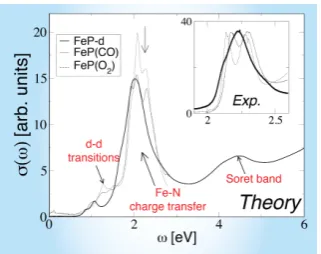
FIG. 4: Optical measurements: Optical conductivity of FeP-d (bold line) and FeP(CO) (solid) and FeP(O2) (dashed
line). The vertical arrow indicates the energy of the experi-mental peak associated to the Fe-N charge transfer. Inset: ex-perimental measurements [28] for unligated heme (bold line), oxy- (dashed line) and carboxy- (solid) heme are shown for comparison. J= 0.8eV was used for all calculations above.
(Fig. 3.b), suggesting further that the heme molecule is particularly well suited to host metallic d atoms, which tend to have a large screenedJ interaction when hybri-dising to light elements such as nitrogen or oxygen.
We now move to our calculations of the optical absorp-tion spectra of heme (Fig.4). Our theoretical absorption spectra, shown in Fig. 4, are in reasonable agreement with experimental data [28], in particular for the optical transitions at ω ≈2 eV. We attribute this spectral fea-ture to charge-transfer excitations from iron to nitrogen-centered orbitals. The spectrum is dominated by the characteristic porphyrin Q-bands (those at≈2eV), and Soret bands [29] (at ≈ 4eV). Our results offer insight into the infrared absorption band present at ≈ 1eV, in our calculation, and observed in experiments at 0.6 eV [30]. This infrared peak is described, in our calculations, as arising from transitions between the d3z2−r2 spectral
feature (HOMO) below the Fermi level and the LUMO (quasi-degenerate dxz and dyz) above the Fermi level.
Interestingly, we find that the infrared optical weight in unligated heme, associated with d-d transitions and present in FeP-d, is absent in the planar theoretical model FeP-p. Hence, the symmetry breaking associated with the doming effect of the iron-intercalated porphyrin macrocycle permitsd-doptical transitions, and is respon-sible for the spectral weight in the infrared regime. We note that experimental spectra for FeP(CO) and FeP(O2)
exhibit a double peak structure atω≈2eV, absent from our calculations done at J = 0eV, but recovered for
J > 0.8eV. The best agreement with the experimental
data is obtained forJ = 0.9eV. Finally, we extended our calculations to the time dependence of the magnetization of the iron atom after an initial quench in polarization (see sup. material). We propose that time-resolved spec-troscopy may be used as a sensitive probe for the ligation state of heme.
In conclusion, we have carried out linear-scaling first-principles calculations, in combination with DMFT, on
both unligated and ligated heme. We have presented a newly-developed methodology applied to a molecule of important biological function, exemplifying how subtle quantum effects can be captured by our methodology. In particular, we have found that the Hund’s coupling
J drives an orbital selection process in unligated heme, which enhances the bonding in the out-of-plane direction. The von Neumann entropy quantifying valence fluctua-tions in the iron 3d subspace is large for the physical values ofJ ≈0.8eV. This scenario sheds some light on the strong CO and O2 binding imbalance problem
ob-tained by extracting the binding energies in simpler zero temperature and J = 0eV DFT calculations. The dif-ference in binding energies is dramatically reduced for physical value of J ≈ 0.8. The smaller remaining im-balance might be further explained by the strain energy contained in the protein structure [9] or by the contri-bution from the entropic term. Finally, the relevance of a finite Hund’s coupling in heme is confirmed by the to-tal energy extracted from the DFT+DMFT of unligated heme, which shows a minima forJ = 0.9eV.
We have proposed a new mechanism for ligand binding to heme based on an orbital selective process, on this ba-sis, a scenario which we termbonding determined by local valence fluctuations. Finally, we have obtained a reason-able agreement between experimental and our theoreti-cal optitheoreti-cal absorption spectra, our description accounting for the observation of optical transitions in the infrared regime and the double peaked structure of the optical response atω≈2eV.
At the time of writing, we became aware of related application of DMFT to an organometallic crystal [31]. We are grateful to R.H. McKenzie for comments and bringing Ref. [23] to our attention, and to D. Cole for many insightful discussions. C.W. was supported by the Swiss National Foundation for Science (SNFS). D.D.O’R. was supported by EPSRC. N.D.M.H was sup-ported by EPSRC grant number EP/G055882/1. P.B.L is supported by the US Department of Energy under FWP 70069. Calculations were performed on the Cam-bridge High Performance Computing Service under EP-SRC grant EP/F032773/1. Correspondence and requests for materials should be addressed to C.W.
[1] A. M. P. Sena, V. Br´azdov´a, and D. R. Bowler,Phys.
Rev. B79, 245404 (2009).
[2] D. D. O’Regan, N. D. M. Hine, M. C. Payne, and A. A. Mostofi,Phys. Rev. B82, 081102 (2010).
[3] P. M. Oppeneer, P. M. Panchmatia, B. Sanyal, O. Eriks-son, and M. E. Ali, Progress in Surface Science84, 18
(2009).
[4] W. Kohn and L. J. Sham, ibid. 140, A1133 (1965). [5] D. Benito-Garagorri, I. Lagoja, L. F. Veirosb, and K. A.
[6] C. Rovira, P. Ballone, and M. Parrinello, Chem. Phys. Lett.271, 247 (1997).
[7] D. A. Scherlis, M. Cococcion, P. Sit, and N. Marzari, J. Phys. Chem. B 111, 7384 (2007).
[8] H. J. Kulik, M. Cococcioni, D. A. Scherlis, and N. Marzari,Phys. Rev. Lett.97, 103001 (2006). [9] D. J. Cole, D. D. O’Regan, and M. C. Payne,J. Phys.
Chem. Lett.3, 1448 (2012).
[10] C. Rovira and M. Parrinello, Chem. A Eur. J. 5, 250
(1999).
[11] P. M. Panchmatia, M. E. Ali, B. Sanyal, and P. M. Oppenee, J. Phys. Chem. A114, 13381 (2010).
[12] Z. P. Yin, K. Haule, and G. Kotliar, Nat Phys7, 294
(2011).
[13] L. de’ Medici,Phys. Rev. B83, 205112 (2011).
[14] L. de’ Medici, J. Mravlje, and A. Georges,Phys. Rev.
Lett.107, 256401 (2011).
[15] G. Kresse, A. Gil, and P. Sautet, Phys. Rev. B 68,
073401 (2003).
[16] A. Georges, G. Kotliar, W. Krauth, and M. J. Rozen-berg, Rev. Mod. Phys. 68, 13 (1996).
[17] H. Nakashima, J.-Y. Hasegawa, and H. Nakatsuji, J. Comput. Chem.27, 426 (2006).
[18] C.-K. Skylaris, A. A. Mostofi, P. D. Haynes, O. Di´eguez, and M. C. Payne,Phys. Rev. B66, 035119 (2002). [19] C. Weber, D. D. O’Regan, N. D. M. Hine, M. C. Payne,
G. Kotliar, and P. B. Littlewood, Phys. Rev. Lett.108, 256402 (2012).
[20] L. Vaugier, H. Jiang, and S. Biermann,arXiv/1206.3533
(2012).
[21] See Supplemental Material at http://link.aps.org /sup-plemental /10.1103 /PhysRevLett .000.000000 for the methodology and additional data.
[22] A. Kutepov, K. Haule, S. Y. Savrasov, and G. Kotliar,
Phys. Rev. B82, 045105 (2010).
[23] D. A. Case, B. H. Huynh, and M. Karplus, Journal
of the American Chemical Society 101, 4433 (1979),
http://pubs.acs.org/doi/pdf/10.1021/ja00510a001.
[24] G. Lang, K. Spartalian, C. A. Reed, and J. P. Collman, J. Chem. Phys.69, 5424 (1978).
[25] J. P. Collman, J. L. Hoard, N. Kim, G. Lang, and C. A. Reed, J. Am. Chem. Soc.97, 2676 (1975).
[26] J. R. Sams and T. B. Tsin, Chem. Phys. Lett.25, 599 (1974).
[27] D. T. R. Hoffmann, M.M.-L. Chen, Inorg. Chem.16, 503 (1977).
[28] J. M. Steinke and A. P. Shepherd, Clin. Chem.38, 1360 (1992).
[29] R. Schweitzer-Stenner, J. P. Gorden, and A. Hagarman,
J. Chem. Phys.127, 135103 (2007).
[30] M. D. Kamen, T. Kakuno, R. G. Bartsch, and S. Han-non, Proc. Nat. Acad. Sci.70, 1851 (1973).
[31] J. Ferber, K. Foyevtsova, H. O. Jeschke, and R. Valenti,