The analysis of customer behaviour in accommodation
services after 1989 in the Czech Republic
Analýza spotřebitelského chování v ubytovacích službách po roce
1989 v České republice
K. RYGLOVÁ, I. VAJČNEROVÁ
Mendel University of Agriculture and Forestry, Brno, Czech Republic
Abstract: Hospitality services rank among significant realisation factors of tourism. Due to its increasing importance and high potential, tourism falls into significant elements effecting a possible development of rural areas, especially in the area of maintaining and supporting small and medium businesses. This paper deals with the issues of customer behaviour in the Czech Republic with the emphasis on hospitality services. The main purpose was to identify and analyse development changes in customer behaviour in the area of these services. The pursuit of revealing the causes of such established changes and finding possible links and connections between the individual factors was an inseparable part of it. Furthermore, we compare the materially-technical base and the existing accommodation services in the period after 1989 with the contem-porary situation and we also outline new trends in customer behaviour in the Czech Republic. To reach these set targets, a secondary date analysis was conducted and after that, a primary research in the form of questionnaire survey among consumers was carried out. During the statistical evaluation of the research, the frequency of the occurrence of each ques-tion was evaluated (e.g. Informaques-tion on accommodaques-tion facilities is usually found on the Internet for 64% of respondents.), then dependences among verbal features were measured and the expressed hypotheses were tested (e.g. The assumption: less than 30% people are looking for accommodation in the category from 201 CZK to 300 CZK was not rejected and so we can say that approximately 30% people find their accommodation in the category 201–300 CZK). Important results of the conducted surveys with the relevant discussions are a part of this paper.
Key words: customer behaviour, hospitality services, accommodation services, tourism
Abstrakt: Pohostinské služby patří mezi významné realizační faktory cestovního ruchu. Rostoucí význam a vysoký poten-ciál cestovního ruchu ho řadí mezi významné prvky možného rozvoje venkovských oblastí, zejména v oblasti zachování a podpory malého a středního podnikání. Příspěvek se zabývá problematikou chování spotřebitelů v České republice se zaměřením na ubytovací služby. Hlavním cílem bylo identifikovat a analyzovat vývojové změny ve spotřebitelském chování v oblasti těchto služeb. Nedílnou součástí byla snaha o odhalení příčin zjištěných změn a nalezení případných souvislostí a vazeb mezi jednotlivými faktory. Dále porovnáváme materiálně technickou základnu a vnímání ubytovacích služeb v ob-dobí po roce 1989 se současným stavem a nastiňujeme nové směry spotřebitelského chování v České republice. K dosažení vytyčených cílů byla provedena sekundární analýza dat a následně primární výzkum formou dotazníkového šetření mezi spotřebiteli. Při statistickém vyhodnocení výzkumu byla u každé otázky vyhodnocena četnost výskytu odpovědí (např. Informace o ubytovacím zařízení většina lidí (64 %) získává prostřednictvím internetu), dále byly měřeny závislosti mezi slovními znaky a testovány vyslovené hypotézy (např. Hypotéza: méně než 30 % lidí se ubytovává v kategorii od 201–300 Kč nebyla zamítnuta a můžeme tedy tvrdit, že přibližně 30 % lidí se ubytovává v kategorii od 201–300 Kč). Důležité výsledky provedených šetření s příslušnou diskusí jsou součástí příspěvku.
Klíčová slova: spotřebitelské chování, pohostinské služby, ubytovací služby, cestovní ruch
INTRODUCTION AND OBJECTIVE
Tourism is one of the most dynamically develop-ing branches of the economy. People have more and more time, they are willing to invest higher amounts in travelling, recreation and relaxation. So travelling has undoubtedly become an inseparable part of their lifestyles. Hospitality services fall into the group of main factors enabling the factual realization of tour-ism (so-called realization factors).
The expansion of tourism brings employment to the increasing number of people also in distant rural areas that would otherwise depopulate very fast, but at the same time, it lays great and still increasing demands not only on investments but also on the abilities of these rural areas inhabitants to provide more and more complex and demanding services. Thus tourism becomes a highly positive and desirable instrument for the development of rural areas.
The sphere of tourism services including accom-modation services (together with boarding services also called hospitality services) is still developing and undergoing many changes. The awareness of such changes is essential for entrepreneurs in these services, because only when they are able to react quickly and adequately, they can satisfy the needs of their clients, customers and tourists better and so they can reach better economic outcomes. That is why it is inevitable to combine knowledge from the area of tourism and consumer behaviour to reach competitive advantages. It is necessary to take care of a consumer, as a person with his/her expectations and requirements of the provided services.
The aim of this paper is to summarize the informa-tion found during the secondary and subsequently primary survey that were conducted for the purpose of the identification and analysis of the main changes in consumer behaviour in the Czech Republic in the field of accommodation services. The effort was also to reveal the causes of such changes and the possible links and connections among the individual factors.
MATERIALS AND METHODS
Tourism is one of the most significant phenom-ena of economic development; it includes not only accommodation or catering services but also the activities of travel agencies and offices, providers of tourist attractions, professional associations, infor-mation centres, transportation companies and other important services.
Hladká (1997) characterizes tourism by three im-portant elements: leaving the place of permanent
residence; the temporary character of the stay outside the place of permanent residence; performing certain activities as well as passive relaxation.
Orieška (1999) defines tourism more extensively: “Tourism is understood as the set of activities aimed at meeting needs that are connected with the travelling and staying outside the place of permanent residence, usually in leisure time, for the purpose of recreation, knowledge, social contact, cultural and sports activi-ties, spa treatment and business trips.”
Hesková (1999) says that “accommodation services are non-supply due to the character of the product, i.e. disusing accommodation capacities equals economic loss. They participate in ensuring and realization of tourism to a great extent.” Another conception of accommodation services can be characterized for instance as “facilities which regularly (irregularly) ensure temporary accommodation”. However, these definitions are not definite.
Hladká (1997) sees the importance of accommoda-tion services especially in the development of stay tourism and the aim is “to enable the participants of tourism to stay overnight or to receive temporary accommodation off the place of their permanent residence, including meeting other needs that are linked to this overnight stay or temporary accom-modation”.
Accommodation services are also regulated in the Civil Code in the provisions concerning the contract of accommodation (§ 754–759 and others). According
to this law “the customer (guest) has the right to be
provided with temporary accommodation from the side of the provider either for the time arranged before or for the time that is clear from the purpose of the accommodation in the facility that is determined to
such purposes”. The Civil Code assumes the existence
of an accommodation code that should represent a more exact specification of the relationship between both parties; preferably it should state the time limits of payments for the accommodation provided. The guest has the right to use the areas that have been designated for his/her accommodation (connected with the obligation to use them decently), the com-munal areas of the facility as well as the services the provision of which is connected with the accom-modation.
guaran-tees an appropriate quality and level of the services, which is important from the point of view of not only consumers' protection but also of a further develop-ment of tourism.
According to Kopčil (1982), the most elaborate systems of classification attributes for the categories of accommodation facilities can be found in countries with highly developed tourism, mainly Austria and Switzerland. However, legal liability of these regula-tions differs in the individual countries with respect to law and order and the reached development.
In the Czech Republic, there was not any unified classification system for accommodation facilities for a long time. In the communist period, the quality of accommodation services was differentiated according to letters from A to C. It was only in 2003 that the unified certification of accommodation facilities was accepted and it divides accommodation facilities into categories marked with 1–5 stars, which is in accord-ance with the internationally implied certification.
The author of the book Psychologie spotřebitele (The psychology of the consumer, Vysekalová, 2004) defines consumer behaviour according to Hartl (2000)
– “Behaviour in a general character is a sum of
ex-ternal expression, activities, actions and reactions of an organism that are categorized according to the psychological character into instinctive, habit-forming and rational ones. Similarly, we can also character-ize consumer behaviour which focuses on satisfying
specific needs.” The author herself adds that consumer
behaviour “cannot be understood in an isolated way
while excluding the relation towards behaviour in a general sense as well as without the relations towards micro as well as macrostructure of a society. The in-formation about consumer behaviour is provided not only by psychology but also by the whole range of other subject areas such as sociology, cultural anthropology, economics and others.”
For the identification of major changes in con-sumer behaviour, at first it is inevitable to explain what influences shopping and consumer behaviour. Vysekalová (2004) mentions that consumer practice is represented by a certain area of habits that concern buying and using products and services that influence consumer behaviour in general and at the same time they affect a particular purchase.
If a psychological analysis were done, we would find out that the choice of products is influenced by: – The importance of the product for the particular
person: his/her lifestyle, leisure time, times con-nected with using the product etc.;
– Personal factors that influence habits: personal features, customs, needs;
– Motivation factors when deciding about what type and label of product to buy within the frame of product categories: positive motivation and bar-riers during the selection of the sort and label of the product.
Naturally, our wishes and expectations leading to meeting our needs have a great influence on purchase decisions. Nevertheless, not all of our wishes result in purchase behaviour as (Felser 1997):
– Many wishes exist only latently: a consumer does not know that he/she could reach a goal with the help of a certain product;
– Many wishes remain passive: a consumer has a wish that could be fulfilled by a certain product but at the same time he/she perceives the financial or social price connected with the product as inadequate; – Many wishes remain excluded: on one hand, a con-
sumer longs for a certain product but on the oth-er hand, he/she feels forced not to fulfil his/hoth-er wish.
Especially in the case of immaterial services, includ-ing tourism, a consumer does not always make his/her purchase decisions according to the principle of the highest rationality but what also plays an important part are emotions, the power of the label, the image of a service provider, references, the influence of so called external casing (i.e. the interiors of the travel agency, hotel, restaurant, professional behaviour of the staff, their uniforms, the appearance or design of web sites, promotion materials and so on.)
In the Figure 1, we can see five stages of a purchase decision-making process according to Foret et al. (2003). In marketing, it is inevitable to consider all phases of the decision process as a consumer goes through all of them. There are exceptions when a consumer omits some phase but these are special cases such as for instance routine or impulsive
shop-Awareness of
[image:3.595.97.504.691.728.2]the need information Searching Evaluating variants Decision about the purchase Evaluation after the behaviour
ping. The model displayed in Figure 1 is used for the consideration of all consumer trains of thoughts when deciding about buying certain goods or services. Thus it is a complex purchase situation.
Analysing the individual parts of this decision-mak-ing process in detail enables us to assess and evaluate the purchase behaviour of consumers. Considering that not all purchase situations are the same, it is essential to be aware of the fact that even decisions of individual people can be of various levels of com-plexity and that in some cases customers do not even think about their purchase, while in other situations their decisions can be rather complicated and time-consuming.
Current data necessary for reaching the goals that have been mentioned in the introduction were elicited by the force of primary questionnaire survey. The us-ers, i.e. consumers of accommodation services were taken as a selective set.
In the case of statistical evaluation, the frequency of the occurrence of each answer was evaluated in the form of a table, nevertheless, this does not pro-vide much information in the statistical information capability way. Measuring the dependencies or cor-relations among verbal features during marketing surveys is also one of the most often used methods. Nevertheless, the only information that we obtain about this feature is the rate of the particular variety. This rate is related to classification and the result of this is a contingency or an association table. To measure the dependency from the table means to calculate one of the contingency coefficients. That is the reason why contingency tables were created for the selected pairs of questions out which the fol-lowing coefficients were calculated with the help of the coefficients of statistical correlations:
– Chi-quadrate (square contingency – the bigger the difference between the observed and calculated values-rates is, the bigger the dependency of the features is as well, interval <0; max)).
– Crammer coefficient (disengaged from the influ-ence of the contingency chart size – the higher number, the higher intensity of correlation, interval <0; 1>)
– Pearson coefficient (disengaged from the influence of the contingency chart size – the higher number, the higher intensity of correlation, interval <0; 1). According to the final results, we can deduce the correlation between two examined features).
In a contingency task, reciprocal dependency is concerned, so it is not possible to designate unam-biguously which variable is dependent and which is independent – both have the character of observed
variables. Thus the intensity of the correlation is discussed, not its duration.
For processing the results, the method of testing statistical hypotheses was used as well – it is based on considering the credibility of certain expressed assumptions about the target population. This
as-sumption (H0) about the population is expressed
independently on the results of investigating sam-pling population. The characteristics calculated from the sample are important for the procedure of verifying the validity of the hypothesis. The tests of significance are statistical tests for which it is typi-cal that they enable us to reject a given hypothesis with a high probability when it is incorrect but do not enable us to decide if the hypothesis can be considered correct in case nothing counts against it. Testing is a statistical procedure of verifying an expressed hypothesis on the basis of information from a selection. A statistical test assigns one of two possible decisions to each selection – to refuse the tested hypothesis or not.
RESULTS AND DISCUSSION
Preferences for accommodation facilities
Before the year 1989, most Czechs were spending their holidays in facilities of a lower quality. In domestic tourism, short-term unorganized tourism was prevail-ing and it concentrated mainly in summer seasons – in 90% cases it was in the form of cottage and farm stays, camping and staying with relatives and friends.
Nowadays, according to the results of the conducted survey (Figure 2), it is apparent that staying at cottages and farmhouses as well as camp stays still belong to the most popular types of accommodation facilities, but those becoming most often used are hotels (35%) and boarding houses (35%).
The increasing popularity of hotels and boarding houses can be caused by the continually increasing demands of customers and laying more emphasis on comfort and spending their holidays pleasantly obtaining the most of needed services. In category “other” mostly staying at relatives, friends and in tents was mentioned.
At the beginning of the survey, this hypothesis was expressed: more than 90% responders will be accommodated in the form of cottage and farm stays, at their relatives, friends and campsites or in tents. The test of relative frequency rate was conducted,
where H0: Π = 90.
α = 0.05: (–∞; –1.96 ∪ 1.96; ∞) the hypothesis is rejected
α = 0.01: (–∞; –2.576 ∪ 2.576; ∞) the hypothesis is rejected, the difference is highly signifi- cant
The assumption expressed on a zero hypothesis was rejected as there is a highly significant difference. It can
be assumed that only a small proportion of respondents are accommodated in the expected facilities.
The level of quality
The development of accommodation services that are of a higher quality level started in the Czech Republic only after the year 1990 when the branch of tourism began developing with the help of foreign companies. Franchising firms entered the market, the internationalization of an accommodation system started and so the level of accommodation services reached European level.
[image:5.595.89.532.71.216.2]In 1990, there were 2 531 accommodation facilities. In 1995, the number of facilities providing accom-modation services reached even 3 030. The largest proportion was formed by collective accommodation facilities – there were 2 623 of them. Hotels had al-ready been in supply as well, there were 96 of them with 4–5 stars. Only four years later the number of accommodation facilities had already increased to approximately 13 124 and 7 487 of them were col-lective accommodation facilities. In 1999, a huge increase in individual accommodation began – 5 637, in comparison with 1995 when there were only 407 providers.
Figure 2. Types of accommodation facilities used
0 20 40 60 80 100 120 140
not stated hotels cottages/
farmhouses motels campsites boarding houses dormitories bungalows hostelstourist accommodationprivate other
140 120 100 80 60 40 20 0
n c c
c p U
) ( �
� �
1 32428
350 1 0 9 0
9 0 38
0 .
. .
.
. ��
� � � U
the highest quality 7%
not guaranteed quality 3%
medium quality 37%
Not deciding according to the number of stars 49%
not stated
2% lower quality 2%
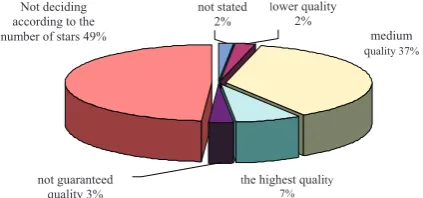
[image:5.595.311.523.636.735.2]37% respondents said that a medium quality is very important for them and they seek their accommoda-tion just in facilities that have two or three stars. The group of 7% is interesting as well and it shows that people are gradually getting accustomed to a higher standard and they rather pay more for their accom-modation when they are made sure that all the services they need will be provided to them (Figure 3).
The number of respondents who did not give their opinions on the quality level is approximately the same as those who mentioned a lower or not guaranteed quality. However, this is a minority that will probably later move to higher categories mentioned above.
It can be seen from the given data that the most frequent answer is the one where the respondents do not decide according to the number of stars.
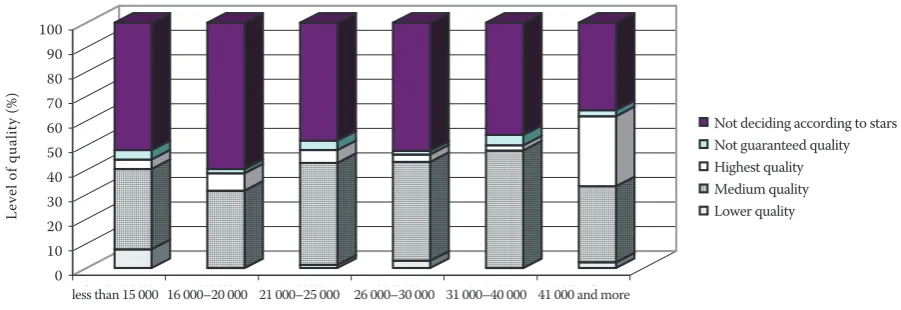
The Figure 4 shows the relation between respond-ents of different income groups and their preferences for different quality levels of accommodation. The picture shows an expected assumption when people with the lowest incomes mostly use the lowest quality while those with the highest salary grade decide for four-star hotels.
Respondents who do not decide according to the number of stars mostly fall into the category of net monthly incomes of 16 000–20 000 CZK. Then it is evident from the picture that all the groups use facilities of a medium category to a great extent. Another significant group of respondents does not decide according to the number of stars at all but they select their accommodation according to their own feelings and other criteria.
Pearson coefficient P = 0.35 derived from square
contingence (47 941) was used for expressing the dependence between the selected quality level and the net monthly income.
From the calculated Pearson coefficient it follows that there is only a weak dependency between the
selected level of accommodation quality and the net monthly income.
On the basis of the results mentioned above, the providers of accommodation services should focus especially on the differentiation from their competi-tors when attracting their clients (distinctions such as providing complementary services not offered by competitors), rather than on mere increasing the level of quality through the number of stars.
The sources of information concerning accommodation facilities
As it is apparent from the historical development of accommodation services, the most information on destinations was usually provided by travel agencies via published catalogues or by friends’ or relatives’ recommendations.
Nowadays tourists obtain the most information con-cerning accommodation possibilities on the Internet (64%). A great number of respondents, as much as 25%, follow recommendations given by their friends who have already stayed at a certain accommodation facility and they have been satisfied with its services. This represents the cheapest way of promotion for accommodation facilities that can be used and it is necessary to develop it further. Other ways of gaining information used by 7% respondents were predomi-nantly their own experience, catalogues and leaflets distributed by hotels and travel agencies. Using daily press for promoting accommodation facilities does not appear to be very effective as not more than 2% respondents answered that they choose their accom-modation according to advertisements published in magazines and newspapers.
The test of the relative frequency rate was conducted
[image:6.595.72.523.580.735.2]afterwards and it rejected a zero hypothesis (less than
Figure 4. The relation between the level of quality and a net monthly income
Le
ve
l o
f q
ua
lit
y
(%
)
100 90 80 70 60 50 40 30 20 10 0
less than 15 000 16 000–20 000 21 000–25 000 26 000–30 000 31 000–40 000 41 000 and more Net monthly income
Not deciding according to stars Not guaranteed quality Highest quality Medium quality Lower quality
0% 10% 20% 30% 40% 50% 60% 70% 80% 90% 100%
the level of guality
less than 15,000 16-20,000 21-25,000 26-30,000 31-40,000 41,000 and more Net monthly income
50% responders will be searching for information on
accommodation possibilitieson the Internet) so it can
be assumed that more than anticipated 50% will use the Internet for obtaining information.
H0: Π = 50
α = 0.05: (–∞; –1.96 ∪ 1.96; ∞) hypothesis is
rejected
α = 0.01: (–∞; –2.576 ∪ 2.576; ∞) hypothesis is
rejected, the difference is highly signifi- cant
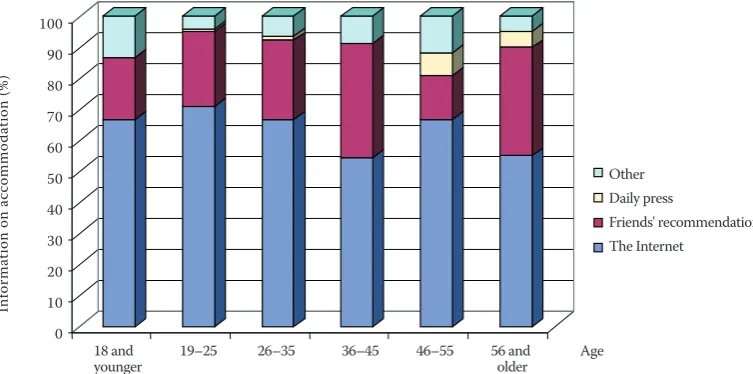
When comparing the ways of acquiring information on accommodation facilities with ages of the respond-ents (Figure 5), it is evident that the age group does not matter that much because the Internet is used by all of them in approximately the same way. Friends’ recommendations are most often followed by groups of 36–45 years of age and also 56 years and more.
The results above reveal that the presentation of a facility on its websites is of a high importance. They should be created professionally but not in a very demanding way so that a potential client is not discouraged by waiting for loading the needed pages too long. Then, web pages should include a contact phone number, e-mail address, a form for booking accommodation and also a map describing the way to the accommodation facility.
The way of making reservations
Despite the massive development of computer technology and increasing number of people using
the Internet, making reservations via the Internet comes only the second with 31%. This can be caused by the fact that when booking our accommodation, we prefer a direct contact with a real person rather than impersonal trusting in e-mails or internet res-ervations without an order that is confirmed verbally. The most of the responders – 47% – use telephones for making their reservations and this is mainly due to the past experience when the Internet was not used. 17% respondents book their accommodation even when departing the place when they intend to repeat their stay there. Personal reservations are also connected with trips that have no specific goal and their participants expect the capacity of an accom-modation facility not to be 100% full.
The preferences for the ways of spending free time at accommodation facilities and their surroundings
The ways of spending free time that people have during their stays are very individual. Complementary services that were used before year 1989 in the area of accommodation were organized by travel agencies and these were for instance tickets to sports and cul-tural events, roundtrips and sightseeing tours, trips, foreign currency exchange, game licences and so on. Tourist brought tokens for services with them which had been paid by the travel agency before and with these they received the corresponding services.
Nearly half of the respondents look for the infor-mation about free time activities before booking their stays at accommodation facilities – not only at the accommodation facility itself but also in its surrounding areas. About by 10% respondents less
n c c c p U ) ( � � �
1 5238
350 5 0 5 0 5 0 64 0 . . . . . � � � � U 0% 10% 20% 30% 40% 50% 60% 70% 80% 90% 100% In fo rm at io n on ac co m m od at io n 18 and
younger 19-25 26-35 36-45 46-55 56 andolder
Age Other Daily press Friends’ recommendations The Internet 100 90 80 70 60 50 40 30 20 10 0 In fo rm at io n on a cc om m od at io n (% )
18 and 19–25 26–35 36–45 46–55 56 and Age younger older
Other Daily press
[image:7.595.126.503.561.748.2]Friends' recommendations The Internet
search for such information occasionally. Only 15% of them are interested neither in the surroundings nor other possibilities of spending their leisure time at the facility of their accommodation. These can be people on business trips or travellers who admire all specialities of the given area and they use all the services that are available without inquiring about them before their departure.
Entrepreneurs who would like to attract more clients ought to describe all opportunities for spending free time on their web pages, supplemented with suit-able photographs and also references about places of interest in the neighbourhood that can be visited in case of good as well as bad weather.
The way of transportation to the accommodation facility
68% respondents said that they mostly reach the place of accommodation by car. It can be either a private or a company one. It is evident that despite the increasing quality of transportation services, car transportation is associated with comfort and inde-pendence on other means of transport. It is possible to stop when driving through interesting places and having seen them to continue travelling. This is not quite possible when travelling by bus or train.
Bus and train services are approximately at the same level and that is 13% and 11%. These are not only travels for sightseeing reasons but also business and educational trips. We can probably assume that the level of using these services will not decrease more. Walking and cycling is used by not more than 3% respondents, the same rate as for other ways of transportation. These are people who, similarly as in the past, prefer a healthy lifestyle and do not want to burden our environment with exhaust fumes.
All the age categories use mainly cars, the age group of 26–35 years the most of all. Up to 36 years of age, train transportation is also used to a large degree, however, the preference of this kind de-creases with a higher age. Older people prefer bus transportation to other means as they probably consider it to be more comfortable and faster than train transportation.
Satisfaction with room equipment
From the facts mentioned in historical records con-cerning the state of accommodation facilities, we get to know that the ways how rooms in accommodation facilities used to be equipped in the past were
insuf-ficient and so was their number. The furnishing was very plain with only the most necessary things.
After 1990, when foreign companies entered Czech market, the ways of equipment improved and more emphasis was laid on aesthetics and tastefulness of accommodation.
In 2007, when the research was conducted, 66% respondents were rather satisfied with room equip-ment and 28% of them were entirely satisfied. This represents 94% of the total number of interviewed people, so we can conclude that room equipment is on a satisfactory level or that Czech consumers are not very demanding. However, this does not indicate that when people are satisfied with room equipment, they do not lack anything. That is why it is important to continue in acquiring information about what customers would like to have in their rooms and what is possible to be arranged for the stable price of the room.
When determining the dependence between the evaluation of room equipment and the highest adjusted education, theoretical values were calculated and so
was also square contingence χ2 = 29.919, from which
we derived Pearson coefficient P = 0.283. This
coef-ficient shows that there is only a weak dependence between the evaluation of satisfaction with room equipment and the highest reached education.
When we look at Figure 6 more carefully we can see that respondents who have attended only ap-prentice training centres and those with higher pro-fessional education have given approximately the same answers: they are either entirely satisfied or rather satisfied with room equipment. Respondents with elementary education show the lowest rate of satisfaction with room equipment, which can also be caused by the category of accommodation they usually use. University graduates or people with secondary education are mostly satisfied with room equipment although there are a few percent of respondents who lack something in their rooms.
not as fast as when searching for the needed data on computers.
It is also evident from the answers that Czech clients like making themselves a cup of tea or coffee in their rooms so that they can feel at home. Many people would also like to have a TV set in their rooms. Other lacked things or matters are for example: flowers or plants, a balcony, a bar, daily press, a radio, a CD player, MP3 and DVD players, tidiness, electrical sockets, information on the surroundings, a cof-feemaker, air-conditioning, spare waste-bin bags, quiet, paintings, more comfortable furniture (beds, chairs, armchairs…), a wardrobe with a lock, cosi-ness, a telephone, racks in the bathroom, hangers in the wardrobe, a hairdryer, a mirror and also an iron. Some of these wishes are not so demanding to be realized and they would indisputably lead to a more pleasant stay at an accommodation facility.
Complementary services used in hotels
Before year 1989, complementary services such as exchange offices, fitness centres, solariums, hair-dressers’ and cosmetics services were not available in accommodation facilities and neither was the access to the Internet at all. After foreign companies had arrived, a lot of such services appeared on the Czech market as complements to accommodation ones, and today they are considered to be a standard on a certain quality level.
Sports services are ranked among the most usual services that are utilized in accommodation facilities. These can be for example hiring sports equipment (balls, nets, bicycles ...) as well as using hotel swimming
pools. The sale of maps, guidebooks and postcards depicting surroundings is used by customers as well – however, exactly these services were those that respondents most often complained about; they were not available and even the staff in the facilities was not able to answer clients’ questions. Other services that can usually be found in accommodation facili-ties are used on a minimum level only and in some cases they have to be paid extra for. Approximately half of the respondents would like to have their pets on their holidays (dogs).
Average expense per one person and night
There were several landmarks in the past that led to an increase in prices of accommodation, and these were especially opening our state boundaries in 1989, launching market economy, the crisis in 1997 (cur-rency) or merely increasing prices of energy and so on. Annual abstracts of statistics reveal that for example one night in a double room in a two-star hotel cost 246 CZK in 1991. This price is nowadays paid for a lower quality level. In 1995, a double room in the same hotel already cost 705 CZK and in 1999 it was 1 718 CZK. This represents approximately a septuple price increase. This is partially caused by inflation but also by an economic development of the country.
Before the questionnaire survey itself was conducted, a hypothesis was expressed – that 30% respondents will look for accommodation in the category from 201 to 300 CZK. The results are rather similar to the expected ones – 26% responders. People mostly spend 301–400 CZK per person and night on average. This
0% 20% 40% 60% 80% 100%
Satisfaction with room equipment
elementary secondary with school-leaving examination
apprentice
training professionalhigher university
The highest adjusted education
Not satisfied Rather unsatisfied Rather satisfied Satisfied
100
80
60
40
20
0
Sa
tis
fa
ct
io
n
w
ith
ro
om
e
qu
ip
m
en
t (
%
)
elementary secondary with apprentice higher university school-leaving training professional
education
The highest adjusted education
[image:9.595.102.500.70.270.2]Not satisfied Rather unsatisfied Rather satisfied Satisfied
was mentioned by 29% respondents who use hotels and boarding houses.
The second largest group was in the range of 201–300 CZK, this category was mentioned by 26% respondents. By 10% less usually find accommoda-tion in more expensive facilities and they usually pay 401–500 CZK on average. When evaluating individual financial amounts, it is necessary to be aware of the fact that not everywhere the prices of accommoda-tion are the same. In large cities or towns and areas with developed foreign tourism, these prices are higher than in places with no historical sights that are well-known due to media and have unharmed countryside or nature only.
Accommodation in the price ranges of 501– 600 CZK, more than 600 CZK or less than 200 CZK is used by approximately 10% responders. They usually mentioned accommodation in hotels of a
medium price category or, in case of the category 201–300 CZK, in cottages, farmhouses or dwelling units in campsites.
The assumption (H0: Π = 30, less than 30% people
are looking for accommodation in the category from 201 CZK to 300 CZK) was not rejected and so we can say that approximately 30% people find their accom-modation in the category 201–300 CZK.
The Figure 7 shows the relation between the price spent on accommodation and the number of house-hold members. It is important to be aware of the fact that the number of household members includes dependant children as well as those who are already independent but they still live with their parents.
The result of Pearson contingence coefficient (P =
0.36) shows that the dependence between the expense per one person and night and the number of house-hold members is rather weak.
0% 20% 40% 60% 80% 100%
Information on accommodation
one two three four five six and more
The number of members in the household
More than 600 501-600 CZK 401-500 CZK 301-400 CZK 201-300 CZK less than 200
100
80
60
40
20
0
In
fo
rm
at
io
n
on
a
cc
om
m
od
at
io
n
(%
)
one two three four five six and more The number of members in the household
[image:10.595.91.504.65.281.2]More than 600 CZK 501–600 CZK 401–500 CZK 301–400 CZK 201–300 CZK Less than 200 CZK
Figure 7. The relation between expenses on accommodation and the number of household members
0 10 20 30 40 50 60 70 80 90 100
home-made meals
voluntary work at a
farm
presence of
animals free time activities family peacequiet and demonstrationcraft
Figure 8. Services used at a country yard
[image:10.595.133.452.581.742.2]Holiday at a country yard
Terms “holiday at a country yard”, “agrotourism” or “ecoagrotourism” are quite new and they are con-nected with a non-production function of agriculture with the aim to increase the farmers’ additional in-comes. The pursuit of farmers is not to be directly dependent on the government subsidy or on their harvest only.
Holiday at a country yard or a farm attracts only 39% respondents. They are interested mainly in activi-ties that include horse-riding, cyclotourism, hiking, mushrooming, fishing or hunting with gamekeepers (Figure 8).
Quiet and family peace is the second attraction of a country yard as this is usually lacked by people from towns and cities. Silence, the wind whispering in trees and birds singing have an encouraging and regenerating effect on a human organism. The pre-sence of domestic animals has the same influence, which can be used for instance as a therapy for disa-bled children. Not that many people are interested in working at a farm. This is probably due to the fact that most participants of this kind of holiday want to rest and relax and working with domestic animals is usually very difficult and demanding.
Tramping
Tramping, or in other words free few-day walking and staying outdoors in the open countryside, has been inspired by the western literature. It is linked with clothes of discreet nature colours, backpacks, guitars and of course a group of good friends and a good mood in any weather. Tramping is based on the friendship between people and nature.
Nowadays tramping is not as widespread as it used to be in the past, but it still remains very popular, 37% respondents go tramping. In our country, build-ing tents in woods and forests is legal in comparison with foreign countries; it is limited only in areas protected by the state, i.e. in national parks and na-ture reserves.
Young people in the age of 19–25 are engaged in tramping the most often. By 50% less, people who like tramping can be found in the category of 26–35 years of age. After the age of 35, the number of people interested in tramping decreases dramatically. These decreasing tendencies can be caused by the fact that people over 30 usually start their families, which brings much less free time for leisure activities than before, for example due to worries with children. The remaining popularity of tramping offers entrepreneurs
in accommodation services good opportunities to unable their guests to spend their free time outside accommodation facilities, for example in gardens with benches, tables for picnics or outdoor fireplaces.
CONCLUSION
People mostly find their accommodation in hotels (35%), boarding houses (37%) or in privacy (16%). Cottages, country houses and campsites have be-come less popular and make way for new types of accommodation facilities. Not many people choose the facility according to its quality level. They either do not pay attention to the number of stars or they select a medium category. Information on accom-modation facilities is usually found on the Internet (64%) which is also used for searching for informa-tion about possibilities of free time activities at these facilities but also in their neighbourhood. After all necessary information on an accommodation facility and its surroundings is found, a reservation is made. However, it is not made via the Internet to such an extent, in comparison with searching for information. It is usually made by telephone (47%), similarly as in case of boarding services. Transportation to the place of accommodation is usually in the form of car transport (68%), only exceptionally people use buses or trains. An average price for accommodation per one person is approximately 300–400 CZK per night. Room equipment is usually on a satisfactory level. Guests mostly lack the Internet connection in their rooms (10%), a kitchen (6%) or more comfort-able furniture. In accommodation facilities, they also lack cultural events, information on places of interest in the neighbourhood and possibilities for sports activities that are quite widespread nowadays. 46% responders consider the company of their pets to be very important. The other would rather leave them at home, at their friends’ or in pet hotels. The relationship to nature and animals is also reflected in the willingness to spend holidays at country yards. This type of holiday has not become very popular yet. However, when at a country yard, people ap-preciate the possibilities of free time activities there, home-made meals, the presence of animals or simply the quiet and family peace there. The tradition of tramping is also connected with nature and it has been lasting for many years in our country. Singing tramp songs, sleeping in the open air, evening fires and mostly positive relationship to nature are typical and favoured by 37% respondents.
materi-ally-technical equipment as well as on the quality of services has increased, which is also connected with the entrance of foreign investors. Four- and five-star hotels are built and they are able to satisfy even the most demanding needs of clients. Foreign investors use the from of franchising more and more often, which provides clients with the quality of services that is usual and common abroad. The prices of rooms in hotels that are on the top level in accommodation services reach as high as several thousand Czech crowns, it is also possible to book a suite or even a whole hotel floor.
Increasing demands of clients also increase the requirements of the culture of room equipment, complementary services – mainly sports, the avail-ability of information on surroundings of facilities from the cultural as well as natural area.
Providers of accommodation facilities should en-deavour as much as possible to create internet pre-sentations of a high quality with a possibility to obtain all needed information about their accommodation facilities, their neighbourhood, access routes, and availability and so on. Then they should have at least one computer with the Internet connection in their building. Room equipment should be tasteful, with flowers or plants at windows and paintings on walls (for example painted by local artists).
The current development shows that requirements of consumers are more and more demanding and so it is inevitable to keep looking for information about what influences them the most. We still have to ask why consumers behave as they do, what makes them behave in these ways. It is not possible to find a universal answer, of course, but we have to take all the measures that can help us approach it and it is only up to us if we utilize the acquired knowledge to reach a competitive advantage.
REFERENCES
Felser G. (1997): Werbe- und Konsumentenpsycholo-gie. Schäffer-Poeschel, Berlin.
Foret M., Procházka P., Urbánek T. (2003): Marke-ting (MarkeMarke-ting). Computer Press, Brno; ISBN 80-722-6888-0.
Hartl P; Hartlová H. (2000): Psychologický slovník (Psychological dictionary). Portál, Praha; ISBN 80-7178-303-X.
Hesková M. (1999): Základní problémy cestovního ruchu (The basic problems of tourism). VŠE, Praha; ISBN 80-7079-047-4.
Hégrová M. (2007): Identifikace hlavních změn spo-třebitelského chování v pohostinských službách (The identification of main changes in consumer behaviour in hospitality services). [Diploma thesis.] MZLU, Brno.
Hladká J. (1997): Technika cestovního ruchu (The techniques of tourism). Grada, Praha; ISBN 80-7169-476-2.
Kopčil R. (1982): Cestovní ruch (Tourism). Merkur, Praha; ISBN 51-471-85.
Orieška J. (1999): Technika služeb cestovního ruchu (The techniques of tourism services). Idea Servis, Praha; ISBN 80-85970-27-9.
Vysekalová J. (2004): Spotřebitelské chování – jak zákazníci nakupují (Consumer behaviour – how customers purchase). Grada, Praha; ISBN 80-247-0393-9.
Zákon č. 40/1964 Sb., občanský zákoník [online]. Parlament České republiky, Praha [Quoted 2006-09-3].
Arrived on 16th August 2007
Contact address:
Kateřina Ryglová, Mendel University of Agriculture and Forestry Brno, Zemědělská 1, 613 00 Brno, Czech Republic