133
Volume LX 14 Number 4, 2012
DEVELOPMENT OF MERGERS IN THE
CZECH REPUBLIC IN 2001–2010
E. Hýblová, J. Sedláček, Z. Křížová
Received: October 10, 2011
Abstract
HÝBLOVÁ, E., SEDLÁČEK, J., KŘÍŽOVÁ, Z.: Development of mergers in the Czech Republic in 2001–2010.
Acta univ. agric. et silvic. Mendel. Brun., 2012, LX, No. 4, pp. 133–140
One of consequences of the substantial market globalization is company transformations, which essentially aff ect the creation, existence or dissolution of companies; their number has been on the increase in recent years. They are mergers and acquisitions; mergers represent a combination of companies, whereas acquisitions involve selling, purchase or investments of companies. The main reason for a merger is economic growth which can be provided in various ways: these are e.g. decreases in costs, strengthening of a position in the market or access to new markets, decrease in prices and thus gaining new customers, access to knowledge or diversifi cation of risks.
The process of a merger is a highly demanding matter which includes the economic view (a choice of the right partner, setting merger objectives, preparation of merger project) and the legal view as the merger involves commercial law, reporting and taxation legislation. Discrepancies in the legal, reporting and taxation procedures in the area can have a negative eff ect on the process of merger and economic practice. The development of mergers and acquisitions and their success rate is related to the development of the economic and legislative environment. An important aspect is also the successfulness of mergers in the following year which will confi rm (or not) the quality of all previous decisions.
Research studies conducted in this fi eld focus on mergers with the aim to evaluate procedures during mergers. An important part of research is an analysis of the eff ect of a merger on the evaluation of the successor company’s performance, changes in capital and capital structure of the entities. The aim of the paper is to publish fi rst partial results in this direction of research.
The fi rst part of the research focuses on the creation of a database of companies as this is essential for practical verifi cation of the results of the theoretical research. Due to the fact that there is no similar offi cial statistics in the Czech Republic, its creation needs to be devoted great attention. It is also vital to defi ne the transactions which will be included in the total number so that the results are relevant. company transformations, merger, acquisition, economic development of a company
The market globalization in recent years has increased the number of company transformations, specifi cally mergers and acquisitions. Today, these are not only mergers of companies within the same country; more and more o en new large multinational companies are born with the aim to utilize cost optimization, to gain access to new
markets, to obtain new technologies or to be able to achieve tax savings.
Company transformations are related to the force of a company, the society and individual partners. They are implemented in and signifi cantly aff ected by a wider political, ideological and moral environment (Vomáčková, 2009). In the rating of transaction attractiveness1, prepared by
the Mergers and Acquisitions Research Centre (MARC), Cass Business School of City University London in cooperation with Ernst & Young, the Czech Republic gained the 25th position, i.e. the best position of the Central and Eastern European countries (EY, 2011).
Mergers represent a combination from an economic and legal point of view. The Czech legislation distinguishes between a merger while no new company is formed (in which the successor company takes over the dissolving company) and a merger while a new company is formed (in which two or more companies, which are dissolved without going to liquidation, give rise to a new successor company).
Research objective
The actual process of company mergers is a multidisciplinary issue subject to commercial law, accounting and taxation legislation. Discrepancies between legal, accounting and taxation approaches to company combinations in the theoretic fi eld and their consequences for the economic practice led to the creation of a research project which was entrusted to Masaryk University, the Faculty of Economics and Administration in Brno. It is a project of the Grant Agency of the Czech Republic No. P403/11/0447 The Analysis of Taxation
and Accounting Practices during Mergers. The aim of
the project is to analyse accounting and taxation practices during mergers, identify the diff erences in the supranational and national procedures, and to evaluate their infl uence on the reported situation concerning equities and capital of participating companies and investments of partners. In relation to the ongoing harmonization of accounting, another topic of the research is accounting and reporting practices according to the IFRS, the US GAAP and Czech GAAP, the found diff erences and their causes, and the fi nal impacts on the reporting of capital, assets and liabilities in the dissolving companies and in the starting balance sheet of the successor company. Similarly, the commercial and legal conditions and tax laws concerning mergers will be analysed.
The paper contains the fi rst results of the project obtained from an informative study aiming at the identifi cation of some of the problems occurring during the preparation of mergers.
The fi rst step is a creation of a set of companies which will be subject to further research. Statistical data concerning mergers and acquisitions in the Czech market are hard to obtain. The trade register, in which the movement is captured, does not provide these data in a temporal series. Mediators, who participate in these transactions by counselling, do not provide these data either as mainly in large counselling agencies the data overlap and duplicity occurs (in some transactions these agencies are listed as counsellors for purchase, in others for sale or other types of counselling services related to mergers and acquisitions), (Czech Statistical Offi ce,
2011). Therefore, the data provided by individual counselling agencies diff er and cannot be used for obtaining the real state of mergers.
For example, the data published by counselling agency Ernst & Young show that sixty-eight mergers and acquisitions took place in the Czech Republic in 2010; in 2009 there were 97 of them, (News e15. cz). Data of counselling agencies usually do not distinguish between mergers and acquisitions. Generally spoken, they are both combinations of shares in the form of company combinations; however, they diff er in essence. Capital acquisitions lead to a relationship of parent-subsidiary type; equity acquisitions include sale, purchase and investments of the company; in mergers a new or a successor company is born taking the assets and liabilities of the dissolving companies and at the same time exchanges the securities or shares of the dissolving company for its own in an agreed ratio to the partners of the dissolving companies (Vomáčková, 2009).
According to server www.fi nance.cz the market of mergers and acquisitions in the Czech Republic continued falling in 2010 and both from the perspective of the number and the value of transactions reached the lowest numbers in the last four years. The total number of concluded transactions in 2010 was 167, (www.fi nance.cz, 2011).
All sources (Vomáčková, 2009, www.fi nance, 2011, Czech Statistical Offi ce 2010) observe a dependence between the development of economy and the number of mergers and acquisitions as in the times of prosperity, i.e. vivid activity in business, these transactions are much more numerous than in the times of economic depression, (Czech Statistical Offi ce 2010). Therefore, a basic comparison of the economic development in the Czech Republic as measured by GDP changes in relation to the number of mergers was conducted.
The complex matter of the issue we are presenting calls for a defi nition of the companies which will be subjected to the research. When creating the dataset of the companies in 2001–2010 using the data provided in the Czech Trade Register, we have chosen those whose ownership transactions met the defi nitions of mergers stipulated by Act no. 125/2008, on transformations of trading companies: • a merger in which a trading company or a coop-er ative is dissolved or more trading companies or cooperatives are dissolved, without going into liquidation; the equity of the dissolved trading company or cooperative including its rights and duties following from labour-law relations are transferred to another existent trading company or cooperative (hereina er merger type 1);
transferred to another newly established successor trading company or cooperative (hereina er merger type 2).
Pragmatically speaking, also transactions referred to as follows can be considered merger type 1 (in which no new company is formed):
• division of a company by combination, in which one of the divided companies is combined with another existing company (hereina er division type 1); or
• division of a company by demerger, during which a demerged company is combined with another existing company (hereina er merger type 1).
RESULTS AND DISCUSSION
Based on the analysis of company data from 2001–2010 included in the Trade Register, a set of companies which meet the conditions for a merger in compliance with Act No. 125/2008 Coll., on transformations of trading companies and cooperatives, was established. The results of the research were processed into time series, documenting the trend of mergers in the years 2001 to 2010. It was found out that in the selected period, mergers took place in 2 684 companies – table I and fi gure 1 show their distribution in individual years. As regards the types of mergers, type 1 prevails (2 255 mergers out of the total 2 684, which is 84 %, see Figure 2). The trend of merger development
in individual years grew from 2001 to 2003, then decreased until 2005, increased again till 2008, in 2009 there was a fall and the year 2010 brought new recovery.
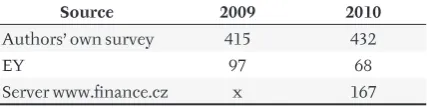
The comparison of data obtained within the research with other available sources is presented in Table II.
I: Number of mergers in individual years
Year 2001 2002 2003 2004 2005 2006 2007 2008 2009 2010 Total
In total 69 142 249 185 135 300 328 429 415 432 2 684
Merger type 1 67 141 246 183 118 256 214 342 335 353 2255
Merger type 2 2 1 2 2 6 23 27 34 29 15 141
Division type 2 0 0 0 0 6 16 86 50 38 61 257
Division type 1 0 0 0 0 5 5 1 2 7 3 23
Source: Authors’ own analysis
69 142
249 185
135 300
328 429
415 432
0 50 100 150 200 250 300 350 400 450 500
2001 2002 2003 2004 2005 2006 2007 2008 2009 2010
1: Development in amounts of mergers in 2001–2010
Source: Authors’ own analysis
2255 141
257 238
Merger type 1 Merger type 2 Division type 2 Division type 1 The others
2: Structure of mergers and divisions in 2001–2010
Source: Authors’ own analysis
II: Comparison of amounts of mergers found in diff erent sources for years 2009 and 2010
Source 2009 2010
Authors’ own survey 415 432
EY 97 68
Server www.fi nance.cz x 167
The data from other sources were compared with our data for years 2009 and 2010. Table II shows that the numbers of mergers performed in these periods as published by counselling agencies (www.fi nance. cz, 2011, News e15.cz, 2011) are markedly lower than the numbers found by authors of this paper. This is a result of a diff erent approach to establishing the number of mergers: the authors have reached the number through an analysis of all data available in the Trade Register, whereas counselling agencies
list only those where they participate. This fact is also confi rmed by reports published by the Czech statistical offi ce (Czech Statistical Offi ce, 2010).
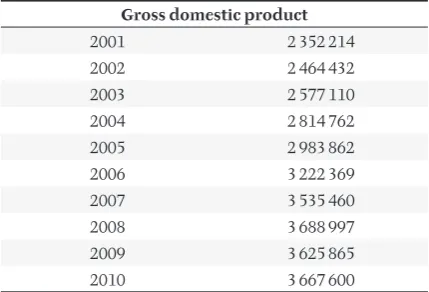
Another dependence mentioned by the sources (Vomáčková, 2009, www.fi nance, 2011, Czech Statistical Offi ce 2010) is the dependence of the number of mergers on the development of economy, in this case measured by the value of GDP; the data on GDP development are presented in Table III and Figure 3; the interannual changes in Table IV and Figure 4.
The worst year within the monitored period from an economic point of view was the year 2009. In the fi rst half of the year there was a recession and in the second half only slight improvement came; the real decrease of GDP for the entire year 2009 was 4.2 %. While in 2001–2008 Czech economy grew substantially faster than the entire EU (4.3 % on annual average in contrast to 2 % in the EU), the GDP drop of 2009 in the Czech Republic was the same as in the EU and the process of convergence to the EU economic level thus stopped. The negative impact of the recession was mainly manifested in the increasing unemployment rate, strong growth of government defi cit and debt and the fall of investment activity, (Spěváček, 2010).
The analysis of temporal series shows that the development trend of the number of mergers in time does not correspond to the development of
III: Development of gross domestic product in 2001–2010, in
common prices, mil. CZK
Gross domestic product
2001 2 352 214
2002 2 464 432
2003 2 577 110
2004 2 814 762
2005 2 983 862
2006 3 222 369
2007 3 535 460
2008 3 688 997
2009 3 625 865
2010 3 667 600
Source: authors’ own construction based on data of www. csu.cz
0 500 000 1 000 000 1 500 000 2 000 000 2 500 000 3 000 000 3 500 000 4 000 000
2001 2002 2003 2004 2005 2006 2007 2008 2009 2010
year m il. C Z K , c o m m o n p ric es
3: GDP development in 2001–2010 in common prices
Source: authors’ own construction based on data of www.csu.cz
IV: Interannual changes in GDP in 2001–2010, stable prices, in %
2001 2002 2003 2004 2005 2006 2007 2008 2009 2010
GDP changes 2.5 1.9 3.6 4.5 6.3 6.8 6.1 2.5 −4.1 2.2
Source: authors’ own construction based on data of www.csu.cz
-6,0 -4,0 -2,0 0,0 2,0 4,0 6,0 8,0
2001 2002 2003 2004 2005 2006 2007 2008 2009 2010
year % , la st y ea r is 1 00 %
4: Interannual changes in GDP in stable prices in %
GDP: mergers grew from 2001 to 2003, dropped until 2005, then grew until 2008, in 2009 there was a slump and in 2010 recovery again, whereas the GDP, except 2002, had an increasing trend until 2006, then decreased until 2009 and started to grow again in 2010. This could be caused by the fact that the research only focused on mergers, not acquisitions, which include capital acquisitions, i.e. purchase, selling or investment of a company, which can be more dependent on the development of economy, especially investment activity.
We used Pearson correlation coeffi cient for an initial estimate of dependence or independence. The value of the coeffi cient for the examined data was 0.9113. There is a strong dependence between the number of mergers and GDP. Therefore, we continued searching for an expression of the dependence of one variable on the other. We assume that the number of mergers develops in dependence on GDP. The independent variable (x axis) is GDP and the dependent variable (y axis) is the number of mergers (see Figure 5).
Further, we performed a linear regression because the graph shows a linear dependence of the number of mergers on GDP. The value of the determination index – 0.8305 – indicates the suitability of
the estimated model for the description of the dependence (see Figure 6).
A choice of another regression function could increase the value of the determination index2, but for our study the expression of the dependence by the linear function is suffi cient.
CONCLUSION
The creation of the database of companies which meet the conditions defi ned for mergers and divisions of companies in compliance with Act No. 125/2008, on transformations of trading companies, was a time-demanding yet essential task which forms a foundation for further research and a source for practical verifi cation of theoretical information. As has been mentioned in the paper, there is no statistics on mergers and counselling agencies only publish those transactions they are involved in. Using the defi nition of a merger stipulated in Act No. 125/2008, on transformations of trading companies and cooperatives, mergers were strictly distinguished from acquisitions.
To be able to draw conclusions regarding the development of the number of transactions in dependence on the GDP development presented in the sources (Vomáčková, 2009, www.fi nance, 2011,
5: Dependence of the number of mergers on the GDP development
Source: authors’ own construction
6: Linear regression function and determination index for the dependence of the number of mergers on the GDP development
Source: authors’ own construction
Czech Statistical Offi ce 2010), we need to approach this from two perspectives: fi rst, the perspective of the development of temporal series, second, to verify the data by a simple correlation analysis. When evaluating the temporal series, the trend of the development of mergers does not copy changes in GDP. The verifi cation of the dependence using Pearson correlation coeffi cient shows a strong
dependence between the number of mergers and GDP (the value of correlation coeffi cient is 0.9113).
Further research needs to be oriented at specifi c barriers to mergers related to legislative insuffi ciencies and discrepancies in the area of trading, reporting and taxation approaches and at a practical verifi cation using the created database of merging companies.
SUMMARY
The numbers of company transformations, namely mergers and acquisitions, are a signifi cant indicator o f the ongoing globalization of world markets. Multinational companies are born more frequently as they endeavour to optimize costs, gain access to new markets or new technologies and make use of tax savings.
Mergers represent a combination from an economic and legal point of view. We distinguish between two types of mergers: in the fi rst case, the successor company acquires the dissolved company; in the second case, two or more companies are merged into one, a new successor company, and they are dissolved without going into liquidation.
The paper is one of the fi rst outputs of project of the Grant Agency of the Czech Republic No.
P403/11/0447 The Analysis of Taxation and Accounting Practices during Mergers. The aim of the project is to
analyse accounting and taxation practices during mergers, identify the diff erences in supranational and national procedures, and to evaluate their impacts on the reported situation concerning equities and capital of participating companies and investments of partners.
For the purposes of the analysis, it was necessary to create a database of companies which can be then subjected to further examination. There is no usable statistic of mergers and acquisitions in the Czech market; counselling agencies only publish the cases they are involved in. The number of mergers and acquisitions is generally stated to be dependent on the development of the national economy as well; therefore, this was represented in the study by the GDP development in common and stable prices. The examination of the data in the Trade Register gave rise to a database containing the companies which went through a merger in 2000–2010. The database will serve as a base for further research. Thanks to this, the number of merging companies was given more precision; the resulting dataset only includes those transactions which comply with the conditions for mergers stipulated by Act No. 125/2008, on transformations of trading companies and cooperatives. This also explains the result which did not confi rm the dependence of the number of mergers and acquisitions on the development of the national economy – even in the period of GDP drop, the merger and acquisition development had a growing tendency.
Acknowledgement
The paper was prepared with the support from Grant Agency of the Czech Republic project
No. P403/11/0447 The Analysis of Taxation and Accounting Practices during Mergers.
REFERENCES
Czech Statistical Offi ce, 2010: Podnikatelské prostředí a ekonomický růst České republiky únor 2010, available at http://www.czso.cz/csu/2009edicniplan.nsf/p/ 1154 -09.
Czech Statistical Offi ce, 2011: Vývoj české ekonomiky
v roce 2010, available at: http://www.czso.cz/csu/ tz.
nsf/i/ceska_ekonomika_v_roce_2010_zakladni_ trendy_vyvoj.
Czech Statistical Offi ce, 2010: Tendence a faktory
makroekonomického vývoje v roce 2009, available at:
http://www.czso.cz/csu/redakce.nsf/i/analyzy_ csu.
Počet akvizic a fúzí loni v Česku klesl téměř o třetinu. News e15.cz. Published 19.4.2011 17:38 available at http:// zpravy.e15.cz/domaci/ekonomika/po cet
-akvizic-a-fuzi-loni-v-cesku-klesl-temer-o-tretinu?utm_ source=jnp&utm_medium=selfpromo&utm_ campaign=rsshub.
SEDLÁČEK, J., KŘÍŽOVÁ, Z., HÝBLOVÁ, E., 2011:
Acta Universitatis Agriculturae et Silviculturae
Mende-lianae Brunensis, Brno, LIX, 7, od s. 337–346, 10 s.
ISSN 1211-8516. 2011. GA403/11/0447.
SPĚVÁČEK, V., 2010: Recese české ekonomiky. Ekono-mické listy. Odborný vědecký časopis Centra eko-nomických studií Vysoké školy eko nomie a mana-gementu, 01/2010. ISSN 1804-4166. Available at http://www.vsem.cz/data/data/ces-soubory/eko-nomicke_listy/gf_Ekonomickelisty0510.pdf.
zebricek-tuzemsky-trh-fuzi-a-akvizic-loni- zmirnil-pokles-ty-velke-stale-chybely-top-10-m-a-poradcu-/.
Tisková zpráva společnosti EY (EY Press Release). Žebříček transakční atraktivity: Česká republika předstihla ostatní země střední a východní Evropy. Published 28.1.2011, available at http://www. ey.com/CZ/cs/Newsroom/News-releases.
VOMÁČKOVÁ, H., 2009: Účetnictví akvizicí, fúzí a jiných vlastnických transakcí (vyšší účetnictví).
4. aktualizované a rozšířené vydání. Praha: Bova Polygon, 2009, 560 p. ISBN 978-80-7273-157-2. Act No. 513/1991 Coll., commercial code, as
amended.
Act No. 125/2008 Coll., on transformations of trading companies and cooperatives.
Address