Extensive industrial production causes the emis-sion of a wide variety of contaminants to the environ-ment. Heavy metals are one of the most dangerous of these contaminants. They accumulate in the soil, ground, and bo�om sediment of seas and oceans and have a long-term effect on the biotic factors of the environment. Soil contaminated by heavy metals reduced the quality of the cultivated plants, which o�en limits and sometimes disqualifies the soil from the production of quality food products or animal feed (Frossard 1993, Obata and Umebayashi 1997, Kabata-Pendias and Pendias 2001). When analyzing the quality of plants harvested from fields contami-nated with heavy metals, an examination for heavy metals content is carried out and the concentrations of other chemical elements are omi�ed. Cadmium is a very mobile heavy metal in the environment. It is easily taken up by plants and transferred to their particular organs (Kabata-Pendias and Pendias 2001). Cadmium can have a destructive effect on the cell membrane plasma in the roots of sensitive plants, limiting the uptake of water and macro-elements. This effect is determined by the plant species. Obata et al. (1996) claimed that the activity of H+-ATPase in the cell membrane plasma
of the roots of papilionaceous plants is significantly lower than in the cucurbitaceous plants, which are quite tolerant to cadmium in the soil. H+-ATPase also participates in the uptake of elements by roots (Serrano 1989). Cadmium has an effect on the com-ponents of phospholipides and the cell membrane proteins, other than ATPase, by being toxic to the uptake of elements, and consequently, on root de-velopment (Obata and Umebayashi 1997). Research of cadmium effects on the macro-element content in plants is relatively scarce and the mechanism of its effect on uptake of macro-elements has not yet been sufficiently explained.
The aim of the experiment was to determine the effect of cadmium on the nitrogen uptake by plants. Moreover, the correlations between the nitrogen content in plants and the cadmium concentration in soil, plant yield and the content of macro- and microelements in the plants were determined.
MATERIAL AND METHODS
To investigate this mechanism, five pot ex-periments were carried out in a vegetation hall.
The effect of elevated cadmium content in soil
on the uptake of nitrogen by plants
Z. Ciecko
1, S. Kalembasa
2, M. Wyszkowski
1, E. Rolka
11
Department of Environmental Chemistry, University of Warmia and Mazury in Olsztyn,
Poland
2
Department of Soil Science and Agricultural Chemistry, Academy of Podlasie, Siedlce,
Poland
ABSTRACT
The aim of this study was to determine the effect of cadmium (10, 20, 30 and 40 mg Cd/kg of soil) contamination in soil with the application of different substances (compost, brown coal, lime and bentonite) on the intake of nitrogen by some plants. The correlations between the nitrogen content in the plants and the cadmium concentration in the soil, as well as the plant yield and the content of micro- and macroelements in the plants were determined. Plant spe-cies and cadmium dose determined the effects of soil contamination with cadmium on the content of nitrogen. Large doses of cadmium caused an increase in nitrogen content in the Avena sativa straw and roots and in the Zea mays roots. Soil contamination with cadmium resulted in a decrease of nitrogen content in the Avena sativa grain, in abo-ve-ground parts and roots of the Lupinus luteus, in the above-ground parts of the Zea mays and in the above-ground parts and roots of Phacelia tanacaetifolia. Among the experimental different substances, the application of bentonite had the strongest and a usually negative effect on the nitrogen content in plants. The greatest effect of bentonite was on Avena sativa grain, above-ground parts Zea mays and Lupinus luteus and Phacelia tanacaetifolia. The content of nitro-gen in the plants was nitro-generally positively correlated with the content of the macroelements and some of the microele-ments, regardless of the substances added to the soil.
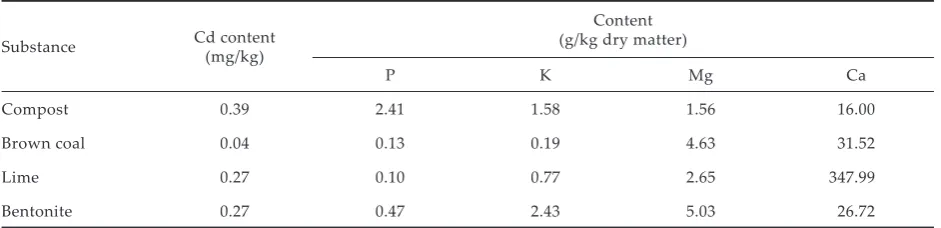
Increasing cadmium doses were applied in the experiment: 10, 20, 30 and 40 mg Cd/kg of soil as CdCl2. The effect of artificial soil contamination with cadmium on Avena sativa L., Zea mays L., Lupinus luteus L., Raphanus sativus L. and Phacelia tanacaetifolia Bentch. was observed. The follow-ing supplements to the soil were used to im-mobilize cadmium: in the cultivation of Avena sativa: compost, brown coal and lime and in the cultivation of the remaining plants: the same as for Avena sativa plus bentonite. The experiment was carried out on acidic Eutric Cambisol soil with a granulometric composition of light loamy sand in polyethylene pots (Table 1). Before the experiment was established, the soil was mixed with mineral fertilisers and with cadmium chlo-ride and different substances where required. The post was filled with 9 or 10 kg of soil. The compost and brown coal were added in the amount of 4%, bentonite in the amount of 2% of the soil mass and lime was added in an amount corresponding to 1 hydrolytic acidity (experiment with: Avena sativa – 1.51 g Ca/kg, Zea mays and Lupinus luteus – 0.91 g Ca/kg, Raphanus sativus – 1.15 g Ca/kgand Phacelia tanacaetifolia – 0.82 g Ca/kg of soil). Some physicochemical properties applied substances are in Table 2. In all pots, the soil was enriched with
the following amounts of macro-elements neces-sary for the proper growth and development of plants (quantities expressed in mg/kgof soil): N – 100 (50 – in experiment with Lupinus luteus) as CO(NH2)2, P – 43.6 as Ca(H2PO4)2 + H3PO4 + CaSO4, K – 96 as KCl. For the whole vegetation period, the soil moisture was maintained at a fixed level of 60% of the capillary water holding capacity. The plants harvest was realized in the following phases of vegetation: Avena sativa – in phase of full maturity, Lupinus luteus – in flowering phase, Zea mays – after cobs formation, Raphanus sativus – in phase of full maturity and Phacelia tanacaetifolia – in flowering phase.
During the harvest, samples of the above-ground parts and roots of plants were taken, then disin-tegrated, dried and ground. Such prepared plant material was analysed for nitrogen content with the Kjeldahl method (Bremner 1965), for macro- and microelement content with atomic spectrometry absorption (ASA) with the use of the Unicam 939 Solar spectrometer (Calvell 1955, Szyszko 1982). While preparing the analyses of nitrogen, 1 g of plant dry matter was ashed in 25 cm3 concentrated H2SO4 with the addition of 5 cm3 hydrogen per-oxide as a catalysing agent. Statistical calculations (Pearson’s simple correlation coefficients) were
Plant Type (kind)of soil pHKCl [mmol(+)/Hh
kg of soil]
Cd content (mg/kg)
Content of available forms (mg/kg)
C P K Mg
Avena sativa L. Zea mays L. Lupinus luteusL.
Eutric Cambisol
(light loamy sand) 4.50 32.6 0.17 5.30 10.77 11.10 3.51
Raphanus sativus L. (light loamy sand)Eutric Cambisol 4.07 27.4 0.07 5.62 12.60 14.73 2.93
Phacelia tanacaetifolia Bench. (light loamy sand)Eutric Cambisol 5.91 19.5 0.00 5.01 11.92 13.80 3.44
[image:2.595.63.535.85.228.2]C – organic carbon content, Hh – hydrolytic acidity
Table 2. Content of cadmium and macroelements in applied substances
Substance Cd content(mg/kg)
Content (g/kg dry matter)
P K Mg Ca
Compost 0.39 2.41 1.58 1.56 16.00
Brown coal 0.04 0.13 0.19 4.63 31.52
Lime 0.27 0.10 0.77 2.65 347.99
[image:2.595.63.534.643.757.2]carried out with the use of the Statistica software package, version 6 (StatSoft Inc. 2001).
RESULTS AND DISCUSSION
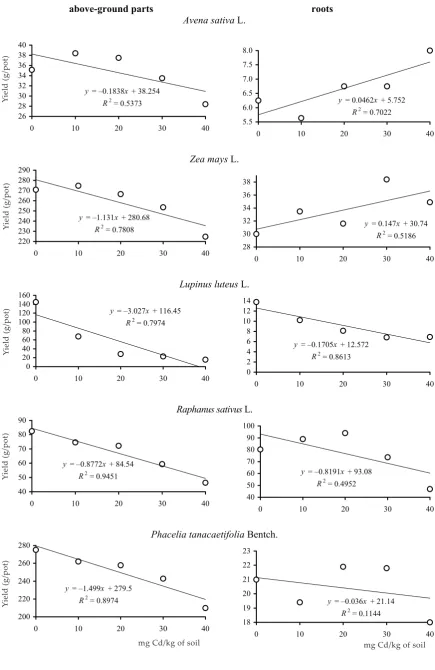
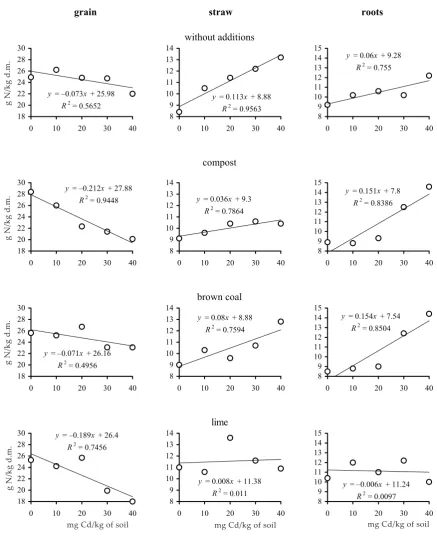
Soil contamination with heavy metals has an effect on the properties of the soil directly surrounding the roots by modifying the plant intake of chemi-cal elements essential for their proper growth and development. This effect is determined by both the degree of soil contamination and the plant species and their organs, which have different resistance to toxic heavy metals (Frossard 1993, Novozamsky et al. 1993, Gussarsson 1994, Obata and Umebayashi 1997, Tlustoš et al. 1998, Fargašová 2001). It seems, however, that plant species is an important factor (Obata and Umebayashi 1997, Kabata-Pendias and Pendias 2001). In our experiments, the effects of ar-tificial soil contamination with cadmium depended mainly on the plant species and organ and on the material supplemented to the soil. The experiments involved an analysis of the effect of the factors on the above-ground organs and roots of Avena sativa, Zea mays, Lupinus luteus, Raphanus sativus and Phacelia tanacaetifolia (Figures 1–6). A high concen-tration of cadmium in the soil caused a significant decrease in yield of the above-ground parts of all the plants’ and roots of Lupinus luteus, Raphanus sativus and Phacelia tanacaetifolia (Figure 1). In the roots of Avena sativa and Zea mays there was an opposite correlation. The application of compost, brown coal, lime and bentonite reduced the nega-tive influence of cadmium on the plants yield. In Avena sativa cultivated without application sub-stances, the highest cadmium dose (40 mg Cd/kg of soil) caused a high increase in nitrogen content (r = 0.67) in the roots and (r = 0.84) in the straw (Figure 2). In Avena sativa grain highest cadmium doses decreased nitrogen content (r = –0.75) at the application of 40 mg Cd/kg of soil in relation to the control series (without Cd). This decrease in Avena sativa grain was even higher in the pots supplemented with compost (r = –0.97) and lime (r = –0.86). On the other hand, soil contamination with cadmium and supplemented with compost and brown coal caused an increase in nitrogen content in the Avena sativa straw and roots. In straw it was clearly lower and in roots higher than in the series with no soil supplements. Moreover the mean nitrogen content was the higher in the Avena sativa grain than straw and roots.
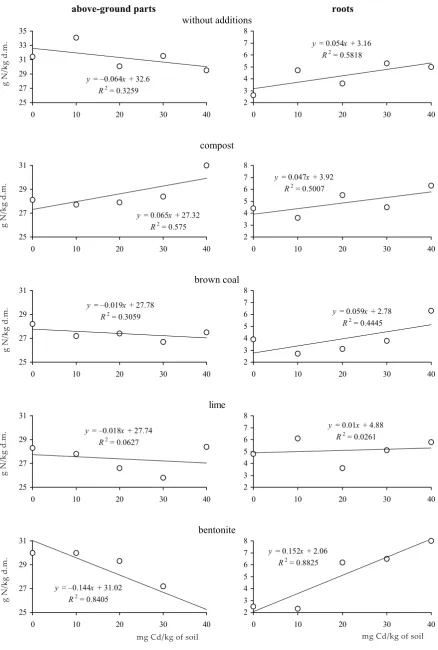
In the experiments with Zea mays cultivated with no supplements, soil contamination with cadmium caused relatively small changes in the nitrogen con-tent in the above-ground parts and a high, almost twice the increase (r = 0.76) of its concentration, in the roots (Figure 3). After the application of the
neutralizing matter to the pots with compost, the nitrogen content indicated a tendency to increase (r = 0.41) and in the series with bentonite it indi-cated a tendency to decrease (r = –0.92). In the pots with brown coal and lime, the cadmium effect was relatively low and multidirectional. In the roots of Zea mays cultivated with different substances, the highest cadmium dose (40 mg Cd/kg of soil) resulted in an increase of the nitrogen content in the series with compost (r = 0.71), brown coal (r = 0.67) and bentonite (r = 0.78). Moreover, the mean nitrogen content in the pots with supplements was lower in the above-ground parts and it was higher in the roots of plants cultivated without supplements.
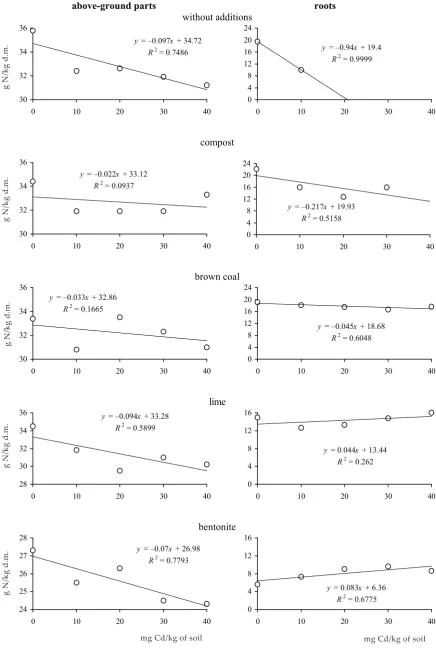
Massive contamination of soil with cadmium had a completely different effect on the nitrogen content in Lupinus luteus (Figure 4). In the pots without supplements, the nitrogen content decreased in the above-ground parts and in the roots. The nitrogen content analysis was carried out only in the two initial experimental pots. The root mass obtained in the combinations with 20, 30 and 40 mg Cd/kg of soil was insufficient to complete such analysis. In the pots with soil supplemented with the differ-ent substances, soil contamination with cadmium resulted in a decrease in nitrogen content in the above-ground parts of Lupinus luteus by 8–20%. The nitrogen content decreased in the roots of lupine cultivated with compost (r = –0.72) and brown coal (r = –0.78) and small increased in the roots of lupine cultivated in lime (r = 0.51) and bentonite (r = 0.82) supplemented soil. The mean nitrogen content in the pots with bentonite was considerably lower than in other experimental series. However, the mean nitrogen content in the roots of lupine cultivated in the pots with compost and brown coal was lower than in the remaining experimental combinations.
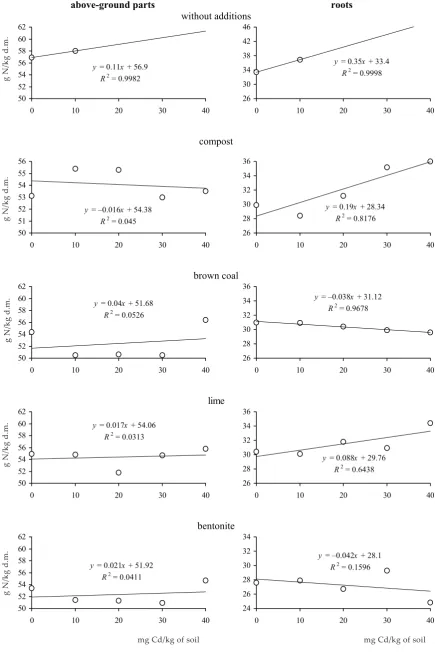
High cadmium concentrations in the soil did not have a significant effect on the nitrogen content in the above-ground parts of Raphanus sativus in the series with application compost, brown coal, lime and bentonite and in the roots in the series with brown coal and bentonite (Figure 5). However, the nitrogen concentration increased in the above-ground parts of Raphanus sativus in the series without additions and in the roots cultivated with compost (r = 0.79) and lime (r = 0.80). The mean nitrogen content in the above-ground parts and roots of Raphanus sativus cultivated with the supplements was a lower, than in the pots with no supplements.
Figure 1. Relationship between the content of cadmium in soil and yield of plants
mg Cd/kg of soil mg Cd/kg of soil
Yi
el
d
(g
/p
ot
)
Yi
el
d
(g
/p
ot
)
Yi
el
d
(g
/p
ot
)
Yi
el
d
(g
/p
ot
)
Yi
el
d
(g
/p
ot
)
Avena sativa L.
y = 0.1838x + 38.254 R2 = 0.5373 26
28 30 32 34 36 38 40
0 10 20 30 40
y = 0.0462x + 5.752 R2 = 0.7022 5.5
6.0 6.5 7.0 7.5 8.0
0 10 20 30 40
Zea mays L.
y = 1.131x + 280.68 R2 = 0.7808 220
230 240 250 260 270 280 290
0 10 20 30 40
y = 0.147x + 30.74 R2 = 0.5186 28
30 32 34 36 38
0 10 20 30 40
Lupinus luteus L.
y = 3.027x + 116.45 R2 = 0.7974
0 20 40 60 80 100 120 140 160
0 10 20 30 40
y = 0.1705x + 12.572 R2 = 0.8613 0
2 4 6 8 10 12 14
0 10 20 30 40
Raphanus sativus L.
y = 0.8772x + 84.54 R2 = 0.9451 40
50 60 70 80 90
0 10 20 30 40
y = 0.8191x + 93.08 R2 = 0.4952 40
50 60 70 80 90 100
0 10 20 30 40
Phacelia tanacaetifolia Bentch.
y = 1.499x + 279.5 R2 = 0.8974 200
220 240 260 280
0 10 20 30 40
y = 0.036x + 21.14 R2 = 0.1144 18
19 20 21 22 23
Figure 2. Nitrogen content in Avena sativa L. (g/kg of dry matter)
mg Cd/kg of soil mg Cd/kg of soil mg Cd/kg of soil
g
N
/k
g
d.
m
.
g
N
/k
g
d.
m
.
g
N
/k
g
d.
m
.
g
N
/k
g
d.
m
.
grain straw roots
without additions
y = 0.073x + 25.98
R2 = 0.5652 18
20 22 24 26 28 30
0 10 20 30 40
y = 0.113x + 8.88
R2 = 0.9563 8
9 10 11 12 13 14
0 10 20 30 40
y = 0.06x + 9.28
R2 = 0.755
8 9 10 11 12 13 14 15
0 10 20 30 40
compost
y = 0.212x + 27.88
R2 = 0.9448
18 20 22 24 26 28 30
0 10 20 30 40
y = 0.036x + 9.3
R2 = 0.7864
8 9 10 11 12 13 14
0 10 20 30 40
y = 0.151x + 7.8
R2 = 0.8386
8 9 10 11 12 13 14 15
0 10 20 30 40
brown coal
y = 0.071x + 26.16
R2 = 0.4956 18
20 22 24 26 28 30
0 10 20 30 40
y = 0.08x + 8.88
R2 = 0.7594
8 9 10 11 12 13 14
0 10 20 30 40
y = 0.154x + 7.54
R2 = 0.8504
8 9 10 11 12 13 14 15
0 10 20 30 40
lime
y = 0.189x + 26.4
R2 = 0.7456
18 20 22 24 26 28 30
0 10 20 30 40
y = 0.008x + 11.38
R2 = 0.011 8
9 10 11 12 13 14
0 10 20 30 40
y = 0.006x + 11.24
R2 = 0.0097 8
9 10 11 12 13 14 15
0 10 20 30 40
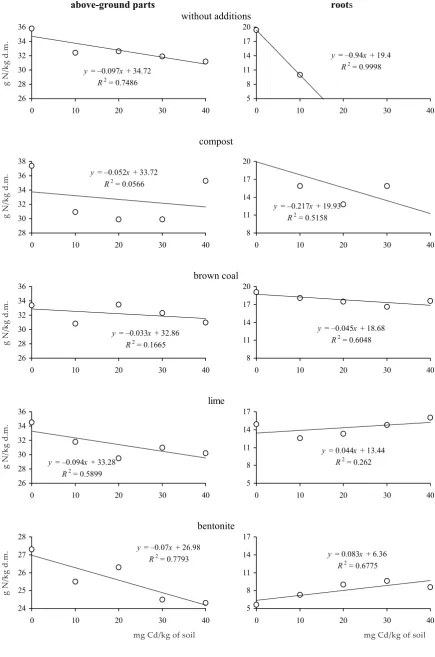
The decrease in the nitrogen content in the above-ground parts of Phacelia tanacaetifolia in the pots with the supplements was similar to that in the pots without the neutralizing matter and was between a few and a dozen per cent. On the other hand, this decrease was clearly greater in the pots with compost. A great increase in the nitrogen content was observed in the roots of Phacelia tanacaetifolia
cultivated with the application of bentonite to the soil contaminated Cd (r = 0.82).
Figure 3. Nitrogen content in Zea mays L. (g/kg of dry matter)
without additions
y = 0.064x + 32.6 R2 = 0.3259 25
27 29 31 33 35
0 10 20 30 40
y = 0.054x + 3.16 R2 = 0.5818
2 3 4 5 6 7 8
0 10 20 30 40
compost
y = 0.065x + 27.32 R2 = 0.575 25
27 29 31
0 10 20 30 40
y = 0.047x + 3.92 R2 = 0.5007
2 3 4 5 6 7 8
0 10 20 30 40
brown coal
y = 0.019x + 27.78 R2 = 0.3059
25 27 29 31
0 10 20 30 40
y = 0.059x + 2.78 R2 = 0.4445
2 3 4 5 6 7 8
0 10 20 30 40
lime
y = 0.018x + 27.74 R2 = 0.0627
25 27 29 31
0 10 20 30 40
y = 0.01x + 4.88 R2 = 0.0261
2 3 4 5 6 7 8
0 10 20 30 40
bentonite
y = 0.144x + 31.02 R2 = 0.8405 25
27 29 31
0 10 20 30 40
y = 0.152x + 2.06 R2 = 0.8825
2 3 4 5 6 7 8
0 10 20 30 40
mg Cd/kg of soil mg Cd/kg of soil
g
N
/k
g
d.
m
.
g
N
/k
g
d.
m
.
g
N
/k
g
d.
m
.
g
N
/k
g
d.
m
.
g
N
/k
g
d.
m
Figure 4. Nitrogen content in Lupinus luteus L. (g/kg of dry matter)
above-ground parts roots
without additions
y = 0.097x + 34.72 R2 = 0.7486
30 32 34 36
0 10 20 30 40
y = 0.94x + 19.4 R2 = 0.9999
0 4 8 12 16 20 24
0 10 20 30 40
compost
y = 0.022x + 33.12 R2 = 0.0937
30 32 34 36
0 10 20 30 40
y = 0.217x + 19.93 R2 = 0.5158 0
4 8 12 16 20 24
0 10 20 30 40
brown coal
y = 0.033x + 32.86 R2 = 0.1665
30 32 34 36
0 10 20 30 40
y = 0.045x + 18.68 R2 = 0.6048
0 4 8 12 16 20 24
0 10 20 30 40
lime
y = 0.094x + 33.28 R2 = 0.5899
28 30 32 34 36
0 10 20 30 40
y = 0.044x + 13.44 R2 = 0.262
0 4 8 12 16
0 10 20 30 40
bentonite
y = 0.07x + 26.98 R2 = 0.7793
24 25 26 27 28
0 10 20 30 40
y = 0.083x + 6.36 R2 = 0.6775 0
4 8 12 16
0 10 20 30 40
mg Cd/kg of soil mg Cd/kg of soil
g
N
/k
g
d.
m
.
g
N
/k
g
d.
m
.
g
N
/k
g
d.
m
.
g
N
/k
g
d.
m
.
g
N
/k
g
d.
m
Figure 5. Nitrogen content in Raphanus sativus L. (g/kg of dry matter)
without additions
y = 0.11x + 56.9 R2 = 0.9982
50 52 54 56 58 60 62
0 10 20 30 40
y = 0.35x + 33.4 R2 = 0.9998
26 30 34 38 42 46
0 10 20 30 40
compost
y = 0.016x + 54.38 R2 = 0.045
50 51 52 53 54 55 56
0 10 20 30 40
y = 0.19x + 28.34 R2 = 0.8176
26 28 30 32 34 36
0 10 20 30 40
brown coal
y = 0.04x + 51.68 R2 = 0.0526
50 52 54 56 58 60 62
0 10 20 30 40
y = 0.038x + 31.12 R2 = 0.9678
26 28 30 32 34 36
0 10 20 30 40
lime
y = 0.017x + 54.06 R2 = 0.0313
50 52 54 56 58 60 62
0 10 20 30 40
y = 0.088x + 29.76 R2 = 0.6438
26 28 30 32 34 36
0 10 20 30 40
bentonite
y = 0.021x + 51.92 R2 = 0.0411
50 52 54 56 58 60 62
0 10 20 30 40
y = 0.042x + 28.1 R2 = 0.1596
24 26 28 30 32 34
0 10 20 30 40
g
N
/k
g
d.
m
.
g
N
/k
g
d.
m
.
g
N
/k
g
d.
m
.
g
N
/k
g
d.
m
.
g
N
/k
g
d.
m
.
Figure 6. Nitrogen content in Phacelia tanacaetifolia Bentch. (g/kg of dry matter)
above-ground parts roots
without additions
y = 0.097x + 34.72 R2 = 0.7486 26
28 30 32 34 36
0 10 20 30 40
y = 0.94x + 19.4 R2 = 0.9998
5 8 11 14 17 20
0 10 20 30 40
compost
y = 0.052x + 33.72 R2 = 0.0566
28 30 32 34 36 38
0 10 20 30 40
y = 0.217x + 19.93 R2 = 0.5158 8
11 14 17 20
0 10 20 30 40
brown coal
y = 0.033x + 32.86 R2 = 0.1665 26
28 30 32 34 36
0 10 20 30 40
y = 0.045x + 18.68 R2 = 0.6048
8 11 14 17 20
0 10 20 30 40
lime
y = 0.094x + 33.28 R2 = 0.5899 26
28 30 32 34 36
0 10 20 30 40
y = 0.044x + 13.44 R2 = 0.262
5 8 11 14 17
0 10 20 30 40
bentonite
y = 0.07x + 26.98 R2 = 0.7793
24 25 26 27 28
0 10 20 30 40
y = 0.083x + 6.36 R2 = 0.6775
5 8 11 14 17
0 10 20 30 40
mg Cd/kg of soil mg Cd/kg of soil
g
N
/k
g
d.
m
.
g
N
/k
g
d.
m
.
g
N
/k
g
d.
m
.
g
N
/k
g
d.
m
.
g
N
/k
g
d.
m
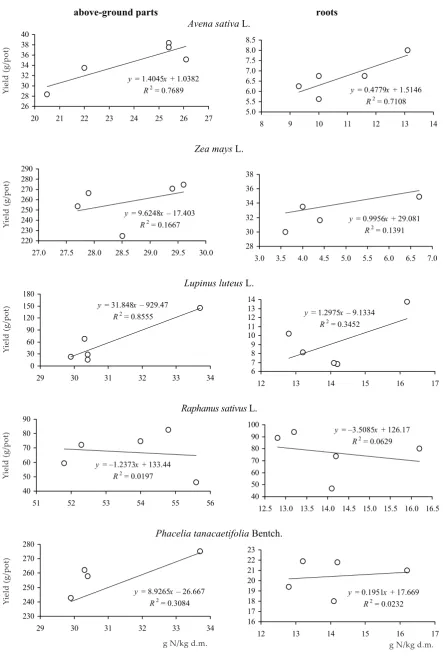
Figure 7. Relationship between the content of nitrogen and yield of plants
Avena sativa L.
y = 1.4045x + 1.0382 R2 = 0.7689 26
28 30 32 34 36 38 40
20 21 22 23 24 25 26 27
y = 0.4779x + 1.5146 R2 = 0.7108 5.0
5.5 6.0 6.5 7.0 7.5 8.0 8.5
8 9 10 11 12 13 14
Zea mays L.
y = 9.6248x 17.403 R2 = 0.1667 220
230 240 250 260 270 280 290
27.0 27.5 28.0 28.5 29.0 29.5 30.0
y = 0.9956x + 29.081 R2 = 0.1391 28
30 32 34 36 38
3.0 3.5 4.0 4.5 5.0 5.5 6.0 6.5 7.0
Lupinus luteus L.
y = 31.848x 929.47 R2 = 0.8555
0 30 60 90 120 150 180
29 30 31 32 33 34
y = 1.2975x 9.1334 R2 = 0.3452
6 7 8 9 10 11 12 13 14
12 13 14 15 16 17
Raphanus sativusL.
y = 1.2373x + 133.44 R2 = 0.0197 40
50 60 70 80 90
51 52 53 54 55 56
y = 3.5085x + 126.17 R2 = 0.0629
40 50 60 70 80 90 100
12.5 13.0 13.5 14.0 14.5 15.0 15.5 16.0 16.5
Phacelia tanacaetifolia Bentch.
y = 8.9265x 26.667 R2 = 0.3084 230
240 250 260 270 280
29 30 31 32 33 34
y = 0.1951x + 17.669 R2 = 0.0232
16 17 18 19 20 21 22 23
12 13 14 15 16 17
g N/kg d.m. g N/kg d.m.
Yi
el
d
(g
/p
ot
)
Yi
el
d
(g
/p
ot
)
Yi
el
d
(g
/p
ot
)
Yi
el
d
(g
/p
ot
)
Yi
el
d
(g
/p
ot
yields. The correlations between the nitrogen content in plants and the cadmium dose and the content of other macro- and microelements, includ-ing heavy metals, is interestinclud-ing (Table 3). Nitrogen content, regardless of the neutralizing matter sup-plemented to the soil, in the Avena sativa grain and the above-ground parts of Lupinus luteus was significantly negatively correlated and in the straw and the roots of Avena sativa and the roots of Zea mays was positively correlated with the cadmium dose. The nitrogen content in the above-ground parts and the roots of the experimental plants was generally significantly positively correlated with the concentration of phosphorus, potassium, mag-nesium, calcium, sodium and sulfur. The nitrogen content also indicated a significant correlation with some microelements in the above-ground parts and roots. This undoubtedly resulted from a com-plicated mechanism of element uptake by plants from soil, among others, from the antagonisms and synergies occurring between particular elements during their uptake by plant roots.
In previous experiments (Ciećko et al. 1998, 2001), the effect of soil contamination with cadmium on the nitrogen uptake by plants was determined by plant species as in the present experiment. In the case of spring triticale grain and straw and the above-ground mass of Zea mays, a high cadmium concentration in the soil had a stimulating effect
and in the case of spring rape an inhibiting effect on the nitrogen accumulation in the above-ground parts of the plants. Considerably lower fluctuations of macro-element concentrations in the yield of Avena sativa and Zea mays as a consequence of soil contamination with cadmium were observed in previous experiments (Ciećko et al. 1995). However, in the experiments of Simon (1998), neither low nor high cadmium doses modified the uptake of nitrogen, phosphorus or potassium by sunflower plants. The effect of soil supplements on the ni-trogen content in plants was observed in previous experiments (Ciećko et al. 1998, 2001).
[image:11.595.62.532.96.381.2]In which a positive nitrogen accumulation was observed in the effect of compost (and particularly brown coal) on the nitrogen content in the grain and straw of triticale and a negative accumulation in the above-ground parts of Zea mays. On the other hand, the effect of lime application on the nitro-gen content in the above-ground parts of triticale was negative and in the above-ground parts of Zea mays this effect was positive (Ciećko et al. 1998, 2001). In the present experiment, the effect of these substances on the uptake of nitrogen by the grain, straw and roots of Avena sativa was rather nega-tive. Supplementation of lime into the soil caused, however, an increase in the nitrogen content in the roots, in contrary to the above-ground parts of Zea mays in which a decrease was observed.
Table 3. Relationships (correlation coefficients r) between the nitrogen content versus the content of cadmium and the content of macro- and microelements in plants
Plant doseCd Content in plants
P K Mg Ca Na S B Mo Mn Fe Cd
Avena
sativa L. grain –0.74** 0.21 0.30 0.09 –0.44** 0.17 0.18 –0.02 0.39* 0.27 –0.37* –0.28 Avena
sativa L. straw 0.59** –0.33* 0.15 0.00 0.38* 0.43** 0.43** –0.09 0.38* –0.31* –0.01 0.44** Avena
sativa L. roots 0.84** 0.17 0.53** 0.56** 0.55** 0.51** 0.53** 0.05 –0.06 0.08 –0.11 0.72**
Zea mays L.
above-ground
parts –0.22 0.61** 0.59** –0.23 0.09 –0.08 0.04 –0.19 0.57** –0.16 0.12
Zea
mays L. roots 0.57** 0.65** 0.22 0.39** 0.35* 0.57** 0.68** 0.11 –0.21 –0.01 0.66**
Lupinus luteus L.
above-ground
parts –0.30* 0.41** 0.72** 0.38** 0.38** –0.84** –0.18 0.27 –0.20 0.56** 0.12 0.19
Lupinus
luteus L. roots –0.02 0.83** 0.93** 0.47** 0.42** –0.48** 0.51** 0.63** 0.03 –0.84** –0.93** 0.30
Raphanus sativus L.
above-ground
parts 0.11 0.04 0.35* –0.19 0.01 –0.25 –0.41** –0.02 –0.30* 0.24 –0.02 0.08
Raphanus
Bremner J.M. (1965): Total nitrogen. In: Black C.A. (ed.): Methods of soil analysis chemical and microbiologi-cal properties. Part 2. Am. Soc. Agron. Madison: 1149–1178.
Cavell A.J. (1955): The colorimetric determination of phosphorous in plant materials. J. Sci. Food Agr., 6: 479–481.
Ciećko Z., Wyszkowski M., Krajewski W., Zabielska J. (2001): Effect of organic matter and liming on the re-duction of cadmium uptake from soil by triticale and spring oilseed rape. Sci. Total Environ., 281: 37–45. Ciećko Z., Wyszkowski M., Żołnowski A. (1995):
Esti-mation of effects of tree bark and lime on yield and cadmium uptake by oats and maize. Zesz. Probl. Post. Nauk Roln., 418: 603–611. (In Polish)
Ciećko Z., Wyszkowski M., Żołnowski A. (1998): Cad-mium uptake by maize in the conditions of brown coal, compost and lime application. Zesz Probl. Post. Nauk. Roln., 455: 47–56. (In Polish)
Fargašová A. (2001): Effect of Cd in combination with Cu, Zn, Pb and Fe on root prolongation and metal accumulation in the roots and cotyledons of mustard (Sinapis alba) seedlings. Rostl. Výr., 47: 97–103. Frossard R. (1993): Contaminant uptake by plants. In:
Schulin R. et al. (eds.): Soil Monitoring. Birkhäuser Verlag, Basel: 7–24.
Gussarsson M. (1994): Cadmium-induced altera-tions in nutrient composition and growth of Betula
a primary target for cadmium toxicity. J. Plant. Nutr., 17: 2151–2163.
Kabata-Pendias A., Pendias H. (2001): Trace elements in soils and plants. 3rd ed. CRC Press, Boca Raton, FL.
Novozamsky I., Lexmond T.M., Houba V.J.G. (1993): A single extraction procedure of soil for evaluation of uptake of some metals by plants. Int. J. Environ. Anal. Chem., 51: 47–58.
Obata H., Inoue N., Umebayashi M. (1996): Effect of Cd on plasma membrane ATPase from plant roots differing in tolerance to Cd. Soil Sci. Plant Nutr., 42: 361–366.
Obata H., Umebayashi M. (1997): Effects of cadmium on mineral nutrient concentrations in plants differing in tolerance for cadmium. J. Plant Nutr., 20: 97–105. Serrano R. (1989): Structure and function of plasma
membrane ATPase. Ann. Rev. Plant Physiol. Plant Mol. Biol., 40: 61–94.
Simon L. (1998): Cadmium accumulation and distribu-tion in sunflower plant. J. Plant Nutr., 21: 341–352. StatSoft, Inc. (2001): STATISTICA (data analysis software
system). Version 6. www.statsoft.com
.
Szyszko E. (1982): Instrumental analytic methods. PZWL, Warszawa. (In Polish)
Tlustoš P., Pavlíková D., Balík J., Száková J., Hanč A., Balíková M. (1998): The accumulation and distribu-tion of arsenic and cadmium in plants. Rostl. Výr., 44: 463–469.
Received on July 3, 2003 ABSTRAKT
Vliv zvýšeného obsahu kadmia v půdě na příjem dusíku různými plodinami
Byl ověřován vliv kontaminace půdy kadmiem (10, 20, 30 a 40 mg Cd/kg půdy) na příjem dusíku některými plodi-nami při současné aplikaci různých materiálů (kompostu, hnědého uhlí, vápna a bentonitu). Byly stanoveny závis-losti mezi obsahem dusíku v jednotlivých plodinách a koncentrací kadmia v půdě, jakož i záviszávis-losti mezi výnosem plodiny a obsahem mikro- a makroprvků v plodinách. Vliv kontaminace půdy kadmiem na obsah dusíku byl dán druhem plodiny a dávkou kadmia. Vysoké dávky kadmia vedly ke zvýšení obsahu dusíku ve slámě a kořenech u druhu Avena sativa a v kořenech Zea mays. Kontaminace půdy kadmiem způsobila snížení obsahu dusíku v zrnu plodiny Avena sativa, v nadzemních částech a kořenech Lupinus luteus, v nadzemních částech Zea mays a v nadzem-ních částech a kořenech Phaceliatanacaetifolia. Aplikace bentonitu měla z uvedených pokusných materiálů nejvý-znamnější a obvykle záporný vliv na obsah dusíku v jednotlivých plodinách. Tento vliv byl největší u zrna Avena sativa, nadzemních částí plodin Zea mays a Lupinus luteus a Phaceliatanacaetifolia. Obecně vzato jsme zjistili pozitivní korelace obsahu dusíku v jednotlivých plodinách s obsahem makroprvků a některých mikroprvků, a to bez ohledu na materiál aplikovaný do půdy.
Klíčová slova: kontaminace půdy kadmiem; kompost; hnědé uhlí; vápno; bentonit; výnos rostlin; obsah dusíku; obsah makro- a mikroprvků
Corresponding author:
Prof. Zdzislaw Ciecko, University of Warmia and Mazury in Olsztyn, Department of Environmental Chemistry, 10-718 Olsztyn, Pl. Lódzki 4, Poland