289 Some shape abnormalities of spermatozoa (AS)
can be a result of pathological processes that affect testicles and the epididymis tract, others can be caused genetically. Some may be caused by unsuit-able rearing conditions.
Some authors of the papers published in this field consider the level of AS occurrence to be an impor-tant marker for the semen quality besides the sperm motility (Leidl et al., 1971; Lyczynski and Pawlak, 1974; Blom and Andersen, 1975; Gamčík et al., 1976; Blom, 1977; Stemmler et al., 1982; Wekerle, 1982; Falkenberg et al., 1984; Yoshida and Kojima,
1989; Waberski et al., 1990, 1994; Itoh and Toyama, 1995; Itoh et al., 1996; Věžník et al., 2000; Louda et al., 2001; Corcuera et al., 2002; Gadea, 2002). According to Waberski et al. (1990) two criteria are sufficient for the selection of boars for insemina-tion or ejaculate: sperm motility and percentage of AS, especially when the semen is preserved and used for the insemination of sows after a longer time, i.e. three to five days. Larsson et al. (1988) considered the motility and morphology of sper-matozoa to be the most sensitive indicators of the heat stress of boars. Malmgren (1989) attributed a
Supported by the Ministry of Agriculture of the Czech Republic (Project Nos. QD 0085 and MZE 0002701401).
Changes in boar semen with a high and low level
of morphologically abnormal spermatozoa
J. ČEŘOVSKÝ, S. FRYDRYCHOVÁ, A. LUSTYKOVÁ, M. ROZKOT
Research Institute of Animal Production, Prague-Uhříněves, Czech Republic
ABSTRACT: The aim of the paper was to find out the level of changes in the sperm quality in two groups of boars in the insemination (A and B) with diametrically different contents of morphologically abnormal spermatozoa (AS) with an interval of 25 weeks between semen collection I and collection II. In the group A there were 22 boars with the AS content up to 10%, in the group B 16 of boars with the AS content above 40% in collection I. Both groups were comparable concerning the parameters of the performance test results and in quantitative param-eters of the semen from collection I. They differed significantly in the AS content (P < 0.01) and in the age (P < 0.05). In collection II in both groups the semen volume increased significantly (A – P < 0.01; B – P < 0.05), in the group A the number of spermatozoa per ejaculate and per day also increased (P < 0.01). In the group B there was an insignificant clear decrease in the sperm concentration (P > 0.05). In comparison with the group B the group A can be characterized as a group with significantly higher dynamics in the sperm production per ejaculate. An opposite trend was noted in the total AS content. In the group A there was a significant increase (P < 0.001) and in the group B a significant decrease (P < 0.001) in collection II. In the group A there was a deterioration of the AS content in 7 boars (31.8%), in the group B an improvement in 7 boars (43.7%). Particular monitored AS forms are given. A significant difference in the total AS content between both groups was in favour of the group A (P < 0.001). While no boars from the group A exceeded the limit in the AS content for the applicability of semen for insemination (in the Czech Republic 25%), in the group B they remained above this limit without applicability pos-sibility. The detected variations and prevailing stability in the AS occurrence in boars kept in the same conditions lead us to a consideration of hereditary characteristics of the spermatogenesis factor, of considerable persistence of the level of monitored characteristics and to a consideration of applicability of the phenotype AS presentation to selection of boars for artificial insemination.
higher occurrence of spermatozoa with proximal protoplasmic droplet to increased temperature in testes. No changes in the AS content were observed in connection with the stalling of boars for insemi-nation (Lahrmann and Gardner, 1994).
Čeřovský (1979), Stemmler et al. (1982) and Krajňák (1995) reported an evident negative sig-nificant correlation between the AS content and the pregnancy rate of sows after insemination. Alanko (1985) published a significant proof of sperm fer-tility damage by means of an evaluation of early embryos and proportion of unfertilized eggs after slaughter of sows three days after insemination. Krajňák (1995) concluded that the pregnancy rate of sows decreased below 70% with 24% AS occur-rence and that the 37.1% AS occuroccur-rence caused pregnancy damage, i.e. the pregnancy rate lower than 60%. Grandjot (1997) provided a graphical representation of the linear dependence of the pregnancy rate in sows and the number of piglets born per litter on the AS level in the insemination conditions.
Even though the heritability of sperm qualities in boars is about 15 to 20%, a selection of boars for the semen parameters is effective and leads to a se-lection progress (Grandjot, 1997). Finnish authors (Andersson et al., 2002) were obviously pioneers in using “marker-assisted genetic selection” for the eradication of a specific sperm defect in boars called “immobile sterilizing short-tail sperm”.
As for the global occurrence of AS in the ejacu-late, Lyczynski and Pawlak (1974) did not recom-mend to use the semen containing more than 25% of AS for insemination, Remmen and Tielen (1976) limited the AS content to 20%. Bach et al. (1982) set the tolerance limit of AS on the level of 25%, Gibson (1983) gave the limit up to 15% for primary changes and also up to 15% for secondary ones. Waberski et al. (1994) recommended that the content of sper-matozoa with protoplasmic droplet should not be higher than 15%, especially when the diluted and preserved semen is used for insemination later after collection and dilution, which is a common practice today. Nowadays in the Czech Republic the appli-cability of the ejaculate for insemination is limited by the AS occurrence up to 25%.
Blom (1973) examined changes in the AS con-tent in boars in the course of time. He discovered that the spermiogram did not change within four months. Grandjot (1997) dealt with the study of seasonal changes in the boar semen in the course of a year. He discovered that the semen volume
oscil-lated in the range of 20%. Changes in the number of spermatozoa per ejaculate were not significant. The variability of the AS content in the ejaculates of boars in the course of several years in dependence on the year season and temperature conditions in stalls was published by Kopřiva and Pikhart (1981). The total number of spermatozoa per ejaculate in all boars is dependent above all on the length of the sexual rest. The highest levels were measured after an interval of 6 to 7 days between collections (Conrad et al., 1981). Gadea (2002) believed that the aim of the examination of the AS content was to find out if the spermatozoa developed in the testes normally and if they matured completely in the epididymis.
The aim of this study was to find out the extent of changes in the AS occurrence and sperm character-istics in groups of boars with diametrically different levels of AS and kept in relatively optimal condi-tions of artificial insemination (A.I.) station.
MATERIAL AND METHODS
Before the beginning of the summer period in the first week of the month of June 118 boars kept for artificial insemination were examined in our labo-ratory for the content of morphologically abnormal spermatozoa (AS) (first collection – I). The boars were kept in the same housing, feeding and tend-ing conditions; the semen was collected and evalu-ated by the same staff. Two groups were chosen from them with diametrically different AS occur-rence, i.e. up to 10% (group A) and more than 40% (group B), regardless of the breed. In both groups the semen collection was repeated (second collec-tion – II) 25 weeks later, i.e. in the first week of November to find out changes in the AS occur-rence in the period of stabilization of qualitative semen parameters after the summer season of the year – in our climate. Two ejaculates from each boar from the examined groups were used for the experiment (A: I and II, B: I and II). Both semen collections, the first one – I and the second one – II from each experimental boar, were performed on the phantom manually on the given dates of the year in the course of 5 days, always between 6 a.m. and 8 a.m.
291
1 500× under immersion: spermatozoa with
proxi-mal protoplasmic droplet, with distal (migrating) protoplasmic droplet, bent tail, folded tail, coiled tail, acrosome defects, narrow at the base, degen-erative spermatozoa and those with other defects (giant and double head, double tail, narrow head or round head, acrosome swelling), existing per 100 evaluated spermatozoa (see Figure 1).
The monitoring of AS was complemented by the results of performance test (PT) and by
conven-tional semen parameters – filtrate (semen volume, sperm concentration, total number of spermatozoa per ejaculate and number of spermatozoa per day of sexual rest = daily sperm production). In addition, the age of boars and the length of previous sexual rest before the monitored collections were taken into account for methodical reasons.
The A group was further divided into two sub-groups (a1 and a2); in the first subgroup of boars the total number of AS in semen collection II did
Figure 1. Morphologically abnormal spermatozoa monitored
distal protoplasmic droplet
coiled tail
narrow at the base
bent tail proximal protoplasmic droplet
folded tail
degenerative form
acrosome defect
giant head
double head
acrosome swelling
narrow head
round head
[image:3.595.98.486.223.750.2]double tail
not exceed the limit of 10% set for selection (a1) and the second subgroup exceeded this limit (a2). The B group of boars was also divided into two subgroups: a subgroup in which the AS content remained above the set limit (b1, more than 40%) and a subgroup of boars that improved, i.e. the total number of AS in collection II decreased below the limit we set for selection – 40% (b2). The results in the tables except Table 7 are presented as arithmetical means. All data were subjected to statistical analysis using the
chi-square test or Student’s t-test.
RESULTS
The numeric presentation of statistically
insig-nificant differences between the averages (–x) in the
length of sexual rest before monitored collections of ejaculates in production markers of collections I and II (Table 1) and differences in the PT between the groups of boars A and B (Table 2), except
sig-nificant difference in the age of groups (P < 0.05),
gives evidence of a methodically favourable situa-tion for the analysis and monitored development of AS. Both groups (A and B) are comparable concern-ing the sperm production markers and the perform-ance test. They differ in the occurrence of AS per
100 evaluated spermatozoa significantly (P < .01),
which is the principal subject of the analysis in this study (Table 5).
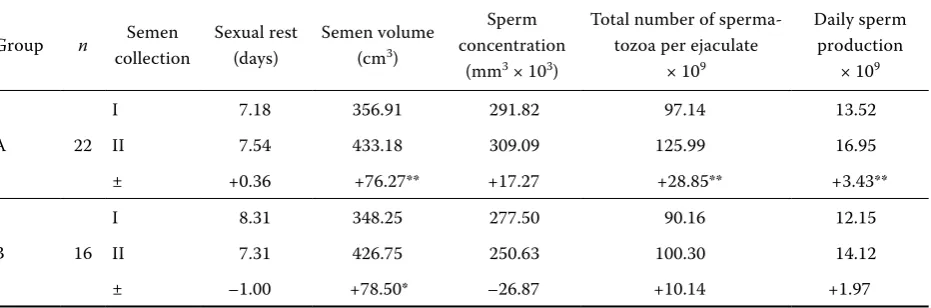
In sperm production markers there were changes with the age in both groups (A and B), i.e. differ-ences in the markers between collection I and II (Table 3). In both groups the semen volume
in-creased almost by the same value (A = +76.27 cm3,
P < 0.01; B = +78.50 cm3, P < 0.05). However,
be-cause of the lower sperm concentration in collec-tion II in group B the increase in the number of spermatozoa per ejaculate was less than a half of the increase in the spermatozoon number per
ejacu-late in the group A (B = +10.14 × 10⁹, P > 0.05 vs.
A = +28.85 × 10⁹, P < 0.01, Table 3). This became
logically evident in a significant increase in sperm production calculated per day of the sexual rest in
group A (A = +3.43 × 10⁹, P < 0.01 vs. B = +1.97 ×
109, P > 0.05) and also in a significant increase in
the number of spermatozoa per ejaculate P < 0.01
(Table 3).
Table 4 gives well-arranged information on sig-nificant changes in the correlation between the first and the second collection in the group A and group B. In group A all markers had a positive
sig-nificant development of the relation (P < 0.05; P <
0.01), while in group B there was a significant nega-tive relation in the sperm concentration (–26.87 ×
[image:4.595.66.535.503.623.2]103 spermatozoa/mm3; r = –0.685, P < 0.01; Tables
Table 1. Comparison of the monitored groups of boars according to average age values and sperm production (–x A vs. –x B)
Se
m
en
co
lle
ct
io
n
G
ro
up n Age
(days)
Sexual rest (days)
Semen volume (cm3)
Sperm concentration
(mm3 × 103)
Total number of spermatozoa per ejaculate
×109
Daily sperm production
×109
I A 22 659.68 ± 264.95 7.18 ± 0.80 356.91 ± 110.91 291.82 ± 115.71 97.14 ± 31.40 13.52 ± 4.24 B 16 859.50* ± 313.04 8.31 ± 3.70 348.25 ± 96.16 277.50 ± 130.86 90.16 ± 32.29 12.18 ± 6.38
II A 22 833.36 ± 264.91 7.55 ± 1.90 433.18 ± 123.82 309.09 ± 126.90 125.99 ± 1.06 16.95 ± 6.19 B 16 1 034.81* ± 312.26 7.31 ± 1.30 426.75 ± 119.23 250.63 ± 113.34 100.30 ± 31.51 14.12 ± 5.21
[image:4.595.63.539.686.756.2]*P < 0.05
Table 2. Comparison of average values of the performance test results (–x A vs. –x B)
Group n Daily weight gain (g) Lean meat (%)
Backfat thickness (cm) from birth in the test
293 3 and 4). Based on the discovered statistically
im-portant details between and within both groups, the group A with a significantly lower number of AS can be marked as a group with evidently higher sperm production dynamics than the group B with significantly higher content of AS.
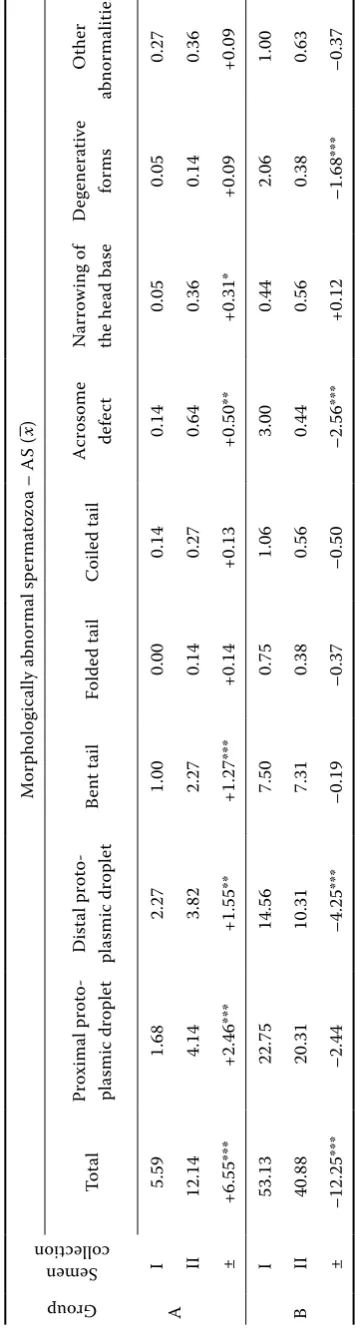
Tables 5 and 6 show development of the frequency of AS in both groups (A and B). In the total occur-rence of AS the diffeoccur-rence between groups A and B is significant in both collections (I a II), in favour of group A (I: 5.59 vs. 53.13, II: 12.14 vs. 40.88;
P < 0.001, Table 5). There was also a different
development within the groups between collections I and II. In the group A the total number of AS
increased significantly (5.59 vs. 12.14; P < 0.001)
while in the group B it decreased significantly
(53.13 vs. 40.88; P < 0.001), see Table 6.
The differences in the occurrence of spermato-zoa with proximal and distal protoplasmic drop-let between groups A and B in the semen from
collection I and II are statistically significant (P <
0.01, Table 5) and are the main portion of the total number of AS in both groups. In the group B in
the semen from collection I a significantly higher content of degenerative spermatozoa was detected
than in the group A (P < 0.05, Table 5). In other
forms of AS the differences between groups A and B according to collection I and II were not statisti-cally significant.
Table 6 shows an increase in particular AS forms in the group A and a decrease in the group B in collections II. Changes in the content of AS with
distal protoplasmic droplet (P < 0.01, P < 0.001) and
acrosome defects (P < 0.01, P < 0.001) account for
a significant portion of the changes. In addition, in group A the occurrence of AS with proximal
proto-plasmic droplet (P < 0.001), bent tail (P < 0.001) and
narrowing of the head base increased significantly
(P < 0.05) and in group B the occurrence of
degen-erated spermatozoon forms decreased significantly
(P < 0.001, Table 6). In the other monitored AS
forms the differences between the occurrences in collections I and II in both groups were not statisti-cally significant.
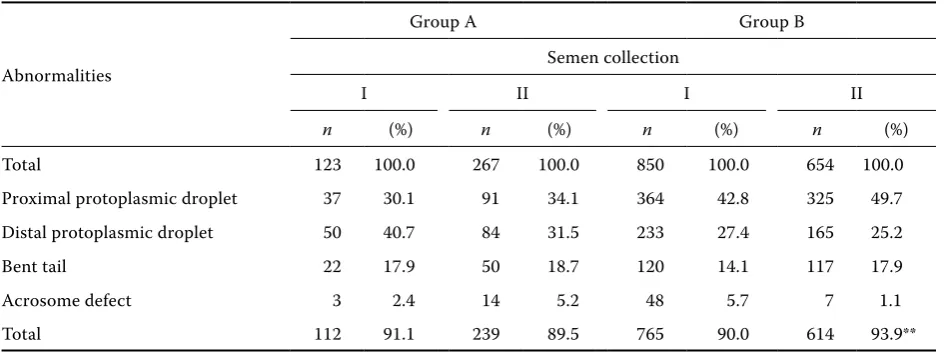
[image:5.595.67.533.435.589.2]Table 7 presents the portion of AS with the high-est occurrence frequency in the total AS content.
Table 3. Changes in sperm production between the first and second collection of the ejaculate in the groups of boars A and B (x)
Group n Semen collection
Sexual rest (days)
Semen volume (cm3)
Sperm concentration
(mm3 × 103)
Total number of sperma-tozoa per ejaculate
× 109
Daily sperm production
× 109
A 22
I 7.18 356.91 291.82 97.14 13.52
II 7.54 433.18 309.09 125.99 16.95
± +0.36 +76.27** +17.27 +28.85** +3.43**
B 16
I 8.31 348.25 277.50 90.16 12.15
II 7.31 426.75 250.63 100.30 14.12
± –1.00 +78.50* –26.87 +10.14 +1.97
[image:5.595.63.532.670.736.2]*P < 0.05, **P < 0.01
Table 4. Correlative relation in the monitored sperm values between collections I and II in the groups of boars A and B(r)
Group n Semen
collection Sexual rest
Semen volume
Spermatozoa
concentration total production per day
A 22 I – II 0.22 0.47* 0.78** 0.54** 0.59**
B 16 I – II –0.04 0.33 –0.69** 0.45 0.02
Ta bl e 5. D iff er en ce s i n th e oc cu rr en ce o f m or ph ol og ic al ly a bn or m al sp er m at oz oa b et w ee n th e gr ou ps o f b oa rs A a nd B a cc or di ng to se m en c ol le ct io n or de r Gro up Sem en lec col tio n M or ph ol og ic al ly a bn or m al sp er m at oz oa – A S (
– x)
To ta l Pr ox im al pr ot op la sm ic dr op le t D is ta l p ro to -pl as m ic d ro pl et Be nt ta il Fo ld ed ta il C oi le d ta il A cr os om e de fe ct N ar ro w in g of th e he ad b as e D eg en er at iv e fo rm s O th er ab no rm al iti es A I 5. 59 ± 2 .3 6 1. 68 ± 1 .5 6 2. 27 ± 1 .7 2 1. 00 ± 1 .4 8 0. 00 0. 14 ± 0 .3 5 0. 14 ± 0 .3 5 0. 05 ± 0 .2 1 0. 05 ± 0 .2 1 0. 27 ± 0 .5 5 B 53 .1 3* * ± 1 4. 70 22 .7 5* * ± 1 4. 41 14 .5 6* * ± 1 4. 88 7. 50 ± 1 2. 39 0. 75 ± 1 .7 7 1. 06 ± 1 .9 1 3. 00 ± 8 .7 8 0. 44 ± 0 .7 3 2. 06 * ± 3 .1 3 1. 00 ± 3 .2 5 A II 12 .1 4 ± 13 .4 3 4. 14 ± 4 .5 0 3. 82 ± 5 .5 4 2. 27 ± 4 .7 7 0. 14 ± 0 .4 7 0. 27 ± 0 .7 0 0. 64 ± 1 .5 3 0. 36 ± 1 .0 9 0. 14 ± 0 .3 5 0. 36 ± 0 .6 6 B 40 .8 8* * ± 1 7. 15 20 .3 1* * ± 1 5. 51 10 .3 1* * ± 6 .2 1 7. 31 ± 1 3. 46 0. 38 ± 0 .7 2 0. 56 ± 0 .8 9 0. 44 ± 0 .8 9 0. 56 ± 0 .9 6 0. 38 ± 0 .8 1 0. 63 ± 0 .9 6 * P < 0 .0 5, ** P < 0 .0 1 Ta bl e 6. D iff er en ce s i n th e oc cu rr en ce o f m or ph ol og ic al ly a bn or m al sp er m at oz oa in g ro up s o f b oa rs A a nd B a cc or di ng to se m en c ol le ct io n or de r Gro up Sem en tio lec col n M or ph ol og ic al ly a bn or m al sp er m at oz oa – A S (
– x)
[image:6.595.73.499.80.783.2] [image:6.595.308.486.93.764.2]295 Four AS forms represent a decisive well-balanced
part of the total AS content (from 89.51 to 93.88%). The portion of these changes resembles the values obtained at our workplace in the past: in boars at insemination stations 90.72 % and in natural breed-ing 90.84% (Čeřovský, 1978).
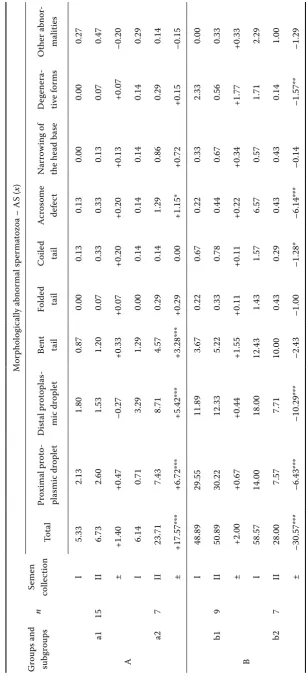
In the group A the AS occurrence deteriorated in 7 boars (31.8%) and in the group B the AS oc-currence improved in 7 boars (43.7%, Table 8). It means that in 15 boars from the group A and in 9 boars from the group B there was no change in the AS occurrence in comparison with the situation in collection I above (group A) and below (group B) the selection limit that we set and described in the “Methods” section. Table 8 documents the changes in the AS level in subgroups (a1, a2; b1, b2) between the situations in collections I and II. Differences in the representation of particular AS forms in sub-groups with the so-called unchanged situation (a1
v. b1) are not significant in all cases (P > 0.05). In the
subgroups with the changed AS situation (a2, b2) there was a significant increase in five monitored AS forms in the subgroup a2, i.e. in the spermato-zoa with proximal and distal protoplasmic droplet, with bent tail, acrosome defects, as well as in the total AS proportion compared to collection I. In the subgroup b2, however, there was a significant de-crease of AS in the spermatozoa with proximal and distal protoplasmic droplet, with acrosome defects, and in addition, in the occurrence of spermatozoa with coiled tail, degenerative forms and the total proportion of AS, all compared to the situation of
AS from collection I (Table 8). Significant changes ± in the occurrence of proximal and distal proto-plasmic droplet and acrosome defects are common for both groups. Differences in the subgroup a2 give evidence of an increased occurrence in all moni-tored AS forms except coiled tail. In the subgroup b2, on the contrary, there was a decrease of all AS forms in comparison with the situation from col-lection I. It is interesting that the differences in the representation of particular AS forms in boars that became worse (a2) and that improved (b2) in collection II are not statistically significant (a2/II
vs. b2/II = P > 0.05). The difference in the
represen-tation of boars with changes in collection II from the groups A and B (a2 vs. b2, or 31.8% vs. 43.7%
from “n” 22 and 16) is not statistically significant
(χ2 = 0.56, P > 0.05).
Significant changes (+ and –) in the AS oc-currence were noted in collection II in 14 boars (36.8%), i.e. practically in one third of boars out of the total number of the monitored ones (A + B = 38 animals). In 24 boars (63.2%) from both groups there were no significant changes either in any of the monitored AS form or in the total AS occur-rence (Table 8).
DISCUSSION
[image:7.595.63.538.114.292.2]For the monitoring of changes two compara-ble initial groups of boars concerning the semen parameters except for the significantly different Table 7. Changes and differences in the number of morphologically abnormal spermatozoa with the highest noted occurrence frequency
Abnormalities
Group A Group B
Semen collection
I II I II
n (%) n (%) n (%) n (%)
Total 123 100.0 267 100.0 850 100.0 654 100.0
Proximal protoplasmic droplet 37 30.1 91 34.1 364 42.8 325 49.7 Distal protoplasmic droplet 50 40.7 84 31.5 233 27.4 165 25.2
Bent tail 22 17.9 50 18.7 120 14.1 117 17.9
Acrosome defect 3 2.4 14 5.2 48 5.7 7 1.1
Total 112 91.1 239 89.5 765 90.0 614 93.9**
297 age average (Table 1) were used, but with a
dia-metrically significant difference in the AS content (Table 5). The development in the sperm produc-tion was however different within the group A and B between collection I and II (Table 3).
Grandjot (1997) studied seasonal changes in the semen of boars in the course of the year. He found out that the semen volume varied in the range of 20%, the number of spermatozoa in the ejaculate differed only slightly. The tendency of both char-acteristics (higher values in autumn and in winter) in our study is in agreement with the experience of the quoted author. The semen volume increased significantly in both groups, the number of sper-matozoa per ejaculate and day increased signifi-cantly only in the group A (Table 3), namely at the optimal average length of the sexual rest in both groups that is 6 to 7 days according to Conrad et al. (1981). It seems that in group B with high con-tent of AS and significantly older boars there is a dependence between the high content of AS and the low growth tendency in the sperm production because the spermatozoon number augmentation per ejaculate is more than twofold in group A for
the same period (10.14 vs. 28.85 × 10⁹ of
sperma-tozoa). That could support the assumption of Leidl et al. (1971), who arrived at a conclusion that there could occur a failure of spermatogenesis at a certain AS occurrence.
In the AS occurrence (in the spermiogram) in groups A and B a completely opposite development was noted. In collection II in the group A there was a significant increase in the AS occurrence, on the other hand, in the group B a significant de-crease of AS at the given representation structure of particular changes (Table 6). The development of AS in both groups differs from the experience of Blom (1973), who observed the AS content in boars for the period of 4 months without changes. However, Kopřiva and Pikhart (1981) recorded changes of various intensity in boars at A.I. sta-tion after several years of monitoring. Boars with small variations in the AS content within the semen applicability limits were marked as “semen stable boars” and boars with different intensity and vari-ations above the limit as “semen unstable boars”. According to the experience of these authors, older boars (more than 16 months) and especially the old-est ones (more than 40 months) were characterized by AS occurrence above the limits. The results of our study, as for the age of boars, are in accordance with the finding given above; because in the group
(boars significantly older) in the second collection no decrease of AS content below our selection limit of 40% was noted even if the average number of AS significantly fell by 12.25% (Table 6).
In Table 7 we can see that the spermatozoa with protoplasmic droplet, bent tail and acrosome de-fect make a proportionally great deal from the total content of AS (about 90%) in both collections and groups of boars (A and B). Concerning the AS fertil-ity Krajňák (1995) reported a considerably negative effect on the pregnancy rate of sows after insemina-tion by doses with AS content with protoplasmic droplet and tail torsion. It is generally difficult to define the effect of the content of AS with acrosome defects because of its low occurrence in the insemi-nation doses; high content is naturally pertinent to semen fertility damage (Gadea, 2002). Flowers (1997), quot. Corcuera et al. (2002), presumed that the effect of problematic semen quality on fertility damage of the inseminated sows could reach 33%. It can be deduced from it that the quality level (fertil-ity) of the semen used, or of the spermatozoa, is a significant marker in the artificial insemination of sows. Gadea (2002) stated that the aim of ascer-taining the AS content was to discover whether the spermatozoa developed normally in the testes and whether it matured fully in the epididymis. According to Malmgren (1989) an increased oc-currence of spermatozoa with protoplasmic drop-let and with acrosome abnormalities is due to an increased temperature in the testes.
In the group A in collection II 7 boars deterio-rated (a2), i.e. the AS content exceeded the selec-tion limit of 10% of AS. On the other hand, in the group B 7 boars improved in collection II (b2), i.e. the AS occurrence decreased in all boars below the selection limit of 40% (Table 8). It is interest-ing that a significant increase and decrease in both subgroups (a2 and b2) concerns the most frequent AS forms given before.
the development of the monitored markers, which demonstrates the persistence of the initial situa-tion. From this aspect we consider the occurrence of AS above the limit in a boar as a criterion for negative selection not only of ejaculates but also of boars for insemination, namely in those that are intended for A.I. We suggest to use “sperm stable boars” with the AS content up to 10% especially for the elite purebred herds and to cull boars with high AS content in time.
CONCLUSIONS
Based on the performed analysis of the develop-ment of the compared sperm characteristics in the groups of boars A and B with diametrically differ-ent AS contdiffer-ent at the beginning of the monitor-ing we can state that a significant increase in the semen volume is the only common feature with positive development for both groups. Group A of significantly younger boars was characterized by significantly progressive development of the sperm production per ejaculate and a significant increase in AS occurrence in comparison with the group B. The group B, i.e. the group of significantly older boars, was on the other hand characterized by a low tendency in the sperm production and a significant decrease in the AS content.
From the aspect of the comparison of the pheno-typic AS development with the permitted occur-rence limit (up to 25% in the Czech Republic for A.I.) the situation in boars of both groups (A + B) did not change in the course of the monitored period. In the group A all boars remained below the limit and in the group B, on the other hand, all boars re-mained above the limit, i.e. without the applicability for insemination. It gives evidence of considerable persistence of the initial condition in the AS content, probably with hereditary background.
REFERENCES
Alanko M. (1985): The effect of acrosomal defects in boar sperms on fertilization of sow ova. In: 36th Ann. Meet. Europ. Assoc. for Anim. Production, Halkidiki, Greece, Session IV.
Andersson M., Lehtinen P., Sirkko K., Sironen A., Vikki J. (2002): Eradication of a hereditary sperm defect by marker assisted genetic selection (MAS) in the pig. Reprod. Domest. Anim., 37 (Abstract P 1.4), 224.
Bach S., Neundorf P., Stemmler K.H., Mudra K., Ueckert H. (1982): Höhe und Bewertung des Anteiles anomaler Spermien beim Eber. Mh. Vet.-Med., 37, 463–467. Becker R.B., Wilcox C.J. (1969): Hereditary defects of
spermatozoa. A. I. Digest, 17 (12), 8–10.
Blom E. (1973): Studies on boar semen I. A new major defect in the sperm head, the SME – defect. Acta Vet. Scand., 14, 633–635.
Blom E., Andersen A. B. (1975): The ultrastructure of a characteristic sperm head – defect in the boar: the SME – defect. Andrologia, 7, 199–209.
Blom E. (1977): Sperm morphology with reference to bull infertility. In: First All-India Symposium on Anim. Re-prod., Ludhiana, India, 61–81.
Conrad F., Mudra K., Willumat A. (1981): Der Einfluss des Absamrhytmus auf die Spermaqualität und die Be-fruchtungsfähigkeit beim Eber. Tierzucht, 35, 529–530. Corcuera B., de Alba C., Hernández – Gil R., Sagüés A.
(2002): Identifying abnormalities in boar semen. Pig Progress, 18, 24–27.
Čeřovský J. (1976): Metoda barvení kančích spermií pro morfologické hodnocení. Živoč. Výr., 21, 361–366. Čeřovský J. (1978): Srovnání výskytu morfologických
abnormalit kančích spermií v ejakulátech infertilních kanců a v ejakulátech kanců s neporušenou fertilitou. Živoč. Výr., 23, 291–296.
Čeřovský J. (1979): Vliv objemu spermatu, koncentrace spermií a procenta morfologicky abnormálních spermií v semeni kanců na zabřezávání prasnic po inseminaci. Živoč. Výr., 24, 363–369.
Falkenberg H., Ritter E., Stienhans H. (1984): Zur züchter-ischen Bewertung der Beziehungen zwzüchter-ischen Sper-maqualität und Fruchtbarkeitsleistung von Ebern. Arch. Tierzucht, Berlin, 27, 523–534.
Flowers W.L. (1997): Management of boars for efficient semen production. J. Reprod. Fertil., 52 Suppl., 67–78. Gadea J. (2002): Sperm under the microscope. Pig
Inter-nat., 32, 24–27.
Gamčík P., Kozumplík J. a kol. (1976): Umelá inseminácia a andrológia hospodárskych zvierat. Príroda, Brati- slava. 574 pp.
Grandjot G. (1997): Grosser oder kleiner Wurf – wieviel liegt am Eber? Schweinez. Schweinemast, 45, 36–39. Gibson Ch. D. (1983): Clinical evaluation of the boar for
breeding soundness: physical examination and semen morphology. Comp. Cont. Educ., 5, 244–250.
Itoh Y., Toyama Y. (1995): Characteristics and fertility of boar semen with a high proportion of knobbed sperm. Jpn. J. Swine Sci., 32, 175–180.
299 Kojima Y., Kinoshita Y., Fukuda M. (1974): Multiple head
spermatozoa in the boar testes. Jpn. J. Veter. Sci., 36, 363–374.
Kopřiva J., Pikhart R. (1981): Výkyvy morfologických změn spermií u plemenných kanců v inseminaci v zá-vislosti na ročním období a stájovém mikroklimatu. Živoč. Výr., 26, 197–209.
Krajňák P. (1995): Vplyv morfologicky abnormálních spermií kancov na prasnosť inseminovaných prasníc. Živoč. Výr., 40, 537–540.
Lahrmann K. H., Gardner I. (1994): Influence of endog-enous and exogendog-enous factors on fertility of A. I. boars. In: Reproduction Domestic Animals (Zuchthygiene), (Abstract 1.) 29, 65–288,
Larsson K., Darenius K., Johansson K. (1980): Sperm morphology and in vitro viability in diluted semen in relation to fertility of A. I. boars. Nord. Vet.-Med., 32, 533–542.
Larsson K., Malmgren L., Einarsson S. (1988): Exposure of boars to elevated ambient temperature – conse-quences for hormone secretion, sperm morphology and fertility. Pig News and Information, 9, March, 4 pp. Leidl W., Schefels W., Stolla R., Metzger E. (1971):
Diffe-renzierung und Befruchtungsvermögen pathologischer Spermien. Dtsch. Tierärztl. Wschr., 78, 129–134 Louda F., Čeřovský J., Ježková A., Stádník L. (2001):
In-seminace hospodářských zvířat se základy biotechnic-kých metod. ČZU, Praha. 225 pp.
Lyczynski A., Pawlak H. (1974): Technika pobierania i oceny przydatnosci nasenia knurów w inseminacji. Przegl. Hodowl., 42, 18–20.
Malmgren L. (1989) Experimentally induced testicular alterations in boars: Sperm morphology changes in mature and peripubertal boars. J. Vet. Med. A, 36, 411–420.
Remmen J.L.A.M., Tielen M.J.M. (1976): Sperma – onder-zoek bij de beer. Tijdschr. Diergeneesk., 101, 599–610. Stemmler K.H., Bach S., Neundorf P., Mudra K., Ueckert
H. (1982): Der Einfluss von Spermienanomalien auf die Befruchtungsleistung beim Eber. Mh. Vet.-Med., 37, 467–470.
Věžník Z. a kol. (2000): Hodnocení semene pro asis-tovanou reprodukci a výběr plemeníků. VÚVeL, Brno. 95–101.
Waberski D., Dirksen G., Weitze K.F., Leiding C., Hahn R. (1990): Spermienmotilität und Morphologie in ihrer Auswirkung auf die Fruchtbarkeit von Besamungsebern in Feldversuchen. Tieräztl. Prax., 18, 591–594. Waberski D., Meding S., Dirksen G., Weitze K.F., Leiding
C., Hahn R. (1994): Fertility of long-term stored boar semen: Influence of extender (Androhep and Kiev), storage time and plasma droplets in the semen. Anim. Reprod. Sci., 36, 145–151.
Wekerle L. (1982): A sertés kansperma laboratóriumi vizsgálata, kűlőnős tekintettel a spermiumok mor-fológiájára. Magyar Allatorv. Lapja, 37, 41–45. Yoshida M., Kojima Y. (1989): Male pronuclear formation
by a boar spermatozoon with harpin-curved tail in zona-free hamster egg. Jpn. J. Vet. Sci., 51, 428–430.
Received: 04–09–07 Accepted after corrections: 05–01–17
Corresponding Author
Doc. Ing. Josef Čeřovský, DrSc., Research Institute of Animal Production, Prague-Uhříněves, Workplace Kostelec nad Orlicí, Komenského 1239, 517 41 Kostelec nad Orlicí, Czech Republic