A time-sensitive historical thesaurus-based semantic tagger for
deep semantic annotation
I
TaggedP
D1
X X
Scott Piao
aD2
X X
,*
,
D3
X X
Fraser Dallachy
D4
X X
b,
D5
X X
Alistair Baron
aD6
X X
,
D7
X X
Jane Demmen
D8
X X
a,
D9
X X
Steve Wattam
D10
X X
a,
D11
X X
Philip Durkin
X X
cD12
,
D13
X X
James McCracken
D14
X X
c,
Paul Rayson
D15
X X
D16
X X
a,
D17
X X
Marc Alexander
D18
X X
bTaggedP
aLancaster University, Lancaster LA1 4WA, United Kingdom
bUniversity of Glasgow, Glasgow G12 8QQ, United Kingdom
cOxford University Press, Oxford OX2 6DP, United Kingdom
Received 22 July 2016; received in revised form 5 February 2017; accepted 30 April 2017 Available online 17 May 2017
TaggedP
Abstract
Automatic extraction and analysis of meaning-related information from natural language data has been an important issue in a number of research areas, such as natural language processing (NLP), text mining, corpus linguistics, and data science. An important aspect of such information extraction and analysis is the semantic annotation of language data using a semantic tagger. In practice, various semantic annotation tools have been designed to carry out different levels of semantic annotation, such as topics of documents, semantic role labeling, named entities or events. Currently, the majority of existing semantic annotation tools identify and tag partial core semantic information in language data, but they tend to be applicable only for modern language corpora. While such semantic analyzers have proven useful for various purposes, a semantic annotation tool that is capable of annotating deep semantic senses of all lexical units, or all-words tagging, is still desirable for a deep, comprehensive semantic analysis of language data. With large-scale dig-itization efforts underway, delivering historical corpora with texts dating from the last 400 years, a particularly challenging aspect is the need to adapt the annotation in the face of significant word meaning change over time. In this paper, we report on the development of a new semantic tagger (the Historical Thesaurus Semantic Tagger), and discuss challenging issues we faced in this work. This new semantic tagger is built on existing NLP tools and incorporates a large-scale historical English thesaurus linked to the Oxford English Dictionary. Employing contextual disambiguation algorithms, this tool is capable of annotating lexical units with a historically-valid highly fine-grained semantic categorization scheme that contains about 225,000 semantic concepts and 4,033 thematic semantic cate-gories. In terms of novelty, it is adapted for processing historical English data, with rich information about historical usage of words and a spelling variant normalizer for historical forms of English. Furthermore, it is able to make use of knowledge about the publica-tion date of a text to adapt its output. In our evaluapublica-tion, the system achieved encouraging accuracies ranging from 77.12% to 91.08% on individual test texts. Applying time-sensitive methods improved results by as much as 3.54% and by 1.72% on average.
Ó 2017 The Authors. Published by Elsevier Ltd.
This is an open access article article under the CC BY license. (http://creativecommons.org/licenses/by/4.0/).
TaggedP
Keywords: Semantic annotation; Natural language processing; Historical thesaurus; Semantic lexicon; Corpus annotation; Language technology
I This paper has been recommended for acceptance by Pascale fung.
* Corresponding author.
E-mail address:[email protected](S. Piao),[email protected](F. Dallachy),[email protected](A. Baron), [email protected](J. Demmen),[email protected](S. Wattam),[email protected](P. Durkin),
[email protected](J. McCracken),[email protected](P. Rayson),[email protected](M. Alexander).
http://dx.doi.org/10.1016/j.csl.2017.04.010
0885-2308/ 2017 The Authors. Published by Elsevier Ltd. This is an open access article under the CC BY license. (http://creativecommons.org/ licenses/by/4.0/)
Computer Speech & Language 46 (2017) 113135
1. Introduction1
TaggedP
Semantic analysis of natural language data is a relevant task for a wide range of research areas and practi-cal applications, such as natural language processing, text mining, corpus linguistics and data science. Numer-ous semantic annotation tools have been developed to carry out variNumer-ous levels of semantic analysis, such as document topics, named entities, temporal information, and so on. For example, some tools are designed to identify the topic or themes of given texts (Allan, 2012), and some are designed to extract specific partial information, such as types of named entities, categories of relations between the specific named entities, and/ or types of events (Miwa et al., 2012; Rizzo and Troncy, 2012; Weston et al., 2013). Another group of seman-tic annotation tools are designed to identify semanseman-tic categories of all lexical units based on a given classifica-tion scheme, which can support a deep comprehensive semantic informaclassifica-tion analysis and extracclassifica-tion from language data. The latter task entails richer semantic lexical resources and a deeper level of sense disambigua-tion, and hence presents tough challenges. Our work presented in this paper addresses the issue of a semanti-cally rich text analytical system.
TaggedP
Over recent years, various semantic lexical resources and semantic annotation tools have been developed, such as EuroWordNet (Vossen, 1998) and the UCREL (University Centre for Computer Corpus Research on Language) Semantic Analysis System (USAS) (Rayson et al., 2004), and they have played an important role in developing intel-ligent natural language processing (NLP) and Human language technology (HLT) systems. For example, the USAS semantic tagger has been applied in a variety of studies, including empirical language studies at the semantic level
(Klebanov et al., 2008; Ooi et al., 2007; Potts and Baker, 2013; Rayson et al., 2004), studies in information
technol-ogy (Doherty et al., 2006; Nakano et al., 2005; Volk et al., 2002), software engineering (Chitchyan et al., 2006;
Taiani et al., 2008) and others (Balossi, 2014; Gacitua et al., 2008; Hancock et al., 2013; Markowitz and Hancock,
2014; Semino et al., 2015).
TaggedP
In this paper, we present our work in designing, developing and evaluating the accuracy of a new semantic tagger: the “Historical-Thesaurus-based Semantic Tagger” (henceforth HTST). The purpose of this tool is to annotate all lexical units of texts with a fine-grained semantic categorization scheme provided by a very large-scale and high-quality English historical thesaurus (Kay et al., 2016[2009]) (detailed further in the next section).
2. Related work
TaggedP
In recent years, researchers have devoted a great deal of effort to the development of various semantic annotation tools of natural language data. In particular, various lexical knowledge bases have been used to assign semantic con-cepts and categories to words and other types of lexical units in text. For example, WordNet is widely used for such a purpose, as demonstrated by the collection of WordNet Sense annotated corpora at the websitehttp://globalword
net.org/wordnet-annotated-corpora(last accessed 19 April 2016). A similar approach has been used for developing a
more semantic field oriented semantic tagger, USAS, at UCREL (Lancaster University, UK;http://ucrel.lancs.ac.uk/ usas), which is based on semantic lexicons containing lexical units classified with a set of pre-defined coarse-grained semantic fields rather than grouped by fine-grained word senses as in WordNet.
TaggedP
A significant amount of effort has been dedicated in previous research to word sense disambiguation, in particular in the SensEval series of events (Evaluation Exercises for the Semantic Analysis of Text;http://www.senseval.org), and more recently this has widened out (in SemEval and *SEM) to encompass other elements of computational anal-ysis of meaning. Although, in some cases these do use existing sense inventories (e.g. BabelNet), generally the sense inventory is induced or clustered from a training set. Corpus-based distributional semantic models and word embed-dings are now proving a very popular approach but generally still conflate different meanings of words under a single vector representation. In some works (Iacobacci et al., 2015), this limitation is starting to be addressed, but so far no research has been able to leverage meaning change over time, and this is obviously key for semantically annotating
1
TaggedP
historical corpora where modern taxonomies and sense clusters would fail to capture historically valid word meanings.
TaggedP
Besides the all-words annotation tools mentioned above, which attempt to assign semantic categories to every word and lexical unit, numerous semantic annotation tools have been developed aiming to identify and assign certain types of semantic information requested by specific tasks to part of the lexical units or text segments, such as types of named entities and events (Named Entity Recognition), relations between entities (Semantic Role Labeling), attributes of prod-uct names (Sentiment Analysis), content analysis, and temporal information of events. A typical software framework developed for such a purpose is GATE (General Architecture for Text Engineering;Cunningham et al., 2011), which provides semantic annotation functionalities for various levels of semantic annotations. However, our focus in this paper is on fine-grained (deep) word sense disambiguation relative to existing historically sensitive semantic taxonomies.
TaggedP
Directly related to our paper is the development of theHistorical Thesaurus of English(hereafter HT;Kay et al., 2016[2009]) carried out at the University of Glasgow, UK. The HT is the result of over four decades’ manual compi-lation by experts, which classifies the recorded vocabulary of English from the Old English period to the present day in a comprehensive semantic structure. The semantic classification is based primarily on a systematic analysis of the content of the Oxford English Dictionary, with other content from additional dictionaries of English. To this end, words are arranged into categories by the concepts they express, with successive subdivision of these categories delineating ever more precise sub-concepts within a concept. (For further details, see the HT website: http://www.
glasgow.ac.uk/thesaurus.)
TaggedP
The HT database consists of two datasets: lexicon dataset and category dataset, which are linked via HT category numerical IDs. For example, in the sample HT entries below, the word “mother” in the HT lexicon dataset has a HT category ID “6959”(second number in the entry), along with various information. This ID is used to link to a defini-tion entry in the HT category dataset (the first number in the lexicon sample entry). The category entry contains vari-ous information such as the HT category tag code “01.01.10.12.02.03” and heading “mater”. For most words, there are multiple lexicon entries which link the words to multiple HT categories.
TaggedP
[Sample HT entries]
TaggedP
Lexicon entry:
TaggedP
“22,028”;“6959”;“mother”;;“mother”;“c1391”;“1391”;“1391”;;;“c”;“1391”;“0”;;;;;“0”;“0”;;;;“0”;“0”;;;;“321”;“0”
TaggedP
Category entry:
TaggedP
“6959”;“01”;“01”;“10”;“12”;“02”;“03”;;“02.01”;“n”;“mater”;“sub.6.2”;“01.01.10.12.02.03”;“A26”;“123”
TaggedP
The creation of the HT was instituted by Michael Samuels at Glasgow in 1965 and completed under the supervi-sion of Christian Kay in 2009, at which point it was both released online (at www.glasgow.ac.uk/thesaurus; last accessed 19 April 2016) and printed by Oxford University Press under the titleHistorical Thesaurus of the Oxford
English Dictionary. Old English (OE) vocabulary is not present in theOxford English Dictionary (OED) except
where a direct reflex of an OE form is found in the present day language, and so to fill this gap,A Thesaurus of Old English(Roberts et al., 1995) was produced as a pilot project to the main thesaurus, acting as a proof of concept and a further input source for its parent project.
TaggedP
The HTST tagger that we report on in this paper falls under the category of all-words tagging. It is based on an English thesaurus knowledge base, and hence employs a highly finely-grained semantic classification scheme that has not previously been incorporated into any language semantic annotation tools. Our work therefore extends the capability of the existing semantic taggers in terms of both the depth and scale of annotation of language data. Since the HT entries are linked directly to OED senses, we are also able to train a tagger, for the first time, on the wealth of information about each sense encoded in the definitions and example sentences in the OED database.
3. Structure of Historical Thesaurus entries
TaggedP
TaggedP
The HT semantic categories are organized in a hierarchical structure, with each category being assigned a label and numeric code. The top level of classification is divided into ‘The External World’, ‘The Mental World’, and ‘The Social World’, prefixed with numeric codes 01, 02 and 03, respectively. At the next level of the hierarchy are 377 major categories, such as ‘The earth’, ‘Language’, and ‘Armed hostility’. The numeric codes extend according to the number of levels in the hierarchy in which the category is found. For example, ‘The Mental World’ is coded 02; within that, ‘Language’ is coded 02.07; at the next level down, ‘A language’ is coded 02.07.01, and so forth, down to a maximum of seven levels. Each category level may also contain subcategories used to classify lexis which provides finer details about the concept in question, but which does not constitute a new category in its own right. Altogether, the 2016 version of the HT contains 225,131 semantic divisions, which are used to classify 793,742 word forms. In terms of word sense ambiguity, approximately 261,642 lexemes in the HT dataset2 have multiple possible senses, of which 32,679 have more than three senses. 70 lexemes are annotated with 100 or more senses each, with a word assigned to 345 possi-ble senses. Although the average number of senses for each word of the whole HT dataset is slightly over 2.00, most commonly used words have multiple word senses.
TaggedP
In order to facilitate semantic analysis and make the category list more easily navigable for the users, a new set of 4033 thematic semantic categories was created for use in the HTST.3This is to create a ‘human-scale’ category set, i.e. one which comprises categories which a human would consider to be significant: neither too vague nor too detailed to be useful for general application. In practice, this involved drawing a notional ‘line’ through the HT, with categories above the line deemed cognitively significant to a human user, whilst the more intricate, often more tech-nical categories below the line were (under the new set of headings) merged into their superordinate category above the line. Criteria used for this were based on the key concept of ‘human scale’ found in chapter sixteen ofFauconnier
and Turner 2002. The resulting thematic hierarchy has five levels, which predominately map to the top five levels of
the original HT hierarchy of semantic categories, and no subcategories. None of the lexis in the HT is lost, but rather some are less finely divided.Table 1shows statistics of the distribution of semantic categories and their sub-catego-ries of the thematic tagset for the top three hierarchical levels. Note that not all tags have five hierarchical levels. For example, tagsAB.02(Birth) andAB.08.d(Development/growth/degeneration) have two and three levels of hierarchy respectively. This explains why the number of categories at layer three is reduced compared to that of layer two.
TaggedP
Users of the HTST can search using the thematic category set, as well as view results aggregated according to this set. The new categories are distinguished from the original HT categories using codes which combine letters and numbers, alternating between the two in successive levels of the hierarchy. For example,Board game is labeled BK.01.d.04.a as follows:
BK Leisure
BK.01 Entertainment
BK.01.d A specific form of amusement/a pastime
BK.01.d.04 Game
BK.01.d.04.a Board game
TaggedP
[image:4.544.134.413.63.115.2]The HTST tags text with both the full HT category and the thematic categories, so users can search on the most suitable level of detail for their needs. For example, HTST tags the word “mat” with the HT code “03.02.07.03.09.14-03" and corresponding thematic level code “AZ.06.f.05.m”. Considering the more practical
Fig. 1. Main information of HT entries used in HTST system.
2
The statistics is based on the HT dataset used in the current version of HTST.
3
For definitions of the thematic categories, see: http://www.gla.ac.uk/media/media_405070_en.pdf and http://www.gla.ac.uk/media/
TaggedP
applicability of the thematic level categories for users, in this paper we evaluate the performance of the HTST based on these categories.
4. Architecture of the HTST system
TaggedP
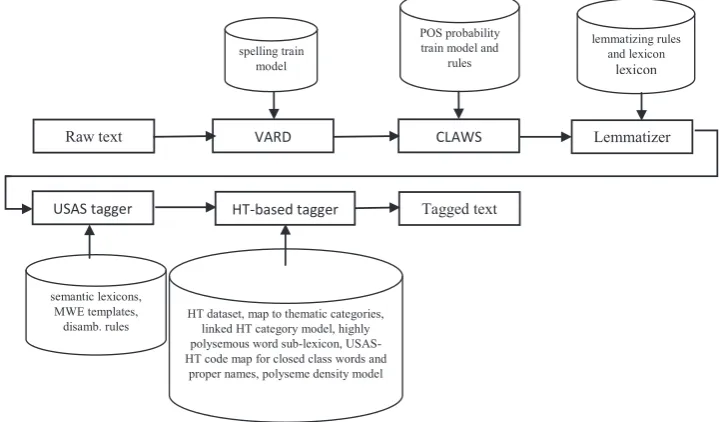
The HTST tagger is based on a set of existing NLP tools developed at UCREL (Lancaster University). These are the Variant Detector (VARD) (Baron and Rayson, 2008), the Constituent Likelihood Automatic Word-tagging Sys-tem (CLAWS) and USAS, which respectively provide functionalities of spelling normalization (particularly for his-torical text), tokenization and part-of-speech annotation, and semantic field annotation. These functionalities are required for pre-processing input text before we can apply the HT knowledge base for a deeper layer of semantic annotation. These tools introduce some errors in the pre-processing steps, which is inevitable for automatic tools, but in this paper we focus on the performance of the whole HTST system, and will not investigate the performance of the individual tools since this is reported in the relevant cited papers.Fig. 2illustrates the pipeline architecture of the HTST annotation system.
TaggedP
[image:5.544.83.458.88.132.2]Compared to other NLP toolkits, a unique component of HTST is the VARD software that is used for normalizing historical spelling variants of English. Spelling variation is a prevalent feature of historical varieties of most lan-guages. This is especially the case for historical English, which has been shown to have high levels of spelling varia-tion, decreasing over the Early Modern English period until around 1700 (Baron et al., 2009). VARD has been developed over a number of years to assist with the normalization of spelling in, particularly, historical texts. It uti-lizes methods commonly found in modern spellcheckers, such as phonetic matching, edit distance and letter replace-ment rules, but specialized for historical texts. The tool can also be trained to deal with spelling variation in different time periods and from different corpora, which improves the precision and recall of the automatic spelling normali-zation (Baron and Rayson, 2009; Hendrickx and Marquilhas, 2011; Lehto et al., 2010). In the HTST, VARD acts as
[image:5.544.89.449.451.662.2]Fig. 2. Architecture of HTST system. Table 1
Distribution of semantic categories and their sub-categories of the thematic tagset for top three hierarchical levels.
Hierarchical layer Number of cats Min numb of sub-categories Max numb of sub-categories Average numb of sub-categories
layer-1 37 20 349 108.05
layer-2 331 1 124 10.48
TaggedP
a pre-processor to other automated tools, which perform more accurately on normalized text versus the original text containing spelling variants. Previous studies have demonstrated that spelling normalization can significantly improve the performance of POS-tagging (Hendrickx and Marquilhas, 2011; Rayson et al., 2007) and semantic annotation (Archer et al., 2003).
TaggedP
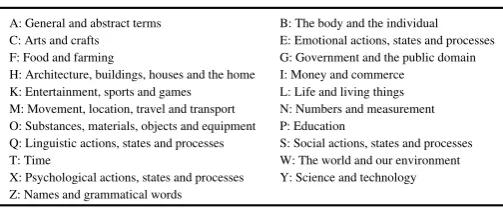
One of the main components of the HTST is the USAS semantic tagger. Although it is now mainly used to seman-tically analyze general modern written texts and transcribed speech, USAS was originally designed for the content analysis of market research interview transcripts in order to bridge the gap between qualitative and quantitative sur-vey methods. Rather than project specific categories, it applies a general purpose semantic taxonomy of 232 catego-ries arranged in a hierarchical structure, with the top level containing 21 major domains (seeTable 2) which in turn break down into three further levels of sub-division.
TaggedP
The USAS semantic taxonomy was originally based on Tom McArthur’sLongman Lexicon of Contemporary English(McArthur, 1981) and allows the tool to distinguish between coarse-grained semantic fields rather than fine-grained word senses. For example, for the word ‘bank’, some printed dictionaries would distinguish between the conceptual categories of the financial institution and the physical high-street branches of the bank. The USAS tagger considers both of these senses as related to money and commerce (Archer et al., 2004).
TaggedP
The knowledge source of the system consists of a single word lexicon currently containing 56,318 items and a multiword expression (MWE) lexicon currently containing 18,971 templates, as shown below.
take_fNp=P=Rgfor_IF granted_
TaggedP
Each single word or MWE has been manually assigned to one or more potential semantic fields (tags). MWEs are considered to be phrases or chunks, potentially discontinuous, which are assigned a single semantic tag. The MWEs mainly include phrasal verbs (e.g. ‘stubbed out’), noun phrases (e.g. ‘riding boots’), proper names (e.g. ‘United States of America’) and true non-compositional idioms (e.g. ‘living the life of riley’) (Piao et al., 2005).
TaggedP
The USAS semantic tagger employs a combination of six methods to contextually disambiguate which of the potential tags is correct. A main method is the grammatical category of a word, hence we pre-process texts with the CLAWS POS tagger (Garside and Smith, 1997). For example, the word ‘spring’ can be partially semantically disam-biguated if we know it is a verb versus a noun, to differentiate meanings such as movement-action (verb) versus metal-coil, season or water-source (all nouns). Subsequent disambiguation methods, applied in order, are:
TaggedP
(a) General likelihood ranking, derived from frequency information, past tagging experience and intuition;
TaggedP
(b) Overlapping template resolution, using length and span heuristics plus closeness of wildcard matching to priori-tize which MWE template is selected;
TaggedP
(c) Domain of discourse, e.g. the topic of a text will help determine the relative ordering of tags
TaggedP
(d) Text-based disambiguation, using recurrence of an item in a text to assign the same semantic field in each case; and
TaggedP
(e) Manually created contextual rules, where immediate local context can determine the correct semantic field.
TaggedP
[image:6.544.148.400.575.679.2]For a full description of the six methods with examples, seeRayson et al., (2004). Both CLAWS and USAS con-tain lemmatizers to enable improved dictionary look-up for grammatical and semantic tagging, although this is rep-resented separately in our pipeline diagram.
Table 2
The USAS tagset top-level domains.
A: General and abstract terms B: The body and the individual
C: Arts and crafts E: Emotional actions, states and processes
F: Food and farming G: Government and the public domain
H: Architecture, buildings, houses and the home I: Money and commerce
K: Entertainment, sports and games L: Life and living things
M: Movement, location, travel and transport N: Numbers and measurement O: Substances, materials, objects and equipment P: Education
Q: Linguistic actions, states and processes S: Social actions, states and processes
T: Time W: The world and our environment
TaggedP
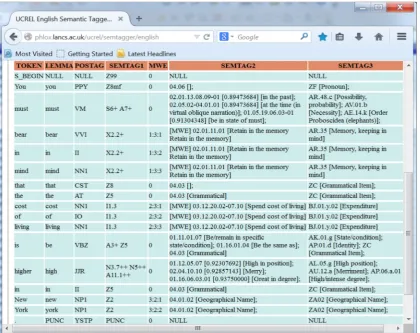
The existing NLP tools mentioned above form a basis upon which the HTST tagger has been developed. Cur-rently, for a given input text, the HTST produces six layers of annotation, as shown inFig. 3, where candidate HT tags (up to three) for each word are selected and sorted by likelihood scores (figures in the brackets). For example, for the word ‘children’ in the sentence “Mary has three children.”, HTST produces the following information:
TaggedP
1) Lemma ‘child’
TaggedP
2) Part-of-speech ‘NN2’
TaggedP
3) USAS semantic tag ‘S2mf/T3-S4mf’
TaggedP
4) Multiword expression flag ‘0’
TaggedP
5) HT sense code ‘01.04.04.04’
TaggedP
6) Thematic level sense code ‘AD.03.d’
5. Disambiguation of HT semantic categories for words
TaggedP
In the HTST tagger, we have implemented a number of word sense disambiguation methods. In detail, the HTST combines the following disambiguation methods:
TaggedP
[image:7.544.62.483.60.393.2]1) Employ manually crafted sub-lexicons of 200 words which provide core HT categories of highly polysemous words, such as ‘come’, ‘make’, ‘take’ etc.
TaggedP
2) Map USAS tags to HT categories for closed-class words, where stable relations exist between these two sets of tags. This method is mostly applied to function words and proper nouns.
TaggedP
3) Polysemy density model which provides most likely HT category code out of the HT’s top three layers.
TaggedP
4) Context-based disambiguation model based on statistical distance between the HT semantic categories, which function as brief definitions of the categories, and the context words.
TaggedP
5) Context-based disambiguation statistical model based on a HT-USAS semantic tag association model, which is extracted from the OED word sense definitions.
TaggedP
6) Time-filtering of the HT categories, which aims to remove irrelevant categories of word senses with respect to time of word usage, e.g. archaic meaning for contemporary word usage or newly coined meaning for historical usage of words.
TaggedP
7) Mapping the full HT categories into the thematic categories, which helps to disambiguate word senses by elimi-nating extremely fine-grained semantic distinction.
TaggedP
The first main disambiguation approach is to use a manually compiled sub-lexicon and tag mapping to deal with highly polysemous words (methods 1 and 2 on the above list). Such words can have a maximum of more than a hun-dred HT meanings assigned to them. These include “set”which has 425 possible meanings in theHistorical Thesau-rus, and “run”, which has 337 possible meanings. The level of detail achieved by theHistorical Thesaurusin these categorizations is essential for accurately representing the complex semantics of the language, and predominately follows theOED’s equally detailed division of word senses. However, the exceptionally fine-grained nature of this categorization scheme can lead to difficulty in disambiguating word senses using automatic algorithms (and, indeed, human experts may disagree on precise categorization of given instances). Along with the polysemy density model (method 3), the sub-lexicon and tag mapping provide an effective method for disambiguating the word sense for highly polysemous words.
TaggedP
HT head words are the words used to define categories, and were composed by the editors of theThesaurusduring its creation. The appearance of a word in a category heading does not preclude the inclusion of the word within the category. For example, category 03.01.01.03.10 ‘ancestor’ includes the wordancestor.The use of a word in a cate-gory heading is not a reliable indicator that the catecate-gory contains the most common or important sense of that word, but has been trialled in this system as a clue and indicator (technically as part of the feature set) for selecting senses of polysemous words to be more highly weighted. The contextual disambiguation method based on the head words (method 4) works as follows:
TaggedP
1) For a given word and for each of its candidate HT categories: Extract all possible parent HT categories and col-lect their headings (key words that define a HT category), including the headings of the HT category under con-sideration. Words of the headings form a feature setHWi= {h1,h2,. . .,hm}.
TaggedP
2) Collect up to five content words from each side of the key word/MWE. Together with the target word/MWEwt,
they form a context feature setCW= {wt, w1,w2,. . .,wn}.
TaggedP
3) Measure Jaccard Distance (Levandowsky and Winter, 1971) betweenCWand eachHWi, and select the candidate categories (up to three) that have the closest distances to the context. Jaccard Distance is calculated as below:
Jaccard_Distancei¼ ðjCW[HWijjCW\HWijÞ=ðjCW[HWijÞ:
TaggedP
A key disambiguation method is based on the OED data (method 5), which is made possible due to the HT cate-gory information contained in OED entries (for further details about the link between HT and OED, see website:
http://public.oed.com/historical-thesaurus-of-the-oed). Most OED headwords are linked to one or more HT
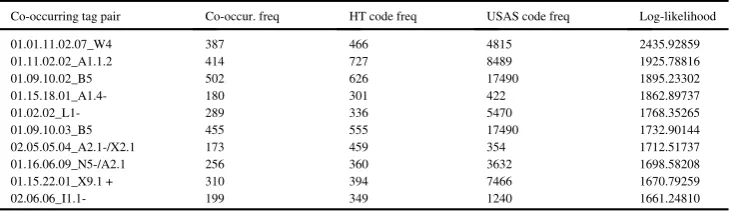
catego-ries, e.g. “ancestor” is linked to HT code 03.01.01.03.10 which denotes the concept “Kinship/relationship->Ancestor”. Our approach is first to tag the word sense definitions in the OED using the USAS tagger, then extract the statistical association metric between the HT categories of the headwords and the USAS tags contained in the definition entries. Below is a USAS-tagged OED definition of the word “ancestor”, which illustrates a strong statisti-cal association between the HT code03.01.01.03.10and USAS category ofS4(kinship).
TaggedP
ancestor_03.01.01.03.10_n:
TaggedP
TaggedP
_PUNC Also_N5++,_PUNC of_Z5 animals_L2mfn,_PUNC and_Z5 fig._Z99 as_Z5 spiritual_S9 ancestor_S4/ T1.1.1 ._PUNC
TaggedP
As shown in the sample, theS4tag occurs six times in the definition, implying a strong association with the HT concept of ancestor (03.01.01.03.10). Note that theZ5tag indicates grammatical function words, therefore they are excluded from the association extraction process.Table 3shows a sample from a log-likelihood association table between HT categories and USAS tags extracted from the entire OED definition data, where the codes denote seman-tic meanings as shown below.
TaggedP
HT Codes (same sequence as in table):
TaggedP
01.01.11.02.07: Wind
TaggedP
01.11.02.02: Destruction
TaggedP
01.09.10.02: Freedom from impurities
TaggedP
01.15.18.01: Calamity/misfortune
TaggedP
01.02.02: Biology
TaggedP
01.09.10.03: Pest control
TaggedP
02.05.05.04: Obstinacy/stubbornness
TaggedP
01.16.06.09: Decrease/reduction in quantity/amount/degree
TaggedP
01.15.22.01: Skill/skillfulness
TaggedP
02.06.06: Poverty
TaggedP
USAS Codes (same sequence as in table):
TaggedP
W4: Weather
TaggedP
A1.1.2: Damaging and destroying
TaggedP
B5: Clothes and personal belongings
TaggedP
A1.4-: Chance, luck (negative)
TaggedP
L1-: Life and living things (negative)
TaggedP
A2.1-/X2.1: Affect: Modify, change (negative) / Thought, belief
TaggedP
N5-/A2.1: Quantities (negative) / Affect: Modify, change
TaggedP
X9.1 +: Ability:- Ability, intelligence (positive)
TaggedP
I1.1-: Money: Affluence (negative)
TaggedP
In the HTST, this association table is used to find the candidate HT category which has the greatest mean associa-tion score with the surrounding USAS tags within its context of sentence.
TaggedP
[image:9.544.88.453.573.679.2]The novel time filtering approach (method 6 in our list of disambiguation methods employed by the HTST) is pos-sible because the HT dataset contains records of the periods of time during which a given word sense appears. Our approach is to restrict the range of candidate word senses to those which appear within a certain time-window around the publication time of a given text. For example, if a text was published in 1810, then we set a time range of 1750 to
Table 3
Sample of association between HT categories and USAS tags.
Co-occurring tag pair Co-occur. freq HT code freq USAS code freq Log-likelihood
01.01.11.02.07_W4 387 466 4815 2435.92859
01.11.02.02_A1.1.2 414 727 8489 1925.78816
01.09.10.02_B5 502 626 17490 1895.23302
01.15.18.01_A1.4- 180 301 422 1862.89737
01.02.02_L1- 289 336 5470 1768.35265
01.09.10.03_B5 455 555 17490 1732.90144
02.05.05.04_A2.1-/X2.1 173 459 354 1712.51737
01.16.06.09_N5-/A2.1 256 360 3632 1698.58208
01.15.22.01_X9.1 + 310 394 7466 1670.79259
TaggedP
1850 and filter out the candidate word senses which were not used within this period. Our assumption is that such a method would reduce some of the noise during the automatic word sense disambiguation process.
TaggedP
Finally, the full HT categories selected by the HTST are mapped to the thematic HT categories (method 7), which provides a more practical granularity of semantic category classification and which helps to disambiguate word senses. In the evaluation in the next section, we use the thematic HT categories to test the accuracy of the HTST tagger’s output.
6. Evaluation
TaggedP
In this section, we describe our evaluation of the HTST, including test data preparation and evaluation cri-teria (in Section 6.1), statistical results of the HTST performance and the impacts of the main disambiguation methods implemented in the HTST (Section 6.2), and software design to improve the runtime speed of the HTST software (Section 6.3).
6.1. Test data preparation
TaggedP
For the evaluation of the performance of the HTST, we selected ten texts from different genres/domains and publication times as test data to be manually annotated. The test texts were restricted to approximately 1000 words in length to make them manageable for the manual annotators; where texts were longer, excerpts were selected. Texts ended at a sentence (and often a paragraph) boundary so that there were no unintended sentence fragments. In order to ensure the objectivity of our evaluation, these test data were not used in the development of the HTST system.
TaggedP
As part of the SAMUELS project, in which the HTST was developed, three sub-projects conducted research using the semantically-tagged Hansard Corpus (Alexander and Davies 2015; available at http://www.
hansard-corpus.org; last accessed 19 April 2016) covering the years 1803 to 2005, and so text selection was
guided by the requirement to evaluate the tagger on a variety of writing styles across the period covered by this corpus. Eight test texts were selected based on this criterion, which were published from the 19th century onward, and we consider these as contemporary English for the purposes of our study (because spelling is standardized in English by this time).
TaggedP
In addition to the test texts of contemporary English, two Early Modern English (EModE) test texts were selected: a news text dated 1621 (sourced from the Burney Collection database) and a comedy drama dated 1623 (sourced
fromEarly English Books Online (EEBO)). These genres were chosen because they presented the HTST with
differ-ent levels of challenge in semantic disambiguation. The news text is written in continuous prose and purports to be a mainly factual report of events which have taken place (in our sample, a fire in the city of Paris). It contains rela-tively little figurative language compared to the comedy drama, which is more densely packed with metaphor and other figurative devices.
TaggedP
In order to help evaluate the correct meanings in context, the researchers made use of the substantial body of digi-tized texts from the Early Modern period on EEBO (to examine other cases in context of unfamiliar words in the sample texts), for both EModE samples. Additionally, for the comedy drama sample, which was from a play by William Shakespeare, the corpus-based glossary of Shakespearean meanings byCrystal and Crystal (2002)and the notes from a scholarly edition of Shakespeare’s plays (Greenblatt et al. 1997) were also used to help determine correct meanings.Table 4lists the ten test texts.
TaggedP
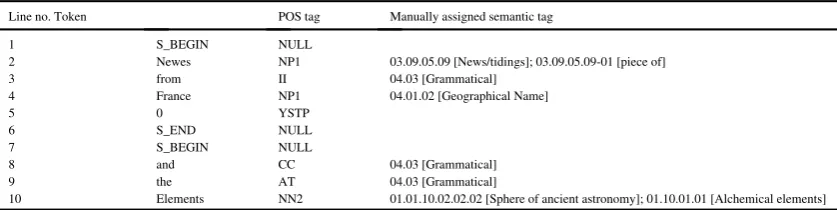
In order to check the accuracy of automatic annotation of the HTST tagger, the test texts were manually annotated with the HT semantic categories.Table 5shows a sample of manually annotated text. Where the candidate code sug-gested by the POS was NULL, as in lines 2, 3, 6, 7 and 8 inTable 4, the HTST does not identify the lexical item suf-ficiently well to suggest a candidate meaning code. NULL cases in our example are mostly metadata which help zone the text, e.g. the tags S_BEGIN and S_END, which are not of interest for analysis in any case, and required no action from the researchers. The lexical item ‘Newes’, in line 2, would, however, be of interest. The spelling was not normalized to ‘News’ during the VARD stage of the HT tagging process (discussed above inSection 4and shown in
Fig. 1), which would probably have allowed the HTST to suggest a correct candidate HT code. In this case the
TaggedP
03.09.05.09-01 [piece of]. Either would be correct in the context, and, although one or the other would suffice, to enable the HTST to ‘learn’ most effectively both were added manually. The selection of correct candidate codes in cases such as this can be subjective and open to debate, as we cannot be sure of either the author’s intended meaning (s), or the way in which the meaning(s) would be inferred by a contemporaneous audience. These issues could them-selves be the subject of lengthy discussions. A practical way forward was achieved through the application of inter-rater agreement (discussed further below).
TaggedP
HT codes beginning ‘04’ are not part of the taxonomy in the HT itself (Kay et al. 2016), but are a separate set designed for the SAMUELS project to accommodate frequently-occurring lexical items that have little or no semantic content or to group together unmatched lexical items in a convenient way. Many grammatical words are subsumed under the category 04.03, including prepositions (e.g. ‘from’, line 3), conjunctions (e.g. ‘and’, line 8) and articles (e.g. ‘the’, line 9). Periphrastic ‘do’ is also assigned to the 04.03 Grammatical category, as in “The Change Bridge did no less feel the force”. Geographical names are subsumed under a single category, 04.01.02 (e.g. ‘France’, line 4).
TaggedP
[image:11.544.47.494.86.222.2]The final lexical item in our example, ‘Elements’ (line 10), has three candidate HT codes suggested by the HT: 01.01.10.02.02.02 [1.00000000] [Sphere of ancient astronomy]; 01.10.01.01 [1.00000000] [Alchemical elements]; and 01.10.02.17-01 [1.00000000] [elements]. The number in brackets after the semantic category label (which is always between 0 and 1) indicates the likelihood of the code being correct. The lower the number, the more confidence there is that the meaning in context is correct. In this case the confidence of the tagger is equal for all three candidate codes. These were checked manually by the researcher who determined that the first two codes were indeed possible mean-ings in the context (either would be correct, and one is not obviously more correct than the other—though we cannot discount the possibility that contemporaneous audiences would disagree). The third suggested candidate meaning code relates to elements and compounds but has a meaning that does not start until 1724 (according to the OED data imported into the HT), more than 100 years later than our sample, so it was discounted as a possible candidate mean-ing. The two correct candidate meaning codes were then entered in the Correct-Tag column.
Table 5
Sample of manual annotation of HT semantic category codes.
Line no. Token POS tag Manually assigned semantic tag
1 S_BEGIN NULL
2 Newes NP1 03.09.05.09 [News/tidings]; 03.09.05.09-01 [piece of]
3 from II 04.03 [Grammatical]
4 France NP1 04.01.02 [Geographical Name]
5 0 YSTP
6 S_END NULL
7 S_BEGIN NULL
8 and CC 04.03 [Grammatical]
9 the AT 04.03 [Grammatical]
[image:11.544.61.480.565.670.2]10 Elements NN2 01.01.10.02.02.02 [Sphere of ancient astronomy]; 01.10.01.01 [Alchemical elements]
Table 4
List of test texts used for HTST evaluation.
Test text Genre Description
File 1 Biography By Stratemeyer, Edward. 1904.American Boy’s Life of Theodore Roosevelt.Boston, MA: Lee and Shepard [From the Project Gutenberg edition].
File 2 Fiction (General) By Dickens, Charles. 1852. ‘I In Chancery’. FromBleak House, [Project Gutenberg edition]. File 3 Fiction (Humor) By Wodehouse, PG. 1915. Chapter 1. FromSomething Fresh, [Project Gutenberg edition]. File 4 Political speech By Scott, William. 1820. Choice of a Speaker. HC Deb 21 April 1820, volume 1, columns 29.
File 5 Political speech By Blair, Tony. 2010. International Terrorism and Attacks in the USA. HC Deb 14 September 2001, volume 372, columns 60416. File 6 Historical writing By Gibbon, Edward (revised with notes by H.H. Milman). 1845 [1782]. ‘II.II The Internal Prosperity In The Age Of The Antonines’.
FromThe History of The Decline and Fall of the Roman Empire, volume 1. [Project Gutenberg edition].
File 7 Journalism By Silverstein, Ken. 1998. ‘The Radioactive Boy Scout’.Harper’s Magazine, November 1998.
File 8 Journalism By Moran, Caitlin. 2010. ‘Drinking is like a mini-break—as exhilarating as spending three days sightseeing in Rome’.
The Times(Opinion column), 17 July 2010.
File 9 News By author unknown. 1621. ‘Newes from France’. The Burney Collection of English Newspapers, British Library.
File 10 Comedy drama By Shakespeare, William. 1623.The Merry Wives of Windsor, II:ii [EEBO First Folio editiona].
a The play was first produced in 159798, and there is a quarto edition dated 1602 (see the Database of Early English Playbooks athttp://deep.sas.upenn.edu/index.html,
TaggedP
Metaphors in the sample texts presented both a challenge (both to the HTST and to the researchers) and an oppor-tunity to gain insight into the pervasive use of metaphor in English. In some cases, the HTST suggested candidate meaning codes corresponding to the metaphorical meaning, along with others corresponding to the literal meaning. In such cases, the researchers entered just the metaphorical meaning code in the Correct-Tag column, not the literal meaning, as the metaphorical meaning is the one that is correct in the context. Where literal meaning codes only were suggested for metaphorical lexical items, the researchers checked whether or not a meaning code for metaphor-ical use exists in the HT, and if so it was entered in the Correct-Tag column. If no metaphormetaphor-ical meaning code exists in the HT, it is beyond the capabilities of the HTST to suggest one, and therefore the literal meaning code most closely corresponding to the source of the metaphor was entered in the Correct-Tag column (with the additional cog-nitive step of interpreting the metaphorical meaning left for the reader/audience to make). Work on this was informed by a separate AHRC-funded project using the HT, Mapping Metaphor with the Historical Thesaurus
(Anderson et al., 2015), whose findings demonstrate the complex interrelationships of metaphor in both the HT
data-base and the history of English. Although the version of the HT datadata-base employed for building the HTST does not contain information on the metaphorical links between categories, it would be possible to include this information in the instance of further development of the system. This should lead to a better method of automatically identifying cases in which competing semantic tags are the result of metaphorical word use.
TaggedP
Each text sample was independently checked by two researchers, and their decisions on the evaluation of the annotations compared afterward. Tricky cases were discussed (for example, in cases where the nuances of a particu-lar semantic meaning were unclear from the context, and where more than one HT category could reasonably be con-sidered equally correct). The researchers carrying out the evaluation had expertise in historical English and experience in working with older texts, and in nearly all cases there was inter-rater agreement over the semantic cate-gory which was most correct in the given context. For a minority of cases the most correct meaning remained debat-able in the context, and we then applied the HT category which would be the least contentious, whilst acknowledging that another meaning could apply but the evidence for its application was insufficient. Finally, if dif-ferent annotators chose difdif-ferent HT codes for the same words but did not contest the other’s choice, their annota-tions were merged, assuming both of them are correct.
TaggedP
It is a highly challenging and time-consuming task to produce manually annotated test corpus data due to the highly fine-grained nature of the HT semantic classification scheme. Therefore, the size of the manually analyzed test data is limited. However, the high quality of manual annotation carried out by the linguistic experts and the wide coverage of the data both in terms of genre/domain and publication time enabled us to test the HTST’s performance on different types of text using relatively small amounts of test data. (The manually annotated test data is available at URL:https://github.com/UCREL/SAMUELS).
TaggedP
[image:12.544.52.505.611.677.2]As discussed above, the HT database can contain multiple correct semantic codes for a single word in a given context, all of which provide correct word senses or components of word sense in the context of its use. The nature of any natural language is that meaning is not precise and categorical, but is emergent in the sense of any complex system. During the manual annotation, therefore, the annotators sometimes assigned different HT codes for a word from different branches of the hierarchical HT semantic classification structure, all of which provide correct senses of the word. For example, the two annotators assigned HT code pairs of ‘03.09.05.04 [Report information], 03.09.11-01 [Journalism]’ and ‘02.07.03.03 [Narration], 03.09.05.04’ to the word ‘report’. Merging together, this word has three HT codes assigned: 03.09.05.04, 03.09.11-01 and 02.07.03.03. Here, the first two codes and the third one derive from different top-level semantic categories explained inSection 3: ‘The Social World’ (with 03 code prefixes) and ‘The Mental World’ (02 code prefixes) respectively. There are numerous such cases, as shown by examples inTable 6, where HT tags have the following definitions.
Table 6
Sample of diverse of HT codes assigned to words during manual annotation.
Word HT codes Description
Accident 01.15.18.01-02.10.05, 01.11.04-02, 01.15.18.01-02.10.05 Same top category, but from different second level branches
Plainly 01.09.08.11-10, 02.01.07-01, 03.09.02.01 All codes from different top categories
Surprised 02.01.14.02-05, 02.01.14.02-04, 02.01.14.02 Share main code, but different sub-categories
Astonishment 02.01.14.08, 01.03.02.01.02-04, 01.03.03.04.21-01, 02.04.21.08-02 Codes from wide range of locations in HT sense structure
TaggedP
TaggedP
01.15.18.01-02.10.05: Calamity/misfortune: a mishap/unlucky accident
TaggedP
01.11.04-02: Occurrence: an occurrence/event
TaggedP
01.09.08.11-10: Visibility: sightworthiness
TaggedP
02.01.07-01: Perception/cognition: theory of
TaggedP
03.09.02.01: Manifestness
TaggedP
02.01.14.02-05: Surprise, unexpectedness: one who surprises
TaggedP
02.01.14.02-04: Surprise, unexpectedness: feeling of surprise
TaggedP
02.01.14.02: Surprise, unexpectedness
TaggedP
02.01.14.08: Feeling of wonder, astonishment
TaggedP
01.03.02.01.02-04: Degree/type of madness: mental prostration/paralysis
TaggedP
01.03.03.04.21-01: Anaesthetization/painkilling etc.: anaesthetization
TaggedP
02.04.21.08-02: Dismay: consternation
TaggedP
01.11.03.02-03: Source/origin: source of material thing
TaggedP
01.15.06-03: Carrying out: of justice, etc.
TaggedP
02.06.08-12: Acquisition: that which is obtained/acquired
TaggedP
When we merged manual annotations of the same test text carried out by different annotators, we found that many content words (nouns, verbs, adjectives and adverbs) were annotated with more than one HT code, up to six different codes for single words.
TaggedP
Such a diversity of HT codes sharing similar senses that are applicable to a given word presents a challenge for our evaluation. An implication of the HT code diversity is that, in many cases, there exist multiple correct HT codes for a single word. The question is: do we request that the annotation tool find all of the correct HT codes for each word? Obviously, it is impractical to achieve this with an automatic tool, as it is very difficult even for human linguistic experts. During the manual annotation, very often the individual annotators found that the possi-ble codes were present in closely related categories within the HT, and thus that the higher-level components of the category codes were the same for multiple active fine-grained meaning distinctions. This means that possible senses of any given word often shared digits at the beginning of their codes, as in the case of ‘surprised’ in
Table 6.
TaggedP
A more practical approach would be to require the semantic annotation tool to find the whole or part of the cor-rect HT code set for each word, and we adopted this approach in our evaluation. Considering the multiple possible correct HT codes for a given word, if the annotation tool assigns at least a correct HT semantic code within the top three most likely candidate tags of a word (ranked by statistical likelihood scores), we considered it to be suc-cessful. For cases where more than one correct HT code is identified by the tool, it is still considered to be a single successful case. Although the high level of HT granularity creates difficulty with assigning a single ‘correct’ tag to many words, this granularity is still valuable in the weighting of senses using polyseme density (Section 5, method 3 above).
6.2. Impacts of disambiguation methods
TaggedP
In our evaluation, we focused on examining the impact of four main disambiguation methods on the performance of the HTST. They are:
TaggedP
1) The sub-lexicons, mapping list between some USAS tags and HT categories, and polysemy density list, includ-ing methods 1), 2) and 3) described in Section 5.
TaggedP
2) Context-based disambiguation model based on the HT head words and the context words.
TaggedP
3) Context-based disambiguation model based on the HT-USAS semantic tag association model, which is extracted from the OED word sense definitions.
TaggedP
4) Time-filtering of the candidate HT categories.
TaggedP
TaggedP
of 15.41% on the ten test texts. We then added the above-mentioned four main methods one by one and re-calculated the accuracies in each step.Table 7lists the results (refer toTable 3for the contents of the test files) showing the impacts.
TaggedP
As shown inTable 7, the HTST achieved average accuracies of 69.39%, 79.77% and 79.85% after adding the dis-ambiguation measures numbered 1), 2) and 3) respectively. This result demonstrates a significant improvement for the sub-lexicons etc. of method 1) over the baseline as well as a noticeable improvement resulting from the context based disambiguation method 2). The results of method 3) are more complicated. Overall, this method only margin-ally improved the average accuracy, from 79.77% to 79.85%. But a closer observation reveals that this method has a greater impact on contemporary texts than on historical texts. If we only consider the eight contemporary test files (from file 1 to file 8), the average accuracy is improved from 78.22% to 78.37%. On the other hand, this method has a slightly negative impact on the historical data (see file 9 and file 10). There are two factors accounting for this result. The first one is that the USAS semantic tagger performs less accurately on historical data, thus affecting the performance of the OED data based disambiguation, which is based on the USAS tags. The second one is that, because the OED word sense definitions are written in contemporary English, as training data they therefore do not reflect the features of historical English texts published hundreds of years ago. This shows that our current USAS tags based association model is suitable for processing contemporary text, but not suitable for tagging historical data.
TaggedP
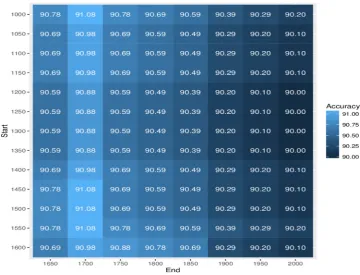
Next, we tested the impact of the time-filtering method. In detail, we tagged each of the ten test files by changing a pair of time-boundary variables, namely lower and upper time boundaries, around the publication time of the texts. For example, for a test text published in 1621, the upper time boundary increases by 50 years each step from 1650 until the upper limit of 2000 is reached (the date considered to be ‘the present’ in the HT dataset). On the other hand, the lower time boundary reduces by 50 years each step from 1600. In this way, we obtain the HTST’s accuracy for all possible time ranges within the search space, as shown inFigs. 4and5(the lower time boundaries earlier than 1000 did not affect the accuracy, so they are not shown in the figures). The tables in these two figures reflect the impact of the time filtering algorithm on the historical text (published in 1621) and contemporary English text (pub-lished in 1820). The bottom-left corners of the figures represent the narrowest ranges between the upper and lower time boundaries, and the lighter colors indicate the higher accuracies. FromFigs. 4and5, we can see that the accu-racy peaks at certain time-ranges for both test files: 91.08% inFig. 4and 86.37% inFig. 5.
TaggedP
We repeated the same experiment for every test file, and found the accuracy peaks at certain time-ranges on every file, improving the average accuracy by 1.72% on average from 79.89% to 81.61%, as shown inTable 8. This indi-cates the time filtering approach can be effective for all types of texts.Table 8also shows the HTST’s tagging accu-racies obtained by using the time filtering method for each of the test files in comparison with those obtained without it. As the results show, proper time filtering can improve the HTST’s performance substantially on different types of texts, both contemporary and historical. For example, the time filtering improved the accuracy of File 2 (general fiction dated 1852) by 3.54%.
TaggedP
A technical challenge in applying the time filtering disambiguation method is automatically detecting the publica-tion time of a given document. For well-designed corpora, such informapublica-tion can be encoded in the data, but in other situations, techniques for determining publication time of documents would be necessary for applying the time filter-ing method.
TaggedP
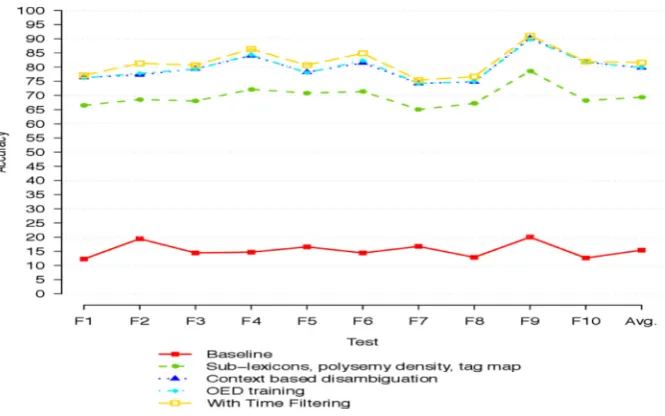
Fig. 6summarizes the improvements of performance of the HTST tagger achieved by combining more and more
[image:14.544.57.492.87.150.2]disambiguation methods in the sequence of a) sub-lexicon, polysemy density and tag mapping, b) context-words based disambiguation, c) USAS-HT tag collocation in OED sense definitions, and d) time filtering of word sense usage in HT dataset, which correspond to the green, dark-blue, light-blue and yellow lines respectively. When
Table 7
Impact of resources and disambiguation methods in comparison with baseline performance.
Test file File 1 File 2 File 3 File 4 File 5 File 6 File 7 File 8 File 9 File 10 Avg.
Words 1027 932 1004 1027 1032 1567 1005 877 1020 1225
Baseline (%) 12.27 19.42 14.44 14.70 16.57 14.42 16.72 12.88 20.00 12.65 15.41
Sub-lexicons, polysemy density, tag mapping (%) 66.50 68.56 68.03 72.15 70.83 71.35 65.07 67.16 78.63 68.16 69.39
Context/headwords based disambig. (%) 76.34 77.25 79.38 84.03 78.20 81.49 74.23 74.80 90.20 81.80 79.77
Fig. 4. Search for optimal performance in time range space on historical data (File 9: news published in 1621).
TaggedP
combined together, these disambiguation methods have improved the tagger’s performance substantially on average, from 15.41% of the baseline to 81.61%: an improvement of 66.20 percentage points (or approx 400%).
TaggedP
Finally, we tested the significance of different methods against the baseline performance, using Chi-squared tests with Bonferroni correction to compensate for the use of multiple hypotheses.Fig. 7shows the result, where
TaggedP
Method_1: Sub-lexicons, polysemy density, tag mapping.
TaggedP
[image:16.544.50.499.87.187.2]Method_2: Context/headwords based disambiguation.
Table 8
Improvement of performance achieved by time filters.
Test file File1 File2 File3 File4 File5 File6 File7 File8 File9 File10 Average
Pub. date 1904 1852 1915 1820 2001 1845 1998 2010 1621 1623
Accuracy with no time filtering
76.14 77.79 79.28 84.32 78.00 82.32 74.23 74.91 90.10 81.80 79.89
Accuracy with time
(1900
2000)
(1750
1860)
(1850 2000)
(1800 1850)
(1850
2000)
(1800 1850)
(1950 2000)
(1900
2000)
(1450 1700)
(1500 1850) filtering &
time range
[image:16.544.110.443.214.422.2]77.12 81.33 80.68 86.37 80.68 84.88 75.42 76.62 91.08 81.96 81.61
Fig. 6. Improvements of four disambiguation algorithms in comparison with baseline.
[image:16.544.128.426.579.662.2]TaggedP
Method_3: OED word sense definition data training.
TaggedP
Method_4: Time filtering.
TaggedP
AsFig. 7illustrates, all refinements are shown to be significantly higher accuracy at the 1% level across our test
corpus (one-tailed; X>6490; p<0.000001).
TaggedP
Despite the encouraging performance of the current version of the tagger, it needs further improvements in order to provide a reliable annotation system for a wider range of practical applications. For example, when only the first tag of the automatically produced candidate tags is considered, the average accuracy drops to 66.82%. More efficient algorithms and methods are needed to rank more correct senses to the top in the candidate list. In light of our experi-ence, cleaner training data and more efficient context-based disambiguation algorithms would be needed to achieve a higher accuracy of the HTST’s performance.
6.3. Overview of main error types
TaggedP
Our manual analysis of the errors in the annotation of the HTST reveals the types of challenge faced by semantic annotation tools, some of which are unique to this system. These can be exemplified using one of the fiction test texts, Dickens’ Bleak House. As previously mentioned, metaphor and metonymy are the most common causes of error in the annotation. For example, for the wordfacein the phrase ’the face of the earth’, the tagger weights most highly the category ’Face, facial expression’ (AB.17.e.01.a). In this instance, the source domain for the metaphor has been identified, and is arguably correct. However, the human taggers prefer the metaphorical extension offace
found in the category ’Surface’ (AL.05.c.01), which the HTST returns as the third candidate tag in this instance. Metaphorical interference also appears to be present in the mislabeling ofbrokein ’if this day ever broke’, for which the HTST returns ’Breaking/cracking’ (AK.02.b.01) as the most likely sense.
TaggedP
Difficulty with metonymy can also be found with the word soot, for which the tagger most highly weights ’Black/blackness’ (AJ.09.e.02) followed by ’Granular texture’ (AJ.04.c), identifying senses of soot for which a quality of the substance is expressed using the term for the substance itself. The correct tag, ’Burning, fire, flame, ash’ (AJ.03.c.02.c), is given in third position. One of the most likely contributing factors to this error are that senses of soot are found close together in the thematic level semantic hierarchy (all three are found in the AJ ’Matter’ category). Also contributing to the higher weighting of ’Black/blackness’ is the presence of the word black itself earlier in the sentence: ’Smoke lowering down from chimney-pots, making a soft black drizzle, with flakes of soot in it[. . .]’. Similar confusion between metonymic senses can be found inriver, for which the first given tag is ’Action/process of flowing’ (AJ.05.h), and the correct tag, ’Rivers, streams’ (AA.04.b), is returned as the second likely candidate. Here, as before, the phenomenon (river) is used to rep-resent one of its most salient properties (flowing motion), while the more literal tag is the one agreed as most correct by human taggers.
TaggedP
Some errors arise from the difficulties in identifying and labeling multi-word expressions (MWE). These come in two main forms: identification of an MWE where one is not present; and parsing and individual labeling of words which could be conceived as forming a set phrase. The HTST is intended to treat words individually wherever possi-ble. In some instances, however, it is debatable whether individual words should have been grouped together. The words in ’Lincoln’s Inn Hall’ are tagged separately with varying degrees of accuracy (the first tags for its component words are ’Geographical Name’ (ZA.02), ’Public lodging-place’ (AZ.06.e.01.a), and ’University administration’ (BE.05.b) respectively). It is arguably the case that these could be labeled as a single MWE with the ’Geographical Name’ tag to indicate its status as a location. The opposite has occurred where ‘in the streets’ has been erroneously labeled as an MWE related to a way of dealing stocks and shares (BJ.01.aa) when individual tagging of each word would have been more appropriate.
TaggedP
TaggedP
measures (see Section 5, method 4), for which a tag has been weighted more highly because the word to be tagged (i.e. term) itself appears in the category or subcategory heading (‘term/expression’, 02.07.04.05.02-05). It is often difficult to tell where this has occurred since it is frequently true that the search term does appear in the correct HT heading, as is the case withimplacable (’implacable’, 02.05.05.04-04), weather (’Weather’, 01.01.11.02), and mud (’Mud’, 01.01.07.04.06.03), all found within the first thirty words of this passage. Future development of the HTST will seek to fine-tune the tagger’s judgment of how highly to weight meas-ures such as this and the use of the polysemous words list.
6.4. Issue of speed as a resource-intensive software
TaggedP
As detailed inSection 4, the HTST system consists of a suite of NLP tools and includes a number of lexical knowledge data and disambiguation training model files. Hence, it is a resource-intensive software. In particular, when the HTST starts up, it costs some time to load all the resources into the system memory. Currently on average it takes 7308 milliseconds (ms) to start up if the VARD tool is not activated, and 8,917 ms if VARD is included, creating an issue of speed when the system processes corpus data stored in many files.
TaggedP
In order to alleviate the speed issue, a service wrapper was developed for the HTST, so that the HTST only needs to load the resources once, then interacts with the input data through a computer socket. When a pipeline mode is needed, client software of the HTST service can be included as a component in the pipeline, which drastically improves the speed compared to directly including the original HTST package. Such a design also improves the modularity of the system, as the HTST package can be maintained separately, and it allows loose coupling of soft-ware components, achieving a high level of separation of concerns.
TaggedP
To examine the impact of such service-based design on the HTST performance, we carried out an evaluation of speed on three sample corpus data of different sizes selected from the Hansard Corpus (cf.Section 6.1) on a PC (IntelÒ CoreTM i7 CPU Q 740 @ 1.73 GHz £8) installed with Ubuntu 14.04 LTS 64-bit OS. Table 9 shows the results of the test. The second column lists the number of files containing the test data. Because the test data is con-temporary English text, VARD is not activated in this experiment.
TaggedP
As shown inTable 9, when the HTST was used as a standalone tool that starts up for every individual test data file, it only achieved an average speed of 11.34 tokens per second. The speed for the biggest test data was increased because the data contained some larger files, which decreased the number of HTST start-ups. On the other hand, when the HTST was run as a service (a client program is used to call the service on the same PC), the processing times obtained improvements of 11.75, 11.86 and 5.87 times over the standalone package for the three test data, with an average of 9.83 times. With regard to the number of tokens processed per second, the service-based HTST processes 84.74 more tokens per second. Considering that the default HTST package runs with an average speed of 11.34 tokens per second, this is a substantial improvement.
TaggedP
[image:18.544.74.475.602.669.2]It should be noted that, if the tools process a single large file, the speed improvement would be negligible. But in many practical applications, annotation tools need to process data in many batches of files, and in such cases the ser-vice oriented design can bring a significant impact on the speed of resource-intensive tools like the HTST. In the SAMUELS project, Hadoop was used to distribute the tagging process across a cluster of fifteen commodity machines. This configuration was able to tag the 1.26bn words of the Hansard Commons corpus in approximately six days, with a rate of 2436 tokens per second.
Table 9
Impact of service-oriented design on the speed of the HTST.
Tokens in test data Number of files HTST as standalone tool HTST as service Process time improvement Increased Tokens/s
Time (ms) Tokens/s Time (ms) Tokens/s
1000 17 137,129 7.29 11,669 85.70 11.75 times 78.45
10,000 165 1316861 7.59 111,041 90.06 11.86 times 82.47
100,000 593 5222849 19.15 889,205 112.46 5.87 times 93.31
7. Conclusion
TaggedP
In this paper, we presented the HTST system, which is both the first semantic tagger that employs theHistorical Thesaurus of English, a large historical thesaurus produced by linguistic experts, and the first to be trained on word sense definitions from the Oxford English Dictionary. This enables an unprecedented level of semantic annotation, and facilitates a deeper semantic analysis of language data compared to existing annotation tools. In particular, with the HT’s rich information about word usage and the historical semantic development of the English language, the HTST is well adapted for annotating historical English corpus data since it is able to annotate words with historically sensitive categories to reflect their meaning at the time of use. With the ability to adapt its annotation given the date of the text, the HTST advances the capability of existing corpus annotation tools.
TaggedP
While the HTST has demonstrated an encouraging performance, there is still room for further improvement. We will integrate and develop better algorithms to fully exploit the information provided by the HT knowledge base to improve word sense disambiguation. We will also build more training data for enhancing the context-based disam-biguation methods.
TaggedP
As it stands, the HTST has already been used for processing corpus data on a large scale, such as the Hansard Cor-pus, which provides valuable resources for research communities (Alexander et al., 2015a, 2015b; Alexander and
Davies 2015; Demmen et al., preparation). We envisage that, with further development and improvement, the HTST
will provide a powerful tool for both corpus-based studies and ICT applications.4
Acknowledgment
TaggedP
This work was supported by the UK Arts and Humanities Research Council in conjunction with the Economic and Social Research Council (ESRC) as part of the Semantic Annotation and Mark-Up for Enhancing Lexical Searches (SAMUELS) Project (grant numberAH/L010062/1).
References
TaggedP
Alexander, M., Baron, A., Dallachy, F., Piao, S., Rayson, P., 2015a. Metaphor, popular science and semantic tagging: Distant reading with the his-torical thesaurus of English. Digital Scholarship Humanit. 30 (1), 16–27.
TaggedP
Alexander, M., Baron, A., Dallachy, F., Piao, S., Rayson, P., Wattam, S., 2015b. Semantic tagging and early modern collocates. In: Proceedings of The Corpus Linguistics 2015 Conference. Lancaster University, UK, pp. 8–10.
TaggedPAlexander, M., Davies, M., 2015. The Hansard Corpus 1803-2005. http://www.hansard-corpus.org (accessed 6.07.16).
TaggedP
Allan, J. (Ed.), 2012. Topic Detection and Tracking: Event-Based Information Organization. vol. 12, Springer Science & Business Media.
TaggedPAnderson, W., Hough, C., Kay, C., Bramwell, E., Aitken, B., Hamilton, R., Alexander, M., 2015. Metaphor map of English. http://www.glasgow.
ac.uk/metaphor (accessed 6.07.16).
TaggedP
Archer, D., McEnery, T., Rayson, P., Hardie, A., 2003. Developing an automated semantic analysis system for Early Modern English. In: Archer, D, Rayson, P., Wilson, A., McEnery, T. (Eds.), Proceedings of the Corpus Linguistics 2003 Conference, Lancaster University, UKpp. 22–31.
TaggedP
Archer, D., Rayson, P., Piao, S., McEnery, T., 2004. Comparing the UCREL semantic annotation scheme with lexicographical taxonomies. In: Williams, G., Vessier, S. (Eds.), Proceedings of the Eleventh EURALEX (European Association for Lexicography) International Congress (Euralex 2004), Lorient, FranceVolume III, pp. 817–827.
TaggedP
Balossi, G., 2014. A corpus linguistic approach to literary language and characterization: Virginia Woolf’s The Waves. John Benjamins, Amster-dam.
TaggedP
Baron, A., Rayson, P., 2008. VARD 2: A tool for dealing with spelling variation in historical corpora. In: Proceedings of the Postgraduate Confer-ence in Corpus Linguistics. Birmingham, UK. Aston University. 22 May 2008.
TaggedP
Baron, A., Rayson, P., 2009. Automatic standardisation of texts containing spelling variation: How much training data do you need? In: Proceed-ings of the Corpus Linguistics 2009 Conference. Lancaster University, UK.
TaggedP
Baron, A., Rayson, P., Archer, D., 2009. Word frequency and key word statistics in historical corpus linguistics. Anglistik: Int. J. Eng. Stud. 20 (1), 41–67.
TaggedP
Chitchyan, R., Sampaio, A., Rashid, A., Rayson, P., 2006. Evaluating EA-Miner: Are early aspect mining techniques effective? In: Proceedings of Towards Evaluation of Aspect Mining (TEAM 2006). Workshop co-located with ECOOP 2006 (European Conference on Object-Oriented Programming), Nantes, Francetwentieth ed. pp. 5–8.
4
For a demo website of the HTST tagger, seehttp://phlox.lancs.ac.uk/ucrel/semtagger/english;A client GUI tool of the HTST tagger is available