~c..(
~"
NCE
&
tECHNO~
o
June,
~Yf~Vo
l
. 22,
NO.6
co
I:"H~!!!:i~
and people
THE GAME:
"MOON LANDER"
Computer Programming Using Natural Language
Soviet I nformation-Handling Problems
Computer Utilization in Management of Water Quality A Humanized Approach to Computers
Watergate: What More is There to Hide?
The American News Media and the Assassination of President Kennedy
The Importance of Calling a Defeat a Defeat
E.
C.
Berkeley,
A. Langer,
and
C.
Otten
R.
A. and K. M. Bartol
J.
H. Morris
E.
A. Tomeski and H. Lazarus
R. E. Sprague
R. E. Sprague
P.
M.
Sweezy and H. Magdoff
.
5106049 0
2C1721
1 cO W
, J
lOS ST
018
Pre-publication offer expiring July 31, 1973:
2
"RIDE THE EAST WIND:
Parables of Yesterday and Today"
by Edmund
C.
Berkeley,
Author and AnthologistOver fifty parables (including anecdotes, allegories, and fables) by Berkeley and many other authors, modern and ancient, dealing with famous problems, modern, classic, or ageless. Many parables are decorated by a bouquet of proverbs and quotations - for readers who like to choose which variety of lesson appeals to them. A short guide to some patches of common sense and wisdom. An ideal gift. Illustrated. Hard cover. Over 250 pages.
The eagle in the great forest flew swiftly, but the Eastwind flew
more swiftly still
Do you remember the story of the fox and the grapes? illustrating a principle of such timeless value that the phrase "sour grapes" has been used and understood by millions of people for 2000 years?
Well, why not make a collection of ideas and principles of common sense and wisdom - and why not illustrate them with fables, allegories, and anecdotes of enormous impact?
That was the plan of this book.
It comes right out of our work on the "Notebook on Common Sense and Wisdom, Elementary and Advanced" - which we have been talking about for two years to anyone who would listen.
Some of the issues of the Notebook roused the interest of the president of Quadrangle Books - and this book is one of the results.
You can't lose by taking a look at this book:
• You might enjoy it.
• You might find much of it humor-ous and imaginative - as did Aesop's listeners.
• You might find it instructive, phil-osophical, worth thinking about, and more besides.
You can see it, read it, keep it for 7
days, return it, and back comes the full price of the book.
How can you lose?
We want only satisfied customers.
COMPUTERS and AUTOMATION for June. 1973
"RIDE
THE
EAST WIND:
Parables of Yesterday and Today"
Table of Contents (preliminary)
Part 1. The Condition of Man
The Garden of Paradise* / Hans Christian Andersen
*to which the King's son was transported by the Eastwind
Pandora and the Mysterious Box / H. A. Guerber The History of the Doasyoulikes / Charles Kingsley The Maker of Computing-Machines / George R. Price The Locksmith and the Stranger / Edmund C. Berkeley(B) The Elephant and the Donkey / James Reston
Where that Superhighway Runs, There Used to be a Cornfield / Robert Redfield
The Fire Squirrels / B
Part 2. On Flattery and Persuasion
The Crow and the Fox / Jean de La Fontaine The Visitor who Got a Lot for Three Dollars /
George Ade
The Cuckoo and the Eagle / Ivan A. Kriloff The Wind and the Sun / Aesop
The Young Seagull and the Clam / B The Two Raccoons and the Button / B
Part 3. On Perseverance and Resourcefulness
The Crow and the Pitcher / Aesop
Robert Bruce and the Spider / Sir Walter Scott The Blue Cream Pitcher and the Pink Sugar Bowl / B Hannibal Mouse and the Other End of the World / B The Fly, the Spider, and the Hornet / B
Part 4. Behavior - Moral and Otherwise
A Small Wharf of Stones / Benjamin Franklin The Three Bricklayers / B
The Good Samaritan / St. Luke
The King of the Golden River / John Ruskin The Fisherman, the Farmer, and the Peddler / B
Part 5. The Problem of Truth
On Being a Reasonable Creature / Benjamin Franklin The Monkey and the Spectacles / Ivan A. Kriloff The Golden Trumpets of Yap Yap / Mike Quin The Barrels and the Pittsburgh Manufacturer / B The Empty Column / William J. Wiswesser
The Differences in Two Strains of Corn / Edgar Anderson The Six Blind Men of Nepal / B
The Sighting of a Whale / B
The Stars and the Young Rabbit / B Part 6. On Common Sense
The Lark and her Young Ones / Aesop The Bear and the Young Dog / B The Bear and the Young Calf / B The Bear and the Young Beaver / B
The Wasps and the Honey Pot / Sir Roger I' Estrange Falling 1800 Feet Down a Mountain / B
The Cochrans vs. Catastrophe / B Missile Alarm from Greenland / B
COMPUTERS and AUTOMATION for June, 1973
The Fox of Mt. Etna and the Grapes
Once there was a Fox who lived on the lower slopes of Mt. Etna, the great volcano in Sicily. These slopes are ex-tremely fertile; the grapes that grow there may well be the most delicious in the world; and of all the farmers there, Farmer Mario was probably the best. And this Fox longed and longed for some of Farmer Mario's grapes. But they
gr~ very high on arbors, and all the arbors were inside a vineyard with high walls, and the Fox had a problem. Of course, the Fox of Mt Etna had utterly no use for his fam-ous ancestor, who leaping for grapes that he could not reach, called them sour, and went away.
The Fox decided that what he needed was Engineering Technology. So he went to a retired Engineer who lived on the slopes of Mt. Etna, because he liked· the balmy climate and the view of the Mediterranean Sea and the excitement of watching his instruments that measured the degree of sleep-ing or waksleep-ing of Mt. Etna. The Fox put his problem be-fore the Engineer.
The Six-Day War / B
The Deceived Eagle / James Northcote Doomsday in St. Pierre, Martinique / B
Part 7. Problem Solving
The Wolf and the Dog of Sherwood / Aesop, B The Three Earthworms / B
The Hippopotamus and the Bricks / B
The Cricket that Made Music / Jean de La Fontaine, B The Fox of Mt. Etna and the Grapes / B
The Mice of Cambridge who Wanted to Bell the Cat / Aesop, B
Brer Badger's Old Motor Car that Wouldn't Go / B The First Climbing of the Highest Mountain in the
World / Sir John Hunt
The Evening Star and the Princess / B
Bibliography & Index
Expected to be published in October 1973 by
Quadrangle Books, a subsidiary of The New York Times,
hard cover, probable price, $6.00
Pre-publication offer expiring July 31: Book $4.50 (25% discount), plus postage and handling costs $.50 = $5.00
~- (may be copied on any piece of paper)
-To: Computers and Automation
815 Washington St., Newtonville, Mass. 02160 Please send me when published (October publication
expected) _ _ copy(ies) of Ride the East Wind: Parables of Yesterday and Today by Edmund C. Berkeley, Author and Anthologist. I enclose $5.00 (Pre-publication price + Postage and Handling) per copy.
Total enclosed (Prepayment is necessary) Returnable in 7 days for full refund if not satisfactory. My name and address are attached.
Vol. 22, No. 6
June, 1973
Editor
Assistant Editors
Software Editor
Advertising Director
Art Director
Contributing Editors
Advisory Committee
Editon'al Offices
Advertising Contact
Edmund C. Berkeley
Barbara L. Chaffee Linda Ladd Lovett Neil D. Macdonald
Stewart B. Nelson
Edmund C. Berkeley
Ray W. Hass
John Bennett Moses M. Berlin Andrew D. Booth John W. Carr "I Ned Chapin Leslie Mezei
Bernhard W. Romberg T eel Schoeters Richard E. Sprague
Ed Burnett James J. Cryan Bernard Quint
Berkeley Enterprises, I nc~
815 Washington St. Newtonville, Mass. 02160 617-332-5453
The Publisher
Berkeley Enterprises, Inc. 815 Washington St. Newtonville, Mass. 02160 617-332-5453
"Computers and Automation" is pub· lished monthly, 12 issues per year, at 815 Washington St., Newtonville, Mass. 02160, by Berkeley Enterprises, Inc. Printed in U.S.A. Second Class Postage paid at Boston, Mass., and additional mailing points.
Subscription rates: United States, $9.50 for one year, $18.00 for two years. Canada: add 50 cents a year for postage; foreign, add $3.50 a year for postage.
NOTE: The above rates do not include our publication "The Computer Directory and Buyers' Guide". If you elect to reo ceive "The Computer Directory and Buyers' Guide", please add $9.00 per year to your
SU bscription rate.
Please address all mail to: Berkeley Enterprises, Inc., 815 Washington St., New-tonville, Mass. 02160.
Postmaster: Please send all forms 3579 to Berkeley Enterprises, Inc., 815 Washing-ton St .. NewWashing-tonville, Mass. 02160.
© Copyright 1973, by Berkeley Enter-prises, Inc.
Change of address: If your address changes, please send us both your new address and your old address (as it ap-pears on the magazine address imprint), and allow three weeks for the change to be made.
4
corn~uters
and automation
and people
Computer Programming
10 Computer Programming Using Natural Language [T A] by Edmund C. Berkeley, Andy Langer, and Casper Otten,
Frontiers Group, Newtonville, Mass.
A number of principles for using ordinary natural language describing an algorithm, to produce automatically a precise computer program to execute the algorithm - and a specific, simple example of doing just this.
6 The Fountain of Youth, in Computer Form [NT E] by Edmund C. Berkeley, Editor,
Computers and Automation
How the ability that a computer provides effectively
ex-tends our lifetime, and how a computer might be program-med to deal intelligently with words and so write books.
Computer Applications
16 Soviet Information-Handling Problems: The Possibilities [NT A] in Computer Usage
by Robert A. Bartol and Kathryn M. Bartol, University of Massachusetts, Amherst, Mass.
The barriers to solving one of history's most formidable data-handling problems: the centralized planning of a big nation's entire economy.
19 Computer Utilization in Management of Water Quality by Jack H. Morris, Texas Christian University,
Ft. Worth, Texas
[NT A]
How the states of the United States are beginning to use computers to solve problems of evaluating and controlling the quality of water.
Computers and People
21 A Humanized Approach to Computers [NT A]
by Dr. Edward A. Tomeski, Fordham University, Bronx, N.Y., and Dr. Harold Lazarus, New York University, New York, N.Y.
The computer industry and computer users have in general emphasized computers, instead of emphasizing the human beings who must be depended on for smooth and cooper-ative integration of systems using computers.
The Profession of Information Engineer and the Pursuit of Truth
31 Unsettling, Disturbing, Critical [NT F]
Statement of policy by
Computers and Automation
26 Watergate: What More is There to Hide? - Part 6 [NT A] by Richard E. Sprague, Hartsdale, N.Y.
The magazine of the design, applications, and implications of
information processing systems - and the pursuit of truth in
input, output, and processing, for the benefit of people.
The Profession of Information Engineer and
the Pursuit of Truth (continued)
36 The American News Media and the Assassination of President John F. Kennedy: Accessories After the Fact - Part 1
by Richard E. Sprague, Hartsdale, N.Y.
[NT A]
An examination of what happened in many important American news organizations, to cover up and hide the facts about how President John F. Kennedy was actually assassinated in Dallas.
32 The Importance of Calling a Defeat a Defeat [NT A]
by Paul M. Sweezy and Harry Magdoff, Editors, Monthly Review, New York, N.Y.
An argument: that the most plausible explanation of the 1972 Christmas-New Year bombing of Hanoi and Haiphong was the Pentagon's overruling of Nixon; that this produced a stunning military defeat for the United States - the un-acceptable rate of loss of 8-52's; and that this led to the signing in January of an agreement rejected in October.
Computers, Science, and Common Sense
9 The C&A Notebook on Common Sense, Elementary and Advanced
Titles of the first 36 issues, and capsule summaries of many.
8 Preventing Mistakes Before They Happen
The Computer Industry
35 The 19th Annual Edition of the Computer Directory and Buyers' Guide, 1973
Notice and Contents
Computers and Puzzles
49 Numbles
by Neil Macdonald
47 Problem Corner
by Walter Penney, CDP
[NT G)
[NT G)
[NT G)
[T C)
[T C)
NOTICE: The official name of this magazine throughout 1973 is. Computers and Automation. We expect to change the name officially as of January 1, 1974, t~ Computers and People. During 1973 from time to time, unofficially, and irregularly, we plan to use the name Computers and Automation and People as a way of informing our subscribers and readers of the intended change on January 1, 1974.
COMPUTERS and AUTOMATION for June, 1973
Front Cover Picture
The front cover shows a display by a "moon lander" computer pro-gram, a realistic game. Its object is to "Iand" the "space ship" safely on the "moon". There are many changing parameters; the task of the person interacting with the computer is difficult. The program and equipment are from Digital Equipment Corporation, Maynard, Mass. For more information, see page 25.
Departments
42 Across the Editor's Desk -Computing and Data Processing Newsletter 41 Advertising Index
41 Calendar of Coming Events
48 Monthly Computer Census 46
47 51
Key
New Contracts New Installations Who's Who Entry Form
Article
Monthly Column Editorial
Forum
[A1
[C)
[E) [F) [G)
[NT]
[R]
[T]
The Golden Trumpet Not Technical
Reference Information Technical
NOTICE
*0 ON YOUR ADDRESS IMPRINT MEANS THAT YOUR SUBSCRIP-TION INCLUDES THE COMPUTER DIRECTORY. *N MEANS THAT YOUR PRESENT SUBSCRIPTION DOES NOT INCLUDE THE COM-PUTER DIRECTORY.
EDITORIAL
The Fountain of Youth, in Computer Form
One of the computer books which I really prize is
An
Executive's Guide to Computer Concepts by James E. Monsma and Kenneth F. Powell, published by Pitman Pub-lishing Corp., 6 East 43rd St., New York, N.Y., 1969,166 pp. I recommend it highly; it is full of interesting and significant ideas. I quote from page 99:
One of the authors while working with an engineer-ing firm determined that a major product costengineer-ing mil-lions could be described by five [program] bUilding blocks. When the building blocks were programmed, it became possible for the engineers of the firm to design these products with the aid of the computer. One day a senior engineer sat at the console of the computer and designed product after product. He was heard to re-mark as he got up from the console, "I've learned more about designing this product in the last 20 minutes than I have in the previous 20 years".
This was not entirely an exaggeration, for now he was able to test within the machine, products he would never dare to build. At worst, errors in their design would flash a red light. Because of the ever present possibility of danger and the pressures of time, he had previously limited his design work to modifying existing designs by handbook and rule of thumb methods of calculation. With danger removed and the speed of the computer at his disposal, he was free to experiment with various designs and evaluate their performance.
If Ponce de Leon in his search for the fountain of youth had encountered the modern computer, he might not have viewed it as the answer to his quest; yet in one special sense the computer has extended the executive's lifetime. If we view the life span as a series of
experi-ences~ the ability that the computer provides is tanta-mount to extending our lifetime. ... There is no finer operational training ground for future company execu-tives than the computer area. . .. Skillfully utilized the computer enables its users to extend their lifetime of experiences.
Recently I had the task of comparing two parables. They dealt with much the same theme. One had been written thirty years ago, the other one recently. Each had 8 human characters - but there were substantial differences between them. One had 13 dramatic scenes and the other
18. One was about 3500 words long, the other about 5000 words long. Both had somewhat the same conclusion to draw.
Because of the existence of an appropriate computer program on our computer, I was able to undertake a com-parison that would have been totally out of the question in B.C. ("Before the Computer"). This was a comparison of the two vocabularies of content words. A content word is a word which belongs specifically to a given context. The other words are those which may be used in a great many different contexts and which stick content words to-gether (as cement sticks bricks); these other words are called function words.
For example, if we are given the context of a game of bridge, the words "deck, shuffle, trick, honors" take on unique meanings related to the game. We easily think first and quickly of a deck of cards, not the deck of a boat; of shuffling the cards, not of an old man shuffling along the floor; of a trick consisting of four cards one collected from each player, not a playful trick or a Water-gate trick; of the honor cards of a suit of cards, not a stu-dent on the honors list. And words like "and, of, a, the, not, along, from, on" are function words; they appear in all contexts and perform a function; they are like logical cement.
The comparison I was able to make was this one:
What is each content word in alphabetic sequence, for Parable A and for Parable B? what is the fre-quency of each? and how different are these two parables in this respect?
Here is a short extract of the comparison:
Parable A Parable B
cascades 1 0
celestial object 0 3
chain 5 0
cloak 3 0
cloudless 0 1
confused 0 1
corridors 0 3
cover (-s, -ed) 5 0
For persons who produce works composed of words, as do writers, reporters, lecturers, poets, authors, editors, publishers, and so on, the existence of new computerized techniques for dealing with words is a new dimension. And it invites further development. In fact, there ought to be a computerized way in which ideas could be ampli-fied by computers into interesting, well-worded sentences, and a way in which the sentences could be assembled into paragraphs, and the paragraphs into chapters, and the chapters into books.
From 1943 to 1973 I have written 14 books; now at age 64, there are 20 more that I want to write. Perhaps the only way I may succeed, it seems to me, is to make use of the fountain of youth provided by the computer - and to program our computer to write books for me, the way I would like to write them!
How fanciful is it to program a computer to write books, especially nonfiction? Is this a sensible idea or a silly one?
A great deal of nonfiction is quite constrained. The first work of nonfiction that I studied over and over again with intense interest (because as a boy I collected min-erals), was a Textbook of Mineralogy by Edward Salisbury Dana and W. E. Ford. The descriptions of minerals always consisted of the reporting of facts about mineral species, always in the same systematic sequence, in a condensed style. Accompanying this editorial is a sample of two of these descriptions, slightly abbreviated and modified.
Suppose we imagine a table of data of 100 items listed down and 20 reports on 20 properties for each item going across. It should be rather easy to convert this tabular presentation into running text.
To avoid monotony, a random number generator mod-ule in the computer program could choose at random among several equivalent modes of expression. For ex-ample, a few patterns of function words that all have the same meaning are:
All ... s are ---so Every ... is a - - - . Each ... is a - - - . Always, an ... is a
If the relation of inclusion of one class of things in another is indicated in the data in the cell (intersection of column and row), then one of these forms of expression could be selected at random. Similarly, for other relations.
The two biggest barriers it seems to me to programming a computer to write a book are:
• Lack of imagination.
• The belief (or the conviction) that such a thing can-not be done.
c~c::.~
Edmund
C.
Berkeley
Editor
A COMPUTER SHOULD BE ABLE TO WRITE AS WELL!
The following are somewhat shortened and modified descriptions of two common mineral species that were de-scribed one after the other in A Textbook of Mineralogy by Edward Salisbury Dana, Third Edition revised and en-larged by William E. Ford, John Wiley and Sons, New York, 1922, 720 pp.
CORUNDUM Rhombohedral. Axis c = 1.3630. HEMATITE Rhombohedral. Axis c = 1.3656.
Twins, sometimes penetration twins. Often polysyn-thetic, and thus producing a laminated structure. Crys-tals usually rough and rounded. Also, massive, with nearly rectangular parting or pseudocleavage. Granular, coarse, or fine.
Parting, sometimes perfect, but interrupted. Frac-ture, uneven to conchoidal. Brittle; when compact very tough. Hardness,9. Specific gravity, 3.95 to 4.10. Luster, adamantine to vitreous; on the basal plane, sometimes pearly. Occasionally, showing asterism as in star sapphire. Color, blue, red, yellow, brown, gray, and nearly white; streak uncolored. Pleochroic in deep-ly colored varieties. Transparent to translucent.
Varieties: Sapphire, ruby, corundum, emery.
Composition: Alumina, A1203. The crystalized
va-rieties are essentially pure.
Use: Clear varieties of corundum form valuable gem stones. Also formerly largely used as an abrasive; at present, various artificial abrasives are largely used instead.
COMPUTERS and AUTOMATION for June. 1973
Twins, penetration twins, polysynthetic twinning lamellae, producing a fine striation, and giving rise to a distinct parting or pseudocleavage. Cyrstals, often thick to thin, tabular, parallel to the base, and grouped in parallel position or rosettes; also in cube-like rhombo-hedrons. Also columnar to granular, botryoidal, and stalactitic shapes.
Parting, due to lamellar structure, and caused by twinning. Fracture, sub conchoidal to uneven. Brittle in compact forms; elastic in thin laminae. Hardness, 5.5 to 6.5. Specific gravity, 4.9 to 5.3; of crystals, mostly 5.20 to 5.25; of some compact varieties, as low as 4.2. Luster, metallic and usually splendent; some-times dull. Color, dark steel gray or iron black; in very thin particles blood red by transmitted light; when earthy, red. Streak, cherry red or reddish brown. Opaque, except when in thin laminae.
Varieties: Specular, compact, columnar, fibrous, red ocherous, clay iron-stone.
Composition: Iron sesquioxide, Fe203.
Use: The most important iron ore.
IF YOU COULD PREVENT
JUST ONE IMPORTANT MISTAKE BEFORE IT HAPPENED
-- like the Democratic Party's mistake with Senator Eagleton - like the Republican Party's mistake with the Watergate Bugging
like the West German government's mistake in not catching the Arab guerrillas before they penetrated to the Israeli Olympic Team's building like Southern Airways' mistake in allowing three hijackers with guns on to
one of their planes
HOW MUCH
WOULD THAT BE WORTH TO YOU - $100? - $1000? more?
Our considered estimate is that 10 to 20% or more of the cost of operation of most businesses is the cost of mistakes. (Just one foreseeable mistake that "Computers and Automation" made in 1970 has cost us $4000.)
WOULDN'T YOU AGREE
THAT SENSE, COMMON AND UNCOMMON,
OUGHT TO BE THE KEY TO PREVENTING MISTAKES?
In a number of the issues of "The Notebook on Common Sense, Elementary and Advanced", we examine systematically the prevention of mistakes, such as:
No. 15: Preventing Mistakes from Failure to Understand
No. 23: Preventing Mistakes from Forgetting
No. 38: The Concepts of Feedback and Feedback Control No. 41: Preventing Mistakes from Unforeseen Hazards
Among the forthcoming issues of the Notebook in Volume 2 are:
- Preventing Mistakes from Camouflage
- Preventing Mistakes from Placidity
) - Volume 1, first subscription year
)
- Volume 2, second subscription yearand we are planning at least 20 more issues in Volumes 2 to 4 under th is general heading.
WHY NOT TRY THE NOTEBOOK ON COMMON SENSE?
GUARANTEE:
(1) You may return (in 7 days) thefirst batch of issues we send you, for FULL REFUND, if not satisfactory. (2) Thereafter, you may cancel at any time, and you will receive
PAST ISSUES:
As a new subscriber, you do not miss pastissues. Every subscriber's subscription starts at Vol. 1, No.1, and he eventually receives all issues. The past issues are sent to him usually four at a time, every week or two, until he has caught up, and thus he does not miss important and interesting issues that never go out of date. a refund for the unmailed portion of your
sub-scription.
HOW CAN YOU LOSE?
- - - (may be copied on any piece of paper) - - -
-To: COMPUTERS AND AUTOMATION AND PEOPLE 815 Washington St., R12, Newtonville, Mass. 02160
( ) YES, please enter my subscription to the Notebook on Common Sense at $12 a year, 24 issues (newsletter style), and extras.
( ) Please send me (as FREE premiums for subscribing) the first six issues:
1. Right Answers - A Short Guide to Obtaining Them 4. Strategy in Chess
2. The Empty Column 5. The Barrels and the Elephant 3. The Golden Trumpets of Yap Yap 6. The Argument of the Beard
( ) I enclose $ ( ) Please bill me ( ) Please bill my organization
NAME _______________________________________________ TITLE ________________________________ _
ORGANIZATION ____________________________________________________________________________ __
ADDRESS ________________________________________________________________________________ ___
INVENTORY OF THE 36 ISSUES OF
- TITLES AND SUMMARIES
THE NOTEBOOK ON COMMON SENSE, FIRST YEAR
VOLUME 1
1. Right Answers - A Short Guide to Obtaining Them A collection of 82 principles and maxims. Example: "The moment you have worked out an answer, start checking it - it probably isn't right."
2. The Empty Column
A parable about a symbol for zero, and the failure to recognize the value of a good idea.
3. The Golden Trumpets of Yap Yap 4. Strategy in Chess
5. The Barrels and the Elephant
A discussion of truth vs. believability. 6. The Argument of the Beard
The accumulation of many small differences may make a huge difference.
7. The Elephant and the Grassy Hillside
The concepts of the ordinary everyday world vs. the pointer readings of exact science.
8. Ground Rules for Arguments
9. False Premises, Valid Reasoning, and True Conclusions The fallacy of asserting that the premises must first be correct in order that correct conclusions be derived.
10. The Investigation of Common Sense 11. Principles of General Science and Proverbs
8 principles and 42 proverbs.
12. Common Sense - Questions for Consideration 13. Falling 1800 Feet Down a Mountain
The story of a skimobiler who fell 1/3 of a mile down Mt. Washington, N.H., and was rescued the next day; and how he used his common sense and survived.
14. The Cu It of the Expert
15. Preventing Mistakes from Failure to Understand Even though you do not understand the cause of some trouble, you may still be able to deal with it. The famous example of a cure for malaria. 16. The Stage of Maturity and Judgement
17. Doomsday in St. Pierre, Martinique - Common Sense vs. Catastrophe
How 30,000 people refusing to apply their common sense died from a volcanic eruption.
18. The History of the Doasyoulikes 19. Individuality in Human Beings
Their chemical natures are as widely varied as their external features.
20. How to be Silly
71 recipes for being silly. Example: "Use twenty words to say something when two will do." 21. The Three Earthworms
A parable about curiosity; and the importance of making observations for oneself.
22. The Cochrans vs. Catastrophe
The history of Samuer·Cochran, Jr., who ate some vichyssoise soup.
23. Preventing Mistakes from Forgetting 24. What is Common Sense?
-An Operational Definition
A proposed definition of common sense not using synonyms but using behavior that is observable. 25. The Subject of What is Generally True and Important
-Common Sense, Elementary and Advanced 26. Natural History, Patterns, and Common Sense Some important techniques for observing. 27. Rationalizing and Common Sense
28. Opposition to New Ideas
Some of the common but foolish reasons for opposing new ideas.
29. A Classification and Review of the Issues of Vol. 30. Index to Volume 1
COMPUTERS and AUTOMATION for June, 1973
VOLUME 2
31. Adding Years to Your Life Through Common Sense 32. The Number of Answers to a Problem
33. "Stupidity has a Knack of Getting Its Way" 34 and 35. Time, Sense, and Wisdom
36. Wisdom - An Operational Definition
. . . . 24 issues promised, 36 issues delivered, for good measure
Some Comments from Subscribers
believe these to be the best, if not the most important, reading that I have had this year.
- Harold J. Coate,EDP Manager, St. Joseph, Mo. Your concept is brilliant, and a welcome antidote to much which is passed off as useful knowledge these days. Keep up the good work.
- Charles E. Abbe, Data Systems Analyst, Pasadena, Calif.
Very good articles; something all managers should read. - William Taylor, Vice President, Calgary, Alberta As I am involved with systems work, I can always use one of the issues to prove a point or teach a lesson.
- Edward K. Nellis, Director of Systems Development, Pittsford, N.Y.
Thoroughly enjoy each issue.
- David Lichard, Data Processing Manager, Chicago, III. All are good and thought-provoking - which in itself is worthwhile. Keep it up.
- Richard Marsh, Washington, D.C. Especially like "Right Answers".
- Ralph E. Taylor, Manager of Research and Develop-ment, West Chester, Ohio
Your tendency to deal with practical applications is very rewarding.
- Jeffrey L. Rosen, Programmer, Toronto, Canada PAST ISSUES: As a new subscriber, you do not miss past
is-sues. Every subscriber's subscription starts at Vol. 1, no. 1, and he eventually receives all issues. The past issues are sent to him usually four at a time, every week or two, until he has caught up, and thus he does not miss important and interesting issues that never go out of date.
GUARANTEE: (1) You may return (in 7 days) the first batch of issues we send you, for FULL REFUND, if not satis-factory. (2) Thereafter, you may cancel at any time, and you will receive a refund for the unmailed portion of your subscription.
-WE WANT ONLY HAPPY AND SATISFIED SUBSCRIBERS.
~ (may be copied on any piece of paper) -To: Computers and Automation and People
815 Washington St., Rl, Newtonville, Mass. 02160
) YES, I would like to try the "Notebook on Common Sense, Elementary and Advanced". Please enter my subscription at $12 a year, 24 issues, newsletter style, and extras. Please send me issues 1 to 6 as FREE PREMIUMS for subscribing.
I enclose ) Please bill me.
) Please bill my organization.
Name _ _ _ _ _ _ _ _ _ Title _ _ _ _ _ _ _ _ _ _
Organization _ _ _ _ _ _ _ _ _ _ _ _ _ _ _ _ _ _ _
Address _ _ _ _ _ _ _ _ _ _ _ _ _ _ _ _ _ _ _ _ _ _ _
Signature _ _ _ _ _ _ _ _ _ Purch. Order No. _ _ _ _
Computer Programming Using Natural Language
Edmund C. Berkeley, Andy Langer, and Casper Otten Associates, Frontiers Group
815 Washington St. Newtonville, Mass. 02160
"Ordinary natural language would become a satisfactory programming language for great numbers of problems."
Outline
1. Automatic Programming Using Natural Language 2. Task F
3. Frontiers Group 4. The Starting Point 5. A Specific Example 6. Strategy
7. The Principle of Appropriate Neglect 8. The Pri nci pIe of the Preferred Synonym 9. The Principle of Relevant Context
10. The Principle of a Series of Separate Statements 11. The Principle of Statements of Reasonable Length 12. The Principle of a Finite Vocabulary
13. The Principle of Gradual Development 14. The Principle of Questioning by the Clerk 15. Other Pri nci pIes
16. Level One Language and Level Two Language 17. Cri ti ci sms
18. The Future
. 1. Automatic Programming Using Natural Language
The objective of programming a computer using or-dinary natural language has been considered out of reach for more than a quarter century of the devel-opment of automatic computers. Consequently, great effort has gone into the creation of over 300 pro-gramming languages, including many very useful ones such as FORTRAN, BASIC, COBOL, assembly languages, and so on. And probably over 200,000 persons have learned how to write a precise computer programming language so as to give instructions, to computers.
But this situation is now changing. Much of the programming of computers is now done interactively where a repertoire of 20 to 50 commands to a com-puter can enable a person sitting at a comcom-puter ter-minal to get just what he wants. For example, there are editing programs whIch give very powerful edit-ing of text by rather simple commands. So part of the programming is inside the computer, and the rest of the programming is inside the mind of the human being using the computer.
In addition there are investigators pursuing the goal of having a computer program understand ordi-nary natural language and thus obey any commands ex-pressed in ordinary natural language. These inves-tigators include groups at Project MAC at Mass. Inst. of Technology, IBM Corporation, Bolt Beranek and Newman, Stanford University, etc.
2. Task F
However, so far as we know at present writing, none of these investigations has been reported as succeeding in the following task, which we shall call Task F:
Produce a definite, efficient, and rather small program which will take in ordinary natural language specifying anyone of many kinds of calculations, and will put out auto-matically a computer program which will cor-rectly handle any sample of any kind of those calculations.
This would mean that ordinary natural language expressed in unconstrained ordinary English would become a programming language for computers for a large collection of problems to be solved.
If Task F is accomplished, then the following consequences occur, among others~
• A large part (not necessarily all) of ordinary calculations done in ordinary offices and other places can be performed using ordinary natural language to specify them to the com-puter.
• A great many people will not have to learn BASIC or FORTRAN or some other programming language.
• The expense of a computer installation can be reduced by hiring fewer programmers and pur-chasing less software.
• If a program (for one of this class of calcu-lations) needs to be modified, all that is needed is to mOdify the ordinary natural language expressing the program.
• Ordinary natural language would become a sat-isfactory programming language for great num-bers of problems.
3. Frontiers Group
Task F as described above is what we think we have done -- though on a small and preliminary scale. "We" is a group of persons consisting of Andy Langer and Casper Otten (seniors at Newton high schools) and myself. From time to time we call our-selves "Frontiers Group". The work in this direc-tion has proceeded since August 1972, and is an off-shoot of work done under a contract with the Office of Naval Research, N09014-70-C-0225, on computer-assisted documentation of Navy computer programs.
One of the problems investigated under that con-tract was documenting an unknown working binary pro-gram, i.e., discovering what it was doing without knowing any program description or documentation ex-cept the operating instructions. We applied crypt-analytic and other methods to the unknown working binary program to find out many things about it.
Table 1
Calculating Mean and Standard Deviation Manager's I nstructions to a Clerk
-Input to GENIE
1. Take the first number in column (1), and multi-ply it by the first number in column (2), and enter the result in Column (3).
2. Do the same operation all the way down through the first two columns.
3. Then, take the first number in Column 3 and mul-tiply that by the first number in Column 1, and put that result as the first entry in Column 4.
4. Do'that same operation also all the way down the table.
5. Total column (2), and put the total in item (5).
·6. Find the sum of column (3) and put the result in item (6).
7. Add up column (4) and put what is obtained in item (7).
8. Now perform the following calculations:
9. For item (8): Divide Item 6 by Item 5; the result is the MEAN, the first answer.
10. For item (9): Divide item (7) by item (5); the result is put in item (9).
11. Item (10): Multiply item (8) by item (8).
12. Item (11): Subtract item (10) from item (9).
13. Item (12): Take the square root of item (11); this is item (12), the STANDARD DEVIATION, the second answer.
4. The Starting Point
The place where we like to start is the follow-ing:
• If one person can effectively explain to another person using ordinary natural language and ordinary examples, how to perform a certain kind of calculation
--• Then that explanation still in natural lan-guage can go into a general computer pro-gram (suppose we call this propro-gram GENIE) and GENIE will automatically produce as output a precise computer program that will perform that kind of calculation.
Sup~o~e we call the person giving the explanation the "mariager," and the person receiving the explan-ation the "clerk". Over and over again in business, accounting, engineering, and elsewhere, managers give such explanations to clerks. From them clerks are informed how to perform the calculation. Often, the calculation is aided by a calculation layout form with columns and rows where many intermediate figures are entered during the course of the cal-culation.
So the input to the computer program GENIE con-sists of: (1) manager's instructions to a clerk, (2) one or more numerical examples which the clerk can use as a model, and (3) a calculation layout form.
COMPUTERS and AUTOMATION for June, 1973
The computer program which GENIE produces may be written in BASIC or FORTRAN or machine language or some other programming language. ~he computer program produced as output will be correct; it will not suffer from certain kinds of human programmer errors, where the programmer 'forgets for example that only abbreviations starting with the letters I, J, K, L, or M can be used for variables with integer values.
5. A Specific Example
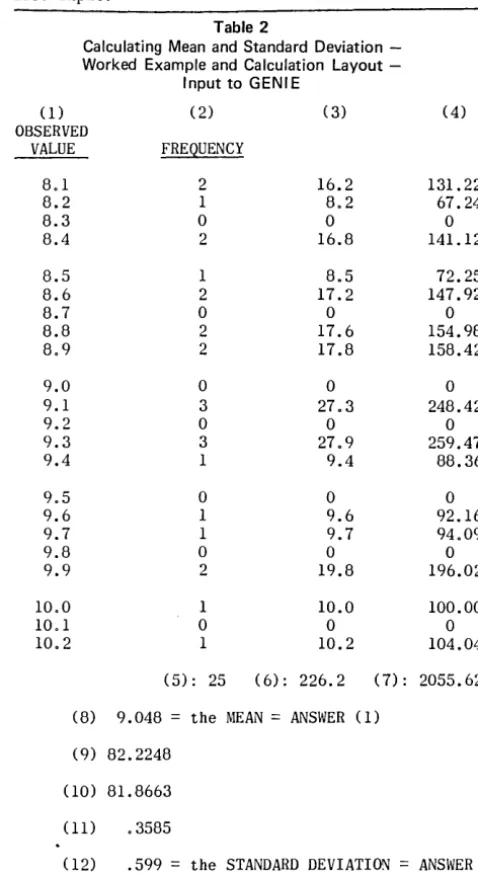
Let's suppose that in the first case the desired calculation is to find the mean and standard devia-tion for a frequency distribudevia-tion. Table 1 shows the manager's instructions -- input. Table 2 shows the worked example and the calculation layout --also input.
Table 2
Calculating Mean and Standard Deviation Worked Example and Calculation Layout
-Input to GENI E
(1) ( 2) ( 3)
OBSERVED
VALUE FREQUENCY
8.1 2 16.2
8.2 1 8.2
8.3 0 0
8.4 2 16.8
8.5 1 8.5
8.6 2 17.2
8.7 0 0
8.8 2 17.6
8.9 2 17.8
9.0 0 0
9.1 3 27.3
9.2 0 0
9.3 3 27.9
9.4 1 9.4
9.5 0 0
9.6 1 9.6
9.7 1 9.7
9.8 0 0
9.9 2 19.8
10.0 1 10.0
10.1 0 0
10.2 1 10.2
(5): 25 (6) : 226.2 (7) :
(8) 9.048
=
the MEAN=
ANSWER (1) (9) 82.2248(10) 81. 8663
(11) .3585
(4)
131. 22 67.24
0 141.12
72.25 147.92
0 154.98 158.42
0 248.42
0 259.47
88.36
0 92.16 94.09
0 196.02
100.00 0 104.04
2055.62
(12) .599
=
the STANDARD DEVIATION=
ANSWER (2) If we inspect the example, we can see that the manager's instructions are satisfactorily complete and definite for a human clerk, and that the figures look reasonable. If we verify the arithmetic, we find that the figures are actually correct. The in-formation given therefore ought to be sufficient for a clerk to know just what to do, and do it.But instead of giving this information to a clerk, we give it to the computer program we call GENIE.
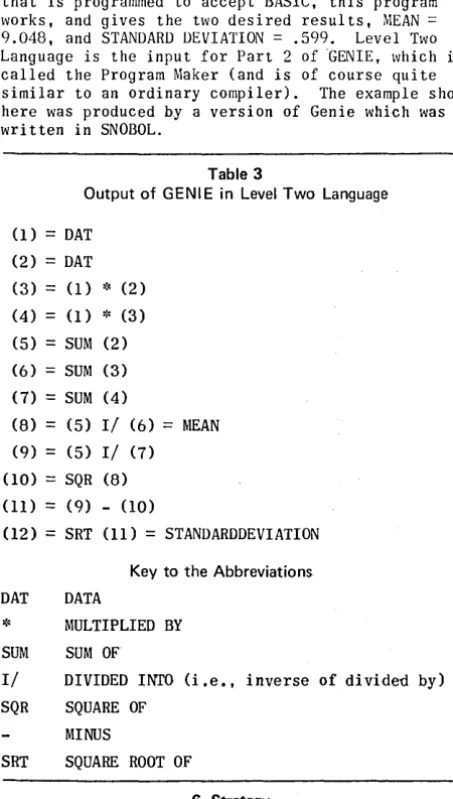
[image:11.620.325.564.221.659.2]The first output that GENIE produces is shown in Table 3. It is expressed in what we call Level Two Language, and it is the output of Part 1 of GENIE which is called the Statement Analyzer. The example shown here was produced by a version of GENIE which was written in machine language for the DEC PDP-9 computer.
The second output that GENIE produces is expressed in this case in the programming language BASIC. This output is shown in Table 4. For a computer that is programmed to accept BASIC, this program works, and gives the two desired results, MEAN = 9.048, and STANDARD DEVIATION = .599. Level Two Language is the input for Part 2 of GENIE, which is called the Program Maker (and is of course quite similar to an ordinary compiler). The example shown here was produced by a version of Genie which was written in SNOBOL.
Table 3
Output of GENI E in Level Two Language
0)
=
OAT (2)=
OAT (3)=
0) >:c (2) (4) 0)*
(3) (5)=
SUM (2) (6)=
SUM (3)(7)
=
SUM (4)(8)
=
(5) I( (6)=
MEAN (9)=
(5) I( (7) ( 0 ) = SQR (8)(11)
=
(9) - (10)(12)
=
SRT (11)=
STANDARDDEVIATIONKey to the Abbreviations
DAT DATA
SUM
II
SQR
SRT
MULTIPLIED BY
SUM OF
DIVIDED INTO (i.e., inverse of divideu by) SQUARE OF
MINUS
SQUARE ROOT OF
6. Strategy
Let's now discuss the strategy which we are using: the ideas and the principles by means of which we have gone from ordinary natural language, worked example, and calculation layout to a program ex-pressed in standard programming language. Let's call this "Strategy F".
7. The Principle of Appropriate Neglect
First is what we might call the Principle of Ap-propriate Neglect.
Many words that occur in a set of manager's in-structions to a clerk make almost no difference in conveying understanding to the clerk, in the con-text of what is to be done: the carrying out of a calculating rule. For example, the words "a" and "the" are very likely to make no difference. The same principle is applied in newspaper headlines: "SMITHVILLE MAN BITES DOG" is used in place of "A MAN IN SMITHVILLE BITES A DOG". A large amount of
12
Table 4
Output of GENI E as a Program in 8ASIC
10 DIM A2( 22) 20 FOR 1=1 TO 22 30 READ A2 (I ) 40 NEXT I 50 DIM A3(22) 60 FOR 1=1 TO 22 70 READ A3(I) 80 NEXT I 90 DIM A4( 22) 100 FOR 1=1 TO 22
110 LET A4(I)=A2(I)*A3(I) 120 NEXT I
130 DIM A5(22) 140 FOR 1=1 TO 22
150 LET A5(I)=A2(I)':'A40) 160 NEXT I
170 LET A7=~
180 FOR 1=1 TO 22 190 LET A7=A7+A3(I) 200 NEXT I
210 LET A8=0 220 FOR 1=1 TO 22 230 LET A8=A8+A4(I) 240 NEXT I
250 LET A9=0 260 FOR 1=1 TO 22 270 LET A9=A9+A5(I) 280 NEXT I
290 LET B0=A8/A7 300 PRINT "MEAN="B0 310 LET Bl=A9/A7 320 LET 82=80*80 330 LET 83=81-B2 340 LET B4=SQR(B3)
350 PRINT "STANDARDDEVIATION="B4
900 DATA 8.1,8.2,8.3,8.4,8.5,8.6,8.7,8.8, 8.9,9.0,9.1,9.2,9.3,9.4,9.5, 901 DATA 9.6,9.7,9.8,9.9,10.0,10.1,10.2 902 DATA 2,1,0,2,1,2,0,2,2,0,3,0,3,1,0,1,
1,0,2,1,0,1 2000 END
effort and a large amount of programming can be avoided if we do not try to "understand" all the words and phrases that are being used in a set of manager's instructions to a clerk.
8. The Principle of the Preferred Synonym
The next principle we may call the Principle of the Preferred Synonym.
In a set of manager's instructions to a clerk, it may well be that the manager uses different synonyms for the same idea. For example in Statement 5 of Table 1 we find: "Total Column (2)," which means "Sum the values in Column (2)". In Statement 6 we find: "Find the sum of Column (3)" which means "Sum the values in Column (3)". In Statement 7 we find: "Add up Column (4)" which means "Sum the values in Column (4)".
In the Statement Analyzer portion of GENIE we store a table of synonyms for words and phrases. Opposite each one we place the preferred synonym. For example, a portion of that table might contain:
ADD UP:SUM DETERMINE: FIND
SUM: SUM FIND:FIND
THE SUM OF:SUM GET: FIND
[image:12.617.318.563.50.470.2] [image:12.617.52.279.158.558.2]Then it is easy for the statement analyzer to recog-nize many words and phrases, and to replace each one by its preferred synonym.
This is regularly done in mathematics. The
pressions "TWO,II" are regularly replaced by the ex-pression "2". The use of a single convenient symbol for an idea is a great aid to calculation using sym-bols to stand for ideas.
9. The Principle of Relevant Context
It is not always possible to translate one and the same word into the same preferred synonym. Take for example Statement 5 in Table 1:
Total Column 2 and put the total in Item 5.
In this sentence, the first word "total" desigrlates an operation, and should be translated into the pre-ferred synonym SUM. The second word "total" how-Rver designates the result of an operation, and its preferred synonym here should be RESULT. The
pro-Table 5
gram GENIE should be designed so that it can trans-late the first "total" into SUM and the second "total" into RESULT, responding to the difference in context. Based on our experience so far, this is not difficult.
10. The Principle of a Series of Separate Statements
A manager's instructions to a clerk are assumed to be expressed in good English with a clear meaning, and in a style which an ordinary human clerk would readily understand.
As a result, a very natural requirement is that the instructions should be stated in a reasonable series of separate statements. The statements would be in a natural sequence, just as in a recipe for making bread: what you do first, what you do later, what you do to finish.
For Task F, there is no need to design a program to understand complicated discourse such as legal documents where statements may be bundled together with "whereases" or "provideds".
Probably Acceptable Vocabulary
A
a
according to add
added to again all the way an
and and/or and so on answer any appropriate are array as
as soon as assign at this point
~ beginning box but by 52 calculate call called case cell class collection column compute continue correct corresponding count o data define determine difference digit divide di vided by di vi sor do down E e.g. each element else empty end ending enter equal equals etc. evaluate example express E false figure fi 11 in final find first following for
for example for instance from
G
get gi ve gi ven go to group
COMPUTERS and AUTOMATION for June. 1973 H here I I i.e. in input
in other words intermediate is
it it is item iterate iteration its
h
last less let list look 1\1 me minus upmul tipli cand mul ti plier multiply mul ti pli ed by
name named namely next no none not number
a
observed obtained once more one of operation otherwise out of output outset p partial percent perform plus points print proceed process produced product provided put down put in put into puttingquantity quotation marks quotient quotes R read respectively response result return return to row
x
same same way score second see set several shall shown in simi larly single quote space square root start starting subtract subtract from subtracted from sum
suppose
T
table take take away take away temporary that that is the then this thi sis from thi rd through times total to
to the end of true type U unit us use using
v
value values variable W we wait for what whatever which which is will with write write down write iny
yes you
z
zero refer to
regardless of remainder repeat repeated repetition reply
Note: The program G ENI E at this time may not be able to handle some of the phrases that can be con-structed using these words, particularly where those phrases have special or idiomatic meanings.
[image:13.612.57.549.306.749.2]11. The Principle of Statements of. Reasonable Length
One of the requirements of good clear English for manager's instructions to a clerk is that the indi-vidual sentences should not be "too long". A good limiting length is about 25 or 30 words.
Versions of GENIE should be designed to complain if anyone of the manager's statements to a clerk is longer than 30 words.
It is easy enough to break long sentences of in-structions into shorter ones. A manager:should not protest about this. Often in fact a clerk can then work more efficiently -- because clarity is in-creased.
12. The Principle of a Finite Vocabulary
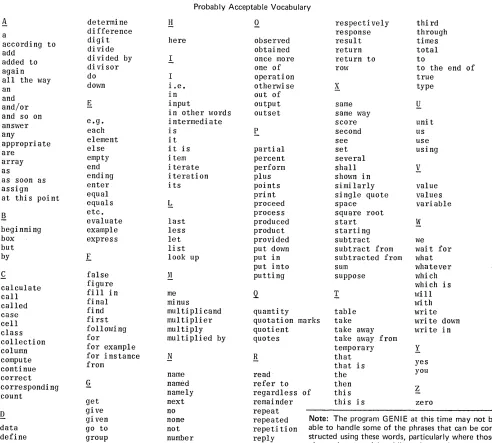
At the present time we are working with only a small finite vocabulary of words that may occur in manager's instructions to a clerk. The reason for this decision is that it makes sense to begin with less than a full vocabulary and then after achieving success with that, move on to a more inclusive vo-cabulary.
The vocabulary we are working with currently is shown in Table 5, "Probably Acceptable Vocabulary".
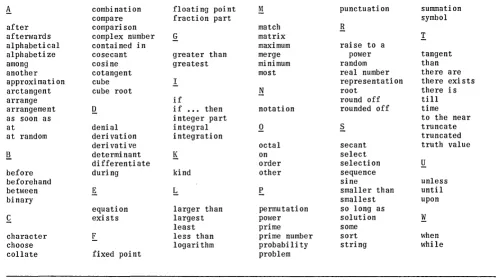
The vocabulary of words and phrases which may oc-cur in managers' instructions to clerks, and which we do not believe that GENIE can handle at this time is .shown in Table 6, "Probably Unacceptable Vocabu-lary (At This Time)". But we see no theoretical barriers to the extension of GENIE to handle these words (and the corresponding ideas).
13. The Principle of Gradual Development
A major principle we are using is the Principle of Gradual Development as contrasted with the Prin-ciple of Assembly Line Production. For, if you do not have a very good idea of just how to produce something, it makes sense to make a series of models or trials, ranging from a very simple model to a complicated one. Then you learn from each model. On the other hand, if you really know just what you are producing, it makes sense to set up an assembly line and have each prefabricated component arrive at the time it is to be assembled.
In the case of natural language programming, we do not know all we would like to know. So we begin with a very simple problem (like the calculation of mean and standard deviation) and proceed to more complicated ones. Deliberately, we are not tryIng to design immediately a full system for dealing with all of natural language for all sets of problems that we can imagine computers being applied to. An automobile manufacturer knows enough to set up an assembly line; we don't as yet.
However, we have selected a group of problems connected with businesses, that computers should be able to deal with. For this group of applications, first, we hope to develop GENIE. The list of appli-cations is shown in Table 7.
14. The Principle of Questioning by the Clerk
It may well be that the "clerk" after "listening" to the "manager's instructions" has some questions
especially if the manager's instructions are in-complete or inconsistent. It is logical for the program GENIE to inquire of the person giving it the manager's instructions whenever it finds upon ex-amining the information given to it, that there are
puzzles or ambiguities. A prior program that does this is DWIM, "Do What I Mean, the Programmer's As-sistant," by Warren Tei telman (see Computers and Automation for April 1972).
Although our versions of the program GENIE do not as yet contain this feature, this is a desirable feature in interactive computer programs and should be relatively easy to implement.
15. Other Principles
These eight principles mentioned constitute per-haps a quarter of all the principles that we are us-ing in Strategy F. Many of the others however are more detailed and of less general interest than those we have mentioned here.
We are hoping to find ways to expand the work we are engaged in, and to apply our ideas to many more problems of understanding manager's instructions to a clerk than we have so far tackled.
16. Level One Language and Level Two Language
As we mentioned before, GENIE has several portions. The first portion of GENIE is the Statement Analyz-er, which produces what we call Level One Language. Another portion of GENIE is the Program Maker, which takes in Level Two Language produced by prior por-tions of GENIE and in its turn produces a regular computer program in a regular computer programming language -- which may be BASIC or machine language or something else.
So far the varieties of Level One Language that we have been experimenting with seem unsatisfactory.
Level Two Language, th€ input to the Program Maker, is a very natural kind of language for those persons who have had experience with calculations in business, accounting, engineering, and similar fields. Basically it consists of:
• Naming columns and items (i.e., variables) with numbers or letters (for example Column (5), Sch~dule B, Form 1090);
• Expressing in symbols and words the relations between the columns and the items.
The Federal Income Tax Form is a good example. The directions "(6) is 0) or (3) or (5), whichever is greatest," is a good example. In the years 1930-41 when I worked in the actuarial departments of life insurance companies, I was surprised to see how much more one could do with this sort of specification of calculating rules than one could do with the ordi-nary mathematical notation of the academic world.
17. Criticisms
Many criticisms can be directed at what we have done so far. Suppose we try to express some of them and a rebuttal to each in a kind of dialog.
Question: How far have you gone? and what evi-dence do you have that you can go the rest of the way?
Answer: Not very far. But as long as an ordinary uninformed clerk can learn what a manager is saying about how a calculation is to be performed, it seems logical to.believe that those ordinary natural lan-guage directions can be "understood" by a computer program.
Table 6
Probably Unacceptable Vocabulary (At This Time)
A
after afterwards alphabetical alphabetize among another approximation arctangent arrange arrangement as soon as at
at random
before beforehand between binary
character choose collate
combination compare comparison complex number contained in cosecant cosine cotangent cube cube root
D
denial derivation deri vati ve determinant differentiate during
E
equation exists
F
fixed point
floati ng poi nt fraction part
G
greater than greatest
I
if
if ••• then integer part integral integration
K
kind
L
larger than largest least less than logarithm
M
match matrix maximum merge minimum most
notation
o
octal on order other
P
permutation power prime prime number probabili ty problem
Table 7
punctuation
R
raise to a power random real number representation root
round off rounded off
S
secant select selection sequence sine
smaller than smallest so long as solution some sort string
summation symbol
T
tangent than there are there exists there is till time to the near truncate truncated truth value
u
unless until upon
w
when while
General Business Applications to which the Program GENI E Might Apply First
Absenteeism reports Accounts receivable Advertising effectiveness Attendance records Billing and invoicing Budgeting
Capital investment analysis Consumer credit verification Cost accounting
Data assembling, from multiple sources Depreciation calculations
Dispatching
Equipment, register and inventory Financial statements
Forecasting General ledger Hiring analysis
Insurance records and schedules Inventory control
Labor cost calculations Lease and rental accounting Manhour records and analysis
Overhead cost allocation Overtime reports
Payroll computation and payment Performance evaluation
Price analysis
Production forecasting Property accounting
Purchase orders, writing and followup Questionnaire analysis
Repair and maintenance Rent analysis
Reti!ement fund records and valuation
Sales analysis, area distribution, forecasting, quota calculations
Sales order processing, invoicing, shipping Savings bond deductions
Seniority records Taxes
Transportation optimization Traveling salesmen scheduling Turnover analysis
Vacation scheduling
Wages and salaries, analysis, and records Orders: acknowledgement, analysis, processing,
shipping records Work in process records
(please turn to page 18)
[image:15.613.54.550.105.385.2]Soviet Information-Handling Problems:
The Possibilities in Computer Usage
Robert A. Bartol Kathryn M. Bartol
School of Business Administration University of Massachusetts Amherst, Mass. 01002
'While the numbers of projects involving computers are multiplying, benefits from computer utilization are severely limited by a series of chronic problems ... "
When a nation centrally plans its entire economy, the data problems incumbent in collecting and dis-seminating the necessary economic information are indeed sizable. In the vast Union of Soviet Social-ist Republics (USSR), which stretches from the Bal-tic Sea to the Pacific and from the ArcBal-tic Ocean to the Black and Caspian seas, the commitment to cen-tralized planning has resulted in one of history's most formidable data-handling problems,
Since the early sixties, Soviet economic, sta-tistical, and computer experts have given increasing attention to the massive data requirements of their economic structure, As an indicator of the accel-era ting complexi ty of the Sovi.et economy, one expert estimates that the number of persons involved in ec-onomic planning and control increased 50 percent be-tween 1955 and 1~62.1 V. Glushkov, head of the Ukrainian Republic Academy of Sciences' Cybernetics Institute and one of the Soviet Union's foremost computer specialists, estimates that utilizing ad-ding machines and calculators, it would take three billion persons to solve current management prob-lems in the Soviet Union. 2 Another writer warns that unless manual data collection and calculation methods are altered, every adult in the Soviet Union will be engaged in planning and administration by 1980. 3
Barriers to Effective Usage of Computers
After Norbert Wiener's book, Cybernetics or Con-trol and Communication in the Animal and the Machine (MIT Press, 1948), was published in the Soviet Union in 1958, many Soviet experts seriously began to con-sider computers a means of maintaining the continued viability of their centrally planned economy. To-day, there is heavy emphasis on computer usage in many sectors of the economy. At the same time, numerous barriers, such as insufficient hardware, inadequate software, and organizational difficult-ies, obstruct the eff~ctive utilization of computers in the Soviet Union.
Pyramid-Like Network of Computers
A prominent part of plans to streamline data handling has been the concept of a nation-wide net-work of computers which could collect and dissemi-nate Soviet economic information. Proposed as early as 1959 by the noted Soviet Academician A. I. Berg, the network usually is envisioned as a pyramid with three levels. 4 At the bottom level, computers would be placed in various plants or enterprises. For the second level, computer centers would be set up on the basis of either industrial sectors and their ministries or territorial divisions based on the USSR's fifteen republics. At the top of the prya-mid, computer centers would serve major
administra-tive units in Moscow, including the Central Sta-tistical Administration (Tsentral'noe statisticheskoe upravlenie -- TsSU) and the State Planning Committee (Gosplan). Thus appropriate information would be channeled up the pyramid, with summary data ulti-mately used in Moscow. In addition, special multi-user centers would be established at the bottom lev-el for those enterprises without their own computers.
Network Controversy
Hardly had initial work on planning the network received the official sanction of the Party Central Committee and the Council of Ministers in 1964,5 when signs of controversy regarding the network be-gan to emerge. The dispute primarily centered around who should have jurisdiction over the net-work and how the second level of the pyramid should be organized. One side, led mainly by the TsSU, argued that the statistical administration should have sole control of the network and that the sec-ond level should be organized on a regional basis. In this way enterprises could send their data to existing regional TsSU mechanized accounting cen-ters which would acquire compucen-ters to complement their calculating _equipment. In addition, TsSU would expand the number of mechanized accounting centers under its control. 6 Data would be supplied by TsSU to industrial ministries, Gosplan, and other users. Some advantages of the TsSU approach would be: (1) centralized data collection for greater con-trol of information; (2) efficient use of computer equipment and trained personnel because they would be clustered in centers; (3) regional planning while still furnishing industrial sectors and their min-istries data essential for planning.
Industrial Sectors vs. Regional Planning