SHORT COMMUNICATION
The repeatability of mating failure in a polyandrous bug
E . V ( G I N N Y ) G R E E N W A Y & D . M . S H U K E R
School of Biology, University of St Andrews, St Andrews, Fife KY16 9TH, UK
Keywords:
insect reproduction; mating failure; polyandry; sexual selection.
Abstract
Mating failure, characterized by the lack of production of offspring following copulation, is relatively common across taxa yet is little understood. It is unclear whether mating failures are stochastic occurrences between incom-patible mating partners or represent a persistent, meaningful phenotype on the part of one or other sex. Here we test this in the seed bugLygaeus simu-lans, by sequentially mating families of males with randomly allocated unre-lated females and calculating the repeatability of mating outcome for each individual male and family. Mating outcome is significantly repeatable within individual males but not across full-sib brothers. We conclude that mating failure represents a consistent male-associated phenotype with low heritability in this species, affected by as yet undetermined environmental influences on males.
Introduction
Why do so many matings fail? Given that successful fertilization is the raison d’^etre of mating and should be a focus of both natural and sexual selection, relatively frequent failure to convert matings into fertilizations in the absence of competitors is something of an evolu-tionary enigma. The costs of both achieving and then carrying out matings to both males and females are well documented (Thornhill & Alcock, 1983; Wedell
et al., 2002), and selection to capitalize on matings is
apparent in the evolution of a huge diversity of genital and sperm morphologies and peri- and post-copulatory behaviours (Eberhard, 1996; Simmons, 2001). Failure to find a suitable mate, due to demographic effects, low mate encounter rate, out-competition by rivals or prereproductive death, has been well documented (Rhainds, 2010). However, matings that fail to result in offspring production despite the successfully securing of, and coupling with, a mate have achieved somewhat less attention until recently (e.g. Tyler & Tregenza, 2013). Studies and meta-analyses across taxa reveal nontrivial levels of copulation failure, occurring on average in 22% of matings across 30 insect species
(Garcıa-Gonzalez, 2004), and hatching failure rates of up to 55% in avian species (Koenig, 1982). However, the precise mechanisms for such failures and the fitness consequences for individuals remain unclear.
A mating can fail to produce offspring for myriad reasons and at any stage of copulation, and putative explanations of mating failure range from absence or depletion of sperm, mechanical intromission or insemi-nation failures, genetic incompatibility, and the exer-tion of cryptic choice by females (Eberhard, 1996; Garcıa-Gonzalez, 2004). Given the degree of heritable genetic variation demonstrated in fertility-related traits such as sperm morphology (Morrow & Gage, 2001; Evans, 2011; Murray et al., 2011), mating duration (MacBean & Parsons, 1967) and sperm competition success (Konior et al., 2006), natural selection should prevent the maintenance of genetically determined and costly low fertility within populations. Although it may theoretically be preserved at low levels by mutation-selection balance (Lande, 1995), in actuality less fertile males would be outcompeted by more fertile rivals and so fail to gain paternity. Thus, such a deleterious trait should not persist in the population, although more ephemeral or environmentally determined forms of infertility such as sperm depletion or sperm limitation are unlikely to be so highly penalized by sexual selec-tion and therefore might be more common (Sheldon, 1994; Hasson & Stone, 2009).
Correspondence:E. V(Ginny) Greenway, School of Biology, University of St Andrews, Harold Mitchell Building, St Andrews, Fife KY16 9TH, UK. Tel.: 01334 463500; fax: 01334 463366; e-mail: [email protected]
ª2 0 1 5 T H E A U T H O R S .J . E V O L . B I O L .
Measuring the repeatability of mating failure offers a method to tease apart some of these possibilities. For instance, by establishing how consistent male mating outcomes are over successive trials would help us to estimate the importance of female influence. Further-more, repeatability can indicate the upper limit of heri-tability (Boake, 1989), providing an insight into the genetic components of behaviour upon which natural and sexual selection may act. Although high levels of repeatability of reproductive behaviour have been dem-onstrated in some species (e.g. sexual conflict outcome
in Coelopa frigida (Shuker & Day, 2001)), other studies
report little or none (e.g. Tregenza et al., 2009). Simi-larly, using related individuals to gauge trait heritability has produced opposing results in closely related species (Tayloret al., 2013; Bretmanet al., 2014). Moreover, in their meta-analysis Bell et al. (2009) observed that although components of mating success are generally repeatable, mate preference is far less so, reflecting higher levels of behavioural context dependence and condition dependence (e.g. Cotton et al., 2006). This broad range of repeatability and heritability, both within and between species and behaviours, has long been well appreciated and is likely in part to reflect varying genotype-by-environment interactions (GEIs). Using repeated measures from both individual male and family-level male mating success, we aim to gain an indication of the genetic and environmental compo-nents of mating failure.
The study species, Lygaeus simulans (Heteroptera: Lygaeidae), is characterized by a promiscuous mating system in which both males and females engage in multiple and prolonged copulations. Rates of mating failure are nontrivial, ranging from 36% to 60% (Tadler, 1999a,b). Some virgin females (of bothL. simu-lansand sister speciesLygaeus equestris) produce infertile eggs, but far higher levels of oviposition are stimulated by mating (Sillen-Tullberg, 1981). As precopulatory sexual selection appears to be relatively weak in the sister species L. equestris (Burdfield-Steel et al., 2013; Dougherty & Shuker, 2014), understanding mating failures may be key in unravelling the extent of post-copulatory sexual selection in this species. We used an experimental paradigm in which males were given suc-cessive matings with randomly selected virgin females. We firstly assessed to what extent mating outcome was repeatable within individual males, and secondly across full-sib families. For mating failure to be considered a meaningful phenotype (i.e. not just a stochastic failure unrelated to male and/or female reproductive anatomy, physiology or behaviour), we would predict that it should demonstrate significant repeatability. Whether we would expect this repeatability to be maintained at the family level depends on the mechanisms underlying mating failure. Repeatability of outcome between full sibs would suggest a high level of genetic control,
whereas little or no repeatability points towards a lack of heritability and substantial environmental influence.
Materials and Methods
Husbandry and production of full-sib males
Lygaeus simulansfifth instar nymphs were collected from
a laboratory stock population (originally collected from Tuscany in 2004) and raised to adulthood at a tempera-ture of 29°C and under a 22:2-h light:dark cycle to prevent the initiation of reproductive diapause. Newly moulted adult virgin males and females were sorted by sex into plastic tubs with ad libitum organic sunflower seeds and tubes of distilled water with a cotton bung until sexual maturity. Sexually mature males and females were then randomly paired in individual tubs (withad libitum seeds and water) and left to mate. The resulting eggs from these pairings were incubated and offspring-collected. At least 10 full-sib virgin males were collected from each family (N=14) and reared to sexual maturity at maximum densities of 10 individuals per tub.
Mating trials
Individual focal males (N=168) between 7 and 10 days old were placed in 85-mm-diameter petri dishes and randomly paired with virgin females. Mating attempts were scored within the first two hours of con-tinuous observation. After this period, dishes were checked at 10-min intervals for new pairings (males and females in end-to-end mating position) or separa-tions for a further 7½h. Only matings over a cut-off of 30 min were considered, as this constitutes the esti-mated minimum time required for sperm transfer to occur in this species (Micholitschet al., 2000). Individu-als were separated immediately after mating, pairings that had not terminated naturally by the end of the 9½-h observation period were separated, and mating latency and duration were recorded.
This procedure was repeated for a further three suc-cessive days, with males randomly paired with a new virgin female each day. Males were returned to the incubator overnight between trials in petri dishes con-taining three sunflower seeds and water source. Only males that mated 3 or 4 times were included in analysis to calculate repeatability robustly (N=102).
Statistical analysis
We classed mating outcome as a binary response (‘suc-cess’ or ‘failure’). Repeatability of mating outcomes was calculated using a binomially distributed GLMM with logit-link and multiplicative overdispersion, with ‘male ID’ as repeatability ‘group’ (R package rptR: Nakagawa
& Schielzeth, 2010). Repeatability of outcome within families was calculated similarly, replacing individual mating outcomes as the unit of repeatability with the sum of each individual’s successful or failed matings and ‘family ID’ as the repeatability group. Here we report repeatabilities on the link scale (see Supporting Information for original scale repeatabilities). Similarly, due to their bimodal distribution (see Supporting Infor-mation) mating durations were classified by their
posi-tion relative to the mean mating duration
(295.05 min). As such, ‘short’ durations consisted of matings up to and including 295 min in length. Any matings exceeding 295 min were considered to be ‘long’ in duration.
Results
The mating failure rate was 49.2%; 23.6% of matings resulted in no eggs and 25.5% in no fertile eggs, and the majority of males mated on at least three of the available four opportunities (mean mating num-ber=3.04 SE 0.102). Total mating success displayed a clearly bimodal distribution, with zero or 100% mat-ing success representmat-ing two of the most frequent out-comes (see Supporting Information), and individual
mating outcome was significantly repeatable
(R =0.415 SE 0.07, P=0.001). On the other hand,
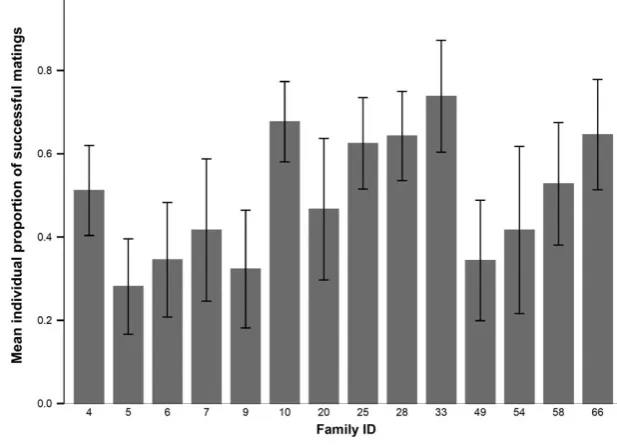
whilst mean mating success varied considerably between the 14 families of males (Fig. 1), the repeat-ability of mating outcome within family was low and nonsignificant (R=0.007SE 0.02,P=0.268). When any males that mated with a female who did not lay eggs were excluded from analysis, levels of repeatability increased individual male mating outcome repeatability (n =45, R=0.464 SE 0.11, P=0.001). Longer copulations were significantly more likely to lead to successful matings (v²(1)=63.42,P= <0.001), and mat-ing duration, like mean matmat-ing success, exhibited high between-family variation (see Supporting Information). Mating duration displayed low but significant levels of repeatability at the individual level (R=0.266 SE 0.07, P=0.001) and but no significant family repeat-ability (R=0.019SE 0.02,P=0.124).
The number of previous matings males had under-taken had no significant effect on mating failure (GLMM,Z=1.056,P=0.291; see Supporting Informa-tion). Therefore, mating order had no effect on out-come, as a result of either possible sperm depletion or sexual experience.
Discussion
Mating failure is repeatable for male Lygaeus simulans
bugs. Despite acknowledgement that widespread per-manent sterility or low fertility within populations has traditionally been considered unlikely (Sheldon, 1994; Garcıa-Gonzalez, 2004), approximately half of the matings in this study failed to result in fertilization and, more importantly, around a quarter of multiply-mating males fathered no offspring at all. Although demonstration of high levels of mating failure within
[image:3.595.220.529.489.713.2]the Lygaeidae is not novel (Tadler, 1999b), this is the first time such failure has been shown to be signifi-cantly repeatable within individuals in any species.
The observed repeatabilities, comparatively high in the context of behavioural studies (Bell et al., 2009), suggest that mating failure constitutes a genuine male-associated phenotype. By comparison, the low repeata-bilities of copulation duration suggest perhaps that females play more of a role in determining copulation length. Explanations of mating failure in L. simulans
have focused on intromittent organ insertion as well as potential female prevention of insemination (Tadler, 1999a). Tadler (1999b) provides evidence of stabilizing selection on male intromittent organ length, with males possessing an intromittent organ of intermediate length achieving highest levels of fertilization (see also
Dough-erty et al., 2015). Incidentally, intromittent organ
length in the sister species Lygaeus equestris has been demonstrated to be significantly heritable (H2=0.306 SE 0.18; Higgins et al., 2009). Additionally, mating duration correlates significantly with mating outcome both in this and previous studies (Micholitsch et al., 2000), with failed matings terminating typically within the initial hour of mating. Despite this, duration dis-plays a lower level of repeatability within individuals than mating outcome, suggesting it is not the sole determinant of mating failure. The absence of a signifi-cant effect of mating order also indicates no signifisignifi-cant role of sperm limitation in mating failure in this species.
Examining mating outcome repeatability at the fam-ily level offers further mechanistic insight. Although repeatability provides an upper limit to heritability, it does not confirm that level of heritability (Boake, 1989). The lack of congruence between our individual and family-level repeatabilities emphasizes this, with the discrepancy suggesting that nonadditive genetic or environmental effects influence variation in mating fail-ure. As selection acts solely upon heritable variation, this goes some way to explaining why mating failures persist despite selection acting to maximize reproduc-tive success, although it should be noted that the rela-tively small family sample size used limits our ability to reject definitively the possibility of a genetic component to mating failure. In terms of environmental effects, arguably the most important factor likely to influence a male’s mating success is that of the female with whom he is mating (Eberhard, 1996; Ingleby et al., 2010). However, the repeatability of mating outcome displayed by individual males mating with multiple independent females precludes variation among females in terms of their ‘copulatory’ environment influencing our results and leads us to conclude that environmental effects associated more directly with males are the predomi-nant source of phenotypic variation. What these are, and to what extent they are associated with laboratory rearing for multiple generations, remains to be seen.
The vast majority of mating behaviour studies mea-sure individuals only once, and the degree to which behavioural measurements are repeatable within indi-viduals remains to be verified in most species. Estimat-ing the repeatability of matEstimat-ing failure is important not only for our understanding of this enigmatic trait but also in terms of experimental design and interpretation. Overlooking mating failure can result in incorrect inter-pretations of sperm competition experiments and incor-rect estimates of polyandry (Garcıa-Gonzalez, 2004), both of which are central to post-copulatory sexual selection research. Put another way, we should not necessarily discard individuals or pairs from our analyses when mating has apparently ‘failed’. More positively, significant consistency of mating outcome and no apparent effect of virgin male status provide support for the results of previous studies on this species performed using single mating trials.
Although it is possible that laboratory conditions may have generally lessened the selection pressure on male mating performance in L. simulans, the level of repeat-ability demonstrated in this study confirms that mating failures cannot be dismissed as stochastic events or purely the result of male–female preference or genetic incompatibilities. Such high levels of male infertility and variation in reproductive success would intuitively have substantial repercussions for mating strategy evolution, increasing the likelihood of female sperm limitation (Wedell et al., 2002) and as a result female remating rates (Sheldon, 1994; Jennions & Petrie, 2000; Hasson & Stone, 2009). The risk of mating fail-ure, even if low, has been both theoretically and empir-ically demonstrated to support fertility insurance and bet-hedging strategies (Forbes, 2014; Garcıa-Gonzalez
et al., 2014). Under these conditions, direct benefits
derived by polyandrous individuals, in terms of maxi-mizing offspring production, are likely to outweigh the potential costs of mating multiply. Although mating failure is probably a complex trait, varying in origin across taxa, its prevalence suggests it should not be overlooked as a major factor in unravelling the evolu-tion of polyandry.
Acknowledgments
EVG is supported by a Natural Environmental Research Council PhD studentship. We are very grateful to Liam Dougherty, Luc Bussiere and two anonymous reviewers for extremely helpful comments on the manuscript.
References
Bell, A.M., Hankison, S.J. & Laskowski, K.L. 2009. The repeat-ability of behaviour: a meta-analysis.Anim. Behav.77: 771– 783.
Bretman, A., Lize, A., Walling, C.A. & Price, T.A.R. 2014. The heritability of mating behaviour in a fly and its plasticity in response to the threat of sperm competition. PLoS ONE 9: e90236.
Burdfield-Steel, E.R., Dougherty, L.R., Smith, L.A., Collins, L.A. & Shuker, D.M. 2013. Variation in social and sexual behaviour in four species of aposematic seed bugs (Hemip-tera: Lygaeidae): the role of toxic and non-toxic food.Behav. Proc.99: 52–61.
Cotton, S., Small, J. & Pomiankowski, A. 2006. Sexual selec-tion and condiselec-tion-dependent mate preferences. Curr. Biol. 16: 755–765.
Dougherty, L.R. & Shuker, D.M. 2014. Precopulatory sexual selection in the seed bugLygaeus equestris: a comparison of choice and no-choice paradigms.Anim. Behav.89: 207–214. Dougherty, L.R., Rahman, I.A., Burdfield-steel, E.R., Greenway,
E.V. & Shuker, D.M. 2015. Experimental reduction of intro-mittent organ length reduces male reproductive success in a bug.Proc. R. Soc. B Biol. Sci.282: 20150724.
Eberhard, W. 1996. Female Control: Sexual Selection by Cryptic Female Choice. Princeton University Press, Princeton, NJ. Evans, J.P. 2011. Patterns of genetic variation and covariation
in ejaculate traits reveal potential evolutionary constraints in guppies.Heredity106: 869–875.
Forbes, S. 2014. Partial fertility and polyandry: a benefit of multiple mating hiding in plain sight? Behav. Ecol. Sociobiol. 68: 1329–1334.
Garcıa-Gonzalez, F. 2004. Infertile matings and sperm competi-tion: the effect of “nonsperm representation” on intraspecific variation in sperm precedence patterns.Am. Nat.164: 457– 472.
Garcıa-Gonzalez, F., Yasui, Y. & Evans, J.P. 2014. Mating port-folios: bet-hedging, sexual selection and female multiple mating.Proc. R. Soc. B Biol. Sci.282: 20141525.
Hasson, O. & Stone, L. 2009. Male infertility, female fertility and extrapair copulations. Biol. Rev. Camb. Philos. Soc. 84: 225–244.
Higgins, S.L., Hosken, D.J. & Wedell, N. 2009. Phenotypic and genetic variation in male genitalia in the seedbug, Lygaeus equestris(Heteroptera).Biol. J. Linn. Soc.98: 400–405. Ingleby, F.C., Hunt, J. & Hosken, D.J. 2010. The role of
geno-type-by-environment interactions in sexual selection.J. Evol. Biol.23: 2031–2045.
Jennions, M.D. & Petrie, M. 2000. Why do females mate multiply? A review of the genetic benefits.Biol. Rev. Camb. Philos. Soc.75: 21–64.
Koenig, W.D. 1982. Ecological and social factors affecting hatchability of eggs.Auk99: 526–536.
Konior, M., Radwan, J., Kołodziejczyk, M. & Keller, L. 2006. Strong association between a single gene and fertilization efficiency of males and fecundity of their mates in the bulb mite.Proc. R. Soc. B Biol. Sci.273: 309–314.
Lande, R. 1995. Mutation and conservation. Conserv. Biol.9: 782–791.
MacBean, I.T. & Parsons, P.A. 1967. Directional selection for duration of copulation inDrosophila melanogaster.Genetics56: 233–239.
Micholitsch, T., Krugel, P. & Pass, G. 2000. Insemination and fertilization in the seed bug Lygaeus simulans (Heteroptera: Lygaeidae).Eur. J. Entomol.97: 13–18.
Morrow, E.H. & Gage, M.J.G. 2001. Artificial selection and heritability of sperm length in Gryllus bimaculatus. Heredity 87: 356–362.
Murray, R.L., Kozlowska, J.L. & Cutter, A.D. 2011. Heritable determinants of male fertilization success in the nematode Caenorhabditis elegans.BMC Evol. Biol.11: 99.
Nakagawa, S. & Schielzeth, H. 2010. Repeatability for Gaussian and non-Gaussian data: a practical guide for biologists.Biol. Rev. Camb. Philos. Soc.85: 935–956.
Rhainds, M. 2010. Female mating failures in insects. Entomol. Exp. Appl.136: 211–226.
Sheldon, B.C. 1994. Male phenotype, fertility, and the pursuit of extra-pair copulations by female birds.Proc. R. Soc. B Biol. Sci.257: 25–30.
Shuker, D.M. & Day, T.H. 2001. The repeatability of a sexual conflict over mating.Anim. Behav.61: 755–762.
Sillen-Tullberg, B. 1981. Prolonged copulation: a male “postcopulatory” strategy in a promiscuous species, Lygaeus equestris (Heteroptera: Lygaeidae). Behav. Ecol. Sociobiol. 9: 283–289.
Simmons, L.W. 2001. Sperm Competition and its Evolutionary Consequences in the Insects. Princeton University Press, Prince-ton, NJ.
Tadler, A. 1999a. Selection of a conspicuous male genitalic trait in the seedbugLygaeus simulans.Proc. R. Soc. B Biol. Sci. 266: 1773–1777.
Tadler, A. 1999b. Selection of male traits during and after copulation in the seedbug Lygaeus simulans (Heteroptera, Lygaeidae).Biol. J. Linn. Soc.68: 471–483.
Taylor, M.L., Evans, J.P. & Garcia-Gonzalez, F. 2013. No evi-dence for heritability of male mating latency or copulation duration across social environments inDrosophila melanogas-ter.PLoS ONE8: e77347.
Thornhill, R. & Alcock, J. 1983. The Evolution of Insect Mating Systems. Harvard University Press, Cambridge, MA.
Tregenza, T., Attia, F. & Bushaiba, S.S. 2009. Repeatability and heritability of sperm competition outcomes in males and females ofTribolium castaneum.Behav. Ecol. Sociobiol.63: 817– 823.
Tyler, F. & Tregenza, T. 2013. Why do so many flour beetle copulations fail?Entomol. Exp. Appl.146: 199–206.
Wedell, N., Gage, M.J.G. & Parker, G.A. 2002. Sperm competi-tion, male prudence and sperm-limited females.Trends Ecol. Evol.17: 313–320.
Supporting information
Additional Supporting Information may be found in the online version of this article:
Table S1Link and original scale repeatabilities
Table S2Effect of mating order on outcome
Figure S1 Frequency distribution of total individual mating success.
Figure S2No effect of mating order on mating failure.
[image:5.595.59.288.77.706.2]Figure S3Frequency distribution of mating durations.
Figure S4Mean mating duration by family.