ISSN Online: 2327-5227 ISSN Print: 2327-5219
DOI: 10.4236/jcc.2019.710009 Oct. 16, 2019 94 Journal of Computer and Communications
Edge-Cloud Collaborative Optimization
Scheduling with Micro-Service Architecture
Qiuyan Liu1, Jiajun Li2, Huazhang Lv1, Zhonghao Zhang1, Mingxuan Li1, Yi Feng1
1Institute of Network Technology, China Unicom Co. Ltd., Beijing, China 2Huasheng Terminal, China Unicom Co. Ltd., Beijing, China
Abstract
The architecture of edge-cloud cooperation is proposed as a compromising solution that combines the advantage of MEC and central cloud. In this paper we investigated the problem of how to reduce the average delay of MEC ap-plication by collaborative task scheduling. The collaborative task scheduling is modeled as a constrained shortest path problem over an acyclic graph. By characterizing the optimal solution, the constrained optimization problem is simplified according to one-climb theory and enumeration algorithm. Gener-ally, the edge-cloud collaborative task scheduling scheme performance better than independent scheme in reducing average delay. In heavy workload sce-nario, high blocking probability and retransmission delay at MEC is the key factor for average delay. Hence, more task executed on central cloud with abundant resource is the optimal scheme. Otherwise, transmission delay is inevitable compared with execution delay. MEC configured with higher priority and deployed close to terminals obtain more performance gain.
Keywords
Edge-Cloud Collaboration, Micro-Service, Scheduling Policy, Markov Process
1. Introduction
As digital applications proliferate, 5G network is deeply integrated with en-hanced mobile broadband (eMBB), ultra reliable low latency communications (uRLLC), and massive machine type communication (mMTC) services, such as virtual reality/augmented reality, 4K/8K live video, artificial intelligence decision and big data analysis [1] [2] [3] [4]. Multiple access edge computing (MEC) is a promise technology which allows various access mode, high bandwidth, low
la-How to cite this paper: Liu, Q.Y., Li, J.J., Lv, H.Z., Zhang, Z.H., Li, M.X. and Feng, Y. (2019) Edge-Cloud Collaborative Opti-mization Scheduling with Micro-Service Architecture. Journal of Computer and Communications, 7, 94-104.
https://doi.org/10.4236/jcc.2019.710009
DOI: 10.4236/jcc.2019.710009 95 Journal of Computer and Communications
tency services executed locally by deploying multiple access edge cloud at the edge of the network [5] [6]. As a simplified version of central cloud, MEC ex-ecutes the cloud computing task locally by deep data inspection, which can re-duce the transmission delay and avoid the flow storm towards backhaul and core network [7] [8] [9]. More and more broadband and low latency services are ap-plied with the assistant of MEC instead of centralized cloud. However, MEC is deployed at the edge of network with limited resources including computing, storage, cache, even physical space, air-conditioning environment and energy consumption. Compared with MEC, central cloud is assumed to offers virtually unlimited computing capacity, massive storage and abundant cache in core data center (DC). Hence, the architecture of edge-cloud cooperation is proposed as a compromising solution that combines the advantage of MEC and central cloud [10] [11]. In the cooperation scenario, it is critical to utilize the limited resource efficiently and balance the workload between edge and cloud by offloading me-chanism and resource management schemes.
Offloading mechanism has been studied extensively in mobile edge compu-ting scenario [12]-[19]. Generally, there are three kinds of offloading policies aiming at minimal delay, minimal energy and balance between delay and energy. Liu adopt a Markov decision process approach to handle the delay and optimal computation offloading policy, incorporating different timescales in the task ex-ecution process [12] [13] [14]. Several strategies are proposed to minimize the energy consumption with predefined delay constrains [15] [16] [17] [18]. Ka-moun suggested continuous optimization algorithms preconfigured offline and based on network status online [15] [16]. Resource allocation is considered in a MEC offloading system comprising multiple users sharing the same edge cloud [17] [18]. Furthermore, some offloading proposals are considered for energy ef-ficiency in latency constrained [19] [20]. However, most of the literatures are assumed to solve the optimal cooperation between the mobile terminal and MEC platform with fading channels. In fact, the cooperation between MEC and central cloud is also significant in task scheduling [21]. In this scenario, not only backhaul bandwidth but also transmission delay with various MEC deployment positions are the critical factors.
DOI: 10.4236/jcc.2019.710009 96 Journal of Computer and Communications
The rest of this paper is organized as follows. System model and problem formulation is presented in Section 2. Section 3 provides the characterization of the optimal solution to the optimization problem. In Section 4, some simula-tion results are listed to compare the performance gain in average delay. Fi-nally, the conclusions of this paper and suggestions for future work are given in Section 5.
2. System Model and Problem Formulation
In this section, we present the model for tasks with micro-service architecture collaborated between MEC and cloud. Generally, an application task is a hybrid of services executed sequentially and in parallel.
1) Micro-Service Task Model
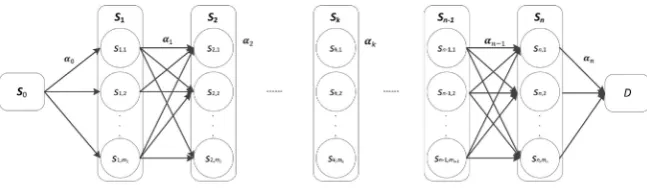
We assume that an application task Φ is presented by a sequence of cro-service sets with a linear topology. Each micro-service set consists of cro-services which can be executed in parallel. Figure 1 illustrates the mi-cro-service task model in a grid topology. S0 and D are the initiator and
destina-tion of the applicadestina-tion task, respectively. There are n sequentially executed mi-cro-service sets {S1, S2, ∙∙∙, Sn} in the task, which can be modeled as a Poisson
process. We denote the output of Si as αi for i = 1, 2, ∙∙∙, n. And α0 is the
in-put initialized by the initiator S0. Each set Si (0 < i ≤ n) is consist of mi
indepen-dent micro services {si j, | 0< ≤i n,0< ≤j mi} which are executed in parallel.
Specially, {wi j, | 0< ≤i n,0< ≤j mi} is the computing workload of the jth
mi-cro service in the mimi-cro-service set Si. However, micro-service set Si (0 < i ≤ n) is
executed based on the output of previous set Si−1 (0 < i ≤ n). Hence, notice that i
α (0 ≤ i ≤ n) is a non-zero matrix. Generally, there are three kinds of
edge-cloud collaborative policy: local execution, partial offload and all offload. Hence, ξ is defined as the ratio of micro-service set that offloaded to MEC platform.
2) Execution Model
In this paper, we focus on the collaborative task execution between MEC and cloud. Specially, each micro service in the grid topology can be executed on the local MEC platform or offload to the cloud. In this configuration, we establish atomic modules involved during the collaboration between MEC and cloud.
MEC execution. If the jth micro service in the micro-service set Si (0 < i ≤ n) is
[image:3.595.211.535.617.711.2]executed on the MEC platform, the completion time is given by
DOI: 10.4236/jcc.2019.710009 97 Journal of Computer and Communications
( )
( )
1MEC
ij ij MEC
t ξ =l ξ ∗f− (1)
and the energy consumption of MEC platform is given by
( )
( )
3MEC MEC MEC
ij ij MEC ij ij MEC
e =t ξ ∗p =κ t ξ f (2) where fMEC is the computation power function related with CPU frequency,
ij
κ is a constant related to the hardware architecture, and pMEC is the energy
consumption model proportional to 3
MEC
f . Therefore, the completion time of MEC platform for micro-service Si (0 < i ≤ n) with mi micro services executed in
parallel is given by
( )
max{( )
1 | [1, ] Z}MEC
i ij MEC i
t ξ = l ξ ∗f− j m ∩ (3)
Edge-cloud transmission. MEC transmits necessary input αi for
mi-cro-service set Si+1 when its buffer is full. The transmission bandwidth for MEC
is defined as a constant B. LEC is the transmission distance from MEC to cloud.
Generally, the typical transmission delay of backhaul is a constant related with distance, e.g. 5us per kilometer. Then the loop transmission delay of output data
i
α (0 ≤ i ≤ n) between MEC and cloud is given by
( )
2 0 /EC
i EC i
t ξ = ∗ ∗t L ∗α B (4) where t0 is the transmission delay per kilometer and B is the transmission rate of
backhaul between MEC and central cloud.
The energy consumption of output data αi (0 ≤ i ≤ n) transmission between
MEC and cloud is given by
( )
t i i t
e t= ξ ∗p (5)
where t i
t is the transmission delay to MEC or central cloud, pt is the energy
consumption function with fixed parameter during the computation.
Cloud execution. Similarly, if the jth micro service in the micro-service set Si−1
(0 < i ≤ n) is executed on the cloud, the completion time is given by
( )
( )
1C
ij ij C
t ξ =l ξ ∗f− (6)
and the energy consumption of cloud is given by
( )
( )
( )
3MEC MEC MEC
ij ij MEC ij ij MEC
e ξ =t ξ ∗p =κ t ξ f (7) where fC is the computation power function related with central CPU
fre-quency, κij is a constant related to the hardware architecture, and pC is the
energy consumption model proportional to 3
C
f . Generally, cloud is more po-werful and efficient than MEC with higher fC. Therefore, the completion time
of cloud for micro-service Si (0 < i ≤ n) with mi micro services executed in
paral-lel is given by
( )
max{( )
1| [1, ] Z}C
i ij C i
t ξ = l ξ ∗f− j m ∩ (8)
3) Markov Process
re-DOI: 10.4236/jcc.2019.710009 98 Journal of Computer and Communications
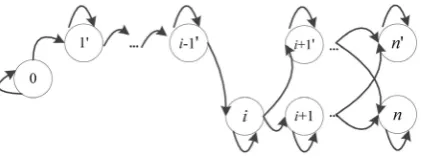
spectively. Node i represents that the ith micro-service set Si is executed on MEC
platform and node i’ represents that the ith micro-service set Si is executed on
[image:5.595.269.480.630.709.2]cloud. We can find that |V| = 2n + 2 and |A| = 4n. However, cloud can complete the micro-service sets in advance without prior information from the output of MEC. Hence, the application task collaborated between MEC and cloud can be divided into two parts, as shown in Figure 3. The previous i − 1 nodes on cloud are independent from special MEC platform service. Hence, non-time limited and services independent task can be executed on cloud previously, such as pre-configuration and model training in machine leaning. The collaborative task execution between and cloud model is modified as the latter part, from node i + 1 or i + 1’ to node n or n’ in Figure 3. Hence, the number of nodes |V| and arcs |A| can be modified as |V| = 2n − i + 2 and |A| = 4n − 3i.
State (i, j) represents the state where the current number of requests at MEC is i and at cloud is j. Let pij be the stationary probability of state (i, j).
Unlike cloud, computing and cache resource are limited at MEC. The subse-quence service has to be transmitted to the cloud if its request buffer is full. Hence, the micro-service sets executed on the MEC platform can be expressed as a modified M/M/c/K queue with cache capacity K1. And the arrival rate λ1 and
the response completion time obey negative exponential distribution with para-meter as μ1.
( )
( )
( )
1ξ tMEC 1 tE
µ
ξ ξ
=
+
(9)
where
[ ]
is the average operator.Then, the micro-service sets executed on cloud can be modeled as a modified M/M/c/K queue with cache capacity K2. And the arrival rate λ2 and the response
completion time obeys negative exponential distribution with parameter as μ2.
( )
( )
( )
2 tC 1tEC
µ ξ
ξ ξ
=
+
(10)
Figure 2. Markov model of edge-cloud collaboration.
DOI: 10.4236/jcc.2019.710009 99 Journal of Computer and Communications
3. Characterization of Optimal Solution to Task Scheduling
Policy
The arc of the adjacent modes, i and j, is associated with the nonnegative delay ti,j
for a corresponding service. Under this framework, we can transform the edge-cloud collaborative scheduling problem to the shortest distance route problem between node i and D, subject to the constraint that the expected com-pletion time of that path should be less than or equal to the energy ceiling. A path p is feasible if the expected energy consumption satisfies the energy con-straint. A feasible path p* with the minimum time delay is the optimal solution among all the feasible paths. Mathematically, it can be formulated as a con-strained shortest path problem,
( )
( ), ,( )
minp∈T ξ =
∑
i j p∈ ti j ξ (11)s.t.
( )
( )i j p, ∈ ei j, ξ Emax ≤
∑
(12)
1 1 1
n n ij i= j= p =
∑ ∑
(13)0, ,
ij
p > ∀i j (14)
0≤ ≤ξ 1 (15) where is the set of all possible paths from node i to D and Emax is the
max-imal energy consumption of the entire application. Since each micro service can be executed by offloading to MEC or on cloud, there are 2n-i possible options for
the solution. This constrained optimization problem is shown to be NP-complete. Based on the optimality of the one-climb policy, the minimal delay optimal ex-ecution only migrates once from MEC to the cloud after node i. Then, we design an efficient algorithm for task scheduling. We can enumerate all the paths under the one-climb policy rather than all the 2n-i paths [20]. We define ′ as the set
of all the paths under one-climb policy. There are
(
(
n i− +1)(
n i−)
/ 2 1)
+paths in ′, thus the optimal solution is available by reformulating T into a
se-ries of linear programming problems with non-convex T.
The probability flows from the previous level to the current level are captured by the matrix A0 with fixed ξ, for queue length from 0 to K1, and by the
ma-trix A0 = −λξI for the other levels. 0 = −λξ
A I (16) where I is the identity matrix. The queue length keeps the same with expression
1
* 2
*
1 2
*
( 1) 0 0
( 1) 0
0 0
0 0 0
µ λ ξ λ
µ µ λ ξ λ µ µ λξ
µ λ
+ −
− + −
= − +
+
A
(17)
DOI: 10.4236/jcc.2019.710009 100 Journal of Computer and Communications * 2 * 2 * 1
( 1) 0 0
( 1) 0
0 0
0 0 0
λ ξ λ
µ µ λ ξ λ µ µ λ
µ λ − − + − ′ = − + + A (18) 1 * 2 * * 1 2 * 0 0 0 0 0
0 0 0
µ λ λ
µ µ λ λ µ µ λ
µ + − − + − = − + A (19)
where A1′ and A1* are matrix for state (0, 0) and (K, K).
Finally, the matrix from the next state to the current state is given by
1 * 2 * 2 2 *
0 0 0
0 0
0 0
0 0 0
µ µ µ µ µ µ − − = − − A (20)
Then the average delay are given by
( )
1(
)
(
)
2 2 1 1, 1 1 1 1 2 1 1
minp minp K Kj 1 ij Kj 1 K j
i i p j p
ξ
µ = µ = −
∈ ∈ = = + + +
∑
∑
∑
T s.t. ( ), ,( )
1 1 1 0, , 0 1i j max i j p
n n ij j i ij e E p
p i j
ξ ξ ∈ = = ≤ =
> ∀
≤ ≤
∑
∑
∑
(21)Searching space of the one-climb policy is much smaller than that of the brute-force search. Detailed procedures for solving minimal delay T are summa-rized as follows.
One-dimensional search algorithm
set ξ=0, and Φ as a sufficiently large integer for ϕ=0: 1: Φ do
(T,E) = Shortest Path (S0, D, t, ξ)
//solve the shortest path in terms of delay with a fixed ξ
if E ≤ Emax
return T
else
update the offload rate ξ as ξ+1/ Φ
end
DOI: 10.4236/jcc.2019.710009 101 Journal of Computer and Communications
4. Performance Evaluation
In this section, we evaluated the performance of the proposed edge-cloud colla-borative task scheduling scheme with independent task scheduling scheme. In this simulation, it is assumed that the input data packet obeys Poisson process. Compared with the independent scheme, the workload ratio ξ is adaptive to
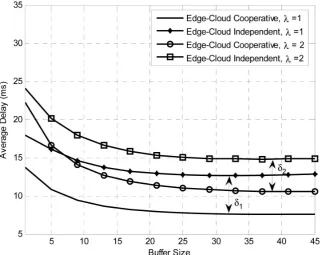
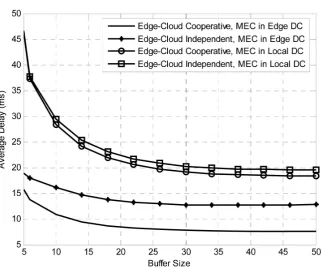
[image:8.595.214.535.437.692.2]ob-tain the minimal delay. Figure 4 illustrated the average delay comparison of co-operative and independent schemes with ARQ (Automatic Repeat-Request). Generally, edge-cloud collaborative scheme performs better than the indepen-dent scheme. The average delay gap is reduced as the workload increases with higher task density λ and less buffer size. In heavy workload scenario, high blocking probability with intensive retransmission is the most significant factor in average delay. Hence, the heavy workload case is a resource limited case. There is no extremely obvious difference whether MEC is configured with high-er priority or not. Othhigh-erwise, high and inevitable transmission delay is a more critical factor in sparse task scenario. In this resource sufficient case, more task is executed at MEC platform until its buffer is full. Cooperative task scheduling obtains more performance gain than the independent scheme. Figure 5 illu-strated the average delay comparison between different task scheduling policies with MEC deployed in edge DC and local DC. Compared with execution delay, transmission delay is a more significant factor in edge-cloud collaborative task scheduling with MEC deployed in different DC. Hence, the average delay is in-creased extensively with MEC deployed on a higher layer, especially with insuf-ficient buffer size.
DOI: 10.4236/jcc.2019.710009 102 Journal of Computer and Communications Figure 5. Average delay comparison between different task scheduling policies with dif-ferent MEC deployment position.
5. Conclusions
In this paper we investigated the problem of how to reduce the average delay of MEC application by collaborative task scheduling. The collaborative task sche-duling is modeled as a constrained shortest path problem over a acyclic graph. By characterizing the optimal solution, the constrained optimization problem is simplified according to one-climb theory and enumeration algorithm. Generally, the edge-cloud collaborative task scheduling scheme performs better than inde-pendent scheme in reducing average delay. In heavy workload scenario, high blocking probability and retransmission delay at MEC is the key factor for aver-age delay. Hence, more task executed on central cloud with abundant resource is the optimal scheme. Otherwise, transmission delay is inevitable compared with execution delay. MEC configured with higher priority and deployed close to terminals obtain more performance gain.
For future work, we will consider various extensions of this work. First, more mathematical models of practical details in cloud computing are necessary to be considered in edge-cloud collaborative execution. Second, power saving on MEC and cloud platform is also important. In addition, the task workflow topology can be extended into more general modes.
Acknowledgements
Engi-DOI: 10.4236/jcc.2019.710009 103 Journal of Computer and Communications
neering Project of Ministry of Industry and Information Technology.
Funding
This work was support by Key R & D Program (Z91170GZX03011) grant from the Ministry of Science and Technology, Innovation and Development of Engi-neering Project of Ministry of Industry and Information Technology.
Conflicts of Interest
The authors declare no conflicts of interest regarding the publication of this pa-per.
References
[1] Cisco System (2019) Cosic Visual Networking Index: Global Mobile Data Traffic Forecast Update, 2017-2022 White Paper.
https://www.cisco.com/c/en/us/solutions/collateral/service-provider/visual-network ing-index-vni/white-paper-c11-738429.html
[2] Barbarossa, S., Sardellitti, S. and Di Lorenzo, P. (2014) Communicating While Computing: Distributed Mobile Cloud Computing over 5G Heterogeneous Net-works. IEEE Signal Processing Magazine, 31, 45-55.
https://doi.org/10.1109/msp.2014.2334709
[3] Hu, Y., Patel, M., Sabella, D., Sprecher, N. and Young, V. (2015) Mobile Edge Computing: A Key Technology towards 5G-First Edition.
[4] Markakis, E.K., Karras, K. and Sideris, A. (2017) Computing, Caching, and Com-munication at the Edge: the Cornerstone for Building a Versatile 5G Ecosystem.
IEEE Communications Magazine, 55, 152-157.
https://doi.org/10.1109/mcom.2017.1700105
[5] Khan, A.R., Othman, M., Madani, S.A. and Khan, S.U. (2014) A Survey of Mobile Cloud Computing Application Models. IEEE Communications Survey & Tutorials, 16, 393-413.https://doi.org/10.1109/surv.2013.062613.00160
[6] Mao, Y., You, C., Zhang, J., Huang, K. and Letaief, K.B. (2017) A Survey on Mobile Edge Computing: The Communication Perspective. IEEE Communications Surveys
& Tutorials, 19, 2322-2358.https://doi.org/10.1109/comst.2017.2745201
[7] Abbas, N., Zhang, Y. and Taherkordi, A. (2018) Mobile Edge Computing: A Survey.
IEEE Internet of Things Journal, 5, 450-465.
https://doi.org/10.1109/jiot.2017.2750180
[8] Mtibaa, A., Fahim, A., Harras, K.A. and Ammer, M.H. (2013) Towards Resource Sharing in Mobile Device Clouds: Power Balancing across Mobile Devices. ACM
SIGCOMM Workshop on Mobile Cloud Computing, 51-56.
https://doi.org/10.1145/2491266.2491276
[9] Kliazovich, D. and Granerlli, F. (2008) Distributed Protocol Stacks: A Framework for Balancing Interoperability and Optimization. IEEE International Conference on
Communications (ICC) Workshop, 241-245.https://doi.org/10.1109/iccw.2008.51
[10] Kosta, S., Aucinas, A., Hui, P., Mortier, R. and Zhang, X. (2012) ThinkAir: Dynamic Resource Allocation and Parallel Execution in the Cloud for Mobile Code Offload-ing. IEEE INFOCOM, 945-953.https://doi.org/10.1109/infcom.2012.6195845
DOI: 10.4236/jcc.2019.710009 104 Journal of Computer and Communications
Architecture, and Synthesis for Embedded Systems,238-246.
https://doi.org/10.1145/502251.502257
[12] Liu, J., Mao, Y., Zhang, J. and Letaief, K.B. (2016) Delay-Optimal Computation Task Scheduling for Mobile-Edge Computing Systems. 2016International
Sympo-sium on Information Theory, 1451-1455. https://doi.org/10.1109/isit.2016.7541539
[13] Liu, J., Bai, B., Zhang, J. and Letaief, K.B. (2017) Cache Placement in Fog-RANs: From Centralized to Distributed Algorithms. IEEE Transactions on Wireless
Communications, 16, 7039-7051.https://doi.org/10.1109/twc.2017.2737015
[14] Mao, Y., Zhang, J. and Letaief, K.B. (2016) Dynamic Computation Offloading for Mobile-Edge Computing with Energy Harvesting Devices. IEEE Journal on Selected
Areas in Communications, 34, 3590-3605.
https://doi.org/10.1109/jsac.2016.2611964
[15] Kamoun, M., Labidi, W. and Sarkiss, M. (2015) Joint Resource Allocation and of-floading Strategies in Cloud Enabled Cellular Networks. IEEE International
Confe-rence on Communications, 5529-5534.https://doi.org/10.1109/icc.2015.7249203
[16] Labidi, W., Sarkiss, M. and Kamoun, M. (2015) Joint Multi-User Resource Sche-duling and Computation Offloading in Small Cell Networks. 2015 IEEE 11th
Inter-national Conference on Wireless and Mobile Computing, Networking and
Com-munications, 1093-1098.https://doi.org/10.1109/wimob.2015.7348043
[17] You, C. and Huang, K. (2016) Multiuser Resource Allcoation for Mobile-Edge Computational Offlaoding. 2016 IEEE Global Communications Conference, 1-6. https://doi.org/10.1109/glocom.2016.7842016
[18] Liang, Z., Liut, Y., Lok, T. and Huang, K. (2019) I/O Interference Aware Multiuser Computation Offloading for Virtualized Edge Computing. 2019 IEEE International
Conference on Communications, 1-30. https://doi.org/10.1109/icc.2019.8762042
[19] Munoz, O., Pascual-Iserte, A. and Vidal, J. (2015) Optimization of Radio and Computational Resources for Energy Efficiency in Latency-Constrained Application Offloading. IEEE Transactions on Vehicular Technology, 64, 4738-4755.
https://doi.org/10.1109/tvt.2014.2372852
[20] Zhang, W., Wen, Y. and Wu, D.O. (2013) Energy-Efficient Scheduling Policy for Collaborative Execution in Mobile Cloud Computing. IEEE INFOCOM, 190-194. https://doi.org/10.1109/infcom.2013.6566761
[21] Beraldi, R., Mtibaa, A. and Alnuweiri, H. (2017) Cooperative Load Balancing Scheme for Edge Computing Resources. 2017 2ndInternational Conference on Fog