Project Sanitarium: Gaming TB
A serious game for a serious problem
Dr. Iain Donald, Dr. Karen Meyer, Mr John Brengman
School of Arts, Media and Computer GamesAbertay University Dundee, UK
[email protected], [email protected], [email protected]
Professor Stephen Gillespie, Dr. Ruth Bowness
School of MedicineUniversity of St Andrews St. Andrews, Fife
[email protected], [email protected]
Abstract— Collaborative projects between Industry and Academia provide excellent opportunities for learning. Throughout the academic year 2014-2015 undergraduates from the School of Arts, Media and Computer Games at Abertay University worked with academics from the Infection Group at the University of St Andrews and industry partners Microsoft and DeltaDNA. The result was a serious game prototype that utilized game design techniques and technology to demystify and educate players about the diagnosis and treatment of one of the world’s oldest and deadliest diseases, Tuberculosis (TB). Project Sanitarium is a game incorporating a mathematical model that is based on data from real-world drug trials. This paper discusses the project design and development, demonstrating how the project builds on the successful collaborative pedagogical model developed by academic staff at Abertay University. The aim of the model is to provide undergraduates with workplace simulation, wider industry collaboration and access to academic expertise to solve challenging and complex problems.
Keywords—games with purpose; games for change; serious games; games education; educational games
I. INTRODUCTION
Project Sanitarium is a game created by undergraduate students at Abertay University in Dundee, Scotland. It is a ‘serious game’ designed to use real world medical data regarding the treatment of Tuberculosis (TB) and combine it with proven game mechanics to deliver a simulation that could entertain players, mimic clinical trials and provide a powerful tool for increasing awareness of one of the world’s oldest diseases. The project was the result of the successful collaboration of Abertay’s School of Arts Media and Computer Games pedagogical model for workplace simulation, the medical expertise of the University of St Andrews Infection Group and the technical integration of Microsoft’s Windows 8 platform, Azure technologies and DeltaDNA’s games analytics platform.
Historically TB has been one of the world’s most deadly diseases. Today it is second only to HIV/AIDS as the greatest killer worldwide due to a single infectious agent, and patients have the same chance of surviving Ebola without treatment as surviving TB with treatment. [1][2] Whilst considerable progress has been made in treating the disease there remains much that still needs to be researched and understood. In recent
years drug resistance has become a particular concern. It was building on the clinical research of Professor Stephen Gillespie of the University of St Andrews that the opportunity for the project came about. Prof. Gillespie and the Infection Group were keen to develop a simple visual tool to present data from clinical trials. In August 2014 a creative brief was developed with the aim to create a game that would:
• Mimic the disease developing in a person • Mimic how treatment might cure the disease • Explore how new treatments might work in the future Key to the brief was the need to visually simplify the multiple complex parameters for people developing new treatments for the disease, and to take what is known and present it in a way that could engage players in order to help them understand more about how treatment works.
The brief identified several possible audiences for the game and considered the commercial success of games such as
Pandemic 2 and Plague, Inc. as examples of people’s
fascination with disease in a gaming context. The main audiences for the game were identified as:
• Biology, health sciences and medical students • Global health and development advocates • TB Drug developers
• Anyone who wants to understand more about the world’s oldest disease
II. BACKGROUND
A. Project Context
Tuberculosis is a disease that kills 1.5 million people each year or more than one person every 20 seconds. [3] Widely ignored by the mainstream media the global threat of TB has been growing, fuelled by global poverty, the AIDS epidemic, and drug resistance. Currently, the recommended treatment therapy for TB lasts for 6 months, and many patients cannot complete the treatment because of toxicity. Put simply, there is a need for faster-acting tools to treat TB in all forms, wherever it may strike around the world. A shorter, less toxic regimen would enable more patients to complete the therapy while also reducing the risk of drug resistance occurring.
New treatments are currently tested in lengthy and expensive clinical trials, but a mathematical model enables researchers to test the effects of varying parameters (including those associated with drug efficacy) and explore ‘virtual clinical trials’, more cheaply. The team at the University of St Andrews used results from a series of global clinical trials to develop a mathematical model for the treatment of tuberculosis; however there remained an issue in being able to display complex research and data to a wide variety of researchers, academics, funding bodies and medical professionals. [4][5][6] The result was the collaborative project with Abertay University to help demonstrate the power of the mathematical model whilst maintaining an accurate yet engaging tool for visualizing the model.
B. The AMG Abertay Model
An inter-disciplinary approach has always been at the core of teaching game development at Abertay University. The School of Arts, Media and Computer Games (AMG) has successfully developed a pedagogical model based around Etienne Wenger’s Communities of Practice and integrated it with the team based and collaborative models widely used throughout the creative industries. [7] The pedagogical model is now core for the curriculum in all the School’s undergraduate programs and is centered upon placing all third-year AMG undergraduates into small inter-disciplinary teams to work on an industry and client led creative brief. Each year approximately 20-25 student led teams take on board briefs that challenge them to develop a prototype that can be professionally presented at the end of the academic year. Over the years clients have ranged from large multinational corporations to small indie game developers, with almost every conceivable combination in between.
C. The Project Brief
For the Academic Year 2014-15 the students were given the choice of over 20 clients and 30 different briefs. Two of the clients were Microsoft and the Infection Group at the University of St Andrews. Microsoft set a number of very open briefs that encouraged the use and development of their technology, including the Kinect Version 2, the Windows 8 Phone ecosystem and Azure, Microsoft’s cloud platform. The Infection Group had more specific aims and were looking for a team to help them visualize the data from recent clinical trials in a more engaging and entertaining way. [8] One student team
proposed combining several briefs to create a game that would focus around the Infection Group creative challenge and examine the treatment of Tuberculosis. This was done by utilizing the Microsoft systems for the Windows 8 Phone and harnessing Azure to handle the data.
D. The Project Team
The Team consisted of 10 undergraduates split into the roles of Producer, Game Designer, 3 Programmers, 3 Artists and 2 Audio Engineers. These directly reflected the makeup of Abertay’s undergraduate programs with participants from the following degree courses [9]:
• BSc (Hons) Computer Games Technology • BSc (Hons) Computer Game Applications
Development
• BA (Hons) Computer Arts
• BA (Hons) Creative Sound Production
• BA (Hons) Game Design & Production Management • BA (Hons) Visual Communication & Media Design The team were assisted by their module tutors, Dr. Iain Donald and Dr. Robin Sloan, and assigned an academic mentor, Dr. Karen Meyer, to assist with the mathematical modelling. The team also had feedback at regular interviews from both Microsoft and the University of St Andrews Infection Group.
E. Project Structure
Although the module is core for all undergraduate programs it only accounts for a quarter of each student’s academic workload. In total the number of hours equates to each person working full-time for approximately 6 weeks. Given the time constraints and the additional complications of working in a University environment (no dedicated PC’s or workspace, a flat team hierarchy, difficulty in bringing in additional resources and the restrictiveness of the University calendar) the team resolved to work with a hybrid Waterfall and Agile model. This balanced model was chosen to best deliver features within the confines of the University two-semester structure. [10] The approach allowed the team the benefits of a structured system to communicate with the clients directly, and create identifiable milestones for the clients, and themselves. However it also allowed the space to respond to feedback, via iterative ‘sprints’ in order to fine-tune the game and make any adjustments as needed within the game development process. From the outset the team resolved that they were creating a serious game using serious technology and that delivery to different clients across industry and academia required clear, strong models for planning and delivery. The project plan developed into two distinct phases that aligned with the University semesters.
tested for fun and value. The milestones were broken down as follows:
• M1: Analyzing the problem • M2: Organizing the Plan • M3: Creating the Design • M4: Paper Prototyping • M5: First Coded Prototypes • M6: First Play Test
The team worked towards the goals on the basis that there would be indicative feedback that could be iterated on, rather than major changes. The team would then move on to a more agile approach for semester two, with a clear focus on iterative weekly sprints and milestones:
• M7: Game Framework
• M8: Digital Wireframe Prototype • M9: Three Mini-games
• M10: Create Game Trailer
• M11: Core Game Loop Using Mathematical Model • M12: Integrating Azure Cloud Features
• M13: Integrating Live Tiles and Push Notifications • M14: Integrating Analytics
• M15: Play Testing and Bug fixes
The goal of the weekly sprints was to motivate the team and demonstrate progress, while the milestones had the overall aim of having that development component or segment fully completed and testable.
III. RESEARCH&DESIGN
The project had several creative and technical challenges, and from the outset required the students and academics to move into areas that they were not familiar with. Each team member helped to research the overall project area but generally focused on their specific disciplines. The key areas for research were examining tuberculosis, other serious games, understanding the mathematical model, examining core gameplay concepts and defining a clear game aesthetic, visually and aurally.
A. Tuberculosis Research
The team came to the project without any in-depth knowledge and had to learn as much as was possible about the history, diagnosis and treatment of Tuberculosis as was feasible in order to inform the game design. The wealth of material available ensured that the team read medical journals, press articles and documents from various sources to inform themselves. For clear and concise understanding the United Kingdom’s National Health Service website provided the basic knowledge in direct language. [11] Two other articles emerged as core for the team to utilize. The first of these was the paper published by the Clinical Trial team in the New England
Journal of Medicine, which discussed a recent 4-month drug
trial treatment regimen. [12] The second was a study on using games to combat Tuberculosis published in the International
Journal of Science and Research. [13] For students of games
and the creative industries the material is quite a departure from the usual research. Moving onto more familiar territory the team researched a number of key games.
B. Game Research
The initial research, beyond understanding the work from the University of St Andrews and Microsoft technology, was to examine other games that the team decided would be similar either in genre or problem-solving. Specifically they examined games that dealt with health and disease, such as Foldit,
Fraxinus, Play to Cure: Genes in Space, Pandemic 2, Plague
Inc. These were each played and analyzed in order to inform the design ideas and the user experience.
• Foldit is a game that sees the player folding protein
strings to try and predict the best possible structure for them. Using this information new protein chains can be designed in an effort to combat diseases and potentially even cure them. Created by various departments and labs from the University of Washington, the game is one of the first examples of crowdsourcing scientific solutions through gaming. The key is in using the player base for their intuitive, 3D-puzzle solving skill that computers simply cannot match. [14]
• Fraxinus is a game made to combat a specific species of
fungus that was causing Ash Die Back in ash trees across Europe. By creating and matching patterns the player uses real genetic data to try and find why some trees are immune to this fungus. Fraxinus demonstrated that it was possible to make a fun, entertaining game based on real scientific data. In particular the gene matching puzzle showed that complex data could be presented in simple form and gameplay. [15]
• Play to Cure: Genes in Space was funded by Cancer
Research UK and in a similar vein uses the collective force of players to analyze real genetic data. Ostensibly the game sees the player piloting a spaceship in order to collect Element Alpha. Underneath the surface the game finds the optimal route to pick up the most Element Alpha, and in doing so plots a course through genuine ‘DNA microarray’ data. Crunching the data helps scientists identify the DNA faults that could lead to cancer. [16]
• Pandemic 2 and Plague Inc. are very similar games that
various parameters coming into effect based on local conditions. [17][18]
Each game brought insights into design approaches and the challenge that the team faced in particular with ensuring that the game did not detract from the underlying mathematical model.
C. Mathematical Modelling
The core element of making the game a ‘serious game’ was the interpretation and integration of the mathematical model for the treatment of tuberculosis (TB) that was developed by Dr. Ruth Bowness and Professor Stephen Gillespie from the University of St Andrews.
The team at the University of St Andrews used results from a series of clinical trials to develop the model. Half of the data were used to constrain the parameters within the model. The other half were used to test the model’s results and demonstrate its accuracy. The mathematical model is built into the game to determine a patient’s outcome based on the player’s choices and performance within mini-games.
The model assumes that two biologically different populations of Mycobacterium Tuberculosis exist within a patient, which they designate “active” and “dormant”, and that the bacteria may transfer between states. A pair of coupled first-order ordinary differential equations defines the evolution of these populations. The differential equation that describes the active cells contains a growth term, which represents the replication rate of the actively multiplying bacteria, a lethality rate that captures the drug effect on the bacterial population, and transfer parameters to allow transfer between populations. The differential equation describing the dormant cells equivalently has a lethality rate and transfer parameters, but here there is no replication rate as negligible growth is assumed in this population. Parameter values in the model are based on previous literature, laboratory experiments and available clinical trial data. It was the parameters that make up these equations that the Abertay team used to influence the game design. The equations themselves are soon to be published in a medical journal and hence are not displayed here.
The mathematical model allows different parameters to be altered by TB researchers in order to simulate different future treatments. The game design was required to consider these parameters in order to ensure gameplay affected the model. This included values such as the variation in the number of active/dormant bacteria and the calculated total. Other parameters such as the growth rate of the active population of bacteria, the assumed transfer rates of the bacteria from dormant to active and vice versa, and the death rates of the active and dormant bacteria, were considered for design input. The challenge for the Abertay team was in designing a game that would fit with this mathematical model, and could be used to impact upon the gameplay without taking liberties with the accuracy of the model. To that end the mathematical model strongly influenced the decision to focus on mini-games for the gameplay and frame these with an overarching story for the overall design. The team was fortunate enough to have an academic mentor experienced with the model, Dr. Karen Meyer, based at Abertay University. This enabled the team to
iterate on the mini-game design quickly and effectively to ensure that the model was accurately replicated within the gameplay.
D. Game Aesthetics
While the design was being developed, the art and audio team members focused on exploring the aesthetics. The artists began by examining medical imaging to get an understanding of the colors that are used in medical applications and to help get a feel for the overall visual style, before expanding their research to include games that utilize color well. This was much broader than the serious games studied to influence the game design and varied from the DICE’s Mirrors Edge which uses colors to guide the player through the level, through to the Indie hit Papers Please for how information is displayed. [19][20] Initial User Interface Designs were influenced by the clean design of Deus Ex. [21] That futuristic feel was further enhanced by research into cinematic blockbusters such as Iron Man to the new Star Trek reboots. [22][23] The research was met with success and the initial mock-ups created as exploratory designs became the foundation of the look of the game. The audio team worked alongside the art team to ensure that the futuristic feel was delivered consistently through the content, deciding upon a clean electronic ambient soundtrack. The audio was also influenced by Hollywood: Iron Man,
Gravity and Interstellar each encouraged the creation of music
that would match the pace of the gameplay without overwhelming or creating audio fatigue in the player. [24][25] However it was the vision to bring in professional voice-over talent, Tara Platt, which helped to establish a clear audio identity. [26] The steady pacing and clear scripting took the early prototypes to a different level and can be identified as the point that people started to take notice of the game.
IV. GAMEDEVELOPMENT
The initial ideas were developed through mock-ups and rough prototypes. These were then presented to the clients via a series of meetings and presentations. The level of engagement with the clients led to considerably better feedback and stronger iteration on the core game. Each discipline was involved in the process and the ability of team members to identify issues, problem-solve and re-iterate on all aspects was key to developing a strong prototype.
A. Design Overview
Fig. 1 Main Game Loop
Ostensibly the player takes on the role of a medical doctor throughout their career, from graduating medical school through to retirement. As a doctor the player navigates a variety of mini-games each, asking them to help in the diagnosis and treatment of patients. The more successful the player is, the more complex cases they get to diagnose and treat. The further the player advances, the more they travel to hotspots throughout the world, thereby encountering different parameters and different underlying variables. The player needs to take into consideration the patient history, such as the possibility of the patient being HIV positive, whether they smoke, drink, are overweight, or conversely suffer malnutrition. If the patient is uneducated, then there is a risk that they could stop treatments at the first sign of feeling better, thinking they are cured. This could result in relapse. The game also considers the economic difficulty the patients face in receiving treatment because they don't have the resources to be properly cared for. From a design perspective, having multiple parameters ensured that the game that evolved had depth, but it was often harrowing to realize that these were not fictional or fantastical situations. These were real scenarios faced by medical professionals throughout the world.
The recognition of the number of varying parameters and the importance of understanding how players would react to these led the team to incorporate game analytics software, provided by DeltaDNA. The inclusion of analytics enabled the team to playtest more effectively but added an additional technical challenge to what could have been a complex technology setup. However, the team found that focusing on a single technology ecosystem, provided by Microsoft’s Windows 8 platform, enabled iteration to be quick and effective. The design of the main game loop then effectively hid much of the underlying complexity from the player.
B. Main Game Loop
The core of the game centers round the player looping through four event screens: Doctor, World Map, Patient and Diagnosis/Treatment. See Fig 1.
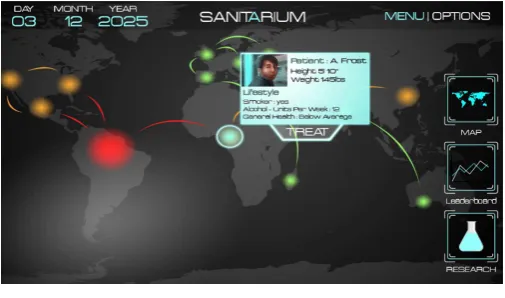
The Doctor screen provides all the player-specific information regarding their status within the game world. This includes personal and medical information, plus game events that may impact upon player actions. From there the player can decide to enter either the World Map or the Patient screens. In the World Map, various cases or geographical hotspots can be selected. On selecting a location, the player is presented with patient information and can make the decision to treat the patient or return to the map if they don’t feel confident about that particular case. Underneath the surface of this the game uses the mathematical model to determine a patients’ profile (weight, smoker, non-smoker, geography, etc.).
Fig. 2 In-game screenshots of the World Map screen
[image:5.595.306.559.425.574.2]scenarios and outcomes. Most importantly, difficulty will be altered based upon the player’s success each time around.
C. Mini-Games
[image:6.595.307.560.52.211.2]In the game world, the procedures of patient diagnosis and treatment are represented and implemented as mini-games, each representing a diagnosis test and a corresponding treatment. The outcome of playing each determines the condition of the patient and the possible result of their treatment. All of the mini-games factor into the final score for each patient, and whether the player is able to cure them. The design aim here was to provide a quasi-realistic game environment for the player and to provide some gameplay variety. The prototype developed an initial three mini-games, with the intention of expanding this if the project went forward. For the purposes of the prototype development, the mini-game design represents a simplified three-step process in diagnosis and treatment (the first step being a smear test, the second, an X-ray, and third the prescription of some form of drug treatment). The intention was to provide these initial games at a high level of polish and to add more mini-games if time and resources allowed.
Fig. 3. Mini-Game 1: Petri Dish
The first mini-game developed represented a Petri dish, where the player is required to identify and kill TB bacilli (See Fig. 3). The initial total number of bacteria is determined based on a player’s performance in the Petri dish mini-game: a poorer performance in the game results in the patient being infected with TB for longer before detection, and hence a higher initial number of bacteria.
In the mini-game the player is presented with a petri dish with various cells around the scene. They then rotate around the petri dish and count bacteria by shooting them within a specific time frame. This represents a sputum test where a doctor will take a saliva swab then count the bacteria from the swab in the petri dish. The design also identified that there are 'good bacteria' and for every good bacteria the player hits they lose one second on the timer. It builds upon a game mechanic that combined arcade classics such Whac-A-Mole and Space
Invaders before evolving through play testing to the current
version. [27] The player’s final score is then used to determine how long it has taken to detect TB within the patient's body, and hence the initial number of bacteria.
Fig. 4. Mini-Game 2: X-ray
[image:6.595.36.289.304.463.2]The second diagnosis mini-game is the X-ray game, and proved challenging due to the difficulty in accurately representing real-world diagnosis. The aim of this was to get the player to identify problems within the patient’s lung. They are presented with the lungs in the form of an X-ray scan (see Fig. 4). The player has a limited number of guesses within a defined time frame to spot and identify the cavities within the lung X-ray. Although simplistic, the game is fundamentally more realistic and educational than the other mini-games. Reading X-rays is challenging and requires considerable training for clinical staff. The design of the game is based on real software called OsiriX, which medical professionals use to examine X-rays. [28] This allows the player to adjust the brightness and contrast of the image to facilitate the identification of cavities. The results again feed back into the underlying mathematical model and change the patients’ status based on their final score: the better the player performs within the game, the easier treatment becomes.
Fig. 5 Mini-Game 3: Treatment Game
[image:6.595.306.560.418.574.2]balls are used to destroy the corresponding colored blocks. The mini-game score is determined by how many blocks the player destroys and how many are left intact. Various iterations were designed, developed and play tested. The core game play always focused on the player keeping the ball as centered on the infected area as possible. Multiple restart and power-up opportunities are provided, and again player success has a direct impact upon the virtual patient’s health. Essentially success in the mini-games increases the chances of progression in the overall game. Although not implemented for the prototype, each successful treatment results in additional time and monetary resource. Effective management of the resources and making difficult moral decisions then affect the overall game progression.
V. OUTREACH
The criteria for this project to be judged a success were multi-faceted. From the client perspective of the University of St Andrews’ Infection Group, success was delivering a game about treating tuberculosis that is engaging and entertaining whilst remaining true (in regard to point of infection, diagnosis, treatment, possible cure, death or relapse) and that incorporated the mathematical model where input variables can be plugged in and modeled with appropriate results. For Microsoft and DeltaDNA it was the technical ease that their platforms can be developed for. For the Abertay students and staff the initial goal of a successful workplace simulation and a completed prototype grew more ambitious as the project developed.
A. TB Awareness
One of the key goals of the team was to increase awareness that the fight against TB remains constant. To that end, through contacts from the University of St Andrews, the team began building connections with organizations such as the TB Alliance. There remains much to be done in providing a fully functioning game and in developing the message about TB awareness through gaming. However the initial prototype and trailer demonstrate the potential that the game has for increasing awareness. Reflecting the commercial reality of Game Development, the team found that they were not alone in trying to achieve this and that they were not first to market, with the release of a similar game on World Tuberculosis Day, 24 March 2015. Tuberspot is a serious game developed by researchers at the Polytechnic University of Madrid. [30] Although different in many aspects it naturally has some cross-over, for example in Tuberspot, players help analyze real digitized sputum samples and it too has a vision to develop for the mobile platform. Specifically Tuberspot is looking to develop a microscopy system on a mobile phone to allow telediagnosis. The fact that other researchers are looking at similar game developments is healthy both for TB awareness and the use of serious games. The games remain significantly different and one of the next goals will be to explore potential collaborations.
B. Game Competitions
As the project progressed and was met with enthusiasm from those viewing the project and engaging with the game, suitable games contests were identified to enter the prototype
into, such as Microsoft’s Imagine Cup and the Serious Play Awards. The completed prototype earned the team a place in the UK Finals of the Imagine Cup. It seemed the perfect fit, as Project Sanitarium was a prototype that encompassed all three categories – Games, World Citizenship (Social Impact) and Innovation. In the end the team entered through the Games category and although they did not win, they learned new skills in regard to pitching a ‘Serious Game’ in an entrepreneurial setting and realizing how their message could be heard through all the noise that is produced in this age of information. It was the recognition of the social impact that gaming can have that remains one of the teams’ most interesting challenges and as the development has come to a natural hiatus, they have looked to ensure that the message and recognition that TB remains one of the world’s most deadly diseases remains in the forefront of their work. The prototype has since won a Gold award at the 2015 International Serious Play Awards, a fantastic achievement. [31]
VI. CONCLUSION
Project Sanitarium demonstrates the potential that serious games can deliver for an undergraduate level, without specific project funding. For the undergraduate team to take on the challenges of developing and delivering a game that addresses the fundamental aspects of diagnosing and treating tuberculosis in the modern day, whilst remaining true to an underlying mathematical model, and still provide an experience entertaining enough to secure a place in the UK finals of the Imagine Cup and win Gold in the Serious Play Awards is a success for all of the team to be proud of. The project further demonstrates that serious games research and development provide unparalleled opportunities for student learning. Taking students outside of their comfort zone in terms of games-subject matter but still providing the experience of commercial game development and working with industry and academic clients of the caliber of Microsoft and the University of St Andrews will hopefully bode well for their careers. For the clients, Microsoft has a great example of their strong technical ecosystem and a team that is roundly convinced of how easy the system can be utilized. The University of St Andrews Infection Group has a playable, functioning and professional prototype to demonstrate the potential of mathematical model. In project terms, Project Sanitarium moves forward to its next challenge, one that resonates with both academia and industry, and that is to secure funding for further development.
ACKNOWLEDGMENT
The authors would like to thank the Abertay students, Microsoft UK’s Technical Evangelist Lee Stott, Chris Wright and the team at DeltaDNA, and the entire Infection Group at the University of St Andrews for all their help and support in making the project possible.
REFERENCES
[2] M. Wang and R. Oshi, “Working Paper: Benefits and Costs of the Tuberculosis Targets for the Post-2015 Development Agenda,” (2014). [online] Copenhagen Consensus Center, Available:
http://www.copenhagenconsensus.com/sites/default/files/health_viewpoi nt_tb_-_wang.pdf (Accessed March 30th 2015).
[3] TB Alliance, “Our Mission” (no date). [online] Available: http://www.tballiance.org/about/mission.php (Accessed March 30th 2015).
[4] S.H. Gillespie SH, R. D. Gosling, and B. M. Charalambous, “A reiterative method for calculating the early bactericidal activity of antituberculosis drugs.” American Journal of Respiratory and Critical Care Medicine, Vol. 166, No. 1 (2002) pp. 31–5.
[5] I. Honeyborne, T.D. McHugh, P. P. J. Phillips, et al. “Molecular Bacterial Load Assay, a Culture-Free Biomarker for Rapid and Accurate Quantification of Sputum Mycobacterium tuberculosis Bacillary Load during Treatment.” Journal of Clinical Microbiology Vol. 49 (2011) pp. 3905–11.
[6] S. H. Gillespie, A. M. Crook, T. D. McHugh, et al. “Four-month moxifloxacin-based regimens for drug-sensitive tuberculosis,” New England Journal of Medcine, Vol. 371 (2014) pp. 1577–87.
[7] E. Wenger, Communities of Practice: Learning, meaning, and identity. New York: Cambridge University Press. 1998.
[8] The Review on Antimicrobial Resistance. 2014. “Antimicrobial Resistance: Tackling a crisis for the health and wealth of nations,” [online] Available from:
http://www.jpiamr.eu/wp- content/uploads/2014/12/AMR-Review-Paper-Tackling-a-crisis-for-the-health-and-wealth-of-nations_1-2.pdf (Accessed 30th March 2015) [9] Abertay University. 2015. AMG Course List. [online] Available from:
http://www.abertay.ac.uk/studentlife/schools/amg/courses/ (Accessed 30th March 2015)
[10] B. Boehm and R. Turner, Balancing Agility and Discipline: A Guide for the Perplexed, Boston, MA: Addison-Wesley Longman Publishing Co., Inc. 2003.
[11] NHS, “Tuberculosis (TB),” (no date). [online] Available:
http://www.nhs.uk/Conditions/Tuberculosis/Pages/Introduction.aspx (Accessed March 30th 2015).
[12] S. H. Gillespie, A. M. Crook, T. D. McHugh, et al. “Four-month moxifloxacin-based regimens for drug-sensitive tuberculosis,” New England Journal of Medcine, Vol. 371 (2014) pp. 1577–87.
[13] A. Singh. “Games to Combat Tuberculosis,” International Journal of Science and Research, Vol. 3:1, January 2014, pp. 361-367
[14] Foldit: Solve Puzzles for Science, (no date). [online] Available: https://fold.it/portal/ (Accessed 30th March 2015)
[15] Team Cooper, “Fraxinus,” (no date). [online] Available:
http://teamcooper.co.uk/work/fraxinus/ (Accessed 30th March 2015)
[16] Guerrilla Tea, “Play to Cure,” (no date). [online] Available:
http://www.guerillatea.com/play-to-cure-genes-in-space/ (Accessed 30th March 2015)
[17] Dark Realm Studios, “Pandemic 2,” (no date). [online] Available: http://www.darkrealmstudios.com/ (Accessed 30th March 2015) [18] Ndemic Creations, “Plague Inc.,” (no date). [online] Available:
http://www.ndemiccreations.com/en/22-plague-inc (Accessed 30th March 2015)
[19] Deadendthrills, “Building the Impossible: The Art of Mirror’s Edge,” (no date). [online] Available: http://deadendthrills.com/building-the-impossible-mirrors-edge/ (Accessed 30th March 2015)
[20] First Person Scholar, “The Art of Papers, Please,” 23 October 2013. [online] Available: http://www.firstpersonscholar.com/the-art-of-papers-please/ (Accessed 30th March 2015)
[21] Behance.net, “Deus Ex Human Revolution - User Interface,” (no date). [online] Available: https://www.behance.net/gallery/2465641/Deus-Ex-Human-Revolution-User-Interface (Accessed 30th March 2015) [22] Pushing-Pixels.org, “At the intersection of the physical and digital –
interview with Michael Goldman,” 24 June 2014. [online] Available: http://www.pushing-pixels.org/2014/06/24/at-the-intersection-of-the-physical-and-digital-interview-with-michael-goldman.html (Accessed 30th March 2015)
[23] V. Frei, “Interview - Star Trek Into Darkness: Roger Guyett,” 27 June 2013. [online] Available: http://www.artofvfx.com/?p=4623 (Accessed 30th March 2015)
[24] C. Rosen, “Gravity' Composer Steven Price On The Film's Incredible Soundtrack” 4 October 2013. The Huffington Post. [online] Available:
http://www.huffingtonpost.com/2013/10/04/gravity-steven-price_n_4039455.html (Accessed 30th March 2015)
[25] B. Child, “Interstellar's sound 'right for an experimental film', says Nolan” 17 November 2014. The Guardian. [online] Available: http://www.theguardian.com/film/2014/nov/17/interstellar-sound-christopher-nolan (Accessed 30th March 2015)
[26] IMDb, “Tara Platt,” (no date). [online] Available:
http://www.imdb.com/name/nm1297428/ (Accessed 30th March 2015) [27] J. Sellers. Arcade Fever: The Fan’s Guide to thE golden Age of Video
Games. Philadelphia: Running Press, 2001.
[28] OsiriX, (no date). [online]. Available http://www.osirix-viewer.com/index.html (accessed 16th June 2015)
[29] S. Kent, Ultimate History of Video Games. New York: Three Rivers Press, 2001.
[30] Tuberspot, (no date). [online] Available http://tuberspot.org/en/ (Accessed 30th March 2015)
[31] 2015 Serious Play Awards, (no date). [online]. Available http://www.seriousplayconference.com/awards/ (Accessed 29th June