Original Article
Abnormal quantity and function of Th17 cells in patients
with severe aplastic anemia combined with infection
Yuhong Wu*, Mengying Zheng*, Chunyan Liu*, Rong Fu, Huaquan Wang, Zonghong Shao
Department of Hematology, General Hospital of Tianjin Medical University, Tianjin, China. *Equal contributors. Received February 19, 2016; Accepted May 21, 2016; Epub August 1, 2016; Published August 15, 2016
Abstract: Severe aplastic anemia (SAA) is a hematologic disease characterized by peripheral pancytopenia with bone marrow failure. Fatal bacterial or invasive fungal infections are the most frequent cause of mortality in SAA. Th17 cells are a recently discovered CD4+ T-helper subset that secrete cytokines such as interleukin 17A (IL-17A) and subsequently provide protective immunity against infections and cancer. Further, Th17 cells are also associated
with chronic inflammation and autoimmunity. In this study, we analyzed alterations and quantitative and functional
changes in Th17 cells in the peripheral blood of patients with SAA who had severe infections, as compared with SAA patients with recovered infection after anti-infection therapy and normal controls. The results showed that the IL-17A level in the Th17 cells of peripheral blood lymphocytes was increased in patients with SAA who had severe infections. After anti-infection therapy, the level of IL-17A in the Th17 cells was dramatically decreased. The median expression of IL-17A mRNA in the Th17 cells was increased in patients with SAA who had severe infections, as compared with the remission group and normal controls. Therefore, we concluded that an increase in excessively
activated Th17 cells might participate in the immune dysfunction and the development of inflammatory response in patients with SAA who had severe infections. The above mentioned findings indicate that Th17 could be a potential
target for treatment and could help improve the prognosis of SAA patients.
Keywords: Severe aplastic anemia, Th17, infection
Introduction
Severe aplastic anemia (SAA) is a serious he- matologic disease characterized by bone mar-row hematopoietic failure with a high mortality rate. The pathogenesis of SAA is T-lymphocyte hyperfunction that leads to the apoptosis of hematopoietic cells through type I lymphokines and effector T cells [1-3]. Patients with SAA usually die for a serious of complications su- ch as infection, severe anemia, or hemorrhage. Neutropenia combined with the use of gluco-corticoids, cyclosporin, and antithymocyte glo- bulin (ATG) makes patients with SAA a high-risk group for infection. Fatal bacterial or invasive fungal infections are the most frequent cause of death in SAA [4-6].
Recent studies have found the presence of a new CD4 effector T cell, Th17 cells, which are differentiated from natural T-cell precursors. Th17 cells are characterized by expressing the chemokine receptor, CCR6; transcription
Herein, we will show that patients with SAA who have infections have an increased number of circulating Th17 cells, as compared with healthy controls. Moreover, we will show that IL-17A is highly expressed in the Th17 cells of these patients. Therefore, Th17 cells might play a major role in the mechanism of infections in SAA and thus be a new target for anti-inflamma -tion in SAA.
Material and methods
Subjects
Twenty-one newly diagnosed SAA patients with infections (13 males and 8 females; median age, 41 [range, 7-73 years]), 14 SAA patients convalescing from an infection (6 males and 8 females; median age, 50 [range 7-75 years]) and 10 uninfected SAA patients (4 males and 6 females; median age, 47 [range 9-64 years]) were enrolled in this study. All patients were diagnosed from March 2014 to March 2015 in the Hematology Department of General Hospital Tianjin Medical University using the International AA Study Group criteria. The dis-ease was considered SAA if at least two of the following parameters were met: neutrophil count of < 0.5 × 10⁹/L; platelet count of < 20 ×
109/L; and a reticulocyte count of < 20 × 109/L
with hypocellular bone marrow (< 30% cellular-ity). If the neutrophil count was < 0.2 × 10⁹/L,
the AA was considered very severe (vSAA). Patients were excluded if they had congenital AA or other autoimmune diseases. Patients were screened for paroxysmal nocturnal hemo-globinuria (PNH) with flow cytometry using anti-CD55 and anti-CD59 antibodies, and no PNH clones had been found. All patients in the group had a fever after receiving IST (including the use of glucocorticoids, cyclosporin, and ATG) or were suspected of having a bacterial or inva-sive fungal infection according to microbiologi-cal or radiographic evidence and clinimicrobiologi-cal crite-ria. During and after IST, a neutropenic fever in these patients was treated initially with empiric
broad-spectrum antibiotics, followed by empiric anti-fungal therapy within 48 h if the fever per-sisted. Patients received granulocyte transfu-sions and G-CSF treatment depending on medi-cal necessity. Responses to anti-infective ther- apy were defined as improvement in microbio -logic (resolution of bacteremia), radiographic (decrease in infiltrates or nodule size), and clini -cal criteria. The clini-cal criteria included defer-vescence or body temperature decrease of at least 1.5°C, hemodynamic stabilization, and improvement in symptoms such as dyspnea [16].
Eighteen healthy volunteers with a median age of 34 years (range, 19-45 years) were included as normal controls. The Ethics Committee of Tianjin Medical University approved the rese- arch program, and all subjects provided infor- med consent.
Bacteriological examination
Bacteriological examination were assessed, including responses at different time points (prior to therapy and 1 and 4 weeks post-thera-py), as well as bacteriological responses in dif-ferent species and sites.
Monoclonal antibodies
APC-labeled mouse anti-human CD3 monoclo-nal antibody, PerCP-labeled mouse anti-human CD8 monoclonal antibody, PE-labeled mouse anti-human IL-17A monoclonal antibody, and their respective isotype controls were pur-chased from Becton Dickinson (BD, Franklin Lakes, NJ, USA). An FACS Calibur flow cytome -ter was used (Becton Dickinson, USA).
FCM analysis
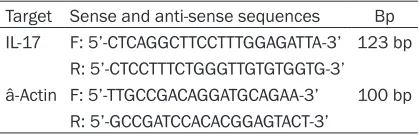
[image:2.612.87.297.84.152.2]Th17 cells (CD3+ CD4+ IL-17A+) were identified using flow cytometry. One hundred microliters of a whole blood sample was immunostained in control and test TruCount tubes (BD) in the dark at 4°C for 20 min, followed by red blood cell lysis in 2.0 mL of an erythrocyte lysis solution (BD Biosciences, San Jose, CA, USA) at room temperature for 8 min and mixing with 1.0 mL of an FACSTM permeabilization solution (BD) for 10 min. At least 10000-30000 cells were acquired using a fluorescence-activated cell sorter FACS Calibur flow cytometer (BD Biosciences, San Jose, CA, USA) and analyzed Table 1. The primers sequences
Target Sense and anti-sense sequences Bp IL-17 F: 5’-CTCAGGCTTCCTTTGGAGATTA-3’ 123 bp
R: 5’-CTCCTTTCTGGGTTGTGTGGTG-3’ â-Actin F: 5’-TTGCCGACAGGATGCAGAA-3’ 100 bp
Figure 1. Flow cytometry (FCM) tests. The levels ofIL-17A in Th17 cells in infection group, remission group and nor-mal contral.
Figure 2. The IL-17 mRNA expression of Th17 cells in infected SAA patients, patients inremission group
and normal contrals.
using CellQuest software version 3.1 software (BD).
Isolation and purification of Th17 lymphocytes
Ten milliliters of fresh peripheral blood was obtained from the infected SAA group, remmis-ion group, and normal controls. Peripheral blood mononuclear cells (PBMCs) were isolated from the blood samples with density gradient centrifugation using a Ficoll-Paque Plus solu-tion (Amersham Bioscience, Uppsala, Sweden). After staining with fluorophore-conjugated mo-noclonal antibodies as previously described, the Th17 cells were subsequently sorted and obtained using a FacsAria flow cytometer (BD Biosciences). The sorted cells were analyzed using the Cell Quest software program (Version 3.1, Becton Dickinson), and the purity of Th17 cells was > 90%.
Quantitative real-time PCR
The total RNA for the Th17 cells from the infect-ed SAA group, remmision group, and normal controls was extracted using a TRIzol reagent (Invitrogen, USA) and then reverse-transcribed using a TIANScript RT Kit (TIANGEN, Beijing, China). β-actin was employed as a housekeep -ing gene to standardize the targeted mRNA expression. Table 1 presents the sequences of primers specific to IL-17 and β-actin that were designed and synthesized by Sangon Biotech
(Shanghai, China). Quantitative real-time PCR was performed using the Bio-Rad iQ 5 Real-time System (Bio-Rad, Hercules, CA, USA). SYBR Green (TIANGEN, Beijing, China) was used as a double-strand DNA-specific dye. Amplification was performed using 40 cycles at 95°C for 5 s and 56°C for 34 s with extension at 72°C for 30 s. The IL-17 levels were calcu-lated using the 2-ΔΔCt method ((Ct, target gene-Ct, β-actin) sample - (Ct, target gene-Ct, β-actin)), after normalizing the data according to the β-actin mRNA expression.
Statistical analysis
The statistical analysis software SPSS 21.0 was used. Normally distributed numerical vari-ables are presented as mean ± standard devia-tion (SD). The difference between 2 groups was compared using the Student’s t test. Skewed distributed data are reported as the median and were analyzed using the Wilcoxon test. Differences were considered statistically sig-nificant with a P value of < 0.05.
Results
Percentage of Th17 cells increased in the
peripheral blood of patients with SAA and an infection
was no significant difference in IL-17A between the remission group and uninfected SAA group.
IL-17 mRNA expression increased in the peripheral blood Th17 cells from patients with
SAA and an infection
To determine the role of Th17 cells in SAA, IL-17 mRNA expression was evaluated in the periph-eral blood Th17 cells from patients with SAA and an infection, the remission group, and nor-mal controls. The mRNA expression for the rela-tive expression of IL-17 mRNA was significantly increased in the peripheral blood Th17 cells from infected cases (2.65 ± 1.21), as com-pared with the remission group (1.63 ± 0.42) and normal controls (0.93 ± 0.36) (P < 0.05; Figure 2).
Bacteriological examination
Of the 21 identified patients with a severe infection, most patients had multiple microbial infections involving more than one bacterial
For the 11 patients who had invasive fungal infections (IFI), the percentage of Th17 cells was (66.47 ± 15.90)% and was slightly higher than that of the noninvasive fungal infection group (P < 0.05) (Figure 3).
A trend towards higher Th17 levels in patients who had prior therapy for Aspergillus spp was seen (P = 0.06), as compared with other patho-gens. There were no significant differences observed in the SAA patients with infections for any other pathogens at any time point.
Patient outcomes by time point
After anti-infective therapy, the percentage of peripheral Th17 cells in patients with SAA and an infection at 1 week and 4 weeks was 58.03 ± 11.91% and 47.94 ± 18.71%, respectively. The patient outcomes at 1 week and 4 weeks are shown in Figure 4. The percentage of peripheral Th17 cells was found to be signifi -cantly lower at 4 weeks post-therapy than 1 week post-therapy and in untreated patients with SAA. No significant difference was detect -ed between the untreat-ed SAA.
We also investigated the relationship between the duration of infection and the percentage of peripheral Th17 cells. With the increase of the duration of infection, the level of Th17 cells were significantly elevated (Figure 5).
Discussion
SAA is a hematological disease characterized by hematopoietic failure of the bone marrow and has a high mortality rate. Recent studies have demonstrated that enhanced immuno-Table 2. Characteristics of infections in SAA patients
N. of
patients Blood Lung CNS
Bacterial 10
Staphylococcus 4 4
Stenotrophomonas maltophilia 2 1 2
Escherichia coli 2 2
Acinetobacter baumannii 1 1
Klebsiella pneumoniae 1 1
Fungal 11
Aspergillus spp 4 4
Candida albicans 4 2 3
Candida tropicalis 2 1 1
[image:5.612.89.306.82.413.2]Cryptococcus neoformans 1 1
Figure 3. Th17 level in invasive fungal infections (IFI) group and noninvasive fungal infection (nIFI) group.
[image:5.612.90.326.89.281.2]suppression combined with the promotion of hematopoiesis have improved the treatment efficacy of SAA to 70% in China. A higher mor -tality rate from infection is observed in patients who do not respond to treatment. The patho-genesis of SAA involves the abnormal function of T lymphocytes combined with severe agranu-locytosis, resulting in a higher incidence of infection in patients because of impaired anti-infective capabilities. Once these patients develop an infection, the infections are usually more severe and do not respond to enhanced antibiotic treatments. Therefore, anti-infective therapy has become a critical issue for the treatment of SAA. Only effective anti-infection treatment can gain times for immunosuppres-sive drugs to take effect.
Th17 cells have become a “hotspot” in immu-nological studies in recent years; they were the third type of effector T cells that were identified after the Th1 and Th2 subtypes. For the secre-tion of IL-17, Th17 cells have been reported to play an important role in the pathogenesis of autoimmune diseases such as rheumatoid arthritis (RA) and systemic lupus erythemato-sus (SLE). A study conducted by Lubberts et al. demonstrated the important role of Th17 in RA through symptom amelioration after adminis-tering an IL-17 inhibitor. In patients with SLE, the interaction of IL-17 with IL-21 induces B cells to secrete a large amount of autoantibod-ies, leading to disease progression. Meanwhile, recent studies found that Th17 cells also play a critical role in host defense against bacterial infections. IL-17 is an important cytokine in ho- st defense against pathogens through the re- cruitment of neutrophils. Romagnani [17] and Annunziato [18] demonstrated that Th17 cells have proliferative abilities and cytotoxicity by causing B cells to produce IgG, IgM, or IgA, but not IgE. For the first time, Huang [19] confirmed the critical role of Th17 response in host de- fense against Monilia infections, as demonstr- ated by the increased sensitivity to Monilia albi-cans infections with the decreased release of IL-17RA. Furthermore, IL-17R-mediated inflam -mation leading to a Monilia albicans infection in mouse intestines has been reported. In addi-tion, a higher sensitivity and obvious immuno-logical and pathoimmuno-logical changes to Monilia and Aspergillus infections were observed in TIR8-deficient (a negative regulatory factor of Th17) mice [20, 21]. All these observations indicate the importance of Th17 in host defense against Monilia infections. Meanwhile, IL-17 also plays an important role in Pneumocystis carinii infections.
We measured the number of Th17 cells in patients with SAA who had an infection (SAA-infection) and found a significantly higher num -ber of cells were observed in patients with SAA than in patients posttreatment and normal con-trols, suggesting a close association with Th17 cells in SAA-infection. By conducting a correla-tion analysis, we also found a correlacorrela-tion with Th17 cells numbers and hematology recovery, along with the percentage of peripheral CD4+/ CD8+, indicating that Th17 cells are associated with not only infection, but also humoral immu-Figure 4. Percentage of peripheral Th17 cells in SAA
[image:6.612.90.287.72.259.2]patients with infections by timepoint.
[image:6.612.93.286.313.447.2]nity, leading to the pathogenesis of SAA-infection. Furthermore, we obtained the same results as a PCR analysis that indicated higher expressions of IL-17A in patients with SAA-infection, further supporting the abovemen-tioned conclusion. Meanwhile, we observed higher numbers of Th17 cells in patients with a mycotic infection than those without, suggest-ing the importance of Th17 cells in mycotic infections. In addition, Th17 cell numbers were also associated with the amount of time patients had an infection, as in patients with infections lasting a longer time, higher num-bers of Th17 cells were found.
In conclusion, the pathogenesis of SAA has been confirmed to be associated with immune abnormalities. Severe agranulocytosis usually leads to a higher incidence of infection-related mortality. As a cell population related to immu-nity and infection, the Th17 cell was found to be associated with SAA immunity and infection in our study, indicating it might be involved in the immunological and infectious pathogene- sis of SAA that will be a focus of our future investigations.
Acknowledgements
This work was supported by the National Na- tural Science Foundation of China (81570106, 81570111, 81400085, 81400088), Tianjin Municipal Natural Science Foundation (14JCY- BJC25400, 15JCYBJC24300, 12JCZDJC215- 00), Tianjin Science and Technology support key project plan (20140109) and Tianjin appli-cation foundation and advanced technology research plan (WS908680).
Disclosure of conflict of interest None.
Address correspondence to: Zonghong Shao, De- partment of Hematology, General Hospital of Tianjin Medical University, Tianjin, China. E-mail: [email protected]
References
[1] Bacigalupo A. Aplastic anemia: pathogenesis and treatment. Hematology Am Soc Hematol Educ Program 2007: 23-28.
[2] Marsh JC, Ball SE, Cavenagh J, Darbyshire P, Dokal I, Gordon-Smith EC, Keidan J, Laurie A, Martin A, Mercieca J, Killick SB, Stewart R, Yin JA; British Committee for Standards in Haema-
tology. Guidelines for the diagnosis and ma- nagement of aplastic anaemia. Br J Haematol 2009; 147: 43-70.
[3] Young NS, Calado RT, Scheinberg P. Current concepts in the pathophysiology and treat-ment of aplastic anemia. Blood 2006; 108: 2509-2519.
[4] Brodsky RA, Chen AR, Dorr D, Fuchs EJ, Huff CA, Luznik L, Smith BD, Matsui WH, Goodman SN, Ambinder RF, Jones RJ. High-dose cyclo- phosphamide for severe aplastic anemia: long-term follow-up. Blood 2010; 115: 2136-2141. [5] Risitano AM, Selleri C, Serio B, Torelli GF,
Kula-gin A, Maury S, Halter J, Gupta V, Bacigalupo A, Sociè G, Tichelli A, Schrezenmeier H, Marsh J, Passweg J, Rotoli B; Working Party Severe Aplastic Anaemia (WPSAA) of the European Group for Blood and Marrow Transplantation (EBMT). Alemtuzumab is safe and effective as immunosuppressive treatment for aplastic anaemia and singlelineage marrow failure: a pilot study and a survey from the EBMT WP-SAA. Br J Haematol 2010; 148: 791-796. [6] Scheinberg P, Wu CO, Nunez O, Scheinberg P,
Boss C, Sloand EM, Young NS. Treatment of severe aplastic anemia with a combination of horse antithymocyte globulin and cyclospo-rine, with or without sirolimus: a prospective randomized study. Haematologica 2009; 94: 348-354.
[7] Hirota K, Duarte JH, Veldhoen M, Hornsby E, Li Y, Cua DJ, Ahlfors H, Wilhelm C, Tolaini M, Men-zel U, Garefalaki A, Potocnik AJ, Stockinger B. Fatemappingof IL-17-producing T cells in
in-flammatory responses. NatureImmunol 2011;
12: 255-263.
[8] Kom T, Bettelli E, Oukka M. IL-17 and Th17
Cells. Annu Rev Immunol 2009; 27: 485-517. [9] Herrada AA, Contreras FJ, Marini NP, Amador
CA, González PA, Cortés CM, Riedel CA, Carva-jal CA, Figueroa F, Michea LF, Fardella CE, Ka-lergis AM. Aldosterone promotes autoimmune damage by enhancing Th17-mediated immu-nity. J Immunol 2010; 184: 191-202.
[10] Aggarwal S, Gurney AL. IL-17: prototype mem-ber of an emerging cytokine family. J Leukoc Biol 2002; 71: 1-8.
[11] Zhu S, Pan W, Song X, Liu Y, Shao X, Tang Y, Liang D, He D, Wang H, Liu W, Shi Y, Harley JB, Shen N, Qian Y. The microRNA miR-23b
sup-presses IL-17-associated autoimmune
infla-mmation by targeting TAB2, TAB3 and IKK-al-pha. Nat Med 2012; 18: 1077-1086.
[12] Khader SA, Gaffen SL, Kolls JK. Th17 cells at the crossroads of innate and adaptive immu-nity against infectious diseases at the mucosa. Mucosal Immunol 2009; 2: 403-411.
[13] Zheng Y, Danilenko DM, Valdez P, Kasman I,
-leukin-22, a T(H)17 cytokine, mediates
IL-23-induced dermal inflammation and acantho -sis. Nature 2007; 445: 648-651.
[14] Robinson KM, Manni ML, Biswas PS, Alcorn JF. Clinical consequences of targeting IL-17 and Th17 in autoimmune and allergic disorders. Curr Allergy Asthma Rep 2013; 13: 587-95. [15] Yen D, Cheung J, Scheerens H, Poulet F,
Mc-Clanahan T, McKenzie B, Kleinschek MA, Owy -ang A, Mattson J, Blumenschein W, Murphy E, Sathe M, Cua DJ, Kastelein RA, Rennick D. IL-23 is essential for T cell-mediated colitis and
promotes inflammation via IL-17 and IL-6. J Clin
Invest 2006; 116: 1310-1316.
[16] Quillen K, Wong E, Scheinberg P, Young NS,
Walsh TJ, Wu CO, Leitman SF. Granulocyte
transfusions in severe aplastic anemia: an eleven-year experience. Haematologica 2009; 94: 1661-1668.
[17] Romagnani S. Human Th17 cells. Arthritis Res Ther 2008; 10: 206.
[18] Annunziato F, Cosmi L, Santarlasci V. Pheno-typic and functional features of human Th17 cells. J Exp Med 2007; 204: 1849-61. [19] Huang W, Na L, Fidel PL, Schwarzenberger P.
Requirement of interlekin-17A for systemic anti Candida albicanshost defense in mice. J Infect Dis 2004; 190: 624-631.
[20] Lubberts E, Koenders MI, van den Berg WB. The role of T-cell interleukin-17 in conducting destructive arthritis: lessons from animal mod-els. Arthritis Res Ther 2005; 7: 29-37. [21] Doreau A, Belot A, Bastid J, Riche B,
Trescol-Biemont MC, RanchinB, Fabien N, Cochat P, Pouteil-Noble C, Trolliet P, Durieu I, Tebib J, Kassai B, Ansieau S, Puisieux A, Eliaou JF, Bon-nefoy-Bérard N. Interleukin 17 acts in synergy
with B cell-activating factor to influenceB cell