A Preliminary Study of Tweet Summarization using Information Extraction
Wei Xu, Ralph Grishman, Adam Meyers Computer Science Department
New York University New York, NY 10003, USA
{xuwei,grishman,meyers}@cs.nyu.edu
Alan Ritter
Computer Science and Engineering University of Washington
Seattle, WA 98125, USA [email protected]
Abstract
Although the ideal length of summaries dif-fers greatly from topic to topic on Twitter, pre-vious work has only generated summaries of a pre-fixed length. In this paper, we propose an event-graph based method using informa-tion extracinforma-tion techniques that is able to cre-ate summaries of variable length for different topics. In particular, we extend the Pagerank-like ranking algorithm from previous work to partition event graphs and thereby detect fine-grained aspects of the event to be summarized. Our preliminary results show that summaries created by our method are more concise and news-worthy than SumBasic according to hu-man judges. We also provide a brief survey of datasets and evaluation design used in previ-ous work to highlight the need of developing a standard evaluation for automatic tweet sum-marization task.
1 Introduction
Tweets contain a wide variety of useful information from many perspectives about important events tak-ing place in the world. The huge number of mes-sages, many containing irrelevant and redundant in-formation, quickly leads to a situation of informa-tion overload. This motivates the need for automatic summarization systems which can select a few mes-sages for presentation to a user which cover the most important information relating to the event without redundancy and filter out irrelevant and personal in-formation that is not of interest beyond the user’s immediate social network.
Although there is much recent work focusing on the task of multi-tweet summarization (Becker et al., 2011; Inouye and Kalita, 2011; Zubiaga et al., 2012; Liu et al., 2011a; Takamura et al., 2011; Harabagiu and Hickl, 2011; Wei et al., 2012), most previous work relies only on surface lexical clues, redun-dancy and social network specific signals (e.g. user relationship), and little work has considered taking limited advantage of information extraction tech-niques (Harabagiu and Hickl, 2011) in generative models. Because of the noise and redundancy in social media posts, the performance of off-the-shelf news-trained natural language process systems is de-graded while simple term frequency is proven pow-erful for summarizing tweets (Inouye and Kalita, 2011). A natural and interesting research question is whether it is beneficial to extract named entities and events in the tweets as has been shown for clas-sic multi-document summarization (Li et al., 2006). Recent progress on building NLP tools for Twitter (Ritter et al., 2011; Gimpel et al., 2011; Liu et al., 2011b; Ritter et al., 2012; Liu et al., 2012) makes it possible to investigate an approach to summariz-ing Twitter events which is based on Information Ex-traction techniques.
We investigate a graph-based approach which leverages named entities, event phrases and their connections across tweets. A similar idea has been studied by Li et al. (2006) to rank the salience of event concepts in summarizing news articles. However, the extreme redundancy and simplicity of tweets allows us to explicitly split the event graph into subcomponents that cover various aspects of the initial event to be summarized to create
Work Dataset (size of each
clus-ter) System Output Evaluation Metrics Inouye and
Kalita (2011) trending topics (approxi-mately 1500 tweets) 4 tweets ROUGE and human (over-all quality comparing to human summary)
Sharifi et al. (2010)
same as above 1 tweet same as above
Rosa et al.
(2011) segmented hashtag top-ics by LDA and k-means clustering (average 410 tweets)
1, 5, 10 tweets Precision@k (relevance to topic)
Harabagiu and
Hickl (2011) real-word event topics (aminimum of 2500 tweets) top tweets until a limit of250 words was reached human (coverage and co-herence) Liu et al.
(2011a) general topics and hash-tag topics (average 1.7k tweets)
same lengths as of the human summary, vary for each topic (about 2 or 3 tweets)
ROUGE and human (con-tent coverage, grammat-icality, non-redundancy, referential clarity, focus) Wei et al.
(2012) segmented hashtag top-ics according to burstiness (average 10k tweets)
10 tweets ROUGE, Precison/Recall (good readability and rich content)
Takamura et al. (2011)
specific soccer games (2.8k - 5.2k tweets)
same lengths as the hu-man summary, vary for each topic (26 - 41 tweets)
ROUGE (considering only content words)
Chakrabarti and Punera (2011)
specific football games (1.8k tweets)
[image:2.612.76.538.63.421.2]10 - 70 tweets Precision@k (relevance to topic)
Table 1: Summary of datasets and evaluation metrics used in several previous work on tweet summarization
sive and non-redundant summaries. Our work is the first to use a Pagerank-like algorithm for graph parti-tioning and ranking in the context of summarization, and the first to generate tweet summaries of variable length which is particularly important for tweet sum-marization. Unlike news articles, the amount of in-formation in a set of topically clustered tweets varies greatly, from very repetitive to very discrete. For ex-ample, the tweets about one album release can be more or less paraphrases, while those about another album by a popular singer may involve rumors and release events etc. In the human study conducted by Inouye and Kalita (2011), annotators strongly prefer different numbers of tweets in a summary for dif-ferent topics. However, most of the previous work produced summaries of a pre-fixed length and has no evaluation on conciseness. Liu et al. (2011a) and Takamura et al. (2011) also noticed the ideal
length of summaries can be very different from topic to topic, and had to use the length of human refer-ence summaries to decide the length of system out-puts, information which is not available in practice. In contrast, we developed a system that is capable of detecting fine-grained sub-events and generating summaries with the proper number of representative tweets accordingly for different topics.
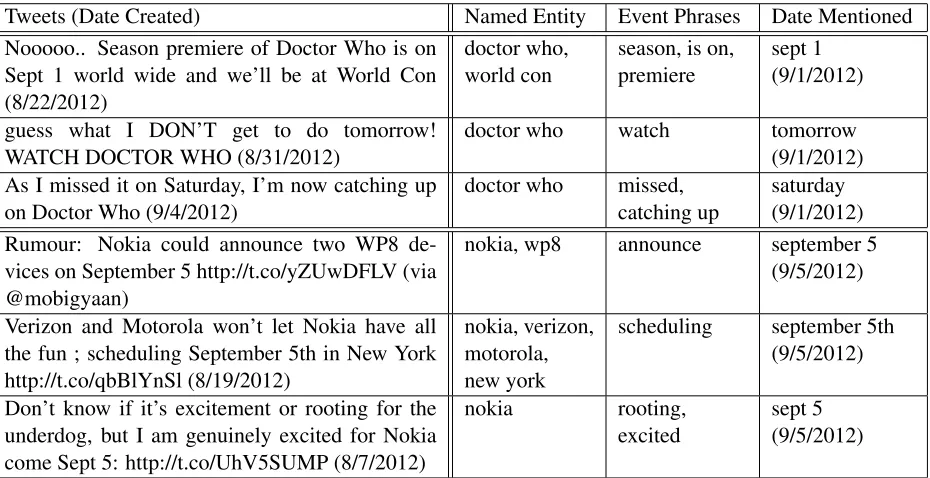
re-Tweets (Date Created) Named Entity Event Phrases Date Mentioned Nooooo.. Season premiere of Doctor Who is on
Sept 1 world wide and we’ll be at World Con (8/22/2012)
doctor who,
world con season, is on,premiere sept 1(9/1/2012)
guess what I DON’T get to do tomorrow!
WATCH DOCTOR WHO (8/31/2012) doctor who watch tomorrow(9/1/2012) As I missed it on Saturday, I’m now catching up
on Doctor Who (9/4/2012)
doctor who missed, catching up
saturday (9/1/2012) Rumour: Nokia could announce two WP8
de-vices on September 5 http://t.co/yZUwDFLV (via @mobigyaan)
nokia, wp8 announce september 5 (9/5/2012)
Verizon and Motorola won’t let Nokia have all the fun ; scheduling September 5th in New York http://t.co/qbBlYnSl (8/19/2012)
nokia, verizon, motorola, new york
scheduling september 5th (9/5/2012)
Don’t know if it’s excitement or rooting for the underdog, but I am genuinely excited for Nokia come Sept 5: http://t.co/UhV5SUMP (8/7/2012)
nokia rooting,
[image:3.612.76.541.59.298.2]excited sept 5(9/5/2012)
Table 2: Event-related information extracted from tweets
duces the complexity of the relationship (or no re-lationship) between events according to their co-occurrence, resulting in differences in constructing event graphs from previous work in news domain (Li et al., 2006).
2 Issues in Current Research on Tweet Summarization
The most serious problem in tweet summarization is that there is no standard dataset, and conse-quently no standard evaluation methodology. Al-though there are more than a dozen recent works on social media summarization, astonishingly, almost each research group used a different dataset and a different experiment setup. This is largely attributed to the difficulty of defining the right granularity of a topic in Twitter. In Table 1, we summarize the exper-iment designs of several selective works. Regardless of the differences, researchers generally agreed on :
• clustering tweets topically and temporally
• generating either a very short summary for a focused topic or a long summary for large-size clusters
• difficulty and necessity to generate summaries of variable length for different topics
Although the need of variable-length summaries have been raised in previous work, none has pro-vide a good solution (Liu et al., 2011a; Takamura et al., 2011; Inouye and Kalita, 2011). In this pa-per, our focus is study the feasibility of generating concise summaries of variable length and improv-ing meanimprov-ingfulness by usimprov-ing information extraction techniques. We hope this study can provide new in-sights on the task and help in developing a standard evaluation in the future.
3 Approach
We first extract event information including named entities and event phrases from tweets and construct event graphs that represent the relationship between them. We then rank and partition the events using PageRank-like algorithms, and create summaries of variable length for different topics.
3.1 Event Extraction from Tweets
2012) and temporal expressions (Mani and Wilson, 2000). Both the named entity and event taggers uti-lize Conditional Random Fields models (Lafferty, 2001) trained on annotated data, while the temporal expression resolver uses a mix of hand-crafted and machine-learned rules. Example event information extracted from Tweets are presented in Table 2.
The self-contained nature of tweets allows effi-cient extraction of event information without deep analysis (e.g. co-reference resolution). On the other hand, individual tweets are also very terse, often lacking sufficient context to access the importance of events. It is crucial to exploit the highly redun-dancy in Twitter. Closely following previous work by Ritter et al. (2012), we group together sets of topically and temporally related tweets, which men-tion the same named entity and a temporal refer-ence resolved to the same unique calendar date. We also employ a statistical significance test to measure strength of association between each named entity and date, and thereby identify important events dis-cussed widely among users with a specific focus, such as the release of a new iPhone as opposed to in-dividual users discussing everyday events involving their phones. By discarding frequent but insignifi-cant events, we can produce more meaningful sum-maries about popular real-world events.
3.2 Event Graphs
Since tweets have simple discourse and are self-contained, it is a reasonable assumption that named entities and event phrases that co-occurred together in a single tweet are very likely related. Given a col-lection of tweets, we represent such connections by a weighted undirected graph :
• Nodes: named entities and event phrases are represented by nodes and treated indifferently.
• Edges: two nodes are connected by an undi-rected edge if they co-occurred inktweets, and
the weight of edge isk.
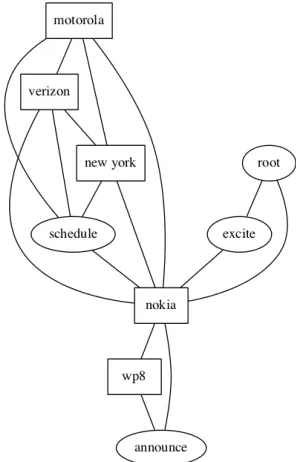
We find it helpful to merge named entities and event phrases that have lexical overlap if they are fre-quent but not the topic of the tweet cluster. For ex-ample, ’bbc’, ’radio 1’, ’bbc radio 1’ are combined together in a set of tweets about a band. Figure 1 shows a very small toy example of event graph. In
[image:4.612.356.504.111.342.2]the experiments of this paper, we also exclude the edges with k < 2 to reduce noise in the data and calculation cost.
Figure 1: A toy event graph example built from the three sentences of the event ’Nokia - 9/5/2012’ in Table 2
3.3 Event Ranking and Partitioning
Graph-based ranking algorithms are widely used in automatic summarization to decide salience of con-cepts or sentences based on global information re-cursively drawn from the entire graph. We adapt the PageRank-like algorithm used in TextRank (Mihal-cea and Tarau, 2004) that takes into account edge weights when computing the score associated with a vertex in the graph.
Formally, letG = (V, E) be a undirected graph
with the set of verticesV and set of edgesE, where E is a subset of V ⇥V. For a given vertexVi, let Ad(Vi)be the set of vertices that adjacent to it. The
weight of the edge betweenVi andVj is denoted as wij, and wij = wji. The score of a vertex Vi is
defined as follows:
S(Vi) = (1 d) +d⇥
X
Vj2Ad(Vi)
wij⇥S(Vj)
P
Vk2Ad(Vj)wjk
wheredis a damping factor that is usually set to 0.85
Starting from arbitrary values assigned to each node in the graph, the computation iterates until con-vergence. Note that the final salience score of each node is not affected by the choice of the initial val-ues assigned to each node in the graph, but rather the weights of edges.
In previous work computed scores are then used directly to select text fractions for summaries (Li et al., 2006). However, the redundancy and simplic-ity of tweets allow further exploration into sub-event detection by graph partitioning. The intuition is that the correlations between named entities and event phrases within same sub-events are much stronger than between sub-events. This phenomena is more obvious and clear in tweet than in news articles, where events are more diverse and complicated re-lated to each other given lengthy context.
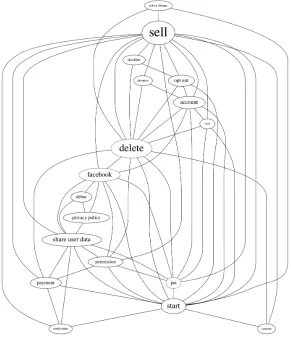
As theoretically studied in local partitioning prob-lem (Andersen et al., 2006), a good partition of the graph can be obtained by separating high ranked ver-tices from low ranked verver-tices, if the nodes in the graph have ranks that are distinguishable. Utilizing a similar idea, we show that a simple greedy algo-rithm is efficient to find important sub-events and generate useful summaries in our tasks. As shown in Figure 2 and 3, the high ranked nodes (whose scores are greater than 1, the average score of all nodes in the graph) in tweet event graphs show the divisions within a topic. We search for strongly con-nected sub-graphs, as gauged by parameter↵, from
the highest ranked node to lower ranked ones.The proportion of tweets in a set that are related to a sub-event is then estimated according to the ratio be-tween the sum of node scores in the sub-graph ver-sus the entire graph. We select one tweet for each sub-event that best covers the related nodes with the highest sum of node scores normalized by length as summaries. By adding a cutoff (parameter ) on proportion of sub-event required to be included into summaries, we can produce summaries with the ap-propriate length according to the diversity of infor-mation in a set of tweets.
In Figure 2, 3 and 4, the named entity which is also the topic of tweet cluster is omitted since it is connected with every node in the event graph. The size of node represents the salience score, while the shorter, straighter and more vertical the edge is, the higher its weight. The nodes with rectangle shapes
Algorithm 1Find important sub-events
Require: Ranked event graph G = (V, E), the
named entity V0 which is the topic of event
cluster, parameters ↵ and that can be set
towards user preference over development data
1: Initialize the pool of high ranked nodes ˜
V {Vi|8Vi 2 V, S(Vi) > 1} V0 and the
total weightW PV
i2V˜ S(Vi)
2: whileV˜ 6=;do
3: Pop the highest ranked nodeVmfromV˜
4: PutVmto a temporary sub-evente {Vm}
5: for allVninV˜ do
6: if wmn/w0m > ↵ and w0n/w0m > ↵
then
7: e e[ {Vn}
8: end if
9: end for
10: We PVi2eS(Vi) 11: ifWe/W > then
12: Successfully find a sub-evente 13: Remove all nodes inefromV˜
14: end if
15: end while
are named entities, while round shaped ones are event phrases. Note that in most cases, sub-events correspond to connected components in the event graph of high ranked nodes as in Figure 2 and 3. However, our simple greedy algorithm also allows multiple sub-events for a single connected compo-nent that can not be covered by one tweet in the summary. For example, in Figure 4, two sub-events
e1 = {sell, delete, start, payment} and e2 =
{f acebook, share user data, privacy policy, debut}
are chosen to accommodate the complex event.
4 Experiments
4.1 Data
Figure 2: Event graph of ’Google - 1/16/2013’, an example of event cluster with multiple focuses
[image:6.612.161.452.336.674.2]Figure 4: Event graph of ’West Ham - 1/16/2013’, an example of event cluster with a single focus
a Twitter specific name entity tagger1) and a
refer-ence to the same unique calendar date (resolved us-ing a temporal expression processor (Mani and Wil-son, 2000)). Tweets published during the whole pe-riod are aggregated together to find top events that happen on each calendar day. We applied the G2
test for statistical significance (Dunning, 1993) to rank the event clusters, considering the corpus fre-quency of the named entity, the number of times the date has been mentioned, and the number of tweets which mention both together. We randomly picked the events of one day for human evaluation, that is the day of January 16, 2013 with 38 events and an average of 465 tweets per event cluster.
For each cluster, our systems produce two ver-sions of summaries, one with a fixed number (set to 3) of tweets and another one with a flexible num-ber (vary from 1 to 4) of tweets. Both↵and are set to 0.1 in our implementation. All parameters are set experimentally over a small development dataset consisting of 10 events in Twitter data of September 2012.
1https://github.com/aritter/twitter_nlp
4.2 Baseline
SumBasic (Vanderwende et al., 2007) is a simple and effective summarization approach based on term frequency, which we use as our baseline. It uses word probabilities with an update function to avoid redundancy to select sentences or posts in a social media setting. It is shown to outperform three other well-known multi-document summarization meth-ods, namely LexRank (Erkan and Radev, 2004), TextRank (Mihalcea and Tarau, 2004) and MEAD (Radev et al., 2004) on tweets in (Inouye and Kalita, 2011), possibly because that the relationship be-tween tweets is much simpler than bebe-tween sen-tences in news articles and can be well captured by simple frequency methods. The improvement over the LexRank model on tweets is gained by consid-ering the number of retweets and influential users is another side-proof (Wei et al., 2012) of the effective-ness of frequency.
EventRank−Flexible EventRank−Fixed SumBasic
Annotator 1
0
1
2
3
4
5
compactness completeness overall
EventRank−Flexible EventRank−Fixed SumBasic
Annotator 2
0
1
2
3
4
5
compactness completeness overall
[image:7.612.352.497.346.646.2]Event System Summary
- Google ’s home page is a Zamboni game in celebration of Frank Zam-boni ’s birthday January 16 #GameOn
EventRank (Flexible)
- Today social , Tomorrow Google ! Facebook Has Publicly Redefined Itself As A Search Company http://t.co/dAevB2V0 via @sai
1/16/2013 - Orange says has it has forced Google to pay for traffic . The Head ofthe Orange said on Wednesday it had ... http://t.co/dOqAHhWi - Tomorrow’s Google doodle is going to be a Zamboni! I may have to take a vacation day.
SumBasic - the game on google today reminds me of hockey #tooexcited #saturday - The fact that I was soooo involved in that google doodle game says something about this Wednesday #TGIW You should try it!
EventRank
(Flexible) - So Instagram can sell your pictures to advertisers without u knowingstarting January 16th I’m bout to delete my instagram ! - Instagram debuts new privacy policy , set to share user data with Face-book beginning January 16
1/16/2013 - Instagram will have the rights to sell your photos to Advertisers as ofjan 16 SumBasic - Over for Instagram on January 16th
- Instagram says it now has the right to sell your photos unless you delete your account by January 16th http://t.co/tsjic6yA
EventRank (Flexible)
- RT @Bassa_Mufc : Wayne Rooney and Nani will feature in the FA Cup replay with West Ham on Wednesday - Sir Alex Ferguson
West Ham
1/16/2013 - Wayne Rooney could be back to face West Ham in next Wednesday’sFA Cup replay at Old Trafford. #BPL SumBasic - Tomorrow night come on West Ham lol
[image:8.612.80.533.59.447.2]- Nani’s fit abd WILL play tomorrow against West Ham! Sir Alex con-firmed :)
Table 3: Event-related information extracted from tweets
4.3 Preliminary Results
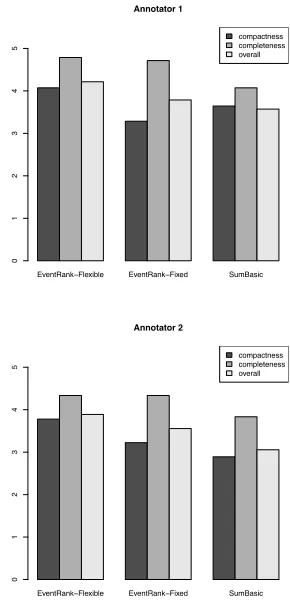
We performed a human evaluation in which two an-notators were asked to rate the system on a five-point scale (1=very poor, 5=very good) for com-pleteness and compactness. Comcom-pleteness refers to how well the summary cover the important content in the tweets. Compactness refers to how much meaningful and non-redundant information is in the summary. Because the tweets were collected ac-cording to information extraction results and ranked by salience, the readability of summaries generated by different systems are generally very good. The top 38 events of January 16, 2013 are used as test set. The aggregate results of the human evaluation are displayed in Figure 5. Agreement between an-notators measured using Pearson’s Correlation
Co-efficient is 0.59, 0.62, 0.62 respectively for compact-ness, completeness and overall judgements.
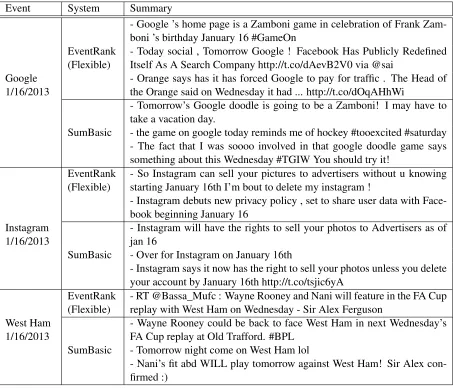
Results suggest that the models described in this paper produce more satisfactory results as the base-line approaches. The improvement of EventRank-Flexible over SumBasic is significant (two-tailed
p < 0.05) for all three metrics according to
stu-dent’s t test. Example summaries of the events in
to-gether of the baseline system. For another example, among the tweets about Google around 1/16/2013, users intensively talk about the Google doodle game with a very wide range of words creatively, giving word-based methods a hard time to pick up the di-verse and essential event information that is less fre-quent.
5 Conclusions and Future Work
We present an initial study of feasibility to gen-erate compact summaries of variable lengths for tweet summarization by extending a Pagerank-like algorithm to partition event graphs. The evalua-tion shows that informaevalua-tion extracevalua-tion techniques are helpful to generate news-worthy summaries of good readability from tweets.
In the future, we are interested in improving the approach and evaluation, studying automatic met-rics to evaluate summarization of variable length and getting involved in developing a standard eval-uation for tweet summarization tasks. We wonder whether other graph partitioning algorithms may im-prove the performance. We also consider extending this graph-based approach to disambiguate named entities or resolve event coreference in Twitter data. Another direction of future work is to extend the proposed approach to different data, for example, temporal-aware clustered tweets etc.
Acknowledgments
This research was supported in part by NSF grant IIS-0803481, ONR grant N00014-08-1-0431, and DARPA contract FA8750- 09-C-0179, and carried out at the University of Washington’s Turing Center. We thank Mausam and Oren Etzioni of University of Washington, Maria Pershina of New York Univer-sity for their advice.
References
Reid Andersen, Fan Chung, and Kevin Lang. 2006. Local graph partitioning using pagerank vectors. In Foundations of Computer Science, 2006. FOCS’06. 47th Annual IEEE Symposium on, pages 475–486. IEEE.
Hila Becker, Mor Naaman, and Luis Gravano. 2011. Se-lecting quality twitter content for events. In
Proceed-ings of the Fifth International AAAI Conference on We-blogs and Social Media (ICWSM’11).
Sergey Brin and Lawrence Page. 1998. The anatomy of a large-scale hypertextual web search engine.Computer networks and ISDN systems, 30(1):107–117.
Deepayan Chakrabarti and Kunal Punera. 2011. Event summarization using tweets. In Proceedings of the Fifth International AAAI Conference on Weblogs and Social Media, pages 66–73.
Ted Dunning. 1993. Accurate methods for the statistics of surprise and coincidence. Computational linguis-tics, 19(1):61–74.
Günes Erkan and Dragomir R. Radev. 2004. Lexrank: Graph-based lexical centrality as salience in text sum-marization.J. Artif. Intell. Res. (JAIR), 22:457–479. Kevin Gimpel, Nathan Schneider, Brendan O’Connor,
Dipanjan Das, Daniel Mills, Jacob Eisenstein, Michael Heilman, Dani Yogatama, Jeffrey Flanigan, and Noah A. Smith. 2011. Part-of-speech tagging for twit-ter: Annotation, features, and experiments. InACL. Sanda Harabagiu and Andrew Hickl. 2011. Relevance
modeling for microblog summarization. In Fifth In-ternational AAAI Conference on Weblogs and Social Media.
David Inouye and Jugal K Kalita. 2011. Comparing twit-ter summarization algorithms for multiple post sum-maries. InPrivacy, security, risk and trust (passat), 2011 ieee third international conference on and 2011 ieee third international conference on social comput-ing (socialcom), pages 298–306. IEEE.
John Lafferty. 2001. Conditional random fields: Proba-bilistic models for segmenting and labeling sequence data. pages 282–289. Morgan Kaufmann.
Wenjie Li, Wei Xu, Chunfa Yuan, Mingli Wu, and Qin Lu. 2006. Extractive summarization using inter- and intra- event relevance. InProceedings of the 21st In-ternational Conference on Computational Linguistics and the 44th annual meeting of the Association for Computational Linguistics, ACL-44, pages 369–376, Stroudsburg, PA, USA. Association for Computational Linguistics.
Fei Liu, Yang Liu, and Fuliang Weng. 2011a. Why is ÒsxswÓ trending? exploring multiple text sources for twitter topic summarization.ACL HLT 2011, page 66. Xiaohua Liu, Shaodian Zhang, Furu Wei, and Ming Zhou. 2011b. Recognizing named entities in tweets. InACL.
Xiaohua Liu, Furu Wei, Ming Zhou, et al. 2012. Quick-view: Nlp-based tweet search. InProceedings of the ACL 2012 System Demonstrations, pages 13–18. As-sociation for Computational Linguistics.
An-nual Meeting on Association for Computational Lin-guistics, ACL ’00, pages 69–76, Stroudsburg, PA, USA. Association for Computational Linguistics. Rada Mihalcea and Paul Tarau. 2004. Textrank:
Bring-ing order into texts. InProceedings of EMNLP, vol-ume 4, pages 404–411. Barcelona, Spain.
Dragomir Radev, Timothy Allison, Sasha Blair-Goldensohn, John Blitzer, Arda Celebi, Stanko Dimitrov, Elliott Drabek, Ali Hakim, Wai Lam, Danyu Liu, et al. 2004. Mead-a platform for multidocument multilingual text summarization. In Proceedings of LREC, volume 2004.
Alan Ritter, Sam Clark, Mausam, and Oren Etzioni. 2011. Named entity recognition in tweets: An experi-mental study.
Alan Ritter, Mausam, Oren Etzioni, and Sam Clark. 2012. Open domain event extraction from twitter. In KDD, pages 1104–1112. ACM.
Kevin Dela Rosa, Rushin Shah, Bo Lin, Anatole Gersh-man, and Robert Frederking. 2011. Topical clustering of tweets. Proceedings of the ACM SIGIR: SWSM. Beaux Sharifi, Mark-Anthony Hutton, and Jugal K
Kalita. 2010. Experiments in microblog summariza-tion. In Proc. of IEEE Second International Confer-ence on Social Computing.
Hiroya Takamura, Hikaru Yokono, and Manabu Oku-mura. 2011. Summarizing a document stream. Ad-vances in Information Retrieval, pages 177–188. Lucy Vanderwende, Hisami Suzuki, Chris Brockett, and
Ani Nenkova. 2007. Beyond sumbasic: Task-focused summarization with sentence simplification and lex-ical expansion. Information Processing & Manage-ment, 43(6):1606–1618.
Furu Wei, Ming Zhou, and Heung-Yeung Shum. 2012. Twitter topic summarization by ranking tweets using social influence and content quality. InCOLING. Arkaitz Zubiaga, Damiano Spina, Enrique Amigó, and