Vector Space Models for Phrase-based Machine Translation
Tamer Alkhouli1, Andreas Guta1, and Hermann Ney1,2 1Human Language Technology and Pattern Recognition Group
RWTH Aachen University, Aachen, Germany 2Spoken Language Processing Group
Univ. Paris-Sud, France and LIMSI/CNRS, Orsay, France {surname}@cs.rwth-aachen.de
Abstract
This paper investigates the application of vector space models (VSMs) to the standard phrase-based machine translation pipeline. VSMs are models based on continuous word representations embed-ded in a vector space. We exploit word vectors to augment the phrase table with new inferred phrase pairs. This helps reduce out-of-vocabulary (OOV) words. In addition, we present a simple way to learn bilingually-constrained phrase vec-tors. The phrase vectors are then used to provide additional scoring of phrase pairs, which fits into the standard log-linear framework of phrase-based statistical ma-chine translation. Both methods result in significant improvements over a com-petitive in-domain baseline applied to the Arabic-to-English task of IWSLT 2013.
1 Introduction
Categorical word representation has been widely used in many natural language processing (NLP) applications including statistical machine transla-tion (SMT), where words are treated as discrete random variables. Continuous word representa-tions, on the other hand, have been applied suc-cessfully in many NLP areas (Manning et al., 2008; Collobert and Weston, 2008). However, their application to machine translation is still an open research question. Several works tried to ad-dress the question recently (Mikolov et al., 2013b; Zhang et al., 2014; Zou et al., 2013), and this work is but another step in that direction.
While categorical representations do not encode any information about word identities, continuous representations embed words in a vector space, re-sulting in geometric arrangements that reflect
in-formation about the represented words. Such em-beddings open the potential for applying informa-tion retrieval approaches where it becomes possi-ble to define and compute similarity between dif-ferent words. We focus on continuous represen-tations whose training is influenced by the sur-rounding context of the token being represented. One motivation for such representations is to cap-ture word semantics (Turney et al., 2010). This is based on thedistributional hypothesis (Harris, 1954) which says that words that occur in similar contexts tend to have similar meanings.
We make use of continuous vectors learned using simple neural networks. Neural networks have been gaining increasing attention recently, where they have been able to enhance strong SMT baselines (Devlin et al., 2014; Sundermeyer et al., 2014). While neural language and transla-tion modeling make intermediate use of continu-ous representations, there have been also attempts at explicit learning of continuous representations to improve translation (Zhang et al., 2014; Gao et al., 2013).
This work explores the potential of word se-mantics based on continuous vector representa-tions to enhance the performance of phrase-based machine translation. We present a greedy algo-rithm that employs the phrase table to identify phrases in a training corpus. The phrase table serves to bilingually restrict the phrases spotted in the monolingual corpus. The algorithm is ap-plied separately to the source and target sides of the training data, resulting in source and target cor-pora of phrases (instead of words). The phrase corpus is used to learn phrase vectors using the same methods that produce word vectors. The vectors are then used to provide semantic scor-ing of phrase pairs. We also learn word vectors and employ them to augment the phrase table with paraphrased entries. This leads to a reduction in
the OOV rate which translates to improved BLEU and and TERscores. We apply the two methods on the IWSLT 2013 Arabic-to-English task and show significant improvements over a strong in-domain baseline.
The rest of the paper is structured as follows. Section 2 presents a background on word and phrase vectors. The construction of the phrase corpus is discussed in Section 3, while Section 4 demonstrates how to use word and phrase vectors in the standard phrase-based SMT pipeline. Ex-periments are presented in Section 5, followed by an overview of the related word in Section 6, and finally Section 7 concludes the work.
2 Vector Space Models
One way to obtain context-based word vectors is through a neural network (Bengio et al., 2003; Schwenk, 2007). With a vocabulary sizeV, one-hot encoding ofV-dimensional vectors is used to represent input words, effectively associating each word with a D-dimensional vector in the V×D
input weight matrix, where D is the size of the hidden layer. Similarly, one-hot encoding on the output layer associates words with vectors in the output weight matrix.
Alternatively, a count-based V-dimensional word co-occurrence vector can serve as a word representation (Lund and Burgess, 1996; Lan-dauer and Dumais, 1997). Such representations are sparse and high-dimensional, which might re-quire an additional dimensionality reduction step (e.g. using SVD). In contrast, learning word rep-resentations via neural models results directly in relatively low-dimensional, dense vectors. In this work, we follow the neural network approach to extract the feature vectors. Whether word vectors are extracted by means of a neural network or co-occurrence counts, the context surrounding a word influences its final representation by design. Such context-based representations can be used to de-termine semantic similarities.
The construction ofphraserepresentations, on the other hand, can be done in different ways. The compositional approach constructs the vector representation of a phrase by resorting to its con-stituent words (or sub-phrases) (Gao et al., 2013; Chen et al., 2010). Kalchbrenner and Blunsom (2013) obtain continuous sentence representations
by applying a sequence of convolutions, starting with word representations.
Another approach for phrase representation considers phrases as atomic units that can not be divided further. The representations are learned directly in this case (Mikolov et al., 2013b; Hu et al., 2014).
In this work, we follow the second approach to obtain phrase vectors. To this end, we apply the same methods that yield word vectors, with the difference that phrases are used instead of words. In the case of neural word representations, a neural network that is presented with words at the input layer is presented with phrases instead. The result-ing vocabulary size in this case would be the num-ber of distinct phrases observed during training. Although learning phrase embeddings directly is amenable to data sparsity issues, it provides us with a simple means to build phrase vectors mak-ing use of tools already developed for word vec-tors, focussing the effort on preprocessing the data as will be discussed in the next section.
3 Phrase Corpus
When training word vectors using neural net-works, the network is presented with a corpus. To build phrase vectors, we first identify phrases in the corpus and generate a phrase corpus. The phrase corpus is similar to the original corpus ex-cept that its words are joined to make up phrases. The new corpus is then used to train the neural net-work. The columns of the resulting input weight matrix of the network are the phrase vectors corre-sponding to the phrases encountered during train-ing.
Algorithm 1Phrase Corpus Construction 1: p←1
2: for p≤numPassesdo 3: i←2
4: fori≤corpus.size−1do
5: w˜← join(ti,ti+1) .create a phrase using the current and next tokens
6: v˜← join(ti−1,ti) .create a phrase using the previous and current tokens
7: joinForward←score(w)˜
8: joinBackward←score(v)˜
9: if joinForward≥ joinBackwardand joinForward≥θ then
10: ti←w˜
11: removeti+1
12: i←i+2 .newly created phrase not available for further merge during current pass
13: else
14: if joinBackward> joinForwardand joinBackward≥θ then
15: ti−1←v˜
16: removeti
17: i←i+2 .newly created phrase not available for further merge during current pass
18: else
19: i←i+1
20: end if
21: end if 22: end for 23: p← p+1 24: end for
construct the monolingual phrase corpus encodes bilingual information in the corpus, namely, the corpus will include phrases that having a match-ing phrase in the other language, which is in line with the purpose for which the phrases are con-structed, that is, their use in the phrase-based ma-chine translation pipeline which is explained in the next section. In addition, the aforementioned scor-ing serves to exclude noisy phrase-pair entries dur-ing the construction of the phrase corpus. Next, we explain the details of the construction algorithm.
3.1 Phrase Spotting
We propose Algorithm 1 as a greedy approach for phrase corpus construction. It is a multi-pass algo-rithm where each pass can extend tokens obtained during the previous pass by a single token at most. Before the first pass, all tokens are words. During the passes the tokens might remain as words or can be extended to become phrases. Given a tokenti
at position i, a scoring function is used to score the phrase (ti,ti+1) and the phrase (ti−1,ti). The
phrase having a higher score is adopted as long as its score exceeds a predefined threshold θ. The
scoring function used in lines 7 and 8 is based on the phrase table. If the phrase does not belong to the phrase table it is given a scoreθ0 <θ. If the
phrase exists, a bilingual score is computed using the phrase table fields as follows:
score(f˜) =max
˜ e
(
L
∑
i=1wigi(
˜
f,e)˜ )
(1)
where gi(f˜,e)˜ is the ith feature of the bilingual
phrase pair(f˜,e)˜ . The maximization is carried out over all phrases ˜eof the other language. The score is the weighted sum of the phrase pair features. Throughout our experiments, we use 2 phrasal and 2 lexical features for scoring, with manual tuning of the weightswi.
The resulting corpus is then used to train phrase vectors following the same procedure of training word vectors.
4 End-to-end Translation
4.1 Phrase-based Machine Translation
The phrase-based decoder consists of a search us-ing a log-linear framework (Och and Ney, 2002) as follows:
ˆ
eI1ˆ=argmax
I,eI
1
( max
K,sK
1
M
∑
m=1λmhm(e I
1,sK1,f1J)
) (2)
where eI
1 = e1...eI is the target sentence, f1J =
f1...fJ is the source sentence, sK1 = s1...sK is
the hidden alignment or derivation. The mod-elshm(eI1,s1K,f1J)are weighted by the weightsλm
which are tuned using minimum error rate train-ing (MERT) (Och, 2003). The rest of the section presents two ways to integrate vector representa-tions into the system described above.
4.2 Semantic Phrase Feature
Words that occur in similar contexts tend to have similar meanings. This idea is known as the dis-tributional hypothesis(Harris, 1954), and it moti-vates the use of word context to learn word repre-sentations that capture word semantics (Turney et al., 2010). Extending this notion to phrases, phrase vectors that are learned based on the surrounding context encode phrase semantics. Since we will use phrase vectors to compute a feature of a phrase pair in the following, we refer to the feature as a semantic phrase feature.
Given a phrase pair(f˜,e)˜ , we can use the phrase vectors of the source and target phrases to compute a semantic phrase feature as follows:
hM+1(f˜,e) =˜ sim(Wxf˜,ze˜) (3)
wheresimis a similarity function,xf˜andze˜are the S-dimensional source and T-dimensional target vectors respectively corresponding to the source phrase ˜f and target phrase ˜e.W is anS×T linear projection matrix that maps the source space to the target space (Mikolov et al., 2013a). The matrix is estimated by optimizing the following criterion with stochastic gradient descent:
min
W N
∑
i=1||Wxi−zi||
2 (4)
where the training data consists of the pairs {(x1,z1),...,(xN,zN)}corresponding to the source
and target vectors.
Since the source and target phrase vectors are learned separately, we do not have an immedi-ate mapping between them. As such mapping is needed for the training of the projection matrix, we resort to the phrase table to obtain it. A source and a target phrase vectors are paired if there is a corresponding phrase pair entry in the phrase table whose score exceeds a certain threshold. Scoring is computed using Eq. 1. Similarly, word vectors are paired using IBM 1 p(e|f)andp(f|e)lexica. Noisy entries are assumed to have a probability less than a certain threshold and are not used to pair word vectors.
4.3 Paraphrasing
While the standard phrase table is extracted using parallel training data, we propose to extend it and infer new entries relying on continuous representa-tions. With a similarity measure (e.g. cosine sim-ilarity) that computes the similarity between two phrases, a new phrase pair can be generated by re-placing either or both of its constituent phrases by similar phrases. The new phrase is referred to as a paraphrase of the phrase it replaces. This enables a richer use of the bilingual data, as a source para-phrase can be borrowed from a sentence that is not aligned to a sentence containing the target side of the phrase pair. It also enables the use of monolin-gual data, as the source and target paraphrases do not have to occur in the parallel data. The cross-interaction between sentences in the parallel data and the inclusion of the monolingual data to ex-tend the phrase table are potentially capable of re-ducing the out-of-vocabulary (OOV) rate.
highest similarity value.
We focus on a certain setting that avoids in-terference with original phrase rules, by extend-ing the phrase table to cover OOVs only. That is, source-side paraphrasing is performed only if the source paraphrase does not already occur in the phrase table. This ensures that original entries are not interfered with and only OOVs are affected during translation. Reducing OOVs by extending the phrase table has the advantage of exploiting the full decoding capabilities (e.g. LM scoring), as opposed to post-decoding translation of OOVs, which would not exhibit any decoding benefits.
The k-nearest neighbor (k-NN) approach is computationally prohibitive for large phrase tables and large number of vectors. This can be allevi-ated by resorting to approximatek-NN search (e.g. locality sensitive hashing). Note that this search is performed during training time to generate ad-ditional phrase table entries, and does not affect decoding time, except through the increase of the phrase table size. In our experiments, the train-ing time ustrain-ing exactk-NN search was acceptable, therefore no search approximations were made.
5 Experiments
In the following we first provide an analysis of the word vectors that are later used for translation ex-periments. We use word vectors (as opposed to phrase vectors) for phrase table paraphrasing to reduce the OOV rate. Next, we present end-to-end translation results using the proposed seman-tic feature and our OOV reduction method.
The experiments are based on vectors trained using the word2vec1toolkit, setting vector
dimen-sionality to 800 for Arabic and 200 for English vectors. We used the skip-gram model with a max-imum skip length of 10. The phrase corpus was constructed using 5 passes, with scores computed according to Eq. 1 using 2 phrasal and 2 lexical features. The phrasal and lexical weights were set to 1 and 0.5 respectively, with all features being negative log-probabilities, and the scoring thresh-old θ was set to 10. All translation experiments are performed with the Jane toolkit (Vilar et al., 2010; Wuebker et al., 2012).
1https://code.google.com/p/word2vec/
5.1 Baseline System
Our phrase-based baseline system consists of two phrasal and two lexical translation models, trained using a word-aligned bilingual training corpus. Word alignment is automatically generated by GIZA++ (Och and Ney, 2003) given a sentence-aligned bilingual corpus. We also include bi-nary count features and bidirectional hierarchical reordering models (Galley and Manning, 2008), with three orientation classes per direction result-ing in six reorderresult-ing models. The baseline also in-cludes word penalty, phrase penalty and a simple distance-based distortion model.
The language model (LM) is a 4-gram mix-ture LM trained on several data sets using mod-ified Kneser-Ney discounting with interpolation, and combined with weights tuned to achieve the lowest perplexity on a development set using the SRILM toolkit (Stolcke, 2002). Data selection is performed using cross-entropy filtering (Moore and Lewis, 2010).
5.2 Word Vectors
Here we analyze the quality of word vectors used in the OOV reduction experiments. The vectors are trained using an unaltered word corpus. We build a lexicon using source and target word vec-tors together with the projection matrix using the similarity score sim(Wxf,ze)), where the
projec-tion matrixW is used to project the source word vectorxf, corresponding to the source word f, to
the target vector space. The similarity between the projection resultWxf and the target word vector
ze is computed. In the following we will refer to
these scores computed using vector representation as VSM-based scores.
The resulting lexicon is compared to the IBM 1 lexicon2. Given a source word, we select the
the best target word according to the VSM-based score. This is compared to the best translation based on the IBM 1 probability. If both transla-tions coincide, we refer to this as a 1-best match. We also check whether the best translation accord-ing to IBM 1 matches any of the top-5 translations based on the VSM model. A match in this case is referred to as a 5-best match.
2We assume for the purpose of this experiment that the
corpus Lang. # tokens # segments
WIT Ar 3,185,357 147,256
UN Ar 228,302,244 7,884,752
arGiga3 Ar 782,638,101 27,190,387
WIT En 2,951,851 147,256
UN En 226,280,918 7,884,752
[image:6.595.311.524.61.150.2]news En 1,129,871,814 45,240,651
Table 1: Arabic and English corpora statistics.
The vectors are trained on a mixture of in-domain data (WIT) which correspond to TED talks, and out-of-domain data (UN). These sets are provided as part of the IWSLT 2013 evaluation campaign. We include the LDC2007T40 Arabic Gigaword v3 (arGiga3) and English news crawl ar-ticles (2007 through 2012) to experiment with the effect of increasing the size of the training corpus on the quality of the word vectors. Table 1 shows the corpora statistics obtained after preprocessing.
The fractions of the 1- and 5-best matches are shown in table 2. The table is split into two halves. The upper part investigates the effect of increasing the amount of Arabic data while keeping the En-glish data fixed (2nd row), the effect of increasing the amount of the English data while keeping the Arabic data fixed (3rd row), and the effect of using more data on both sides (4th row). The projection is done on the representation of the Arabic wordf, and the similarity is computed between the projec-tion and the representaprojec-tion of the English worde. In the lower half of the table, the same effects are explored, except that the projection is performed on the English side instead. The results indicate that the accuracy increases when increasing the amount of data only on the side being projected. More data on the corresponding side (i.e. the side being projected to) decreases the accuracy. The same behavior is observed whether the projected side is Arabic (upper half) or English (lower half). All in all, the accuracy values are low. The accu-racy increases about three times when looking at the 5-best instead of the 1-best accuracy. While the accuracies 32.2% and 33.1% are low, they reflect that the word representations are encoding some information about the words, although this infor-mation might not be good enough to build a word-to-word lexicon. However, using this information for OOV reduction might still yield improvements as we will see in the translation results.
Arabic English
word corpus size 231M 229M
phrase corpus size 126M 115M
word corpus vocab. size 467K 421K
phrase corpus vocab. size 5.8M 5.3M
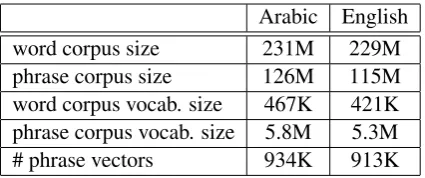
[image:6.595.71.293.62.161.2]# phrase vectors 934K 913K
Table 3: Phrase vectors statistics.
5.3 Phrase Vectors
Translation experiments pertaining to the pro-posed semantic feature are presented here. The feature is based on phrase vectors which are built with the word2vec toolkit in a similar way word vectors are trained, except that the training cor-pus is the phrase corcor-pus containing phrases con-structed as described in section 3. Once trained, a new feature is added to the phrase table. The fea-ture is computed for each phrase pair using phrase vectors as described in Eq. 3.
Table 3 shows statistics about the phrase corpus and the original word corpus it is based on. Al-gorithm 1 is used to build the phrase corpus using 5 passes. The number of phrase vectors trained using the phrase corpus are also shown. Note that the tool used does not produce vectors for all 5.8M Arabic and 5.3M English phrases in the vocab-ulary. Rather, noisy phrases are excluded from training, eventually leading to 934K Arabic and 913K English phrase embeddings.
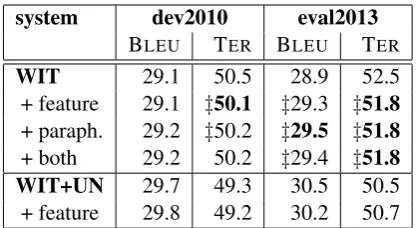
We perform two experiments on the IWSLT 2013 Arabic-to-English evaluation data set. In the first experiment, we examine how the semantic feature affects a small phrase table (2.3M phrase pairs) trained on the in-domain data (WIT). The second experiment deals with a larger phrase table (34M phrase pairs), constructed by a linear inter-polation between in- and out-of-domain phrase ta-bles including UN data, resulting in a competitive baseline. The two baselines have hierarchical re-ordering models (HRMs) and a tuned mixture LM, in addition to the standard models, as described in section 5.1. The results are shown in table 4.
Arabic Data English Data 1-best
Match % 5-bestMatches %
WIT+UN WIT+UN 8.0 26.1
WIT+UN+arGiga3 WIT+UN 10.9 32.2
WIT+UN WIT+UN+news 4.9 17.9
WIT+UN+arGiga3 WIT+UN+news 7.5 25.7
WIT+UN WIT+UN 8.4 27.2
WIT+UN WIT+UN+news 10.9 33.1
WIT+UN+arGiga3 WIT+UN 5.7 18.9
[image:7.595.136.465.61.202.2]WIT+UN+arGiga3 WIT+UN+news 8.3 25.2
Table 2: The effect of increasing the amount of data on the quality of word vectors. VSM-based scores are compared to IBM model 1 p(e|f)(upper half) and p(f|e)(lower half), effectively regarding the IBM 1 models as the true probability distributions. In the upper part, the projection is done on the representation of the Arabic word f, and the similarity is computed between the projection and the representation of the English worde. In the lower half of the table, the role of f andeis interchanged, where the English side in this case will be projected.
system dev2010 eval2013
BLEU TER BLEU TER
WIT 29.1 50.5 28.9 52.5
+ feature 29.1 ‡50.1 ‡29.3 ‡51.8
+ paraph. 29.2 ‡50.2 ‡29.5 ‡51.8
+ both 29.2 50.2 ‡29.4 ‡51.8
WIT+UN 29.7 49.3 30.5 50.5
+ feature 29.8 49.2 30.2 50.7
Table 4: Semantic feature and paraphrasing re-sults. The symbol ‡ indicates statistical signifi-cance with p<0.01.
features, which disregards context. As for the hi-erarchical reordering models which are part of the baseline, they do not capture lexical information about the context. They are only limited to the or-dering information. The skip-gram-based phrase vectors used for the semantic feature, on the other hand, discard ordering information, but uses con-textual lexical information for phrase representa-tion. In this sense, HRMs and the semantic feature can be said to complement each other. Using the semantic feature for the large phrase table did not yield improvements. The difference compared to the baseline in this case is not statistically signifi-cant.
All reported results are averages of 3 MERT op-timizer runs. Statistical significance is computed using the Approximate Randomization (AR) test. We used the multeval toolkit (Clark et al., 2011) for evaluation.
5.4 Paraphrasing and OOV Reduction
The next set of experiments investigates the re-duction of the OOV rate through paraphrasing, and its impact on translation. Paraphrasing is per-formed employing the cosine similarity, and thek -NN search is done on the source side, withk=3. The nearest neighbors are required to satisfy a ra-dius thresholdr>0.3, i.e., neighbors with a simi-larity value less or equal torare rejected. Training the projection matrices is performed using a small amount of training data amounting to less than 30k
translation pairs.
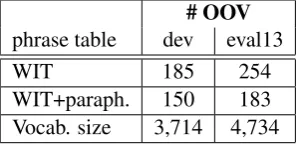
To examine the effect of OOV reduction, we perform paraphrasing on a resource-limited sys-tem, where a small amount of parallel data ex-ists, but a larger amount of monolingual data is available. Such a system is simulated by train-ing word vectors on the WIT+UN data monolin-gually , while extracting the phrase table using the much smaller in-domain WIT data set only. Table 5 shows the change in the number of OOV words after introducing the paraphrased rules to the WIT-based phrase table. 19% and 30% of the original OOVs are eliminated in the dev and eval13 sets, respectively. This reduction translates to an im-provement of 0.6% BLEUand 0.7% TERas indi-cated in table 4.
[image:7.595.77.286.313.427.2]# OOV
phrase table dev eval13
WIT 185 254
WIT+paraph. 150 183
Vocab. size 3,714 4,734
Table 5: OOV change due to paraphrasing. Vocab-ulary refers to the number of unique tokens in the Arabic dev and test sets.
OOV VSM-based
Translation Reference
I ® ºK
found unfoldedéQk
interested keenú æm.
jail imprisoned¨CK.
claim reporté.JÊÓ
confusing confoundingIJk
encourage rallied for [image:8.595.107.256.63.135.2]AKðQ¯
villagers redneckTable 6: Examples of OOV words that were trans-lated due to paraphrasing. The examples are extracted from the translation hypotheses of the small experiment.
OOV reduction. Examples are shown in Table 6. Although the reference words are not matched ex-actly, the VSM translations are semantically close to them, suggesting that OOV reduction in these cases was somewhat successful, although not re-warded by either of the scoring measures used.
6 Related Work
Bilingually-constrained phrase embeddings were developed in (Zhang et al., 2014). Initial embed-dings were trained in an unsupervised manner, fol-lowed by fine-tuning using bilingual knowledge to minimize the semantic distance between transla-tion equivalents, and maximizing the distance be-tween non-translation pairs. The embeddings are learned using recursive neural networks by de-composing phrases to their constituents. While our work includes bilingual constraints to learn phrase vectors, the constraints are implicit in the phrase corpus. Our approach is simple, focusing on the preprocessing step of preparing the phrase corpus, and therefore it can be used with different
existing frameworks that were developed for word vectors.
Zou et al. (2013) learn bilingual word embed-dings by designing an objective function that com-bines unsupervised training with bilingual con-straints based on word alignments. Similar to our work, they compute an additional feature for phrase pairs using cosine similarity. Word vec-tors are averaged to obtain phrase representations. In contrast, our approach learns phrase representa-tions directly.
Recurrent neural networks were used with min-imum translation units (Hu et al., 2014), which are phrase pairs undergoing certain constraints. At the input layer, each of the source and target phrases are modeled as a bag of words, while the output phrase is predicted word-by-word assuming con-ditional independence. The approach seeks to al-leviate data sparsity problems that would arise if phrases were to be uniquely distinguished. Our approach does not break phrases down to words, but learns phrase embeddings directly.
Chen et al. (2010) represent a rule in the hierar-chical phrase table using a bag-of-words approach. Instead, we learn phrase vectors directly without resorting to their constituent words. Moreover, they apply a count-based approach and employ IBM model 1 probabilities to project the target space to the source space. In contrast, our map-ping is similar to that of Mikolov et al. (2013a) and is learned directly from a small set of bilin-gual data.
Mikolov et al. (2013a) proposed an efficient method to learn word vectors through feed-forward neural networks by eliminating the hid-den layer. They do not report end-to-end sentence translation results as we do in this work.
Mikolov et al. (2013b) learn direct representa-tions of phrases after joining a training corpus us-ing a simple monolus-ingual point-wise mutual in-formation criterion with discounting. Our work exploits the rich bilingual knowledge provided by the phrase table to join the corpus instead.
We also do not follow their bag-of-words phrase model approach.
Marton et al. (2009) proposed to eliminate OOVs by looking for similar words using distri-butional vectors, but they prune the search space limiting it to candidates observed in the same con-text as that of the OOV. We do not employ such a heuristic. Instead, we perform a k-nearest neigh-bor search spanning the full phrase table to para-phrase its rules and generate new entries.
Estimating phrase table scores using monolin-gual data was investigated in (Klementiev et al., 2012), by building co-occurrence context vectors and using a small dictionary to induce new scores for existing phrase rules. Our work explores the use of distributional vectors extracted from neu-ral networks, moreover, we induce new phrase rules to extend the phrase table. New phrase rules were also generated in (Irvine and Callison-Burch, 2014), where new phrases were produced as a composition of unigram translations.
7 Conclusion
In this work we adapted vector space models to provide the state-of-the-art phrase-based statisti-cal machine translation system with semantic in-formation. We leveraged the bilingual knowledge of the phrase table to construct source and target phrase corpora to learn phrase vectors, which were used to provide semantic scoring of phrase pairs. Word vectors allowed to extend the phrase table and eliminate OOVs. Both methods proved bene-ficial for low-resource tasks.
Future work would investigate decoder inte-gration of semantic scoring that extends beyond phrase boundaries to provide semantically coher-ent translations.
Acknowledgments
This material is partially based upon work sup-ported by the DARPA BOLT project under Con-tract No. HR0011- 12-C-0015. Any opinions, findings and conclusions or recommendations ex-pressed in this material are those of the authors and do not necessarily reflect the views of DARPA. The research leading to these results has also re-ceived funding from the European Union Sev-enth Framework Programme (FP7/2007-2013) un-der grant agreement no287658.
References
Yoshua Bengio, Rejean Ducharme, and Pascal Vincent. 2003. A neural probabilistic language model. Jour-nal of Machine Learning Research, 3:1137–1155. Boxing Chen, George Foster, and Roland Kuhn. 2010.
Bilingual sense similarity for statistical machine translation. InProceedings of the 48th Annual Meet-ing of the Association for Computational LMeet-inguis- Linguis-tics, pages 834–843.
Jonathan H. Clark, Chris Dyer, Alon Lavie, and Noah A. Smith. 2011. Better hypothesis test-ing for statistical machine translation: Controlltest-ing for optimizer instability. In 49th Annual Meet-ing of the Association for Computational LMeet-inguis- Linguis-tics:shortpapers, pages 176–181, Portland, Oregon, June.
Ronan Collobert and Jason Weston. 2008. A unified architecture for natural language processing: Deep neural networks with multitask learning. In Pro-ceedings of the 25th international conference on Machine learning, pages 160–167. ACM.
Jacob Devlin, Rabih Zbib, Zhongqiang Huang, Thomas Lamar, Richard Schwartz, and John Makhoul. 2014. Fast and Robust Neural Network Joint Models for Statistical Machine Translation. In 52nd Annual Meeting of the Association for Computational Lin-guistics, Baltimore, MD, USA, June.
Michel Galley and Christopher D. Manning. 2008. A simple and effective hierarchical phrase reorder-ing model. In Proceedings of the Conference on Empirical Methods in Natural Language Process-ing, EMNLP ’08, pages 848–856, Stroudsburg, PA, USA. Association for Computational Linguistics. Jianfeng Gao, Xiaodong He, Wen-tau Yih, and
Li Deng. 2013. Learning semantic representations for the phrase translation model. arXiv preprint arXiv:1312.0482.
Zellig S Harris. 1954. Distributional structure. Word. Yuening Hu, Michael Auli, Qin Gao, and Jianfeng Gao.
2014. Minimum translation modeling with recur-rent neural networks. In Proceedings of the 14th Conference of the European Chapter of the Associ-ation for ComputAssoci-ational Linguistics, pages 20–29, Gothenburg, Sweden, April. Association for Com-putational Linguistics.
Ann Irvine and Chris Callison-Burch. 2014. Hal-lucinating phrase translations for low resource mt. InProceedings of the Conference on Computational Natural Language Learning (CoNLL).
Alexandre Klementiev, Ann Irvine, Chris Callison-Burch, and David Yarowsky. 2012. Toward statisti-cal machine translation without parallel corpora. In
Proceedings of the 13th Conference of the European Chapter of the Association for Computational Lin-guistics, pages 130–140. Association for Computa-tional Linguistics.
Thomas K Landauer and Susan T Dumais. 1997. A solution to plato’s problem: The latent semantic analysis theory of acquisition, induction, and rep-resentation of knowledge. Psychological review, 104(2):211.
Kevin Lund and Curt Burgess. 1996. Producing high-dimensional semantic spaces from lexical co-occurrence. Behavior Research Methods, Instru-ments, & Computers, 28(2):203–208.
Christopher D Manning, Prabhakar Raghavan, and Hinrich Sch¨utze. 2008. Introduction to informa-tion retrieval, volume 1. Cambridge university press Cambridge.
Yuval Marton, Chris Callison-Burch, and Philip Resnik. 2009. Improved statistical machine trans-lation using monolingually-derived paraphrases. In
Proceedings of the 2009 Conference on Empirical Methods in Natural Language Processing: Volume 1-Volume 1, pages 381–390. Association for Com-putational Linguistics.
Tomas Mikolov, Quoc V Le, and Ilya Sutskever. 2013a. Exploiting similarities among lan-guages for machine translation. arXiv preprint arXiv:1309.4168.
Tomas Mikolov, Ilya Sutskever, Kai Chen, Greg S Cor-rado, and Jeff Dean. 2013b. Distributed representa-tions of words and phrases and their compositional-ity. InAdvances in Neural Information Processing Systems, pages 3111–3119.
R.C. Moore and W. Lewis. 2010. Intelligent Selection of Language Model Training Data. InACL (Short Papers), pages 220–224, Uppsala, Sweden, July.
Franz Josef Och and Hermann Ney. 2002. Discrimi-native Training and Maximum Entropy Models for Statistical Machine Translation. InProc. of the 40th Annual Meeting of the Association for Computa-tional Linguistics (ACL), pages 295–302, Philadel-phia, PA, July.
Franz Josef Och and Hermann Ney. 2003. A System-atic Comparison of Various Statistical Alignment Models. Computational Linguistics, 29(1):19–51, March.
Franz Josef Och. 2003. Minimum Error Rate Training in Statistical Machine Translation. InProc. of the 41th Annual Meeting of the Association for Com-putational Linguistics (ACL), pages 160–167, Sap-poro, Japan, July.
Holger Schwenk. 2007. Continuous space language models.Computer Speech & Language, 21(3):492– 518.
Andreas Stolcke. 2002. SRILM – An Extensible Lan-guage Modeling Toolkit. InProc. of the Int. Conf. on Speech and Language Processing (ICSLP), vol-ume 2, pages 901–904, Denver, CO, September. Martin Sundermeyer, Tamer Alkhouli, Joern Wuebker,
and Hermann Ney. 2014. Translation Modeling with Bidirectional Recurrent Neural Networks. In
Proceedings of the Conference on Empirical Meth-ods on Natural Language Processing, October. Peter D Turney, Patrick Pantel, et al. 2010. From
frequency to meaning: Vector space models of se-mantics. Journal of artificial intelligence research, 37(1):141–188.
David Vilar, Daniel Stein, Matthias Huck, and Her-mann Ney. 2010. Jane: Open source hierarchi-cal translation, extended with reordering and lexi-con models. InACL 2010 Joint Fifth Workshop on Statistical Machine Translation and Metrics MATR, pages 262–270, Uppsala, Sweden, July.
Joern Wuebker, Matthias Huck, Stephan Peitz, Malte Nuhn, Markus Freitag, Jan-Thorsten Peter, Saab Mansour, and Hermann Ney. 2012. Jane 2: Open source phrase-based and hierarchical statistical ma-chine translation. In International Conference on Computational Linguistics, pages 483–491, Mum-bai, India, December.
Jiajun Zhang, Shujie Liu, Mu Li, Ming Zhou, and Chengqing Zong. 2014. Bilingually-constrained phrase embeddings for machine translation. In Pro-ceedings of the 52th Annual Meeting on Associa-tion for ComputaAssocia-tional Linguistics. AssociaAssocia-tion for Computational Linguistics.
Will Y Zou, Richard Socher, Daniel M Cer, and Christopher D Manning. 2013. Bilingual word em-beddings for phrase-based machine translation. In