
Integrating Translation Memory into Phrase-Based
Machine Translation during Decoding
Kun Wang
†Chengqing Zong
†Keh-Yih Su
‡ †National Laboratory of Pattern Recognition, Institute of Automation,
Chinese Academy of Sciences, Beijing, China
‡
Behavior Design Corporation, Taiwan
†
{kunwang, cqzong}@nlpr.ia.ac.cn,
‡[email protected]
Abstract
Since statistical machine translation (SMT) and translation memory (TM) complement each other in matched and unmatched regions, integrated models are proposed in this paper to incorporate TM information into phrase-based SMT. Unlike previous multi-stage pipeline approaches, which directly merge TM result into the final output, the proposed models refer to the corresponding TM information associat-ed with each phrase at SMT decoding. On a Chinese–English TM database, our experi-ments show that the proposed integrated Mod-el-III is significantly better than either the SMT or the TM systems when the fuzzy match score is above 0.4. Furthermore, integrated Model-III achieves overall 3.48 BLEU points improvement and 2.62 TER points reduction in comparison with the pure SMT system. Be-sides, the proposed models also outperform previous approaches significantly.
1
Introduction
Statistical machine translation (SMT), especially the phrase-based model (Koehn et al., 2003), has developed very fast in the last decade. For cer-tain language pairs and special applications, SMT output has reached an acceptable level, es-pecially in the domains where abundant parallel corpora are available (He et al., 2010). However, SMT is rarely applied to professional translation because its output quality is still far from satis-factory. Especially, there is no guarantee that a SMT system can produce translations in a con-sistent manner (Ma et al., 2011).
In contrast, translation memory (TM), which uses the most similar translation sentence (usual-ly above a certain fuzzy match threshold) in the database as the reference for post-editing, has
been widely adopted in professional translation field for many years (Lagoudaki, 2006). TM is very useful for repetitive material such as updat-ed product manuals, and can give high quality and consistent translations when the similarity of fuzzy match is high. Therefore, professional translators trust TM much more than SMT. However, high-similarity fuzzy matches are available unless the material is very repetitive.
In general, for those matched segments1, TM provides more reliable results than SMT does. One reason is that the results of TM have been revised by human according to the global context, but SMT only utilizes local context. However, for those unmatched segments, SMT is more re-liable. Since TM and SMT complement each other in those matched and unmatched segments, the output quality is expected to be raised signif-icantly if they can be combined to supplement each other.
In recent years, some previous works have in-corporated TM matched segments into SMT in a pipelined manner (Koehn and Senellart, 2010; Zhechev and van Genabith, 2010; He et al., 2011; Ma et al., 2011). All these pipeline approaches translate the sentence in two stages. They first determine whether the extracted TM sentence pair should be adopted or not. Most of them use fuzzy match score as the threshold, but He et al. (2011) and Ma et al. (2011) use a classifier to make the judgment. Afterwards, they merge the relevant translations of matched segments into the source sentence, and then force the SMT sys-tem to only translate those unmatched segments at decoding.
There are three obvious drawbacks for the above pipeline approaches. Firstly, all of them determine whether those matched segments
1
We mean “sub-sentential segments” in this work.
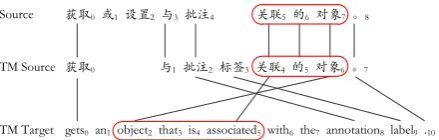
should be adopted or not at sentence level. That is, they are either all adopted or all abandoned regardless of their individual quality. Secondly, as several TM target phrases might be available for one given TM source phrase due to insertions, the incorrect selection made in the merging stage cannot be remedied in the following translation stage. For example, there are six possible corre-sponding TM target phrases for the given TM source phrase “关联4 的5 对象6” (as shown in Figure 1) such as “object2 that3is4 associated5”, and “an1object2that3is4associated5 with6”, etc. And it is hard to tell which one should be adopt-ed in the merging stage. Thirdly, the pipeline approach does not utilize the SMT probabilistic information in deciding whether a matched TM phrase should be adopted or not, and which tar-get phrase should be selected when we have mul-tiple candidates. Therefore, the possible im-provements resulted from those pipeline ap-proaches are quite limited.
On the other hand, instead of directly merging TM matched phrases into the source sentence, some approaches (Biçici and Dymetman, 2008; Simard and Isabelle, 2009) simply add the long-est matched pairs into SMT phrase table, and then associate them with a fixed large probability value to favor the corresponding TM target phrase at SMT decoding. However, since only one aligned target phrase will be added for each matched source phrase, they share most draw-backs with the pipeline approaches mentioned above and merely achieve similar performance.
To avoid the drawbacks of the pipeline ap-proach (mainly due to making a hard decision before decoding), we propose several integrated models to completely make use of TM infor-mation during decoding. For each TM source phrase, we keep all its possible corresponding target phrases (instead of keeping only one of them). The integrated models then consider all corresponding TM target phrases and SMT pref-erence during decoding. Therefore, the proposed integrated models combine SMT and TM at a deep level (versus the surface level at which TM result is directly plugged in under previous pipe-line approaches).
On a Chinese–English computer technical documents TM database, our experiments have shown that the proposed Model-III improves the translation quality significantly over either the pure phrase-based SMT or the TM systems when the fuzzy match score is above 0.4. Compared with the pure SMT system, the proposed inte-grated Model-III achieves 3.48 BLEU points im-provement and 2.62 TER points reduction over-all. Furthermore, the proposed models signifi-cantly outperform previous pipeline approaches.
2
Problem Formulation
Compared with the standard phrase-based ma-chine translation model, the translation problem is reformulated as follows (only based on the best TM, however, it is similar for multiple TM sentences):
(1)
Where is the given source sentence to be trans-lated, is the corresponding target sentence and is the final translation;
are the associated information of the best TM sentence-pair; and denote the corre-sponding TM sentence pair; denotes its associated fuzzy match score (from 0.0 to 1.0); is the editing operations between and ; and denotes the word alignment between
and .
Let and denote the k-th associated source phrase and target phrase, respectively. Also, and denote the associated source phrase sequence and the target phrase sequence, respectively (total phrases without insertion). Then the above formula (1) can be decomposed as below:
(2)
Afterwards, for any given source phrase , we can find its corresponding TM source phrase and all possible TM target phrases (each of them is denoted by ) with the help of corresponding editing operations and word alignment . As mentioned above, we can have six different possible TM target phrases for the TM source phrase “关联4 的5对象6”. This 获取0 与1 批注2 标签3 关联4 的5 对象6 。7
获取0 或1 设置2 与3 批注4 关联5 的6 对象7 。8
gets0 an1 object2 that3 is4 associated5 with6 the7 annotation8 label9 .10 Source
TM Source
[image:2.595.71.291.70.140.2]TM Target
is because there are insertions around the directly aligned TM target phrase.
In the above Equation (2), we first segment the given source sentence into various phrases, and then translate the sentence based on those source phrases. Also, is replaced by , as they are actually the same segmentation sequence. Assume that the segmentation probability is a uniform distribution, with the corre-sponding TM source and target phrases obtained above, this problem can be further simplified as follows:
(3)
Where is the corresponding TM phrase matching status for , which is a vector consist-ing of various indicators (e.g., Target Phrase Content Matching Status, etc., to be defined lat-er), and reflects the quality of the given candi-date; is the linking status vector of (the aligned source phrase of within ), and indi-cates the matching and linking status in the source side (which is closely related to the status in the target side); also, indicates the corre-sponding TM fuzzy match interval specified later.
In the second line of Equation (3), we convert the fuzzy match score into its correspond-ing interval , and incorporate all possible com-binations of TM target phrases. Afterwards, we select the best one in the third line. Last, in the fourth line, we introduce the source matching status and the target linking status (detailed fea-tures would be defined later). Since we might have several possible TM target phrases , the one with the maximum score will be adopted during decoding.
The first factor in the above for-mula (3) is just the typical phrase-based SMT model, and the second factor (to be specified in the Section 3) is the information de-rived from the TM sentence pair. Therefore, we can still keep the original phrase-based SMT model and only pay attention to how to extract
useful information from the best TM sentence pair to guide SMT decoding.
3
Proposed Models
Three integrated models are proposed to incorpo-rate different features as follows:
3.1 Model-I
In this simplest model, we only consider Target Phrase Content Matching Status (TCM) for . For , we consider four different features at the same time: Source Phrase Content Matching Status (SCM), Number of Linking Neighbors (NLN), Source Phrase Length (SPL), and Sen-tence End Punctuation Indicator (SEP). Those features will be defined below. is then specified as:
All features incorporated in this model are speci-fied as follows:
TM Fuzzy Match Interval (z): The fuzzy match
score (FMS) between source sentence and TM source sentence indicates the reliability of the given TM sentence, and is defined as (Sikes, 2007):
Where is the word-based Levenshtein Distance (Levenshtein, 1966) be-tween and . We equally divide FMS into ten fuzzy match intervals such as: [0.9, 1.0), [0.8, 0.9) etc., and the index specifies the corre-sponding interval. For example, since the fuzzy match score between and in Figure 1 is 0.667, then .
Target Phrase Content Matching Status
(TCM): It indicates the content matching status
between and , and reflects the quality of . Because is nearly perfect when FMS is high, if the similarity between and
is high, it implies that the given is possibly a good candidate. It is a member of {Same, High, Low, NA (Not-Applicable)}, and isspecified as: (1) If is not null:
(a) if , ;
(b) else if , ;
(c) else, ;
(2) If is null, ;
aligned with . In the example of Figure 1, assume that the given is “关联 5
的6 对象7” and is “object that is associated”. If is “object2 that3 is4 associated5”, ; if is “an1 object2 that3 is4associated5”, .
Source Phrase Content Matching Status
(SCM): Which indicates the content matching
status between and , and it affects the matching status of and greatly. The more similar is to , the more similar is to . It is a member of {Same, High, Low, NA} and is defined as:
(1) If is not null:
(a) if , ;
(b) else if ,
; (c) else, ;
(2) If is null, ;
Here is null means that there is no corre-sponding TM source phrase for the giv-en source phrase . Take the source phrase
“关联5 的6 对象7” in Figure 1 for an ex-ample, since its corresponding is “关联4
的5对象6”, then .
Number of Linking Neighbors(NLN): Usually,
the context of a source phrase would affect its target translation. The more similar the context are, the more likely that the translations are the same. Therefore, this NLN feature reflects the number of matched neighbors (words) and it is a vector of <x, y>. Where “x” denotes the number of matched source neighbors; and “y” denotes how many those neighbors are also linked to tar-get words (not null), which also affects the TM target phrase selection. This feature is a member of {<x, y>: <2, 2>, <2, 1>, <2, 0>, <1, 1>, <1, 0>, <0, 0>}. For the source phrase “关联5的6对象 7” in Figure 1, the corresponding TM source phrase is “关联 4 的 5 对象 6” . As only their right neighbors “。8” and “。7” are matched, and “。7” is aligned with “.10”, NLN will be <1, 1>.
Source Phrase Length(SPL): Usually the
long-er the source phrase is, the more reliable the TM target phrase is. For example, the corresponding for the source phrase with 5 words would be more reliable than that with only one word. This feature denotes the number of words included in , and is a member of {1, 2, 3, 4, ≥5}. For the case “关联5的6对象7”, SPL will be 3.
Sentence End Punctuation Indicator (SEP):
Which indicates whether the current phrase is a punctuation at the end of the sentence, and is a member of {Yes, No}. For example, the SEP for “关联 5 的 6 对象 7” will be “No”. It is intro-duced because the SCM and TCM for a sen-tence-end-punctuation are always “Same” re-gardless of other features. Therefore, it is used to distinguish this special case from other cases.
3.2 Model-II
As Model-I ignores the relationship among vari-ous possible TM target phrases, we add two fea-tures TM Candidate Set Status (CSS) and Long-est TM Candidate Indicator (LTC) to incorporate this relationship among them. Since CSS is re-dundant after LTC is known, we thus ignore it for evaluating TCM probability in the following derivation:
The two new features CSS and LTC adopted in Model-II are defined as follows:
TM Candidate Set Status (CSS): Which
re-stricts the possible status of , and is a member of {Single, Left-Ext, Right-Ext, Both-Ext, NA}. Where “Single” means that there is only one candidate for the given source phrase ; “Left-Ext” means that there are multiple candidates, and all the candi-dates are generated by extending only the left boundary; “Right-Ext” means that there are mul-tiple candidates, and all the candidates are generated by only extending to the right; “Both-Ext” means that there are multiple
candidates, and the candidates are generated by extending to both sides; “NA” means that
is null.
For “关联 4 的 5 对象 6” in Figure 1, the linked TM target phrase is “object2that3is4 asso-ciated5”, and there are 5 other candidates by ex-tending to both sides. Therefore,
.
Longest TM Candidate Indicator (LTC):
is only extended to the left and is the longest one; “Right-Longest” means that the giv-en is only extended to the right and is the longest one; “Both-Longest” means that the given is extended to both sides and is the longest one; “Medium” means that the given has been extended but not the longest one; “NA” means that is null.
For “object2 that3 is4 associated5” in Figure 1, ; for “an1 ob-ject2 that3 is4 associated5”, ; for the longest “an1 object2 that3 is4 as-sociated5with6the7”, .
3.3 Model-III
The abovementioned integrated models ignore the reordering information implied by TM. Therefore, we add a new feature Target Phrase Adjacent Candidate Relative Position Matching Status (CPM) into Model-II and Model-III is given as:
We assume that CPM is independent with SPL and SEP, because the length of source phrase would not affect reordering too much and SEP is used to distinguish the sentence end punctuation with other phrases.
The new feature CPM adopted in Model-III is defined as:
Target Phrase Adjacent Candidate Relative
Position Matching Status (CPM): Which
indi-cates the matching status between the relative position of and the relative position of
. It checks if are positioned in the same order with
, and reflects the quality of ordering the given target candidate . It is a member of {Adjacent-Same, Adjacent-Substitute, Linked-Interleaved, Linked-Cross, Linked-Reversed, Forward, Cross, Skip-Reversed, NA}. Recall that is always right ad-jacent to , then various cases are defined as follows:
(1) If both and are not null: (a) If is on the right of
and they are also adjacent to each other: i. If the right boundary words of and
are the same, and the left
boundary words of and are
the same, ;
ii. Otherwise, ;
(b) If is on the right of
but they are not adjacent to each other, ;
(c) If is not on the right of :
i. If there are cross parts between
and , ;
ii. Otherwise, ;
(2) If is null but is not null, then find the first which is not null ( starts from 2)2:
(a) If is on the right of , ;
(b) If is not on the right of :
i. If there are cross parts between
and , ;
ii. Otherwise, .
(3) If is null, .
In Figure 1, assume that , and are “gets an”, “object that is associat-ed with” and “gets0 an1”, respectively. For
“object2 that3 is4 associated5”, because is on the right of and they are adjacent pair, and both boundary words (“an” and “an1”; “object” and “object2”) are matched, ; for “an1 object2 that3 is4 associated5”, because there are cross parts “an1” between and , . On the other hand, as-sume that , and are “gets”, “ ob-ject that is associated with” and “gets0”, respec-tively. For “an1 object2 that3 is4 associ-ated5”, because and are adja-cent pair, but the left boundary words of and
(“object” and “an1”) are not matched, ; for “object2 that3 is4 associated5”, because is on the right of but they are not adjacent pair,
therefore, . One more
example, assume that , and are “the annotation label”, “object that is associated with” and “the7 annotation8 label9”, respectively. For “an1 object2 that3 is4 associated5”, because is on the left of , and there are no cross parts, .
2
4
Experiments
4.1 Experimental Setup
Our TM database consists of computer domain Chinese-English translation sentence-pairs, which contains about 267k sentence-pairs. The average length of Chinese sentences is 13.85 words and that of English sentences is 13.86 words. We randomly selected a development set and a test set, and then the remaining sentence pairs are for training set. The detailed corpus sta-tistics are shown in Table 1. Furthermore, devel-opment set and test set are divided into various intervals according to their best fuzzy match scores. Corpus statistics for each interval in the test set are shown in Table 2.
For the phrase-based SMT system, we adopted the Moses toolkit (Koehn et al., 2007). The sys-tem configurations are as follows: GIZA++ (Och and Ney, 2003) is used to obtain the bidirectional word alignments. Afterwards, “intersection” 3 refinement (Koehn et al., 2003) is adopted to ex-tract phrase-pairs. We use the SRI Language Model toolkit (Stolcke, 2002) to train a 5-gram model with modified Kneser-Ney smoothing (Kneser and Ney, 1995; Chen and Goodman, 1998) on the target-side (English) training corpus. All the feature weights and the weight for each probability factor (3 factors for Model-III) are tuned on the development set with minimum-error-rate training (MERT) (Och, 2003). The maximum phrase length is set to 7 in our exper-iments.
In this work, the translation performance is measured with case-insensitive BLEU-4 score (Papineni et al., 2002) and TER score (Snover et al., 2006). Statistical significance test is conduct-ed with re-sampling (1,000 times) approach (Koehn, 2004) in 95% confidence level.
4.2 Cross-Fold Translation
To estimate the probabilities of proposed models, the corresponding phrase segmentations for bi-lingual sentences are required. As we want to check what actually happened during decoding in the real situation, cross-fold translation is used to obtain the corresponding phrase segmentations. We first extract 95% of the bilingual sentences as a new training corpus to train a SMT system. Afterwards, we generate the corresponding phrase segmentations for the remaining 5%
3
“grow-diag-final” and “grow-diag-final-and” are also test-ed. However, “intersection” is the best option in our exper-iments, especially for those high fuzzy match intervals.
lingual sentences with Forced Decoding (Li et al., 2000; Zollmann et al., 2008; Auli et al., 2009; Wisniewski et al., 2010), whichsearches the best phrase segmentation for the specified output. Having repeated the above steps 20 times4, we obtain the corresponding phrase segmentations for the SMT training data (which will then be used to train the integrated models).
Due to OOV words and insertion words, not all given source sentences can generate the de-sired results through forced decoding. Fortunate-ly, in our work, 71.7% of the training bilingual sentences can generate the corresponding target results. The remaining 28.3% of the sentence pairs are thus not adopted for generating training samples. Furthermore, more than 90% obtained source phrases are observed to be less than 5 words, which explains why five different quanti-zation levels are adopted for Source Phrase Length (SPL)in section 3.1.
4.3 Translation Results
After obtaining all the training samples via cross-fold translation, we use Factored Language Model toolkit (Kirchhoff et al., 2007) to estimate the probabilities of integrated models with Wit-ten-Bell smoothing (Bell et al., 1990; Witten et al., 1991) and Back-off method. Afterwards, we incorporate the TM information for each phrase at decoding. All experiments are
4
This training process only took about 10 hours on our Ubuntu server (Intel 4-core Xeon 3.47GHz, 132 GB of RAM).
Train Develop Test #Sentences 261,906 2,569 2,576
#Chn. Words 3,623,516 38,585 38,648
#Chn. VOC. 43,112 3,287 3,460
#Eng. Words 3,627,028 38,329 38,510
#Eng. VOC. 44,221 3,993 4,046
Table 1: Corpus Statistics
Intervals #Sentences #Words W/S
[0.9, 1.0) 269 4,468 16.6
[0.8, 0.9) 362 5,004 13.8
[0.7, 0.8) 290 4,046 14.0
[0.6, 0.7) 379 4,998 13.2
[0.5, 0.6) 472 6,073 12.9
[0.4, 0.5) 401 5,921 14.8
[0.3, 0.4) 305 5,499 18.0
(0.0, 0.3) 98 2,639 26.9
(0.0, 1.0) 2,576 38,648 15.0
Intervals TM SMT Model-I Model-II Model-III Koehn-10 Ma-11 Ma-11-U
[0.9, 1.0) 81.31 81.38 85.44 * 86.47 *# 89.41 *# 82.79 77.72 82.78
[0.8, 0.9) 73.25 76.16 79.97 * 80.89 * 84.04 *# 79.74 * 73.00 77.66
[0.7, 0.8) 63.62 67.71 71.65 * 72.39 * 74.73 *# 71.02 * 66.54 69.78
[0.6, 0.7) 43.64 54.56 54.88 # 55.88 *# 57.53 *# 53.06 54.00 56.37
[0.5, 0.6) 27.37 46.32 47.32 *# 47.45 *# 47.54 *# 39.31 46.06 47.73
[0.4, 0.5) 15.43 37.18 37.25 # 37.60 # 38.18 *# 28.99 36.23 37.93
[0.3, 0.4) 8.24 29.27 29.52 # 29.38 # 29.15 # 23.58 29.40 30.20
(0.0, 0.3) 4.13 26.38 25.61 # 25.32 # 25.57 # 18.56 26.30 26.92
[image:7.595.72.527.239.360.2](0.0, 1.0) 40.17 53.03 54.57 *# 55.10 *# 56.51 *# 50.31 51.98 54.32
Table 3: Translation Results (BLEU%). Scores marked by “*” are significantly better (p < 0.05) than both TM and SMT systems, and those marked by “#” are significantly better (p < 0.05) than Koehn-10.
Intervals TM SMT Model-I Model-II Model-III Koehn-10 Ma-11 Ma-11-U
[0.9, 1.0) 9.79 13.01 9.22 # 8.52 *# 6.77 *# 13.01 18.80 11.90
[0.8, 0.9) 16.21 16.07 13.12 *# 12.74 *# 10.75 *# 15.27 20.60 14.74
[0.7, 0.8) 27.79 22.80 19.10 *# 18.58 *# 17.11 *# 21.85 25.33 21.11
[0.6, 0.7) 46.40 33.38 32.63 # 32.27 *# 29.96 *# 35.93 35.24 31.76
[0.5, 0.6) 62.59 39.56 38.24 *# 38.77 *# 38.74 *# 47.37 40.24 38.01
[0.4, 0.5) 73.93 47.19 47.03 # 46.34 *# 46.00 *# 56.84 48.74 46.10
[0.3, 0.4) 79.86 55.71 55.38 # 55.44 # 55.87 # 64.55 55.93 54.15
(0.0, 0.3) 85.31 61.76 62.38 # 63.66 # 63.51 # 73.30 63.00 60.67
(0.0, 1.0) 50.51 35.88 34.34 *# 34.18 *# 33.26 *# 40.75 38.10 34.49
Table 4: Translation Results (TER%). Scores marked by “*” are significantly better (p < 0.05) than both TM and SMT systems, and those marked by “#” are significantly better (p < 0.05) than Koehn-10.
conducted using the Moses phrase-based decoder (Koehn et al., 2007).
Table 3 and 4 give the translation results of TM, SMT, and three integrated models in the test set. In the tables, the best translation results (ei-ther in BLEU or TER) at each interval have been marked in bold. Scores marked by “*” are signif-icantly better (p < 0.05) than both the TM and the SMT systems.
It can be seen that TM significantly exceeds SMT at the interval [0.9, 1.0) in TER score, which illustrates why professional translators prefer TM rather than SMT as their assistant tool. Compared with TM and SMT, Model-I is signif-icantly better than the SMT system in either BLEU or TER when the fuzzy match score is above 0.7; Model-II significantly outperforms both the TM and the SMT systems in either BLEU or TER when the fuzzy match score is above 0.5; Model-III significantly exceeds both the TM and the SMT systems in either BLEU or TER when the fuzzy match score is above 0.4. All these improvements show that our integrated models have combined the strength of both TM and SMT.
However, the improvements from integrated models get less when the fuzzy match score de-creases. For example, Model-III outperforms
SMT 8.03 BLEU points at interval [0.9, 1.0), while the advantage is only 2.97 BLEU points at interval [0.6, 0.7). This is because lower fuzzy match score means that there are more un-matched parts between and ; the output of TM is thus less reliable.
Across all intervals (the last row in the table), Model-III not only achieves the best BLEU score (56.51), but also gets the best TER score (33.26). If intervals are evaluated separately, when the fuzzy match score is above 0.4, Model-III out-performs both Model-II and Model-I in either BLEU or TER. Model-II also exceeds Model-I in either BLEU or TER. The only exception is at interval [0.5, 0.6), in which Model-I achieves the best TER score. This might be due to that the optimization criterion for MERT is BLEU rather than TER in our work.
4.4 Comparison with Previous Work
In order to compare our proposed models with previous work, we re-implement two XML-Markup approaches: (Koehn and Senellart, 2010) and (Ma et al, 2011), which are denoted as
Koehn-10 and Ma-11, respectively. They are
Source 如果0禁用1此2策略3设置4,5 internet6 explorer7不8搜索9 internet10查找11浏览器12 的13新14版本15,16因此17不18会19提示20用户21安装22。23
Reference
if0 you1 disable2 this3 policy4 setting5 ,6 internet7 explorer8 does9 not10 check11 the12 internet13 for14 new15 versions16 of17 the18 browser19 ,20 so21 does22 not23 prompt24 users25 to26 install27 them28 .29
TM Source
如果0不1配置2此3策略4设置5,6 internet7 explorer8不9搜索10 internet11查找12浏览
器13的14新15版本16,17因此18不19会20提示21用户22安装23。24
TM Target
if0 you1 do2 not3 configure4 this5 policy6 setting7 ,8 internet9 explorer10 does11 not12 check13 the14 internet15 for16 new17 versions18 of19 the20 browser21 ,22 so23 does24 not25 prompt26 users27 to28 install29 them30 .31
TM Alignment
0-0 1-3 2-4 3-5 4-6 5-7 6-8 7-9 8-10 9-11 11-15 13-21 14-19 15-17 16-18 17-22 18-23 19-24 21-26 22-27 23-29 24-31
SMT
if you disable this policy setting , internet explorer does not prompt users to install internet for new versions of the browser . [Miss 7 target words: 9~12, 20~21, 28; Has one wrong permuta-tion]
Koehn-10
if you do you disable this policy setting , internet explorer does not check the internet for new versions of the browser , so does not prompt users to install them . [Insert two spurious target words]
Ma-11
if you disable this policy setting , internet explorer does not prompt users to install internet for new versions of the browser . [Miss 7 target words: 9~12, 20~21, 28; Has one wrong permuta-tion]
Model-I
if you disable this policy setting , internet explorer does not prompt users to install new ver-sions of the browser , so does not check the internet . [Miss 2 target words: 14, 28; Has one wrong permutation]
Model-II
if you disable this policy setting , internet explorer does not prompt users to install new ver-sions of the browser , so does not check the internet . [Miss 2 target words: 14, 28; Has one wrong permutation]
Model-III if you disable this policy setting , internet explorer does not check the internet for new versions
[image:8.595.72.527.77.419.2]of the browser , so does not prompt users to install them . [Exactly the same as the reference]
Figure 2: A Translation Example at Interval [0.9, 1.0] (with FMS=0.920)
Koehn et al. (2010) first find out the un-matched parts between the given source sentence and TM source sentence. Afterwards, for each unmatched phrase in the TM source sentence, they replace its corresponding translation in the TM target sentence by the corresponding source phrase in the input sentence, and then mark the substitution part. After replacing the correspond-ing translations of all unmatched source phrases in the TM target sentence, an XML input sen-tence (with mixed TM target phrases and marked input source phrases) is thus obtained. The SMT decoder then only translates the un-matched/marked source phrases and gets the de-sired results. Therefore, the inserted parts in the TM target sentence are automatically included. They use fuzzy match score to determine wheth-er the current sentence should be marked or not; and their experiments show that this method is only effective when the fuzzy match score is above 0.8.
Ma et al. (2011) think fuzzy match score is not reliable and use a discriminative learning method to decide whether the current sentence should be
marked or not. Another difference between Ma-11 and Koehn-10 is how the XML input is con-structed. In constructing the XML input sentence, Ma-11 replaces each matched source phrase in the given source sentence with the corresponding TM target phrase. Therefore, the inserted parts in the TM target sentence are not included. In Ma’s another paper (He et al., 2011), more linguistic features for discriminative learning are also add-ed. In our work, we only re-implement the XML-Markup method used in (He et al., 2011; Ma et al, 2011), but do not implement the discriminative learning method. This is because the features adopted in their discriminative learning are com-plicated and difficult to re-implement. However, the proposed Model-III even outperforms the upper bound of their methods, which will be dis-cussed later.
upper bound according to the method described in (Ma et al., 2011). Since He et al., (2011) only add more linguistic features to the discriminative learning method, the upper bound of (He et al., 2011) is still the same with (Ma et al., 2011); therefore, Ma-11-U applies for both cases.
It is observed that Model-III significantly ex-ceeds Koehn-10 at all intervals. More important-ly, the proposed models achieve much better TER score than the TM system does at interval [0.9, 1.0), but Koehn-10 does not even exceed the TM system at this interval. Furthermore, Model-III is much better than Ma-11-U at most intervals. Therefore, it can be concluded that the proposed models outperform the pipeline ap-proaches significantly.
Figure 2 gives an example at interval [0.9, 1.0), which shows the difference among different sys-tem outputs. It can be seen that “you do” is re-dundant for Koehn-10, because they are inser-tions and thus are kept in the XML input. How-ever, SMT system still inserts another “you”, regardless of “you do” has already existed. This problem does not occur at Ma-11, but it misses some words and adopts one wrong permutation. Besides, Model-I selects more right words than SMT does but still puts them in wrong positions due to ignoring TM reordering information. In this example, Model-II obtains the same results with Model-I because it also lacks reordering information. Last, since Model-III considers both TM content and TM position information, it gives a perfect translation.
5
Conclusion and Future Work
Unlike the previous pipeline approaches, which directly merge TM phrases into the final transla-tion result, we integrate TM informatransla-tion of each source phrase into the phrase-based SMT at de-coding. In addition, all possible TM target phrases are kept and the proposed models select the best one during decoding via referring SMT information. Besides, the integrated model con-siders the probability information of both SMT and TM factors.
The experiments show that the proposed Model-III outperforms both the TM and the SMT systems significantly (p < 0.05) in either BLEU or TER when fuzzy match score is above 0.4. Compared with the pure SMT system, Model-III achieves overall 3.48 BLEU points improvement and 2.62 TER points reduction on a Chinese–
English TM database. Furthermore, Model-III significantly exceeds all previous pipeline
ap-proaches. Similar improvements are also ob-served on the Hansards parts of LDC2004T08 (not shown in this paper due to space limitation). Since no language-dependent feature is adopted, the proposed approaches can be easily adapted for other language pairs.
Moreover, following the approaches of Koehn-10 and Ma-11 (to give a fair comparison), training data for SMT and TM are the same in the current experiments. However, the TM is expected to play an even more important role when the SMT training-set differs from the TM database, as additional phrase-pairs that are un-seen in the SMT phrase table can be extracted from TM (which can then be dynamically added into the SMT phrase table at decoding time). Our another study has shown that the integrated mod-el would be even more effective when the TM database and the SMT training data-set are from different corpora in the same domain (not shown in this paper). In addition, more source phrases can be matched if a set of high-FMS sentences, instead of only the sentence with the highest FMS, can be extracted and referred at the same time. And it could further raise the performance.
Last, some related approaches (Smith and Clark, 2009; Phillips, 2011) combine SMT and example-based machine translation (EBMT) (Nagao, 1984). It would be also interesting to compare our integrated approach with that of theirs.
Acknowledgments
The research work has been funded by the Hi-Tech Research and Development Program (“863” Program) of China under Grant No. 2011AA01A207, 2012AA011101, and 2012AA011102 and also supported by the Key Project of Knowledge Innovation Program of Chinese Academy of Sciences under Grant No.KGZD-EW-501.
The authors would like to thank the anony-mous reviewers for their insightful comments and suggestions. Our sincere thanks are also ex-tended to Dr. Yanjun Ma and Dr. Yifan He for their valuable discussions during this study.
References
Timothy C. Bell, J.G. Cleary and Ian H. Witten, 1990. Text compression: Prentice Hall, Englewood Cliffs, NJ.
Ergun Biçici and Marc Dymetman. 2008. Dynamic translation memory: using statistical machine trans-lation to improve transtrans-lation memory fuzzy match-es. In Proceedings of the 9th International Confer-ence on Intelligent Text Processing and Computa-tional Linguistics (CICLing 2008), pages 454–465.
Stanley F. Chen and Joshua Goodman. 1998. An em-pirical study of smoothing techniques for language modeling. Technical Report TR-10-98, Harvard University Center for Research in Computing Technology.
Yifan He, Yanjun Ma, Josef van Genabith and Andy Way, 2010. Bridging SMT and TM with transla-tion recommendatransla-tion. In Proceedings of the 48th Annual Meeting of the Association for Computa-tional Linguistics (ACL), pages 622–630.
Yifan He, Yanjun Ma, Andy Way and Josef van Genabith. 2011. Rich linguistic features for transla-tion memory-inspired consistent translatransla-tion. In
Proceedings of the Thirteenth Machine Translation Summit, pages 456–463.
Reinhard Kneser and Hermann Ney. 1995. Improved backing-off for m-gram language modeling. In
Proceedings of the IEEE International Conference on Acoustics, Speech and Signal Processing, pages 181–184.
Katrin Kirchhoff, Jeff A. Bilmes and Kevin Duh. 2007. Factored language models tutorial. Technical report, Department of Electrical Engineering, Uni-versity of Washington, Seattle, Washington, USA.
Philipp Koehn. 2004. Statistical significance tests for machine translation evaluation. In Proceedings of the 2004 Conference on Empirical Methods in Natural Language Processing (EMNLP), pages 388–395, Barcelona, Spain.
Philipp Koehn, Hieu Hoang, Alexandra Birch, Chris Callison-Burch, Marcello Federico, Nicola Bertoldi, Brooke Cowan, Wade Shen, Christine Moran, Richard Zens, Chris Dyer and Ondřej Bojar. 2007. Moses: Open source toolkit for statistical machine translation. In Proceedings of the ACL 2007 Demo and Poster Sessions, pages 177–180.
Philipp Koehn, Franz Josef Och and Daniel Marcu. 2003. Statistical phrase-based translation. In Pro-ceedings of the 2003 Conference of the North American Chapter of the Association for Computa-tional Linguistics on Human Language Technology, pages 48–54.
Philipp Koehn and Jean Senellart. 2010. Convergence of translation memory and statistical machine translation. In AMTA Workshop on MT Research and the Translation Industry, pages 21–31.
Elina Lagoudaki. 2006. Translation memories survey 2006: Users’ perceptions around tm use. In Pro-ceedings of the ASLIB International Conference Translating and the Computer 28, pages 1–29.
Qi Li, Biing-Hwang Juang, Qiru Zhou, and Chin-Hui Lee. 2000. Automatic verbal information verifica-tion for user authenticaverifica-tion. IEEE transactions on speech and audio processing, Vol. 8, No. 5, pages 1063–6676.
Vladimir Iosifovich Levenshtein. 1966. Binary codes capable of correcting deletions, insertions, and re-versals. Soviet Physics Doklady, 10 (8). pages 707– 710.
Yanjun Ma, Yifan He, Andy Way and Josef van Genabith. 2011. Consistent translation using dis-criminative learning: a translation memory-inspired approach. In Proceedings of the 49th Annual Meet-ing of the Association for Computational LMeet-inguis- Linguis-tics, pages 1239–1248, Portland, Oregon.
Makoto Nagao, 1984. A framework of a mechanical translation between Japanese and English by anal-ogy principle. In: Banerji, Alick Elithorn and Ran-an (ed). Artifiical Ran-and HumRan-an Intelligence: Edited Review Papers Presented at the International NATO Symposium on Artificial and Human Intelli-gence. North-Holland, Amsterdam, 173–180.
Franz Josef Och. 2003. Minimum error rate training in statistical machine translation. In Proceedings of the 41st Annual Meeting of the Association for Computational Linguistics, pages 160–167.
Franz Josef Och and Hermann Ney. 2003. A system-atic comparison of various statistical alignment models. Computational Linguistics, 29 (1). pages 19–51.
Kishore Papineni, Salim Roukos, Todd Ward and Wei-Jing Zhu. 2002. BLEU: a method for automat-ic evaluation of machine translation. In Proceed-ings of the 40th Annual Meeting of the Association for Computational Linguistics (ACL), pages 311– 318.
Aaron B. Phillips, 2011. Cunei: open-source machine translation with relevance-based models of each translation instance. Machine Translation, 25 (2). pages 166-177.
Richard Sikes. 2007, Fuzzy matching in theory and practice. Multilingual, 18(6):39–43.
Michel Simard and Pierre Isabelle. 2009. Phrase-based machine translation in a computer-assisted translation environment. In Proceedings of the Twelfth Machine Translation Summit (MT Summit XII), pages 120–127.
Example-Based Machine Translation (EBMT'09), pages 3– 10, Dublin, Ireland.
Matthew Snover, Bonnie Dorr, Richard Schwartz, Linnea Micciulla and John Makhoul. 2006. A study of translation edit rate with targeted human annotation. In Proceedings of Association for Ma-chine Translation in the Americas (AMTA-2006), pages 223–231.
Andreas Stolcke. 2002. SRILM-an extensible lan-guage modeling toolkit. In Proceedings of the In-ternational Conference on Spoken Language Pro-cessing, pages 311–318.
Guillaume Wisniewski, Alexandre Allauzen and François Yvon, 2010. Assessing phrase-based translation models with oracle decoding. In Pro-ceedings of the 2010 Conference on Empirical Methods in Natural Language Processing, pages 933–943.
Ian H. Witten and Timothy C. Bell. 1991. The zero-frequency problem: estimating the probabilities of novel events in adaptive test compression. IEEE Transactions on Information Theory, 37(4): 1085– 1094, July.
Ventsislav Zhechev and Josef van Genabith. 2010. Seeding statistical machine translation with transla-tion memory output through tree-based structural alignment. In Proceedings of the 4th Workshop on Syntax and Structure in Statistical Translation, pages 43–51.
Andreas Zollmann, Ashish Venugopal, Franz Josef Och and Jay Ponte, 2008. A systematic comparison
of phrase-based, hierarchical and

![Figure 2: A Translation Example at Interval [0.9, 1.0] (with FMS=0.920)](https://thumb-us.123doks.com/thumbv2/123dok_us/208806.519981/8.595.72.527.77.419/figure-translation-example-interval-fms.webp)
