Phrase-Based SMT with Shallow Tree-Phrases
Philippe Langlais and Fabrizio Gotti
RALI – DIRO
Universit´e de Montr´eal, C.P. 6128 Succ. Centre-Ville
H3C 3J7, Montr´eal, Canada
{felipe,gottif}@iro.umontreal.ca
Abstract
In this article, we present a translation system which builds translations by glu-ing together Tree-Phrases, i.e. associ-ations between simple syntactic depen-dency treelets in a source language and their corresponding phrases in a target language. The Tree-Phrases we use in this study are syntactically informed and present the advantage of gathering source and target material whose words do not have to be adjacent. We show that the phrase-based translation engine we imple-mented benefits from Tree-Phrases.
1 Introduction
Phrase-based machine translation is now a popular paradigm. It has the advantage of naturally cap-turing local reorderings and is shown to outper-form word-based machine translation (Koehn et al., 2003). The underlying unit (a pair of phrases), how-ever, does not handle well languages with very dif-ferent word orders and fails to derive generalizations from the training corpus.
Several alternatives have been recently proposed to tackle some of these weaknesses. (Matusov et al., 2005) propose to reorder the source text in or-der to mimic the target word oror-der, and then let a phrase-based model do what it is good at. (Simard et al., 2005) detail an approach where the standard phrases are extended to account for “gaps” either on the target or source side. They show that this
repre-sentation has the potential to better exploit the train-ing corpus and to nicely handle differences such as negations in French and English that are poorly han-dled by standard phrase-based models.
Others are considering translation as a syn-chronous parsing process e.g. (Melamed, 2004; Ding and Palmer, 2005)) and several algorithms have been proposed to learn the underlying produc-tion rule probabilities (Graehl and Knight, 2004; Ding and Palmer, 2004). (Chiang, 2005) proposes an heuristic way of acquiring context free transfer rules that significantly improves upon a standard phrase-based model.
As mentioned in (Ding and Palmer, 2005), most of these approaches require some assumptions on the level of isomorphism (lexical and/or structural) between two languages. In this work, we consider a simple kind of unit: a Tree-Phrase (TP), a com-bination of a fully lexicalized treelet (TL) and an elastic phrase (EP), the tokens of which may be in non-contiguous positions. TPs capture some syntac-tic information between two languages and can eas-ily be merged with standard phrase-based engines.
A TP can be seen as a simplification of the treelet pairs manipulated in (Quirk et al., 2005). In particu-lar, we do not address the issue of projecting a source treelet into a target one, but take the bet that collect-ing (without structure) the target words associated with the words encoded in the nodes of a treelet will suffice to allow translation. This set of target words is what we call an elastic phrase.
We show that these units lead to (modest) im-provements in translation quality as measured by au-tomatic metrics. We conducted all our experiments
on an in-house version of the French-English Cana-dian Hansards.
This paper is organized as follows. We first define a Tree-Phrase in Section 2, the unit with which we built our system. Then, we describe in Section 3 the phrase-based MT decoder that we designed to handle TPs. We report in Section 4 the experiments we conducted combining standard phrase pairs and TPs. We discuss this work in Section 5 and then conclude in Section 6.
2 Tree-Phrases
We calltree-phrase(TP) a bilingual unit consisting of a source, fully-lexicalizedtreelet(TL) and a tar-getphrase(EP), that is, the target words associated with the nodes of the treelet, in order. A treelet can be an arbitrary, fully-lexicalized subtree of the parse tree associated with a source sentence. A phrase can be an arbitrary sequence of words. This includes the standard notion of phrase, popular with phrased-based SMT (Koehn et al., 2003; Vogel et al., 2003) as well as sequences of words that contain gaps (pos-sibly of arbitrary size).
In this study, we collected a repository of tree-phrases using a robust syntactic parser called SYN
-TEX(Bourigault and Fabre, 2000). SYNTEX identi-fies syntactic dependency relations between words. It takes as input a text processed by the TREETAG
-GERpart-of-speech tagger.1 An example of the
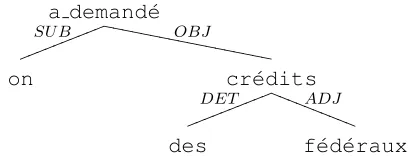
out-put SYNTEX produces for the source (French) sen-tence “on a demand´e des cr´edits f´ed´eraux” (request for federal funding) is presented in Figure 1.
We parsed with SYNTEXthe source (French) part of our training bitext (see Section 4.1). From this material, we extracted all dependency subtrees of depth 1 from the complete dependency trees found by SYNTEX. An elastic phrase is simply the list of tokens aligned with the words of the corresponding treelet as well as the respective offsets at which they were found in the target sentence (the first token of an elastic phrase always has an offset of 0).
For instance, the two treelets in Figure 2 will be collected out of the parse tree in Figure 1, yielding 2 tree-phrases. Note that the TLs as well as the EPs might not be contiguous as is for instance the case
1www.ims.uni-stuttgart.de/projekte/
corplex/.
a demand´e SU B
llllllllllYYYYYYYYOBJYYYYYYYYYY
on cr´edits
DET
llllllllll RRADJRRRRRR R R
[image:2.612.327.534.58.136.2]des f´ed´eraux
Figure 1: Parse of the sentence “on a demand´e des cr´edits f´ed´eraux” (request for federal funding). Note that the 2 words “a” and “demand´e” (literally “have” and “asked”) from the original sentence have been merged together by SYNTEXto form a single token. These tokens are the ones we use in this study.
with the first pair of structures listed in the example.
3 The Translation Engine
We built a translation engine very similar to the sta-tistical phrase-based engine PHARAOHdescribed in (Koehn, 2004) that we extended to use tree-phrases. Not only does our decoder differ from PHARAOHby using TPs, it also uses direct translation models. We know from (Och and Ney, 2002) that not using the noisy-channel approach does not impact the quality of the translation produced.
3.1 The maximization setting
For a source sentencef, our engine incrementally generates a set of translation hypothesesHby com-bining tree-phrase (TP) units and phrase-phrase (PP) units.2 We define a hypothesis in this set as h =
{Ui ≡ (Fi, Ei)}i∈[1,u], a set of u pairs of source
(Fi) and target sequences (Ei) ofni andmi words
respectively:
Fi ≡ {fji n :j
i
n∈[1,|f|]}n∈[1,ni] Ei ≡ {eli
m :l
i
m ∈[1,|e|]}m∈[1,mi] under the constraints that for alli ∈ [1, u],jni < jin+1,∀n ∈[1, ni[for a sourcetreelet(similar
con-straints apply on the target side), andjni+1 = jin+ 1,∀n ∈ [1, ni[for a source phrase. The way the
hypotheses are built imposes additional constraints between units that will be described in Section 3.3. Note that, at decoding time,|e|, the number of words
2What we call here a phrase-phrase unit is simply a pair of
alignment:
a demand´e≡request for, f´ed´eraux≡federal, cr´edits≡funding
treelets:
a demand´e
qqqqqq q
M M M M M M M
on cr´edits
cr´edits
qqqqqq q
M M M M M M M
des f´ed´eraux
tree-phrases:
TL? {{on@-1} a_demand´e {cr´edits@2}}
EP? |request@0||for@1||funding@3|
TL {{des@-1} cr´edits {f´ed´eraux@1}}
EP |federal@0||funding@1|
Figure 2: The Tree-Phrases collected out of the SYNTEX parse for the sentence pair of Figure 1. Non-contiguous structures are marked with a star. Each dependent node of a given governor token is displayed as a list surrounding the governor node, e.g. {governor{right-dependent}}. Along with the tokens of each node, we present their respective off-set (the governor/root node has the offoff-set 0 by defi-nition). The format we use to represent the treelets is similar to the one proposed in (Quirk et al., 2005).
of the translation is unknown, but is bounded accord-ing to|f|(in our case,|e|max= 2× |f|+ 5).
We define the source and target projection of a hypothesishby theproj operator which collectsin orderthe words of a hypothesis along one language:
projF(h) =
n
fp :p∈Sui=1{jni}n∈[1,ni] o
projE(h) =
n
ep :p∈Sui=1{lim}m∈[1,mi] o
If we denote by Hf the set of hypotheses that
have f as a source projection (that is, Hf = {h : projF(h) ≡ f}), then our translation engine seeks
ˆ
e=projE(ˆh)where:
ˆ
h= argmax
h∈Hf s(h)
The function we seek to maximizes(h)is a log-linear combination of 9 components, and might be
better understood as the numerator of a maximum entropy model popular in several statistical MT sys-tems (Och and Ney, 2002; Bertoldi et al., 2004; Zens and Ney, 2004; Simard et al., 2005; Quirk et al., 2005). The components are the so-called feature functions (described below) and the weighting co-efficients (λ) are the parameters of the model:
s(h) = λpprflogppprf(h) +λp|h|+ λtprflogptprf(h) +λt|h|+ λppibmlogpppibm(h)+ λtpibmlogptpibm(h)+ λlmlogplm(projE(h))+
λdd(h) +λw|projE(h)|
3.2 The components of the scoring function
We briefly enumerate the features used in this study.
Translation models Even if a tree-phrase is a gen-eralization of a standard phrase-phrase unit, for in-vestigation purposes, we differentiate in our MT system between two kinds of models: a TP-based modelptpand a phrase-phrase modelppp. Both rely
on conditional distributions whose parameters are learned over a corpus. Thus, each model is assigned its own weighting coefficient, allowing the tuning process to bias the engine toward a special kind of unit (TP or PP).
We have, fork∈ {rf,ibm}:
pppk(h) = Qu
i=1ppp(Ei|Fi)
ptpk(h) = Qu
i=1ptp(Ei|Fi)
with p•rf standing for a model trained by rel-ative frequency, whereas p•ibm designates a non-normalized score computed by an IBM model-1 translation model p, where f0 designates the
so-called NULL word:
p•ibm(Ei|Fi) =
mi Y
m=1
ni X
n=1
p(eli
m|fjin) +p(ekmi |f0) Note that by settingλtprf andλtpibm to zero, we revert back to a standard phrase-based translation engine. This will serve as a reference system in the experiments reported (see Section 4).
The language model Following a standard prac-tice, we use a trigram target language model plm(projE(h))to control the fluency of the
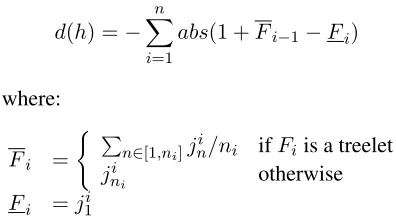
Distortion modeld This feature is very similar to the one described in (Koehn, 2004) and only de-pends on the offsets of the source units. The only difference here arises when TPs are used to build a translation hypothesis:
d(h) =− n
X
i=1
abs(1 +Fi−1−Fi)
where:
Fi =
( P
n∈[1,ni]j
i
n/ni ifFi is a treelet
jnii otherwise
Fi =ji
1
This score encourages the decoder to produce a monotonous translation, unless the language model strongly privileges the opposite.
Global bias features Finally, three simple fea-tures help control the translation produced. Each TP (resp. PP) unit used to produce a hypothesis receives a fixed weight λt (resp. λp). This allows
the introduction of an artificial bias favoring either PPs or TPs during decoding. Each target word pro-duced is furthermore given a so-called word penalty λw which provides a weak way of controlling the
preference of the decoder for long or short transla-tions.
3.3 The search procedure
The search procedure is described by the algorithm in Figure 3. The first stage of the search consists in collecting all the units (TPs or PPs) whose source part matches the source sentencef. We callU the set of those matching units.
In this study, we apply a simple match policy that we callexact matchpolicy. A TLtmatches a source sentencef if its root matchesf at a source position denotedrand if all the other wordswoftsatisfy:
fow+r =w
whereow designates the offset ofwint.
Hypotheses are built synchronously along with the target side (by appending the target material to the right of the translation being produced) by pro-gressively covering the positions of the source sen-tencefbeing translated.
Require: a source sentencef U ← {u:s-match(u, f)}
FUTURECOST(U)
fors←1to|f|do
S[s]← ∅
S[0]← {(∅, ,0)}
fors←0to|f| −1do
PRUNE(S[s], β)
for allhypotheses aliveh∈S[s]do for allu∈U do
ifEXTENDS(u, h)then h0 ←UPDATE(u, h) k← |projF(h0)|
S[k]←S[k]∪ {h0}
[image:4.612.82.280.133.244.2]returnargmaxh∈S[|f|]ρ:h→(ps, t, ρ)
Figure 3: The search algorithm. The symbol← is used in place of assignments, while→denotes uni-fication (as in languages such as Prolog).
The search space is organized into a setS of|f|
stacks, where a stackS[s](s∈ [1,|f|]) contains all the hypotheses covering exactlyssource words. A hypothesish = (ps, t, ρ) is composed of its target
materialt, the source positions coveredpsas well as
its score ρ. The search space is initialized with an empty hypothesis:S[0] ={(∅, ,0)}.
The search procedure consists in extending each partial hypothesis h with every unit that can con-tinue it. This process ends when all partial hypothe-ses have been expanded. The translation returned is the best one contained inS[|f|]:
ˆ
e=projE(argmax h∈S[|f|]
ρ:h→(ps, t, ρ))
PRUNE — In order to make the search tractable, each stack S[s] is pruned before being expanded. Only the hypotheses whose scores are within a frac-tion (controlled by a meta-parameterβ which typi-cally is 0.0001 in our experiments) of the score of the best hypothesis in that stack are considered for expansion. We also limit the number of hypotheses maintained in a given stack to the topmaxStack
ones (maxStackis typically set to 500).
that are highly scored by the translation and lan-guage models), the score considered while pruning not only involves the cost of a partial hypothesis so far, but also an estimation of the future cost that will be incurred by fully expanding it.
FUTURECOST — We followed the heuristic de-scribed in (Koehn, 2004), which consists in comput-ing for each source range [i, j] the minimum cost c(i, j) with which we can translate the source se-quence fij. This is pre-computed efficiently at an early stage of the decoding (second line of the algo-rithm in Figure 3) by a bottom-up dynamic program-ming scheme relying on the following recursion:
c(i, j) =min (
mink∈[i,j[c(i, k) +c(k, j)
minu∈U/u
s∩fij=usscore(us) whereusstands for the projection ofuon the
tar-get side (us ≡ projE(u)), and score(u) is
com-puted by considering the language model and the translation componentsppp of thes(h) score. The
future cost of h is then computed by summing the costc(i, j)of all its empty source ranges[i, j].
EXTENDS — When we simply deal with standard
(contiguous) phrases, extending a hypothesishby a unitubasically requires that the source positions of u be empty in h. Then, the target material of u is appended to the current hypothesish.
Because we work with treelets here, things are a little more intricate. Conceptually, we are con-fronted with the construction of a (partial) source dependency tree while collecting the target mate-rial in order. Therefore, the decoder needs to check whether a given TL (the source part ofu) is compati-ble with the TLs belonging toh. Since we decided in this study to use depth-one treelets, we consider that two TLs arecompatible if either they do not share any source word, or, if they do, this shared word must be the governor of one TL and a dependent in the other TL.
So, for instance, in the case of Figure 2, the two treelets are deemed compatible (they obviously should be since they both belong to the same orig-inal parse tree) because cr´edit is the governor in the right-hand treelet while being the depen-dent in the left-hand one. On the other hand, the two treelets in Figure 4 are not, sincepr´esident
is the governor of both treelets, even though mr. le pr´esident suppl´eant would be a valid source phrase. Note that it might be the case that the treelet {{mr.@-2} {le@-1} pr´esident {suppl´eant@1}} has been observed during training, in which case it will compete with the treelets in Figure 2.
pr´esident
mr.
pr´esident
qqqqqq q
M M M M M M M
le suppl´eant
Figure 4: Example of two incompatible treelets.
mr. speaker and the acting speaker
are their respective English translations.
Therefore, extending a hypothesis containing a treelet with a new treelet consists in merging the two treelets (if they are compatible) and combining the target material accordingly. This operation is more complicated than in a standard phrase-based decoder since we allow gaps on the target side as well. More-over, the target material of two compatible treelets may intersect. This is for instance the case for the two TPs in Figure 2 where the wordfunding is common to both phrases.
UPDATE — Whenever u extends h, we add a new hypothesis h0 in the corresponding stack S[|projF(h0)|]. Its score is computed by adding to
that of h the score of each component involved in s(h). For all but the one language model compo-nent, this is straightforward. However, care must be taken to update the language model score since the target material ofudoes not come necessarily right after that ofh as would be the case if we only ma-nipulated PP units.
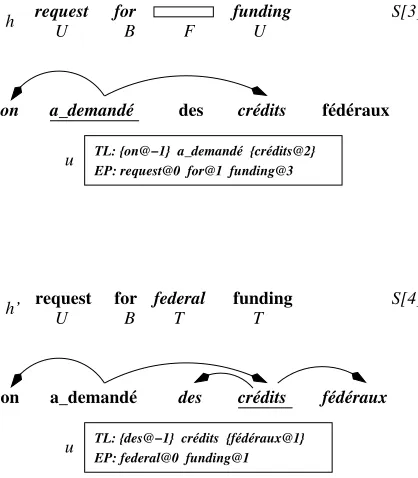
Figure 5 illustrates the kind of bookkeeping required. In practice, the target material of a hypothesis is encoded as a vector of triplets
{hwi,logplm(wi|ci), lii}i∈[1,|e|max] wherewi is the word at positioniin the translation, logplm(wi|ci)
is its score as given by the language model,ci
de-notes the largest conditioning context possible, and li indicates the length (in words) ofci (0 means a
u
des fédéraux
on a_demandé crédits
TL: {on@−1} a_demandé {crédits@2} EP: request@0 for@1 funding@3
TL: {des@−1} crédits {fédéraux@1} EP: federal@0 funding@1
U B F U
request for funding
crédits
on a_demandé des fédéraux
for
request funding
U B T T
federal
h
h’
S[3]
S[4]
[image:6.612.79.288.55.294.2]u
Figure 5: Illustration of the language model up-dates that must be made when a new target unit (circles with arrows represent dependency links) ex-tends an existing hypothesis (rectangles). The tag inside each occupied target position shows whether this word has been scored by aUnigram, aBigram or aTrigram probability.
4 Experimental Setting
4.1 Corpora
We conducted our experiments on an in-house ver-sion of the Canadian Hansards focussing on the translation of French into English. The split of this material into train, development and test corpora is detailed in Table 1. The TESTcorpus is subdivided
in 16 (disjoints) slices of 500 sentences each that we translated separately. The vocabulary is atypi-cally large since some tokens are being merged by SYNTEX, such as ´etaient#financ´ees (were financedin English).
The training corpus has been aligned at the word level by two Viterbi word-alignments (French2English and English2French) that we combined in a heuristic way similar to the refined
method described in (Och and Ney, 2003). The parameters of the word models (IBM model 2) were trained with the GIZA++ package (Och and Ney, 2000).
TRAIN DEV TEST
sentences 1 699 592 500 8000
e-toks 27 717 389 8 160 130 192
f-toks 30 425 066 8 946 143 089
e-toks/sent 16.3(±9.0) 16.3(±9.1) 16.3(±9.0) f-toks/sent 17.9(±9.5) 17.9(±9.5) 17.9(±9.5)
e-types 164 255 2 224 12 591
f-types 210 085 2 481 15 008
e-hapax 68 506 1 469 6 887
f-hapax 90 747 1 704 8 612
Table 1: Main characteristics of the corpora used in this study. For each languagel,l-toks is the number of tokens, l-toks/sent is the average number of to-kens per sentence (±the standard deviation),l-types is the number of different token forms andl-hapax is the number of tokens that appear only once in the corpus.
4.2 Models
Tree-phrases Out of 1.7 million pairs of sen-tences, we collected more than 3 million different kinds of TLs from which we projected 6.5 million different kinds of EPs. Slightly less than half of the treelets are contiguous ones (i.e. involving a se-quence of adjacent words); 40% of the EPs are con-tiguous. When the respective frequency of each TL or EP is factored in, we have approximately 11 mil-lion TLs and 10 milmil-lion EPs. Roughly half of the treelets collected have exactly two dependents (three word long treelets).
Since the word alignment of non-contiguous phrases is likely to be less accurate than the align-ment of adjacent word sequences, we further filter the repository of TPs by keeping the most likely EPs for each TL according to an estimate ofp(EP|T L) that do not take into account the offsets of the EP or the TL.
PP-model We collected the PP parameters by sim-ply reading the alignment matrices resulting from the word alignment, in a way similar to the one described in (Koehn et al., 2003). We use an in-house tool to collect pairs of phrases of up to 8 words. Freely available packages such as THOT
[image:6.612.311.545.55.197.2]Language model We trained a Kneser-Ney tri-gram language model using the SRILMtoolkit (Stol-cke, 2002).
4.3 Protocol
We compared the performances of two versions of our engine: one which employs TPs ans PPs (TP
-ENGINE hereafter), and one which only uses PPs (PP-ENGINE). We translated the 16 disjoint sub-corpora of theTESTcorpus with and without TPs.
We measure the quality of the translation pro-duced with three automatic metrics. Two error rates: the sentence error rate (SER) and the word error rate (WER) that we seek to minimize, and BLEU (Papineni et al., 2002), that we seek to
maximize. This last metric was computed with themulti-bleu.perl script available at www. statmt.org/wmt06/shared-task/.
We separately tuned both systems on theDEV cor-pus by applying a brute force strategy, i.e. by sam-pling uniformly the range of each parameter (λ) and picking the configuration which led to the best BLEU
score. This strategy is inelegant, but in early experi-ments we conducted, we found better configurations this way than by applying the Simplex method with multiple starting points. The tuning roughly takes 24 hours of computation on a cluster of 16 comput-ers clocked at 3 GHz, but, in practice, we found that one hour of computation is sufficient to get a con-figuration whose performances, while subobptimal, are close enough to the best one reachable by an ex-haustive search.
Both configurations were set up to avoid distor-tions exceeding 3 (maxDist = 3). Stacks were allowed to contain no more than 500 hypotheses (maxStack = 500) and we further restrained the number of hypotheses considered by keeping for each matching unit (treelet or phrase) the 5 best ranked target associations. This setting has been fixed experimentally on theDEVcorpus.
4.4 Results
The scores for the 16 slices of the test corpus are re-ported in Table 2. TP-ENGINEshows slightly better figures for all metrics.
For each system and for each metric, we had 16 scores (from each of the 16 slices of the test cor-pus) and were therefore able to test the statistical
sig-nicance of the difference between the TP-ENGINE
and PP-ENGINE using a Wilcoxon signed-rank test for paired samples. This test showed that the dif-ference observed between the two systems is signif-icant at the 95% probability level for BLEUand sig-nificant at the 99% level for WERand SER.
Engine WER% SER% BLEU%
PP 52.80±1.2 94.32±0.9 29.95±1.2 TP 51.98±1.2 92.83±1.3 30.47±1.4
Table 2: Median WER, SER and BLEU scores
(±value range) of the translations produced by the two engines on a test set of 16 disjoint corpora of 500 sentences each. The figures reported are per-centages.
On the DEV corpus, we measured that, on aver-age, each source sentence is covered by 39 TPs (their source part, naturally), yielding a source coverage of approximately 70%. In contrast, the average number of covering PPs per sentence is 233.
5 Discussion
On a comparable test set (Canadian Hansard texts), (Simard et al., 2005) report improvements by adding non-contiguous bi-phrases to their engine without requiring a parser at all. At the same time, they also report negative results when adding non-contiguous phrases computed from the refined alignment tech-nique that we used here.
Although the results are not directly comparable, (Quirk et al., 2005) report much larger improve-ments over a phrase-based statistical engine with their translation engine that employs a source parser. The fact that we consider only depth-one treelets in this work, coupled with the absence of any particular treelet projection algorithm (which prevents us from training a syntactically motivated reordering model as they do) are other possible explanations for the modest yet significant improvements we observe in this study.
6 Conclusion
We developed a translation engine which makes use of tree-phrases on top of pairs of source/target sequences of words. The experiments we conducted suggest that TPs have the potential to improve trans-lation quality, although the improvements we mea-sured are modest, yet statistically significant.
We considered only one simple form of tree in this study: depth-one subtrees. We plan to test our en-gine on a repository of treelets of arbitrary depth. In theory, there is not much to change in our engine to account for such units and it would offer an al-ternative to the system proposed recently by (Liu et al., 2005), which performs translations by recycling a collection of tree-string-correspondence (TSC) ex-amples.
References
Nicola Bertoldi, Roldano Cattoni, Mauro Cettolo, and Marcello Federico. 2004. The ITC-irst statistical
ma-chine translation system for IWSLT-2004. InIWSLT,
pages 51–58, Kyoto, Japan.
Didier Bourigault and C´ecile Fabre. 2000.
Ap-proche linguistique pour l’analyse syntaxique de cor-pus. Cahiers de Grammaire, (25):131–151. Toulouse le Mirail.
David Chiang. 2005. A hierarchical phrase-based model for statistical machine translation. In43rd ACL, pages 263–270, Ann Arbor, Michigan, USA.
Yuang Ding and Martha Palmer. 2004. Automatic learn-ing of parallel dependency treelet pairs. In Proceed-ings of the first International Joint Conference on NLP.
Yuan Ding and Martha Palmer. 2005. Machine trans-lation using probabilistic synchronous dependency
in-sertion grammars. In43rd ACL, pages 541–548, Ann
Arbor, Michigan, June.
Jonathan Graehl and Kevin Knight. 2004. Training tree
transducers. In HLT-NAACL 2004, pages 105–112,
Boston, Massachusetts, USA, May 2 - May 7. Asso-ciation for Computational Linguistics.
Philipp Koehn, Franz Joseph Och, and Daniel Marcu.
2003. Statistical Phrase-Based Translation. In
Pro-ceedings of HLT, pages 127–133.
Philipp Koehn. 2004. Pharaoh: a Beam Search Decoder
for Phrase-Based SMT. In Proceedings of AMTA,
pages 115–124.
Zhanyi Liu, Haifeng Wang, and Hua Wu. 2005.
Example-based machine translation based on tsc and
statistical generation. In Proceedings of MT Summit
X, pages 25–32, Phuket, Thailand.
Evgeny Matusov, Stephan Kanthak, and Hermann Ney.
2005. Efficient statistical machine translation with
constraint reordering. In10th EAMT, pages 181–188,
Budapest, Hongary, May 30-31.
I. Dan Melamed. 2004. Statistical machine translation
by parsing. In42nd ACL, pages 653–660, Barcelona,
Spain.
Franz Joseph Och and Hermann Ney. 2000. Improved Statistical Alignment Models. InProceedings of ACL, pages 440–447, Hongkong, China.
Franz Joseph Och and Hermann Ney. 2002. Discrimina-tive training and maximum entropy models for statis-tical machine translation. InProceedings of the ACL, pages 295–302.
Franz Joseph Och and Hermann Ney. 2003. A
Sys-tematic Comparison of Various Statistical Alignment
Models.Computational Linguistics, 29:19–51.
Daniel Ortiz-Mart´ınez, Ismael Garci´a-Varea, and
Fran-cisco Casacuberta. 2005. Thot: a toolkit to train
phrase-based statistical translation models. In
Pro-ceedings of MT Summit X, pages 141–148, Phuket, Thailand, Sep.
Kishore Papineni, Salim Roukos, Todd Ward, and Wei-Jing Zhu. 2002. Bleu: a method for automatic evalua-tion of machine translaevalua-tion. In40th ACL, pages 311– 318, Philadelphia, Pennsylvania.
Chris Quirk, Arul Menezes, and Colin Cherry. 2005. De-pendency treelet translation: Syntactically informed
phrasal SMT. In43rd ACL, pages 271–279, Ann
Ar-bor, Michigan, June.
Michel Simard, Nicola Cancedda, Bruno Cavestro,
Marc Dymetman, Eric Gaussier, Cyril Goutte,
Kenji Yamada, Philippe Langlais, and Arne Mauser. 2005. Translating with non-contiguous phrases. In
HLT/EMNLP, pages 755–762, Vancouver, British Columbia, Canada, Oct.
Andreas Stolcke. 2002. Srilm - an Extensible Language
Modeling Toolkit. InProceedings of ICSLP, Denver,
Colorado, Sept.
Stephan Vogel, Ying Zhang, Fei Huang, Alicai Trib-ble, Ashish Venugopal, Bing Zao, and Alex Waibel. 2003. The CMU Statistical Machine Translation
Sys-tem. InMachine Translation Summit IX, New Orleans,
Louisina, USA, Sep.