Local System Voting Feature for Machine Translation System
Combination
Markus Freitag, Jan-Thorsten Peter, Stephan Peitz, Minwei Feng and Hermann Ney
Human Language Technology and Pattern Recognition Group Computer Science Department
RWTH Aachen University D-52056 Aachen, Germany
<surname>@cs.rwth-aachen.de
Abstract
In this paper, we enhance the traditional confusion network system combination approach with an additional model trained by a neural network. This work is moti-vated by the fact that the commonly used binary system voting models only assign each input system a global weight which is responsible for the global impact of each input system on all translations. This prevents individual systems with low sys-tem weights from having influence on the system combination output, although in some situations this could be helpful. Fur-ther, words which have only been seen by one or few systems rarely have a chance of being present in the combined output. We train a local system voting model by a neural network which is based on the words themselves and the combinatorial occurrences of the different system out-puts. This gives system combination the option to prefer other systems at different word positions even for the same sentence. 1 Introduction
Adding more linguistic informed models (e.g. language model or translation model) additionally to the standard models into system combination seems to yield no or only small improvements. The reason is that all these models should have al-ready been applied during the decoding process of the individual systems (which serve as input hy-potheses for system combination) and hence al-ready fired before system combination. To im-prove system combination with additional models, we need to define a model which can not be ap-plied by an individual system.
In state-of-the-art confusion network system combination the following models are usually ap-plied:
System voting (globalVote) models For each word the voting model for systemi(1≤i≤I) is 1 iff the word is from systemi, otherwise 0. Binary primary system model (primary)
A model that marks the primary hypothesis. Language model 3-gram language model (LM)
trained on the input hypotheses.
Word penalty Counts the number of words. To gain improvements with additional models, it is better to define models which are not used by an individual system. A simple model which can not be applied by any individual system is the binary system voting model (globalVote). This model is the most important one during system combination decoding as it determines the impact of each individual system. Each system i is as-signed one globalVote model which fires if the word is generated by systemi. Nevertheless, this simple model is independent of the actual words and the score is only based on the global prefer-ences of the individual systems. This disadvan-tage prevents system combination from produc-ing words which have only been seen by systems with low system weights (low globalVote model weights). To give systems and words with low weights a chance to affect the final output, we de-fine a new local system voting model (localVote) which makes decisions based on the current word options and not only on a general weight. The lo-cal system voting model allows system combina-tion to prefer different system outputs at different word positions even for the same sentence.
Motivated by the success of neural networks in language modelling (Bengio et al., 2006, Schwenk and Gauvain, 2002) and translation modelling (Son et al., 2012), we choose feedforward neural networks to train the novel model. Instead of cal-culating the probabilities in a discrete space, the neural network projects the words into a continu-ous space. This projection gives us the option to assign probability also to input sequences which
were not observed in the training data. In sys-tem combination each training sentence has to be translated by all individual system engines which is time consuming. Due to this we have a small amount of training data and thus it is very likely that many input sequences of a test set have not be seen during training.
The remainder of this paper is structured as fol-lows: in Section 2, we discuss some related work. In Section 3, the novel local system voting model is described. In Section 4, experimental results are presented which are analyzed in Section 5. The paper is concluded in Section 6.
2 Related Work
In confusion network decoding, pairwise align-ments between all system outputs are generated. From the calculated alignment information, a con-fusion network is built from which the system combination output is determined using major-ity voting and additional models. The hypothesis alignment algorithm is a crucial part of building the confusion network and many alternatives have been proposed in the literature:
(Bangalore et al., 2001) use a multiple string alignment (MSA) algorithm to identify the unit of consensus and applied a posterior lan-guage model to extract the consensus trans-lations. In contrast to the following ap-proaches, MSA is unable to capture word re-orderings.
(Matusov et al., 2006) produce pairwise word alignments with the statistical alignment al-gorithm toolkit GIZA++ that explicitly mod-els word reordering. The context of a whole document of translations rather than a single sentence is taken into account to produce the alignments.
(Sim et al., 2007) construct a consensus network by using TER (Snover et al., 2006)
align-ments. Minimum bayes risk decoding is ap-plied to obtain a primary hypothesis to which all other hypotheses are aligned.
(Rosti et al., 2007) extend the TERalignment
ap-proach and introduce an incremental TER
alignment which aligns one system at a time to all previously aligned hypotheses.
(Karakos et al., 2008) use the inversion trans-duction grammar (ITG) formalism (Wu, 1997) and treat the alignment problem as a
problem of bilingual parsing to generate the pairwise alignments.
(He et al., 2008) propose an indirect hidden markov model (IHMM) alignment approach to address the synonym matching and word ordering issues in hypothesis alignment. (Heafield and Lavie, 2010) use the METEOR
toolkit to calculate pairwise alignments be-tween the hypotheses.
All confusion network system combination ap-proaches only use the global system voting mod-els. Regarding to this chapter, there has been sim-ilar effort in the area of speech recognition: (Hillard et al., 2007) Similar work has been
pre-sented for system combination of speech recognitions systems: the authors train a clas-sifier to learn which system should be se-lected for each output word. The learn-ing target for each slot is the set of sys-tems which match the reference word, or the null class if no systems match the reference word. Their novel approach outperforms the ROVER baseline by up to 14.5% relatively on an evaluation set.
3 Novel Local System Voting Model In the following subsections we introduce a novel local system voting model (localVote) trained by a neural network. The purpose of this model is to prefer one particular path in the con-fusion network and therefore all local word deci-sions between two nodes leading to this particular path. More precisely, we want the neural network to learn an oracle path extracted from the confu-sion network graph which leads to the lowest error score. In Subsection 3.1, we describe a polyno-mial approximation algorithm to extract the best sentence level BLEU(SBLEU) path in a confusion
network. Taking this path as reference path, we define the model in Subsection 3.2 followed by its integration in the linear model combination in Subsection 3.3.
3.1 FindingSBLEU-optimal Hypotheses In this section, we describe a polynomial ap-proximation algorithm to extract the best SBLEU
hypothesis from a confusion network. (Leusch et al., 2008) showed that this problem is generally NP-hard for the popular BLEU (Papineni et al.,
Using BLEU as metric to extract the best
pos-sible path is problematic as in the original BLEU
definition there is no smoothing for the geomet-ric mean. This has the disadvantage that the BLEU
score becomes zero already if the four-gram preci-sion is zero, which can happen obviously very of-ten with short or difficult translations. To allow for sentence-wise evaluation, we use theSBLEU
met-ric (Lin and Och, 2004), which is basically BLEU
where alln-gram counts are initialized with 1 in-stead of 0. The brevity penalty is calculated only on the current hypothesis and reference sentence.
We use the advantage that confusion networks can be sorted topologically. We walk the confu-sion network from the start node to the end node, keeping track of all n-grams seen so far. At each node we keep a k-best list containing the partial hypotheses with the mostn-gram matches leading to this node and recombine only partial hypothe-ses containing the same translation. As the search space can become exponentially large, we only keepk possible options at each node. This prun-ing can lead to search errors and hence yield non-optimal results. If needed for hypotheses with the samen-gram counts, we prefer hypotheses with a higher translation score based on the original mod-els. For the final node we add the brevity penalty to all possible translations.
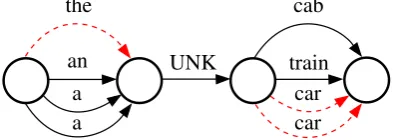
As we are only interested in arc decisions which match a reference word, we simplify the confusion network before applying the algorithm. If all arcs between two adjacent nodes are not present in the reference, we remove all of them and add a single arc labeled with ”UNK”. This reduces the vocab-ulary size and still gives us the same bestSBLEU
scores as before. In Figure 1, a confusion network of four input hypotheses is given. As the words
black,red,orange, andgreenare all not present in the reference, all of them are mapped to one single ”UNK” arc (cf. Figure 2). The bestSBLEUpath is
the UNK car.
the black
an a
a green
orange red
cab
[image:3.595.318.515.64.134.2]train car car
Figure 1: System A:the black cab; System B:an red train; System C:a orange car ; System D:a green car; Reference:the blue car.
the
an a a
UNK
cab
[image:3.595.80.282.626.699.2]train car car
Figure 2: As the words black, red, orange, and
greenin Figure 1 are all not present in the refer-ence (the blue car), they are mapped to one single ”UNK” arc.
3.2 localVote Model Training
The purpose of the new localVote model is to prefer the bestSBLEUpath and therefore to learn
the word decisions between all adjacent nodes which lead to this particular path. During the ex-traction of the best SBLEU hypotheses from the
confusion network, we keep track of all arc de-cisions. This gives us the possibility to generate local training examples based only on the I arcs between two nodes. For the confusion network il-lustrated in Figure 2, we generate two training ex-amples for the neural network training. Based on the arcsthe, an, aandawe learn the output the. Based on the arcscab,train,carandcarwe learn the outputcar.
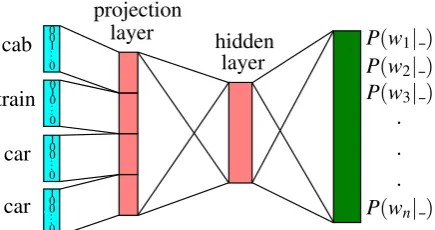
In all upcoming system setups, we use the open source toolkit NPLM (Vaswani et al., 2013) for training and testing the neural network models. We use the standard setup as described in the pa-per and use the neural network with one projection layer and one hidden layer. For more details we refer the reader to the original paper of the NPLM toolkit. The inputs to the neural network are theI
words produced by theI different individual sys-tems. The outputs are the posterior probabilities of all words of the vocabulary. The input uses the so-called 1-of-n coding, i.e. the i-th word of the vocabulary is coded by setting thei-th element of the vector to 1 and all the other elements to 0.
For a system combination of I individual sys-tems, a training example consists of I+1 words. The firstI words (input of the neural network) are representing the words of the individual systems, the last position (output of the neural network) serves as slot for the decision we want to learn (ex-tracted from the bestSBLEUpath). We do not add
the ”UNK” arcs to the neural network training as they do not help to increase theSBLEUscore.
car car train
cab P(w1| )
projection
hidden layer
layer P(w2| )
P(w3| )
P(wn| )
001 0 .. .
100 0.. .
010 0.. .
010 0 .. .
[image:4.595.74.292.55.170.2]. . .
Figure 3: Unigram neural network training exam-ple: SystemAproducescab, SystemB train, Sys-temC car, SystemD car, reference iscar. 1-of-n
encoding was applied to map words to a suitable neural network input.
Table 1: Training examples from Figure 2. input layer
Sys A Sys B Sys C Sys D ref
the an a a the
cab train car car car
individual system provides one input word. In Ta-ble 1 the two training examples for Figure 2 are illustrated.
As a neural network training example only con-sists of theI words between two adjacent nodes, we are able to produce several training examples for each sentences. For a system combination ofI
systems and a development set ofSsentences with an average sentence length ofL, we can generate up toI∗S∗Lneural network training examples.
Further, we can expand the model to use arbi-trary history size, if we take the predecessor words into account. Instead of just using the local word decision of a system, we add additionally the pre-decessors of the individual systems into the train-ing data. In Figure 4, we e.g. use the bigramred traininstead of the unigramtrainfor systemBinto the training data. In Table 2 all bigram training ex-amples of Figure 2 can be seen.
3.3 localVote model Integration
Having a trained localVote model, we then add it as an additional model into the confusion net-work. We calculate for each arc the probability of the word in the trained neural network. E.g. for Figure 1, we extract the probabilities for all arcs by the strings illustrated in Table 3. Finally, we add the scores as a new model and assign it a weight which is trained additionally to the standard model
green orange red
black P(w1| )
projection
hidden layer
layer P(w2| )
P(w3| )
P(wn| ) . . . cab
train
car
car
[image:4.595.310.527.57.162.2]Figure 4: Bigram neural network training exam-ple: SystemAproducesblack cab, SystemB red train, SystemC orange car, System Dgreen car, reference iscar.
Table 2: Training examples (bigram) from Fig. 2. input layer
SysA SysB SysC SysD ref
<s>the <s>an <s>a <s>a the black cab red train orange car green car car
[image:4.595.311.525.268.326.2]weights with MERT.
Table 3: Calculating the probability for all possi-ble output words from Figure 1. The output layer is the current generated word.
input layer
Sys A Sys B Sys C Sys D arc word
the an a a the
the an a a an
the an a a a
black red orange green black black red orange green red black red orange green orange black red orange green green
cab train car car cab
cab train car car train cab train car car car
3.4 Word Classes
[image:4.595.310.524.431.596.2]4 Experiments
All experiments have been conducted with the open source system combination toolkit Jane (Fre-itag et al., 2014). For training and scoring neu-ral networks, we use the open source toolkit NPLM (Vaswani et al., 2013). NPLM is a toolkit for training and using feedforward neural lan-guage models. Variations in neural network ar-chitecture have been tested. We tried various hid-den layer sizes as well as projection layer sizes. We achieved similar results for all setups and de-cided to stick to 1 hidden layer whose size is 200, a learning rate of 0.08 and let the training run 20 epochs in all experiments.
Translation quality is measured in lower-case with BLEU (Papineni et al., 2002) and
TER (Snover et al., 2006) whereas the
perfor-mance of each setup is the best score on the tune set across five different MERT runs. The system combination weights of the linear model are opti-mized with MERT on 200-best lists with (TER
-BLEU)/2 as optimization criterion. For all
lan-guage pairs we use three different test sets. In the following the test set for extracting the training ex-amples for the neural network training is labeled astune (NN). The test set tune (MERT)indicates the tune set for MERT andtestindicates the blind test set.
The individual systems are different extensions of phrase-based or hierarchical phrase-based sys-tems. The systems are built on the same amount of preprocessed training data and differ mostly in the models which are used to score the translation op-tions. Further, some systems are syntactical aug-mented based on syntax trees on either source or target side.
4.1 BOLT Chinese→English
For Chinese→English, we use the current BOLT data set (corpus statistics are given in Ta-ble 4). The test sets consist of text drawn from ”discussion forums” in Mandarin Chinese. We use nine individual systems to perform the system combination experiments. The lambda weights are optimized on a tune set of 985 sentences (tune (MERT)). We train the proposed localVote model on 15,323,897 training examples extracted from the 1844 sentences tune (NN) set.
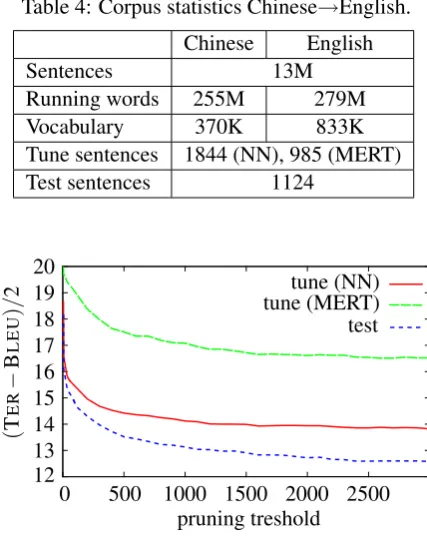
As a first step we have to determine the k-best pruning threshold for extracting the SBLEU
opti-mal path from the current confusion networks (cf.
Section 3.1). In Figure 5 the (TER-BLEU)/2
re-sults of the SBLEU optimal hypotheses extracted
with different k-best sizes are given. Although, the BLEUscore improves by settingk to a higher
[image:5.595.308.522.193.466.2]value, the computational time increases. To find a tradeoff between running time and performance, we set thek-best size to 1200 in the following ex-periments.
Table 4: Corpus statistics Chinese→English. Chinese English
Sentences 13M
Running words 255M 279M Vocabulary 370K 833K Tune sentences 1844 (NN), 985 (MERT) Test sentences 1124
12 13 14 15 16 17 18 19 20
0 500 1000 1500 2000 2500
(
T
E
R
−
B
L
E
U
)
/
2
pruning treshold tune (NN) tune (MERT) test
Figure 5: (TER−BLEU)/2 scores for
dif-ferent k-best pruning thresholds on the BOLT Chinese→English data set.
Experimental results are given in Table 5. The
baselineis a system combination run without any localVote model of nine individual systems us-ing the standard models as described in (Freitag et al., 2014). The oracle score is calculated on the hypothesis of the SBLEU best path extracted
with k =1200. We train the neural network on 15,323,897 training examples generated from the 1844 tune (NN) sentences. By training a neu-ral network based on unigram decisions (unigram NN), we gain small improvements of -0.6 points in TER. As we have only few sentences of training
Table 5: Results for the BOLT Chinese→English translation task. The localVote models of the systems +unigram NN and+unigram wcNN are trained based on one word per system. The lo-calVote models of the systems +bigram NN and
+bigram wcNN are trained based on two words per system. For systems labeled with wcNN, the neural network is trained on word classes. Sig-nificance is marked with † for 95% confidence and ‡ for 99% confidence, and is measured with the bootstrap resampling method as described in (Koehn, 2004).
system tune test
BLEU TER BLEU TER baseline 17.9 61.5 18.3 60.9
+unigram NN 18.1 61.2 18.3 60.3†
+unigram wcNN 18.4 61.5 19.0‡ 60.3†
+bigram NN 18.1 61.3 18.6† 60.3†
+bigram wcNN 18.1 61.2 18.7† 59.9‡ oracle 28.6 62.3 31.1 57.2
TER. By taking a bigram history into the training
of the neural network, we reach only small fur-ther improvement. Compared to thebaseline, the system combination+bigram NNoutperforms the
baselineby +0.3 points in BLEU and -0.6 points
in TER. By using word classes (+bigram wcNN)
we gain improvement of +0.4 points in BLEUand
-1.0 points in TER.
All results are reached with a word class size of 1500. In Figure 6 the(TER−BLEU)/2 scores
on tune(MERT) of system combinations including one unigram localVote model trained with differ-ent word class sizes are illustrated. Independdiffer-ent of the word class size, system combination including a localVote model always performs better com-pared to the baseline. The best performance is reached by a word class size of 1500. One rea-son for the loss of performance when using no word classes is the size of the neural network tune set. Within a size of 1844 sentences, many words of the test set have never been seen during neu-ral network training. The test set has a vocab-ulary size of 6106 within 2487 words (40.73%) are not present in the training set (tune (NN)) of the neural network. For the MERT tune set 2556 words (40.91%) are not present in the neural net-work training set. Word classes tackle this prob-lem and it is much more likely that each word class
has been seen during the training procedure of the neural network.
21.4 21.5 21.6 21.7 21.8 21.9
500 1000 1500 2000 2500
baseline +unigram wcNN
(
T
E
R
−
B
L
E
U
)
/
2
[image:6.595.73.291.237.350.2]word class size
Figure 6: (TER−BLEU)/2 scores for different
word class sizes on the BOLT Chinese→English tune (MERT) set.
4.2 BOLT Arabic→English
For Arabic→English, we use the current BOLT data set (corpus statistics are given in Table 6). The test sets consist of text drawn from ”discus-sion forums” in Egyptian Arabic. We train the neural network on 6,591,158 training examples extracted from the 1510 sentences tune (NN) dev set. The model weights are optimized on a 1080 sentences tune set. All results are system com-binations of five individual systems. The test set has a vocabulary size of 3491 within 1510 words (43.25%) are not present in the training set (tune (NN)) of the neural network. For the MERT tune set 1549 words (43.24%) are not part of the neural network training set.
We run the same experiment pipeline as for Chinese→English and first determine the k-best threshold for getting the oracle paths in the con-fusion networks. As the Arabic→English system combination is only based on 5 individual systems, the confusion networks are much smaller. We set the pruning threshold to 1000 (k =1000) which is a good tradeoff between running time and per-formance. Figure 7 shows the (TER−BLEU)/2
scores for differentk-best pruning thresholds. In-creasingk to a higher value then 1000 improves the(TER−BLEU)/2 only slightly.
Experimental results are given in Table 7. The
Table 6: Corpus statistics BOLT Arabic→English. Arabic English
Sentences 8M
Running words 189M 186M Vocabulary 608K 519K Tune sentences 1510 (NN), 1080 (MERT) Test sentences 1137
4 6 8 10 12 14 16
0 500 1000 1500 2000 2500 pruning treshold
(
T
E
R
−
B
L
E
U
)
/
2 tune (MERT)tune (NN) test
Figure 7: (TER− BLEU)/2 scores for
dif-ferent k-best pruning thresholds on the BOLT Arabic→English tune (MERT) set.
of the SBLEU best path extracted with k=1000.
Training a localVote model based on the best
SBLEU path (+unigram NN) gives us
improve-ment of +0.9 points in BLEU compared to the
baseline. Adding bigram context to the neural net-work training (+bigram NN) yields improvement of +0.8 points in BLEU compared to thebaseline
system combination. By training word classes on the bilingual part of the training data, we gain ad-ditional improvements. When using word classes and a history size of two, +bigram wcNN yields the best performance with +1.1 points in BLEU
compared to thebaseline.
All results are conducted with a word class size of 1000. The tune set performance of different un-igram localVote models trained on different word class sizes are illustrated in Figure 8. The results are fluctuating and we set the word class size to 1000 in all Arabic→English experiments.
5 Analysis
[image:7.595.308.524.236.518.2]In this section we compare the final translations of the Chinese→English system combination +bi-gram wcNN with thebaseline. The word occur-rence distributions for both setups are illustrated in Table 8. This table shows how many input sys-tems produce a certain word and finally if it is part
Table 7: Results for the BOLT Arabic→English translation task. The localVote models of the systems +unigram NN and+unigram wcNN are trained by a neural network based on one word per system. The localVote models of the systems +bi-gram NNand+bigram wcNNare trained by a neu-ral network based on two words per system. For systems labeled withwcNN, the neural network is trained on word classes for both input and output layer. Significance is marked with ‡ for 99% con-fidence and is measured with the bootstrap resam-pling method as described in (Koehn, 2004).
system tune test
BLEU TER BLEU TER baseline 30.1 51.2 27.6 55.8
+unigram NN 31.4 51.2 28.5‡ 56.0
+unigram wcNN 31.1 51.1 28.3‡ 55.7
+bigram NN 31.3 51.1 28.4‡ 55.8
+bigram wcNN 31.4 51.2 28.7‡ 56.0 oracle 38.1 46.3 34.8 50.9
9.8 10 10.2 10.4 10.6
500 1500 2500 3500
baseline +unigram wcNN
(
T
E
R
−
B
L
E
U
)
/
2
word class size
Figure 8: (TER−BLEU)/2 tune set scores
for different word class sizes on the BOLT Arabic→English task.
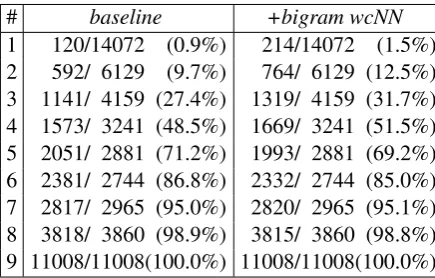
Table 8: Word occurrence distribution for the Chinese→English setup. First column indicates in how many systems a word appears. E.g. 120/14072 (0.9%) indicates that 14072 words only appear in one individual input system from which 120 (0.9%) are present in the baseline system com-bination hypothesis.
# baseline +bigram wcNN
1 120/14072 (0.9%) 214/14072 (1.5%) 2 592/ 6129 (9.7%) 764/ 6129 (12.5%) 3 1141/ 4159 (27.4%) 1319/ 4159 (31.7%) 4 1573/ 3241 (48.5%) 1669/ 3241 (51.5%) 5 2051/ 2881 (71.2%) 1993/ 2881 (69.2%) 6 2381/ 2744 (86.8%) 2332/ 2744 (85.0%) 7 2817/ 2965 (95.0%) 2820/ 2965 (95.1%) 8 3818/ 3860 (98.9%) 3815/ 3860 (98.8%) 9 11008/11008(100.0%) 11008/11008(100.0%)
baseline system combination output. The miss-ing words result mostly from alignment errors pro-duced by the pairwise alignment algorithm when aligning the single systems together.
We observe the problem that the globalVote models prevent words, which have only been pro-duced by few systems, to be present in the system combination output. In Table 8, you can see that words which are only produced by 1-4 individual systems are more likely to be present in the final output when including the novel localVote model. As e.g. in the baseline 592 of the 6129 words which have only been produced by two individ-ual system are in the output, the advanced +bi-gram wcNN setup contains additional 172 words. These statistics demonstrate the functionality of the novel localVote model which does not only im-prove the translation quality in terms of BLEU, but
also tackles the problem of the dominating glob-alVote models.
The Arabic→English word occurrence distribu-tion is illustrated in Table 9. A similar scenario as for the Chinese→English translation task can be observed. The words which only occur in few in-dividual systems have a much higher chance to be in the final output when using the novel local vot-ing system model. It is also visible that the neural network model prevents some words of being in the combined output even if the word have been produced by 4 of 5 systems. The novel local sys-tem voting model gives syssys-tem combination the
option to select words which have only be gener-ated by few individual systems.
Table 9: Word occurrence distribution for the Arabic→English setup. First column indicates in how many systems a word appears. E.g. 214/5791 (3.7%) indicates that 5791 words only appear in one individual input system from which 214 (3.7%) are present in the baseline system combi-nation hypothesis.
# baseline +bigram wcNN
1 214/ 5791 (3.7%) 285/ 5791 (4.9%) 2 1225/ 3200 (38.3%) 1243/ 3200 (38.8%) 3 2162/ 2719 (79.5%) 2297/ 2719 (84.5%) 4 3148/ 3207 (98.2%) 3119/ 3207 (97.3%) 5 14602/14602(100.0%) 14602/14602(100.0%)
6 Conclusion
In this work we proposed a novel local system voting model (localVote) which has been trained by a feedforward neural network. In contrast to the traditional globalVote model, the presented lo-calVote model takes the word contents and their combinatorial occurrences into account and does not only promote global preferences for some in-dividual systems. This advantage gives confusion network decoding the option to prefer other sys-tems at different positions even in the same sen-tence. As all words are projected to a continuous space, the neural network gives also unseen word sequences a useful probability. Due to the rela-tively small neural network training set, we used word classes in some experiments to tackle the data sparsity problem.
Experiments have been conducted with high quality input systems for the BOLT Chinese→English and Arabic→English trans-lation tasks. Training an additional model by a neural network with word classes yields trans-lation improvement from up to +0.9 points in BLEUand -0.5 points in TER. We also took word
[image:8.595.72.290.179.318.2]more likely to be part of the system combination output when using the proposed model.
Acknowledgement
This material is partially based upon work sup-ported by the DARPA BOLT project under Con-tract No. HR0011-12-C-0015. Any opinions, findings and conclusions or recommendations ex-pressed in this material are those of the au-thors and do not necessarily reflect the views of DARPA. Further, this paper has received funding from the European Union’s Horizon 2020 research and innovation programme under grant agreement no645452 (QT21).
References
Srinivas Bangalore, German Bordel, and Giuseppe Ric-cardi. 2001. Computing consensus translation from multiple machine translation systems. InIEEE Workshop on Automatic Speech Recognition and Understanding (ASRU), pages 351–354, Madonna di Campiglio, Italy, December.
Yoshua Bengio, Holger Schwenk, Jean-S´ebastien Sen´ecal, Fr´ederic Morin, and Jean-Luc Gauvain. 2006. Neural probabilistic language models. In Innovations in Machine Learning, pages 137–186. Springer.
Markus Freitag, Matthias Huck, and Hermann Ney. 2014. Jane: Open source machine translation sys-tem combination. In Conference of the European Chapter of the Association for Computational Lin-guistics (EACL), pages 29–32, Gothenburg, Sweden, April. Association for Computational Linguistics.
Xiaodong He, Mei Yang, Jianfeng Gao, Patrick Nguyen, and Robert Moore. 2008. Indirect-HMM-based Hypothesis Alignment for Combining Out-puts from Machine Translation Systems. In Con-ference on Empirical Methods in Natural Language Processing (EMNLP), pages 98–107, Honolulu, HI, USA, October.
Kenneth Heafield and Alon Lavie. 2010. Combining Machine Translation Output with Open Source: The Carnegie Mellon Multi-Engine Machine Translation Scheme. The Prague Bulletin of Mathematical Lin-guistics, 93:27–36.
Dustin Hillard, Bj¨orn Hoffmeister, Mari Ostendorf, Ralf Schl¨uter, and Hermann Ney. 2007. i rover: improving system combination with classifi-cation. InConference of the North American Chap-ter of the Association for Computational Linguistics (NAACL), pages 65–68, Rochester, NY, USA, April. Association for Computational Linguistics.
Damianos Karakos, Jason Eisner, Sanjeev Khudanpur, and Markus Dreyer. 2008. Machine translation sys-tem combination using ITG-based alignments. In 46th Annual Meeting of the Association for Compu-tational Linguistics on Human Language Technolo-gies (ACL): Short Papers, pages 81–84, Columbus, OH, USA, June.
Philipp Koehn. 2004. Statistical significance tests for machine translation evaluation. In Conference on Empirical Methods in Natural Language Processing (EMNLP), pages 388–395, Barcelona, Spain, July. Gregor Leusch, Evgeny Matusov, and Hermann Ney.
2008. Complexity of finding the bleu-optimal hy-pothesis in a confusion network. InConference on Empirical Methods in Natural Language Processing (EMNLP), pages 839–847, Honolulu, HI, USA, Oc-tober.
Chin-Yew Lin and Franz Josef Och. 2004. Auto-matic evaluation of machine translation quality us-ing longest common subsequence and skip-bigram statistics. InThe 42nd Annual Meeting on Associa-tion for ComputaAssocia-tional Linguistics (ACL), page 605, Barcelona, Spain, July.
Evgeny Matusov, Nicola Ueffing, and Hermann Ney. 2006. Computing Consensus Translation from Mul-tiple Machine Translation Systems Using Enhanced Hypotheses Alignment. In Conference of the Eu-ropean Chapter of the Association for Computa-tional Linguistics (EACL), pages 33–40, Trento, Italy, April.
Franz Josef Och. 1999. An Efficient Method for De-termining Bilingual Word Classes. In Ninth Con-ference on European Chapter of the Association for Computational Linguistics (EACL), pages 71– 76, Bergen, Norway, June.
Kishore Papineni, Salim Roukos, Todd Ward, and Wei-Jing Zhu. 2002. Bleu: a method for automatic evaluation of machine translation. In40th Annual Meeting on Association for Computational Linguis-tics (ACL), pages 311–318, Philadelphia, PA, USA, July.
Antti-Veikko Rosti, Necip Fazil Ayan, Bing Xiang, Spyridon Matsoukas, Richard Schwartz, and Bon-nie Dorr. 2007. Combining outputs from multiple machine translation systems. InThe Annual Confer-ence of the North American Chapter of the Associ-ation for ComputAssoci-ational Linguistics (NAACL-HLT), pages 228–235, Rochester, NY, USA, April. Holger Schwenk and Jean-Luc Gauvain. 2002.
Con-nectionist language modeling for large vocabulary continuous speech recognition. In IEEE Interna-tional Conference on Acoustics, Speech, and Signal Processing (ICASSP), volume 1, pages I–765, Or-lando, FL, USA, May.
Translation System Combination. InIEEE Interna-tional Conference on Acoustics, Speech and Signal Processing (ICASSP), pages 105–108, Honolulu, HI, USA, April.
Matthew Snover, Bonnie Dorr, Richard Schwartz, Lin-nea Micciula, and John Makhoul. 2006. A Study of Translation Edit Rate with Targeted Human An-notation. InAssociation for Machine Translation in the Americas (AMTA), pages 223–231, Cambridge, MA, USA, August.
Le Hai Son, Alexandre Allauzen, and Franc¸ois Yvon. 2012. Continuous space translation models with neural networks. In The 2012 Conference of the North American Chapter of the Association for Computational Linguistics: Human Language Tech-nologies (NAACL HLT), pages 39–48, Montreal, Canada, June.
Ashish Vaswani, Yinggong Zhao, Victoria Fossum, and David Chiang. 2013. Decoding with large-scale neural language models improves translation. In Conference on Empirical Methods in Natural Language Processing (EMNLP), pages 1387–1392, Seattle, WA, USA, October.