Proceedings of SSST-3, Third Workshop on Syntax and Structure in Statistical Translation, pages 37–44,
References Extension for the Automatic Evaluation of MT by
Syntactic Hybridization
Bo Wang, Tiejun Zhao, Muyun Yang, Sheng Li
School of Computer Science and Technology Harbin Institute of Technology
Harbin, China
{bowang,tjzhao,ymy,sl}@mtlab.hit.edu.cn
Abstract
Because of the variations of the languages, the coverage of the references is very important to the reference based automatic evaluation of machine translation systems. We propose a method to extend the reference set of the au-tomatic evaluation only based on multiple manual references and their syntactic struc-tures. In our approach, the syntactic equiva-lents in the reference sentences are identified and hybridized to generate new references. The new method need no external knowledge and can obtain the equivalents of long sub-segments of reference sentences. The experi-mental results show that using the extended reference set the popular automatic evaluation metrics achieve better correlations with the human assessments.
1
Introduction
While human evaluation of machine translation output remains the most reliable method to assess translation quality, it is a costly and time consum-ing process. The development of automatic ma-chine translation evaluation metrics enables the rapid assessment of system output. By providing immediate feedback on the effectiveness of various techniques, these metrics have guided machine translation research and have facilitated rapid ad-vances in the state of the art. In addition, automatic evaluation metrics are useful in comparing the per-formance of multiple machine translation systems
on a given translation task. Since automatic evalua-tion metrics are meant to serve as a surrogate for human judgments, their quality is determined by how well they correlate with assessors’ preferences and how accurately they predicts human judg-ments.
Although current methods for automatically evaluating machine translation output do not re-quire humans to assess individual system output, humans are nevertheless needed to generate a number of reference translations. The quality of machine-generated translations is determined by automatically comparing system output with these references. All current automatic evaluation met-rics are based on the various measures of the gen-eral similarity between the system translation and manual references. This kind of method has an ob-vious drawback: it does not account for combina-tions of lexical and syntactic differences that might occur between a perfectly fluent and accurately-translated machine output and a human reference translation (beyond variations already captured by the different reference translations themselves). Moreover, the set of human reference translations is unlikely to be an exhaustive inventory of “good translations” for any given foreign language sen-tence. Therefore, it would be highly desirable to extend the coverage of the references for the simi-larity based evaluation methods.
To match the system translation with various presentation of the same meaning, many work ha-ven been proposed to extend the references by generating lexical variations. The first strategy fo-cuses on the extension based on paraphrase
fication (Lepage and Denoual, 2005; Lassner et al. 2005; Zhou et al. 2006; Kauchak and Barzilay, 2006; Owczarzak et al. 2006; Owczarzak et al. 2007). In this kind of method, the quality of system translations can be viewed as the extent to which the conveyed meaning matches the semantics of the reference translations, independent of sub-strings they may share. In short, all paraphrases of human-generated references should be considered “good” translations. The second strategy extends the references with the synonymy (Banerjee and Lavie, 2005; Lassner et al. 2005). This is an alter-nation to obtain lexical variations with synonymy dictionaries instead of the paraphrase. In this kind of method, the reference is matched against to the system translation with the pack of the synonymies of the reference words instead of the exact match-ing.
Both two strategies can successfully capture the lexical variations and greatly extend the coverage of the references. But they still have two common deficiencies. The first is the demand of the external knowledge. Paraphrase based method need a mass of external corpus to extract paraphrases and syn-onymy based method need manually constructed semantic dictionaries. These demands seriously limit the application on various languages for which the external knowledge is absent.
Another deficiency is that the two strategies cannot capture the equivalents of long sub-segments such as a clause. Synonymy based me-thod can only capture the equivalents of single words. Paraphrase based method can capture the equivalents of longer units but the length is still very narrow. In many cases, some long sub-segments can be varied with an entirely different presentation which cannot be decomposed into the variations of words or phrases.
To address these problems we propose a novel strategy to generate variations presentation only using existing multiple manual references without any external knowledge. We identify the syntactic components on different level as the replaceable units and determine the syntactic equivalents of the components in the corresponding references. Then the equivalents of the syntactic components are hybridized into new references.
The rest of the paper is organized as follows. Section 2 introduces the concept and identification of the syntactic equivalents. Section 3 proposes a process to hybridize the syntactic equivalents
effi-ciently. Experimental results are illustrated in sec-tion 4. We also include some related discussion in Section 5. Finally this work is concluded in Sec-tion 6.
2
Syntactic Equivalents
In our approach, we propose a novel method to obtain the equivalents of the sub-segments from the corresponding references to a single source sentence. A sub-segment can be a word, a phrase or longer unit such as a clause. As we know, the variations of the sentences to the same meaning can be distinguished into two categories. The first is the structural variations. In this case, presenta-tions employ the same words but arrange them in different structure. The second is lexical variations. In this case, presentations have the same structure but employ the different words. In practice, one reference sentence often has both of the two kinds of variations comparing with other corresponding reference sentences.
As the previous works, we also focus on the lexical variations. The approach is that the equiva-lents of the words are not obtained by external knowledge. In our strategy, generally speaking, the equivalents of a sub-segment S in a reference sen-tence are identified as the sub-segments which play the same syntactic role in the same structure in the other corresponding references. The equivalents obtained in this way are called syntactic equiva-lents.
Suppose R1 and R2 is a corresponding reference sentence pair. T1 and T2 are the consecutive syntac-tic trees of R1 and R2 respectively. We formally define a syntactic equivalent pair between R1 and R2 with a 4-tuple:
<N1, N2, S1, S2>
where Ni is a non-terminal node in Ti and Siis the
sub-segment which is covered by Ni. Then, all the
syntactic equivalent pair R1 and R2 can be
recur-sively identified using following process:
• The first syntactic equivalent pair <N1, N2, S1, S2> is identified where Ni is the root of Tiand Si= Ri.
N1 and N2 respectively. If n=m and N1i= N2i
(i.e. the child nodes sequence of N1 and N2
are exactly the same), for each node pair N1i
and N2i a syntactic equivalent pair is identi-fied as < N1i, N2i, S1i, S2i>.
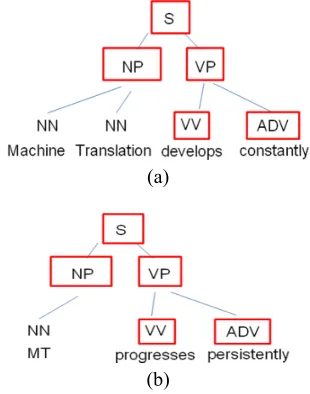
With this process, all equivalent pairs on differ-ent syntactic level can be iddiffer-entified by synchro-nously traveling the two trees from top to bottom. The following is an example of the identification of the equivalent pairs. Figure 1 gives out a refer-ence sentrefer-ence pair and their syntactic trees. The nodes which are included in certain equivalent pair are surrounded by a rectangle.
(a)
[image:3.612.112.267.262.459.2](b)
Figure 1 An example of the identification of the syn-tactic equivalent pairs.
In this example, five equivalent pairs can be identified:
• <S, S, “Machine translation develops con-stantly”, “MT progresses persistently”>
• <NP, NP, “Machine translation”, “MT”>
• <VP, VP, “develops constantly”, “progresses persistently”>
• <VV, VV, “develops”, “progresses”>
• <ADV, ADV, “constantly”, “persistently”>
3
Hybridization of Syntactic Equivalents
The indentified syntactic equivalents pairs include the sub-segments which sharing the same role in the same syntactic structure. Because of this, we
can obtain a variation of a reference sentence by switching the two sub-segments of an equivalent pair in this sentence. This operation did not change the structure of the sentence but only replace a sub-segment in the structure with its equivalent.
Consequently, two new references can be gener-ated by switching the two sub-segments of an equivalent pair between two reference sentences. Furthermore when we switch the sub-segments of all equivalent pairs between the two references, multiple new references are generated with various combinations of the switches. This operation is called the syntactic hybridization of the references which can be illustrated by following steps:
Suppose R={ri}i=1…n is a reference set containing
n reference sentences to a single source sentence.
R’ is the new reference set containing the original reference sentences and the hybridized reference sentences. R’ can be obtained by formula (1):
where rooti is the root node of the syntactic tree of ri. Equ(nt) returns the set of all equivalent of the
sub-segments covered by the tree node nt. The de-tailed process of Equ(nt) is:
Equ(nt):
Define set equ = Φ Add Seg(nt) to equ
If nt is included in an equivalent pair <nt, nt’, s, s’> Add p’ to equ
Define childi=1…m is the m children of nt
Define hybr = Equ(child1)×Equ(child2)…×
Equ(childm)
Merge hybr into equ Return equ
where Seg(nt) is the sub-segment covered by the tree node nt. Operation S1× S2 generates the Carte-sian product of the sub-segment set S1 and S2, i.e. for each arbitrary sub-segment pair s1 and s2 se-lected from S1 and S respectively, we concatenate
s1 and s2. Finally, the reduplicate references in R’
are removed.
• Machine Translation develops constantly
• Machine Translation develops persistently
• Machine Translation progresses constantly
• Machine Translation progresses persistently
• MT develops constantly
• MT develops persistently
• MT progresses constantly
• MT progresses persistently
4
Experiments
We will show experimental results in this section to verify the effectiveness of the extended set of hybridized reference sentences. In the experiments, multiple translations of the source language sen-tences are evaluated with several popular auto-matic evaluation metrics. The evaluation is carried out on sentence level using the original reference set and the extended reference set respectively. Finally, the Pearson’s correlations between the human assessments and evaluation scores using two reference set are calculated and compared.
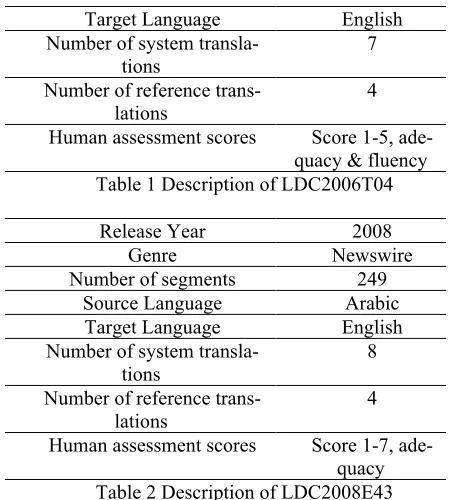
The multiple translations and human assess-ments are obtained from the dataset of the MT evaluation workshop at ACL05 (LDC2006T04) and the dataset from NistMATR08 (LDC2008E43). Table 1 & 2 describes the detail of the two datasets. The popular automatic evaluation metrics in-clude BLEU (Papieni et al., 2002), GTM (Me-lamed et al., 2003), Rouge (Lin and Och, 2004) and METEOR (Banerjee and Lavie, 2005). The syntactic trees of the reference sentences are ob-tained with the Stanford statistical parser (Klein 2003) for LDC2006T04 and Collins parser (Collins 1999) for LDC2008E43.
Table 3 & 4 gives out the correlations using two reference set on both datasets. The first column is the name of the used metrics. The second column is the correlations based on the original reference set. The third column is the correlations based on the extended reference set. In the experiment, the maximum length of N-gram in BLEU is 4. The exponent of GTM is 2. ROUGE uses skip-bigram with a window of nine words. And METEOR is run in “exact” mode.
Release Year 2006
Genre Newswire
Number of segments 919 Source Language Chinese
Target Language English Number of system
transla-tions
7
Number of reference
trans-lations 4
[image:4.612.310.535.69.319.2]Human assessment scores Score 1-5, ade-quacy & fluency Table 1 Description of LDC2006T04
Release Year 2008
Genre Newswire
Number of segments 249 Source Language Arabic Target Language English Number of system
transla-tions
8
Number of reference
trans-lations 4
Human assessment scores Score 1-7, ade-quacy Table 2 Description of LDC2008E43
After the hybridization, each source sentence in LDC2006T04 has 31 corresponding reference sen-tences in average and each source sentence in LDC2008E43 has 66 corresponding reference sen-tences in average. The number of the references is greatly increased. And as shown in the results, the usage of the extended reference set improves the correlations with human assessments for all the metrics in most cases except the ROUGE on LDC 2008E43.
Metric Original Extended BLEU 0.3488 0.3564
GTM 0.3671 0.3681
ROUGE 0.4252 0.4325 METEOR 0.4686 0.4723 Table 3 Pearson’s correlations with human
assess-ments on sentence level on LDC2006T04
Metric Original Extended
BLEU 0.6092 0.6109
GTM 0.5434 0.5438
ROUGE 0.6628 0.6582
METEOR 0.7053 0.7089 Table 4 Pearson’s correlations with human
assess-ments on sentence level on LDC2008E43
The following is a real instance in the experi-ments from LDC2008E43:
• Ten churches burned down in 10 days in the American state of Alabama
• Burning of ten churches in ten days in the American state of Alabama
• Ten churches set on fire in ten days in American state of Alabama
• Torching of ten churches within ten days in American state of Alabama
Six additional references:
• Torching of ten churches in ten days in the American state of Alabama
• Torching of ten churches within ten days in the American state of Alabama
• Torching of ten churches in ten days in American state of Alabama
• Burning of ten churches within ten days in American state of Alabama
• Burning of ten churches within ten days in the American state of Alabama
• Burning of ten churches in ten days in American state of Alabama
The syntactic structure of the original references:
• (TOP (S (NPB (CD Ten) (NNS Churches)) (VP (VBN Burned) (PP (IN Down) (PP (IN in) (NP (NPB (CD 10) (NNS Days)) (PP (IN in) (NP (NPB (DT the) (NNP American) (NNP State)) (PP (IN of) (NPB (NNP Ala-bama)))))))))))
• (TOP (NP (NPB (NN Burning)) (PP (IN of) (NP (NPB (CD Ten) (NNS Churches)) (PP (IN in) (NP (NPB (CD Ten) (NNS Days)) (PP (IN in) (NP (NPB (DT the) (NNP American) (NNP State)) (PP (IN of) (NPB (NNP Alabama)))))))))))
• (TOP (S (NPB (CD Ten) (NNS Churches)) (VP (VB Set) (PP (IN on) (NPB (NN Fire))) (PP (IN in) (NP (NPB (CD Ten) (NNS Days)) (PP (IN in) (NP (NPB (NNP Ameri-can) (NNP State)) (PP (IN of) (NPB (NNP Alabama))))))))))
• (TOP (NP (NPB (NNP Torching)) (PP (IN of) (NP (NPB (CD Ten) (NNS Churches)) (PP (IN within) (NP (NPB (CD Ten) (NNS Days)) (PP (IN in) (NP (NPB (NNP
Ameri-can) (NNP State)) (PP (IN of) (NPB (NNP Alabama)))))))))))
To investigate the distribution of the equivalents we also perform several statistics about the count and the length of the syntactic nodes. In table 5, we list the information about the count of the nodes. The first row is the average words count per refer-ence sentrefer-ence. The second and third row is the count of all tree nodes and equivalent nodes in all references respectively. The fourth and fifth row is the average count of tree nodes and equivalent nodes per reference sentence respectively.
2006T 04
2008E4 3 Average length of
reference 31.52 34.43 Total tree nodes 21123
1 62569
Total equivalent nodes 21807 10073 Average tree nodes 57.46 62.82 Average equivalent
nodes
5.93 10.11
Table 5 Counts of the tree nodes and equivalent nodes in references.
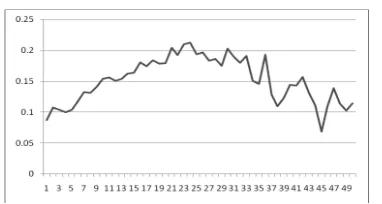
We also investigate the distribution of the length (count of covered words) of the nodes. First, we count the tree nodes and equivalent nodes whose length is from 1 word to 50 words. Then we calcu-late the pro-portion of equivalent nodes and tree nodes for each length. Figure 2 and 3 illustrate the distribution of absolute count of the equivalent nodes. The X-axis is the length of the nodes and the Y-axis is the count. Figure 4 and 5 illustrate the distribution of the proportions on two datasets re-spectively. The X-axis is the length of the nodes and the Y-axis is the proportion.
in Chinese-English data. Arabic-English references have much more equivalents than Chinese-English data and bias to long equivalents more significant.
[image:6.612.100.288.119.215.2]Figure 2 Distribution of absolute length of equivalent node on LDC2006T04
[image:6.612.89.290.122.327.2]Figure 3 Distribution of absolute length of equivalent node on LDC2008E43
Figure 4 Distribution of length proportion of equiva-lent nodes on LDC2006T04
Figure 5 Distribution of length proportion of equiva-lent nodes on LDC2008E43
5
Discussion
The experimental results verify the positive effect of the hybridized reference for the automatic
eval-evaluation in most cases. Though the improvement of the correlations is not very significant it is stable across the metrics in various styles.
Compared with the previous works based on pa-raphrase and synonym the new method has three important advantages. The first is that the hybrid-ized reference can switch the long span sub-segments beyond the words and phrases.
The second is that the switch can be per-formed in multiple levels, i.e. a sub-segment can not only be replaced as a single unit but also can be varied by replacing some child sub-segments of it. It’s noticeable that the multiple level switches also make it possible to present some structural varia-tions by means of the lexical variavaria-tions. In hybridi-zation, we can realize some structural variation between syntactic nodes by switch their parent node instead of reordering them directly.
The third advantage is that the new method needs no external knowledge which greatly facili-tates the application. But this advantage also re-sults in the main deficiency of this approach: the hybridization references cannot adopt any novel equivalents which are absent in existing references. This deficiency can be overcome by introducing the paraphrase and synonym into the syntactic hy-bridization.
It should be indicated that though the hybridiza-tion process generate many new references not all of the new references are reasonable.
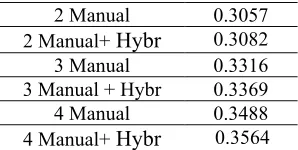
In table 6 we compare the effect of hybridized references and manual references with more details on LDC2006T04. In the table, the first column is the contents of the references for each source sen-tence. “Manual” means the manual references and the number in front of it indicates how many man-ual references are provided. “Hybr” means the hy-bridized references generated from the manual references in front of the “+”. The second column is the Pearson’s correlations between human as-sessments and the BLEU scores using the corre-sponding reference set. Besides the set containing 4 references the other correlations are the average of the correlations based on all possible subset con-taining certain number of references. For example correlation of “2 Manual” is the average of the cor-relations based on 6 possible subset containing 2 references.
[image:6.612.97.288.389.491.2]2 Manual 0.3057 2 Manual+ Hybr 0.3082 3 Manual 0.3316 3 Manual + Hybr 0.3369 4 Manual 0.3488 4 Manual+ Hybr 0.3564
Table 6 Pearson’s correlations based on incremental reference set
As shown in the Table 6 hybridized references can improve the correlations with human assess-ments on different sizes of manual references set. But it also indicated that though hybridization can generate a mass of novel references the new refer-ences is always not more effective than even one additional manual references. This tells us that the quality of the hybridized references still need to be further refined.
Another message revealed by the table is that with the increase of the number of manual refer-ences the improvement of correlation made by ad-ditional manual references is decreasing. However, the improvement made by the hybridized is in-creasing. This happens because the number of hy-bridized references increases much faster than the number of manual references.
There are still several noticeable deficiencies of this work. First, it only works when there are more than two existing references. This make it cannot be used to extend the single reference in mass bi-lingual corpus. Second, which is also the most im-portant one is that this method strongly focuses on the precision at the cost of recall. Though we have recognized many equivalents for each sentence but there are still many equivalents that share different context cannot be recognized. This will be our main future work. The last deficiency is the bias to the long equivalents. This problem is caused by the same reason with the second deficiency: this method define the equivalent with the same syntac-tic context. If two sub-nodes do not share the same parent it often have different brothers.
6
Conclusions and Future Work
In this work we present a novel method to extend the coverage of the reference set for the automatic evaluation of machine translation. The new method decomposes the existing references into sub-segments according to the syntactic structure. And then generate new reference sentences by
hybridiz-ing the equivalents of the segments which play the same syntactic role in corresponding references. In this way the new method can not only capture the equivalents of words and phrases like the other methods but also capture the equivalents of long sub-segments which are out of the capability of the other methods. Another important advantage of the new method is the no use of the external knowl-edge which greatly facilitates the application.
Experimental results show that with the ex-tended reference set the state-of-the-arts automatic evaluation metrics achieve better correlation with the human assessments.
In the future work, we will relax the restriction of the equivalent definition and try to recognize more equivalents. We will also introduce the para-phrase and synonyms into our method to see fur-ther improvement. Anofur-ther interesting challenge is to hybridize the equivalents in the different order and present the structural variations directly.
Acknowledgments
This work is supported by the National Natural Science Foundation of China under Grant No. 60773066 and 60736014, the National High Tech-nology Development 863 Program of China under Grant No. 2006AA010108.
References
Statanjeev Banerjee, Alon Lavie. 2005. METEOR: An Automatic Metric for MT Evaluation with Im-proved Correlation with Human Judgements. In Proceedings of the ACL Workshop on Intrinsic and Extrinsic Evaluation Measures for Machine Trans-lation and/or Summarization.
M. Collins. 1999. Head-Driven Statistical Models for Natural Language Parsing. PhD Dissertation, Uni-versity of Pennsylvania.
I. Dan Melamed, Ryan Green, Joseph P. Turian, 2003, Precision and recall of machine translation, In Pro-ceedings of HLT/NAACL 2003.
David Kauchak, Regina Barzilay. 2006. Paraphrasing for Automatic Evaluation, In Proceedings of the NAACL 2006.
Dan Klein, Christopher Manning. 2003. Accurate Un-lexicalized Parsing. In Proceedings of the 41th Meet-ing of the ACL, pp. 423-430.
refer-ences in objective evaluation measures of ma-chine translation, In Proceedings of the IWP 2005.
Karolina Owczarzak, Declan Groves, Josef Van Ge-nabith ,Andy Way. 2006. Contextual Bitext-Derived Paraphrases in Automatic MT Evaluation, In Pro-ceedings of the Workshop on Statistical Ma-chine Translation.
Karolina Owczarzak, Josef Van Genabith, Andy Way. 2007. Dependency-Based Automatic Evaluation for Machine Translation, In Proceedings of SSST, NAACL-HLT 2007 / AMTA Workshop on Syntax and Structure in Statistical Translation.
Kishore Papieni, Salim Roukos, Todd Ward, Wei-Jing Zhu. 2002. BLEU: a method for automatic evalua-tion of machine translaevalua-tion, In Proceedings of the 40th Meeting of the ACL.
Grazia Russo-Lassner, Jimmy Lin, Philip Resnik. 2005. Re-evaluating Machine Translation Results with Pa-raphrase Support, Technical Report LAMP-TR-125/CS-TR-4754/UMIACS-TR-2005-57, University of Maryland, College Park, MD.
Chin-Yew Lin, Franz Josef Och. 2004. Automatic evaluation of machine translation quality using long-est common subsequence and skip-bigram sta-tistics. In Proceedings of the 42th Meeting of the ACL. Liang Zhou, Chin-Yew Lin, and Eduard Hovy. 2006.