Training for a transformed service : the experience of
learners in 2016
SMYTH, Graham and WATSON, Aileen
Available from Sheffield Hallam University Research Archive (SHURA) at:
http://shura.shu.ac.uk/18420/
This document is the author deposited version. You are advised to consult the publisher's version if you wish to cite from it.
Published version
SMYTH, Graham and WATSON, Aileen (2018). Training for a transformed service : the experience of learners in 2016. Probation Journal, 65 (1), 61-76.
Copyright and re-use policy
See http://shura.shu.ac.uk/information.html
Training for a Transformed Service: the experience of learners in 2016
Graham Smyth (MMU) and Aileen Watson (SHU)
To be published Probation Journal, March 2018
Abstract
This article explores the training and early practice experience of the first cohort
of probation learners trained under the auspices of ‘Transforming Rehabilitation’
(TR). It draws on interviews with learners qualifying in 2016 in order to examine the adequacy of their training and their early perceptions of delivering TR as qualified practitioners. While highlighting their training as stressful and noting issues with TR and some implications of the highly risk focused nature of NPS work in particular, participants were generally positive about their training and early post-qualification experiences. Some inferences are drawn in relation to the future approach to training.
Keywords
Probation training, blended learning, Transforming Rehabilitation, practice, learning/teaching, values
Introduction
At the time of writing, the professional training of probation officers is into its third version since the move away from the social work qualification in 1994. The
‘Professional Qualification in Probation’ (PQIP) commenced in 2016, replacing
the ‘Probation Qualification Framework’ (PQF) which in turn succeeded the Diploma in Probation Studies in 2010. The structure and mode of delivery of the
PQIP (or the final ‘level 6’ qualification within it at any rate) is not dissimilar to that
of the PQF in its latter days.
This article considers the training and early practice experience of learners completing the PQF in that latter stage and qualifying in 2016 – the first cohort to
have started and finished the PQF under the auspices of ‘Transforming
was also pursued as part of a wider research interest in the changing context of probation training.
Background
The given rationale for the creation of the PQF in 2010 was to increase the level of qualification throughout probation so as to equip all staff for their role in risk management, and to build a quicker and more flexible route to qualification. The
Ministry of Justice’s consultation on the new framework in 2009 stressed ‘the urgency for qualified practitioners at every level in the National Probation Service subsequent to the findings of the Sonnex inquiry’1 (MoJ 2009: 5). A minimum qualification was created for probation service officers (PSO’s), and the new
framework made it far easier for existing PSO’s to undertake the qualification
from within their existing position without sacrificing income or job security. For the probation officer qualification, accredited workplace learning would be allied to undertaking an academic qualification delivered by nominated universities on a
‘blended’ learning basis – i.e. primarily online but complemented by some face-to-face teaching. The framework allowed for the qualification to be completed as a three-year degree, or for those with an existing relevant degree2, as a fifteen month graduate diploma. In the early years, most learners went through the degree route. From 2015, with probation organisations critically short of qualified staff as TR got underway, the three-year degree was abandoned, and the PQF experienced a swansong as three cohorts (nearly seventy individuals in the North West alone) were put through the Graduate Diploma during its final year.
The demands of the changing probation landscape led to a rethink of some of the academic content of the PQF as delivered prior to the exclusive use of the
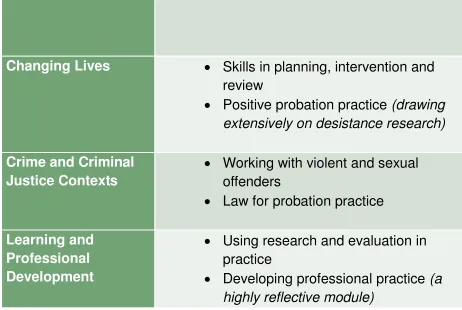
Graduate Diploma. The resulting academic programme is shown in Table 1 below.
Strand
Modules
Principles for
Effective Practice
Rehabilitation and recovery
(ie
concerning substance misuse and
mental health)
Working with difference
1
This inquiry established that serious failings in the supervision of a young man by the name of Dano Sonnex allowed him to carry out two savage murders while on licence
2
Changing Lives
Skills in planning, intervention and
review
Positive probation practice
(drawing
extensively on desistance research)
Crime and Criminal
Justice Contexts
Working with violent and sexual
offenders
Law for probation practice
Learning and
Professional
Development
Using research and evaluation in
practice
[image:4.612.84.546.75.385.2]
Developing professional practice
(a
highly reflective module)
Table 1: Module structure of the Graduate Diploma in Probation Practice.
Alongside the academic programme learners were assessed in the workplace for a Vocational Qualification (VQ) which required them to demonstrate competence in a range of practice areas such as effective communication, promoting
prosocial behaviour and managing risk. Passes in both the academic and
vocational elements of the programme were required to achieve the professional qualification. This required a high level of co-operation and co-ordination
between the universities delivering the academic component and NPS staff running the VQ element.
The demands on these learners – all with degrees regarded as relevant in theoretical terms at least, but many having no previous experience of working in probation – were considerable. It was a feature of working with PQF learners throughout the six years of that qualification that they harked back to what appeared to them the relatively easy experience of trainee probation officers
(TPO’s) on the DiPS – an experience which had in fact been highlighted by
bureaucracy; undertake frequent training; undergo assessment for their
vocational qualification (VQ); undertake the equivalent of a full final year’s study for an honours degree, with the aid of one day a week study leave (assuming they managed to take that). In these circumstances, the attrition rate was surprisingly low (just over five per cent in the north west).
In terms of probation culture, the adoption of the PQF was arguably less of a shift than had been the move from a social work qualification to the DiPS. Deering (2010: 9) suggested there had been an intention in that move to recruit from a
wider ‘and implicitly non social work’ base so as to have a workforce more geared up for ‘the assessment and management of risk and the management of
offenders to ‘protect the public’, rather than a broader, more traditional aim of rehabilitation’. However, his research with trainees under that regime found a
higher retention of traditional values, beliefs and aims than Government might, in his view, have wished.
The extent to which those values have survived the enormous structural changes wrought by TR is a question to be reviewed again, not least in view of Deering
and Feilzer’s assertion (2015: 1) that one of the reasons behind the split was the
government’s desire to change the values of the probation service which were
‘deemed to be too soft on crime’.
Mawby & Worrall (2013: 116), while charting an evolution over time in the motivation and modus operendi of different generations of probation workers,
nevertheless found all to be ‘bound by common values, including a desire to ‘make a difference’, a conviction that people can change and a belief in the worth
of working directly with individuals to effect change’. At the outset of the PQF
however, they anticipated, ‘a very different culture emerging, where the
‘transformative’ nature of training is less marked than it has been to date’ (ibid, 2011: 10).
Unsurprisingly there was an emphasis in the PQF – including its Graduate
Diploma iteration – on risk assessment and management, but also on values and ethics in the work and on positive engagement with service users. The Graduate Diploma as delivered by Sheffield Hallam and its partner universities in North West and North East England, for example, included modules on desistance and recovery-informed practice and on working with difference, along with a reflective assignment to be centred around risk assessment and management (see Table 1).
for which they were preparing, most of those on the Diploma were headed for the
‘relentless’ (Phillips et al, 2016) high risk work entailed in a National Probation
Service (NPS) caseload.
Writing about his experience of going through the PQF during TR, Cracknell (ibid: 216) suggests that the prioritisation given to public protection during his training
is liable to ‘foster a culture of punitiveness’. He notes that the compression of
training under the Graduate Diploma potentially denies trainees the time and space to thoroughly learn their craft, hence promoting more defensive, and by implication more punitive, practice.
This suggests the potential for training to impact on probation culture not only by its content but by the way it is organised. There will in turn be an influence from the pervading culture within the organisation, just as the training will in turn influence that culture (Vogelvang, 2014, citing Farrow et al). Vogelvang (ibid) distinguishes between an institutional and a support paradigm in probation training: the former meets the needs of the organisation in terms of managing offenders and the risk they pose, promoting rehabilitation within that framework; the latter works alongside the offender, stressing his or her strengths,
possibilities and social networks as starting points. How these are balanced may be expected to have a significant influence in the approach taken by the next generation of probation officers / offender managers / case managers.
Robinson et al (ibid: 176) make the case for a ‘compelling and coherent narrative of service delivery that remains true to the core of a probation ethos’ within the new probation organisations. It follows that this needs also to be imbued within the training if it is to survive.
Methodology
This research is drawn from interviews with eleven of the first exclusively Graduate Diploma cohort in the North West /North East,3 completing their qualification in 2016. Interviews were conducted several months after they had started work, ten of them with the NPS and one with a Community Rehabilitation Company (CRC), allowing them to reflect on their early experiences within the new world of probation and how the course had prepared them for their new roles. All twenty-nine of the North West cohort were invited to participate, of whom ten (just over one third) took up the invitation. In the North East nine students had been sponsored through the training by CRCs and so these students were approached in order to gain an alternative perspective. Unfortunately, only one student was able to participate and so whilst the
3
response from this student was helpful in providing a candid CRC-based view, it cannot be used to discuss the experience of CRC students more broadly.
All participants gave informed consent to be interviewed. The research was covered by relevant academic ethical procedures.
The methodology used does raise the potential issues attendant on having a self-selected sample, and a sample interviewed by people who had taught them on the programme at that, but there was no sense that anyone was talking less than frankly, and it does offer a spread of opinion and, in the North West at least, a reasonable proportion of the cohort.
All interviewees were assured of anonymity and were aware that no remarks or opinions quoted would be attributable – a pre-requisite in research such as this if we are to be confident of securing their genuine views. Participants are referred to in the following section as P1 to P11.
Findings and analysis
Findings will be considered first in relation to the qualification itself and its fitness
for purpose, and then in relation to participants’ views on the new probation
service in which they find themselves and their role within it. Given the prevailing negativity in the world of probation, a finding that was perhaps as surprising as it was consistent was the positive views expressed, in relation both to the
programme and to the early stages of a probation career.
The PQF
The PQF model (like the current PQIP) asked a lot of its participants, who had to maintain a PSO workload to varying degrees, while also taking on offender manager work for which they were being trained and assessed, and at the same
time embarking on degree level academic study; or in P10’s words:
Working full time in an office at what was a difficult time for everyone with caseloads at an all time high (following the split) and how you fitted in that was very difficult to pin down initially .. and finding your best way within it to manage what was going on.
It is therefore not surprising to find the most common assessment of the PQF experience to have been that it was stressful, the experience of many being summed up by P7 in these terms:
If I was to pick one word it would be stressful.
In most cases, however, stress was seen as an inevitable aspect of a programme designed to prepare people for this career, typified in P5’s description of the programme as
Exciting, stressful, interesting, I feel very lucky to have got on the course…
Similarly P6 observed:
Overall it was very good —challenging at times but rewarding at the end of it, … for all the stress at the end, or for whatever little failings there might be there, I
think it’s a very worthwhile thing to do and … it’s competitive to get onto I believe so I’m glad I’ve done it.
While P9 said:
I knew it was going to be hard going —probation is always difficult, it’s always hard going so I knew it was going to be hard… initially I just thought take it one
day at a time till I get to the end but towards the end I did get a bit stressed… and it built up… but overall it was what I expected it to be.
Three participants referred to causes of stress which they regarded as more avoidable: factors such as a perceived degree of disorganisation in
arrangements for training (P7); that the programme
…felt a bit rushed, personally I would have preferred it to be a bit longer to help digest what we’d learned and put it more into practice as opposed to trying to cram everything in to the 15 months (P2);
and that,
I don’t think in the new PQF they have considered the changing role of offender managers, so the fact we’re doing more high risk and more medium risk cases —
we didn’t have the same generic caseload as perhaps they had previously, because that adds a lot of pressure… But I’m glad I did it and when they say it
will prepare you for probation I can see their point (P8).
Reference was made to juggling different elements (P3), but all elements were considered valuable by most – the academic component in particular was
consistently appreciated and regarded as relevant to developing practice. Some frustration was expressed at the extent to which capacity to engage with
I am a bit of a geek, I like studying but … I was so short of time I just did what I
needed to do and stuck with safe topics… I think if I had had longer I would
probably have immersed myself more in the course and enjoyed the learning
side of it… There’s only one study day a week so I’d think, ‘okay what do I need to do and how can I do it in the most efficient way?’ There would be journal
articles and I ‘d think ‘that’s interesting I’ll come back to that’but I’d never get time… it was a missed opportunity for enjoying the work.
Nevertheless, when asked to rate their engagement with the academic learning on a scale of one to ten, our participants, while commenting on the challenge of fitting it in and the necessary sacrifice of leisure time, averaged at 7.64 (P2 was
between 5 and 6). It was considered by some that allowing longer for the course, or starting the university part of the course earlier (under the PQF this started six months into the course) would have helped, but nevertheless, the sacrifice of time was generally considered worth it. P5, whose work earned a distinction and whose engagement rating was 8, said:
I engaged with it, I was interested and I thought it was good stuff… I enjoyed it as
well.
The structure of a programme such as this makes it particularly important to integrate academic and practice learning. Most participants considered that to have been achieved. P6 commented that,
…every academic module that we did integrated with the practice and with the training … I didn’t think anything we did was not worth doing, I thought it was all useful and it all related to everyday stuff;
while P2 went so far as to say that,
it helped me sort of challenge the office — a lot of it was sort of recovery based, desistance and then coming into the office you can lose sight of that because
you’re concentrating on managing risk so the academic side really helped me to bring that into my practice because you could lose sight of that if you didn’t continue to look at the different areas in the academic world’
The two participants who took a different view did so on the basis that,
There’s so many changes within probation … we actually farm out interventions
now — we deliver less interventions on a personal one-to-one, we sell them to the private sector, so sometimes it felt very far removed from what we actually do
(P8);
And in the case of P4, I don’t feel I got anything out of the VQ bit to be honest.
would have been better to do the academic stuff from the start for communication between the two.
Asked about the most valuable learning from the programme, most referred to theoretical underpinning and practical application in areas such as risk
management and desistance research. Some, however, referred to more day-to-day practical matters, such as, in two cases time management, given the quality of work you had to do in such a short time (P4), learning from colleagues in the workplace and partner organisations (P1) and in one case from short term
placements in different settings (P5) [the extent to which this was available varied between different learners]. Encouragingly, given the time pressures of this
programme, broader developmental or reflective learning was explicitly mentioned by two participants, as witness P8:
I think as a person it’s taught me more about myself, that I’m capable of more
than I realised, and that I can rise to a challenge ... I think by being able to self analyse it helped me.
The acid test for a programme such as this is the extent to which a qualified individual feels that it has equipped them to do the job they have trained for. All participants considered that it had helped them acquire the core skills for the basic tasks they would be required to perform, which in most cases were
continuing to develop. A couple had experienced initial crises of confidence and it was noted that while the programme might have developed confidence and abilities to carry out a community-based role where learners were entirely or mostly placed during training, this was significantly weaker for P1 whose first job was in a prison, which has been the case for a number of Graduate Diploma appointments. The one CRC respondent did not feel prepared by the programme for that role – or more to the point, did not consider that the job allowed
application of skills learned on the PQF. Others considered themselves ill
equipped to work with certain categories of client, such as sex offenders, or when offenders kick off (P4), or to write reports for parole or court:
If I was given a PSR to do now, I would feel very anxious because although I am
a qualified PO I don’t think I am a qualified report writer (P2).
Accordingly there was some variance in views as to how comprehensive such a programme can be, with some considering that it should be structured – and perhaps extended – to deal more with such areas of work as those mentioned above, but more of a consensus that, given the core skills,
once you start as a full PO the learning only starts now.
I feel comfortable about my ability to sit and speak with clients —I’m okay with that — the qualification is about trusting I could do that and using those around me to help me develop in that (P2);
I felt I had those core skills, I had confidence in my decision-making, it’s having
the confidence to trust your judgement and not rely on someone else saying ‘yes that’s fine’, having the confidence to just do it (P3);
When I sit down and think, the fundamentals of doing the job I feel strong in, so
I’m confident in that (P6).
Respondents typically felt that the programme had built their confidence to meet the demands of the role. For P6 the difference pre and post qualification was
Night and day I would say — how I started and how I am now, while P8 stated,
I think I’m more confident, I think I believe in my own judgements, I think I’m happier as a person, I feel as though I’ve finally achieved what I set out to
achieve —it’s taken me 24 years but I’ve done it. And I’m really proud of myself.
Online Learning
In contrast to previous models for probation training, the PQF (and even more so the current PQIP) was very reliant on online learning, albeit delivered in a
blended form with a face-to-face workshop for each module, and with the potential for some additional support to be provided in that way. This allows learners to be taught across wide regions with only a limited amount of time out of the workplace to attend classes. Teaching on this programme, it was
noticeable that Graduate Diploma cohorts which tended to include a reasonable proportion of relatively recent graduates with experience of virtual learning
environments adjusted more readily to this way of learning than previous learners coming through the three-year degree route.
This was borne out by our respondents all bar one of whom (P8, who struggled) were on a spectrum between I didn’t mind that so much (P6) and brilliant… fitted
my learning style (P7). It should be noted, however, that nearly all saw the face-to-face element as an essential complement to this, and several indicated they would have preferred more. One of those (P4) said that should never go, even if
it’s only as much as we had, once every so often while for P5 they were,
really important for that opportunity to ask questions but also in making you think
‘I’m here, I’m at university there’s a piece of work due’… prompting you and putting you into that mindset for learning and doing the work;
I did find the face to face session for each module essential really because you focus on the key aspects of things, and particularly assignments.
This is an important consideration, given that the tender for the new PQIP did not require any face element. It suggests that the benefit of mutual, face-to-face learning and sharing experience and knowledge in this kind of programme, along with the reassurance of direct guidance from teachers should not be underestimated.
Overall
When participants were asked how the programme might be improved, some resourcing and coordination issues in relation to workplace training and
assessment were highlighted (though it should be noted that as the first cohort exclusively on the Graduate Diploma, some teething problems were
experienced) and suggestions made for the incorporation of more detailed practical instruction in relation to things like reports. There were arguments for more consistency and for a differential approach as between those with and without previous probation experience. Nobody suggested elements that could be dropped out of the programme and there was an even split between those thinking it should be longer and those who did not. Overall though, as has been seen, there was a generally high degree of satisfaction with the programme and its role in preparing participants for practice.
From the PQF into probation
We now turn to consider the early experience and views of this cohort - the first cohort of newly qualified probation officers (if we can use that term) to take up posts following TR - on the job they were training for and the organisations for whom they are working.
This cohort have trained to take their place in a ‘transformed’ world of probation,
split in two, the larger part run for profit by private companies – albeit ten of our eleven participants took roles as civil servant probation officers within the NPS. As qualified workers this state of affairs is all they have known and three
indicated they were not in a position to compare the present situation with what had gone before; others had previously worked as PSO’s, and all, regardless, had quickly become aware of issues with the split, including an imbalance in resources, inefficiencies, blockages in the sharing of information, confusion for clients and pressure caused by the high risk nature of the NPS caseload.
There’s resentment between the two sets of officers — they were always calling us the dark side and we were calling them the dark side, so there are already
divides there, if they become bigger which I’m sure they will do… (P1).
A knowledge gap as to how things work on the other side of the divide had also quickly set in. This was expressed by half of the NPS staff interviewed, put most strongly by P2:
I don’t understand how the CRC work I couldn’t even tell you if they use the same operating system as us. It really is a different service now and I think that’s
a bit of a shame
On the CRC side there was a feeling of being looked down on by NPS staff, along with bafflement at how that had arisen so quickly given that many had worked side by side as part of the same organisation prior to the split.
A minority of PQF places were bought by CRC’s, and as things stand they
continue to commission some places on the current PQIP, though have questioned whether they would not be better with their own dedicated qualification. This would certainly be endorsed by the one CRC employee amongst our participants for whom the training:
… doesn’t feelvaluable . . . I’ve come back into the CRC and I feel like all the skills I’ve learned and developed aren’t particularly relevant here . . . we do it this way because it’s cheap and it’s quick, (there’s) no evidence behind how we’re
working (P11).
Some of the other participants had short CRC placements during their training and most echoed the different training needs, particularly a reduced requirement to focus on risk, though one did question this on the basis that both remain in the same business (P5).
In making the transition from training to practice, our NPS participants are, for the most part, doing the job they expected. The main digression from this is a refrain that would have been familiar long before TR - You spend a lot more time at your computer than I thought you would do (P1), a point made by four of the ten.
Two participants felt that the emphasis on risk management had curtailed a significant part of what they came into the job for. P4, echoed to a lesser degree by P5 said,
In my head I had this picture of being able to really help . . . and I think the job is . . . not what it used to be when I speak to older colleagues who have been around for a while — there was a bit more of a social work approach I think. . . So for me I just feel we sit across a table and we say we’re here to help but when they need
change the world and help people, but actually we’re restricted a lot by
regulations and rules.
This goes to the heart of the extent to which the shift to an exclusively high risk NPS client base, and the training which goes with that has affected the
motivation and philosophy of those coming through training and into the job. In delivering the qualification the writers found amongst learners a motivation to engage with service users and offer positive help and support which was not obviously different from that which would have been evident in previous
incarnations of the qualification. So, when our participants were asked what they like about the job, the following answers were not untypical:
When you see … for every ten failures if you like there’s always one success and that’s really good to see . . . I like the fact that you can read about them and they’ve done something awful but then when you meet them and you can give them a bit of like personality, like they’re not —they’ve done something terrible but they’re still someone human that you can engage with . . . you can’t beat the
fact that you can have that contact with them — getting to know their families, just working with them really (P4);
When you get a good relationship with somebody and you get the feedback from
them that you have helped for them to become substance free …(or) offence free
for a period of time and get a job and just to get their life in a certain direction, I
think that’s the kind of reward you get out of it I think (P6);
I do really enjoy the face-to-face work and the satisfaction of when you get a really difficult case and you start to progress with them and see some sort of changes no matter how little they are (P7);
I like working with people and I am a firm believer that people can change… it’s
absolute, and I just think, give someone the right set of circumstances and they can do it —if that’s what they want to do then they will do it and they can do it
(P8).
That, of course, is only part of the picture and it is equally important to know how this motivation plays out in the context in which newly qualified probation staff are placed. Hence we also asked them how they would describe their main role and, raising a question that has again been alive in probation since long before TR, who they consider to be their primary client. The message about risk and public protection has certainly gone home and was spelled out by half of the NPS participants, though rarely in the unequivocal terms of P1 who described the main role as:
Public protection:… I see rehabilitation as secondary now to public protection.
The role of an OM being protecting the public and preventing reoffending and helping to rehabilitate —I don’t see them as mutually exclusive I think they’re all linked together.
Or as P5 put it,
I suppose we want probationers to manage …. the focus, sort of the priorities of the probation service as it is now would be to look after the public and manage
people’s risk in the community.. people who have proved in the past they are capable of being dangerous or causing harm so it’s always being aware of that;
so I think it’s managing what I think may happen with the guys and ladies on my
caseload but also I think for me it’s about forming a relationship with people and
see if I can help them move in a direction where they don’t have that contact with the CJS and the negative things that impact on them.
Views on who they regard as their principal client were again suggestive not so much of a new guard of enforcers but of practitioners seeking to apply traditional probation values within a modern context. There were a couple for whom this was pretty well exclusively the public/community but again, other answers were
more nuanced, as witness P2’s response:
We’re meant to be protecting the public, but it’s theway you go about that isn’t it? And for me it’s about supporting the client and I see myself as working to help the client and that stops them doing things that are harmful to them and others. And I think that can sometimes sway your decision making and you can come across too soft for maybe the police or even the prisons, but that’sour job isn’t it? To help people and then along the way hopefully reduce reoffending.
Similarly P4 indicated that it was primarily the person sat across the desk from me:
I mean I know we have to take into account the public, but when you’re sat
opposite from that person … you always have to be mindful of the victim, but our focus, when we’re thinking of protective factors and what we can put in place, it’s
always for that person sat opposite us — with the interests of the public, but at the time we are always doing it for the benefit of that person, to help their risk.
P5, while conceding, I suppose as a Government agency you’d always have to
say it’s the public, added:
… but it’s hard not to say that it’s the people that you have in front of you
because I find it really difficult not to – you have invested in those people and
you’ve built up that relationship with them… you feel like you’re working on their behalf… so I don’t really know but I do want to feel I’m working on behalf of my
P6 put this in a way that perhaps reflected the approach of most:
I think it’s all three (offender, victim and wider community): I think it’s the person
sat across the table from you but it’s also the general public and it’s also victims who might be victims of the person you’re working with or potential future
victims… you work with someone to help them make better of themselves, but
the ultimate goal is to protect victims and the public by doing that, so again I don’t
think it’s mutually exclusive —for me it’s not just about helping someone and forget about what they’ve done, I think it’s to make sure it doesn’t happen again to anyone else in the future and to make sure that if there’s any past victims, the person is less of a threat to them, to doing something again.
There is much here, then to support the notion that the PQF class of 2016, while taking seriously the responsibilities and pressures attendant on the unequivocal risk management role of the NPS in particular, were also trying to hold on to many of the values that were part of probation training and practice when the social work qualification held sway. Given the tensions that inevitably go with that juggling act, it would not be surprising if, having accomplished the relatively hasty qualification, new officers were not beginning the process of repenting at leisure. As some of the above quotations indicate, there are certainly frustrations for some in their efforts to carry out the job in the way they had hoped – and at least one Graduate Diploma learner in the North West withdrew from the course on the basis that he had not signed up for what he believed to be the punitive approach of the job.
In spite of all this, however, all ten of our NPS participants indicated that they were enjoying the work –two of them ‘loving’ it and two indicating that they would recommend it to others. It should be added that one participant (P7) qualified that enjoyment as limited to the thirty per cent (of time) that I am with clients….
But there are other occasions when I’ve felt quite disheartened and disillusioned
with the whole service in terms of there are just sometimes no resources to help some of the most complex people.
Nevertheless, the overwhelming sense was positive. The exception amongst our participants was the CRC employee, who was frustrated, negative about the approach of the CRC in which s/he worked and looking to leave. Given that this was only one person, it is not suggested that any conclusions can be drawn from this, though it does arguably underline a possible mismatch between the training
offered through the PQF and the work expected of qualified staff in some CRC’s
at least. Not that any positive suggestions in responding to that were forthcoming
I don’t know what (training) programme you could design that would work for that
(how the CRC works) because I don’t think it’s a good way of dealing with people
(P11).
Some conclusions
Reviewing the responses of this, admittedly small, sample of the first post-TR
cohort of PQF graduates, there is little evidence of the ‘culture of punitiveness’
predicted by Cracknell (ibid). Much more evident were the positive ‘common
values’ which Mawby & Worrall (ibid) considered to bind previous generations of probation training.
There is no doubt that the task of sustaining those values in the face of a massive NPS preoccupation with risk, the pressured and abbreviated nature of the programme and reduced opportunities for peer support is a challenge for both learners and teachers, but it is one that must be faced.
It is also notable that, while identifying learning gaps for themselves from the truncated nature of the programme and some level of perceived disorganisation / teething troubles in training and VQ provision, learners generally felt quite well equipped to embark on roles as qualified offender managers within the NPS. Much will depend on how this is consolidated in the early months and years of the careers of newly qualified staff. In the case of our participants, all ten NPS participants said they were being well supported in this respect – referring to active support from managers and colleagues (though with one plea for special training for those appointed to prison jobs, which was said to have been
promised but, by the time of the interview at any rate, not delivered). For the CRC participant there had not been any such opportunities and a feeling that this person was simply back where they had been before embarking on the
programme.
The importance of interactions with peers in the process of 'professional socialiazation' has been highlighted by Grant (2017) who found that many aspects of actually learning how to practice within criminal justice occurred outside of proscribed training arrangements. Durnescu (2014) has also
emphasised how the process of professional socialisation occurs over the course of a probation career albeit at a different rate for all individuals. Our participants are embarking on probation careers at a particularly challenging time and it remains to be seen what impact this has on sustaining the values and professional culture that have been central to probation practice.
approach if probation staff are to continue to embark confidently and competently on this increasingly challenging career.
Meanwhile, there is a case for picking up the threads of this research, carried out as it was primarily with recruits to the NPS and explore how the training/practice
axis is playing out in CRC’s.
References
Cracknell, M. (2016), ‘Reflections on undertaking the Probation Qualifying
Framework Scheme during the Transforming Rehabilitation Changes’, Probation Journal 63(2), 211-218.
Deering, J. (2010), ‘Attitudes and beliefs of trainee probation officers: a ‘new breed’?’, Probation Journal, vol 57(1), 9-26
Deering, J and Feilzer, M (2015). Privatising Probation: Is Transforming Rehabilitation the End of the Probation Ideal? Bristol: Policy Press.
Durnescu I (2014) Probation skills between education and professional socialization. European Journal of Criminology 11(4): 429–444.
Grant., S. (2017) Learning on the e job? Exploring first-year experiences of newly-qualified criminal justice social workers in Scotland. Probation Journal Vol. 64 (1) 33-49
Her Majesty’s Inspectorate of Probation (2016), Transforming Rehabilitation –
Early Implementation (5), London HMIP,
https://www.justiceinspectorates.gov.uk/hmiprobation/media/press-releases/2016/05/tr5/
Mawby, R. & Worrall, A. (2011), Probation Workers and their Occupational Cultures, Leicester: University of Leicester
https://www2.le.ac.uk/departments/criminology/documents/Final_report_Nov_201 1%20-17%20Nov%202011.pdf
Mawby, R. & Worrall, A. (2013), ‘Working with offenders: someone has to do it but not just anyone can’, British Journal of Community Justice, vol 11, no. 2/3, 115-118
Phillips, J., Westaby, C. & Fowler, A. (2016),‘‘It’s relentless’: the impact of working primarily with high risk offenders’, Probation Journal 63 (2), 182-192
Robinson, G., Burke, L. & Millings, M. (2016), ‘Criminal Justice identities in
transition: the case of devolved probation services in England and Wales’, Br J Criminol (2016) 56 (1): 161-178
Vogelvang, B. (2014), ‘Aligning the purposes of Probation with professional and