Becoming a teacher: conceptual and practice development
in the learning and skills sector
MAXWELL, Bronwen <http://orcid.org/0000-0002-8022-9213>
Available from Sheffield Hallam University Research Archive (SHURA) at: http://shura.shu.ac.uk/2942/
This document is the author deposited version. You are advised to consult the publisher's version if you wish to cite from it.
Published version
MAXWELL, Bronwen (2009). Becoming a teacher: conceptual and practice development in the learning and skills sector. Research in Post-Compulsory Education, 14 (4), 459-478.
Copyright and re-use policy
See http://shura.shu.ac.uk/information.html
Author
Bronwen Maxwell
Sheffield Hallam University
Address for Correspondence:
Dr Bronwen Maxwell
Deputy Head / Principal Lecturer
Centre for Education and Inclusion Research, Sheffield Hallam University,
Unit 7 Science Park, Howard Street, Sheffield S1 1WB
Becoming a teacher: Conceptual and practice development in the Learning and Skills Sector
Bronwen Maxwell
Centre for Education and Inclusion Research, Sheffield Hallam University, Sheffield, UK. Abstract
Drawing on a mixed methods study of in-service learning and skills sector (LSS) trainees, comprising beginning and end of year surveys and six longitudinal case studies together with literature on trainee’ development in the LSS, schools and higher education sectors, conceptual and practice development continua are proposed. Conceptions become more multi-dimensional and increasingly link teaching and learning whilst initial concern with the practicalities of teaching is followed by recognition of learners’ needs. Next, greater emphasis is placed on learner autonomy and catering for individuals’ needs and finally assessment and evaluation is used systematically to shape practice. The continua offer an understanding of the subtleties and complexities of trainee development allowing for different starting and end points and
accommodating varied work contexts. I argue that this provides a more adequate basis for the development of initial teacher education than the prescriptive approach embedded within recent LSS ITE policy reforms.
Keywords: conceptions of learning and teaching; initial teacher education; teacher development;
Introduction
The Learning and Skills Sector (LSS) in England is diverse, comprising further education colleges, sixth form colleges, personal and community development learning and work based training and learning in other adult settings such as prisons and the uniformed services. Over the last 15 years the sector has moved from a position of ‘benign neglect’ (Young et al. 1995, 7) to being placed ‘at the forefront of UK’s attempt to raise its skill profile’ (DIUS 2007, 3).
Developing the workforce needed to support this ambitious agenda became one of the central themes of sector reform (DfES 2002). At the same time the inspectorate reached the damning conclusion that:
The current system of FE [Further Education] teacher1 training does not provide a satisfactory
foundation of professional development for FE teachers at the start of their careers. (Ofsted 2003,
2).
Perceived weaknesses in trainee preparation that led to ‘many trainees mak[ing] insufficient progress’ (Ofsted 2003, 2) included, amongst other issues, lack of opportunities for trainees to learn how to teach their specialist subjects and little effective training on managing behaviour.
Reforms to LSS ITE led to the replacement of a curriculum largely determined by individual Higher Education Institutions and Awarding Bodies2 to one prescribed by Lifelong Learning UK,
(LLUK) the sector skills council, through the micro-specification of professional standards and ‘units of assessment’ (LLUK 2007a; 2007b). ITE provision is now intensively regulated and monitored by Standards Verification UK (a subsidiary of LLUK) and Ofsted.
There is no shortage of prescriptions for what trainees should do to be a ‘good teacher’ in the LLUK professional standards and units of assessment, and the Ofsted (2009) criteria for grading trainees. Likewise the conditions of ITE and workplace experience that are necessary for effective initial teacher education are prescribed in inspection frameworks (Ofsted 2004, 2008). However, there is a significant omission in these documents – they are silent about the
processes of professional development. I argue that understanding the ways in which trainees’
ideas and practices develop and recognising the complexities of trainees’ journeys is necessary to illuminate how best they can be supported to become teachers in the sector. This silence may partly be attributable to the limited research base. The relatively few published studies of LSS trainee development focus mainly on FE college lecturers, largely exclude trainees who teach in the wider learning and skills sector and under-represent trainees undertaking Awarding Body qualifications and in-service trainees. In–service trainees, who undertake ITE on a part-time basis after they have begun teaching, make up approximately 83% of the trainee population (DfES, 2003).
that I argue may be used to describe trainees’ perceptions of their development. I conclude by considering the implications for LSS ITE programmes and policy.
Trainees’ conceptions and practices– evidence from the LSS sector
Many LSS trainees enter ITE with idealistic beliefs wanting ‘to make a contribution to society and have an impact on others’ (Garner and Harper 2003, 146). This is often articulated in terms of a commitment to ‘providing education to those who have missed out on education for one reason or another’ (Bathmaker and Avis 2005, 55). However, a dominant theme in empirical studies is the disjunction between pre-service trainees’ initial idealistic perceptions of learners and teaching and the reality of teaching in FE colleges. Trainees’ expectations that students will be enthusiastic committed learners are confounded by their placement experience (Avis and Bathmaker 2004) where they find students uncooperative, badly behaved and unable to meet the demands of their course (Wallace 2002).
Pre-service trainees hold contradictory constructions of learners. They espouse a discourse of social justice and exhibit a strong ethic of care to the extent that: ’caring appeared to be pivotal to their construction of a preferred identity as a lecturer’ (Avis and Bathmaker 2004, 306).
Yet, drawing on their lived experiences of learners in the sector, they pathologise ‘good’ learners who are willing to learn, and unresponsive ‘bad’ learners (Avis, Bathmaker and Parsons 2002). Trainees’ construct individualised understandings of learners, failing to recognise socio-cultural factors and power relations that pattern learners’ experiences or the political, socio-economic and historical context of FE. The limited evidence from studies of in-service trainees indicates that they are more accepting of learners, ‘recognising the significant social, educational and personal problems and difficulties that made students behave as they did’ (Avis, Bathmaker and Parsons 2002, 36). Some in-service trainees personally identify with learners whose behaviour and experiences align with their own experiences of education (Spenceley 2007).
There is conflicting evidence about the ways in which trainees conceptualise their role. Spenceley found that in-service trainees strongly identified with a ‘traditional’ view of the teacher and linked this to the idea of ‘educator as expert’:
Many felt that teaching in FE was about ’standing up in a classroom, in front of people’, or being able to ’keep control of the class.’ (2007, 91)
However, Avis, Bathmaker and Parsons found that pre and in-service trainees construed their role as facilitating learning, using terms such as ‘identifying learners’ needs; enabling students to learn; [and] encouraging them to reach their potential’ (2002, 35), and being ‘someone who would enable and assist students to learn, but would not take a pro-active or directive role in the teaching process’ (Bathmaker and Avis 2005, 55-56). These apparently contradictory findings may
later stage, found that while pre-service trainees identified subject knowledge as the most important characteristic of a ‘good’ teacher, in-service trainees thought that understanding how people learn was most important. Trainees in my earlier study of in-service trainees’ knowledge resources described how their conceptions of teaching had initially been located within a subject frame where the concern was how best to transmit a body of knowledge:
I tended to work more in isolation thinking in terms of the subject knowledge […]. At that time I was actually thinking in terms of the subject knowledge rather than what people might want to do with it (Mike) (Maxwell 2004, 10).
As trainees realised that learners do not all learn in the same way they moved away from a subject-orientated conception of teaching to focus on facilitating learning. This resonates with
Spenceley’s (2007) observation that trainees began to develop more engaging approaches to teaching as they recognise the need to match delivery strategies to learners’ needs.
Conflicts in trainees’ conceptions of their role are evident. In Spenceley’s (2007) research, trainees’ personal identification with learners and their own preferences as learners for teachers with less didactic styles conflicted with their dominant construction of an ideal ‘traditional’ teacher. Conversely, Bathmaker and Avis (2007) found that pre-service trainees whose idealised role was one of facilitation, adopted ‘schooling identities’ with a focus on discipline and control rather than on developing learning when faced with unmotivated learners.
The importance trainees place on creating supportive conditions to enable learning was highlighted in Avis and Bathmaker’s study:
Our trainees emphasised the need to create pedagogic contexts in which learners feel valued and were thereby empowered to learn. (2004, 305).
This resonates with the value placed on interacting with learners and building relationships with them in Garner and Harper’s (2003) study. While this appears contradictory to trainees’
conceptions of a traditional ‘formal’ teaching relationship found in Spenceley’s (2007) study, the trainees in Spenceley’s study soon became aware of the heavy pastoral demand made by learners.
To summarise, research evidence from the LSS sector indicates that trainees’ initial idealistic beliefs of learners and the sector are confounded by their experiences. It is unclear whether trainees begin their ITE programmes with teacher-centred or student-centred conceptions of their role and teaching. However, whatever their starting point, the evidence indicates that their conceptions and practices develop to accommodate the realisation that different learners learn in different ways.
What can we learn from research in the school and university sectors about LSS trainees’ conceptual and practice development?
applied to aid understanding of trainees’ conceptual and practice development in the LSS.
Building on phenomenological studies of university students’ conceptions of learning (Säljö 1979), a body of studies, mostly undertaken in the 1990’s, focused on university lecturers’
conceptions of learning and teaching. Kember’s (1997) review of 13 of these studies found a high degree of commonality in categorisation and synthesised a progressive model of the development of conceptions from a teacher-centred/content orientation to a student-centred/learning
orientation. The relationship between conceptions of learning, conceptions of teaching and approaches to teaching was explored in Trigwell and Prosser’s (1996) study of 24 science lecturers. They found a strong statistically significant relationship between a nested set of hierarchically ordered conceptions of teaching and a nested set of hierarchically ordered approaches to teaching, and a weaker, but still statistically significant, relationship between conceptions of learning and approaches to teaching.
A pattern of trainee development from a teacher/content to a student/learning orientation is also supported by some literature from the schools sector, particularly early cognitive teacher thinking studies. Fuller and Bown’s (1975) stage model sees trainees progress from having no concerns, to concerns about survival, then teaching and finally pupil learning. There are echoes of this
progression in Furlong and Maynard’s (1995) stage model of primary school trainee development which begins with ‘early idealism’ where trainees hold idealised images of themselves as
teachers, perceive teaching and learning simplistically and consider their relationship with pupils to be crucial in terms of their effectiveness as teachers. This is soon replaced by a personal survival stage where their idealised image of themselves as a teacher, and their relationship with children, is severely challenged. In the next ‘dealing with difficulties’ stage trainees focus on their own performance but still do not understand the complexities of teaching and at the ‘hitting a plateau’ stage they still show little appreciation of the relationship between teaching and learning. It is not until the final ‘moving on’ stage that they begin to relate teaching to learning and
understand teaching in a more complex way.
While the preceding discussion indicates a broad direction of development, a simple teacher-centred to student-teacher-centred transition does not adequately account for the findings of studies of LSS trainees’ conceptions and practices discussed earlier, or the findings of other university and schools sector studies. For example, Burn et al. (2000, 275) uncovered secondary trainees’ ‘early awareness of the complexity of teaching, and their capacity to take into account a wide range of impinging conditions in deciding what to do’. McLean and Bullard (2000) found that novice university lecturers held student-focused conceptions of teaching. Murray and MacDonald (1997) found lecturers’ perceptions and practices did not fit neatly into any one of the established
extended awareness of the relationship between learning and teaching. This view of conceptual development appears to offer an explanatory framework that can more adequately help us understand LSS trainees’ development.
Methodology
A concurrent mixed methods study was undertaken to explore the ways in which LSS trainees’ conceptions of learning and teaching and practices develop during professional formation, and what leads to and inhibits development. This paper reports the findings on conceptual and practice development. The study comprised beginning and end of year surveys and longitudinal case studies of in-service trainees undertaking their first year of an ITE programme. Data were generated at different points during the year to avoid problems of inaccurate memory recall and trainees rationalising past ideas and practices in terms of current understandings and practices.
Each case study comprised three interviews with the trainee, two observations of their teaching by the researcher, documentary analysis of their ITE teaching observation reports, the trainee’s reflections on the observation and their reflective journal and professional development file. Observations were used to access informal and tacit knowledge:
with observations as a starting point, an interview becomes a discourse of description, rather than a discourse of justification. (Furner and Steadman 2004, 4)
In order to minimise discrepancies between espoused theory and theory-in-use, trainees’ everyday practices and ideas about teaching and learning were primarily elicited in relation to specific situated instances of practice. To aid recall and access tacit understandings trainees were also encouraged to use artefacts (Eraut 2004) such as lesson plans, resources and assessment materials.
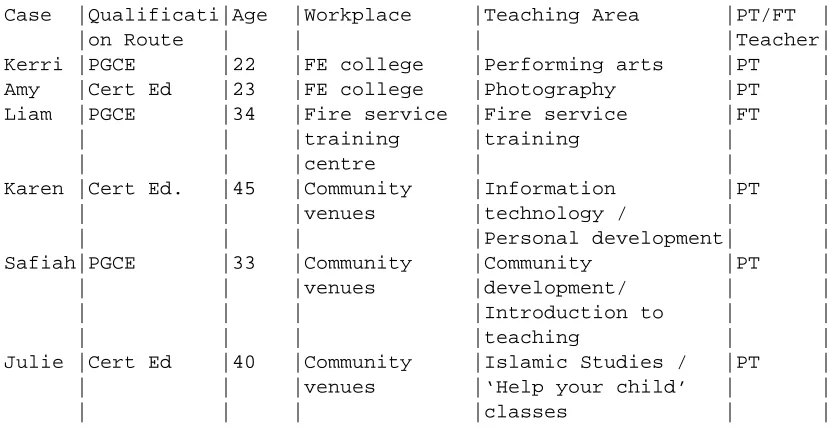
Six in-service trainees (Table 1) within one university partnership volunteered to take part in the case studies. While this is not a representative sample, it provided the opportunity to generate rich contextualised data from a range of LSS settings.
Table 1 about here
Kerri and Amy were new to teaching, taking up co-teaching roles in the same colleges where they had been students. Liam had been a training officer for eighteen months before beginning his ITE programme and prior to this had spent five years as a fire-fighter. Karen, who had particularly negative experiences of her own schooling, had taught for one year alongside her work as reading development officer for the library service. Safiah had delivered occasional workshops and led informal training as part of her role as a community development manager. Julie had a long involvement in voluntary community activity and in co-leading informal study groups.
The survey population comprised all in-service trainees in year 1 of university or awarding body ITE qualifications at one university and its partner colleges. 50 trainees completed the beginning of the year questionnaire (58% return rate) and 26 completed the end of the year questionnaire (31% return rate) with 14 completing both questionnaires. While there was consistency between the samples in the profiles of respondents’ age, sex and full or part-time teacher status, fewer of the end of year respondents taught in colleges (Q1=50%; Q2=27%), more taught in community and adult education (Q1=Q20%; Q2=42%) and more of the end of year respondents were undertaking university qualifications than awarding body qualifications (Q1=60%, Q2 =92%).
The case study and survey data were analysed separately before a cross-method analysis, focusing on pattern matching, explanation building and considering rival explanations was undertaken. Case study analysis began with the construction of holistic individual case summaries that were checked with trainees in the final interview to ensure trustworthiness (Bassey, 1999). This was followed by categorical analysis of cases to produce individual development summaries. Cross-case analysis was aided through the construction of a series of comparison tables and cross-Cross-case coding.
The main findings of the study on trainees’ conceptual and practice development, supported with illustrative data from the case studies and surveys, are presented in the next section.
Trainees’ accounts of their conceptual and practice development
Conceptions of learning
Trainees overwhelmingly defined learning as the ‘acquisition of knowledge and skills’. This remained unchanged over the year: 73% of respondents in both the beginning and end of year surveys rated it as closest to their definition of learning. As Figures 1 and 2 demonstrate, survey respondents’ conceptions of learning were most strongly associated with definitions that fall within the lower levels of Saljö’s (1979) and Marton, Dall’Alba and Beaty’s (1993) hierarchy of conceptions, with the notable exception that respondents rejected the conception of learning as memorising.
Figure 1 and 2 on one page about here
While there was no evidence of a shift in trainees’ conceptualisations of the purpose of learning, trainees developed more multi-dimensional conceptions of how learning took place:
I now realise that, going back to how people learn, some are totally different. Some people like to be spoken to; some of them’s got all the answers, some like demonstrations. (Liam, Interview 2)
In response to an open question in questionnaire 2, 50% of all respondents recorded their growing awareness of differences in how people learn. This was often expressed within the frame of the learning styles discourse that pervades the sector. Some trainees mentioned the importance of realising that their students did not necessarily prefer to learn in the same ways as they did:
Conceptions of teaching and role
In the end of year survey more respondents reported changes to their ideas about teaching (77%) than their ideas about learning (69%). As may be expected, the most widespread development was an expanded awareness of a wider range of strategies and methods of teaching. However, in both the case studies and survey there was considerable variation in the specific areas of
development reported by trainees.
Acquiring expanded conceptions was not simply a matter of absorbing prescriptions of how to teach but required the development of trainees’ own understandings of those prescriptions:
‘I think now I’ve got a greater understanding of being more varied.’ (Amy, Interview 3)
From the outset, all the case study trainees emphasised the importance of creating a positive, supportive atmosphere and building good relationships with learners as necessary conditions of learning:
‘if you make it a comfortable work environment and a nice work environment then they know they can basically do anything, and I think that makes it a lot easier.’ (Kerri, Interview 1)
As trainees’ conceptions of learning expanded to incorporate awareness of variation in the ways people learn, their conceptions of teaching first began to take greater account of general group characteristics and then individual needs and expanded to include strategies for recognising and taking account of differences between learners:
Yeah, I became very aware of the differentiation thing because I thought it was OK, if they were all beginners, that we’re all starting off and everybody would understand …... and of course it’s not long before you realise that that’s not the case at all. (Karen, Interview 3)
so knowing that there are different methods about how people learn. I know that I’ve got to try and use those methods to get the message across. So what one person’s not going to get, the other person might get it. I would never perhaps have looked at it like that, … I’d have perhaps been, well this is teaching, and I’m teaching it. (Liam, Interview 2)
Trainees’ conceptions of teaching expanded to recognise the role of formative assessment and incorporate understanding of assessment methods:
I always thought that if I taught them something and … they were listening and thinking things in their own heads, then that was fine, but it’s more a structured thing now, I’ve found that they’ve got to feedback on it. (Amy, Interview 2)
Some trainees also began to place importance on the role of evaluation in shaping practice:
The pace of case study trainees’ conceptual development varied and there was often a time delay between a desire to adopt a new strategy, such as differentiating learning, and developing an understanding of how to achieve this in practice.
At the beginning of the year trainees identified most closely with being a guide or facilitator (Figure 3). 68% of questionnaire 1 respondents chose ‘guide’ as one of their three most important roles, with 27% ranking it as their most important role, and 65% chose ‘facilitator’ as one of their three most important roles, with 24% ranking it as their most important role. Being a content expert was also regarded as important: 44% of respondents selected it as one of their three most important roles, however, they were more likely to rate it as their second most important role (24%) rather than their most important role (12%).
Figure 3 Trainees’ three most important roles about here
Again, at the end of the year, being a guide and facilitator dominated trainees’ conceptions of role. The greater association with being a facilitator (71% of Q2 respondents identified it as their most important role and 46% as one of their three most important roles), than being a guide (54% ranked it one of their three most important roles but only 4% of respondents ranked it their most important role), may reflect the prevalence of the term ‘facilitator’ in teacher training discourses rather than a fundamental change in trainees’ conceptualisation of their role. Trainees were less likely to consider being a content expert as one of their three most important roles by the end of the year (Q1 = 44%: Q2 = 33%). This aligns with the shift in their conceptions of teaching from ‘telling’ to a more learner-centred orientation which was reported in an open question by 35% of the end of year survey respondents and in three of the case study trainees’ narratives:
‘I’ve realised that I don’t have to perform all the time and I don’t have to entertain them all the time.’ (Karen, Interview 3)
I carried many conventional ideas that teachers are all knowing and wise. Teaching for me now is coordinating and influencing a situation using different techniques as well as laying down basic concepts. Learners journey towards knowledge and realisation themselves. (Trainee 25, End of year questionnaire)
While there was evidence of a broad trend of development from a teacher-centred to learner-centred orientation, like the school trainees in Burn’s et al.’s (2000) study, some LSS trainees began the year with conceptions that focused on learners. The absence of a simple teacher-centred/ student centred dichotomy (Entwistle et al. 2000) is further supported by the data which indicates that trainees may hold weaker teacher-centred conceptions and deploy some teacher teacher-centred practices, while maintaining stronger learner-centred conceptions and deploying student-centred practices.
The strength of trainees’ focus on learners at the beginning of the year found in this study, which resonates with the ‘ethic of care’ found by Avis and Bathmaker (2004), may emanate from the trainees’ dominant nurturing perspective. Pratt (1998) defines a teaching perspective as an ‘inter-related set of beliefs and intentions’ that form ‘a lens through which we view teaching and
perspective on teaching’ (21). The nurturing perspective, one of the five categories of teaching perspectives identified by Pratt (1998, 239), is ‘based on a belief in the critical relationship between learners’ self-concept and learning’, so the prime focus for constructing conceptions of teaching and role is the teacher/learner relationship. The dominance of the key characteristics of nurturing teachers: focusing on fostering a climate of trust, providing encouragement and support, guiding students through content to build confidence, engaging empathetically with individual needs and challenging as well as caring were evident in both the case studies and survey responses:
To me a teacher should be able to create such an atmosphere that everybody is comfortable with that learning environment so they can learn, they can ask questions, they can ask whatever they want … I don’t feel I’m just there to teach. I’m there to nurture. (Julie, Interview 1)
Practice Development
More end of year survey respondents (96%) identified that they had made changes to their practice than reported developments in their ideas about learning or teaching. This may indicate that conceptions are held more tacitly than knowledge of practice. The main changes to practice reported by trainees, which echo those found in earlier studies (Harkin, Clow and Hillier 2003; Maxwell, 2004), were:
• More careful systematic planning and improved planning documentation (the most frequently mentioned change, reported in an open question by 73% of questionnaire 2 respondents).
• The use of a wider range of teaching strategies and methods.
• Increased use of participative activities, more facilitative approaches and less teacher ‘performance’.
• Implementation of approaches to cater for individual needs and to differentiate learning. • Development of formative assessment practices.
• Development of more regular, analytical and focused evaluation.
Again there was wide variation in the specific areas of development identified by trainees. Even when development focused on the same aspect of teaching there were qualitative differences in practice changes made by trainees. For example Kerri, who had learnt about formative
assessment for the first time during her ITE course, was experimenting with assessment activities whereas Safiah, who embarked on the ITE programme with knowledge of the purposes of
assessment and some experience of conducting assessment, focused on collecting robust assessment evidence:
before I would rely a lot more on my instinct whether people have learnt or not, whereas now … I find myself slowly feeling more and more reliant on collecting concrete evidence of someone understanding something……. I set myself clear criteria for what I am looking out for now. (Safiah, Interview 3)
working relationships and interacted more with learners. However, occasionally, this was not the case. While Karen talked about realising that learners learn in different ways, her strong beliefs about older learners:
they like the idea that they’re almost spoon fed, they like the step by step instructions …. They’d sooner me take them all along at the same pace, than feel they were doing something different. (Karen, Interview I3)
meant that she made few changes to her practices to accommodate different learners.
Teaching intentions were reconfigured by social interactions in new contexts. In unfamiliar teaching contexts, trainees’ conceptions and practices became less sophisticated. Julie, who was promoting learner autonomy in her familiar teaching context, retreated into a knowledge giving role and used a more limited questioning strategy when she began teaching a different subject and learner group:
with this group you can, you know, you can tell that they’re sat there and they have like a different set of expectations and you know, you can tell they’re very different and waiting to receive. (Interview 3)
Conceptualising conceptual and practice development as continua
Drawing on the findings of this study and the literature discussed earlier it is possible to draw out some key features of LSS trainees’ perceptions of their conceptual and practice development. Trainees’ conceptions of learning and teaching generally become more multi-dimensional and expand to incorporate awareness of the links between learning and teaching. The main
development in the way trainees conceptualise learning is a realisation that different learners learn in different ways. Trainees’ conceptions of teaching expand to take greater account of learner characteristics, initially focusing on learner groups and later on individual learners, and incorporate a wider range of strategies and methods. While many trainees begin ITE with a dominant conception of their role as a facilitator or guide, there is often still movement from performance-orientated conceptions and practices to more student-centred conceptions and more participative practices. Trainees begin to deploy a wider range of strategies and methods in their teaching. There is broad alignment between conceptual and practice change although
contradictory conceptions may be held and occasionally new conceptions are not enacted in practice. There are notable variations between trainees in the areas of conceptual and practice development experienced by trainees. Trainees have different starting points, with some holding sophisticated conceptions when they enter ITE, and develop at different rates. In new contexts trainees may revert to adopting less sophisticated conceptions and practices.
Characteristics within a phase do not necessarily all assume significance at exactly the same time and some may be more significant in some contexts than others.
In the first phase of the conceptual development continuum, developing awareness of the
teachers’ toolkit, the main development is increased awareness of a range of teaching methods.
Trainees recognise the need to vary teaching and adopt participative activities but do not
necessarily understand what this means in practice. Trainees working with challenging learners become more aware of classroom management techniques and ways of motivating learners. Trainees then pass through a phase characterised by realising different learners need different
approaches, where they recognise the need to take account of learner difference, and to
differentiate learning, but have limited awareness of differentiation strategies. Around this time they also begin to develop awareness of the role of formative assessment and some assessment methods. This is followed by a phase where trainees re-position the role of the learner, realising that they have to support and challenge learners to learn for themselves, develop expanded awareness of formative assessment strategies and how to differentiate learning. Towards the end of the continuum, trainees move towards becoming an autonomous teacher, where they have developed more sophisticated understandings of teaching strategies and methods which link learning and teaching and begin to recognise the role of evaluation in developing their practices.
Figures 4 and 5 Conceptual and Practice Development Continua about here
The practice development continuum (Figure 5) broadly aligns with the conceptual development continuum. Trainees begin developing their practice by establishing a repertoire of strategies and
skills that meet the most immediate needs of the teaching context, using more varied methods,
beginning to plan systematically and developing more productive working relationships with learners. This is followed by developing strategies and methods that recognise and respond to
learners’ needs, where developments from the earlier phase continue and trainees begin to deploy
approaches to meet learners’ needs, with a particular focus on group characteristics, develop questioning skills and introduce formative assessment. The next phase, promoting learner
autonomy and catering for individual needs, is characterised by an expanded range of practices
incorporating more activities where students find things out for themselves and apply strategies to differentiate learning more consistently. Finally, trainees begin using assessment information and
evaluation to shape practice, where they use a range of teaching strategies and methods, more
rigorous approaches to formative assessment and systematically undertake evaluation to inform teaching decisions.
Inevitably the continua are tentative and partial. They represent trainees’ perceptions of their development and the detail relies on data that is not representative of all contexts within the LSS. The instrumental nature of the continua is striking opening up questions about why trainees’ narratives are framed within this limited orientation towards teaching. Nonetheless, the continua provide a useful starting point for understanding trainees’ conceptual and practice development.
To illustrate how the continua can be used as explanatory tools to articulate trainees’ journeys, the two case study trainees’ journeys are presented. Amy embarked on her ITE course at the same time as beginning to co-teach level 2 photography modules in an FE college with a more
I thought these kids would want to learn the subject,…. and it was quite a shock how de-motivated they were…..I really can’t believe how uninspired these kids are. (Interview 1)
From the beginning Amy exhibited a strong ethic of care and perceived her role as a guide and facilitator:
the role of the teacher is really changed, whereas you’re not supposed to come out knowing parrot fashion like, your mums and dads did, knowing everything, it being hammered into you, I think it’s a bit more relaxed now and a bit more fun and…. it shows that in having fun and you’re relating kind of one on one with your student, that they learn a lot better. I wouldn’t like to be the kind of traditional teacher. (Interview 1)
Amy’s development pattern largely mirrored that shown in the first two phases of the
development continua. A key aspect of Amy’s development was developing awareness of the
teachers’ toolkit and establishing a repertoire of skills and strategies to meet the needs of the immediate context. Developing understanding of student motivation and approaches to
motivating and managing behaviour was particularly significant. In the early stages Amy focused on trying out new techniques, such as bringing in photographs to inspire learners, and using praise. However, by the second interview, as Amy’s conceptions expanded and she made more links between teaching and learning, she realised that different learners need different approaches and began to develop strategies and methods that recognise and respond to learners’ needs. Reflecting back over the year Amy noted:
I know different motivational techniques now and stuff and they are a lot more motivated. But I think it’s understanding what level they’re at and what experience they’ve got and how intellectual they are or so you know what level to pitch at for them to be motivated. (Interview 3)
In the second half of the year Amy developed awareness of the role of formative assessment, began to adopt a more structured approach towards formative assessment in her practice and implemented a system for checking learners’ progress against summative assignment tasks.
Julie, who taught a weekly non-accredited Islamic studies class, had considerable experience of leading informal study circles and had completed an Awarding Body introductory teaching course prior to embarking on her university ITE course. At the beginning of the year she had already progressed through most aspects of the first two phases of the development and was able to draw on her awareness of the teachers’ toolkit to deploy strategies and methods that supported learning:
I’m very conscious about varying my teaching methods and how I am presenting it to them, using the white board and things like the handouts. (Interview 1)
She had begun to realise that different learners needed different approaches, was deploying some strategies to address learners’ needs and was making explicit links between teaching decisions and learners’ needs.
of empowering learners to learn for themselves and the need for challenge. She expanded her practices to promote learner autonomy:
certainly we’re doing a lot more, not just group work, but I’m trying to do investigative work as well, I’m trying to get them to research so they’re actually, not just thinking and discussing but efficiently finding out. (Interview 2)
it’s getting them thinking …. I want it to be challenging. (Interview 2)
She also developed her practices in catering for individual’s needs by deploying strategies such as differentiated questioning.
Julie began the year with a basic understanding of formative assessment, a characteristic of the second phase on the continua. Over the year she adopted more rigorous approaches:
I produce sheets…with questions on, on the subject that I’m going to be covering. See how much they actually answer and then they’ve got a second box where they can… put an answer
in…afterwards and I can see where the actual session’s taken them. (Interview 3)
Julie began to move towards becoming an autonomous teacher, recognising the importance of evaluation to support the development of her teaching and using assessment information and
evaluation to shape practice’. She recalled her approach to evaluation at the beginning of the year
as:
negligible … when I say negligible, it’s like, “did you enjoy it? Was it a good session? Did you find it useful? Right, good, thanks, bye”. And that was it. (Interview, 3)
Over the year Julie introduced session evaluation, initially through the use of log books, which she further developed into an easier to prepare question sheet.
As illustrated earlier, faced with the different social dynamics of a new teaching context towards the end of the year, Julie adopted less sophisticated conceptions and practices with the new group which were characteristic of the first two phases of the continua.
Amy and Julie’s journeys illustrate how the continua may be used to plot and understand individual journeys. While Amy began her journey at the start of the continua and progressed through the first two phases, Julie began at the beginning of the third phase and in her familiar teaching context progressed into the fourth phase. Whilst the flexibility of the continua in describing trainees’ journeys may be seen to begin in different places, the possibility of placing different emphases on sub-continua in different contexts and, allowing for regression to earlier phases in unfamiliar situations, allow the subtleties and complexities of teacher development to be accommodated and understood. The continua therefore have utility for teacher educators, trainees and their employers and mentors in aiding deeper understanding of trainees’ development and informing the design of training programmes and support.
The research raises a number of issues for ITE programme design and brings into question some LSS ITE policy assumptions.
Amy’s and Julie’s journeys illustrate the wide difference between trainees’ levels of conceptual understanding and teaching skills. ‘Meeting trainee needs’ is a strong theme in LSS ITE policy but has recently been highlighted as the weakest element of trainees’ experience (Ofsted 2008). Initial diagnostic testing, particularly of trainees’ literacy, numeracy and information technology skills, and the creation of individual learning plans has become common practice. However, this has not necessarily led to trainees experiencing training and support that takes account of their levels of conceptual understanding and teaching skills. A more radical approach by teacher educators, mentors and employers to planning and differentiating individual programmes of training and support may be needed to address the substantial differences between trainees and genuinely ‘meet individual needs’.
The lack of opportunities for trainees to experience a range of teaching contexts has also been highlighted as a weakness in trainee preparation (Ofsted 2008). This study indicates that trainees’ conceptions and practices regress along the continua in unfamiliar teaching contexts, indicating that the transfer of conceptual understanding and teaching skills between contexts involves
substantial new learning. If trainees are to be ‘equipped’ (DfES 2004) to teach in diverse contexts then teacher educators and employers will need to ensure that trainees gain sustained experience in a variety of contexts. This is particularly problematic in such a diverse sector where the vast majority of trainees are already employed and a significant number work part-time. The financial and inspection policy levers applied to the LSS prioritise the retention and achievement of
learners. Employers are therefore, understandably, reluctant to divert trainees’ attention from maximising the retention and achievement of the learning groups they have been employed to teach by allowing them to engage in wider experience, particularly if that can only be gained outside their organisation.
Subject knowledge and the development of subject pedagogy do not appear in the continua as there were few references to either in the data. However, they are dominant themes in LSS ITE policy rhetoric. Both this and my earlier study (Maxwell, 2004) indicate that trainees’ concerns with subject, evident in their conceptions at the beginning of ITE, are replaced by thinking about learning from the learners’ perspective. A ‘common-sense’ explanation for the silences in the data may be a lack of emphasis on subject by the providers of these trainees’ ITE programme. However, even if this was the case, trainees’ narratives also omit ‘subject specialist’ workplace discourses indicating that the idea of ‘subject specialism’ and therefore ‘subject specialist pedagogy’ may be problematic in the LSS. As Fisher and Webb (2006) point out change in the sector has led to a connective model of working where teachers are facilitators of student-centred curricula which are ‘atomized’ in relation to workplace roles and cross subject-boundaries. Current inspection regimes which focus on learners and learning, rather than teaching, and provide teachers with generic ‘grade 1’ lesson criteria as measures of their success may also, albeit unintentionally, divert attention away from ‘subject pedagogy’. Implementing subject-focused ITE in a sector where teachers have much broader roles and learners, rather than subject discipline is the focus for organising teaching, is inevitably problematic not least in terms of how subject pedagogic knowledge can be accessed and who can adequately support trainees in
Another noticeable silence in the data is behaviour management. Lack of preparation for classroom management has also been a key theme in LSS ITE policy. While there was some evidence in trainees’ narratives of developing understanding of, and skills in, classroom management, it was not a strong concern and is only present in the first phase of the continua. Again this reflects the LSS context. Behaviour management may be a central issue for trainees working with young learners in colleges but it is not a concern in many other LSS contexts.
Fisher and Webb (2006, 341) ‘detect a somewhat traditionalist secondary school informed perception of curriculum in both the DfES and Ofsted thinking’ about subject specialism in LSS ITE. The emphasis on behaviour management in LSS ITE policy also reflects a secondary school perception as does the unproblematic assumption that trainees can be afforded a range of teaching experiences. However, the disjunction between these policy assumptions and trainees’ lived conceptual and practice development indicates that LSS ITE policy cannot simply be ‘transferred in’ from the schools sector, but must take account of the nature and diversity of provision in the sector and the policy constraints that impinge on the organisation of this provision.
Conclusions
Reforms to LSS ITE have led to the micro-specification of the expected behaviour and skills to be exhibited by trainees and the key components necessary for effective ITE. However, they neglect the subtleties and complexities of the process of trainees’ development and the ways in which social dynamics in different contexts impinge upon development. The conceptual and practice development continua that I propose in this paper offer a way of understanding of these
complexities.
Disjunctions between trainees’ lived conceptual and practice development and policy assumptions indicate the need for LSS ITE to take greater account of variation in levels of trainees’ conceptual understanding and practice, and highlight the problematic nature of imposing policy drawn from a traditional secondary school perspective to the LSS. The more sophisticated understanding of the commonalities and diversity of trainees’ journeys that can be gained from using the development continua provide a more effective basis for developing support for trainees and thinking about ways of improving LSS ITE.
Notes
1. Those undertaking teaching roles in the sector have a range of job titles such as tutor, lecturer or trainer. In this paper the term ‘teacher’ is used to cover all these roles, and the term ‘trainee’ is used to refer to any teacher undertaking an initial teacher education qualification.
2. Trainees may take ITE qualifications that are developed by universities or by awarding bodies, such as City and Guilds. All qualifications have to be endorsed by Skills Verification UK.
References
Avis, J., and A-M Bathmaker. 2004. Critical pedagogy, performativity and a politics of hope: Trainee further education lecturer practice. Research in Post-Compulsory Education 9, (2): 301-13.
Avis, J., A-M Bathmaker, and J. Parsons. 2002. Communities of practice and the construction of learners in post-compulsory education and training. Journal of Vocational Education &
Bassey, M. 1999. Case study research in educational settings. Buckingham: Open University Press. Bathmaker, A-M., and J. Avis. 2007. ‘How do I cope with that?’ the development of ’schooling’ cultures
in further education for trainee FE lecturers. British Educational Research Journal 33, (4): 509-532 ______. 2005. Becoming a lecturer in further education in England: The construction of professional
identity and the role of communities of practice. Journal of Education for Teaching 31, (1): 47-62.
Burn, K., H. Hagger, T. Mutton, and T. Everton. 2000. Beyond the concerns with self: The sophisticated thinking of beginning student teachers. Journal of Education for Teaching 26, (3): 259-79.
DfES (Department for Education and Skills). 2004. Equipping our teachers for the future: Reforming initial teacher training for the learning and skills sector.
http://www.successforall.gov.uk/downloads/equippingourteachersforthefuture-115-161.pdf.
______. 2003. The future of initial teacher education for the learning and skills sector: An agenda for reform. Sheffield: DfES.
______. 2002. Success for all: Reforming further education and training – our vision for the future. http://www.dfes.gov.uk/learning&skills.
DIUS (Department Innovation, Universities and Skills), and DCSF (Department for Children, Schools and Families). 2007. Further education: Raising skills, improving life chances:
Update: July 2007. http://www.dius.gov.uk/publications.
Entwistle, N., D. Skinner, D. Entwistle, and S. Orr. 2000. Conceptions and beliefs about "good teaching": An integration of contrasting research areas. Higher Education Research and Development 19, (1): 5-26.
Eraut, M. 2004a. Informal learning in the workplace. Studies in Continuing Education 26, (2): 247-73.
Fisher, R., and K. Webb. 2006. Subject specialist pedagogy and initial teacher training for the learning and skills sector in England: The context, a response and some critical issues. Journal of Further and Higher Education 30, (4): 337-49.
Fuller, F., and O. Bown. 1975. Becoming a teacher. In Teacher education: The 74th yearbook of the
national society for the study of education., ed. K. Ryan, 25-52. Chicago: University of Chicago.
Furlong, J., and T. Maynard. 1995. Mentoring student teachers: The growth of professional knowledge. London: Routledge.
Furner, J., and S. Steadman. 2004. Eliciting professional practical knowledge: Experiences and problems. Paper presented at BERA Annual Conference, UMIST Manchester.
Garner, L., and H. Harper. 2003. Teaching, learning and a new profession: Perceptions of trainee teachers in post-compulsory sectors in Russia and England. Research in Post-Compulsory Education 8, (2): 141-52.
Harkin, J., R. Clow, and Y. Hillier. 2003. Recollected in tranquillity? FE teachers’ perceptions of their initial teacher training. London: Learning and Skills Development Agency.
Kember, K. 1997. A reconceptualisation of the research into university academics conceptions of teaching. Learning and Instruction 7, (3): 255-75.
Lifelong Learning UK. 2007a. New overarching professional standards for teachers, trainers and tutors in the lifelong learning sector.
http://www.lifelonglearninguk.org/documents/standards/professional_standards_for_itts_020107.pdf. ______. 2007b. Guidance for awarding institutions on teacher roles and initial teaching qualifications: All
mandatory units of assessment. http://www.lluk.org/documents/uoa_all.pdf.
Marton, F., G. Dall’Alba, and L. Beaty. 1993. Conceptions of learning. International Journal of Educational Research 19, (3): 277-300.
Author. 2004. Becoming a teacher in the learning and skills sector: Using a knowledge resources perspective to inform the development of initial teacher education. Paper presented at the Scottish Educational Research Association Annual Conference, Perth.
How academics learn to teach. Teacher Development 4, (1): 79-101.
Murray, K., and R. MacDonald. 1997. The disjunction between lecturers’ conceptions of teaching and their claimed educational practice. Higher Education 33, 331-49.
Ofsted. 2008a. Framework for the inspection of initial teacher education 2008-11. London: Ofsted. ______. 2008b. The initial training of further education teachers: Findings from the 2006/7 inspections of
courses leading to national awarding body qualifications.
http://www.ofsted.gov.uk/assets/Internet_Content/Shared_Content/Files/2008/jan/itt_fet.pdf. ______. 2004. Framework for the inspection of initial teacher training of further education teachers HMI
2274. http://www.ofsted.gov.uk/publications.
______. 2003. The initial training of further education teachers: A survey HMI 17. http://ofsted.gov.uk/publications.
Pratt, D. D., and Associates. 1998. Five perspectives on teaching in adult and higher education. Florida: Krieger Publishing Company.
Säljö, R. 1979. Learning in the learner’s perspective I. Some common-sense conceptions. University of Gothenburg: Reports from the Department of Education No. 76.
Spenceley, L. 2007. ’Walking into a dark room’-the initial impressions of learner-educators in further education and training. Journal of Further and Higher Education 31, (2): 87-96.
Trigwell, K., and M. Prosser. 1996. Congruence between intention and strategy in science teachers’ approach to teaching. Higher Education 32, (1): 77-87.
Wallace, S. 2002. No good surprises: Intending lecturers’ preconceptions and initial experiences of further education British Educational Research Journal 28, (1): 80-93.
|Case |Qualificati|Age |Workplace |Teaching Area |PT/FT | | |on Route | | | |Teacher| |Kerri |PGCE |22 |FE college |Performing arts |PT | |Amy |Cert Ed |23 |FE college |Photography |PT | |Liam |PGCE |34 |Fire service |Fire service |FT | | | | |training |training | | | | | |centre | | | |Karen |Cert Ed. |45 |Community |Information |PT | | | | |venues |technology / | | | | | | |Personal development| | |Safiah|PGCE |33 |Community |Community |PT | | | | |venues |development/ | | | | | | |Introduction to | | | | | | |teaching | | |Julie |Cert Ed |40 |Community |Islamic Studies / |PT | | | | |venues |‘Help your child’ | | | | | | |classes | |
Figure 1. Beginning of year - Trainees conceptions of learning
Note: n=37, Ranking scale 1=closest match to own definition of learning(6=least close match ,Friedman test: chi square =94.42; df=5; asymp. p=0.00
Figure 2. End of year - Trainees conceptions of learning
[image:22.595.72.391.424.685.2]Figure 3. Trainees’ three most important roles Q1 (n=34) and Q2 (n=24)
Note: Q1= Beginning of Year Questionnaire; Q2= End of Year Questionnaire
Figure 4. Conceptual development continuum
Figure 5. Practice development continuum
---Re-positioning the role of the learner
Expanded awareness and more sophisticated understanding of teaching strategies and methods
Realising the need to empower learners to learn for themselves
Recognising teaching incorporates challenge as well as support
Expanded awareness of how to differentiate learning
Expanded awareness of formative assessment strategies and methods
Being the knowledgeable performer becomes a less important aspect of teacher identity
Developing awareness of the teachers’ toolkit
Becoming aware of a much wider range of methods
Increased awareness of approaches to motivating learners
Increased awareness of approaches to classroom management
Beginning to recognise the need for variety and learner participation
Becoming an autonomous teacher
Recognising the importance of evaluation and expanded awareness of evaluation strategies and methods
More sophisticated understanding of formative assessment processes
Realising different learners need different approaches
Expanded awareness of teaching strategies and methods
Recognition of the need to take account of learners levels, prior knowledge and experience, and intellectual capabilities in thinking about teaching
Realising the need for differentiating learning but limited awareness of differentiation strategies
Beginning to develop awareness of the role of formative assessment and some assessment methods
Beginning to realise learner activity is more important than tutor performance
Developing strategies and methods that recognise and respond to learners’ needs
Developing planning
Using more varied range of teaching strategies and methods
Increasing interaction with learners
Less tutor talk / more learner activity
Developing questioning skills
Beginning to adapt strategies and methods to meet learners’ needs
Introducing formative assessment
Establishing a repertoire of strategies and skills to meet the most immediate needs of teaching context
Using a more varied range of teaching methods
Increasing interaction with learners
Less tutor talk/ more learner activity
Establishing better working relationships with learners
Becoming more assertive
Deploying techniques to address classroom management
Using assessment information and evaluation to shape practice
Using more varied range of teaching strategies and methods
Developing systematic evaluation strategies and methods
Selection of teaching strategies and methods takes account of student feedback
Developing strategies, methods and resources to differentiate learning
More rigorous approach to formative assessment -making it evidence based and keeping records
Promoting learner autonomy and catering for individuals’ needs
Developing planning
Using more varied range of teaching strategies and methods
More activities where students find things out themselves / More student led activity
Developing questioning skills