Acta Cryst.(2003). E59, o857±o859 DOI: 10.1107/S1600536803010560 M. Alagaret al. C5H11NO20.5C4H4O4
o857
organic papers
Acta Crystallographica Section E Structure Reports Online
ISSN 1600-5368
DL
-Valine-fumaric acid (2/1)
M. Alagar,aR. V. Krishnakumar,b M. Subha Nandhinicand S. Natarajanc*
aDepartment of Physics, Ayya Nadar Janaki
Ammal College, Sivakasi 626 123, India,
bDepartment of Physics, Thiagarajar College,
Madurai 625 009, India, andcDepartment of
Physics, Madurai Kamaraj University, Madurai 625 021, India
Correspondence e-mail: [email protected]
Key indicators
Single-crystal X-ray study
T= 293 K
Mean(C±C) = 0.003 AÊ
Rfactor = 0.058
wRfactor = 0.154
Data-to-parameter ratio = 13.7
For details of how these key indicators were automatically derived from the article, see http://journals.iucr.org/e.
#2003 International Union of Crystallography Printed in Great Britain ± all rights reserved
In the title compound, C5H11NO20.5C4H4O4, the valine molecule exists as a zwitterion and the fumaric acid molecule in the unionized state, forming an adduct, a feature uncommon in similar crystal structures. The fumaric acid molecule has a centre of symmetry and is planar with atrans
con®guration about the central C C bond. The fumaric acid molecules have no hydrogen-bonded interactions among themselves and only mediate interactions betweendl-valine layers, leading to a three-dimensional network of molecules.
Comment
Fumaric acid, a key intermediate in organic acid biosynthesis, is known to readily form adducts/complexes with other organic molecules. Valine, an essential amino acid, is hydro-phobic with a non-polar hydrocarbon chain and plays a vital role in the stabilization of protein molecules. A determination of the present crystal structure, (I), was carried out to examine the stoichiometry and ionization states, and it appears to be the ®rst of its kind involving fumaric acid and an amino acid. Moreover, the aggregation and the interaction patterns observed in amino acid±carboxylic acid complexes might possibly contribute to an understanding of the self-assembly processes that might have led to the emergence of primitive multimolecular systems. Recently, the crystal structures of complexes ofdl-valine with maleic acid (Alagaret al., 2001) and trichloroacetic acid (Rajagopalet al., 2002) were reported from our laboratory.
Fig. 1 shows the molecular structure of (I), with the adopted atom-numbering scheme. The valine molecule exists as a zwitterion, and the fumaric acid molecule in the unionized state, forming an adduct involving the two distinct species, a feature uncommon in similar crystal structures. Usually in the crystals of amino acid±carboxylic acid complexes, the amino acid molecule is expected to exist in the cationic state (with a neutral carboyxlic acid group and a protonated amino group) and the dicarboxylic acid in the anionic state (with a neutral carboxylic acid group and a negatively charged carboxylate group), as a result of proton transfer. The observed zwitter-ionic form ofdl-valine and the unionized state of fumaric acid in the present structure is due to a `break-down' in the
organic papers
o858
M. Alagaret al. C5H11NO20.5C4H4O4 Acta Cryst.(2003). E59, o857±o859 otherwise routine proton transfer observed in such complexes.The conformation of the valine molecule, determined by11 [ÿ58.9 (2)] and 12 [68.5 (2)], differs signi®cantly from the
values observed for the monoclinic form ofdl-valine (Malli-karjunan & Rao, 1969) and for the triclinic form ofdl-valine (Dalhus & GoÈrbitz, 1996). However, the values agree well with those observed in dl-valinium maleate (Alagar et al., 2001), in spite of the difference in the ionization states of the amino acid molecules. The fumaric acid molecule has a centre of symmetry, and is planar with atranscon®guration about the central C C bond.
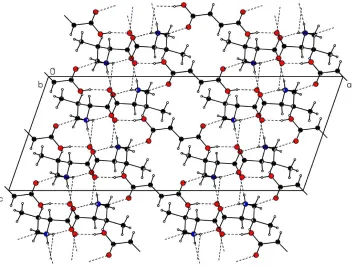
The adduct formed bydl-valine and fumaric acid is held together by hydrogen-bonding interactions (Fig. 2).dl-valine molecules aggregate into layers parallel to the bc plane, in which glide- and screw-related head-to-tail hydrogen bonds are present between the amino acids. The fumaric acid mol-ecules have no hydrogen-bonded interactions among them-selves. They only mediate interactions between dl-valine layers through hydrogen bonds, leading to a three-dimen-sional network of molecules. The aggregation pattern of individual molecules is distinctly different from those observed in the complexes ofdl-valine with maleic acid and trichloroacetic acid.
Experimental
Colourless single crystals of (I) were grown, as transparent needles, from a saturated aqueous solution containingdl-valine and fumaric acid in 1:1 stoichiometric ratio.
Crystal data
C5H11NO20:5C4H4O4
Mr= 175.18 Monoclinic,C2=c a= 24.417 (4) AÊ
b= 7.5713 (10) AÊ
c= 10.013 (2) AÊ
= 109.268 (10)
V= 1747.4 (5) AÊ3
Z= 8
Dx= 1.332 Mg mÿ3
Dm= 1.34 (2) Mg mÿ3
Dmmeasured by ¯otation in xylene± bromoform
MoKradiation Cell parameters from 25
re¯ections
= 7±13
= 0.11 mmÿ1
T= 293 (2) K Plate, colourless 0.280.220.14 mm
Data collection
Enraf±Nonius CAD-4 diffractometer
!±2scans
Absorption correction: scan (Northet al., 1968)
Tmin= 0.88,Tmax= 0.98 2600 measured re¯ections 1524 independent re¯ections 1356 re¯ections withI> 2(I)
Rint= 0.10
max= 25.0
h= 0!28
k=ÿ8!8
l=ÿ11!11 2 standard re¯ections
every 100 re¯ections intensity decay: <1%
Re®nement
Re®nement onF2
R[F2> 2(F2)] = 0.058
wR(F2) = 0.154
S= 1.07 1524 re¯ections 111 parameters
H-atom parameters constrained
w= 1/[2(Fo2) + (0.0869P)2 + 1.3337P]
whereP= (Fo2+ 2Fc2)/3 (/)max< 0.001
max= 0.32 e AÊÿ3
min=ÿ0.28 e AÊÿ3
Extinction correction:SHELXL97 Extinction coef®cient: 0.007 (2)
Table 1
Selected geometric parameters (AÊ,).
O1ÐC1 1.263 (2) O2ÐC1 1.237 (2) O3ÐC6 1.297 (2) O4ÐC6 1.214 (2) N1ÐC2 1.489 (2) C1ÐC2 1.532 (2)
C2ÐC3 1.541 (3) C3ÐC4 1.507 (3) C3ÐC5 1.529 (3) C6ÐC7 1.496 (2) C7ÐC7i 1.322 (4)
O2ÐC1ÐO1 126.24 (16) O2ÐC1ÐC2 116.59 (14) O1ÐC1ÐC2 117.17 (15) N1ÐC2ÐC1 109.74 (12) N1ÐC2ÐC3 113.11 (14) C1ÐC2ÐC3 111.48 (15) C4ÐC3ÐC5 112.7 (2)
C4ÐC3ÐC2 112.48 (16) C5ÐC3ÐC2 111.04 (19) O4ÐC6ÐO3 125.38 (16) O4ÐC6ÐC7 122.61 (16) O3ÐC6ÐC7 112.01 (16) C7iÐC7ÐC6 121.3 (2)
O2ÐC1ÐC2ÐN1 ÿ169.55 (15) O1ÐC1ÐC2ÐN1 10.6 (2) O2ÐC1ÐC2ÐC3 64.3 (2) O1ÐC1ÐC2ÐC3 ÿ115.49 (17)
N1ÐC2ÐC3ÐC4 ÿ58.9 (2) C1ÐC2ÐC3ÐC4 65.3 (2) N1ÐC2ÐC3ÐC5 68.5 (2) C1ÐC2ÐC3ÐC5 ÿ167.25 (18)
Symmetry code: (i)ÿx;ÿy;ÿz.
Figure 2
Packing diagram of the molecules of (I), viewed down thebaxis.
Figure 1
Table 2
Hydrogen-bonding geometry (AÊ,).
DÐH A DÐH H A D A DÐH A
O3ÐH3A O1ii 0.82 1.68 2.4860 (18) 168 N1ÐH1A O4iii 0.89 2.03 2.8755 (19) 158 N1ÐH1B O2iv 0.89 1.97 2.826 (2) 161 N1ÐH1C O2iii 0.89 2.05 2.9201 (19) 166 C2ÐH2 O3v 0.98 2.47 3.233 (2) 135
Symmetry codes: (ii)1
2ÿx;yÿ12;21ÿz; (iii)x;1ÿy;12z; (iv) 12ÿx;12y;12ÿz; (v) x;1y;z.
The H atoms were placed at calculated positions and were allowed to ride on their respective parent atoms.
Data collection: CAD-4 Software (Enraf±Nonius, 1989); cell re®nement: CAD-4 Software; data reduction: CAD-4 Software; program(s) used to solve structure: SHELXS97 (Sheldrick, 1990); program(s) used to re®ne structure:SHELXL97 (Sheldrick, 1997); molecular graphics:PLATON(spek, 1999); software used to prepare material for publication:SHELXL97.
SN thanks the Council of Scienti®c and Industrial Research (CSIR), India, for ®nancial assistance. MA thanks the UGC
for the FIP programme. The authors also thank UGC for the DRS programme and the Bio-informatics Centre, Madurai Kamaraj University, for providing the Cambridge Structural Database (Allen, 2002).
References
Alagar, M., Krishnakumar, R. V., Mostad, A. & Natarajan, S. (2001).Acta Cryst.E57, o1102±o1104.
Allen, F. H. (2002).Acta Cryst.B58, 380±388.
Dalhus, B. & GoÈrbitz, C. H. (1996).Acta Cryst.C52, 1759±1761.
Enraf±Nonius (1989).CAD-4Software. Version 5.0. Enraf±Nonius, Delft, The Netherlands.
Mallikarjunan, M. & Rao, S. T. (1969).Acta Cryst.B25, 296±303.
North, A. C. T., Phillips, D. C. & Mathews, F. S. (1968).Acta Cryst.A24, 351± 359.
Rajagopal, K., Krishnakumar, R. V., Subha Nandhini, M., Mostad, A. & Natarajan, S. (2002).Acta Cryst.E58, o279±o281.
Sheldrick, G. M. (1990).Acta Cryst.A46, 467±473.
Sheldrick, G. M. (1997).SHELXL97. University of GoÈttingen, Germany. Spek, A. L. (1999). PLATON for Windows. Utrecht University, The
Netherlands.
supporting information
sup-1
Acta Cryst. (2003). E59, o857–o859supporting information
Acta Cryst. (2003). E59, o857–o859 [doi:10.1107/S1600536803010560]
DL
-Valine-fumaric acid (2/1)
M. Alagar, R. V. Krishnakumar, M. Subha Nandhini and S. Natarajan
S1. Comment
Fumaric acid, a key intermediate in the organic acid biosynthesis, is known to readily form adducts/complexes with other
organic molecules. Valine, an essential amino acid, is hydrophobic with a non-polar hydrocarbon chain and plays a vital
role in the stabilization of protein molecules. A determination of the present crystal structure, (I), was carried out to
examine the stoichiometry and ionization states and it appears to be the first of its kind involving fumaric acid and an
amino acid. Moreover, the aggregation and the interaction patterns observed in amino acid–carboxylic acid complexes
might possibly contribute to the understanding of the self-assembly processes that might have led to the emergence of the
primitive multimolecular systems. Recently, the crystal structures of complexes of DL-valine with maleic acid (Alagar et
al., 2001) and trichloroacetic acid (Rajagopal et al., 2002) were reported from our laboratory.
Fig. 1 shows the molecular structure of (I) with the adopted atom-numbering scheme. The valine molecule exists as a
zwitterion, and the fumaric acid molecule in the unionized state forming an adduct involving the two distinct species, a
feature uncommon in similar crystal structures. Usually in the crystals of amino acid–carboxylic acid complexes, the
amino acid molecule is expected to exist in the cationic state (with a neutral carboyxlic acid group and a positively
charged amino group) and the dicarboxylic acid in the anionic state (with a neutral carboxylic acid group and a negatively
charged carboxylate group) facilitated by a proton transfer. The observed zwitterionic form of DL-valine and the
unionized state of fumaric acid in the present structure is due to a `break down′ in the otherwise routine proton transfer
observed in such complexes. The coformation of the valine molecule determined by χ11 [−58.9 (2)°] and χ12 [68.5 (2)°]
differs significantly from the values observed for the monoclinic form of DL-valine (Mallikarjunan & Rao, 1969) and for
the triclinic form of valine (Dalhus & Görbitz, 1996). However, the values agree well with those observed in
DL-valinium maleate (Alagar et al., 2001), in spite of the difference in the ionization states of the amino acid molecules. The
fumaric acid molecule has a centre of symmetry and is planar with a trans conformation about the central C═C bond.
The adduct formed by valine and fumaric acid are held together by hydrogen bonded interactions (Fig. 2).
DL-valine molecules aggregate into layers parallel to the bc plane in which glide and screw related head-to-tail hydrogen
bonds between the amino acids are present. The fumaric acid molecules have no hydrogen-bonded interactions among
them. They only mediate interactions between DL-valine layers through hydrogen bonds leading to a three-dimensional
network of molecules. The aggregation pattern of individual molecules is distinctly different from those observed in the
complexes of DL-alanine with maleic acid and trichloroacetic acid.
S2. Experimental
Colorless single crystals of (I) were grown as transparent needles, from a saturated aqueous solution containing
supporting information
sup-2
Acta Cryst. (2003). E59, o857–o859S3. Refinement
The H atoms were placed at calculated positions and were allowed to ride on their respective parent atoms with HFIX
[image:5.610.121.485.125.296.2]instructions using SHELXL97 (Sheldrick, 1997) defaults.
Figure 1
The molecular structure of (I), with the atom-numbering scheme and ellipsoids at the 50% probability level [symmetry
code: (i) −x, −y, −z].
Figure 2
[image:5.610.130.485.347.615.2]supporting information
sup-3
Acta Cryst. (2003). E59, o857–o859DL-valine hemifumaric acid
Crystal data
C5H11NO2·0.5C4H4O4 Mr = 175.18
Monoclinic, C2/c
Hall symbol: -C 2yc
a = 24.417 (4) Å
b = 7.5713 (10) Å
c = 10.013 (2) Å
β = 109.268 (10)°
V = 1747.4 (5) Å3 Z = 8
F(000) = 752
Dx = 1.332 Mg m−3 Dm = 1.34 (2) Mg m−3
Dm measured by flotation in xylene–bromoform Mo Kα radiation, λ = 0.71073 Å
Cell parameters from 25 reflections
θ = 7–13°
µ = 0.11 mm−1 T = 293 K Needle, colourless 0.28 × 0.22 × 0.14 mm
Data collection
Enraf-Nonius CAD-4 diffractometer
Radiation source: fine-focus sealed tube Graphite monochromator
ω–2θ scans
Absorption correction: ψ scan (North et al., 1968)
Tmin = 0.88, Tmax = 0.98 2600 measured reflections
1524 independent reflections 1356 reflections with I > 2σ(I)
Rint = 0.10
θmax = 25.0°, θmin = 2.8° h = 0→28
k = −8→8
l = −11→11
2 standard reflections every 100 reflections intensity decay: <1%
Refinement
Refinement on F2 Least-squares matrix: full
R[F2 > 2σ(F2)] = 0.058 wR(F2) = 0.154 S = 1.07 1524 reflections 111 parameters 0 restraints
Primary atom site location: structure-invariant direct methods
Secondary atom site location: difference Fourier map
Hydrogen site location: inferred from neighbouring sites
H-atom parameters constrained
w = 1/[σ2(F
o2) + (0.0869P)2 + 1.3337P] where P = (Fo2 + 2Fc2)/3
(Δ/σ)max < 0.001 Δρmax = 0.32 e Å−3 Δρmin = −0.28 e Å−3
Extinction correction: SHELXL97, Fc*=kFc[1+0.001xFc2λ3/sin(2θ)]-1/4 Extinction coefficient: 0.007 (2)
Special details
Geometry. All e.s.d.'s (except the e.s.d. in the dihedral angle between two l.s. planes) are estimated using the full covariance matrix. The cell e.s.d.'s are taken into account individually in the estimation of e.s.d.'s in distances, angles and torsion angles; correlations between e.s.d.'s in cell parameters are only used when they are defined by crystal symmetry. An approximate (isotropic) treatment of cell e.s.d.'s is used for estimating e.s.d.'s involving l.s. planes.
Refinement. Refinement of F2 against ALL reflections. The weighted R-factor wR and goodness of fit S are based on F2, conventional R-factors R are based on F, with F set to zero for negative F2. The threshold expression of F2 > σ(F2) is used only for calculating R-factors(gt) etc. and is not relevant to the choice of reflections for refinement. R-factors based on F2 are statistically about twice as large as those based on F, and R- factors based on ALL data will be even larger.
Fractional atomic coordinates and isotropic or equivalent isotropic displacement parameters (Å2)
x y z Uiso*/Ueq
supporting information
sup-4
Acta Cryst. (2003). E59, o857–o859O2 0.24030 (5) 0.4490 (2) 0.15951 (14) 0.0351 (4)
O3 0.12567 (5) −0.0296 (2) 0.12750 (15) 0.0371 (4)
H3A 0.1555 0.0033 0.1147 0.056*
O4 0.08326 (5) 0.1308 (2) −0.06608 (15) 0.0431 (5)
N1 0.17990 (5) 0.7020 (2) 0.38135 (14) 0.0240 (4)
H1A 0.1447 0.7406 0.3754 0.036*
H1B 0.2029 0.7937 0.3831 0.036*
H1C 0.1946 0.6390 0.4602 0.036*
C1 0.23603 (7) 0.5223 (2) 0.26606 (18) 0.0230 (4)
C2 0.17563 (7) 0.5892 (2) 0.25650 (17) 0.0230 (4)
H2 0.1617 0.6641 0.1722 0.028*
C3 0.13226 (8) 0.4356 (3) 0.2373 (2) 0.0332 (5)
H3 0.1350 0.3647 0.1578 0.040*
C4 0.14757 (14) 0.3151 (4) 0.3640 (3) 0.0630 (8)
H4A 0.1870 0.2760 0.3863 0.094*
H4B 0.1221 0.2147 0.3432 0.094*
H4C 0.1434 0.3778 0.4434 0.094*
C5 0.06993 (10) 0.5041 (4) 0.1948 (4) 0.0689 (9)
H5A 0.0622 0.5788 0.1133 0.103*
H5B 0.0649 0.5703 0.2717 0.103*
H5C 0.0435 0.4060 0.1729 0.103*
C6 0.08116 (7) 0.0364 (2) 0.0300 (2) 0.0277 (5)
C7 0.02520 (7) −0.0165 (3) 0.0492 (2) 0.0317 (5)
H7 0.0259 −0.0738 0.1319 0.038*
Atomic displacement parameters (Å2)
U11 U22 U33 U12 U13 U23
O1 0.0259 (7) 0.0428 (9) 0.0285 (8) 0.0043 (5) 0.0053 (5) −0.0091 (6) O2 0.0365 (7) 0.0389 (9) 0.0297 (8) 0.0075 (6) 0.0107 (6) −0.0098 (6) O3 0.0263 (7) 0.0401 (9) 0.0437 (8) −0.0014 (6) 0.0101 (6) 0.0121 (7) O4 0.0314 (7) 0.0500 (10) 0.0471 (9) −0.0044 (6) 0.0119 (6) 0.0192 (8) N1 0.0253 (7) 0.0219 (8) 0.0249 (8) 0.0007 (5) 0.0084 (6) −0.0034 (6) C1 0.0287 (9) 0.0179 (8) 0.0237 (9) 0.0011 (6) 0.0102 (7) −0.0007 (7) C2 0.0268 (8) 0.0212 (9) 0.0197 (8) 0.0016 (7) 0.0059 (6) −0.0022 (7) C3 0.0351 (10) 0.0323 (11) 0.0331 (10) −0.0100 (8) 0.0128 (8) −0.0127 (8) C4 0.097 (2) 0.0484 (16) 0.0454 (13) −0.0372 (14) 0.0264 (13) −0.0037 (12) C5 0.0340 (12) 0.0668 (18) 0.104 (2) −0.0138 (12) 0.0200 (13) −0.0308 (18) C6 0.0279 (9) 0.0236 (10) 0.0325 (10) −0.0022 (7) 0.0113 (7) 0.0004 (8) C7 0.0300 (9) 0.0295 (10) 0.0376 (11) −0.0019 (7) 0.0138 (7) 0.0075 (8)
Geometric parameters (Å, º)
O1—C1 1.263 (2) C3—C4 1.507 (3)
O2—C1 1.237 (2) C3—C5 1.529 (3)
O3—C6 1.297 (2) C3—H3 0.9800
O3—H3A 0.8200 C4—H4A 0.9600
supporting information
sup-5
Acta Cryst. (2003). E59, o857–o859N1—C2 1.489 (2) C4—H4C 0.9600
N1—H1A 0.8900 C5—H5A 0.9600
N1—H1B 0.8900 C5—H5B 0.9600
N1—H1C 0.8900 C5—H5C 0.9600
C1—C2 1.532 (2) C6—C7 1.496 (2)
C2—C3 1.541 (3) C7—C7i 1.322 (4)
C2—H2 0.9800 C7—H7 0.9300
C6—O3—H3A 109.5 C5—C3—H3 106.7
C2—N1—H1A 109.5 C2—C3—H3 106.7
C2—N1—H1B 109.5 C3—C4—H4A 109.5
H1A—N1—H1B 109.5 C3—C4—H4B 109.5
C2—N1—H1C 109.5 H4A—C4—H4B 109.5
H1A—N1—H1C 109.5 C3—C4—H4C 109.5
H1B—N1—H1C 109.5 H4A—C4—H4C 109.5
O2—C1—O1 126.24 (16) H4B—C4—H4C 109.5
O2—C1—C2 116.59 (14) C3—C5—H5A 109.5
O1—C1—C2 117.17 (15) C3—C5—H5B 109.5
N1—C2—C1 109.74 (12) H5A—C5—H5B 109.5
N1—C2—C3 113.11 (14) C3—C5—H5C 109.5
C1—C2—C3 111.48 (15) H5A—C5—H5C 109.5
N1—C2—H2 107.4 H5B—C5—H5C 109.5
C1—C2—H2 107.4 O4—C6—O3 125.38 (16)
C3—C2—H2 107.4 O4—C6—C7 122.61 (16)
C4—C3—C5 112.7 (2) O3—C6—C7 112.01 (16)
C4—C3—C2 112.48 (16) C7i—C7—C6 121.3 (2)
C5—C3—C2 111.04 (19) C7i—C7—H7 119.4
C4—C3—H3 106.7 C6—C7—H7 119.4
O2—C1—C2—N1 −169.55 (15) C1—C2—C3—C4 65.3 (2)
O1—C1—C2—N1 10.6 (2) N1—C2—C3—C5 68.5 (2)
O2—C1—C2—C3 64.3 (2) C1—C2—C3—C5 −167.25 (18)
O1—C1—C2—C3 −115.49 (17) O4—C6—C7—C7i 9.7 (4)
N1—C2—C3—C4 −58.9 (2) O3—C6—C7—C7i −170.6 (2)
Symmetry code: (i) −x, −y, −z.
Hydrogen-bond geometry (Å, º)
D—H···A D—H H···A D···A D—H···A
O3—H3A···O1ii 0.82 1.68 2.4860 (18) 168
N1—H1A···O4iii 0.89 2.03 2.8755 (19) 158
N1—H1B···O2iv 0.89 1.97 2.826 (2) 161
N1—H1C···O2iii 0.89 2.05 2.9201 (19) 166
C2—H2···O3v 0.98 2.47 3.233 (2) 135