Capacity development for knowledge translation :
evaluation of an experiential approach through
secondment opportunities
GERRISH, Kate and PIERCY, Hilary <http://orcid.org/0000-0002-7663-8858>
Available from Sheffield Hallam University Research Archive (SHURA) at:
http://shura.shu.ac.uk/8780/
This document is the author deposited version. You are advised to consult the
publisher's version if you wish to cite from it.
Published version
GERRISH, Kate and PIERCY, Hilary (2014). Capacity development for knowledge
translation : evaluation of an experiential approach through secondment
opportunities. Worldviews on Evidence-Based Nursing, 11 (3), 209-216.
Copyright and re-use policy
See http://shura.shu.ac.uk/information.html
1
CAPACITY DEVELOPMENT FOR KNOWLEDGE TRANSLATION: EVALUATION OF AN EXPERIENTIAL
APPROACH THROUGH SECONDMENT OPPORTUNITIES
ABSRACT
Background
Experiential approaches to skills development using a secondment model have been shown to be
beneficial to healthcare organisations more generally, but little is known about the potential of this
approach to develop capacity for knowledge translation (KT).
Aim
To evaluate the success of KT capacity development secondments from the perspective of multiple
stakeholders.
Methods
A pluralistic evaluation design was used. Data were collected during 2011-12 using focus group and
individual interviews with 14 clinical and academic secondees, and five managers from host and
seconding organisations to gain insight into parti ipa ts per eptio s of the su ess of se o d e ts
and the criteria by which they judged success. Six After Action Reviews were subsequently
undertaken with KT proje t tea s to e plore parti ipa ts per eptio s of the o tri utio se o dees
made to KT projects. Semi-structured interviews were undertaken with three healthcare managers
on completion of projects to explore the impact of secondments on the organisation, staff and
patients. Qualitative content analysis was used to identify criteria for success. The criteria provided a
framework through which the overall success of secondments could be judged.
Results
Six criteria for judging the success of KT capacity development secondments at individual, team and
2
working, enabling KT objectives to be achieved, enhanced care delivery, enhanced education
delivery. Benefits to the individual, the KT team, seconding and host organisations were identified.
Implications for practice
Hosting teams need to provide mentorship support to secondees, and be flexible to accommodate
the needs of secondees as team members. On-going support from managers in seconding
organisations is needed to maximise the benefits to the individual secondee and to the organisation.
Conclusions
Experiential approaches to KT capacity development using secondments can benefit individual
secondees, project teams, seconding and host organisations.
Key words: capacity development, knowledge translation, experiential, secondment, pluralistic
3
INTRODUCTION
In 2008, the National Institute for Health Research (NIHR) established nine Collaborations for
Leadership in Applied Health Research and Care (CLAHRC) in England. CLAHRCs represents a
collaborative partnership between healthcare organisations and universities tasked with addressing
local population health needs by undertaking applied health research, implementing research
findings into practice and increasing capacity to engage in research and knowledge translation (KT).
This paper reports on the evaluation of initiative undertaken by NIHR CLAHRC for South Yorkshire to
increase capacity in KT among clinical and academic nursing staff from partner organisations through
applying a secondment model.
BACKGROUND
The Canadian Institutes for Health Research (CIHR) is attributed with first using the term knowledge
translation to de ote the e ha ge, s thesis, a d ethi all sou d appli atio of k o ledge within
a complex system of interactions among researcher and users (CIHR 2005, para 2). Unlike passive
dissemination e.g. distributing research summaries, KT involves activities leading to behavioural
change to improve practice. The skills required to facilitate KT extend beyond those of evidence
appraisal to include knowledge brokering (Ward et al 2009), boundary spanning (Williams 2010),
change management (Sudsawad 2007) and implementing, monitoring and sustaining KT strategies
(Straus et al 2011). There is a need to develop capacity to undertake KT research and KT activity. To
date, the main focus has been on developing expertise among researchers with less emphasis on
developing capacity to undertake KT among nurses and other healthcare professionals.
Initiatives to develop research capacity can occur at different levels: individual, team, organisational
and supra-organisational (Cooke 2005). At an individual level capacity development generally takes
the form of educational programmes, on-the-job training and mentoring.At team level it involves
sharing knowledge and skills among team members and collaboration within the team.At an
4
including mentorship schemes, networking and training. At a supra-organisational level a whole
systems approach is needed to promote change through policies, systems and networks.
Many initiatives to build KT capacity take an educational approach. For example, a strategic
Canadian initiative to develop capacity in the science and practice of KT produced educational
courses and materials (Straus et al 2011). O Br e a d Smith (2010) identify two further approaches;
facilitative and experiential learning models. The facilitative model focuses on a specific role, unit or
networks which provide support to individuals in addition to education strategies targeting the
wider workforce, whereas the experiential model utilises secondments, collaborative projects and
mentoring to support capacity development.
Although receiving little attention in the KT literature, secondments have been employed in other
areas of healthcare as a means of bringing complementary expertise to a team and providing the
opportunity for secondees to broaden their experience and develop knowledge and skills (Greig
1994; Stern et al 1997; Hamilton & Wilkie 2001). Whereas secondment models may vary in
structure, the main attributes are generally consistent, namely a secondment is where an employee
changes job roles within the same organisation or transfers to another organisation for an agreed
period of time on a full-time or part-time basis. As Hamilton and Wilkie (2001) point out,
secondments have the potential to benefit all parties involved. Secondees benefit from developing
expertise in a specific area. The seconding organisation can benefit in that secondees acquire
transferable skills that they can apply once they return to their substantive post. These skills can
then be communicated across teams/departments within the organisation to improve the skills of
other staff. The host organisation also benefits through assistance with projects and gaining an
external perspective to inform projects.
Providing secondment opportunities for clinical and academic nursing staff from CLAHRC partner
organisations formed part of a broader strategy to develop KT capacity which included educational,
5
alongside experienced team members who were leading KT initiatives. Secondments were created
to enhance the expertise of the KT team, especially in relation to clinical and evaluation skills and to
provide KT capacity development opportunities in anticipation that this would benefit CLAHRC
partner organisations in the longer term.
THE STUDY
Aim
To evaluate the success of the KT capacity development secondments from the perspective of
multiple stakeholders.
Design
A pluralistic evaluation design (Smith & Cantley 1988) was used. The model is based on the premise
that criteria for judging success of an initiative are situational and may be interpreted differently by
various stakeholders. Moreover, the unintended as well as intended consequences are important to
judging overall success. The evaluator, therefore, needs to identify major stakeholders and elicit and
compare their views of the aims and outcomes of the initiative and use their subjective perceptions
as the ajor deter i a t of su ess .
In the current study this entailed identifying the various meanings of success as defined by different
stakeholders and then using these criteria as a framework for evaluating the overall success of the
KT secondments.
Sample
The sampling frame incorporated three perspectives; secondees, the seconding organisation and
host CLAHRC teams. Fourteen clinical and academic secondees who undertook secondments during
2009-2012 were included. Ten secondees were registered nurses, and four were from a dietetics
background and worked collaboratively with nurses on a nutrition KT project. Representatives from
6
were purposively sampled to include participants who could provide strategic and operational
perspectives.
Data collection
Data collection comprised two phases. Phase 1 focused specifically on the secondments in order to
determine the criteria for judging their su ess a d gai se o dees a d stakeholders perspectives
of success. Phase 2 sought further data on the success of secondments as part of a wider review of
KT projects on which secondees worked. Data were collected between 2011 and 2012.
Phase 1
Two focus groups were conducted, one with academic secondees (n=5) and one with clinical
secondees (n=5). Semi-structured interviews were conducted with four secondees who were unable
to attend the focus groups. Individual semi-structured interviews were conducted with managers
from the health service (n=2), university (n=2) and CLAHRC programmes (n=3). Individual and focus
group interview schedules covered the same broad topics but were adapted to reflect the different
roles of respondents. Topics covered included; participants views of the aims of the secondments,
the per ei ed degree of su ess of secondments and the basis on which these judgements were
made, reasons for supporting or undertaking secondments, the experiences of undertaking or
supporting secondees, and factors perceived to have influenced the success of secondments.
Phase 2
Six After Action Review (AAR) group discussions (Darling et al 2005) with KT teams were undertaken.
Each group included secondees, CLAHRC members, clinicians and managers from healthcare
organisations in which KT projects were based. The AARs covered all aspects of project progress,
including the contribution of secondees to projects, their KT skills development and the wider
impact they had on organisations involved. Semi-structured interviews with a further three
7
impact of the KT project on the organisation, staff and patients and included exploration of the
secondment model as a capacity development initiative.
Data analysis
All focus groups, AARs and interviews were audio-recorded and transcribed. Data analysis followed a
two stage process using NVIVO 8. The transcripts from Phase 1 were initially scrutinised to identify
criteria of success. These were subsequently grouped in terms of success at individual, team, and
organisational levels. Six criteria were identified and these provided a framework within which the
success of secondments could be assessed. A more detailed analysis was then undertaken whereby
data from Phase 1 and Phase 2 were coded in order to map the different dimensions of success in
relation to each criterion.
Ethical approval
Ethical approval was obtained from the ethics committees of relevant organisations. Informed verbal
consent was obtained from participants.
FINDINGS
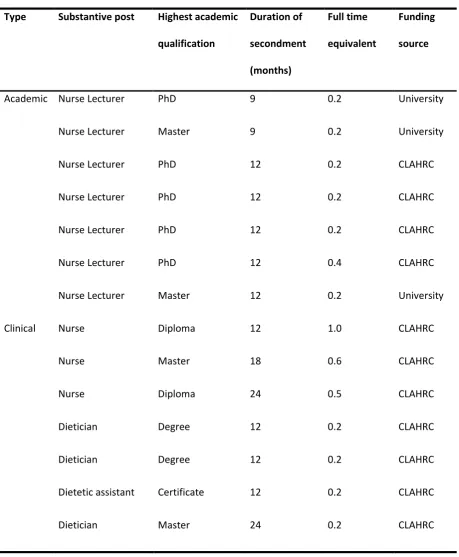
An overview of the secondments is provided in Table 1. The majority were part-time and ranged
from nine months to two years. Eleven secondees were funded by CLAHRC to enable backfill of posts
and three were university funded as staff development opportunities. Secondees were appointed on
the basis of expertise they could contribute to KT teams and their potential to benefit from the
experience. The seven clinical secondees were from organisations where KT projects were
undertaken and contributed clinical expertise and contextual knowledge about the organisation. The
seven academic secondees were from CLAHRC partner universities and contributed evaluation skills
although none had previous experience in KT. Table 2 provides examples of KT initiatives that
8
Criteria for success
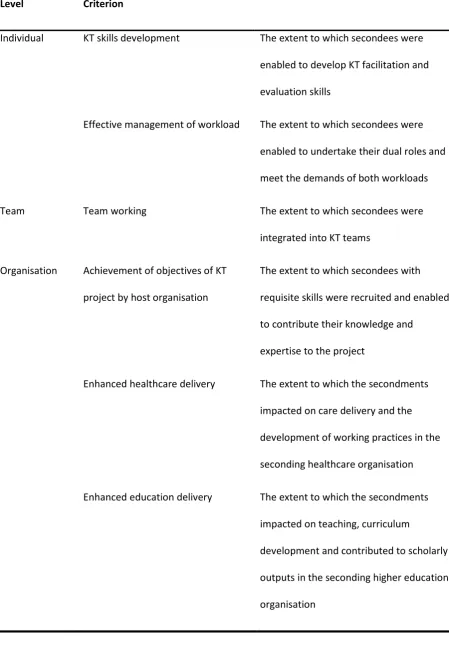
Six criteria were identified which reflected the success of KT secondments at individual, team and
organisational levels (see Table 3). Each criterion will be discussed in turn.
KT skills development
The extent to which secondees were enabled to develop skills to facilitate and evaluate KT was
considered by many to be important to judging the success of the secondments. Clinical secondees
were appointed primarily to facilitate change although they contributed to evaluation. Academic
secondees were involved primarily in evaluating KT projects although some acted as KT facilitators.
KT development was most pronounced in clinical secondees where learning far exceeded
expectations. One described the experience as lear i g o ti ually e ery day, there s so a y
opportunities .
Working alongside experienced KT team members enabled secondees to develop KT skills.
Secondees had no prior experience of using KT frameworks and gained insight in utilising them to
guide KT projects, e.g. Knowledge to Action cycle (Graham et al 2005), Consolidated Framework for
Implementation Research (Damschroeder et al 2009). Clinical secondees also benefited from
developing skills in accessing, appraising and applying evidence, whereas academic secondees were
more confident in these skills from the outset.
Secondees who facilitated change in practice settings spoke positively about developing a repertoire
of KT skills including knowledge brokering, change management, boundary spanning and problem
solving. Secondees also benefited from broadening their interpersonal skills, e.g. negotiation skills
working effectively with other people and not always wanting everything my own way. In addition,
secondees gained experience of strategies to facilitate change such as acting as best practice
champions, education outreach facilitators, undertaking rapid audit and feedback cycles and
9
Several academic secondees valued the opportunity to further develop research skills.
I e extended my research. I e lear t about KT theory and using research skills to evaluate KT
proje ts. I e see ho e aluatio a d feed a k form part of KT processes. (secondee)
Most academic secondees assumed responsibility for a discrete part of a larger KT initiative,
undertaking data collection, analysis and report writing while at the same time developing
team-working skills.
Its not easy after a PhD to get funding for research so this (secondment) has given me the
opportunity to hone my skills. Being responsible for part of a bigger project means Ive worked
as part of a team, so ethi g I did t do i y PhD. (secondee)
Clinical secondees gained understanding of systematic approaches to designing and undertaking KT
projects and developed evaluation skills.
I did t k o ho to do e aluatio efore the se o d e t. No Ive a good understanding of
what data I need to collect, how to collect it and what I need to do to make sense of it. These
skills are important for the project and for my clinical nursing role. (secondee)
Se o dees skill acquisition was evident to both seconding and project managers. A nurse manager
considered that secondees had acquired a better understanding of evaluation and a KT project lead
identified clinical secondees who had developed a whole new skill set, especially around change
management and facilitation, and an understanding of how to evaluate what theyre doing on the
ard.
Effective workload management
As most secondments were part-time, secondees undertook two roles concurrently. Managing two
workloads successfully by reconciling competing demands and expectations was considered
10
sufficient priority was given to both roles although problems were greater for academic than clinical
secondees.
Clinical secondees who were ward-based experienced few problems because the secondment
removed them from their workplace for a proportion of the week. Those who worked across several
clinical areas experienced more difficulties. Although their working practice offered greater flexibility
in responding to the demands of the secondment or the workplace, it required them to ring-fence
secondment time, something which was not always easy in the face of competing clinical demands.
Workload management was more challenging for academic secondees. Several experienced
difficulty adjusting workloads to accommodate the secondment and had therefore increased their
total workload. Three factors contributed to this situation. Firstly, the complexity of the academic
role with activities distributed variably over the academic year made it difficult to ensure a regular
commitment to the secondment, secondly the annual workload management system allowed little
flexibility, and thirdly the limited availability of colleagues to whom workload could be re-allocated.
The extent to which workload had been satisfactorily adjusted was variable. Where it had been
achieved, it contributed to a positive secondment experience. Where it had not been achieved, it
placed secondees under substantial pressure.
It was really difficult to ensure that (the project) was getting its o ey s orth out of e. I
was under terrific pressure at times, balancing so many competing priorities, trying to support
students, do all my teaching, etc.(secondee)
Managerial support in negotiating workload adjustment was considered crucial to ensuring the
success of secondments, as as ide tif i g a spe ifi aspe t of the se o dee s orkload hi h ould
11
Team working
Stakeholders agreed that integration of secondees into KT teams was essential to the success of
secondments: it i pa ted o the i di idual s e perie e a d affected their contribution to the
project. The support from KT project leads was a major determinant of effective integration.
The mentorship from KT project leads was an important source of support. Regular meetings to
agree objectives, identify learning needs and review progress were extremely valuable. Meetings
with the wider KT team provided an additional form of support. Sharing office accommodation with
KT team members facilitated integration: in addition to providing mechanisms for informal support
and information sharing, it fostered a sense of belonging.
Team integration was influenced by the extent to which core team members understood the
pressures that secondees were working under and sought to accommodate their needs. Several
secondees spoke of individual adjustments that had been made to enable them to engage fully.
[the project lead] was incredibly supportive and u dersta di g a out the fa t that I as t
always available and the difficulties we had setting up meetings because of my availability. I
ould t ha e su eeded ithout her support. (secondee)
Where a project team was not so accommodating, secondees had limited opportunity to discuss
progress or seek assistance in dealing with difficulties: this was a source of dissatisfaction and
frustration.
Enabling KT objectives to be achieved
Secondees were appointed on the assumption that they would contribute expertise to KT teams.
The extent to which they were enabled to contribute towards achieving the objectives of KT projects
12
Clinical secondees were recruited because of their clinical expertise and organisational k o ho .
As they worked in the organisation where KT projects were undertaken, their understanding of the
organisation, personnel and existing networks was hugely beneficial.
[the secondee] knows the context much better than anybody else [on the project team]. The
networks she has and can make for us are really important. (KT project lead)
The fact that clinical secondees were engaged in care delivery concurrently and therefore clinically
credible was valuable to their KT role.
I've a foot in each camp, because I'm part-time [on the secondment]. I think this is crucial, you
need to have that clinical contact to appreciate what pressures [ward staff] are under, so you
can marry the two [project and clinical work] together.(secondee)
It also offered secondees valuable insights into the work environment in which they were instigating
change. By drawing on their experience they were able to engage staff and offer realistic solutions to
the problems they were facing.
I felt in a much better position to explain [a practical solution to a clinical problem] than
so e ody ho does t ork i a li i al area. (secondee)
Academic secondees were appointed to contribute to the evaluation of KT projects. This was valued
highly by project teams:
E aluatio s so important to KT. The se o d e ts ha e ea t e e ee a le to uild a tea
with the right skill set. (KT team member)
Enhanced healthcare delivery
Several stakeholders stressed that successful secondments should benefit the healthcare
organisation from which clinical secondees were drawn.
Secondments are i porta t to us. Its not just what the individual gains from the experience;
13
individual increases their knowledge and skills and so is a better practitioner and can pass that
k o ledge o to olleagues, they ll ha e de eloped etter et orks, a d lear t ore a out
how our organisation functions. (nurse manager)
Clinical secondees were ideally placed to ensure that knowledge gained had a direct impact on care.
(secondee) knew quite a lot about VTE from the outset, but her knowledge has really
i reased. She s a le to use it i her clinical role as well as the proje t. She s ade sure other
staff are up-to-date and giving the right are to patie ts. It s ee a spi off that her
colleagues have benefited from. (nurse manager)
Clinical secondees operated within healthcare settings in ways that had not previously been
available in their clinical roles. Secondments required them to work across the organisation with a
broad range of personnel. This enabled them to gain a more comprehensive understanding of the
organisation of care and associated structures and processes to see the big perspective, to
understand how every department works and how important it is (secondee).
Benefits were evident in terms of the substantial increase in confidence that occurred. Clinical
secondees spoke of increased empowerment in relation to their professional role; a realisation that
they could influence care and that they had the capability through which to do so. Managers
identified the substantial professional development that they had witnessed. One manager
described how a nurse secondee had become much more confident and effective as a result of the
secondment with increased ability to operate in different arenas at different organisational levels
and interact with senior managers.
Clinical secondees identified how their increased understanding of care delivery had improved their
own practice: they were more aware of 'everything to do with the whole aspect of care, from
admission to discharge, and things that get missed or things that are important to other people'.
They identified a greater likelihood that they would detect problems and a greater willingness to
14
(the secondment) made me more aware of other things that I could be doing. If I oti e theres
a problem with nutrition, I think maybe I could act on it now. (secondee)
Managers also spoke of tangible benefits. One manager explained how a secondee continually
brought ideas back to the workplace with audit results showing that nutritional referrals in the
clinical area where the secondee worked had improved and were higher than those on comparable
wards.
Enhanced education delivery
Education managers and academic secondees highlighted the benefits of secondments in terms of
the impact on education delivery. Fro the a ager s perspe ti e, the value lay in innovation and
embedding new knowledge in the nursing curriculum. There were several aspects to achieving this.
Being involved in KT at the clinical interface enabled academic secondees to become more engaged
with practice; to update their clinical knowledge, extend their understanding of practice and
enhance working relationships with clinicians. For example, involvement in evaluating a nursing
quality assurance tool provided one secondee with an opportunity to improve her understanding of
healthcare management whilst another had enhanced her insight into nursing care delivery.
Academic secondees identified howtheir improved knowledge exerted a positive impact on their
teaching. They capitalised on opportunities to bring knowledge gained 'back into the curriculum' in a
variety of ways. One identified the value to her teaching of having personal accounts readily
available to her; the way that her own involvement and enthusiasm 'draws students in, in a way that
nothing else will, it makes it real.' Another explained how she had capitalised on her involvement in
KT to facilitate greater student engagement, for example by signposting them to resources and
encouraging interactions between students and KT teams.
There was also evidence of how knowledge gained on secondments had led to curriculum change.
15
management of patients with dysphagia, had introduced the programme into the undergraduate
nursing curriculum whereas another had introduced specific teaching on KT.
The benefit to academic secondees of academic outputs arising from secondments was also relevant
to assessing the success of secondments.
It s ee i porta t to have some outputs from the se o d e t. I e presented at international
conferences a d pu lished i a a ade i jour al. This stre gthe s y CV a d it s good for
the department. (secondee)
DISCUSSION
This study has identified a range of criteria that different stakeholders use to judge the success of a
secondment model to develop capacity in KT. The strength of the pluralistic evaluation approach
used is its ability to articulate the different ways in which success is given meaning by various
stakeholders. Its potential weakness is that criteria may lack generalizability because they are
specific to the context in which the initiative was undertaken. Although there is limited research
examining secondment models as a means of developing capacity in KT, the findings from the
current study reflect the broader literature on the benefits of secondment models to individuals,
teams, host and seconding organisations (Hamilton & Wilkie 2001) and research capacity building
more generally (Cooke 2005). This lends credibility to the findings although further research is
needed to examine the relevance of the criteria for success in other contexts where KT capacity
development is undertaken using experiential approaches. The evaluation relied solely on
self-reported accounts of success. The inclusion of objective measures, e.g. knowledge and skills
development, would have given a stronger indication of success.
There is limited evidence of the merits of different models of KT capacity development. The findings
from the current study lend support to the benefits of an experiential approach using secondments.
Active engagement in KT initiatives, under the mentorship of those experienced in KT methods
16
apa it uildi g O Br e & S ith 2010). Benefits of this approach at an individual level were
clearly evident in terms of the wide range of KT skills acquired by clinical secondees. However,
building expertise in KT is a protracted process (Grimshaw et al 2012. It is highly likely that
secondees would benefit from on-going support to further develop KT skills but this would require
managerial support and an enabling organisational infrastructure (Hamilton & Wilkie 2001).
Academic secondees benefited by developing evaluation skills and extending their understanding of
healthcare contexts. Cooke and Green (2000) and Frontera et al (2006) identify the benefits of
focused support to fast-track research active individuals in order to build capacity. Although
academic secondees reported considerable personal development there was no evidence from the
current study at close of data collection that secondments had led to further involvement in
research. This aspect merits consideration in assessing the longer term benefits of secondments.
The findings of the current study concur with Fitzgerald et al (2003) and Priest et al (2007) that lack
of protected time represents a significant barrier to secondees maximising the potential of an
experiential model. Support from managers in seconding organisations and the host KT team was
important in helping secondees balance the demands of two roles. These findings indicate the need
for dialogue between managers from host and seconding organisations and secondees in setting up
secondments and on-going review.
The secondments undertaken varied in length and format in order to meet the needs of host and
seconding organisations. No attempt was made to examine the optimal length of a secondment for
developing KT capacity. Moreover, the relative merits of full-time versus part-time secondments
were not considered. However, the findings suggest that clinical secondees benefited from on-going
clinical engagement through part-time secondments in order to maintain their credibility with staff
whose practice they were seeking to influence and avoided the difficulty full-time secondees may
experience in readjusting to their substantive clinical role (Hamilton & Wilkie 20001). In contrast, the
17
secondments might be beneficial although they may require support when returning to an academic
role. Whereas part-time secondments may carry benefits in terms of increasing the skill set of
project teams and enabling staff who could not be released full-time to undertake a secondment,
the level of support secondees require should not be underestimated. KT project teams should
balance the needs of the KT initiative with the needs of the KT team, including secondees.
The secondments served a dual purpose of capacity development and ensuring an appropriate skill
set within KT teams. Mentorship and support to secondees was important in enabling them to
maximise their contribution to KT initiatives. Cooke (2005) draws attention to the benefits at team
level of capacity building initiatives which support collaboration and partnership working.
Participants in the current study likewise identified the importance of team membership. Reciprocal
benefits for secondees and KT team members were evident through sharing skills and knowledge
within the team. Purposeful recruitment of secondees in the current study maximised the
complementarity of expertise within teams. However, teams needed to be flexible and adapt to the
needs of secondees to overcome barriers to effective team engagement.
There were clear benefits of the secondment model to both host and seconding organisations. As
host organisation, CLAHRC increased the breadth of expertise of KT teams. Seconding healthcare
organisations benefited from enhanced care delivery arising directly from the actions of secondees
and their influence on work colleagues. Likewise, seconding universities benefited from improved
quality of teaching, and curriculum development as well as the professional development of staff.
Benefits to seconding organisations were reported in the short-term and further evaluation is
required to demonstrate longer term impact.
CONCLUSION
The criteria for success identified in this study demonstrate the benefits of an experiential model of
KT capacity development through secondment at individual, team and organisational levels. The
18
within KT teams provide a valuable learning environment in which to develop a broad repertoire of
KT skills. In addition to extending the expertise of hosting KT teams, the approach creates
opportunities for secondees to transfer learning to seconding organisations. However, the
challenges to securing a successful secondment should not be underestimated. Hosting teams need
to provide mentorship support to secondees, and be flexible to accommodate the needs of
secondees as team members. On-going support from managers in seconding organisations is needed
19
REFERENCES
Canadian Institutes of Health Research (2005) AboutKnowledge Translation. Ottawa, Canadian
Institutes of Health Research
Cooke A, Green B (2000) Developing the research capacity of departments of nursing and midwifery
based in higher education: a review of the literature. Journal of Advanced Nursing 32:1 57-65
Cooke J (2005) A framework to evaluate research capacity building in health care. BMC Family
Practice 6:44
Damschroder L, Aron D, Keith R, Kirsh S, Alexander J, Lowery J (2009) Fostering implementation
of health services research findings into practice: a consolidated framework for advancing
implementation science. Implementation Science, 4:50
Darling M. Parry C, Moore J (2005) Learning in the thick of it. Harvard Business Review 83:7 2-9
Fitzgerald M, Milberger P, Tomlinson-Short P, Peden-McAlpine C, Meires S, Sherman S (2003) Clinical
nurse specialist participation on a collaborative research project: barriers and benefits. Clinical Nurse
Specialist, 17 44-49
Frontera W, Fuhrer A Jette L, Chan R, Cooper P, Duncan J, Kemp K, Ottenbacher P, Peckham E, Roth
E, Tate D (2006) Technical notes. Rehabilitation Medicine Summit: Building Research Capacity:
executive summary. OTJR: Occupation, Participation and Health 26:1 33-38
Graham I, Logan J, Harrison M, Strauss S, Tetroe J, Caswell W, Robinson N (2006) Lost in knowledge
translation: Time for a map. Journal of Continuing Education in the Health Professions 26:1 13–24
Greig J (1994) Secondments in health care quality assurance. International Journal of Health Care
Quarterly Assurance, 7:5 12-13
Grimshaw J, Eccles M, Lavis J, Hill S, Squires J (2012) Knowledge translation of research findings.
20
Hamilton J, Wilkie C (2001) An appraisal of the use of secondment within a large teaching hospital.
Journal of Nursing Management, 9, 315-320
O Br e L, S ith S Models to e ha e resear h apa it a d apability in clinical nurses: a
narrative review. Journal of Clinical Nursing, 20, 1365-1371
Priest H, Segrott J, Green B, Rout A (2007) Harnessing collaboration to build nursing research
capacity: a research team journey. Nurse Education Today 27, 577-587
Smith G, Cantley C (1988) Pluralistic Evaluation. In J. Lishman (Ed) Evaluation. (2nd ed) London:
Jessica Kingsley p118-136
Stern R, Bashford J, Fraser S (1997) Skill swap: a solution in search of a problem. British Journal of
Health Care Management 3:7 378-379
Straus S, Brouwers M, Johnson D, Lavis J, Legare F, Majumdar S, McKibbon A, Sales A, Klein G,
Grimshaw J (2011) Core competencies in the science and practice of knowledge translation:
description of a Canadian strategic training initiative. Implementation Science 6:127
Sudsawad P (2007) Knowledge translation: introduction to models, strategies and measures.
Winsconsin, National Centre for the Dissemination of Disability Research
Ward V, House A, Hamer S (2009) Knowledge brokering: exploring the process of transferring
knowledge into action. BMC Health Services Research 9:12
Williams P (2010) Special agent: the nature and role of boundary spanners. ESRC Seminar series:
Collaborative Future: New Insights from Intra and Inter-Sectorial Collaborations. Birmingham,
21
ACKNOWLEDGEMENTS
This paper presents independent research by the National Institute for Health Research
Collaboration for Leadership in Applied Health Research and Care for South Yorkshire (NIHR CLAHRC
SY). The views and opinions expressed are those of the authors, and not necessarily those of the
NHS, the NIHR or the Department of Health.
CLAHRC SY would also like to acknowledge the participation and resources of our partner
22
Table 1: Overview of secondments
Type Substantive post Highest academic
qualification
Duration of
secondment
(months)
Full time
equivalent
Funding
source
Academic Nurse Lecturer PhD 9 0.2 University
Nurse Lecturer Master 9 0.2 University
Nurse Lecturer PhD 12 0.2 CLAHRC
Nurse Lecturer PhD 12 0.2 CLAHRC
Nurse Lecturer PhD 12 0.2 CLAHRC
Nurse Lecturer PhD 12 0.4 CLAHRC
Nurse Lecturer Master 12 0.2 University
Clinical Nurse Diploma 12 1.0 CLAHRC
Nurse Master 18 0.6 CLAHRC
Nurse Diploma 24 0.5 CLAHRC
Dietician Degree 12 0.2 CLAHRC
Dietician Degree 12 0.2 CLAHRC
Dietetic assistant Certificate 12 0.2 CLAHRC
23
Table 2: Examples of KT projects
Implementation of NICE national quality standards for the prevention of hospital acquired venous
thromboembolism using a best practice champion as a KT strategy
Implementation of a malnutrition screening tool and associated care guidelines using ward-based
nutrition champions as a KT strategy
Improving oral nutrition support through a multi-disciplinary KT intervention led by dietitians
Implementation of a blended e-learning programme to improve the management of stroke patients
with dysphagia.
24
Table 3: Criteria for judging the success of KT secondments
Level Criterion
Individual KT skills development The extent to which secondees were
enabled to develop KT facilitation and
evaluation skills
Effective management of workload The extent to which secondees were
enabled to undertake their dual roles and
meet the demands of both workloads
Team Team working The extent to which secondees were
integrated into KT teams
Organisation Achievement of objectives of KT
project by host organisation
The extent to which secondees with
requisite skills were recruited and enabled
to contribute their knowledge and
expertise to the project
Enhanced healthcare delivery The extent to which the secondments
impacted on care delivery and the
development of working practices in the
seconding healthcare organisation
Enhanced education delivery The extent to which the secondments
impacted on teaching, curriculum
development and contributed to scholarly
outputs in the seconding higher education