as algorithms computed by the nervous system
Thesis by
Jaron T. Colas
in partial fulfillment of the requirements for the degree of
Doctor of Philosophy
CALIFORNIA INSTITUTE OF TECHNOLOGY
Pasadena, California
2018
© 2018
Jaron Colas
ORCID: 0000‑0003‑1872‑7614
Some rights reserved. This is an open‑access document distributed under
the terms of the Creative Commons Attribution 4.0 International License,
which permits unrestricted use, distribution, and reproduction in any
medium, provided the original author(s) and source are credited.
ACKNOWLEDGMENTS
The Moon does not claim credit for reflecting the light of the Sun. It would be
absurd for me to claim credit for what little good I might do.
Countless people deserve my gratitude. It is they who made everything possible.
Only a few are mentioned by name here because of the limits of this space as well
as the limits of my memory.
First and foremost, I thank John O’Doherty, who in supervising this thesis has
proven himself to be a superb advisor. Likewise, I thank the remaining members
of the thesis committee—namely, Antonio Rangel, Ralph Adolphs, and Shinsuke
Shimojo—for their helpful advising.
I thank Nancy Kanwisher and Po‑Jang (Brown) Hsieh, my outstanding
undergraduate advisors, for preparing me for all of this at MIT and getting me into
Caltech in the first place.
Regarding Chapter 2 herein, I thank Cendri Hutcherson, Ian Krajbich, Seung‑Lark
Lim, Joy Lu, Antonio Rangel, and Nicolette (Nikki) Sullivan for contributing data. I
Regarding Chapter 3 herein, I thank Joy Lu for contributions as a coauthor, which
actually included leading the first part of the study. I thank Antonio Rangel for
useful comments.
Regarding Chapter 4 herein, I thank John O’Doherty, Wolfgang Pauli, Tobias
Larsen, and Michael Tyszka for contributions as coauthors.
Incidentally, most of the data that I collected throughout my doctoral work had to
be omitted from the present dissertation for the sake of brevity. In any case, I
thank Alison Harris for contributing to the acquisition and preprocessing of
electroencephalography data as part of one of these omitted projects.
Among all of those who over the years have in various ways been affiliated with
the Computation and Neural Systems program or the greater neuroscience
community at Caltech, there are so many others to thank that I could not list them
all.
As I apologize for being remiss in not thanking other worthy people individually, I
still hope that every single one of them recognizes that they have my utmost
Finally, I gratefully acknowledge the crucial financial support provided by the
National Science Foundation (Graduate Research Fellowship Program), the Rose
Hills Foundation, the Gordon and Betty Moore Foundation, and the National
Institutes of Health (R01DA033077 from OppNet, NIH’s Basic Behavioral and
ABSTRACT
How do we do what we do? Casting light on this essential question, the
blossoming perspective of computational cognitive neuroscience gives rise to the
present exposition of the nervous system and its phenomena of value‑based
decision making and learning. As justified herein by not only theory but also
simulation against empirical data, human decision making and learning are framed
mathematically in the explicit terms of two fundamental classes of algorithms—
namely, sequential sampling and reinforcement learning. These counterparts are
complementary in their coverage of the dynamics of unified neural, mental, and
behavioral processes at different temporal scales. Novel variants of models based
on such algorithms are introduced here to account for findings from experiments
including measurements of both behavior and the brain in human participants.
In principle, formal dynamical models of decision making hold the potential to
represent fundamental computations underpinning value‑based (i.e., preferential)
decisions in addition to perceptual decisions. Sequential‑sampling models such as
the race model and the drift‑diffusion model that are grounded in simplicity,
analytical tractability, and optimality remain popular, but some of their more recent
counterparts have instead been designed with an aim for more feasibility as
connectionist models are proposed at an intermediate level of analysis that bridges
mental phenomena and underlying neurophysiological mechanisms. Several such
models drawing elements from the established race, drift‑diffusion,
feedforward‑inhibition, divisive‑normalization, and competing‑accumulator models
were tested with respect to fitting empirical data from human participants making
choices between foods on the basis of hedonic value rather than a traditional
perceptual attribute. Even when considering performance at emulating behavior
alone, more neurally plausible models were set apart from more normative race or
drift‑diffusion models both quantitatively and qualitatively despite remaining
parsimonious. To best capture the paradigm, a novel six‑parameter computational
model was formulated with features including hierarchical levels of competition via
mutual inhibition as well as a static approximation of attentional modulation, which
promotes “winner‑take‑all” processing. Moreover, a meta‑analysis encompassing
several related experiments validated the robustness of model‑predicted trends in
humans’ value‑based choices and concomitant reaction times. These findings
have yet further implications for analysis of neurophysiological data in accordance
with computational modeling, which is also discussed in this new light.
Decision making in any brain is imperfect and costly in terms of time and energy.
Operating under such constraints, an organism could be in a position to improve
environment being searched. Such an improvement of performance could entail
both faster and more accurate (i.e., reward‑maximizing) decisions. Chapter 3
investigated the extent to which human participants could learn to take advantage
of immediate patterns in the spatial arrangement of serially presented foods such
that a region of space would consistently be associated with greater subjective
value. Eye movements leading up to choices demonstrated rapidly induced biases
in the selective allocation of visual fixation and attention that were accompanied by
both faster and more accurate choices of desired goods as implicit learning
occurred. However, for the control condition with its spatially balanced reward
environment, these subjects exhibited preexisting lateralized biases for eye and
hand movements (i.e., leftward and rightward, respectively) that could act in
opposition not only to each other but also to the orienting biases elicited by the
experimental manipulation, producing an asymmetry between the left and right
hemifields with respect to performance. Potentially owing at least in part to
learned cultural conventions (e.g., reading from left to right), the findings herein
particularly revealed an intrinsic leftward bias underlying initial saccades in the
midst of more immediate feedback‑directed processes for which spatial biases can
be learned flexibly to optimize oculomotor and manual control in value‑based
decision making. The present study thus replicates general findings of learned
attentional biases in a novel context with inherently rewarding stimuli and goes on
Prediction‑error signals consistent with formal models of “reinforcement learning”
(RL) have repeatedly been found within dopaminergic nuclei of the midbrain and
dopaminoceptive areas of the striatum. However, the precise form of the RL
algorithms implemented in the human brain is not yet well determined. For
Chapter 4, we created a novel paradigm optimized to dissociate the subtypes of
reward‑prediction errors that function as the key computational signatures of two
distinct classes of RL models—namely, “actor/critic” models and
action‑value‑learning models (e.g., the Q‑learning model). The
state‑value‑prediction error (SVPE), which is independent of actions, is a hallmark
of the actor/critic architecture, whereas the action‑value‑prediction error (AVPE) is
the distinguishing feature of action‑value‑learning algorithms. To test for the
presence of these prediction‑error signals in the brain, we scanned human
participants with a high‑resolution functional magnetic‑resonance imaging (fMRI)
protocol optimized to enable measurement of neural activity in the dopaminergic
midbrain as well as the striatal areas to which it projects. In keeping with the
actor/critic model, the SVPE signal was detected in the substantia nigra. The
SVPE was also clearly present in both the ventral striatum and the dorsal striatum.
However, alongside these purely state‑value‑based computations we also found
evidence for AVPE signals throughout the striatum. These high‑resolution fMRI
explained algorithmically with RL in terms of an actor/critic mechanism operating in
PUBLISHED CONTENT AND CONTRIBUTIONS
Colas, J. T. (2017). Value‑based decision making via sequential sampling with hierarchical competition and attentional modulation. PLOS ONE, 12(10), e0186822.
https://doi.org/10.1371/journal.pone.0186822
JTC designed, programmed, and conducted the main experiment, analyzed all data, and wrote the manuscript.
Colas, J. T., & Lu, J. (2017). Learning where to look for high value improves decision making asymmetrically. Frontiers in Psychology, 8, 2000.
https://doi.org/10.3389/fpsyg.2017.02000
JL designed, programmed, and conducted the experiment. JTC analyzed the data and wrote the manuscript.
Colas, J. T., Pauli, W. M., Larsen, T., Tyszka, J. M., & O’Doherty, J. P. (2017). Distinct prediction errors in mesostriatal circuits of the human brain mediate
learning about the values of both states and actions: evidence from high‑resolution fMRI. PLOS Computational Biology, 13(10), e1005810.
https://doi.org/10.1371/journal.pcbi.1005810
TABLE OF CONTENTS
Acknowledgments ... iii
Abstract ... vi
Published Content and Contributions ... xi
Table of Contents ... xii
List of Figures and Tables ... xiii
Abbreviations ... xv
Chapter 1. Introduction ... 1
Chapter 2. Value‑based decision making via sequential sampling with hierarchical competition and attentional modulation ... 27
Introduction ... 30
Methods ... 35
Results ... 56
Discussion ... 69
Figures and Tables ... 98
Chapter 3. Learning where to look for high value improves decision making asymmetrically ... 122
Introduction ... 125
Methods ... 129
Results ... 136
Discussion ... 148
Figures ... 154
Chapter 4. Distinct prediction errors in mesostriatal circuits of the human brain mediate learning about the values of both states and actions: evidence from high‑resolution fMRI ... 165
Introduction ... 169
Results ... 177
Discussion ... 189
Methods ... 199
Figures and Tables ... 229
Supplementary Figures ... 240
Chapter 5. Discussion ... 248
LIST OF FIGURES AND TABLES
Chapter 2. Value‑based decision making via sequential sampling with hierarchical competition and attentional modulation
Figure 2.1 ... 98
Table 2.1 ... 99
Figure 2.2 ... 100
Figure 2.3 ... 103
Table 2.2 ... 105
Figure 2.4 ... 107
Table 2.3 ... 108
Figure 2.5 ... 109
Table 2.4 ... 110
Figure 2.6 ... 112
Table 2.5 ... 113
Table 2.6 ... 115
Table 2.7 ... 117
Figure 2.7 ... 119
Table 2.8 ... 120
Chapter 3. Learning where to look for high value improves decision making asymmetrically Figure 3.1 ... 154
Figure 3.2 ... 156
Figure 3.3 ... 158
Figure 3.4 ... 159
Figure 3.5 ... 161
Figure 3.6 ... 162
Figure 3.7 ... 163
Chapter 4. Distinct prediction errors in mesostriatal circuits of the human brain mediate learning about the values of both states and actions: evidence from high‑resolution fMRI Figure 4.1 ... 229
Table 4.1 ... 231
Figure 4.2 ... 232
Table 4.2 ... 233
Figure 4.3 ... 235
Figure 4.4 ... 236
Figure 4.6 ... 238
Figure 4.7 ... 239
Supplementary Figure 4.1 ... 240
Supplementary Figure 4.2 ... 241
Supplementary Figure 4.3 ... 243
Supplementary Figure 4.4 ... 245
Supplementary Figure 4.5 ... 246
ABBREVIATIONS
2AFC two‑alternative forced choice
AC actor/critic
ACQ actor/critic/Q‑learner
AICc corrected Akaike information criterion AVPE action‑value‑prediction error
BIC Bayesian information criterion
BOLD blood‑oxygen‑level‑dependent
CA competing‑accumulator
CQ critic/Q‑learner
DCA divisive competing‑accumulator
DNFI divisive normalization‑or‑feedforward‑inhibition
EEG electroencephalography
fMRI functional magnetic‑resonance imaging
FWE familywise error rate
GLM general linear model
ISI interstimulus interval
ITI intertrial interval
LCA leaky‑competing‑accumulator
MB model‑based
MDP Markov decision process
NDD neural drift‑diffusion
Q Q‑learning
RL reinforcement learning
ROI region of interest
RPE reward‑prediction error
RT reaction time
SCA subtractive competing‑accumulator
SN substantia nigra
SNc substantia nigra pars compacta
SNFI subtractive normalization‑or‑feedforward‑inhibition SPRT sequential probability‑ratio test
SSCA supralinear subtractive competing‑accumulator
SSM sequential‑sampling model
SVC small‑volume correction
SVPE state‑value‑prediction error
TD temporal‑difference
vmPFC ventromedial prefrontal cortex
C h a p t e r 1
Introduction
“We are a way for the cosmos to know itself.”
Computational neuroscience
You are a machine. Yes, you. Humans are machines (de La Mettrie, 1747).
There are differences between us and the machines that we machines construct,
but we are machines nevertheless. This humbling fact is far from obvious. It was
only as the 20th century ushered in the modern era of science that even mental
phenomena, including consciousness (Crick & Koch, 2003; Koch, 2004; Tononi et
al., 2016), could be coherently framed in purely physical terms applicable to
humans and other animals alike. Physicalism (Neurath, 1931), the philosophical
principle that everything is physical, has with sheer evidence taken shape as the
new dogma, readily extending into both neurobiology and psychology, which are
merely two sides of the same coin. Causal determinism has fully supplanted the
ill‑defined notion of free will (Spinoza, 1677). However compelling the subjective
illusion of free will may seem, there is no “ghost” in the machine that embodies life
(Ryle, 1949).
As your ultimate role is that of a vessel for your DNA like every organism of Earth
(Darwin & Wallace, 1858; Darwin, 1859, 1871; Watson & Crick, 1953), you have
been precisely assembled by some 4 billion years (Dodd et al., 2017) of evolution
to have a set of genetically encoded predispositions that contribute to determining
and external. As you—that is, your atoms—are made of the same matter that
everything else in the observable universe consists of, every aspect of your
existence is a direct consequence of the immutable laws of physics (Dalton, 1808;
Patrignani et al., 2016). Therefore, the abstract language of mathematics can be
utilized to model and understand human systems—at any scope even—just as
with any other dynamical physical system (Lapicque, 1907; Lotka, 1920, 1925;
Volterra, 1926; Lewin, 1935, 1936, 1951; Rashevsky, 1938, 1947; McCulloch &
Pitts, 1943; von Neumann & Morgenstern, 1944; Householder & Landahl, 1945;
Wiener, 1948; Shannon & Weaver, 1949; Turing, 1950; Hodgkin & Huxley, 1952;
von Bertalanffy, 1968). The only caveat lies in the inherent complexity of biotic
systems. The human nervous system, our primary interface with the environment,
is characterized by its plasticity (Hebb, 1949; Bennett et al., 1964) and it being
especially complex and chaotic (Moon, 1992; Abraham & Gilgen, 1995; Robertson
& Combs, 1995) among biotic subsystems, such that the distinctive diversity that
we exhibit in behavioral phenotypes contrasts with the uniformity of our species
with respect to genotype (Rosenberg et al., 2002). Yet, notwithstanding the
difficulty of an endeavor toward absolutely comprehensive mechanistic
understanding in practice, it effectively remains within the realm of possibility in
theory (but see Gödel, 1931, for a minor caveat in the incompleteness theorems of
mathematical logic). Ergo, the still‑nascent discipline of computational
Churchland & Sejnowski, 1992; Koch, 1999; Dayan & Abbott, 2001) has risen to
the challenge of explaining how we do what we do in an exact manner.
In the spirit of a paradigm shift (Kuhn, 1962), computational neuroscience is
distinguished by the application of mathematical modeling as a window into the
functions of neural systems. To illustrate the significance of this approach that is a
cornerstone of the present thesis, consider by way of analogy the idealized model
of a pendulum as a simple harmonic oscillator in classical mechanics (Huygens,
1673; Young & Freedman, 2016). For small angles of displacement, the period of
the pendulum’s oscillation can be approximated with the following equation:
𝑇" = 𝑓 𝑃, 𝐸 = 𝑓 𝐿", 𝑔* = 2𝜋 𝐿" 𝑔*
That is, the period TP is a function of the pendulum’s length LP and the local
environment’s acceleration due to gravity gE. The former parameter represents
the internal state of the pendulum P, whereas the latter parameter represents the
state of the pendulum’s external environment E. Although the solution provided by
this model will inevitably be an approximate solution for any pendulum in the real
world, the model is nonetheless tractable and useful enough to be viable as a tool
timekeeping device. As the adage goes, “all models are wrong, but some are
useful” (Box & Draper, 1987).
Turning back to neural systems, the goals of the neuroscientist and the
psychologist are ultimately tantamount to those of the physicist. They all simply
inquire as to how a system does what it does. To this end, neurophysiology can
be reduced to elementary functional units in the form of computations (Rashevsky,
1938; McCulloch & Pitts, 1943; Wiener, 1948; Turing, 1950; Minsky, 1961). In
relation to information theory (Shannon & Weaver, 1949), computation is
information processing—essentially, the processing of input to generate output
(Church, 1936; Turing, 1937). A corollary of this definition is that, at some level,
the medium for computing is irrelevant with respect to the computability of an
operation; computation as it emerges from neural systems resembles computation
in electronic and mechanical computing systems as well as in organisms lacking a
nervous system. Whereas a conventional computer is typically a serial digital
system, the nervous system is a parallel analog system capable of quasi‑digital
output; yet, such differences do not detract from the preceding assertion at all. An
elegant mathematical statement of the overall relationship between input and
output in a biotic system can be found in Lewin’s “field theory” (Lewin, 1935, 1936),
𝐵. = 𝑓 𝑆. = 𝑓 𝑂, 𝐸 .
That is, the organism’s behavior BO, which in this particular context includes
mental events, is a function of the organism’s “life space” (or situation) SO, which
encompasses the internal state of the organism O, the state of the organism’s
external environment E, and the interactions between the organism and the
environment. The parallels with the aforementioned model of a pendulum are
striking. As the behavior of an abiotic physical system is causally determined by
certain internal and external variables, so too is the behavior of a person causally
determined by internal and external variables, including other people. The task for
the scientist, then, is to ascertain the relevant variables in the structure and
function of the dynamical system of interest, where structure determines function.
The universality of such parallels across all systems is integral to systems theory
and cybernetics (Wiener, 1948; von Bertalanffy, 1968).
A comprehensive understanding of any information‑processing system can only be
achieved with adequate descriptions at three complementary levels of analysis
(Marr, 1982). At one extreme, the computational‑theoretic level is concerned with
the most abstract mapping from one kind of information to another. At the
opposite extreme, the implementational and physical level is concerned with the
architecture. Positioned between these extremes, the algorithmic and
representational level is concerned with the representations of input and output as
well as the algorithms transforming one into the other. In keeping with scientific
reductionism, one or two of these levels of description may be deemphasized
initially in the pursuit of incremental progress with research, but, ultimately, these
levels must be linked because the system that they reflect different aspects of is
unitary in actuality.
Computational cognitive neuroscience
Emerging only recently as a bridge between computational neuroscience and
cognitive psychology (Broadbent, 1958; Neisser, 1967; Reisberg, 2015) within the
broader domain of cognitive neuroscience (Gazzaniga, 1984; Gazzaniga &
Mangun, 2014), the subdomain of computational cognitive neuroscience (O’Reilly,
1998; O’Reilly & Munakata, 2000; Forstmann & Wagenmakers, 2015) specifically
aims to establish direct links between neural processes and mental processes as
part of a unified neurocomputational account of brain, mind, and behavior. Owing
to a paradigm shift in the form of the “cognitive revolution” and the genesis of
cognitive science in the middle of the 20th century (Gardner, 1985; Miller, 2003),
the present approach thus stands as an alternative to the strict behaviorist
because they are not as straightforward to measure as external behaviors are.
Furthermore, the present approach stands as an alternative to the exclusively
“cognitivist” (or “neobehaviorist”) approach (Uttal, 2001, 2011) that fails to account
for substrates in neurophysiology because of the challenges involved in mapping
neural states to mental states and behavior. Considering the direct relationship
between neurophysiological and psychological phenomena in actuality, a better
understanding of the brain can enable a better understanding of the mind; likewise,
a better understanding of the mind can enable a better understanding of the brain.
The addition of computational modeling provides a coherent framework within
which theoretical and experimental methods for comprehending both the mind and
the brain are readily integrated. Harmony between theory and praxis is essential.
Although mental states themselves cannot be measured directly, they are reflected
in neurophysiological signals and in consequent behavior in measurable ways.
Owing to recent advances in engineering and technology, developments in
noninvasive techniques for recording manifestations of neural activity in vivo have
made experimental research with human subjects increasingly viable in
neuroscience, which in its brief history (Kandel et al., 2012) has been dominated
by research in nonhuman animals despite Homo sapiens being the species that
we are generally most curious about. Electrophysiological techniques such as
boast high temporal resolution but are limited by low spatial resolution and
coverage of only those neurophysiological signals that can be detected from the
scalp; conversely, functional‑neuroimaging techniques such as functional
magnetic‑resonance imaging (fMRI) (Huettel et al., 2014) and positron‑emission
tomography (PET) compensate for their low temporal resolution with high spatial
resolution and three‑dimensional coverage of the entire brain if needed. Yet, a
caveat noted for correlational methods such as these is that they should eventually
be complemented by causal methods such as transcranial magnetic stimulation
(TMS) and transcranial direct‑current stimulation (tDCS) (Wagner et al., 2007) or, if
possible, the lesion studies of traditional neuropsychology (Broca, 1861; Adolphs,
2016). Later discussed along with EEG in Chapter 2 of the present dissertation
and also featured prominently in Chapter 4, fMRI has emerged as the most
popular tool among these for its balanced efficiency. The notable advent of the
blood‑oxygen‑level‑dependent (BOLD) contrast (Ogawa et al., 1990, 1992; Kim &
Ogawa, 2012) in fMRI has veritably revolutionized cognitive neuroscience as a
whole (Kanwisher, 2010; Mather et al., 2013).
Computational cognitive neuroscience in particular is bolstered by the practice of
computational‑model‑based analysis in neuroimaging (O’Doherty et al., 2007;
Forstmann et al., 2011), employing in neuroscientific methods the sort of cognitive
et al., 1963; Busemeyer et al., 2015) with little to no regard for neurophysiology.
Exponential growth in processing power has facilitated the implementation of
increasingly intricate computer simulations that are becoming progressively more
plausible with respect to actual nervous systems. Connecting the explicit
quantitative predictions of generative models to empirical observations of neural
signals as well as behavior on a trialwise basis allows for an unprecedented level
of rigor to be achieved in experiments. That is, whereas purely qualitative
linguistic labels are intrinsically vague, an unambiguous exposition of laboratory
findings in relation to theory becomes feasible with mathematics available to
complement and clarify the intended meaning of any linguistic labels. In defining a
hypothetical algorithm for the brain, the scientist necessarily must be clear and
objective; this constraint is ideal because any form of ambiguity or subjectivity is
anathema to science.
Decision neuroscience
Overlapping to some extent with computational cognitive neuroscience is the
burgeoning field of decision neuroscience (O’Doherty & Bossaerts, 2008; Dreher &
Tremblay, 2017), which lies at the interface between affect and cognition (Adolphs
& Damasio, 2001) with particular emphasis on conceptualized processes such as
central and causative states comprising more than subjective feelings (Darwin,
1872; Anderson & Adolphs, 2014) and as such are intertwined with many cognitive
processes, meaning that cognitive neuroscience cannot operate independently of
affective neuroscience (Davidson & Sutton, 1995) and vice versa. Related to
decision neuroscience is the title of “neuroeconomics” (Glimcher & Rustichini,
2004; Glimcher & Fehr, 2013) that reflects the movement toward an
interdisciplinary synthesis of the decision sciences in the spirit of its predecessor,
behavioral economics (Simon, 1955; Kahneman & Tversky, 1979; Camerer, 1999).
Behavioral economics initially introduced a psychological perspective to contrast
with the abstractions of microeconomics and its normative assumptions of
rationality such as in expected‑utility theory (Bernoulli, 1738; von Neumann &
Morgenstern, 1944). Different axioms can produce disparate definitions of
rationality in decision theory, but it is rare for humans and other animals alike to
perfectly adhere to the optimal strategy of any formally rational agent within a
specific context. To whatever extent a biotic system may be optimal, it would be
optimized foremost for versatility across the diverse range of situations
encountered and adapted to throughout the phylogenetic history of the organism.
As descriptive models of value‑based or economic decision‑making behavior
supersede the prescriptive models, the additional information afforded by
complete portrait even if one (e.g., an economist or a policymaker) is not interested
in the nervous system per se.
The present dissertation
Poised at the nexus of computational cognitive neuroscience and decision
neuroscience, this dissertation integrates experimental, theoretical, and
computational approaches into its methodology in an effort to precisely elucidate
value‑based decision making and learning in the human nervous system. The
following three empirical studies, including a meta‑analysis of multiple
experiments, relate computational modeling to laboratory findings in the choices
made by human participants, the timing of those choices, the eye movements
leading up to those choices, and the neural activity mediating observed behavior.
Herein, human decision making and learning are framed mathematically in the
explicit terms of two fundamental classes of algorithms—namely, sequential
sampling (Wald, 1947; Stone, 1960; Ratcliff & Smith, 2004; Bogacz et al., 2006)
and reinforcement learning (RL) (Minsky, 1961; Rescorla & Wagner, 1972; Witten,
1977; Bertsekas & Tsitsiklis, 1996; Sutton & Barto, 1998)—that are
complementary in their coverage of neural and behavioral dynamics at different
temporal scales. Whereas standard RL does not encompass all forms of
hypothetically could encompass all forms of decision making. Both sequential
sampling and reinforcement learning are similarly viable as canonical biological
algorithms that even could be ubiquitous in organisms other than animals with
nervous systems (Reid et al., 2015; Abramson & Chicas‑Mosier, 2016; van Dujin,
2017). Another aspect of the cyclical complementarity between decision making
and learning lies in the mechanisms by which learning guides decision making
across time while decisions and their outcomes determine the information that is
actually processed during learning. Feedback, the output of learning, completes
the loop by updating the representations processed in hedonic evaluation, which
forms the basis for the comparisons made in value‑based decision making (e.g.,
“What do I want?”) by providing input as sensation does for perceptual decision
making (e.g., “What do I see?”).
There are a number of major open questions of concern to the present domain of
inquiry, and the specific topics of the studies that follow were intended to address
some of the most basic unanswered questions about value‑based decision making
and learning as well as the interrelated concepts of hedonic evaluation and
attention. For instance, how do we make value‑based (i.e., preferential) decisions
in general? How do the processes involved relate to those involved in perceptual
decisions? How does human decision making and learning relate to normative
theory and control theory? How does attention impact evaluation and decision
making? Conversely, how do evaluation and decision making impact attentional
processes? How are attentional feedback loops formed? How does value‑based
learning shape attention? How do we learn value‑based associations and habits
as future behaviors are predetermined? How does active learning compare to
passive learning in the absence of action? How are value‑based levels and other
levels of representation for an option or a state maintained or integrated as the
dynamics of decision making and learning progress? How might different learning
strategies and algorithms coexist or even interact? When asking “how” in such a
manner, the goal here is to provide as precise of an answer as possible, which is
best accomplished with recourse to computational models of the processes under
scrutiny. Thus, implicit in all of these queries investigated herein is one
fundamental, overarching question: To what extent can decision making, learning,
and related processes be practically reduced to explicit algorithms that
comprehensively account for human neurophysiology and behavior as measured
empirically?
Value‑based decisions can take many forms, but here the focus is on two that are
quite common for people—that is, decisions about types of food and decisions
about opportunities to acquire money. However, this factor of stimulus modality is
hedonic‑value signals according to a common scale or currency with such
representations encoded in ventromedial prefrontal cortex (Montague & Berns,
2002; O’Doherty, 2007; Chib et al., 2009; McNamee et al., 2013; Bartra et al.,
2013; Clithero & Rangel, 2014), which is consistent with functional‑neuroimaging
results in Chapter 4 of the present dissertation. It is by such value‑computing
mechanisms that one is able to compare and choose among qualitatively distinct
options despite there being no objective metric for conversion across them. Thus,
it is reasonable to speculate that the findings herein, which have been observed in
the context of people selecting actions to earn gustatory or monetary rewards, are
mostly generalizable for other types of rewards in other settings as long as there
exists the fundamental element of value‑based decision making. Like many such
complex stimuli, foods are evaluated with respect to multiple attributes that are
weighted and integrated with internal state information into inherently subjective
net value signals. Despite being represented subjectively (Bernoulli, 1738), money
is instead a mathematical abstraction that is well defined and objectively
quantifiable. Because a monetary decision lacking a probabilistic element (e.g., a
guarantee of one dollar versus a guarantee of two dollars) can be reduced to a
simple mathematical operation that performs a subtraction of quantities without
requiring affective processing of the prospective rewards per se, decisions about
familiar foods are better suited to investigation of the processes that sample noisy
Chapter 3 follows along the same lines with food for stimuli but also adds an extra
dimension across trials, where value is consistently mapped to points in space
according to a learnable pattern. On the other hand, as money is not only a salient
motivator for modern humans but also one straightforward to quantify and interpret
as a repeated reward for lack of satiation, it is better suited to investigation of the
processes underlying learning and control. Chapter 4 instead presents subjects
with an objective task to maximally accumulate monetary rewards over the course
of the experiment.
Being in its early stages still, the empirical research herein is for now limited to
two‑alternative forced‑choice (2AFC) paradigms in the tradition of psychophysics
(Fechner, 1860), whereby one’s subjective preferences or percepts are revealed
across trials as the probabilities of the binary choices align to at least some extent
with a sigmoid psychometric function related to differences in the parameters of
alternatives (Shepard, 1957; Luce, 1959). Although multialternative paradigms
and other complexities such as simultaneous representation of multiple attributes
will also need to be investigated in the future (see Discussion), extrapolation from
the findings in 2AFC paradigms can be merited to the extent that fundamental
computations are emphasized here. Keeping these experiments well controlled
and relatively simple is necessary for a firm grasp of the nature of the core
comprehend despite the apparent simplicity of a given scenario as merely a
reflection of the acuity of our personal intuition. Indeed, we take for granted in
ourselves a plethora of phenomenal capabilities that even our most state‑of‑the‑art
computing technology has yet to match and in many cases likely never will match.
The present dissertation is essentially arranged in increasing order of complexity—
starting first from the basic decision problem itself within the short‑term scope of
individual events and ending with the long‑term control problem that necessitates
learning information across multiple encounters with apparently related events.
The former problem is not only simpler than the latter but also embedded within
the latter. Ultimately, then, the two can and should be modeled in parallel within a
hierarchy (see Discussion). However, here they are first dealt with serially and
separately for the most part in the interest of maintaining clarity and tractability
while novel models are being explored. To begin with in Chapter 2, the broad
question of how we make value‑based decisions is addressed with a standard
factorial comparison of neuroalgorithmic models—each drawing from different
strands in a literature that has primarily dealt with perceptual decision making
(Bogacz et al., 2006; Ditterich, 2010; Teodorescu et al., 2013). Yet, missing from
all of the a‑priori models was the oft‑overlooked factor of attention (Shimojo et al.,
2003; Krajbich et al., 2010), which was elaborated on here with its role being put
Measurements of the concomitant reaction time complemented measurements of
discrete choices inasmuch as chronometry provides additional information for
inference about neurophysiological and mental processes underlying behavior
(Luce, 1986). The ensuing framework that bridged evaluation, decision making,
and attention subsequently formed the foundation for Chapter 3, where the eye’s
direction of gaze was tracked as an overt signal of the focus of attention to further
investigate the role of attention as it specifically relates to value‑based decision
making as well as learning.
Chapter 2 of the present dissertation, a meta‑analytic study of behavior including
reaction time, concerns value‑based decision making in the presence of options
that are familiar and thus do not demand learning as part of the task. In this case,
subjects made choices between foods in a 2AFC paradigm that crucially featured
unpredictable subjective values covering a two‑dimensional input space
(Teodorescu et al., 2013; Liston & Stone, 2013). A task less typical of such 2AFC
paradigms, value‑based decision making is distinguished from perceptual decision
making insofar as the former drives actions via processes that are more
internalized and subjective, lacking an objectively correct solution as determined
by the state of the environment in the case of perception. Despite this important
distinction, these two types of decision making fundamentally share a common
canonical algorithms have been proposed to be applicable to both value‑based
and perceptual decisions alike (Summerfield & Tsetos, 2012; Polanía et al., 2014;
Dutilh & Rieskamp, 2016); a review of the literature in Chapter 2 elaborates on the
range of proposed models thus far. A compelling account of neural
decision‑making processes has emerged in the form of sequential‑sampling
models (Stone, 1960) that simulate the inner workings of the brain as a dynamical
system that sequentially samples noisy information (Shannon & Weaver, 1949)
and integrates it per a process of evidence accumulation. Whereas sensory
evidence comprises the input sampled during perceptual decision making, signals
of hedonic value (i.e., subjective utility) are sampled during value‑based decision
making. Invoking the aforementioned “field theory” (Lewin, 1935, 1936) with its
mathematical formalization of topological relations, “decision field theory”
(Busemeyer & Townsend, 1993) postulated this sampling of valence as a
fundamental computation. Sequential sampling has a firm basis as an optimal
strategy (Wald & Wolfowitz, 1948) in stochastic control theory in the vein of
sequential hypothesis testing (Wald, 1945, 1947; Barnard, 1946), and
observations in behavior and neurophysiology alike suggest that such
integration‑to‑threshold processes drive decisions in humans and other animals
(Ratcliff & Smith, 2004; Gold & Shadlen, 2007). Yet, the descriptive modeling
coupled with empirical data herein brings to light subtleties of how more neurally
modulation deviate from normative models of decision making and better account
for human behavior in doing so. Ultimately, a novel model is proposed for the
paradigm with the practical aim of balancing parsimony and accuracy (Myung,
2000), and the predictions of this model were even verified across several related
experiments with a meta‑analysis.
Adhering to the same general scheme of a 2AFC task with foods as stimuli, the
study that followed was actually first analyzed in passing as part of the
aforementioned meta‑analysis without regard for the eye‑tracking component or
the specific experimental manipulations detailed below. Whereas Chapter 2
parsimoniously modeled the net impact of attention on value‑based decisions with
a static approximation, Chapter 3 simultaneously examined the reciprocal impact
of value‑based decision‑making and learning processes on attentional processes
as reflected in eye movements. As Chapter 2 revealed that decisions made by
humans were optimal only to an extent, Chapter 3 was to reveal limitations in
optimal learning of an exploitable pattern in the immediate environment that in
some cases could contradict internal predispositions in orienting behavior. The
very concept of attention as it is introduced in Chapter 2 covers a broad set of
processes that were demonstrated to even play a major role in the form of covert
attention when the task did not allow for eye movements. However, facilitating eye
measurement of an overt manifestation of attention in the form of visual orienting
during decision making.
Chapter 3 of the present dissertation, an eye‑tracking study, concerns value‑based
decision making with a learning component and also expands upon the role of
attention introduced in the previous chapter. Subjects again were making choices
about inherently rewarding familiar foods, but an additional opportunity for implicit
learning arose in the consistency of the spatial mapping of value per the
experimental manipulation. That is, the observer was in a position to exploit an
informative pattern in the environment and optimize performance by preferentially
searching a location consistently associated with greater subjective value. In such
visually guided (but manually executed) decision making, the direction of one’s
gaze functions as a proxy for the selective focus of attention. For visually minded
animals such as humans, oculomotor control is especially representative of a
directed sampling process that is driven by gains in information as well as gains in
value—that is, minimization of uncertainty and maximization of reward,
respectively (Hayhoe & Ballard, 2005; Tatler et al., 2011; Gottlieb, 2012; Gottlieb et
al., 2014). Value‑based decision making is impacted by attentional processes to
the extent that attention selectively enhances the neural representation of an
option and can generate a bias in favor of it that influences sequential‑sampling
2013). Furthermore, a positive‑feedback loop emerges as stimuli attract attention
by possessing high reward value and thus become even more likely to be chosen
merely because they are attended to (Shimojo et al., 2003; Simion & Shimojo,
2006, 2007), which is a critical aspect of the modeling in Chapter 2. In addition to
the spatial biases that could in fact be learned flexibly to optimize oculomotor
control in value‑based decision making even in the absence of any overt cues, the
findings also revealed an asymmetry in this learning due to an intrinsic leftward
bias for initial saccades (Krajbich et al., 2010; Krajbich & Rangel, 2011; Reutskaja
et al., 2011) that is presumably a consequence of deeply ingrained cultural
conventions (Chokron & Imbert, 1993; Chokron & De Agostini, 1995; Chokron et
al., 1998) as well as innate biases (Vallortigara, 2006; Rugani et al., 2010;
Frasnelli et al., 2012). This asymmetry in the capacity to learn where to seek out
high value corresponded to an asymmetry in the extent to which subjects could
improve their decision‑making performance with respect to both the speed and
accuracy of choices.
Although some net effects of value‑based learning on manual and oculomotor
control were indeed significant as hypothesized in the preceding study, a formal
model of the actual reward‑learning processes underlying said effects was still
lacking. Chapter 4 was to address this shortcoming with computational modeling
relying on somewhat divergent experimental paradigms—having, for example,
differences in stimulus modality and the importance of eye movements and
attention—these paradigms had in common an essential role for habit formation
(Thorndike, 1898; Pavlov, 1927). Rather than learning to associate points in space
and corresponding actions with intrinsically rewarding stimuli as in Chapter 3, the
subject in Chapter 4 was to learn such associations for arbitrary stimuli and
arbitrary actions contingent on the presence of certain stimuli as representations of
states of the environment. Nevertheless, both experiments tested properties of the
prediction‑error‑based learning of value representations that ultimately amounts to
biases of future behavior in one direction or another (Rescorla & Wagner, 1972).
Although Chapter 2 does discuss the method of computational‑model‑based
analysis for neurophysiological data (O’Doherty et al., 2007; Forstmann et al.,
2011), Chapter 4 marks the actual application in practice of this method to
functional‑neuroimaging data in tandem with behavioral data. Computational
modeling that implemented as many as three different learning algorithms (Sutton
& Barto, 1998) in parallel was to guide the identification of learning (i.e.,
prediction‑error) signals in the human brain and, in particular, the basal ganglia
and the dopamine system.
Chapter 4 of the present dissertation, an fMRI study featuring a specialized
“reinforcement learning” (RL)—essentially, an area of machine learning and
artificial intelligence (Minsky, 1961; Bertsekas & Tsitsiklis, 1996; Sutton & Barto,
1998) that invokes theories from psychology (Rescorla & Wagner, 1972) and
ultimately has come full circle to inspire its own source of inspiration. As with
sequential sampling in the case of well‑informed decisions, RL models can be
reconciled to an extent with the optimal standards of control theory for ambiguous
decision problems that demand learning and a tradeoff between exploitation of
what is known and exploration of what is not known (Daw et al., 2006b). This
“model‑free” (i.e., habitual) learning coexists with other forms of reward‑related
learning such as in “model‑based” (i.e., goal‑directed) control (Tolman, 1948), and
these subsystems can also interact (O’Doherty et al., 2017). A parallel dichotomy
demarcates instrumental (or operant) conditioning (Thorndike, 1898) and
Pavlovian (or classical) conditioning (Pavlov, 1927) as being response‑dependent
and response‑independent, respectively (Miller & Konorski, 1928; Thorndike,
1932; Skinner, 1935, 1937; Konorski & Miller, 1937; Schlosberg, 1937; Mowrer,
1947; Rescorla & Solomon, 1967; O’Doherty et al., 2017), which applies to
model‑based variants of learning as well (Dayan & Berridge, 2014). Within
Pavlovian conditioning there is an additional division between preparatory and
consummatory reflexive behaviors: the former are nonspecific (e.g., autonomic
arousal or pupil dilation), whereas the latter are responses specific to the stimulus
Whereas Bayesian modeling and dynamic‑programming algorithms (Bellman,
1957) have illuminated aspects of model‑based learning, RL algorithms based on
caching have refined our understanding of model‑free learning. In particular,
temporal‑difference algorithms (Sutton, 1988) with abstract representations of
expected value in real time have formalized strategies for learning via the
signature reward‑prediction error (RPE) that has been documented in
dopaminergic neurons as predicted by theory (Montague et al., 1996; Schultz et
al., 1997; Morris et al., 2006; Roesch et al., 2007; Glimcher, 2011; Schultz, 2015).
These RPE signals are computed as the difference between observed or
anticipated rewards and the agent’s expectation for the value of the relevant state
or state‑action pair. As elaborated on in Chapter 4, there exists within RL the
“actor/critic” model (Witten, 1977; Barto et al., 1983; Sutton, 1984) and
action‑value‑learning models such as the Q‑learning model (Watkins, 1989) that
are distinguished by learning about the values of states and actions, respectively,
via different variants of the RPE signal. Here, however, a hybrid model took the
novel approach of integrating the state‑value‑learning actor/critic architecture
(Houk et al., 1995; Montague et al., 1996; Suri & Schultz, 1998, 1999; Joel et al.,
2002; O’Doherty et al., 2004; Daw et al., 2006a) with action‑value learning and
was found to account for not only human behavior but also the learning signals in
Chapter 5 of the present dissertation, the final chapter, draws to a close with more
general discussion of ideas of the sort presented thus far together with the
empirical findings compiled in Chapters 2 through 4, interweaving these distinct
threads as parts of a greater tapestry. Having made headway in addressing the
foundational questions raised thus far from first principles, broader implications of
these studies are discussed at an individual level as well as in relation to each
other and the relevant literature. Moreover, future directions are suggested for the
wider program of research on value‑based decision making and learning within not
only computational cognitive neuroscience but also related fields, including both
C h a p t e r 2
Value
‑
based decision making via sequential sampling with
hierarchical competition and attentional modulation
ABSTRACT
In principle, formal dynamical models of decision making hold the potential to
represent fundamental computations underpinning value‑based (i.e., preferential)
decisions in addition to perceptual decisions. Sequential‑sampling models such as
the race model and the drift‑diffusion model that are grounded in simplicity,
analytical tractability, and optimality remain popular, but some of their more recent
counterparts have instead been designed with an aim for more feasibility as
architectures to be implemented by actual neural systems. Connectionist models
are proposed herein at an intermediate level of analysis that bridges mental
phenomena and underlying neurophysiological mechanisms. Several such
models drawing elements from the established race, drift‑diffusion,
feedforward‑inhibition, divisive‑normalization, and competing‑accumulator models
were tested with respect to fitting empirical data from human participants making
choices between foods on the basis of hedonic value rather than a traditional
perceptual attribute. Even when considering performance at emulating behavior
alone, more neurally plausible models were set apart from more normative race or
drift‑diffusion models both quantitatively and qualitatively despite remaining
parsimonious. To best capture the paradigm, a novel six‑parameter computational
model was formulated with features including hierarchical levels of competition via
promotes “winner‑take‑all” processing. Moreover, a meta‑analysis encompassing
several related experiments validated the robustness of model‑predicted trends in
humans’ value‑based choices and concomitant reaction times. These findings
have yet further implications for analysis of neurophysiological data in accordance
INTRODUCTION
How do we make value‑based (i.e., preferential) decisions? A variety of
computational models have put forth possible answers to this question in the form
of general algorithms by which options are effectively compared and decided upon
in the presence of noisy information (Shannon & Weaver, 1949). With numerous
existing models to choose among and so many possible models yet to be defined,
the pressing key issues concerning which new models merit exploration and which
models are best under which circumstances remain far from resolved. As theory
ultimately must be reconciled with praxis and actual data, the present study took
an empirical approach to model selection for a two‑alternative forced‑choice
(2AFC) paradigm (Fechner, 1860) involving the subjective values of foods (Fig. 1).
Following the introduction of the sequential probability‑ratio test (SPRT) (Wald,
1945, 1947; Barnard, 1946), stochastic control theory offered an optimal standard
(Wald & Wolfowitz, 1948) for dynamical modeling of decision‑making processes
and was adopted by cognitive psychology as the basis of the sequential‑sampling
models (SSMs) (Stone, 1960) that would rival the atemporal models of
signal‑detection theory (Green & Swets, 1966). Truest to the SPRT and since
emerging as the most popular and influential SSM is the drift‑diffusion model
posits a unidimensional (or mirror‑symmetric) process accumulating the relative
evidence between alternatives (i.e., the log‑likelihood ratio). An alternative to the
drift‑diffusion model commonly referred to as the race model (LaBerge, 1962;
Raab, 1962; Vickers, 1970; Brown & Heathcote, 2008) instead assumes a race of
independent accumulators in parallel within a multidimensional system. In addition
to boasting mathematical elegance, both of these models can be regarded as
normative inasmuch as each adheres to a distinct definition of optimality (see
Discussion).
Yet, recent advances in neuroscience have begun to lend insight toward a less
prescriptive and more descriptive account of human decision making constrained
by neural plausibility rather than simplicity, analytical tractability, or optimality. The
implications of these advances are not limited to interpretation of
neurophysiological signals. On the contrary, the present study reveals unique
contributions of this neurocentric modeling to the emulation of human behavior.
Measurements of the concomitant reaction time (RT) complemented
measurements of discrete choices inasmuch as chronometry provides additional
information for inference about neurophysiological and mental processes
underlying behavior (Luce, 1986). A substantial and growing body of theoretical
and experimental work has solidified the notion that animals’ decisions are driven
nervous system (Ratcliff & Smith, 2004; Gold & Shadlen, 2007). That is, inputs in
the form of reward‑value or evidence signals are sampled and integrated into
accumulating decision signals that activate respective execution signals upon
reaching a threshold at which an action is selected. Rather than making decisions
about the perceptual qualities of stimuli, subjects in the present study instead
chose which of the two foods presented for each trial they would prefer to eat.
Whereas research within this domain has typically emphasized the simpler case of
perceptual decision making, more recent investigation has begun to suggest that
such canonical computations are similarly implicated in value‑based and economic
decision making as well (Summerfield & Tsetos, 2012; Polanía et al., 2014; Dutilh
& Rieskamp, 2016). Invoking “field theory” (Lewin, 1935, 1936) with its
mathematical formalization of decision making in terms of topology, “decision field
theory” (Busemeyer & Townsend, 1993; Roe et al., 2001) was among the first
dynamical models to be explicitly related to preferential decisions, and SSMs
originally intended for perceptual decision making were eventually suggested to
generalize to other domains (e.g., Usher & McClelland, 2004). Nevertheless,
many questions remain as to pivotal details of the architectures of these putative
dynamical systems, including the extent to which the representations of individual
Any computational model of decision making occupies a position along a spectrum
(Frank, 2015) ranging from the most simple and abstract cognitive models to the
most detailed and biophysically realistic models that explicitly represent properties
of individual neurons and membrane proteins (Wang, 2002). A connectionist
model as desired here could stand as a middling hybrid to appease the tension
between these dichotomous extremes, each of which entail advantages and
disadvantages with respect to accuracy, parsimony, and interpretability. The
present work implicitly tested for oft‑overlooked modulatory effects of attention
(Shimojo et al., 2003; Krajbich et al., 2010) and its associated positive‑feedback
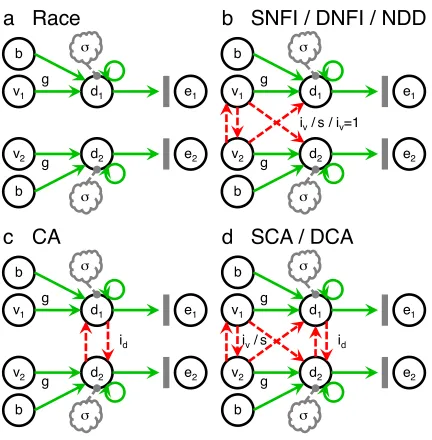
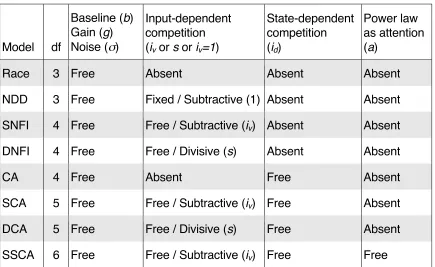
loops as well as essential aspects of established neuroalgorithmic models—
namely, the feedforward‑inhibition model (Ditterich et al., 2003; Mazurek et al.,
2003), the leaky‑competing‑accumulator (LCA) model (Usher & McClelland, 2001,
2004), and the divisive‑normalization model (Heeger, 1992; Louie et al., 2011,
2013; Carandini & Heeger, 2012), which actually has origins outside the realm of
SSMs. Prior studies have generally evaluated SSMs using stimuli that vary along
a single dimension and are thus intrinsically competitive, such as in a
signal‑detection or motion‑discrimination task. Crucially, the 2AFC paradigm
explored herein is distinguished by alternatives with parameters that are
statistically independent across trials (Teodorescu et al., 2013; Liston & Stone,
2013). This feature enabled rigorous assessment of competitive mechanisms or
In the spirit of Occam’s razor and the proverbial assertion that “all models are
wrong, but some are useful” (Box & Draper, 1987), various dynamical models were
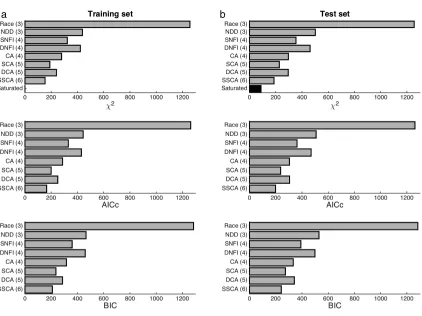
compared with an aim for achieving an ideal balance of parsimony and accuracy
(Myung, 2000), where the latter reflects both empirical fitting performance and
theoretical neural plausibility. Temporality was essential, as effects on observed
RT—that is, half of the available behavioral data—are beyond the scope of any
static model. Moreover, applicability to computational‑model‑based analysis of
neurophysiological data (O’Doherty et al., 2007; Forstmann et al., 2011) imposed
additional constraints. A novel synthesis of key concepts at a moderate level of
complexity was to quantitatively account for this class of value‑based decisions in
a sizeable data set including RT distributions from human subjects. Furthermore,
a meta‑analysis of experiments similarly involving binary choices about randomly
sampled foods with uncorrelated values went on to reveal qualitative trends across
multiple independent data sets that could be related to predictions of this novel
METHODS
Participants
Participants in all of the individual studies were generally healthy volunteers
between 18 and 40 years old from Caltech and the local community. The number
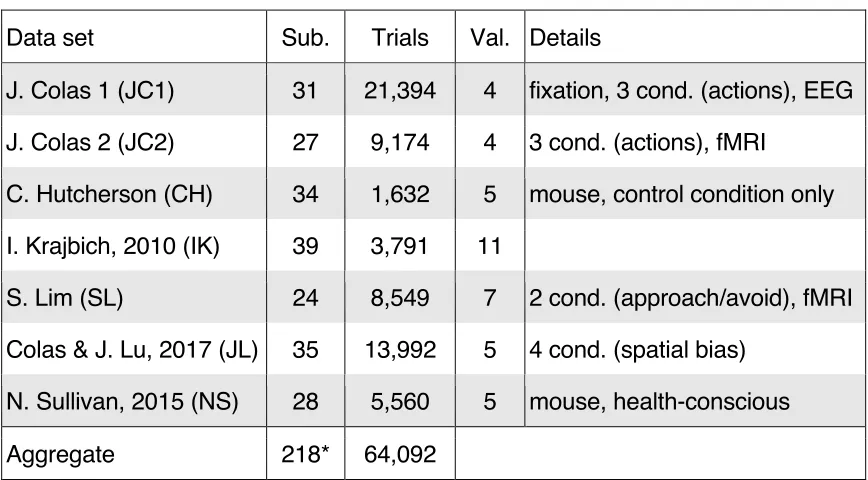
of participants included in each study is listed in Table 1. Participants in the JC1,
JC2, and SL studies were all right‑handed. Across all studies, criteria for
participation included enjoying and regularly eating common American snack
foods such as those used for the experiments. Participants provided informed
written consent for every individual study’s protocols, which were in this and all
other cases approved by the California Institute of Technology Institutional Review
Board. Participants were paid for completing a study and always received a
chosen food item.
Experimental procedures: Modeled data set
Prior to acquisition of the “JC1” data set proper, the subject first completed an
ancillary rating task that solicited the subjective values of all stimuli with linear
rankings. Images of 70 generally appetitive snack foods were presented against a
each food at the end of the experiment according to a 5‑point scale (0: “not at all”,
1: “slightly”, 2: “moderately”, 3: “strongly”, 4: “extremely”). The subject was given
unlimited time to respond by pressing one of five buttons along a row on a
keyboard with the right hand. As feedback, the selected rating was presented
centrally as a white Arabic numeral during an intertrial interval of 1000 ms. The
orientation of the scale was counterbalanced across subjects so that neither side
was consistently associated with positive valence. The order of stimulus
presentation was randomized for each subject. These images were chromatic and
had a resolution of 288 x 288 pixels and each subtended 8.0° x 8.0° of visual
angle. Stimuli were presented on a 23‑inch LCD monitor with a resolution of 1024
x 768 pixels from a distance of 100 cm as part of an interface programmed using
MATLAB and the Psychophysics Toolbox (Brainard, 1997).
Stimuli were randomly selected to form 720 pairs for the subject’s unique
sequence of trials in the main choice task (i.e., for the modeled JC1 data set) as
follows. Only foods with a rating of subjective value greater than zero were
included. Pairs were first selected so as to balance the differences in value
ranging from 0 to 3 as much as possible. Each pair of values among the ten
possible combinations was also balanced within each value‑difference bin. The
within each of the ten combinations. Stimuli were never repeated in consecutive
trials.
The subject was allotted 3 s to choose between a pair of food stimuli presented
adjacently to each other on either side of the white fixation spot (Fig. 1a).
Incidentally, electroencephalography (EEG) data were also being acquired while
the subject performed this choice task. Thus, the subject needed to maintain
fixation at all times during trials to prevent eye‑movement artifacts from
contaminating EEG signals. This task also featured three main experimental
conditions in randomly ordered blocks of 60 trials with balanced values: the subject
would choose by pressing one of two buttons with either index finger, by stepping
on one of two pedals, or with the actions unknown until the time of choosing is
indicated. Whereas the subject immediately indicated the choice using the
appropriate action for the button and pedal conditions, the unknown condition
instead required that the time of choice first be indicated without regard to action
by pressing the space bar with the right thumb. This nonspecific response, which
corresponded to the relevant reaction time (RT), would initiate a cue in the form of
the letter H above fixation or the letter F below fixation as instruction for a button or
pedal response, respectively. Only 800 ms was allotted to subsequently indicate
which item was chosen in the unknown condition’s second phase so as to prevent
from all three conditions could be concatenated prior to analysis. The subject was
prepared for the time constraint of the unknown condition with practice trials as
well as at least 100 trials of a task with the same timing that merely required
reporting which randomly selected side of the screen a gray square appeared on
for each trial. The action cues of the unknown condition were randomly
counterbalanced for each subject. These cues were colored cyan and yellow with
the color mapping counterbalanced across subjects. Trials were separated by an
intertrial interval drawn from a uniform distribution ranging between 2500 and 3500
ms, and self‑paced breaks for blinking and other movements that must be
restricted for EEG were available every three trials.
The subject was required to refrain from eating or drinking anything except for
water for at least 2 hours prior to the start of the experiment. The procedure was
incentive‑compatible (Hurwicz, 1972) inasmuch as the hungry subject was
informed that one of the choices made was to be selected randomly and
implemented at the end of the session. That is, upon completion, the subject was
provided with this chosen food and required to consume it. Failure to choose in
time for any trial resulted in the choice being made randomly by the computer,
such that the subject could not avoid any choice.
The meta‑analysis included six additional data sets (Table 1). Common to these
studies was the basic scheme of a 2AFC task for which subjects made
incentive‑compatible preferential decisions about randomly sampled foods with
values that were uncorrelated across trials; however, unlike the original (i.e., JC1)
study that was modeled, the stimuli were always presented separately on opposite
sides of the display with no restrictions on eye movements (Fig. 1b). Option
values were similarly derived from single‑stimulus rating tasks, and the number of
possible values is listed for each study in Table 1. The specific details of the
experimental procedures of these studies are not directly relevant to the
meta‑analysis, but their primary distinguishing features are described here.
The “JC2” data set was taken from a functional magnetic‑resonance imaging
(fMRI) study analogous to the original EEG study. As mentioned previously,
however, eye movements were allowed. Moreover, the subject was instead
allotted 4560 ms to respond.
The “CH” data set was taken from the blocked control condition of a
mouse‑tracking study. In the two experimental conditions omitted here, decisions
were not made naturally but rather on the basis of either only taste or only