The Haynes
Welding
Manual
by Jay Storer
and John H Haynes
Member of the Guild of Motoring WritersThe Haynes Manual
for selecting and using welding equipment
ABCDE FGHU KLMNO PQRS
Haynes Publishing Group
Sparkford Nr Yeovil
Somerset BA22 7JJ England
Haynes North America, Inc
Acknowledgements
We are grateful for the help and cooperation of welding equipment manufacturers such as Airco, Daytona MIG, HTP America, Lincoln Electric, Miller Electric and the ESAB Group, for their assistance with technical information and illustrations. Thanks to FitzMaurice-Smith Racing in Ventura for assistance with cover photography. We also wish to thank the Eastwood Company, Maguire's Welding and Valley Vintage Rods for assistance.
© Haynes North America, Inc. 1994
With permission from J.H. Haynes & Co. Ltd.
A book in the Haynes Automotive Repair Manual Series Printed in the U.S.A.
All rights reserved. No part of this book may be reproduced or transmitted in any form or by any means, electronic or mechanical, including photocopying, recording or by any information storage or retrieval system, without permission in writing from the copyright holder.
ISBN 1 56392110 3
Library of Congress Catalog Card Number 94-74485
While every attempt is made to ensure that the information in this manual is cor-rect, no liability can be accepted by the authors or publishers for loss, damage or injury caused by any errors in, or omissions from, the information given.
Contents
C h a p t e r 1 Introduction
Definition of welding 1-2 Development of modern welding 1-3 Welding today 1-6
C h a p t e r 2 Types of welding
How it works 2-3 Metal alloys 2-3 Oxy-acetylene gas welding 2-6 Arc welding 2-9 MIG (wire-fed) welding 2-11 TIG (heli-arc) welding 2-14 Duty-cycles 2-17 Plasma-arc welding and cutting 2-18 Practice and training 2-21
C h a p t e r 3 Oxy-acetylene gas welding/cutting
The basic gas process 3-1 The equipment 3-3 Getting started 3-7 Flame adjustment 3-9 Gas welding 3-9 Welding with filler rod 3-11 Brazing 3-16 Oxy-acetylene cutting 3-18 Heating with oxy-acetylene 3-24C h a p t e r 4 Arc welding
C h a p t e r 5 MIG welding
Shopping for a MIG welder 5-5 Choosing shielding gas 5-12 Choosing wire 5-14 Learning MIG welding 5-16
C h a p t e r 6 TIG welding
The equipment 6-4 The process in action 6-8 TIG-welding aluminum 6-13
C h a p t e r 7 Plasma cutting/welding
Plasma-arc welding 7-2 Plasma-arc cutting 7-3 Choosing plasma cutting equipment 7-5 Using a plasma cutter 7-8
C h a p t e r 8 Safety and shop equipment s 1
C h a p t e r 9 Building a utility trailer 9-1
Glossary QL-I
Sourcelist sn
Introduction
Welding is a process critical to our present state of civilization and technicaladvancement, yet little understood and most often taken for granted. Unless ex-posed to the building, machinery or automotive trades, the average person never realizes how much we depend on the welding process, which is a fundamental part of the process of building most of what we depend on daily,
in-cluding vehicles, buildings, appliances, bridges and a great deal more. In fact, once you really start to examine the objects around us, it's hard to imagine our world without the welding process.
Architecturally speaking, we might all be living in one-room wood or adobe-brick houses if it weren't for welding. Certainly all large commercial and residential structures are built with a consid-erable "skeleton" of welded structural steel, and even most single-family, wood-framed houses are built using some welded compo-nents, even down to items like the electrical outlet boxes in the walls. Anyone who has watched the construction progress of a ma-jor highway improvement like a bridge or tunnel has seen the hel-meted weldors, unsung heroes of the construction process, spray-ing a shower of sparks from high on a scaffold while they join metals to hold critical loads.
Sitting in an airport terminal recently with some time on our hands gave us something to think about. Virtually everything around us involved welding in some way. There was a large rack of telephone books in stainless-steel racks, each carefully TIG-welded and sanded, a post office box that was made of welded steel, the telephone stall had welded components, and the seats we were sit-ting on were part of a welded-steel structure that held eight seats. Everywhere you look in the modern world, you'll find examples of how widespread and important is the use of welding techniques and equipment.
Much of our Haynes audience is familiar with the automotive world, and here is a field where construction and repairs made by welding are absolutely essential, in fact essential to virtually all forms of transportation, from bicycles to cars, trucks, trains, aircraft and space vehicles. Even if we could go back before the "horseless carriage" was developed at the end of the 19th century, we would still need some form of welding to return to horse-drawn trans-portation, in welded brackets for harnesses and wagon compo-nents.
1.1 Welding had its ancient origins in the fires of blacksmiths, who could forge two white-hot pieces of
metal together with hammer blows and patience. It remained for history to bring us to electricity and bottled gasses for welding techniques to develop any
1.2 Metal cutting in the old days was no easier. A white-hot piece of metal was laid over a hardy (like a
wedge or chisel point) in the big anvil, and struck hard with a hammer, chopping the softened piece off. Final shaping of most items was by hand with
stones and files.
1.4 Under the center bridge column here are a welder (a machine) and a weldor (a person). He is welding up steel enclosures for the concrete columns, to retrofit more strength in California bridges to meet newer
earthquake codes.
1.3 The farrier of today works out of a truck, filled with equipment like a grinder, drill press and welder, all running on AC power when available; otherwise, horseshoes are shaped in a portable forge. Today's blacksmith has the advantage of tools like this MIG welder
that speed up making special horseshoes.
Since we've established that welding is a technical process our present society can't live without, in this book we'll explore more about the process, removing the mystery, and examining the avail-able equipment as it can be useful to us in fabricating with metal or repairing metal items. We'll show all of the most up-to-date equip-ment, describe the various welding types, make recommendations, show how welding is used in everyday situations, and develop weld-ing projects that illustrate how you can build or repair automotive, farm and household objects.
Definitions of
welding
At one time, the simple definition of welding was "joining metals through heating them to a molten state and fusing them together." As tech-nical progress in welding processes has ad-vanced, the definition has had to change.
There are now two basic forms of welding: fusion and non-fusion. The former is the most common, and it involves the actual melting of the parent metals being joined. Not all welding today involves melting. Non-fusion welding is most commonly represented by soldering and brazing, two processes of joining metals where the parent metal is heated, but not melted, and a second or "filler" metal is melted between them, forming a strong bond when all are cooled.
1.5 Wherever you see buildings go up, the basis for them is always steel, whether they wind up with wood, bricks or
cement on the outside, it all began with the work of ironworkers and weldors.
tool, which is a simple example of a process that can be used in production work in joining metals. Other kinds of "cold" welding may today involve sound and light, as in sonic-welding or laser-welding.
Today, the term "welding" has even been applied to the processes of joining non-metallic materials, such as plastic-weld-ing which sometimes involves a fusion of materials as a result of
heat or chemical action. As kids, we have all played with plastic models that we constructed using "glues" that would react with and actually "melt together" the two pieces we were joining.
For today's definition of welding to be all-encompassing, it would have to read "the joining of metals and plastics without the use of fasteners." This defini-tion covers a lot of ground, but, given the interests and needs of the majority of our readers, this book will concentrate on welding as it applies to metals joined by heat processes produced either by a flame or electrical current.
Semantically speaking, throughout this book we will be illustrating and refer-ring to pieces of welding equipment and to the people who operate them. Some-times the same term "welder" is used to apply to both the machine and the man, which can become confusing, so for our purposes, we will from now on refer to the machine as a "welder" and to the person operating it as a "weldor."
1.6 The construction and repair of heavy equipment and farm machinery would be nearly impossible without
welding. Arc welding is usually used, as here modifying the front of a dirt scoop on a John Deere, where
welding is outdoors and on heavy plates.
Development of
modern welding
1.7 Welding is even used in many art forms today. Bill McKewen is a metal sculptor who works with rods, tubes, plates, wires and custom castings to create interesting works that combine hard metals
with "organic" elements.
1.9 In a close-up of the "transition point" in Bill's sculpture, we can see how the stainless tubing and solid rod
is wrapped with stainless-steel oil field cable and welded to a large shape originally carved of foam and then sandcast in stainless and
final-shaped with a body grinder.
1.8 One of Bill's largest works is this 30-foot tall sculpture called "Organic Form 1", which is made entirely of stainless-steel and weighs
over 1000 pounds.
of the blacksmith as a large, muscular man covered with soot who works in a fiery, smoky environment, hammering loudly and magically making useful objects out of nothing, it's no wonder he was treated a little differently.
The blacksmith heated metals in a wood fire (coal was used later on) and hammered them into tools and weapons, performed basic heat-treating to harden some areas, and ground sharp edges with a foot-powered stone grinding wheel.
There were times when an object couldn't be made from one piece of metal. Gradually, the techniques developed to join pieces of metal either with bolts, hot rivets, or welding. This first use of welding consisted of heating the objects to a certain color (fairly precise indicator of the tempera-ture) and quickly hammering them together on the anvil. The heat and pressure joined the items, and the process has been called "forge-welding."
1.10 In high-technology areas like nuclear vessels, aviation and here, at a large race car-building shop, quality welding
technology is critical to success with metals.
1.11 Not every welder and weldor works indoors. This is an oil field service truck with gas-welding/cutting equipment, arc
welder and crane. Many welding shops have portable setups like this for remote jobs.
allowed to solidify. Repairing broken castings was a common procedure in industry and manufacturing. Cast metal is too brittle for forge-welding on an anvil, and the items were too large, so a process of "cast-welding" was developed in which the broken machin-ery was heated, a temporary mold bolted around the area to be repaired, and molten metal was poured in. Done right, the molten metal bonded with the parent casting and the goldrush mine or cotton gin was back in business.
As the 20th century dawned, electricity came into wider usage, especially for lighting. The early carbon-arc lamps made as much heat as they did light, and someone started using electric carbon-arc rods to fu-sion-weld metals. Soon after, the simple stick electrode was developed that is similar to arc-welding rods of to-day, and about that same time oxy-acetylene gas weld-ing was also developweld-ing. It's ironic that gas weldweld-ing also grew out of the advancements in lighting, since acetylene gas had been used for car lights up until just before W.W.I.
Speaking of W.W.I, anyone who is familiar with history knows that many technological advances have resulted from the accelerated development that, unfortunately, only seems to come from a wartime environment. W.W.I saw the further development of gas and stick welding, and soon after that the refinement of X-ray technology aided further industrial use of welding. The exacting inspec-tion of welds made possible by X-rays speeded welding's acceptance.
The rapid development of the aircraft industry between the wars, and the in-creased use of lightweight metals to replace wood and fabric in fuselages and wings led to further advances in welding. W.W.II saw the burgeoning aircraft in-dustry with increased requirements for joining light metals such as aluminum and magnesium faster, stronger and smoother than with drilling and riveting, as had been used before. Inert-gas welding was invented before the war, but the gasses were considered too expensive at the time, and it took a war-time environment to accelerate its development. After the war, because the lightweight metals were in demand for many military and civilian applications, TIG welding was further re-fined, and MIG welding was invented around 1948.
1.12 The back of the same oil field welding truck is built as a large, heavy workbench-away-from-a-shop. Big Lincoln ac/dc arc
1.13 Back in the Fifties and Sixties, car enthusiast magazines were all advertising these "twin carbon-arc" welders, which were the original "Buzzboxes." While some of these did work, most of them were tried a
few times and then put on a shelf out in the garage. Today they're collector's items from welding history.
1.14 Today's modern home/shop/garage welding equipment is likely to be a clean, efficient, safer welding system like MIG, or wire-feed, welding. Machines like this are getting less expensive all the time, and some models can be hooked to standard household 110V current, making them quite portable.
Today
1.15 If you decide to purchase a welder, visit your local welding supply center to talk to the salespeople and find out what equipment
best suits your needs and budget. A well-equipped store will have everything you'll need, from gasses to glasses.
In the remaining decades of the 20th century, welding developments have come at a rapid pace, often closely tied to electronics development, as new and better methods of applying cleaner and more controlled heat have come along. In the past decade, we have seen the cost and complexity of welding equipment reduced in some areas, to the point where equipment that was once considered solely the province of the high-production profes-sional shop is now found in garages and hobby shops around the country.
It's been good news for the automotive hobbyist, whether he is restoring an old car or building a race car, as well as good news for the small farmer trying to maintain and repair his equipment. Welders are now being purchased by metal-sculptors and other artists and craftsmen, as well as being used for the most everyday kinds of household jobs such as repairing a bicycle or garden tool, building a firewood storage rack or a barbecue, or even fabricating a small utility trailer at home.
pop-ular kinds of modern welding equipment for non-critical jobs. But to make music with that harmonica, or good, strong, clean welds with a welder, will take time. As the hip musician once said when asked how to get to Carnegie Hall, "Prac-tice, man, practice!" The more time spent consistently practicing with a welding setup, whatever the type, the better your results will be. If you use your welder only occasionally, don't just pick-up the torch and expect to lay a perfect bead the first time. There is a rhythm to find. Practice first on a scrap piece of metal of the same thickness as the work you intend to weld, and, when you have the rhythm down, repair or fabricate your job.
Though not considered with the same awe as the ancient blacksmith, a pro-fessional weldor today can still make a satisfying living, for it seems to be a skill that, far from fading out due to replacement technology, is seeing ever-increas-ing usage in business and industry. Weldors today find diversified employment in oil field and pipeline work, building construction, bridges and other infrastructure, automotive work from assembly-line welding to body shop repair to race car fab-rication and antique auto restoration, to the nuclear-power industry, aviation and aerospace work, defense work, and manufacturing work building products from household appliances to huge boilers and construction equipment.
This book is intended as an overall introduction to the welding process, illus-trating most of the common equipment and work techniques for both home and shop welding. While this is not a textbook for the would-be professional weldor, there is enough of an overview here to give a prospective welding student a basic understanding before delving into the more detailed professional textbooks on the subject.
Types of welding
If you are reading this book, chances are you have had some exposure towelding through watching a repair done such as having a new exhaust system put on your car, through some hobby interest in the metal arts/crafts area or through some industrial exposure to welding as used in manufacturing and building processes. Obviously you have become interested enough in learning about welding to purchase this book which we feel is an excellent introduction to a field where there are lots of involved textbooks for the person pursuing welding as a profession, but few basic books for someone getting started at the hobby, farm or home/shop level.
Perhaps your initial exposure to welding has sparked an interest in doing it yourself. If you are involved in
auto-motive work, you already know how valuable the process can be in fabri-cation and repairs. Once you have seen it performed, you realize how handy this capability is. You can join pieces of metal to either repair some-thing that was damaged and other-wise scheduled for replacement or build something entirely new, from a barbecue grille to a race car.
Once you have the basic skills and the right equipment, you'll find many more uses for welding than you had anticipated. Like a good truck or a specialized tool, once you have a welder, you'll wonder how you ever got along without it! You'll probably find yourself building a materials rack, stocking it with various sizes of tubing and plates, and actually looking for new projects to tackle, from building a workbench to last a lifetime, to stor-age racks, moveable shop carts, en-gine stands, shelving, and much more.
There are quite a few types of welding processes, and today there are a great many welders to choose from. There are so many, in fact, that just picking the process and the
ma-2.1 There are a number of choices today when shopping for welding equipment. The right choice for you depends on the kind of jobs you plan to do, where you plan to do them, your budget and how much time you can devote to training and practice
2.2 Welding is a process of fusion, in which metal parts are heated to the melting point and fused together, usually with a filler of the same material melted along with the "parent" metal. All metals melt at different temperatures, and this chart shows some
interesting comparisons, as well as relating the heated metal's color to its temperature.
chinery which best suit your needs may seem a considerable task. This chapter will give you a brief overview of the various processes along with an analysis of the pros and cons for each type and how best to select equipment based on your needs.
How it works
2.3 The welding corner of this well-equipped race-car prep shop holds a variety of equipment, from a large TIG machine
at left (with cooling unit on top), to a heavy-duty plasma cutter, oxy-acetylene cutting/heating/welding outfit, and two
small plasma cutters. Not shown here are the two MIG welders in use elsewhere in the shop.
It takes a tremendous amount of localized heat to weld metals together, and heat control is the key to welding properly. Every material has its own specific melting point, and to make a weld you need to heat the material to that point but not beyond it. Visualize an ice cube, which is solid material (when cold). If you heat it to the melting point (above 32 degrees F), the solid becomes a liquid (wa-ter), heating it further will vaporize it into steam and for your purposes the mate-rial is gone. The same changes happen to metal, although at much higher tem-peratures. Common lead solder such as you might use to solder electrical connections can melt at temperatures from 250-750° F (depending on the alloy), aluminum melts at just below 1250° F, and common mild steel melts at 2750° F. The heat required to make metal molten enough to fusion-weld can be achieved in several ways, but the most common for home/shop situations will be generated either with a flame or some use of electrical current. The traditional source in welding has been the oxy-acetylene torch, while electricity is now used in most of the other methods, such as arc-welding, MIG-welding, and TIG-welding.
One thing that is common to all the forms of welding is that the filler material must be compatible with the parent metal, and all efforts must be made to make a "clean" weld free of outside contaminants that could weaken the joint. If you are welding aluminum, the filler rod must be aluminum, a stainless filler rod must be used for welding stainless-steel and steel rods are used on steel. In gas welding, the cleanliness of the weld is controlled by the correct adjustment of the torch flame and the cleanliness of the two edges of the parent metal. In elec-tric welding, an inert gas "cloud" is formed right around the welding area that keeps outside oxygen or impurities from contaminating the weld. The shielding gas is generated in several ways, as you'll see as we further describe the various types of equipment.
Metal alloys
The melting point of the metal you work with will vary with the basic nature of the material (iron, steel, aluminum, magnesium, etc.), and the alloy of the metal. Most metals today are not in pure form, they are alloyed or mixed with another metal to give the new material special characteristics. Copper, lead and iron are basic pure metals that have been used by man for tools and other
2.5 Non-ferrous metals like aluminum are generally marked with their alloy and heat-treat, such as here on this sheet of 6061-T6. If you need a specific metal for a project, you may have to buy new material rather than remnants, because the smaller scrap pieces may not
have the markings on them.
2.6 Weldor Bill Maguire fabricated this recumbent bicycle for himself from 4130 chrome-moly thinwall tubing, which is very strong but light. The idea was to reduce the bike weight, wind resistance and
pedal effort. Bill joined the thin tubing with TIG welding.
jects for thousands of years. Mixing various metals together can produce a new metal with new uses. Copper mixed with zinc will make brass, which has strength, reduced cost, and better suitability for machining and casting. The same base copper mixed with tin makes bronze, which was alloyed as far back as 2000 years to make weapons. Gold and silver, precious as they are in their pure state are seldom utilized in their natural form which is quite soft in compari-son to other metals.
When alloyed with other metals which add strength or other characteristics, gold and silver can be used for jewelry, coins and many other uses. We com-monly describe different gold objects by "carats." While pure gold is 24 carat, 12-carat gold is only half gold and half other metals, and the closer the carat-number is to 24, the more gold is in the object. The other alloys reduce the ex-pense of the pure gold and make it more durable and useful. Were rings and other jewelry to be made of 24-carat pure gold, they would be too soft and not last in normal use.
2.7 Get to know the personnel at your local welding supply store. They can be very helpful when it comes to choosing equipment, and they will have all the supplies you'll need in the future. Most stores carry several brands of equipment, all
the safety items, and even the smaller home/shop machines.
2.8 The welding supply store should be able to tell you where to buy steel locally, which you will probably use for most of your welding projects. Most yards have a remnant section as shown, where you can buy short lengths of material at
by-the-pound prices. Tubing for a trailer project is being weighed.
stainless-steel, a very useful material that requires somewhat different welding techniques. Anyone familiar with race-car and aircraft construction may have heard of 4130 chrome-moly steel, which is often used in these applications for its high strength relative to its weight. The four-digit number describes the alloy as containing molybdenum, and the amount of carbon. This alloy contains more carbon than mild steel, as well as chromium and molybdenum, both of which add properties of rust-resistance, strength and hardness. Even though this is a higher-carbon steel than mild steel, it really contains only 30/100th of 1% of car-bon, which shows how scientific the alloying of metals really is. A tiny change in content can radically affect the properties of the final metal.
In steel and aluminum, not only are there different alloys, but different heat-treat processes. In the simplest terms, heat-heat-treating is a scientific process of heating a metal to a specific temperature and then cooling it, either slowly or quickly, and with or without oil. The heat-treating can affect the hardness and other characteristics of the metal. When aluminum is purchased new in sheets or tubes, it is generally marked with its alloy and heat-treat, such as 3003-T3, which is a sheet aluminum that is considered "half-hard" and is commonly used in mak-ing race-car bodywork, where it has to be somewhat strong, but also able to be bent, welded and hammered. On the other end of the spectrum, 7075-T6 alu-minum is very hard and strong. Called "aerospace alualu-minum" in the vernacular, it is often used in making machined aluminum parts and applications where very high strength is required. While it is strong and hard, it doesn't bend. There are volumes of scientific books on the alloying and heat-treating of metals, but, for your purposes as a home weldor, just remember to find out what kind of metal you are welding, and when making a project ask a metals expert to recommend the most suitable material. In general, the higher the carbon content in steel, and the higher the heat-treat on aluminum, the stronger the material will be but tougher to form into a shape, and the tougher metal alloys can be more brittle.
sheets or 20-foot lengths of tubing. Use the scrap pieces for all your experimen-tation with various types of welds, until you are doing pretty well. You may even be able to build small projects, like a welding cart, using the short lengths of tub-ing or angle-iron from the scraps section. Once you get to know the people at both the welding supply house and the metal yard, you'll have experts to wade through the technical jargon of alloys and heat-treats, and help you sort out the right material for your future projects.
Oxy-acetylene gas welding
This is perhaps the oldest and most versatile of welding setups. For a long time, it was the only setup recommended for the home/shop use, and has been among the least expensive to get started with. The basic combination in a typical gas-welding package are two high-pressure cylindrical tanks, one for oxygen, one for acetylene, a set of gauges and regulators to control the gas flow out of the tanks, a pair of hoses, and a torch. The torch usually comes with a variety of tips, tip cleaners, a spark lighter, and good sets may include a helmet, gloves and often a cutting-torch.
The latter is what really makes the oxy-acetylene system so versatile. It is one of the few welding systems that can do cutting as well as welding. This can be invaluable in both repair and fabrication work. Cutting away damaged or un-wanted material is easily done with a properly-used cutting-torch attachment, and you may have many projects where you need to cut an irregular shape out of steel plate. The bulk of tubing and angle-iron cutting is usually done with some kind of saw or an abrasive cutoff wheel, but these tools can only make a straight cut; they can't go around corners. If you need to cut out a circle from a steel plate, you can draw the circle on the plate with a compass and a special hard crayon called a soapstone (which leaves a line you can see even when welding), then use your cutting torch to follow the line and you have your part. Any shape can be cut out. If you make up a cardboard template of the piece you need, trace around the pattern with your soapstone onto the plate, and make it.
Cutting with a torch takes skill to closely follow a line, and even then the edges of the metal will require some grinding, filing or sanding to get a smooth edge. Most experienced weldors know just how much to cut outside their pattern
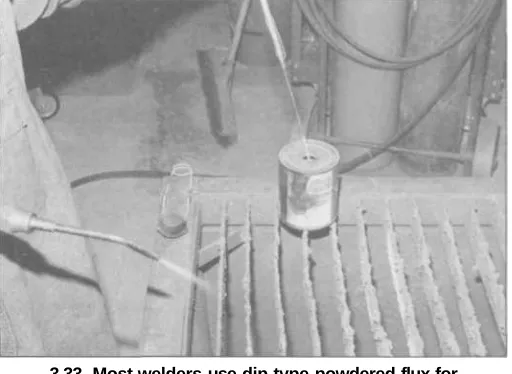
2.10 You'll n e e d a s a f e a r e a t o p r a c t i c e y o u r g a s w e l d i n g . Fire b r i c k s like t h e s e a r e s a f e t o w e l d o n a n d d o n ' t s u c k t h e h e a t out o f y o u r p a r e n t m e t a l a s y o u w e l d . T h e skills you'll h a v e t o
learn w i t h g a s w e l d i n g a r e t o r c h m o v e m e n t , e v e n f e e d i n g o f filler r o d w i t h y o u r o t h e r h a n d , a n d s t e a d y , s m a l l c i r c l e s t o
m a k e c o n s i s t e n t p u d d l e s .
size to have an exact-size piece after cleaning up the cut edges with a grinder.
The oxy-acetylene setup is still the least expensive welding system if you buy the torches, gauges and hoses, and lease the gas cylinders. The tanks are expensive to purchase outright, but can be leased from your local welding supply store with a deposit down and a small monthly fee. Many shops today will take a credit application in lieu of a deposit, and you will open an account there, assuming your credit is good.
2.11 This illustration shows virtually all of the basic weld types and positions. With each type of welding you practice, you'll first learn to make a steady bead on a steel plate, then do flat butt-welds, then move on to corner welds and tougher ones like overhead and vertical welds. If you first learn torch control with gas welding, you'll be able to pick-up any other welding method more easily.
Leasing tanks is an inexpensive way to get started, but if you do only a small amount of welding infrequently it may not be a practical arrangement for you. Af-ter you have been paying rental fees for a year or two, you'll realize you could have purchased the tanks outright for the same amount of money. If you knew you only had to do some gas-welding for a few months, then the leasing deal would be better.
When welding with oxy-acetylene equipment, the basic procedure is to set the proper gas flow to the torch with the regulators, crack open the valves on the torch, light the flame with a friction-sparking lighter and then adjust the ratio of oxygen to acetylene to achieve the proper flame. Changing tip sizes makes a bigger or smaller flame, so you suit the tip size to the thickness of the parent metals you are welding. A smaller flame is used for thinner metals. The torch is brought down to the work area (the weldor is wearing his dark-lensed safety gog-gles) and the flame is used to heat the two edges to be joined, while your other hand feeds a piece of filler rod into the molten puddle as you move along the joint. Weld joints can be made with or without a filler rod, but a filler rod is used most often.
This is a very simplistic description of the process of gas-welding. It takes considerable practice and good hand/eye coordination to master. Once learned, the skills can be very useful, but it is a process rather difficult to learn from a book. Taking a class or having an experienced friend take you through the process will ease the learning curve considerably.
Besides the versatility of doing both welding and cutting, oxy-acetylene equipment also has many other shop uses in supplying a lot of localized heat. You may have projects where you need to bend a piece of metal. Thin sheet metal can be easily bent with pliers, vise-grips or put into a vise and bent over with a hammer, but thick metal may crack when bent cold. If you have a 1/4-in-thick steel bracket you need to bend at an angle, cold-bending with a hammer and vise may require so much hammer force as to distort the part out of shape, as well as mark the surface up or even damage the vise. If you closely examine the piece of thick plate after a cold bend, you may see the metal in the corner of the bend looking crystallized, which weakens that spot. Heating the metal to the right temperature with a torch before bending it, along the line where the bend should be, allows an easy bend with less disturbance of the metal's integrity along the bend. Another use of gas welding equipment is for brazing ferrous and non-ferrous metals such as copper and brass. In brazing, the parent metal is not made molten, it is heated enough to melt a brass filler rod, which attaches to both pieces of parent metal, making a firm joint.
Besides heating metal for bending, gas equipment is also used in many au-tomotive shops for freeing frozen parts. Metals expand when heated, and when a rusted nut on a fastener is heated, the nut expands and breaks the bond, so the nut can be removed. When working under a car that has seen winter road salts, or when disassembling an old car for restoration, a gas torch can be very handy for getting off rusted nuts without busting your knuckles when your wrench rounds off an old nut. Many a mechanic on older cars would not be without his faithful "smoke wrench." Machine shops also use a torch to heat and expand parts that have a press fit. A gear that fits on a shaft may be heated with a special "rosebud" tip that spreads the flame around a wider area, and when the gear has expanded, it is picked up with tongs and slipped onto the unheated (and not ex-panded) shaft. When it cools off and contracts, the gear is securely fastened to the shaft, but can be removed at a later time just by reheating it again.
weld-ing thin sheet metal. Automotive body men today are usweld-ing a torch less and less when doing repairs on thin metal. However, one of the advantages of gas-welding equipment over any electric-welder is portability. Your gas welding cart can be moved around anywhere without wires, even carried (when properly secured) in your pick-up for welding at a remote site.
If you have the budget and the need for gas-welding's versatility and porta-bility, then your ideal shop setup would include
both an oxy-acetylene rig and some kind of electric welder.
Arc welding
Like gas welding, electric arc welding has been around for almost 100 years, and the fact that it is still around today illustrates its continued usefulness. The official acronym for arc welding is SMAW, which stands for Shielded Metal Arc Weld-ing. The basic components of the setup include the machine (the power source), a ground lead you clamp to the work anywhere except where the weld is to be made, an electrode lead which runs from the machine to an electrode holder, which is a handle with a clamp that holds consumable elec-trodes. The electrodes are metal rods covered with a coating.
In use, the weldor strikes an arc against the parent metal with the electrode, which completes the circuit between the two leads and causes a
bright light and concentrated heat. Arc welding uses considerable amperage of electricity to generate the intense arc, which melts the parent metal. The central metal core of the electrode melts as the work progresses, becoming the filler metal, while the fluxed coating produces a shielding gas around the welding area that protects the parent and filler metal from impurities in the air. Arc-welding pro-duces slag as you proceed, a thick coating of impurities and de-posits left from the rod's coating. This slag must be chipped off with a chipping hammer, which is usually included with the machine.
There are a wide variety of welding rods (electrodes) available to suit almost any purpose. The 12-14-inch-long rods are also called "sticks", and you may often hear arc-wetding referred to as stick welding. The rods vary in thickness, according to the thickness of the metal you are welding, and also in alloy and flux-coating con-tent. There are many special-purpose rods, and, because of the va-riety, rods are usually marked with a number at the beginning of the flux coating, and different colors may also be added to the fluxes for quick identification.
Rods are usually sold in boxes or cans of fairly large quantity, which can be a problem for home/shop use where the welding is in-frequent. The coatings on arc-welding rods are very susceptible to moisture in the air, and must be stored in very dry, secure contain-ers to remain effective. You may have seen welding filler rods in gas-welding outfits stored in simple lengths of pipe welded to the welding cart, but this is not suitable for arc rods. If you do purchase an arc machine, invest in several airtight metal containers to store the rods, even using bags of desiccant (moisture-absorbing crystals usually found in small bags packed with cameras or sensitive elec-tronic equipment) in the cans.
2.13 In farm and construction equipment repair, most work is done with oxy-acetylene cutting and arc, or stick, welding. Arc welding is not affected by wind outdoors, and is able to join or repair very
thick materials.
There are two basic types of arc-welders, relating to the polarity of the elec-tricity they produce, AC or DC. The DC machines are generally larger, industrial units found in production shops, where they are hard-wired in, or mounted in conjunction with an engine for truck-mounted use in mobile field welding. Most shop-type DC machines require shop-type electrical input, such as 440V or three-phase 220V, which you will not find in any standard home. They are de-signed to operate day in and day out without overheating, and are considered the best choice for welding really thick materials, so that is why we see DC arc machines in use building bridges, buildings, ships, etc. There are a few small DC machines for home use, but they have limited amperage and should be used on lighter materials. There are even combination AC/DC machines, but these are usually expensive shop machines.
By far, the most basic and practical home/shop arc-welder is an AC machine often called a "buzz-box" because of the sound it makes when you are welding. This is the least expensive single welding system you can buy, with a good name-brand buzz-box costing about the same as a set of oxy-acetylene torches. However, the arc machine comes with rods and everything you need, while the gas setup also requires filled cylinders which make a ready-to-weld gas setup about twice as expensive as a basic arc box.
The wiring you have in your house or shop will be a factor in choosing the type of equipment best suited for your purposes. To use an arc machine, you'll need 220V availability. If you already have an electric stove in your house (or the house had at least been wired for this) or an electric clothes dryer, you're probably in good shape because many electric stoves and dryers use 220V current. However, unless your dryer outlet is already out in your garage, you may have to have a qual-ified electrician run this 220V power out to where you'll be doing your welding. If you don't already have a 220V outlet, the cost of running new service to your garage may double the total expense of setting up to do arc-welding at home.
Also, welders do not just plug into the same outlet as your appliances. The welder has a different arrangement of prongs on its plug, and an adapter is re-quired to plug into a 220V appliance outlet. The outlet you use should also have a good 20-30-amp circuit breaker as well. Note that there are some small buzz-boxes that plug into ordinary household 110V power, but they aren't recom-mended for anything but light and occasional work.
A stick-welder is relatively easy to use. Unlike gas welding, where you have to operate the torch with one hand while feeding the filler rod with the other hand, there is only one piece to control with arc-welding, the rod-holder. However, the rod starts out 12 to 14 inches long but is used up continually (gets shorter) as you weld, making it tough to maintain an exact distance of rod to workpiece, which is critical to a good arc weld. With the rod too close, you burn holes in the metal, and too far away you can lose the arc entirely and have to restart. So the trick in arc welding is control of the tip of the rod, and, because it is always getting shorter, you have to "fine-tune" your wrist movement in the hand working the electrode-holder. For this reason, most arc-welding is done with two hands, es-pecially when learning. Use your other hand to steady and help control your wrist action on the "working" hand. Professional weldors use arc-welding upside down, laying on their back, hanging from scaffolding, or even underwater with special equipment, but for the novice, a comfortable body and hand position is very important to making good welds.
To sum up the pros and cons of an AC arc-welder, the advantages include the low initial cost, easy operation (with practice), versatility (it can be used in-doors or out) and it offers a high level of dependability (no moving parts) and quietness of operation. Disadvantages include: it's less practical for thinner met-als, your shop may require rewiring to accommodate it, the home arc-welder usually can't be used for welding long seams all at one time, you are restricted to the limits of your power-cord length (as with any electric machine except the generator-driven type), the welds may have considerable spatter and not look as "clean" as other types if that is a consideration (such as in art projects, metal fur-niture design or street-rod fabricating), and there is the safety consideration of potential skin burns. Compared to gas welding, arc-welding poses more danger due to burns, not just from little spatters of hot metal, but from any skin that is exposed to the UV and infra-red rays. You can get a severe sunburn from expo-sure (pro weldors wear heavy leather protective clothing) and observing an arc-weld in progress without a helmet on, even for just a second or two, can cause headaches and eye irritation.
The buzz-box was once the most practical home/shop welder, but increas-ing availability and affordability of home MIG machines in the last ten years has put up a serious challenge to that title.
MIG (wire-feed) welders
This category of welding system has become one of the most popular for to-day's home/shop use. The initials stand for Metal Inert Gas, but is also listed in technical descriptions as GMAW, for Gas
Metal Arc Welding. The basic elements of the setup include a power supply (machine), a torch with a large-diameter cable, a ground wire with clamp, and a bottle of compressed shielding gas. Inside the machine is a roll of relatively-thin wire and a motorized transport system for this wire.
In practice, you weld almost like arc-welding, but the electrode (wire) is con-stantly fed through the cable to the gun and consumed at the weld. When you pull the trigger of the MIG gun, you start the supply of amperage (when the arc starts on your work), the feeding of the wire electrode, and the flow of shielding gas, which is also routed inside the gun's cable
and comes out of the tip all around the electrode, preserv-ing the integrity of the weld like the flux coating does on arc rods.
The advantages of the MIG system includes a much cleaner weld than either gas or arc, good versatility in materials with the ability to do very well on thin metals, and there is no elec-trode or filler rod to keep replac-ing. Control is easy because you can set the amperage on the machine and also infinitely ad-just the speed of the wire
com-2.15 Anyone who is a fan of auto racing is familiar with various types of welding. In the immaculate shop of Larry Smith Marketing, a crewman is putting a final MIG weld on a complete NASCAR chassis for a car like the Matco Tools entry at left. Race car shops use a variety of welding techniques, from gas to MIG and TIG.
2.16 Small, portable wire-feed, or MIG, welders have become one of the most popular welding machines for
2.17 Most MIG machines operate with a bottle of shielding gas, but some are equipped to run with flux-cored wire which makes its own shielding gas as it arcs, making the process more suitable for outdoor and drafty situations. This home/shop-sized unit shown is a combination machine that can operate with gas shielding/solid wire, or the flux-core wire. 2.18 At the professional shop level, MIG welders are all 220V machines, and offer power up to 250 amps, which is enough to weld most anything. This Millermatic 250 is a popular machine in fabricating shops and automotive shops. There is even a model of this machine with a small computer in which you can store the welding parameters of up to nine different jobs, in five different languages.
ing out of the gun. Various-diameter steel wires are available to weld material from the thinnest sheet metal to 1/4-inch and 3/8-inch, as well as stainless-steel and aluminum wires to weld those materials with. The weld from a MIG gun is much cleaner than arc welding in terms of spatter, and there is no slag coating to chip off.
Originally, wire-feed MIG machines were developed strictly for the profes-sional shop doing long-duration production welding. A roll of wire in one of these machines can last for an entire eight-hour shift without the weldor ever stopping for a new electrode. Because the wire is machine fed into the weld puddle, the heat and wire-feed rate can be tuned so that production welds can be made much faster than with other systems. The MIG machine has been an expensive piece of equipment in the past (and heavy-duty, big-shop models are still fairly expensive), so it never used to be recommended to anyone for home/shop use. However, less-expensive MIG machines have become widely available in the past 5-10 years that have made these an excellent choice for the hobbyist, par-ticularly the automotive hobbyist. These newer machines, mostly imported and built with a few less features and a lower duty-cycle than would be required in a production environment, have not only become very popular with the hobbyists but are also are finding their way into more small fabricating shops, muffler shops and race-car fabrication shops as a less expensive alternative to the big ma-chines, yet with better speed and weld quality than arc or gas.
2.19 If you're lucky, the welding store near you will have a demonstration area, such as here at Altair
Gasses & Equipment, Oxnard, California. Here a portable MIG unit is being tested where customers
can watch through a large safety lens (behind operator, at right). You can get a feel for different equipment before you decide what machine best
suits your needs.
2.20 If you are interested in cars as a hobby, whether it be kit cars, street rods, race cars, or antique restorations, you should become familiar with various welding techniques, and perhaps buy a system. When fabricating parts at home, it's a lot easier if you have your own welder, even if all you do is tack parts together and bring them to
someone else for final welding.
necessary. These smaller wire-feed machines usually have 4-7 heat range settings from 30 to 110 or 140 amps, and can handle light sheet metal such as auto body material up to metals as thick as 1/4-inch or 3/8-inch (less maximum thickness is possible on aluminum). They either have wheels on the bottom or have optional, wheeled carts that make then very easy to move around your shop or garage. Many beginning weldors like to build their own welding cart as their first project with a new welding machine.
The shielding gas used with MIG machines can be CO2,
Argon, or a mixture of the two, depending on the materials you are welding. The basic gas used most often is straight CO2, because it is the least expensive. Various sized gas
bottles are available from small, very portable 20-cubic-foot bottles (about two feet high), to 120-cubic-foot bottles (four foot high, six-inches in diameter) that can supply enough
gas for eight hours of continuous welding. The small bottles are fine for occa-sional home/shop use where long seams are not welded regularly.
One of the factors that has made MIG welders so popular with home/shop users is the relatively easy learning curve associated with using them. Given a lit-tle instruction and practice, most people can be up and welding a decent bead in an hour or two. We're not suggesting that that person would then be ready for a full-time job as a weldor, or that his/her first welds would pass rigid specifications for nuclear reactors, but the wire-feed machines are easier to learn than most other systems. One of the factors that makes it easier is of course not having to deal with feeding the filler rod in with your other hand. In automotive body work this can be particularly helpful when you have to hold something with your left hand, like the alignment of two pieces of sheet metal, while you tack them to-gether with the one-hand MIG torch. Torch position is very important in all forms of welding, and the fact that the distance of the MIG tip from the work is constant (in many cases the nozzle is actually touching the work to steady it) makes con-trolling the weld much easier.
After selecting the proper heat setting based on the thickness of the material
2.22 Street rodding and antique car restoration frequently require welding on old, even rusty sheet metal body panels. Here the lower portion of a '32 Ford cowl has been patched with new steel to replace rust-out area. The panel was MIG-welded in with a 110V welder, ground down with a body-sander, is ready for finishing and another 60 years on the road.
2.23 Basic components of a TIG-welding system. Very similar to operating a gas torch and using your other hand to feed filler rod, TIG produces the cleanest welds with the least amount of material warpage, and is the best system for thin, high-strength material like chrome-moly as well as aluminum.
you are welding, the only other variable to control is the speed the wire is fed into the weld puddle. If the speed is wrong, there will be a lot of sputtering and uneven welding and penetration. Most MIG weldors tune the wire-speed in by sound, They set up on a scrap piece of metal with a wire speed that may be too slow or too fast, then pull a bead while adjusting the speed. When the right speed is reached, the MIG welder gives a distinctive crackling sound to the procedure. The steady crackling sound means you have the right wire speed.
There are three basic types of small MIG machines. Those that use plain wire with a bottle of shielding gas, those that use flux-coated wire and no gas bottle, and com-bination machines that can run either fluxed or plain wire. The flux on the wire functions the same as the coatings on arc rods, creating a shielding gas as the wire is consumed. The bottled-gas-shielded MIG welding is the preferred method for indoor welding where clean-looking weld beads are desired. How-ever, the shielding gas around the weld process is subject to being disturbed by air currents, so for outdoor welding (such as farm equipment repair, fence con-struction, etc.) the fluxed-wire machine is better. The weld isn't quite as clean as with the gas, and fluxed wire doesn't do as good a job on thin sheet metal (under 18-gauge) but these machines are more practical for the outdoor work, which is usually on heavier materials anyway. Also, the fluxed-wire machine never need to have a bottle refilled, so as long as you have plenty of wire inside the machine, you can't have your work delayed by running out of shielding gas.
Considering all of these factors, the modern MIG machine may be the most practical type of machine for many do-it-yourselfers, particularly the automotive hobbyist, who has to make very clean welds, both with thin sheet metal as well as heavier chassis work. The ease of operation, maneuverability around the shop (with the 110V machines), one-hand torch operation and the gentle learning curve have combined to make many first-time MIG weldors tackle their projects with confidence.
TIG (heli-arc) welding
2.24 While TIG or heli-arc welding is considered by many to be the most controllable welding technique, it takes more practice than any other. You have to learn to manipulate the torch with one hand, the rod with the other, and the amperage control with your foot on a pedal. There are no sparks, spatter
or slag. Here an aluminum frypan's handle mount is being repaired. The heli-arc welding didn't even bother the
non-stick coating on the other side!
heli-arc welding, though this is a trade name established by the Linde Corporation many years ago. The name refers to the fact that back then, helium was used as the shielding gas for the process, though today argon is the most com-monly used gas for TIG welding. Either shielding gas has the capacity to exclude foreign materials during the welding process, as well as being unable to combine with other ele-ments to form chemical compounds detrimental to the weld integrity. The process can also been seen abbreviated as GTAW, for Gas Tungsten Arc Welding.
The basic components of the TIG process include a welding machine, a torch with a tungsten electrode, a ground cable, a foot-operated amperage control pedal and a bottle of compressed shielding gas such as argon. It dif-fers basically from stick welding and MIG welding in that the electrode is not consumed, and filler rod is separately hand-fed into the weld puddle when needed. In operation, the machine is turned on, the weldor brings the torch close
to the work and depresses the foot pedal to start the arc. Current flows through the tungsten to the workpiece, creating an intense but concentrated heat that melts the parent metal, with the operator controlling the amperage with the foot-pedal while welding, and feeding the appropriate filler rod to the puddle as needed. The tungsten electrode has a very high melting point and is not con-sumed.
What makes the heli-arc different in practice from other systems is the higher operator skill required, since the weldor has to coordinate with both hands and the foot pedal, all of which affects the quality of the finished weld. Unless you are already an accomplished weldor with an oxy-acetylene gas-welding torch, you'll find the TIG process takes a lot of practice.
TIG welding produces the cleanest, flux-free and spatter-free beads with vir-tually no contamination. For this reason, it is the method of choice for such criti-cal applications as race cars, aircraft, missile construction and nuclear reactor
2.25 Where TIG welding really shines is in two tough situations in one job, like thin materials and aluminum, such as this part that looks like something from a space ship. This wound up being a belt-pack of controls for a big piece of machinery - the operator strapped this to his waist. Aluminum
welding. The TIG welds are strong, ductile and corrosion-resistant with virtually no cleanup required, making it popular for welding of surgical, medical and food-service equipment, especially on stainless-steel. There is little smoke produced during TIG welding and no flying sparks, and without the smoke and sparks the weldor can more critically observe the welding action as he goes.
While there is a lot of skill required in TIG welding, its ability to handle all kinds of metals of varying thicknesses, the ability to reach into corners and hard-to-access areas to weld and its outstanding ability to mate thin metals without putting excessive heat and distortion into a wide area on either side of the weld has made the heli-arc method particularly useful in race-car and other critical construction applications. The types of metals that can be welded with TIG ma-chines include: all steel alloys, aluminum alloys, aluminum castings, stainless-steel, copper and nickel alloys, magnesium and exotic metals such as titanium and zirconium. It is one of the few systems that can tackle welding dissimilar metals and joining metals of different thicknesses. It's been said that a skilled TIG weldor could join a razor blade to a railroad track, though there isn't much call for that.
The torch for TIG welding is smaller and lighter than most other welding torches, allowing for greater weldor comfort when welding for long periods. For production welding, most TIG machines are equipped with a water-circulating system to keep the torch cool. In use, a water pump circulates filtered water from a storage tank out through the main cable to the torch head and then returns the heated water back to the tank. Many cooling units employ a small radiator and electric fan to cool the water. Where lots of production welding is done, a large water storage tank is used, or the water is fed in cold from the shop's plumbing and the heated water is plumbed back into the drain system, so heated water is never circulated back through the torch. The TIG machine requires shop-type current input (230V/460V/575V single-phase or 230V/460V three-phase) and connections to and from the water-cooling equipment, making it one of the least portable of welding systems.
Because of the electrical requirements and other hookups, the steep opera-tor learning curve, and the considerable expense of the most shop-type TIG ma-chines, this has never been a system that has penetrated much into the home/shop and hobbyist market. Rare and proud is the automotive hobbyist or racer who has a heli-arc machine at home, and who knows how to use it to its capacity. The process has assumed an almost "mystical" aura to automotive fans because of its use in race-car construction, and even otherwise skilled home weldors will bring certain components like critical steering gear to a profes-sional to have the parts TIG-welded. Street rod builders love it for the quality of weld, which is often cosmetically appealing enough to require no grinding or fill-ing to make the welded part ready for paintfill-ing or even chrome-platfill-ing.
Shops with TIG machines rarely take advantage of this, but most TIG weld-ing machines are capable of also performweld-ing stick weldweld-ing if the job should re-quire it. TIG welding is ideal for thinner materials, but if a job rere-quired joining some one-inch-thick plates, the stick-welding mode would be much faster. The arc capability would also come in handy if the job required some welding out-doors or near a drafty doorway, where the draft could blow the argon shielding gas away and cause an erratic weld. Switching to the arc mode simply requires a switch on the machine be thrown to the correct current position for arc, and the arc "torch" electrode cable plugged in. When in the arc mode, the foot control is deactivated and the weldor sets the amperage on the machine with a knob, like a straight arc machine.
components. These new machine are one-half to one-third the cost of their big-ger conventional TIG brothers.
Because of these factors, there are more small shops that today can afford the benefits of TIG welding, such as high-quality welds on thin materials, and the ability to weld beautifully on non-ferrous materials like aluminum, even cast alu-minum. The are often seen in large engine rebuilding facilities and automotive machine shops, where they serve their time repairing cracks in aluminum blocks and heads, expensive parts that would otherwise have to be replaced if such re-pairs could not be made. However, these "economy" TIG machines can't do everything the big ones can, particularly when it comes to torch cooling. If long welds are to be made, the air-cooled torch will get too uncomfortable to hold. Also, the smaller, less-expensive electrical components inside will not have as long a duty-cycle as the big machines (more on duty-cycles later), but in a small shop fabricating race-car or street rod parts and doing precision chassis work, long, continuous welds are not often encountered.
Some welding machines today offer "convertible" adaptability. Kits can be added to some MIG machines to add heli-arc capability, and there are kits with a different torch and a separate wire-feeder to use the output of the bigger TIG ma-chines as a MIG machine, but this convertibility usually puts the machine out of the home/shop price range.
Even with the introduction of this new generation of more-affordable TIG ma-chines, this is still a system that isn't practical for the average home/shop weldor to get into. As with oxy-acetylene gas welding, the practice time it takes to be good with a heli-arc torch requires consistent, daily operation, and most occa-sional weldors just can't get enough time on the machine to really do well. Most basic home/shop fabrication and repair projects do not require the "reactor-qual-ity" welds and superior cosmetic appearance of TIG welding, and even the econ-omy TIG machines cost more than twice what other starting welder setups cost, making the gas welder and small MIG machines still the most versatile equip-ment for home use. A drawback of TIG welding is that it is a slow process, so for a project like building a utility trailer, a typical home MIG machine would be much faster.
Duty-cycles
In any discussion of electric welding processes, the term duty-cycle comes up and is a source of some confusion to the beginning weldor. Basically, the big-ger, heavier and more expensive pro-shop type welding machines have trans-formers and other internal electrical components designed to operate for long periods of time without overheating. Smaller, home-type machines can't operate as long, because the internal components had to be made less expensive in or-der to reduce the overall costs to a "consumer" level.
The official quantifier of such work capability is called the duty-cycle. It is ex-pressed as a percentage, such as a "40% duty-cycle." What this refers to is a ten-minute period in a laboratory welding test. At a 40% duty-cycle, a particular welding machine is capable of welding for four minutes out of ten. In other words, if you welded non-stop for four minutes straight, you would have to let the machine "idle" for six minutes before resuming welding, allowing the internal components to cool off. The maximum current that a welding machine can draw from its components is limited by the temperature rise of those parts, and the temperature goes up with the square of the current draw.
Bigger, more professional and more expensive welding machines will have higher duty-cycles because of the nature of the work they have to do. There are some cases where a robotic or machine-driven automatic welder must be capa-ble of 100% duty-cycle because it is operated continuously, but this is unusual.
2.26 Plasma cutting is rapidly replacing oxy-acetylene cutting in many home and shop applications. Used either as a mechanized cutter or by hand, the system is simple to operate, and makes a faster, cleaner cut with much less sparking and less heat induced into the parent metal.
is required only when welding the thickest material the machine is capable of. As the amperage setting of a welding machine is reduced, the effective duty-cycle is increased, so that there is somewhere on the welding machine's "curve" a point where the duty-cycle is close to 100% at some amperage setting.
For the home/shop user who is rarely welding anything thicker than 1/4-inch or 3/8-inch mild steel, the duty-cycle is not a problem. However, it's important to know what the duty-cycle for your machine is at various amperages, and espe-cially to understand the term when shopping for a machine. For instance, one popular introductory-level 110V MIG machine has an amperage range of 30-110 amps. Right away, you know that such a machine is not really designed for long welds on heavy materials, because the maximum amperage is only 110. Further, the advertised duty-cycle for this machine is 95% at the 30-amp setting, but 25% at the highest amp setting, showing the difference in how the current-draw heats up the components. Depending on your average welding needs, such a machine may be just fine, handling short welds occasionally on 1/4-inch steel, and longer periods on thinner material. Most automotive sheet metal, for in-stance, seldom requires an amperage setting above 30, and even the small MIG machines have a long duty-cycle at this setting.
Generally, welding machine price goes up with maximum amperage and duty-cycle. You can roughly compare the performance of the machines being considered by comparing their duty-cycle at the amperages you will most often be using. A feature to look for on some of the better machines is an "overheat" protection circuit and warning light, which may save you the cost of a burned-out component. Some machines automatically shut down when the overheat circuit kicks, and in others an internal electric fan comes on to speed the cooling pro-cess, but like most "bells and whistles" these features usually cost a little more.
Plasma arc welding
and cutting
safely hidden way up inside the torch body away from the welding action.
The plasma welder makes a hotter and easier-to-control arc than even the much-touted TIG welder. The arc becomes a nar-row column of heated gas (usually argon or nitrogen) that can be directed as precisely as a surgical laser. A second gas is plumbed through the torch to maintain a gas shield over the weld area, as is done in most electric welding. The extremely-high temperature of the plasma arc means that higher welding speeds can be used in production applications, and where there is a close fit of the two edges being welded, as is usually the case in a production situa-tion with newly cut materials, often the plasma weld is accom-plished with no addition of filler material when welding thinner stocks. This has made it a preferred system for some industrial applications.
In operation, the plasma equipment looks much like TIG equipment, except that there are two bottles of gas, and the torch is designed differently inside. The very dense, very hot "flame" does not require as precise an arc-starting-distance of the torch to the material, making plasma equipment somewhat easier to op-erate than TIG, especially on projects where no filler metal is needed. In TIG-welding, the weldor must strike an arc with his tungsten electrode With the plasma method, however, the elec-trode is too far up inside the torch head to get near the parent metal, so most of the plasma machines have high-frequency arc-starting circuitry that makes them easy to get up and running, us-ing the hot gas column to start the arc, after which the proper torch-to-work distance is easily established by the weldor.
While there are specialized applications where plasma-arc welding is the preferred method, its widest area of usage today is in cutting. The column of plasma-stage-heated gas is hot enough to cut through virtually any material at almost any thickness. On thin materials, the plasma cutter goes through as fast as the oper-ator can move the torch (speeds up to 100 inches per minute), and even on 1/2-inch-thick steel the moderate-size cutters can cut at 15 inches per minute, which is about one inch every four seconds!
While the speed of the plasma cutter is exceptional, it is the
quality of the cut that has made it so popular today in many applications like au-tomotive, duct repair and fabrication, and medical or food-service equipment work. The plasma cutter will cut virtually any ferrous or non-ferrous material with equal ease, even on aluminum and stainless where ordinary torch cutting is diffi-cult without considerable pre-cut and post-cut cleaning.
Since there need be no direct contact between the torch and the work mate-rial, plasma cutting doesn't involve a lot of spatter getting into the torch head, and most materials can be cut with no pre-cut cleaning. This is especially impor-tant to automotive users, who can make clean, fast cuts in sheet metal, whether it's painted, rusty or dirty. The concentration of the narrow cut and the speed the plasma torch can travel means that the cut edges are many times cleaner than even a machine-cut edge from an oxy-acetylene torch. There may be little or no cleanup of the cut edges required, depending on the job requirements, and the cut edges are not only smooth but uncontaminated, so that plasma-cut edges can generally be welded together much easier that edges cut with a gas torch where oxidation must be ground off before welding.
Plasma cutters have become particularly popular in machine-cutting opera-tions where the torch head is mounted on a machine that has a pantograph arrangement. The weldor moves an arm around a wood, paper or metal template and the cutting torch cuts that exact shape out of metal. Sometimes, several
cut-2.27 In fabricating shops, a large 220V (or higher current, three-phase) plasma cutter is used, capable of
cutting thick materials and traveling at fast cutting speeds. Most plasma cutters are used without shielding gas, using air from the shop air compressor
2.28 Where the really complete home/shop setup was once an AC arc welder and a set of gas torches, today more shops utilize a MIG welder and plasma cutter. This welding cart features a gas-shielded 130-amp MIG and a plasma cutter capable of cutting up to 3/16-inch material, and both machines operate on household 110V current.
2.29 Eventually, you will find yourself at a steel supply store, shopping for plate, angle-iron or tubing for a project. Steel is usually sold in 20-foot lengths,
but it's often cheaper to buy steel here than at a home/lumber type store.
ting heads are operating on a large sheet of metal plate, cutting three or four copies of the template out at the same time. The clean plasma cuts mean less la-bor is required to make a finished part.
Metal cutting has been done for decades with oxy-acetylene equipment, but, besides the clean-cut edges, a plasma cutter has one other major advantage over the oxy-acetylene torch. Since the main component of the air around us is nitrogen, which make a good inert gas to superheat into a plasma flame, com-mon air can be used as the cutting gas. This is usually supplied simply by hook-ing the weldhook-ing machine up to a standard shop air compressor makhook-ing 75 psi. Not only is the compressed air virtually free, with no bottles to fill, but plasma cutting involves no flammable gasses in dangerous high-pressure cylinders. There is a major savings in bottled-gas costs, convenience, and shop safety.
The nature of the plasma-cutting process is such that very little spark spray comes from the cutting action, and there is virtually no discoloration or distortion of the cut edges. It is almost like "cold" cutting. These attributes make the plasma system the method of choice now in automobile wrecking yards for cut-ting up cars for dismantling. It's much faster than a gas torch, and the chance of fires starting from flying sparks and droplets of molten metal is greatly reduced. Plasma cutters have been operated in such situations with torch hoses as long as 234 feet, with the welding machine kept indoors in a shed and the operator wandering around the yard with the torch, not having to transport a heavy cart with bottles of compressed gasses. Body shops love it for its clean edges and the ability to cut an exterior body panel with less chance of igniting undercoating, paint or burning a hole in an interior panel with a stray blob of molten metal.
fabri-2.30 If you can't carry a 20-foot length of steel home with you, steel houses will generally make one "courtesy" cut for a small fee. Any cuts after that are expensive, so it's best if you have some method at home for cutting the metal for
your projects.
2.31 This steel supply store has a neatly-organized rack for materials, in which each different thickness of material
is identified by a different color of paint on the ends, which makes shopping a lot easier for hobbyists without
a micrometer.
cation shop that has a plasma cutter, see if they will demonstrate it to you. You'll find it amazing when you see how fast it cuts, how little spark spray there is, and how clean an