© 2019, IRJET | Impact Factor value: 7.211 | ISO 9001:2008 Certified Journal | Page 272
GRID INTEGRATED SINGLE PHASE PV WITH SHUNT ACTIVE FILTER
BASED CONTROL FOR DISTRIBUTED SYSTEM
N. THILAGA
1, Dr. G. BALAJI
21
Student, Department of Electrical and Electronics Engineering, Paavai Engineering College
2
HOD, Department of Electrical and Electronics Engineering, Paavai Engineering College
---***---Abstract -
The grid integration is a framework which isused to evaluate a power system with high penetration levels of variable renewable energy. This is established to build generation and transmission capacity, ideally capturing the spatial diversity benefits of solar resources. The grid integration of renewable energy sources depends on the scale of power generation. The small scale power generation is connected to distributed systems and large scale power generations are connected to transmission systems. The conventional passive filter is necessary to insert between the inverter and the utility grid in order to filter the harmonics produced by the inverter. There are three types of passive filter: the L filter, the LCL filter. Nowadays, the LCL filter is vastly used than the others because of its filtering efficiency.
Key Words
:
LCL filter, harmonics, shunt active filter
1. INTRODUCTION
Power quality refers to the ability of electrical equipment to consume the energy being supplied to it. A number of power quality issues including electrical harmonics, poor power factor, voltage instability and imbalance impact on the efficiency of electrical equipment. This has a number of consequences including
Higher energy usage and costs
Higher maintenance costs
Equipment instability and failure
Energy management is an important consideration for any business, and it is critical that power quality be assessed as part of any energy management strategy.
Power quality issues fall generally into three broad categories
1. Harmonic voltages and currents- are introduced by a range of common electrical devices which distort the AC wave form and increases power usage. By introducing
harmonic filters or reactors the harmonics are eliminated and the result is more efficient power usage and cost savings.
2. Poor power factor-refers to an excess of reactive
power in the system. This reactive power does not perform any real work and as such is wasteful and costly. Power factor correction (PFC) reduces and can almost eliminate this reactive power, reduce energy costs and stop equipment over heating, nuisance tripping and motor failure.3. Voltage instability- is in part a side effect of the high or low voltage electricity supply from the network. High voltage does not increase equipment power and is detrimental to equipment performance and longevity, and low voltage can cause brown outs and reduce productivity. Voltage optimization ensures the voltage supplied to the system is stable as required by the equipment on site.
Due to generator we had harmonics disturbance in the transmission line by implementing power quality improvement to rectify losses by harmonics compensation and power factor correction using active filters.
2. EXISTING SYSTEM
© 2019, IRJET | Impact Factor value: 7.211 | ISO 9001:2008 Certified Journal | Page 273
3. PROPOSED SYSTEM
3.1 WORKING OF THE SYSTEM
Solar energy is one of the most important renewable energy sources that have been gaining increased attention in recent years. Solar energy is plentiful; it has the greatest availability compared to other energy sources. The amount of energy supplied to the earth in one day by the sun is sufficient to power the total energy needs of the earth for one year. Solar energy is clean and free of emissions, since it does not produce pollutants or by-products harmful to nature. The conversion of solar energy into electrical energy has many application fields.
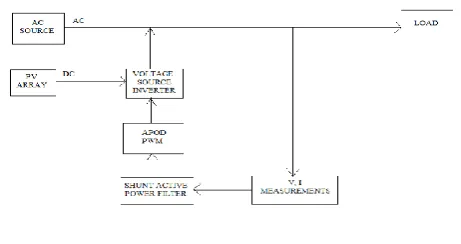
Fig -1: Block Diagram
The solar photovoltaic systems integrate a solar array and power electronics systems that allow perform the power conversion from the solar photovoltaic arrays to the electrical grid. In an isolated system, the system is connected directly to the loads. Generically this system integrates a dc-dc power converter and a dc-dc-ac power converter. The Active Filters are the latest development of interfacing devices between distribution supply grid and the consumer appliances to overcome voltage/current disturbances and to improve the power quality by compensating the reactive and harmonic power generated or absorbed by the load.
The shunt active filter is used for the integration of grid with the solar PV for the harmonic reduction. The harmonics is produced during the conversion of the DC power to AC supply as there are AC and DC grids present in the system. The power produced from the solar is DC supply is converted into the AC by inverters. The AC which is produced cannot be feed directly into the grid as there exists some amount of harmonics in the system. The shunt active filter is used to reduce the harmonic and then the power is feed into the grid.
3.2 SOLAR PHOTOVOLTAIC
Photovoltaic or solar cells, at the present time, furnish one of the most-important long- duration power supplies. This cell is considered a major candidate for obtaining energy from the sun, since it can convert sunlight directly to electricity with high conversion efficiency. It can provide nearly permanent power at low operating cost, and is virtually free of pollution. Since a typical photovoltaic cell produces less than 3 watts at approximately 0.5 volt dc, cells must be connected in series-parallel configurations to produce enough power for high-power applications. Cells are configured into module and modules are connected as arrays. Modules may have peak output powers ranging from a few watts, depending upon the intended application, to more than 300 watts. Typical array output power is in the 100-watt-kilowatt range, although megawatt arrays do exist.
Photovoltaic cells, like batteries, generate direct current (DC), which is generally used for small loads (electronic equipment). When DC from photovoltaic cells is used for commercial applications or sold to electric utilities using the electric grid, it must be converted to alternating current (AC) using grid inverters, solid-state devices that convert DC power to AC.
3.3 SHUNT ACTIVE FILTER
Shunt active power filters have been volts; peak positive volts; zero volts; peak negative volts and then zero volts. This sequence is repeated. The resultant wave very roughly resembles the shape of a sine wave. Most inexpensive consumer power inverters produce a modified sine wave rather than a pure sine wave.
The waveform in commercially available modified-sine-wave inverters resembles a square wave but with a pause during the polarity reversal. Switching states are developed for positive, negative and zero voltages. Generally, the peak voltage to RMS voltage ratio does not maintain the same relationship as for a sine wave. The DC bus voltage may be actively regulated, or the "on" and "off" times can be modified to maintain the same RMS value output up to the DC bus voltage to compensate for DC bus voltage variations.
[image:2.595.40.271.299.421.2]© 2019, IRJET | Impact Factor value: 7.211 | ISO 9001:2008 Certified Journal | Page 274
RMS voltage while maintaining a constant frequency with atechnique called pulse width modulation (PWM). The generated gate pulses are given to each switch in accordance with the developed pattern to obtain the desired output. Harmonic spectrum in the output depends on the width of the pulses and the modulation frequency. When operating induction motors, voltage harmonics are usually not of concern; however, harmonic distortion in the current waveform introduces additional heating and can produce pulsating torques.
3.4
Modelling Electrical Power Systems
With Sim Power Systems a model of a system is built just as the physical system. The components in the model are connected by physical connections that represent the ideal conduction paths. This approach describes the physical structure of the system rather than deriving and implementing the equations for the system. From the model, which closely resembles a schematic, Sim Power Systems automatically constructs the differential algebraic equations (DAEs) that characterize the behavior of the system.
3.5 Simulation Result
The output current and the output voltage of the grid integrated single phase PV with shunt active filter based control for distributed system is given below.
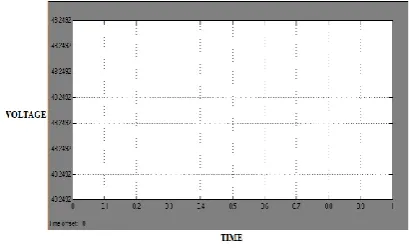
Fig -2: Output Voltage
The main purpose of this proposed system is to reduce the harmonics which is produced in the system by the help of introducing shunt active power filter.
[image:3.595.322.554.101.229.2]In the output waveform of the current which is
Fig -3 Output Current
[image:3.595.331.533.372.503.2]given below is maximum at the starting and after the specified timing the amplitude of the current is reduced as the harmonics which was present in the circuit is eliminated. Initially the value of the current is 240 and the triggering pulse is got the harmonics is reduced to the 6.5. The harmonics is produced due to the presence of power electronic drives present in the system.
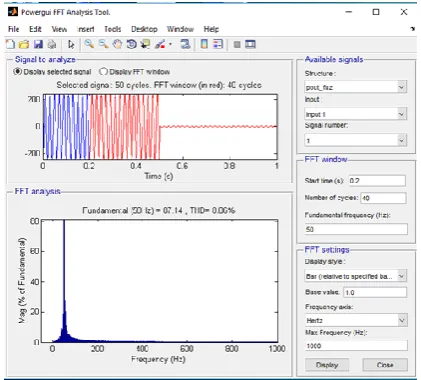
Fig -4 Harmonic Waveform
The total harmonics distortion of this proposed system is 0.06% and the fundamental frequency is 87.14. The system is more advantages as the harmonics which is produced is reduced upto an extend.
[image:3.595.57.267.512.671.2] [image:3.595.350.555.602.726.2]© 2019, IRJET | Impact Factor value: 7.211 | ISO 9001:2008 Certified Journal | Page 275
The experimental results have shown the [image:4.595.55.265.190.326.2]effectiveness of the feedback and feedforward control methods which are also easy to implement. Asa result, the advantages listed above shows that especially for large power applications, hybrid powerfilters are seem to be an appropriate solution.
Fig - 6 Voltage Across The Load
The x-axis of the current waveform is time and the y-axis is the value of current. The value of current is 2.5 at the starting and after the triggering pulse is given the value rises to 6. The x-axis of the voltage waveform is time and the y-axis is the measured voltage. The value of voltage is 0 at first and after the trigger pulse is given the 240 volt is obtained.
Fig-7 Total Harmonic Distortion
The x-axis of the voltage waveform from the PV is time and the y-axis is the voltage. The value of the voltage is 48.29 constant DC output. The x-axis of the harmonic waveform is time and the y-axis is the harmonic value. The value of the harmonic is 4.5 at the starting and after the pulse is given the harmonic is reduced to 2. The x-axis of
the voltage waveform across the load is time and the y-axis is voltage. The value of the output voltage is 240 volts. Thus the desired output is been obtained. The purpose of the project is to reduce the harmonic which is produced due to the presence of power electronic devices in the system.
4. CONCLUSIONS
In this project the conventional passive filter is replaced by shunt active filter for the reduction of harmonics which is produced while integration of grid with the solar photovoltaic. The real and reactive power is compensated in large distribution and transmissionsystems interfacing of renewable energy sources with the utility. It gives better performance like unity power factor, minimum currentTHD. The harmonics is produced during the conversion of dc power to ac power. The system will be efficient only when the harmonics produced is of lower value or lower order. The operation of grid integrated single phase PV with shunt active filter based control for distributed system is developed and output is verified by using MATLAB/SIMULINK model.
The proposed topology is verified through the result obtained. Theproposed topology is very suitable for small scale, the large scale systems such as generation, industrial and domestic applications. In this proposed work maintained power quality improvement like totalharmonic distortion (THD) and power factor.
REFERENCES
[1] Ahmad Khan, Lazhar Ben-Brahim, Adel Gastli, Nasser AI-Emadi “Electrolytic Capacitor-less Dual Buck Inverter with CM and DM Active Resonance Damping Control for NonIsolated Grid-Connected PV Applications” IEEE Transactions On Energy Conversion, Vol. 20, No. 2, March 2018.
[2] Angel Molina-Garcia, Javier Guerrero-Perez, Maria Carmen Bueso, Mathieu Kessler and Emilio Gomez-Lazaro “A New Solar Module Modeling for PV Applications Based on a Symmetrized and Shifted Model” IEEE Transactions On Energy Conversion, Vol. 30, No. 1, March 2015.
[image:4.595.56.267.465.655.2]© 2019, IRJET | Impact Factor value: 7.211 | ISO 9001:2008 Certified Journal | Page 276
Technology Engineering & Management (ICONSTEM)IEEE 2017.
[4] Bidyadhar Subudhi, and Raseswari Pradhan “A Comparative Study on Maximum Power Point Tracking Techniques for Photovoltaic Power Systems” IEEE Transactions On Sustainable Energy, Vol. 4, No. 1, January 2013.
[5] Bhim Singh, Chinmay Jain, and Sagar Goel “ILST Control Algorithm of Single-Stage Dual Purpose Grid Connected Solar PV System” IEEE Transactions On Power Electronics, Vol. 29, No. 10, October 2014.
[6] Bhim Singh, and Shailendra Kumar “Grid Integration of 3P4W Solar PV System Using M-LWDF Based Control Technique” IET Renewable Power Generation 2017.
[7] Chandan Kumar, and Mahesh K. Mishra “A Voltage-Controlled DSTATCOM for Power-Quality Improvement” IEEE Transactions on Power Delivery IEEE 2017.
[8] H. H. Dam, A. Cantoni, S. Nordholm, and K. L. Teo “Digital Laguerre Filter Design With Maximum Passband-to-Stopband Energy Ratio Subject to Peak and Group Delay Constraints” IEEE Transactions on Circuits and Systems—I: regular papers, vol. 53, no. 5, May 2006.
[9] A. Elallali*, A. Abouloifa. C. Taghzaoui, Y.Mchaouar, A. Hamdoun, I. Lachkar “Nonlinear Control of a Single Phase Shunt Active Filter Connected Photovoltaic Systems via Sliding Mode” 2018 5th International Conference on Electrical and Electronics Engineering IEEE 2018