© 2019, IRJET | Impact Factor value: 7.211 | ISO 9001:2008 Certified Journal
| Page 1586
Library Management Using RFID
Padmaj P kumar
*1, Najiya Masood
*2, Sooraj Kumar S
*3, Jismi Rajan
*4, Lijesh L
*51
Student, Dept. of Electronics & Communication Engineering, Musaliar College of Engineering & Technology,
Pathanamthitta, Kerala, India.
2
Student, Dept. of Electronics & Communication Engineering, Musaliar College of Engineering & Technology,
Pathanamthitta, Kerala, India.
3
Student, Dept. of Electronics & Communication Engineering, Musaliar College of Engineering & Technology,
Pathanamthitta, Kerala, India.
4
Student, Dept. of Electronics & Communication Engineering, Musaliar College of Engineering & Technology,
Pathanamthitta, Kerala, India.
5
Associate Professor, Dept. of Electronics & Communication Engineering, Musaliar College of Engineering &
Technology, Pathanamthitta, Kerala, India.
---***---
Abstract - Radio Frequency Identification (RFID) is a new
generation of Auto Identification and Data collection technology which helps to automate business processes and allows identification of large number of tagged objects like books, using radio waves. RFID based Library Management system (LMS) would allow fast transaction flow for the library and will prove immediate and long term benefits to library in traceability and security. The proposed system is based on UHF RFID readers, library cards containing RFID-transponders which are able to electronically store information that can be read / written even without the physical contact with the help of radio medium. The RFID based LMS facilitates the fast issuing, reissuing and returning of books with the help of RFID enabled modules. It directly provides the book information and library member information to the library management system and does not need the manual typing. The searching module provides the fast searching of books using smart shelf, the physical location of the books can be easily located using the proposed smart shelf containing the gantry system. The user interface can be used to search the location of the particular book, relevant details about the book. This project hence reduces the overall time one spends in a libraryKey Words: Library Management, Smart shelf, gantry
system, RFID Reader, Self-checkout, Processing, GUI, stepper motor
1. INTRODUCTION
RFID (Radio Frequency Identification) is that the latest technology to be used in library. Unlike EM (Electro-Mechanical) and RF (Radio Frequency) systems that are utilized in libraries for many years RFID-based systems move on the far side security to become chase systems that mix security with a lot of economical pursuit of materials throughout the library, together with easier and quicker charge and discharge, stocktaking, and material handling.
RFID may be a combination of radio-frequency-based technology and microchip technology. The information contained on microchips within the tags pasted to library materials is scan exploiting frequency technology despite item orientation or alignment and distance from the item is not a vital issue except within the case of extra-wide exit gates.
A unique advantage of RFID systems is their ability to scan books on the shelves while not tipping them out or removing them. A Gantry system fitted with RFID reader can be moved rapidly across a shelf of books to read all of the unique identification information. Using wireless technology, it's doable not solely to update the inventory, however additionally to spot things that are out of correct order.
2. GENERAL BACKGROUND
A library may be an assortment of knowledge, sources, resources, books, and services, and also the structure within which it's housed.
Apart from books several libraries square measure currently additionally repositories and access points for maps, prints, or alternative documents on numerous storage media like microform (microfilm/microfiche), audio tapes, CDs, LPs, cassettes, videotapes, and DVDs. Libraries have materials organized during a mere order per a library system, in order that things is also situated quickly and collections is also browsed with efficiency.
© 2019, IRJET | Impact Factor value: 7.211 | ISO 9001:2008 Certified Journal
| Page 1587
The proposed gantry system along with the librarymanagement system can effectively track the actual location of the book in the library and display the necessary data on GUI.
3. LITERATURE REVIEW
Researchers have implemented many methods for library management using RFID technology many variations can be found where they have employed different techniques for effective management. Most of them have a recurring fault in them that, there is no perfect system for actual tracking of the book in the library and to display the location of the book in the GUI. Some of the notable research papers are as below we tried to combine each and every on eliminating the disadvantages of each
Anastasis C. Polycarpou , Theodoros Samaras , and John N. Sahalos [1] An intelligent Library Management System (LMS) based on Radio Frequency Identification (RFID) was built as a pilot project for the university library. A Graphical User Interface (GUI) was carefully designed to support all necessary library functionalities and user needs. Different types of shelf antennas were designed and fabricated aiming at 100% tag readability in a low-SAR environment for the library users. Prototype smart cabinets were built and tested using different types of near-field shelf antennas ensuring confined coverage in the vicinity of the shelf, thus avoiding unwanted identification of books residing at nearby shelves. SAR simulations were performed in the presence of human phantom models positioned at a close distance to the cabinet. The shelf antennas were optimized in such a way as to maximize tag readability and minimize electromagnetic pollution in the vicinity of the cabinet.
Dhanalakshmi M, Uppala Mamatha[2]Radio Frequency Identification (RFID) is a new generation of Auto Identification and Data collection technology which helps to automate business processes and allows identification of large number of tagged objects like books, using radio waves. RFID based Library Management system (LMS) would allow fast transaction flow for the library and will prove immediate and long term benefits to library in traceability and security. The proposed system is based on UHF RFID readers, supported with antennas at gate and transaction sections, and library cards containing RFID-transponders which are able to electronically store information that can be read / written even without the physical contact with the help of radio medium. This paper presents the experiments conducted to set up RFID based LMS.
Sree Lakshmi Addepalli, Sree Gowri Addepalli[3] Radio frequency identification (RFID) is a rapidly emerging technology which allows productivity and convenience. Radio Frequency Identification (RFID) is a new generation of Auto Identification and Data collection technology which helps to automate business processes and allows
identification of large number of tagged objects like books, using radio waves. This paper proposes RFID Based Library Management System that would allow fast transaction flow and will make it easy to handle the issue and return of books from the library without much intervention of manual book keeping which benefits by adding properties of traceability and security. The proposed system is based on RFID readers and passive RFID tags that are able to electronically store information that can be read with the help of the RFID reader. This system would be able to issue and return books via RFID tags and also calculates the corresponding fine associated with the time period of the absence of the book from the library database
Mr. Chaithanya Kadari, Dr. Ch GVN Prasad [4] : A library is a growing organism. As it grows in size the problems associated with the maintenance and security of the documents also grows. The researchers have always helped the librarian in solving their problems. To solve the problems of searching documents they have given cataloguing guidelines. Bar-codes have served the librarians and libraries for a long time, and now it is slowly getting replaced by RFID. Radio Frequency Identification (RFID) is a new generation of Auto Identification and Data collection technology which helps to automate business processes and allows identification of large number of tagged objects like books, using radio waves. RFID based Library Management System (LMS) would allow fast transaction flow for the library and will prove immediate and long term benefits to library in traceability and security. The proposed system is based on Ultra High Frequency(UHF) RFID readers, supported with antennas at gate and transaction sections, and library cards containing RFID-transponders which are able to electronically store information that can be read / written even without the physical contact with the help of radio medium. This paper presents the technology implementation, features, the experiments conducted to set up RFID based LMS, possible problems of RFID in Library.
© 2019, IRJET | Impact Factor value: 7.211 | ISO 9001:2008 Certified Journal
| Page 1588
sight, it remove manual book keeping of records, improvedutilization of resources like manpower, infrastructure etc.
4 METHEDOLOGY
The main implementation of the Paper is divided into two parts where one part is for the RFID reader enabled book issue station where the user can gain access to the database through the interactive GUI and find the necessary information including the book location, book availability, user data etc. Another part is where the gantry system along with the RFID reader is employed to scan the actual location of the book and store this data on to the database which can be later accessed by the first module to access the necessary data
4.1 GUI design
[image:3.595.342.524.156.617.2]Graphic user interface is needed so that the student can access the database and login using there id card and find the information about their desired book. The software used for developing the GUI for this paper is Processing the user interface is a simple one which is rather simple compared to all the other GUI developing programs, Processing is an open-source graphical library and integrated development environment which can be used to create GUI’s. Fig 1 shows First page will be prompting the user to swipe there RFID card to gain access to the system
Fig – 1 Home pageof the Library management system
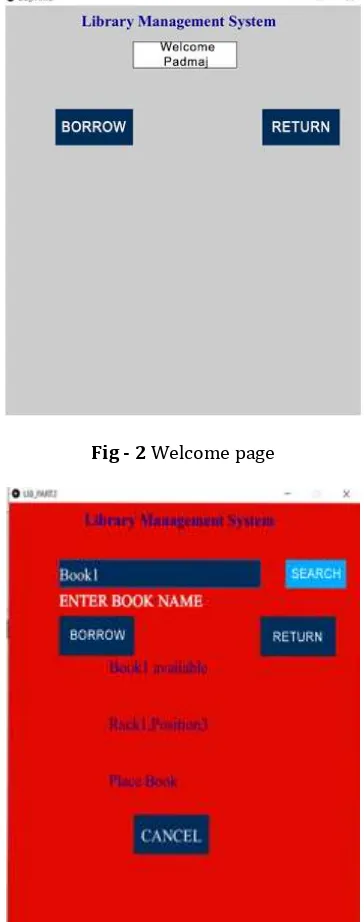
After the student swipes the id card they are prompted if they want to borrow a book or return a book it is shown in fig 2
[image:3.595.345.524.401.632.2]Fig - 2 Welcome page
Fig – 3 Selection page
[image:3.595.68.256.437.664.2]© 2019, IRJET | Impact Factor value: 7.211 | ISO 9001:2008 Certified Journal
| Page 1589
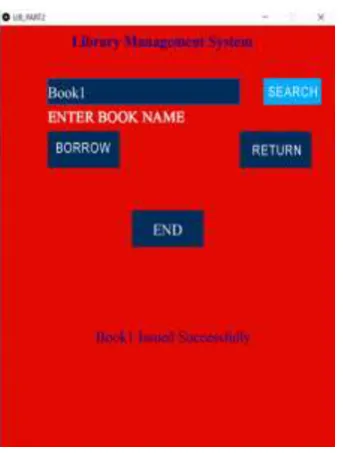
Fig – 4 Book issuing page
Finaly after taking the book from the displayed location the student should place the book in the counter and it will added to the student’s account it is shown in fig 4
If the student were to return the book they will have to press return option, this GUI is a very crude design only containing the necessary details for displaying the location which can later be modified, our main part of the project is the gantry system
4.1 Gantry System
A gantry robot consists of a manipulator mounted onto an overhead system that allows movement across a horizontal plane. Gantry robots are also called Cartesian or linear robots. A Cartesian coordinate robot (also called linear robot) is an industrial robot whose three principal axes of control are linear (i.e. they move in a straight line rather than rotate) and are at right angles to each other. The three sliding joints correspond to moving the wrist up-down, in-out, back-forth. Cartesian coordinate robots with the horizontal member supported at both ends are sometimes called Gantry robots; mechanically, they resemble gantry cranes, although the latter are not generally robots. Gantry robots are often quite large. They consist of a pair of stepper motors along with limit switch’s for identifying the end of each row and column the moving head is attached with a RFID reader so that the tags from the books can be stored onto the database and can later recovered from it.
The proposed gantry system is attached to the shelf and the scanning process is initiated when the user presses the
scanning button, it will continue to scan the whole shelf until the whole shelf has been scanned.
Fig - 5 Gantry system attached to the shelf
The proposed gantry system is made from steel which has a dimension of 100cm across and 80cm downwards. The steel used has a diameter of 1.5 cm. The gantry system is powered by a pair of nema 17 stepper motor for each axis , a4988 driver IC is used to drive the stepper motor, all the movement of the gantry system is governed by a arduino nano where the program is loaded
[image:4.595.320.548.132.349.2]Interfacing of the stepper motor with arduino and switches is shown in fig 6
[image:4.595.324.541.559.745.2]© 2019, IRJET | Impact Factor value: 7.211 | ISO 9001:2008 Certified Journal
| Page 1590
The motor is driven by 12v dc power source 4 limit switches [image:5.595.45.276.165.321.2]are added in total to ensure proper motion of the gantry system the circuit diagram for the same is shown below
Fig - 7 Circuit diagram for interfacing switching
As the program for the motor is initialised simultaneously program for the EM 18 reader module is also started and the location is updated in the excel sheet. This updation is done through a program called PLX-DAQ
[image:5.595.342.525.227.450.2]
Fig - 8 Excel updation
Fig 9 shows the RFID reader head which is connected to the moving head of the gantry system which continuously reads the RFID cards and updates the excel sheet which will act as the database. The action of the limit switch being pressed
with trigger the program to execute the next program and scan the shelf it is being depicted in fig 10.There are in total 4 switches which enable the motion throughout the racks, subsequently when the no of racks is increased the number of switches has to be increased so as to facilitate scanning process. Torque from the motors is transferred using timing belts which has a width of 5mm which is reinforced with Kevlar cores to add extra strength to the belt they are attached to pullies which will allow smooth motion to the whole gantry system.
[image:5.595.36.279.411.685.2]Fig - 9 RFID reader attached to the gantry head
[image:5.595.343.523.495.708.2]© 2019, IRJET | Impact Factor value: 7.211 | ISO 9001:2008 Certified Journal
| Page 1591
Fig - 11 Limit Switch being triggered
5 INTERFACING
Two arduino’s are used so that one can be used to control the gantry system and other can be used for the GUI and other functions .The overall block diagram is shown in fig 12
Fig - 12 Block diagram
Arduino 1 will act as the master controller which will store the GUI program along with the RFID reader program. The program is developed in Arduino IDE which is an open source development platform. Issue site RFID reader is provided for the user to swipe the RFID card, after that a message is initiated to the 2nd slave arduino which will
search through the database for the particular book and if
the book is available then the location will be displayed in the GUI page. Program for the Gantry system is also developed through the arduino IDE. Stepper motor is controlled by a4988 IC which has mainly 2 inputs which control the step and direction of the stepper motor.12 v DC supply is needed for each of the stepper motor this power is given through the IC which also have surge protection capabilities.
6 RESULTS AND CONCLUSION
From the numerous test runs we came to the conclusion that using this proposed system we can decrease the overall time spent by an user in library searching for a particular book, with further development in the GUI system more options can be added so that the librarian can have efficient stock management options like previous transactions of a book, and if in the place of second arduino a Wi-Fi enabled microcontroller is used instead of excel updating we can update Google sheets etc. through which a web portal can be designed to access the GUI. The proposed gantry system proved to be effectively reducing the time required by the librarian to run stock checks in the library. It also significantly increased the transaction time of the library for borrowing, returning books in the library and since a self-checkout kiosk can be equipped in the library the library staff can divert their time for user services.
ACKNOWLEDGEMENT
We express our gratitude for the staffs and officers of keltron, Trivandrum, kerala, india for extending their services and providing advices in successfully completing this paper work.
REFERENCES
[1] Polycarpou, A. C., Samaras, T., & Sahalos, J. N. (2014). An RFID-based library management system using smart cabinets: A pilot project. The 8th European Conference on Antennas and Propagation(EuCAP2014).doi:10.1109/eucap.2014.6902447
[2] Dhanalakshmi M, Uppala Mamatha RFID Based Library Management System https://gaorfid.com/RFID-PDF/RFID-based-Library-Management-System.pdf
[3] Sree Lakshmi Addepalli, Sree Gowri AddepalliSree Lakshmi Addepalli et al, / (IJCSIT) International Journal of Computer Science and Information Technologies, Vol. 5 (6) , 2014, 6932-6935
[image:6.595.54.278.396.655.2]© 2019, IRJET | Impact Factor value: 7.211 | ISO 9001:2008 Certified Journal
| Page 1592
computer science volume 2,No. 2,Mar-Apr 2011 ISSN No.0976-5697
[5] Dr.Annaraman , P. Thamarai, Dr. T.V.U. Kiran Kumar Smart Library Management System using RFIDInternational Journal of Advanced Research in Electrical, Electronics and Instrumentation EngineeringVol. 4, Issue 4, April 2015ISSN (Print) : 2320 – 3765
[6] Cheng Feng, Research for Application of RFID in Library, 978-1-4244-6947-5/10 ©20l0 IEEE
[7] A.Fennani and H. Hamam, an Optimized RFID-Based Academic Library, 978-0-7695-3330-8/08 © 2008 IEEE.
[8] Paul Golding and Vanesa Tennant, Performance and Reliability of Radio Frequency Identification (RFID) Library System, 0-7695-2777-9/07 © 2007 IEEE
[9] Kiyotaka FUJISAKI, An RFID-based System for Library Management and Its Performance Evaluation, 978-1-4799- 8870-9/15 © 2015 IEEE.