© 2019, IRJET | Impact Factor value: 7.211 | ISO 9001:2008 Certified Journal | Page 3668
Proactive Neighbor Knowledge-based Hybrid Broadcasting in
MANET
M. Deshmukh
1, S. Kakarwal
21
Research Scholar, Computer Science Department, Dr. B.A.M University, Maharashtra, India.
2
Professor, Computer Science and Engineering Department, PES College of Engineering, Maharashtra, India.
---***---Abstract -
In recent years, the mobile ad-hoc network(MANET) have become apparent due to its wide applicability in the field of disaster recovery, police operations, crowd management, emergency and military operations such as battle-fields, etc. The mobile ad-hoc network is an infrastructure-less adaptive decentralized system consisting of mobile nodes. In order to establish connectivity among the mobile nodes, each node acts as router to achieve routing operation in MANET. Therefore, routing in MANET is an interesting operation. Most of the routing protocols used flooding as the basic broadcasting mechanism for routing in MANET. Flooding causes redundant broadcasts in the network which leads to performance degradation. Another issue affecting the performance of the network is the link-failure problem caused by link instability and power exhaustion of mobile nodes. In this paper, we introduce a proactive neighbor knowledge-based hybrid broadcasting scheme to address these network challenges of MANET by reducing the routing overhead and achieving energy consumption. The simulation results reveal that proposed schemes decreases reduce routing overhead and energy consumption of network by achieving good packet delivery when compared to Ad-hoc on-demand distance vector and Adaptive neighbor knowledge-based broadcast routing protocol.
Key Words: MANET, neighbor knowledge-based schemes, broadcasting, routing, etc…
1. INTRODUCTION
The mobile ad-hoc networks consists of constantly moving, batter powered wireless mobile nodes. In the absence of infrastructure, these mobile nodes acts as router to provide connectivity among the mobile nodes, producing alternative routes from source to the destination over a period of time. The traditional routing protocols are not applicable for MANET routing operation due to arbitrarily evolving and indefinite behavior of MANETs. Hence routing becomes more challenging operation in MANET [1]. In general, the MANET routing protocols can be classified as reactive or proactive [2]. In reactive routing protocols, routes are established whenever required. The Ad-hoc On-demand Distance Vector Routing (AODV) Protocol and Dynamic Source Routing (DSR) protocol are the reactive routing protocols. Proactive routing protocols are commonly known as table driven protocols such as Destination Sequenced
Distance Vector Routing (DSDV). In proactive routing protocols, alternatives routes are established once a node needs to send data as a source node and selects the most optimized route to transmit the data. Uttermost routing protocols use flooding as a fundamental broadcasting operation for route discovery. Flooding performs neighborhood processing by broadcasting the acquired packet to neighborhood nodes until it reaches to the destination node. It is a very elegant approach to implement route discovery in mobile ad-hoc networks but suffers from broadcast storms [3][4]. MANETs also have limitations of restricted communication range and link-failures due to node instability and power exhaustion of mobile nodes.
The instability of the mobile nodes leads to the changing network topologies of MANET that enables the mobile nodes to be either thickly connected or thinly connected. Consequently, the MANETs are classified as the dense network and the sparse network. As mobile nodes are battery powered, nodes may run out of their energy quickly to cause partitioning of the network ensuring packet loss and link failure in the dense network. The link-failures due to instability of mobile nodes can be inhibited by taking into account the power consumption of the nodes to forward packets from source to destination. In the sparse networks, owing to limited transmission range very few nodes act as intermediate nodes and instability of these intermediate mobile nodes may lead to link-failure in the network, which decreases packet delivery. Hence, the route selection are explored to consider stability of mobile nodes in the sparse networks.
Motivated by addressing the issues of routing in MANET, we primarily bring the following contributions in this research study:
© 2019, IRJET | Impact Factor value: 7.211 | ISO 9001:2008 Certified Journal | Page 3669
energy consumption, routing overhead and packet deliveryratio.
The remainder of this paper is organized as follows. Section 2 provides general idea of related work about broadcast schemes. Section 3 proposes a proactive neighbor knowledge based hybrid broadcasting (PNKHB) scheme to enrich the performance of the network. Section 4 summarizes the performance evaluation through simulations using network simulator. Section 5 summarizes the paper to conclude.
2. RELATED WORK
In the recent years, a lot of research has been carried to manage the issues of flooding in MANET. On the way to manage link-failures, there are some major research contributions that are discussed in this section. There are some schemes that depend on the link stability to select stable routes to improve performance of MANET. Some of these methods rely on the received signal’s strength as in signal stability-based (SSA) adaptive routing [6]. A nodes signal strength from the other nodes is used as metric to estimate the link stability of the nodes. A stability of the link of two nodes is considered as stable, if a node receives strong signal from a neighbor node. ABR proposed in [7] rely on the associativity among the nodes to represent the degree of the link stability. ABR improves the average route survival time. As the routes selected are long-lived routes, the need of reconfiguration of routes decreases which leads to achievable throughput. In [8], authors focused on the link stability and the lifetime of a route to find a route with longer lifetime.
In [9], route stability and energy aware QoS (REAQ) routing protocol is proposed which calculates the reliability factor to consider the stability and the residual energy satisfying the objectives to minimize the bandwidth and to maximize the delay. This reliability factor is used as metric to select the route. The link with least bandwidth and maximum delay can be chosen for the data transfer between the mobile nodes. The stable path routing protocol based on the inverse of the predicted link expiration times (SILET) assigns weights of to each links through GPS and chooses the least weight route to find long-life time of the network [10]. In [11], the protocol considers the link stability and energy as measure to find best route during route discovery. In VANET, as mobility is not strictly random, the link-stability is estimated based on positions of the nodes which increases the availability of the route to improve the longevity of the network.
The novel link stability and energy aware routing (NLSEA)[12] scheme choose the routes with high stability during route discovery focusing link-stability and energy information of the mobile nodes. In the route maintenance,
NLSEA predicts the link-failure probability by the use of the position information of the mobile nodes. The objective of NLSEA is to improve the network lifetime and balance network traffic. In [13], the authors proposed advance velocity aware probabilistic (AVAP) routing scheme which is one of the probabilistic approach to routing in MANET. Their approach considers the velocity vector of the mobile node to dynamically set up the rebroadcast probability and in the view of that categorizes the reliability of the mobile nodes. They focused on balancing of the network traffic to improve the performance and to relieve the congestion in the network. These schemes are introduced in the literature to offer an optimized solution to broadcasting and to extend networks lifetime by focusing on the link stability.
3. IMPLEMENTATION DESIGN
This section gives formal description of the proactive neighbor knowledge-based hybrid broadcasting algorithm. AODV and DSR are reactive on-demand routing protocol well suited in MANET. Though, these protocols uses flooding and selects the shortest path as a route during route discovery without focusing on the stability and energy consumption of mobile nodes. We proposes a PNKHB which is a partial proactive routing scheme. In general, proactive schemes establishes the multiple routes in advance for all source-destination pairs within the network and maintains dynamic updates to the routes periodically. More specifically, PNKHB builds the route only when source needs to send the data and selects the best route with the highest performance coefficients.
The PNKHB aims to reduce routing overhead of the network by the use of neighbor knowledge, power information along with the link failure probabilities. For each nodes in the one hop neighbor list, the routing table entry is formed directly. While forming the routing table entry for the second hop and multi-hop neighbors, the corresponding forwarder node is selected by checking the neighbor connectivity, the power along with the link connection and disconnection probability.
© 2019, IRJET | Impact Factor value: 7.211 | ISO 9001:2008 Certified Journal | Page 3670
Assuming the nodes are battery-powered and gets depletedduring the broadcast process, the route performance coefficient (RQ) is defined to select the route to improve the performance of the network. The route performance coefficient for each hops in the route of the routing table with entries (n_count) can be estimated as given in equation (1) from the power drain rate coefficient (Dr) and the residual power degree (Rd) along with the link-failure degree (Lb) as reference parameters. A route with the highest (RQ) can be selected and a reply is unicasted to the source node.
RQ = Min (1)
The power drain rate (Dr) can be taken to imply the power consumption rate of one node. The power drain rate (Dr) for the unit time period can be estimated by comparing the ratio of power accumulation rate (Ra) to the residual power degree (Rd) with the threshold. The power drain rate (Dr) can be used to select final route to exclude nodes with high power drain rates. The residual power degree (Rd) can be taken to signify the residual power. The link-failure degree (L) can be used as measure to estimate link stability of each link on the route to the destination by taking link-connected (Pc) and link-unconnected (Puc) probabilities. The links with low link-connected probabilities (Pc) than link-unconnected probabilities (Puc) are extremely stable links and makes final route extremely stable. The links with high link-connected probabilities (Pc) than link-unconnected probabilities (Puc) are extremely unstable links and are excluded from the final route.
4. PERFORMANCE EVALUATION
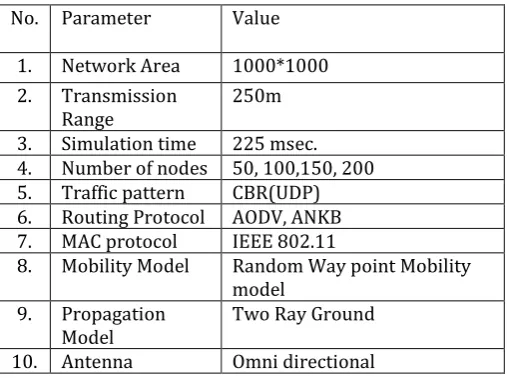
The aim of this section is to evaluate the performance of our proposed proactive neighbor knowledge-based hybrid broadcasting (PNKHB) with Ad-hoc on-demand distance vector (AODV) and Adaptive neighbor knowledge-based broadcast (ANKB) scheme using the NS-2 Simulator (NS-2.34). The performance of the proposed protocols for mobile ad-hoc networks is evaluated in network simulator (ns-2). The simulation parameters used for the evaluation of proposed protocols are listed in table 4.1. The constant transmission range of the network is 250 meters. The MAC layer scheme follows the IEEE 802.11 MAC specification. Each mobile node in MANET follows the random waypoint model to decide the movement pattern of them. The two-ray ground reflection model used for experimenting the routing protocols performs propagation to consider both the direct path and a ground reflection path. The omnidirectional antenna used to configure the transceiver of MANET. The size of the network has been taken as 1000*1000. The simulation experiments runs for 225 msec. over the varied network densities (50, 100, 150, 200).
The following measures are evaluated to measure the effectiveness of PNKHB over AODV and ANKB.
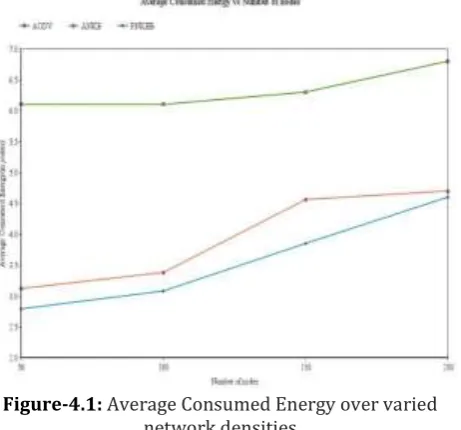
Average Consumed Energy: defines the difference between the current and initial energies of all nodes during the simulation. This measure accounts for energy spent in transmission and reception of the packets. The average consumed energy provides accurate information about the energy consumed by the nodes involved in packet transmissions and receptions.
Delay: represents the total time required by a packet to move from the source to the destination. The link failure in networks incurs delay in networks as more time spent on route maintenance of the network.
Packet delivery ratio: represents the number of data packets that are successfully delivered to the destination. This measure is computed as the ratio of the number of received data packets by each destination to the number of data packets sent from each source.
[image:3.595.308.562.369.558.2] Normalized Routing Overhead: defines the ratio of the control packets to all delivered packets. The continuous changing position of the mobile nodes has an impact on the routing overhead of the network.
Table -1: Simulation Parameters
No. Parameter Value
1. Network Area 1000*1000
2. Transmission
Range 250m
3. Simulation time 225 msec. 4. Number of nodes 50, 100,150, 200
5. Traffic pattern CBR(UDP)
6. Routing Protocol AODV, ANKB
7. MAC protocol IEEE 802.11
8. Mobility Model Random Way point Mobility model
9. Propagation
Model Two Ray Ground
10. Antenna Omni directional
4.1. Simulation Results
© 2019, IRJET | Impact Factor value: 7.211 | ISO 9001:2008 Certified Journal | Page 3671
Figure 4.2 illustrates a graph of packet delivery ratio overvaried network densities. Basically, the main objective of the proposed scheme is to reduce link failure during route discovery, however, PNKHB achieves to increase the packet delivery ratio compared to ANKB and achieves significant enhancement compared to AODV. However, for the proposed schemes, the packet delivery ratio was constant due to the adaptation to network changes. The proposed schemes caused considerable incremental growth of 7% in the packet delivery ratio when with the AODV and ANKB routing protocol.
Figure-4.1: Average Consumed Energy over varied network densities
Figure-4.2: Packet Delivery Ratio over varied network densities
Figure 4.3 illustrates the graph of delay over varied network densities which revealed that there is significant reduction in delay by PNKHB by 68% as compared to the AODV and ANKB. In ANKB and PNKHB the delay has linearly increased in both sparse as well as dense networks. As opposed in
[image:4.595.48.280.244.677.2]AODV, in dense network, it has considerably increased. Indeed, PNKHB achieved considerable improvement by reducing the time required for the route discovery.
Figure 4.4 shows the graph of normalized routing overhead over varied network densities which showed that the routing overhead of AODV is very high. This is because AODV selects the shortest path as a route during route discovery without focusing on the stability and energy consumption of mobile nodes. The main objective of PNKHB is to reduce the routing overhead by the use of neighbor knowledge, power information along with the link failure probabilities. Indeed, PNKHB outperformed AODV in reducing the normalized routing overhead by an additional of 40%. Similarly the normalized routing overhead was increased by 2% in PNKHB scheme when compared to ANKB scheme.
Figure-4.3: Delayover varied network densities
[image:4.595.318.552.302.499.2] [image:4.595.47.281.474.674.2] [image:4.595.318.552.524.713.2]© 2019, IRJET | Impact Factor value: 7.211 | ISO 9001:2008 Certified Journal | Page 3672
4. CONCLUSION
This study addresses the issues of MANETs. In order to address the issues of MANET, we proposed a proactive neighbour knowledge hybrid broadcasting scheme. The PNKHB aims to reduce routing overhead of the network by the use of neighbor knowledge, power information along with the link failure probabilities. In PNKHB, while forming the routing table entry for the second hop and multi-hop neighbors, the corresponding forwarder node is selected by checking the neighbor connectivity, the power along with the link connection and disconnection probability.The proposed scheme outperform over the ANKB and standard AODV protocol. The PNKHB scheme reduced the routing overhead by more than 40% compared to the AODV. Also it perform well by the approximate reduction of 2% when compared to ANKB. The proposed schemes not only attained routing overhead of the network rather than achieved low latency and energy consumption by enhancing the packet delivery.
REFERENCES
[1] Tarique, M., Tepe, K. E., Adibi, S., Erfani, S., “Survey of multipath routing protocols for mobile ad-hoc networks”, Journal of Network and Computer Applications 32(6), 2009. pp 1125–1143.
[2] E. M. Royer and C. K. Toh, “A review of current routing protocols for ad hoc mobile wireless networks,” IEEE Personal Communications, vol. 6, no. 2, April 1999, pp. 46-55.
[3] Sze-Yao Ni, Yu-Chee Tseng, Yuh-Shyan Chen, Jang-Ping Sheu, “The Broadcast Storm Problem in a Mobile Ad Hoc Network”, In: 5th annual ACM/IEEE international conference on Mobile computing and networking (MobiCom), ACM 1999.
[4] Rohit Dube, Cynthia D. Rais, Kuang-Yeh Wang, and Satish K. Tripathi, “Signal Stability-Based Adaptive Routing (SSA) for Ad Hoc Mobile Networks” IEEE Personal Communications Feb. 1997, pp 36-45.
[5]S. Kakarwal, M. Deshmukh, R. Deshmukh, “An Adaptive Neighbour Knowledge-based Hybrid Broadcasting for Emergency Communications”, International Conference on Computer Networks and Inventive Communication Technologies (ICCNCT), 23 May 2019, Coimbatore, India. [6] Yu-Chee Tseng, Sze-Yao Ni, En-Yu Shih, “Adaptive Approaches to Relieving Broadcast Storms in a Wireless Multi-hop Mobile Ad Hoc Network”, Transaction on Computers, vol 52, Issue 5, IEEE 2013, pp. 545-557. [7] C. K. Toh, “Associativity-based routing for ad hoc mobile networks,” Wireless Personal Communications, vol. 4, no. 2, March 1997, pp. 1-36.
[8] Geunhwi Lim, Kwangwook Shin, Seunghak Lee, H. Yoon, Joong Soo Ma, “Link Stability and Route Lifetime in Ad-hoc Wireless Networks”, Proceedings of the International Conference on Parallel Processing Workshops (ICPPW’02), IEEE, 21 Aug. 2002.
[9] P. Srinivasan and P. Kamalakkannan, “REAQ-AODV: Route stability and energy aware qos routing in mobile ad hoc networks,” in Proc. IEEE ICoAC’12, 2012, pp. 1-5.
[10] N. Meghanathan, “A unicast MANET routing protocol to simultaneously minimize the stability-hop count tradeoff and end-to-end delay,” in Proc. IEEE ICoIT’12, 2012, pp. 60-64.
[11] J. Hemmes, M. Fisher, and K. Hopkinson “Predictive routing in mobile ad-hoc networks,” in Proc. IEEE Computer Society, 2011, pp. 117-122.