SNSN-323-63 April 16, 2018
DUNE: Status and Perspectives
Dominic Brailsford, for the DUNE collaboration
Department of Physics
Lancaster University, Bailrigg, Lancaster, United Kingdom
The Deep Underground Neutrino Experiment (DUNE) provides a rich sci-ence program with a focus on neutrino oscillations and other beyond the standard model physics. The high-intensity, wide-band neutrino beam will be produced at the Fermi National Accelerator Laboratory (FNAL) and will be directed to the 40 kt liquid argon far detector at the Sanford Underground Research Facility, 1300 km from FNAL. The primary goals of the experiment are to determine the ordering of neutrino masses and to measure the CP violating phase,δCP. The underground location of the
large DUNE far detector and its excellent energy and spatial resolution will allow also for non-accelerator physics programs predicted by grand unified theories, such as nucleon decay or n—n oscillations. Moreover, DUNE will be sensitive to the electron neutrino flux from a core-collapse supernova, providing valuable information on the phenomenon’s underly-ing mechanisms. This ambitious project requires extensive prototypunderly-ing and a testing program to guarantee that all parts of the technology are fully understood and well tested. Two such prototypes, in both single phase (ProtoDUNE-SP) and dual phase (ProtoDUNE-DP) technologies, are under construction and will be operated at the CERN Neutrino Plat-form (NP) starting in 2018.
PRESENTED AT
NuPhys2017, Prospects in Neutrino Physics
Barbican Centre, London, UK, December 20–22, 2017
1
Introduction
The past century has seen a revolution in neutrino physics, with neutrino oscillations first confirmed within the past 20 years [1, 2, 3] now firmly entering the precision era. Neutrino oscillations rely on flavour mixing in which the three neutrino flavours are a linear combination of the three neutrino mass states, which are combined via a 3×3 mixing matrix. The matrix is typically parameterised in terms of three mixing angles (θ12, θ13, θ23) and a Charge Parity (CP) violating phase δCP. Additionally, the
neutrino oscillation phenomenon does not depend on the absolute mass scale but rather the neutrino mass squared difference ∆m2
ij ≡m2i −m2j.
While many experiments have pushed forward our understanding of the universe by studying neutrino oscillations, some key open questions need to be addressed by future Long BaseLine (LBL) oscillation experiments. Furthermore, a Far Detector (FD) in an LBL experiment (large active mass in a low background environment) is well suited to address certain key questions beyond neutrino physics. A broad cross section of these questions is:
• Charge Parity Violation (CPV) in neutrino oscillations - δCP is yet to
be measured. A CP non-conversing value of δCP (δCP 6= 0, π) would be the
first observation of CPV in the lepton sector; a requirement for leptogenesis. In some models, δCP can directly explain the matter-antimatter asymmetry [4]. • The neutrino Mass Ordering (MO)- Previous experiments have only
mea-sured the magnitude of ∆m2
23 therefore it is not known whether the third mass
state, ν3, is much heavier or much lighter than ν1,2. These scenarios are
re-spectively known as the Normal Mass Ordering (NMO) and the Inverted Mass Ordering (IMO).
• The octant of θ23- Previous experiments have measured degenerate values of
θ23 that are consistent with maximal mixing (θ23= 45◦). Such maximal mixing
may indicate an underlying symmetry of nature.
• Grand Unified Theories (GUT) - GUTs predict baryon number violating processes which are yet to be observed such as proton decay.
• Core-collapse supernova- What are the underlying mechanisms and how to neutrinos play a role?
2
The Deep Underground Neutrino Experiment
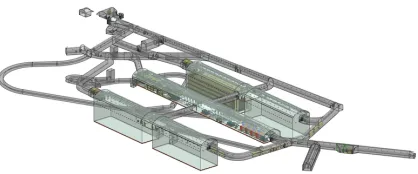
Figure 1: Schematic of the FD complex located on the 4850 level at SURF.
and aiming to address the key open questions outlined in section 1. The near site, located at the Fermi National Accelerator Laboratory (FNAL) (IL), will house the the Long Baseline Neutrino Facility (LBNF) neutrino beam and Near Detector (ND) complex. At the opposing end of the baseline, the far site in the Sanford Underground Research Facility (SURF) (SD) will house four 10 kt Liquid Argon Time Projection Chambers (LArTPCs) acting as FDs.
LBNF [7] will provide a GeV-scale, wide-band, highly pureνµbeam with an initial
power of 1.2 MW, upgradeable to 2.4 MW. Based on features of the NuMI neutrino beam [9] at FNAL, the target and horn system has been tuned via a genetic algorithm to maximise sensitivity to CPV. The beam is capable of operating in Forward Horn Current (FHC) and Reverse Horn Current (RHC) modes which preferentially selects
ν orν via reversal of the magnetic field in the focusing horns.
The role of the ND is to constrain the unoscillated neutrino interaction rate in the FD, reducing systematic uncertainties in the neutrino oscillation measurements. The ND will also provide a rich neutrino interaction cross-section measurement program. The ND, which will be housed 574 m from the LBNF target and∼60 m underground, will be a composite system and is under design, consisting of a LArTPC along with a Gaseous Argon (GAr) time projection chamber or a fine-grained straw tube tracker.
The FD complex, located 4850 ft underground at SURF and shown in Fig. 1, will house four 10 kt LArTPCs [8]. Two technologies are available for the FD modules; a reference design using Single Phase (SP) technology and an alternative Dual Phase (DP) design. The SP design consists of four horizontal drift regions per FD module flanked by opposing anodes and cathodes which maintain a 500 V/cm electric field. The anode is instrumented for ionisation electron readout and consists of three planes of wires. Conversely, the DP design consists of a single, vertical drift volume per FD module with a cathode on the module floor and an instrumented anode on the ceiling, maintaining a 500 V/cm electric field. Sandwiched between the Liquid Argon (LAr) surface and the anode is a GAr phase. The ionisation electrons are extracted from the LAr phase into the GAr phase and amplified by large electron multipliers. The amplified signal is then readout by the 2D segmented anode.
Year Number of installed
FD modules
Total mass of installed FD modules (kt)
LBNF beam power (MW)
Exposure at year end (kt MW yr)
1 2 20 1.07 21
2 3 30 1.07 54
4 4 40 1.07 128
7 4 40 1.07 300
10 4 40 2.14 556
Table 1: DUNE staged data-taking scenario. The scenario assumes a 50:50 time split between FHC and RHC LBNF beam running modes.
FD module planned for 2021. First data is expected in 2024 followed by LBNF neu-trino beam and ND availability in 2026. The technology used for each FD module is dependent upon the success of the ProtoDUNE program (see section 4) but both technologies are expected to be utilised.
3
Physics reach
CPV and the neutrino MO introduce an asymmetry between the neutrino and anti-neutrino oscillation probabilities which causes a measurement degeneracy. The mag-nitude of the MO-induced asymmetry increase with baseline length whereas the CPV-induced asymmetry is constant [10]. This degeneracy can be resolved for baselines longer than 1200 km which implies that DUNE, with a 1300 km baseline, can unam-biguously determine the MO and measure δCP.
The primary neutrino oscillation physics program of DUNE relies not only on mea-suring the oscillated energy spectrum of multiple samples of neutrino interactions in the FD but also measuring subtle differences between them. To establish the physics reach of DUNE prior to data-taking, a parameterised Monte Carlo (MC) simulation of the LBL physics program with GLoBES [11, 12] has been used to explore the key sensitivities of the experiment. This exploration is based on a staged construction scenario which assumes a 50:50 time split between FHC and RHC LBNF beam run-ning and is summarised in table 1.
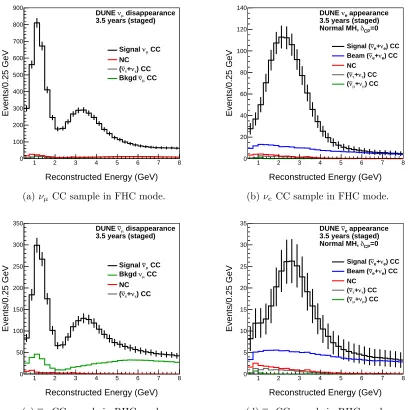
The parameterised MC (the Fast Monte Carlo simulation [5]) outputs selected Charged Current (CC) reconstructed spectra which are shown in Fig. 2 with applied oscillations using the NuFit 2016 [13] parameters. Each distribution shows what level of statistics would be expected after 3.5 years of data-taking in separate FHC and RHC LBNF beam running modes (seven years total).
Reconstructed Energy (GeV)
1 2 3 4 5 6 7 8
Events/0.25 GeV 0 100 200 300 400 500 600 700 800 900 CC µ ν Signal NC ) CC τ ν + τ ν ( CC µ ν Bkgd disappearance µ ν DUNE
3.5 years (staged)
(a)νµ CC sample in FHC mode.
Reconstructed Energy (GeV)
1 2 3 4 5 6 7 8
Events/0.25 GeV 0 20 40 60 80 100 120 140 ) CC e ν + e ν Signal ( ) CC e ν + e ν Beam ( NC ) CC τ ν + τ ν ( ) CC µ ν + µ ν ( appearance e ν DUNE
3.5 years (staged) =0
CP δ
Normal MH,
(b)νeCC sample in FHC mode.
Reconstructed Energy (GeV)
1 2 3 4 5 6 7 8
Events/0.25 GeV 0 50 100 150 200 250 300 350 CC µ ν Signal CC µ ν Bkgd NC ) CC τ ν + τ ν ( disappearance µ ν DUNE
3.5 years (staged)
(c) νµ CC sample in RHC mode.
Reconstructed Energy (GeV)
1 2 3 4 5 6 7 8
Events/0.25 GeV 0 5 10 15 20 25 30 35 ) CC e ν + e ν Signal ( ) CC e ν + e ν Beam ( NC ) CC τ ν + τ ν ( ) CC µ ν + µ ν ( appearance e ν DUNE
3.5 years (staged) =0
CP
δ Normal MH,
[image:5.612.121.529.147.557.2](d)νe CC sample in RHC mode.
Figure 2: Reconstructed spectra of selected (anti-)neutrino CC interactions showing signal (black), Neutral Current (NC) (red), ντ and ντ (grey), νµ or νµ (green) and
LBNF beam intrinsic νe and νe (blue) interactions. Each distribution assumes a
π
/
CP
δ
1
− −0.8−0.6−0.4−0.2 0 0.2 0.4 0.6 0.8 1
2 χ ∆ = σ 0 1 2 3 4 5 6 7 8 9 10
CP Violation Sensitivity
DUNE Sensitivity Normal Ordering 0.003 ± = 0.085 13 θ 2 2 sin
: NuFit 2016 (90% C.L. range) 23 θ σ 3 σ 5
7 years (staged) 10 years (staged)
0.042 ± = 0.441 23 θ 2 sin
CP Violation Sensitivity
(a) True NMO.
π
/
CP δ
1
− −0.8−0.6−0.4−0.2 0 0.2 0.4 0.6 0.8 1
2 χ ∆ = σ 0 1 2 3 4 5 6 7 8 9 10
CP Violation Sensitivity
DUNE Sensitivity Inverted Ordering 0.003 ± = 0.085 13 θ 2 2 sin
: NuFit 2016 (90% C.L. range) 23 θ σ 3 σ 5
7 years (staged) 10 years (staged)
0.042 ± = 0.587 23 θ 2 sin
CP Violation Sensitivity
[image:6.612.136.509.101.291.2](b) True IMO.
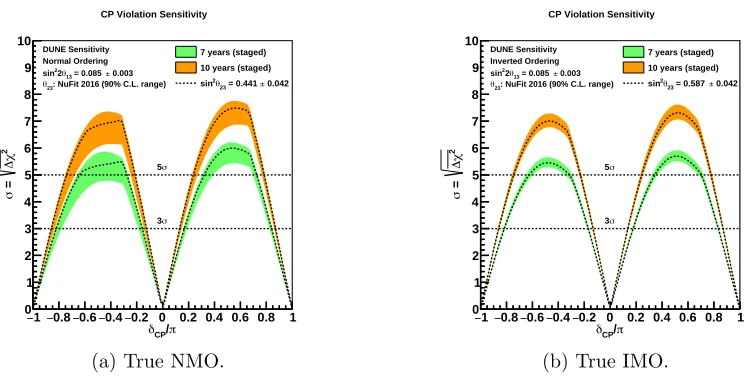
Figure 3: The significance with which δCP6= 0, π, can be determined as a function of
the true value of δCP, for exposures of seven (green) or 10 (orange) years, assuming
the staging scenario described in table 1. The inputs to the sensitivities are shown in Fig. 2. The neutrino oscillation parameters are based on NuFit 2016 [13]. The dashed line is the sensitivity for the NuFit 2016 central value ofθ23 with the width of
the band representing the range of sensitivities for the 90% C.L. range of θ23 values.
with which DUNE can observe lepton sector CPV (δCP 6= 0, π) is shown in Fig. 3
as a function of the true value of δCP for true NMO and IMO. Partial 5σ coverage
occurs after seven years of data-taking with the coverage dramatically increasing as exposure increases to 10 years.
The significance with which DUNE can determine the neutrino MO as a function of the true value of δCP is shown in Fig. 4 for both true NMO and IMO. Driven by
the 1300 km baseline, Fig. 4 shows greater than 5σ sensitivity to the neutrino MO for all possible values of δCP.
Unlike CPV and the neutrino MO, establishing the octant of θ23 relies only a
combined measurement of the νµ → νµ (which is sensitive to sin22θ23) and νµ → νe
(which is sensitive to sin2θ23) oscillation channels. The significance with which DUNE
can establish the octant of θ23 as a function of the true value of sin2θ23 is shown in
Fig. 5. Approximately 50% of the NuFit 2016 sin2θ23 C.L. region is covered with 5σ
signifance after 10 years of data-taking.
The scope of DUNE extends into other Beyond the Standard Model (BSM) physics. GUTs predict proton lifetimes possibly within reach of the full DUNE ex-periment. The p → K+ν decay channel is uniquely suited to a LArTPC due to the
high ionization density of the decayK+which results in high identification efficiency.
π
/
CP
δ
1
− −0.8−0.6−0.4−0.2 0 0.2 0.4 0.6 0.8 1
2 χ ∆ 0 5 10 15 20 25 30
Mass Hierarchy Sensitivity
7 years (staged) 10 years (staged)
0.042 ± = 0.441 23 θ 2 sin DUNE Sensitivity Normal Ordering 0.003 ± = 0.085 13 θ 2 2 sin
: NuFit 2016 (90% C.L. range) 23
θ
Mass Hierarchy Sensitivity
(a) True NMO.
π
/
CP
δ
1
− −0.8−0.6−0.4−0.2 0 0.2 0.4 0.6 0.8 1
2 χ ∆ 0 5 10 15 20 25 30
Mass Hierarchy Sensitivity
7 years (staged) 10 years (staged)
0.042 ± = 0.587 23 θ 2 sin DUNE Sensitivity Inverted Ordering 0.003 ± = 0.085 13 θ 2 2 sin
: NuFit 2016 (90% C.L. range) 23
θ
Mass Hierarchy Sensitivity
[image:7.612.133.508.102.290.2](b) True IMO.
Figure 4: The significance with which the neutrino MO can be determined as a function of the true value of δCP, for exposures of seven (green) or 10 (orange) years,
assuming the staging scenario described in table 1. The inputs to the sensitivities are shown in Fig. 2. The neutrino oscillation parameters are based on NuFit 2016 [13]. The dashed line is the sensitivity for the NuFit 2016 central value of θ23 with the
width of the band representing the range of sensitivities for the 90% C.L. range of θ23
values.
23
θ
2
sin
0.35 0.4 0.45 0.5 0.55 0.6 0.65
2 χ ∆ = σ 0 1 2 3 4 5 6 7 8 Octant Sensitivity
7 years (staged) 10 years (staged)
NuFit 2016 (90% C.L.)
DUNE Sensitivity Normal Ordering 0.003 ± = 0.085 13 θ 2 2 sin Octant Sensitivity
Figure 5: The significance with which the θ23 octant can be resolved as a function of
the true value of sin2θ23, for exposures of seven (green) or 10 (orange) years, assuming
the staging scenario described in table 1. The inputs to the sensitivities are shown in Fig. 2. The neutrino oscillation parameters are based on NuFit 2016 [13]. The width of the band represents the range in sensitivity due to variation in the true value of δCP, where the band covers the top 80% least extreme sensitivities. The yellow
[image:7.612.244.399.410.579.2]0.0 0.5 1.0 1.5 2.0 2.5 3.0 3.5 4.0
Time [years]
0 1 2 3 4 5 6
Free lifetime sensitivity (90% CL) [s]
1e8
Super-Kamiokande bound limit 1.9e32 yrs
[image:8.612.222.434.93.241.2]DUNE sensitivity (10kt/yr) DUNE sensitivity (full 40kt) Super-Kamiokande limit (90% CL
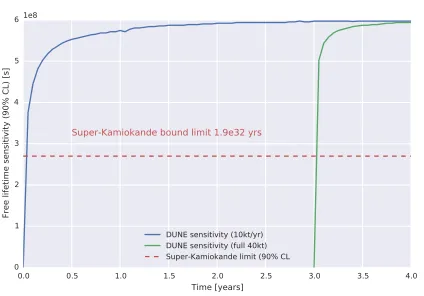
Figure 6: Freen—nlifetime sensitivity as a function of years of exposure with sensi-tivities for two construction scenarios (solid blue and solid green lines) and compared with the Super-K limit (orange dashed line).
converts to an anti-neutron that annihilates with another bound nucleon. This re-sults in an isotropic burst of neutral and charged pions which resembles a distinctive star-like topology. A free lifetime sensitivity has been established using a Convolu-tional Neutral Network (CNN) to select this topology over the dominant atmospheric neutrino interaction background which is shown in Fig. 6.
4
ProtoDUNE
The DUNE FDs, with a combined 40 kt LAr mass, will be the largest LArTPCs ever constructed. This demands extensive R&D to establish the production process, understand subsystem integration and to validate that the design and performance is sufficient for the core physics program. To achieve this goal, two large scale prototype LArTPCs, named ProtoDUNE-SP [14] and ProtoDUNE-DP, which will use the com-plementary SP and DP technologies, are currently under construction at CERN and will be exposed to a GeV-scale charged particle test beam. Both prototypes will each hold 770 t of LAr and will use full scale FD components. Extensions of the H2 and H4 SPS beamlines will service ProtoDUNE-DP and ProtoDUNE-SP respectively.
dE/dx calibration with Michel electrons from stopping muons providing a low energy benchmark for supernova neutrino interactions.
The ProtoDUNE cryostats are complete and are housed in the EHN1 building at the CERN neutrino platform. The final full-scale sub-components of the LArT-PCs are now being shipped from various construction sites in North America and Europe to CERN where installation is taking place. Commissioning and data-taking is expected to take place in 2018 prior to the SPS long shutdown.
5
Conclusions
The neutrino oscillation field is progressing rapidly but some key open questions re-main. DUNE, which will utilise LArTPC technology, will be able to unambiguously determine the neutrino MO and probe lepton sector CPV in a timely manner. The extended physics program will further probe neutrino oscillations and BSM physics.
Two kt scale LArTPCs are currently under construction at CERN (the ProtoDUNE-SP and ProtoDUNE-DP prototypes) that will critically test the engineering and con-struction procedures of the proposed FD technologies whilst providing a rich physics program of direct use in the key measurements of DUNE.
References
[1] Super-Kamiokande Collaboration, Y. Fukuda et al., Phys. Rev. Lett. 81, 1562 (1998).
[2] SNO Collaboration, Q. R. Ahmad et al., Phys. Rev. Lett. 87, 071301 (2001). [3] KamLAND Collaboration, K. Eguchiet al., Phys. Rev. Lett.90, 021802 (2003). [4] S. Pascoli, S. T. Petcov, and A. Riotto, Nucl. Phys. B774, 1 (2007),
hep-ph/0611338.
[5] DUNE, R. Acciarri et al., (2016), 1601.05471. [6] DUNE, R. Acciarri et al., (2015), 1512.06148. [7] DUNE, J. Strait et al., (2016), 1601.05823. [8] DUNE, R. Acciarri et al., (2016), 1601.02984.
[9] P. Adamson et al., Nucl. Instrum. Meth. A806, 279 (2016), 1507.06690. [10] M. Bass et al., Phys. Rev. D91, 052015 (2015), 1311.0212.
[11] P. Huber, M. Lindner, and W. Winter, Comput. Phys. Commun. 167, 195 (2005), hep-ph/0407333.
[12] P. Huber, J. Kopp, M. Lindner, M. Rolinec, and W. Winter, Comput. Phys. Commun. 177, 432 (2007), hep-ph/0701187.
[13] I. Esteban, M. C. Gonzalez-Garcia, M. Maltoni, I. Martinez-Soler, and T. Schwetz, Journal of High Energy Physics 2017, 87 (2017).