doi:10.4236/cweee.2013.22B009 Published Online April 2013 (http://www.scirp.org/journal/cweee)
Effect of pH and Dissolved Silicate on the Formation of
Surface Passivation Layers for Reducing Pyrite Oxidation
Shengjia Zeng
1, Jun Li
1, Russell Schumann
2, Roger Smart
1 1Minerals and Materials Science & Technology, Mawson Institute 2
Levay& Co.; University of South Australia, Adelaide, South Australia, Australia Email: [email protected]
Received 2013
ABSTRACT
Acid mine drainage (AMD)and toxic metal release generated by oxidation of sulphide minerals, particularly pyrite, in mine wastes, are a critical environmental issue worldwide. Currently, there are many options to diminish sulphide oxida- tion including barrier methods that isolate pyrite from oxygen or water, chemical additives and inhibition of iron-oxidizing bacteria. This study focuses on understanding the role that silicate and pH conditions play in the forma-tion and stabilisaforma-tion of pyrite surface passivaforma-tion layers found in lab and field studies. The results from pyrite dissolu-tion tests under various condidissolu-tions showed that the pyrite oxidadissolu-tion rate has been reduced by up to 60% under neutral pH with additional soluble silicate. Solution speciation calculation predicted that crystalline goethite is formed in the experiment without silicate additionbutan amorphous iron hydroxide surface layer is stabilized by the addition of the silicate, inhibiting goethite formation and continuing pyrite oxidation. This coherent, continuous amorphous layer has been verified in SEM.
Keywords: Acid Mine Drainage; Pyrite; Passivation Coating; Silicate
1. Introduction
Acid mine drainage (AMD) is a critical global environ-mental issue from many mine wastes. The discharge of AMD with associated toxic metal release has caused acidification of water environment, leading to extermina-tion of aquatic life and compromised water quality for agriculture and drinking. Sulphide oxidation of sulfidic minerals dominantly contributes to most of AMD issues at mining sites, and pyrite, the most abundant sulphide min-eral in the earth’s crust [1], is widely found in mining activities. Itsoxidation process under various conditions has been therefore widely studied to explore effective approaches and controlling factors to retard the oxidation process [2-5]. It is known that the oxidant (ferric ion or dissolved oxygen), water content and catalyst (i.e. iron oxidizing bacteria) have significant impact on the pyrite oxidation rate [6]. Reduction of any of these factors can contribute a remarkable reduction of the oxidation rate. The oxidant can be inhibited at pyrite particle surfaces by a surface barrier through the formation of passivation layers [2,3,7-10] and some coating agents, e.g. acetyl acetone, humic acids, ammonium lignosulfonates, oxalic acid and sodium silicate, were reported to be employed-for pyrite surface treatmentbut only minor reductions in pyrite oxidation rates resulted [1,3,9,11]. Huminicki and Rimstidt [12] reported that precipitation of iron
hydrox-ide particle reduced oxidant’s diffusion coefficient by more than five orders of magnitude. Evangelou [8] in-troduced a more stableiron hydroxide/silica coating gen-erated via precipitation of an Fe-Si complex. Smart et al. [13] and Miller et al. [14] found from their long term column leaching and field studies at the Grasberg mine Indonesia that silicate may be responsible for stabilising the iron oxy-hydroxide passivation layer on pyrite sur-faces. It was also reported from some of fund amental studies that silicate in hibits the trans formation
ofa-morphous iron hydroxide Fe(OH)3 to crystalline goethite
(FeOOH) in synthesis processes [4,15,16]. However, little has been known on the reaction path ways of the surface coating associated with silicate or the trans for-mation process of iron hydroxideprecipitated and coating stability. In this study, pyrite dissolution tests under various pH conditions in the presence of low
concentra-tions of Na2SiO3(10 and 20 mg/Lsilicate as Si),were
per-formedto investigate the influence of pH and dissolved silicate on the stability of iron oxyhydroxide surface lay-ers formed during oxidative dissolution of pyrite at circum-neutral pH.
2. Method and Materials
Pyrite(particle size 38 - 75 μm)obtained from Geo Di
shown in Table 1 Dissolved silicate, shown as Si centrations from assays, has been chosen based on con-centrations in effluent of column leach tests. Experiments were conducted at four different solution pHs (3.5, 4.5, 5.5 and ~8) and with three concentrations of dissolved Si (none added, 10 mg/L and 20 mg/L added as sodium silicate).Solution samples were periodically taken for Fe, S and Si concentrations by ICP analysis as well as for solution Eh and pH measurements. Solution modelling software, PHREEQC [17], was used to predict the pre-cipitation of possible secondary minerals based on meas-ured Eh, pH and the dissolved element concentrations. This is a thermodynamic prediction of precipitates and solution species and requires experimental verification where possible. Scanning electron microscopy (SEM) was introduced to investigate the surface coating.
3. Results and Discussion
3.1. Effect of pH and Silicate
Concentrationonpyrite Oxidation
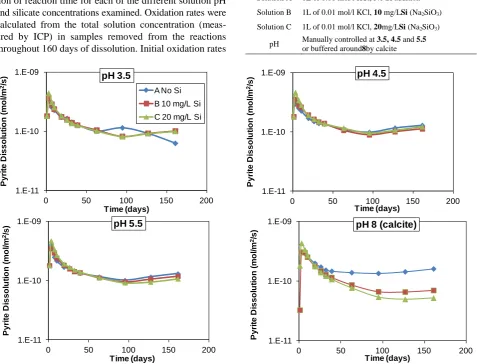
Figure 1 shows pyrite oxidation rates plotted as a func-tion of reacfunc-tion time for each of the different solufunc-tion pH and silicate concentrations examined. Oxidation rates were calculated from the total solution concentration (meas-ured by ICP) in samples removed from the reactions throughout 160 days of dissolution. Initial oxidation rates
were between 3 and 4 × 10⁻¹⁰ mol/m2/s for all
experi-ments, which decreased to around 1 × 10⁻¹⁰ mol/m2/s
during about 100 days of oxidation for solution pH be-tween 3.5 and 5.5 irrespective of how much silicate had been added. At the higher pH (near 8) of the saturated calcite solutions there was a difference in pyrite oxida-tion rates as a result of silicate addioxida-tion. With no silicate added, pyrite oxidation rates in calcite saturated solution were about 60%fasterthan those at lower pH after about 40 days, while in the presence of 10 - 20 mg/L Si the oxidation rates were slower at the higher pH of the cal-cite saturated solutions after about 40 days. The pyrite oxidation rate after about 100 days at circum-neutral pH and with 20 mg/L Si added, was about half of the rate in similar solutions at lower pH (3.5 - 5.5).
Table 1. Experimental details of pyrite dissolution tests.
Object Description
Pyrite 38-75 μm, BET surface area: 0.539 m
2/g , usage: 2 g for each sample
Calcite 38-75 μm, usage: 1.66 g (mole ratio: 1:1 with pyrite),
Solution A 1L of 0.01 mol/l KCl, No Si addition
Solution B 1L of 0.01 mol/l KCl, 10 mg/LSi (Na2SiO3)
Solution C 1L of 0.01 mol/l KCl, 20mg/LSi (Na2SiO3)
pH Manually controlled at 3.5, 4.5 and 5.5 or buffered around8by calcite
1.E-11 1.E-10 1.E-09
0 50 100 150 200
P
y
rit
e
D
is
s
o
lu
tio
n
(
m
o
l/m
2/s
)
Time (days) pH 3.5
A No Si
B 10 mg/L Si
C 20 mg/L Si
1.E-11 1.E-10 1.E-09
0 50 100 150 200
P
y
rit
e
D
is
s
o
lu
tio
n
(
m
o
l/m
2/s
)
Time (days) pH 4.5
1.E-11 1.E-10 1.E-09
0 50 100 150 200
P
y
rit
e
D
is
s
o
lu
tio
n
(
m
o
l/m
2/s
)
Time (days) pH 5.5
1.E-11 1.E-10 1.E-09
0 50 100 150 200
P
y
rit
e
D
is
s
o
lu
tio
n
(
m
o
l/m
2/s
)
Time (days) pH 8 (calcite)
[image:2.595.61.539.355.719.2]The decreasing oxidation rate as a function of time is indicative of passivating iron oxy-hydroxide layer forma-tion found in SEM studies of lab and field samples [13, 14]. These results suggest that across the pH range 3.5 to 5.5, neither the pH nor the concentration of silicate affect the nature of the iron oxy-hydroxide layer that forms as oxidation proceeds. However at the higher pH of calcite saturated solution there appears to be a clear influence of silicate on the oxidation rate, suggesting that increasing solution silicate concentration results in surface layers that are less permeable to oxygen and more stable.
3.2. Change in Solution Fe concentrations
Figure 2 shows solution iron concentrations as a func-tion of time for all of the pyrite oxidafunc-tion experiments. Not unexpectedly, there is a strong correlation between the solution pH and solution iron concentration, with higher concentrations in the lower pH solutions. During the first 10 days of pyrite oxidation at pH 3.5 and 4.5 there was stoichiometric dissolution of iron and sulphur. After this time, the ratio of iron to sulphur decreased be-low two, indicative of iron oxy-hydroxide precipitation [12]. At pH 5.5 and in saturated calcite solution the ratio of iron to sulphur in solution was less than two from thestart, indicating formation of passivating layers from the beginning. Despite these differences, as discussed above, there appears to be no difference in pyrite oxidation rates with silicate addition except for oxidation in calcite satu-rated solution after about 40 days. While these results may suggest differences in the amount of precipitated iron oxy-hydroxide, this does not appear to strongly in-fluence the oxidation rate in solutions with pH between 3.5 and 5.5.
After about 100 days, there was a small increase in the concentration of iron in the solutions at pH 3.5 and 4.5. This corresponds with a slight increase in the oxidation rate and may suggest some dissolution of the iron oxy- hydroxide coating at lower pH values [12].
The data shown in Figure 2 also indicate a correlation between the concentration of iron in solution and that of silicate. They suggest that iron may be stabilized by complexation with silicate enhancing its solubility at the lower pH values. Other investigations on the influence of silicate on pyrite oxidation have shown that, at higher silicate concentrations than those used here and at lower pH, pyrite oxidation is actually enhanced in the presence of silicate, possibly due to stabilization of Fe (III) by complexation with silicate [4].
0 5 10 15 20 25
0 50 100 150 200
Fe
c
onc
e
nt
ra
tion
(m
g/L)
Time (days)
pH 3.5
A No Si B 10 mg/L Si C 20 mg/L Si
0 5 10 15 20 25
0 50 100 150 200
Fe
c
onc
e
nt
ra
tion
(m
g/L)
Time (days)
pH 4.5
0 5 10 15 20 25
0 50 100 150 200
Fe
c
onc
e
nt
ra
tion
(m
g/L)
Time (days)
pH 5.5
0 5 10 15 20 25
0 50 100 150 200
Fe
c
onc
e
nt
ra
tion
(m
g/L)
Time (days)
pH 8 (calcite)
[image:3.595.63.538.393.721.2]3.3. Change in Solution Si Concentrations
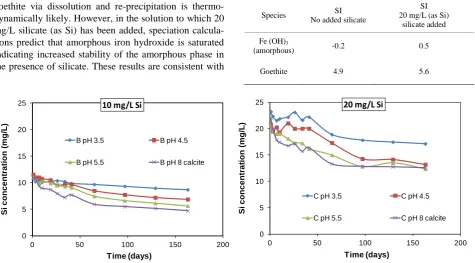
Figure 3 shows solution Si concentrations as a function of time for all of the pyrite oxidation experiments except series A where no silicate was added and silicon concen-trations were generally non-detectable (<0.05 mg/L). There appears to be a clear correlation between solution pH and the concentration of silicon in solution. At pH 3.5 there is little decrease in the concentration of Si during the 160 days of the experiments. At the circum-neutral pH conditions of oxidation in calcite saturated solution there is close to a 50% decrease in the concentration of silicate, suggesting adsorption and/or precipitation of silicate with iron oxy-hydroxide. These results suggest that as the pH increases there is likely to be an increase in the amount of silicate in the iron oxy-hydroxide coat-ing passivatcoat-ing the pyrite surface. However, as discussed above this does not appear to have influenced oxidation rates except in the case of oxidation at circum-neutral pH. It therefore appears that a combination of both relatively high silicate concentration and neutral to high pH is re-quired to have a significant effect on the oxygen permea-bility of iron oxy-hydroxide layers formed during pyrite oxidation.
3.4. Speciation Calculations
Speciation calculations for the pyrite dissolution experi-ments conducted in calcite saturated solutions predict that goethite is saturated both in the presence and ab-sence of added silicate (Table 2). In contrast, amorphous iron hydroxide is predicted to be unsaturated in the ab-sence of added silicate suggesting that conversion to goethite via dissolution and re-precipitation is thermo-dynamically likely. However, in the solution to which 20 mg/L silicate (as Si) has been added, speciation calcula-tions predict that amorphous iron hydroxide is saturated indicating increased stability of the amorphous phase in the presence of silicate. These results are consistent with
the observations of silicate -stabilized amorphous iron hydroxide and retarded the crystallization of goethite reported in literature [4,15,18,19].
3.5. Pyrite Surface Analysis
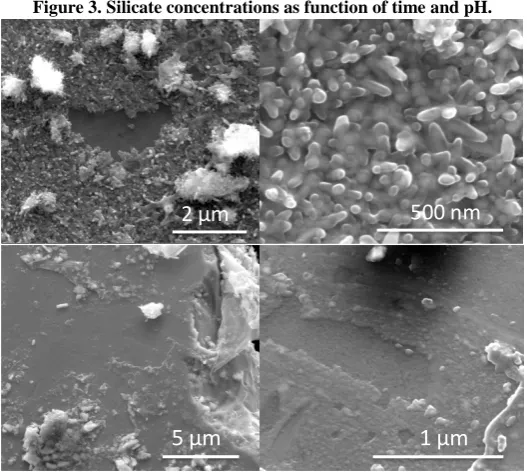
Scanning electron microscopy (SEM) was applied to identify whether iron ox-hydroxide coatings formed on pyrite particles which have slowed pyrite oxidation as the reaction has proceeded, suggested by the oxidation rate data and solution analysis. Figure 4 shows SEM images of pyrite particles sampled from dissolution experiments conducted in calcite-saturated solution. The top images display the surface of pyrite after 160 days dissolution in a solution where no silicate has been added. An iron ox-hydroxide coating is clearly visible with a needle-like morphology suggestive of a crystalline goethite structure. The bottom images show pyrite particles taken after 160 days from a saturated calcite solution to which 20 mg/L silicate (as Si) had been added. Again an iron ox-hydroxide coating is obvious on the pyrite surface, however, with very different morphology to that on py-rite from the solution in which no silicate had been added. In this instance the coating appears to be of a more amorphous nature. The Energy dispersed spectroscopy (EDS) spectra of the pyrite particles shown in Figure 5
c o n f i r m s t h a t
Table 2. Saturation indices (SI) of various mineral phases calculated using PHREEQC for saturated cal-cite solutions from pyrite dissolution with and without added silicate.
Species SI No added silicate
SI 20 mg/L (as Si)
silicate added
Fe (OH)3
(amorphous) -0.2 0.5
Goethite 4.9 5.6
0 5 10 15 20 25
0 50 100 150 200
S
i c
onc
e
nt
ra
tion
(m
g/L)
Time (days)
20 mg/L Si
C pH 3.5 C pH 4.5
C pH 5.5 C pH 8 calcite
0 5 10 15 20 25
0 50 100 150 200
S
i c
onc
e
nt
ra
tion
(m
g/L)
Time (days)
10 mg/L Si
B pH 3.5 B pH 4.5
[image:4.595.63.539.470.733.2]Figure 3. Silicate concentrations as function of time and pH.
2
μ
m
500 nm
5
μ
m
1 µm
Figure 4. SEM images of pyrite surface coatings after dissolution in saturated calcite solution for 160 days with no added silicate (top images) and 20 mg/L (as Si ) added silicate (bottom images).
0 1 2 3 4 5
S
Fe
O
0 1 2 3 4 5
Si S Fe
O
Figure 5. EDS spectra of pyrite surface coatings after dissolution in saturated calcite solution for 160 days with no added silicate (left) and 20 mg/L (as Si ) added silicate (right).
both coatings contain Fe, S and O. Si is only found in the less crystalline coating (amorphous-like coating) formed in the presence silicate. A number of studies examining the transformation from ferrihydrite (an amorphous phase) to goethite (a crystal phase) suggest that the addi-tion of soluble silicate inhibits the crystallizaaddi-tion process [4,15, 16,19]. Our experimental results are consistent with these studies indicating that in solutions with added silicate, the conversion of the initially formed amorphous iron hydroxide is inhibited, while in the silicate free solu-tion transformasolu-tion to goethite is more pronounced. It appears that the presence of silicate inhibits transforma-tion of amorphous iron oxy-hydroxide to a more crystal-line goethite-like phase. The former phase appears to be less per- meable to oxygen and therefore pyrite oxidation is reduced more at circum-neutral pH when the solution
concentration of silicate is higher.
4. Conclusions
Based on the results from the pyrite dissolution tests and the surface analyses, a possible mechanism for the for-mation and stabilization of iron oxy-hydroxide layers on pyrite during oxidation at pH > 5.5 was proposed. In the presence of dissolved silicate an amorphous layer with low oxygen permeability may form via:
● Ferrous ion is oxidized into ferric ion by dissolved
oxygen;
● Ferric ion hydrolyses forming colloidal ferric
hy-droxide. Colloidal particles are aggregated onto the pyrite surface via adsorption eventually resulting in complete surface coverage;
[image:5.595.60.538.358.505.2]particles displacing hydroxyl groups and forming a Si-O-Fe bond during the formation of colloid par-ticles;
● A layer with low oxygen permeability is established
which reduces oxidation rates significantly. The transformation to goethite via dissolution and re-precipitation is retarded.
5. Acknowledgements
This research has been funded by an Australian Postgra-duate Award Industry (APAI) through an Australian Re-search Council Linkage Project Grant with AMIRA In-ternational (Mr Gray Bailey). Sponsors of the Savage River Rehabilitation Project (SRRP), Hidden Valley Ser-vices, BHP Billiton Iron Ore, Rio Tinto Ltd. and Teck Ltd. to support the Project are gratefully acknowledged.
REFERENCES
[1] J. Satur, N. Hiroyoshi, M. Tsunekawa, M. Ito and H. Okamoto, “Carrier-Microencapsulation for Preventing Pyrite Oxidation,” International Journal of Mineral Processing, Vol.83, No. 3–4, 2007, pp. 116-124.
[2] E. Ahlberg and A. E. Broo, “Oxygen Reduction at Sul-phide Minerals. 3. The Effect of Surface Pre-Treatment on the Oxygen Reduction at Pyrite,” International Jour-nal of Mineral Processing, 1996, Vol. 47, No. 1–2, pp.
49-60.
[3] N. Belzile, S. Maki, Y. W. Chen and D. Goldsack, “Inhi-bition of Pyrite Oxidation by Surface Treatment,” Science of The Total Environment, Vol. 196, No. 2, 1997, pp.
177-1
[4] R. Cornell, R. Giovanoli and P. Schindler, “Effect of Silicate Species on the Transformation of Ferrihydrite into Goethite and Hematite in Alkaline Media,” Clays and Clay Minerals, Vol. 35, No. 1, 1987, pp. 21-28.
[5] D. B. Johnson and K. B. Hallberg, “Acid Mine Drainage Remediation Options: A Review,” Science of The Total Environment, Vol. 338, No. 1–2, 2005, pp. 3-14.
[6] A. P. Chandra and A. R. Gerson, “The Mechanisms of Pyrite Oxidation and Leaching: A Fundamental Perspec-tive,” Surface Science Reports, Vol. 65, No. 9, 2010, pp.
293-315.
[7] C. L. Caldeira, V. S. T. Ciminelli, A. Dias and K. Os-seo-Asare, “Pyrite Oxidation in Alkaline Solutions: Na-ture of the Product Layer,” International Journal of Min-eral Processing, Vol. 72, No. 1–4, 2003, pp. 373-386.
[8] V. P. Evangelou, “Pyrite Microencapsulation
Technolo-gies: Principles and Potential Field Application,” Eco-logical Engineering, Vol.17, No. 2–3, 2001, pp.
165-178.
[9] Lalvani, S. B., B. A. DeNeve and A. Weston, “Passiva-tion of Pyrite Due to Surface Treatment,” Fuel, Vol. 69, No. 12, 1990, pp. 1567-1569.
[10] K. Nyavor, N. O. Egiebor and P. M. Fedorak, “Suppres-sion of Microbial Pyrite Oxidation by Fatty Acid Amine Treatment, Science of The Total Environment, Vol. 182, No. 1–3, 1996, pp. 75-83.
[11] C. L. Jiang, X. H. Wang and B. K. Parekh, “Effect of Sodium Oleate on Inhibiting Pyrite Oxidation,” Interna-tional Journal of Mineral Processing, Vol. 58, No. 1–4, 2000, pp. 305-318.
[12] D. M. C. Huminicki and J. D. Rimstidt, “Iron Oxyhy-droxide Coating of Pyrite for Acid Mine Drainage Con-trol. Applied Geochemistry,” Vol. 24, No. 9, 2009, pp.
1626-16
[13] R. S. C. Smart, S. D. Miller, W. S. Stewart, Y. Rusdinar, R. E. Schumann, N. Kawashima and J. Li, “In Situ Cal-cite Formation in Limestone-Saturated Water Leaching of Acid Rock Waste,” Science of The Total Environment, Vol. 408, No. 16, 2010, pp. 3392-3402.
[14] S. Miller, R. Schumann, R. Smart and Y. Rusdinar, “Ard Control by Limestene Induced Armouring and Passiva-tion of Pyrite Mineral Surfaces, in ICARD,” Skellefta Sweden, 2009, p. 11.
[15] L. Dyer, P. D. Fawell, O. M. G. Newman and W. R. Richmond, “Synthesis and Characterisation of Ferrihy-drite/Silica Co-Precipitates,” Journal of Colloid and In-terface Science, Vol. 348, No. 1, 2010, pp. 65-70.
[16] U. Schwertmann and R. M. Cornell, “Iron Oxides in the Laboratory: Preparation and Characterization, ” 1991, Weinheim: VCH.
[17] S. Santomartino and J. A. Webb, “Estimating the Lon-gevity of Limestone Drains in Treating Acid Mine Drainage Containing High Concentrations of Iron,” Ap-plied Geochemistry,Vol. 22, No. 11, 2007, pp. 2344-2361.
[18] D. Mohapatra, P. Singh, W. Zhang and P. Pullammanap-pallil, “The Effect of Citrate, Oxalate, Acetate, Silicate and Phosphate on Stability of Synthetic Arsenic-Loaded Ferrihydrite and Al-Ferrihydrite, ” Journal of Hazardous Materials, Vol. 124, No. 1–3, 2005, pp. 95-100.
![Figure 2 shows solution iron concentrations as a func-[12]. At pH 5.5 and in saturated calcite solution the ratio of iron to sulphur in solution was less than two from the tion of time for all of the pyrite oxidation experiments](https://thumb-us.123doks.com/thumbv2/123dok_us/7777563.720053/3.595.63.538.393.721/solution-concentrations-saturated-solution-sulphur-solution-oxidation-experiments.webp)