http://www.scirp.org/journal/am ISSN Online: 2152-7393
ISSN Print: 2152-7385
Constructing Matching Equivalent Graphs
Tingzeng Wu
1, Huazhong Lü
21School of Mathematics and Statistics, Qinghai Nationalities University, Xining, China
2School of Mathematics Science, University of Electronic Science and Technology of China, Chengdu, China
Abstract
Two nonisomorphic graphs G and H are said to be matching equivalent if and only if G and H have the same matching polynomials. In this paper, some families matching equivalent graphs are constructed. In particular, a new me-thod to construct cospectral forests is given.
Keywords
Matching Polynomial, Matching Equivalent, Cospectral
1. Introduction
We use standard graph-theoretical notation and terminology. For concepts and notations not defined here, we refer the reader to [1].
By a graph we always mean a simple undirected graph G with the vertex set
( ) {
1, 2, , n}
V G = v v v and the edge set E G
( ) {
= e e1, 2,,em}
.We denote the complement of G by G. The degree of a vertex v V G∈( )
is denoted by( )
G
d v , abbreviated as dv. Let GH be the union of two graphs G and H
which have no common vertices. For any positive integer l, let lG be the union of
l disjoint copies of graph G. An acyclic graph, containing no cycles, is called a forest. A connected forest is called a tree. The complete bipartite graph with p+q vertices is denoted by Kp q, . The path, star and complete graph with n
vertices are denoted by Pn, K1,n−1 and Kn, respectively.
A r-matching in G is a set of r pairwise non-incident edges. The number of r- matchings in G is denoted by m G r
(
,)
. Specifically, m G( )
,1 =m and(
,)
0 m G r = for2
n
r> . It is both consistent and convenient to define
(
, 0)
1m G = . The matching polynomial of the graph G is defined as
(
)
( ) (
)
2 0, 1r , n r.
r
G x m G r x
µ −
≥
=
∑
− (1)How to cite this paper: Wu, T.Z. and Lü, H.Z. (2017) Constructing Matching Equiv-alent Graphs. Applied Mathematics, 8, 476- 482.
https://doi.org/10.4236/am.2017.84038
Received: March 28, 2017 Accepted: April 21, 2017 Published: April 24, 2017
Copyright © 2017 by authors and Scientific Research Publishing Inc. This work is licensed under the Creative Commons Attribution International License (CC BY 4.0).
Matching polynomials have some important applications in statistical physics and structural chemistry. Up to now, the matching polynomials of graphs are extensively examined, we refer the reader to [2]-[14] and the references therein.
Two nonisomorphic graphs G and H are said to be matching equivalent, symbolically G~H , if
µ
(
G x,)
=µ
(
H x,)
. Godsil and Gutman [15] first pro-posed the question to determine matching equivalent graphs. This seems diffi-cult in the theory of graph polynomials. By now, little about the matching equiv-alent graphs have been published [16] [17] [18] [19]. In this paper, we plan to investigate the problem which graphs are matching equivalent.2. Some Lemmas
In the section, we will present some lemmas which are required in the proof of the main results.
Lemma 1. [19] [20]
(
)
(
(
)
)
(
)
2(
)
(
2)
0 0
, , 2 , , , .
n n
r n m
r m
G x m G n r K x m G m K x
µ µ µ −
= =
=
∑
− =∑
(2)Corollary 1. G~H if and only if G~H.
Proof. Corollary 1 follows directly by Lemma 1.
Lemma 2. [19] The matching polynomial satisfies the following identities:
1)
µ
(
GH x,)
=µ
(
G x,) (
µ
H x,)
;2)
µ
(
G x,)
=µ
(
G e x\ ,)
−µ
(
G uv x\ ,)
if e={ }
u v, is an edge of G; 3)µ
(
G x,)
=µ
(
G u x\ ,)
−∑
i u~µ
(
G ui x\ ,)
, if u∈V G( )
.Let G be a graph with a vertex u. The path tree T G u
(
,)
is the tree with the paths in G which start at u as its vertices, and where two such paths are joined by an edge if one is a maximal subpath of the other.Lemma 3. [21] Suppose G is a connected graph with u∈V G
( )
, and suppose(
,)
T G u is the path tree associated with G with root u. Then T G u
(
,)
has asubforest T′ such that
(
,)
(
(
(
,)
)
,)
. ,T G u x
G x
T x
µ
µ
µ
=
′ (3)
Remark 1. It is not difficult to derive the following description of an appro-priate subforest T′: find a spanning tree T0 of G by depth-first search from u, and delete from T all vertices corresponding to a path contained in T0.
Wu and Zhang [22] determined all connected graphs with matching number 2 as follows.
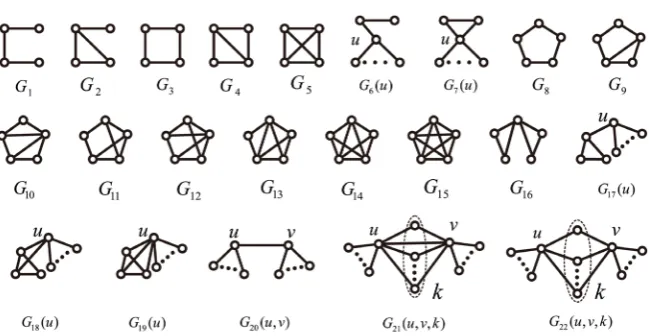
Lemma 4. ([22]) Let G be a connected graph with n vertices. Then
ν
( )
G =2if and only if G is one of 22 graphs as shown in Figure 1, where d u
( )
≥3 in( )
6
G u , d u
( )
≥4 in G u7( )
, d u( )
≥3 in G17( )
u , d u( )
≥3 in G18(u),( )
4d u ≥ in G19(u), d u
( )
≥3 and d v( )
≥3 in G20( )
u v, , d u( )
≥3 and( )
3d v ≥ and k≥1 in G21
(
u v k, ,)
, d u( )
≥2 and d v( )
≥2 and k≥1 in(
)
22 , , G u v k .
Figure 1. All connected graphs with the matching number 2.
graphs of the same order are cospectral if they have the same spectrum. Lemma 5. ([19]) If G is a forest then
φ
(
G x,)
=µ
(
G x,)
, whereφ
(
G x,)
denotes the characteristic polynomial of G.
Lemma 5 implies the following result.
Corollary 2. Let G and H be two forests. If G~H , then G and H are
cos-pectral.
3. Main Results
For convenience, G20
( )
u v, and G22(
u v k, ,)
in Figure 1 are replaced by(
)
20 u, v
G d d and G22
(
d d ku, v,)
, respectively, where du and dv denote the degree of vertices u and v, respectively, and k denotes the number of common neighbors of u and v.Theorem 1. G20
(
n+4, 2n+4 ~)
G22(
n+2, 2n+5,1)
.Proof. By (2) of Lemma 2, we have
(
)
(
)
(
) (
)
(
) (
)
(
)
(
)
20 1, 3 1,2 3 1
3 8 3 6 2 3 4
4, 2 4 , , , 3 6 ,
3 7 2 9 9 ,
n n
n n n
G n n x K x K x n K x
x n x n n x
µ µ + µ + µ
+ + +
+ + = − +
= − + + + +
and
(
)
(
)
(
) (
)
(
) (
)
(
)
(
)
(
)
22
1, 2 1,2 4 1 1, 1
3 8 3 6 2 3 4
2, 2 5,1 ,
, , 2 4 , ,
3 7 2 9 9 .
n n n
n n n
G n n x
K x K x n K x K x
x n x n n x
µ
µ + µ + µ µ +
+ + +
+ +
= − +
= − + + + +
Thus, G20
(
n+4, 2n+4 ~)
G22(
n+2, 2n+5,1)
. By Corollary 1 and Theorem 1, we haveCorollary 3. G20
(
n+4, 2n+4 ~)
G22(
n+2, 2n+5,1)
.Theorem 2. G22
(
k k, +2,k)
and G22(
k+1,k+1,k+1)
K1 are matchingequivalent, and their complements are also matching equivalent, where k>0.
Proof. By (2) of Lemma 2, we have
(
)
(
G22 k k, 2,k ,x)
(
G22(
k k, 1,k)
,x)
(
K x1,)
(
K x1,)
(
K1,k,x)
µ
+ =µ
+µ
−µ
µ
(
)
(
)
(
)
(
)
(
) (
) (
)
(
)
22 1
22 1 1 1,
1, 1, 1 ,
1, , , , 2 4 , k,
G k k k K x
G k k k x K x n K x K x
µ
µ µ µ µ
+ + +
= + − +
Checking G22
(
k k, +1,k)
and G22(
k+1, ,k k)
, it can be seen that(
)
22 , 1,
G k k+ k and G22
(
k+1, ,k k)
are isomorphic. So,(
)
(
)
22 , 2, ~ 22 1, 1, 1 1
G k k+ k G k+ k+ k+ K . By Corollary 1,
(
)
(
)
22 , 2, ~ 22 1, 1, 1 1
G k k+ k G k+ k+ k+ K .
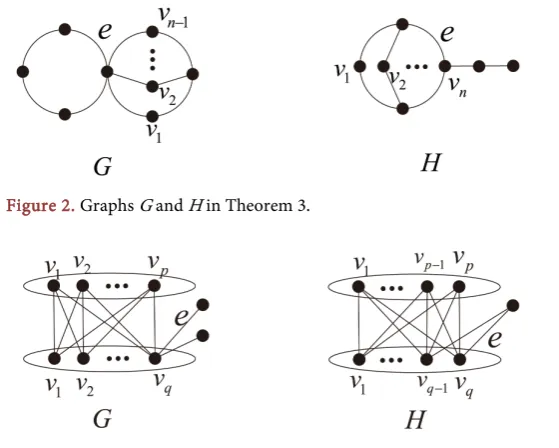
Theorem 3. Let G be a graph obtained by identifying a cycle C4 to vertex u
of G22
(
n−1,n−1,n−1)
, and let H be a graph obtained by attaching a path P2to a vertex of degree two in G22
(
n n n, ,)
, where n≥3 (see Figure 2). Then ~G H and G~H.
Proof. By (2) of Lemma 2, we obtain that
(
G x,)
=(
G e x\ ,)
μ(
K1,n1, x)
μ( , xP2 )µ µ − − and
(
H x,)
(
H e x\ ,)
(
K1,n1,x)
(
P x2,)
µ
=µ
−µ
−µ
. Checking G and H, it can beknown that G e\ and H e\ are isomorphic. So, G~H . By Corollary 1, again we have G~H .
Checking G22
(
d d ku, v,)
, it is easy to find that G22(
2, 4, 2)
and(
)
22 3, 3, 3 1
G K are matching equivalent. Based on the result above, we con-struct a pair of matching equivalent graphs as follows.
Theorem 4. Let G be a graph obtained by joining two single vertices to vq in
,
p q
K , and let H be a graph obtained by joining a single vertex to vq−1 and vq
in Kp q, , respectively, where vq−1 and vq are both in the bipartition of q
ver-tices in Kp q, (see Figure3). Then G~HK1 and G~HK1.
Proof. By (2) of Lemma 2, we obtain that
(
G,x)
µ(
G e\ ,x)
µ(
Kp q, 1,x)
µ(K x1,µ = − − ) and
(
H K1,x)
µ(
H e x\ ,)
µ(K x1, ) µ(
Kp q, 1,x)
µ(K x1, )µ = − − . Checking G and H, it
can be known that G\e and H e\ K1 are isomorphic. So, G~H . By Co-rollary 1, we have G~HK1 .
[image:4.595.239.519.498.722.2]Figure 2. Graphs G and H in Theorem 3.
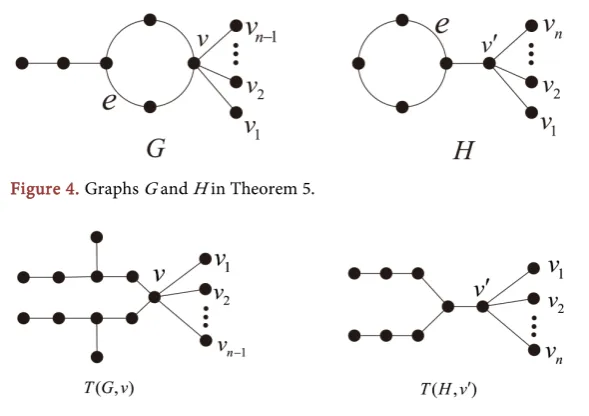
Theorem 5. Let G be a graph obtained by attaching a path P2 to u in
(
)
22 2, 1, 2
G n+ , and let H be a graph obtained by identifying the center of K1,dv
to a pendant vertex of G22
(
2, 2, 3)
(seeFigure 4). Then G~H and G~H.Proof. By (2) of Lemma 2, we obtain that
(
G x,)
(
G e x\ ,)
(
K1,n,x)
(
P x2,)
µ
=µ
−µ
µ
and(
H x,)
(
H e x\ ,)
(
K1,n,x)
(
P x2,)
µ
=µ
−µ
µ
. Checking G and H, it can be knownthat G e\ is isomorphic to H e\ . So G~H . By Corollary 1, we have
~
G H.
Theorem 6. Let G and H be two graphs which are defined in Theorem 5.
Then T G v
(
,)
P3~T H v(
, ′)
I and T G v(
,)
P3~T H v(
, ′)
I , where Idenotes a graph obtained by attaching a single vertex K1 to a pendant vertex of 1,3
K , and T G v
(
,)
and T H v(
, ′)
denote the path-trees of G and H, respec-tively (see Figure 5). In particular, T G v
(
,)
P3 and T H v(
, ′)
I are cospec-tral.
Proof. By Lemma 3, we have
(
,)
(
(
( )
,)
,)
,T G v x
G x
I x
µ
µ
µ
= and
(
)
(
(
(
)
)
)
3 , , ,
,
T H v x
H x
P x
µ
µ
µ
′
= . By Theorem 5, we have
µ
(
G x,)
=µ
(
H x,)
. So,(
)
(
)
( )
(
(
(
3)
)
)
, , , ,
, ,
T G v x T H v x
I x P x
µ
µ
µ
µ
′
= . This implies that T G v
(
,)
P3~T H v(
, ′)
I.By Corollary 1, we have T G v
(
,)
P3~T H v(
, ′)
I. Furthermore, by Corollary 5, we know that T G v(
,)
P3 and T H v(
, ′)
I are cospectral.4. Conclusion
In this paper, we constructed some families matching equivalent graphs in Theorems 1,..., and 4. Based on these results, using the same method in Theorem 6, we can construct some pairs of matching equivalent forests and cospectral fo-rests, respectively.
[image:5.595.228.523.516.724.2]Figure 4. Graphs G and H in Theorem 5.
Acknowledgements
We thank the editor and referees for their comments. Research of Tingzeng Wu is funded by NSF of Qinghai (2016-ZJ-947Q), and high-level personnel of scien-tific research projects of QHMU(2016XJG07). These supports are greatly appre-ciated.
References
[1] Cvetković, D.M., Doob, M., Gutman, I. and Torgašev, A. (1988) Recent Results in the Theory of Graph Spectra. North-Holland, Amsterdam.
[2] Farrell, E.J. (1979) An Introduction to Matching Polynomials. Journal of Combina-torial Theory, Series B, 27, 75-86.
[3] Liu, W., Guo, Q., Zhang, Y., Feng, L. and Gutman, I. (2017) Further Results on the Largest Matching Root of Unicyclic Graphs. Discrete Applied Mathematics, 221, 82-88.
[4] Gutman, I. and Wagner, S. (2012) The Matching Energy of a Graph. Discrete Ap-plied Mathematics, 160, 2177-2187.
[5] Ku, C. and Chen, W. (2010) An Analogue of the Gallai-Edmonds Structure Theo-rem for Non-Zero Roots of the Matching Polynomial. Journal of Combinatorial Theory, Series B, 100, 119-127.
[6] Lass, B. (2004) Matching Polynomials and Duality. Combinatorica, 24, 427-440. https://doi.org/10.1007/s00493-004-0026-7
[7] Li, X., Shi, Y. and Trinks, M. (2015) Polynomial Reconstruction of the Matching Polynomial. Electronic Journal of Graph Theory and Application, 3, 27-34. https://doi.org/10.5614/ejgta.2015.3.1.4
[8] Wu, T., Yan, W. and Zhang, H. (2016) Extremal Matching Energy of Complements of Trees. Discussiones Mathematicae Graph Theory, 36, 505-522.
https://doi.org/10.7151/dmgt.1869
[9] Wu, T. (2016) Two Classes of Topological Indices of Phenylene Molecule Graphs. Mathematical Problems in Engineering, 2016, Article ID: 8421396.
https://doi.org/10.1155/2016/8421396
[10] Yan, W., Yeh, Y. and Zhang, F. (2005) On the Matching Polynomials of Graphs with Small Number of Cycles of Even Length. International Journal of Quantum Chemistry, 105, 124-130. https://doi.org/10.1002/qua.20670
[11] Yan, W. and Yeh, Y. (2009) On the Matching Polynomial of Subdivision Graphs. Discrete Applied Mathematics, 157, 196-200.
[12] Zhang, H., Lin, R. and Yu, G. (2013) The Largest Matching Root of Unicyclic Graphs. Information Processing Letters, 113, 804-806.
[13] Zhang, H., Yu, G. and Li, S. (2015) Graphs with Six Distinct Matching Roots. In-formation Processing Letters, 115, 521-526.
[14] Gutman, I. (2016) A Survey on the Matching Polynomial. In: Shi, Y., et al., Eds., Graph Polynomial, CRC Press, Boca Raton.
[15] Godsil, C.D. and Gutman, I. (1981) On the Theory of the Matching Polynomial. Journal of Graph Theory, 5, 137-144. https://doi.org/10.1002/jgt.3190050203 [16] Beezer, R.A. and Farrell, E.J. (1995) The Matching Polynomial of a Regular Graph.
Discrete Mathematics, 137, 7-18.
[18] Zhang, H. and Shu, J. (2012) On the Matching Polynomial of Theta Graphs. Ars Combinatoria, 104, 477-490.
[19] Godsil, C.D. (1993) Algebraic Combinatorics. Chapman & Hall, New York, Lon-don.
[20] Farrell, E.J. and Whitehead, E.G. (1992) Connections between the Matching and Chromatic Polynomials. International Journal of Mathematics and Mathematical Sciences, 15, 757-766. https://doi.org/10.1155/S016117129200098X
[21] Lovász, L. and Plummer, M.D. (2009) Matching Theory. American Mathematical Society.
[22] Wu, T. and Zhang, H. (2015) Per-Spectral Characterizations of Graphs with Ex-tremal Per-Nullity. Linear Algebra and Its Applications, 484, 13-26.
Submit or recommend next manuscript to SCIRP and we will provide best service for you:
Accepting pre-submission inquiries through Email, Facebook, LinkedIn, Twitter, etc. A wide selection of journals (inclusive of 9 subjects, more than 200 journals)
Providing 24-hour high-quality service User-friendly online submission system Fair and swift peer-review system
Efficient typesetting and proofreading procedure
Display of the result of downloads and visits, as well as the number of cited articles Maximum dissemination of your research work