VOLUME 6 ISSUE 30 AUGUST 2018 ISSN 2050-4349
Understanding the knowledge gaps in whistleblowing
and speaking up in health care: narrative reviews of
the research literature and formal inquiries, a legal
analysis and stakeholder interviews
whistleblowing and speaking up in health
care: narrative reviews of the research
literature and formal inquiries, a legal
analysis and stakeholder interviews
Russell Mannion,
1
* John Blenkinsopp,
2
Martin Powell,
1
Jean McHale,
3
Ross Millar,
1
Nicholas Snowden
4
and Huw Davies
5
1
Health Services Management Centre, University of Birmingham, Birmingham, UK
2
Newcastle Business School, Northumbria University, Newcastle upon Tyne, UK
3
Birmingham Law School, University of Birmingham, Birmingham, UK
4
Hull University Business School, University of Hull, Hull, UK
5
School of Management, University of St Andrews, St Andrews, UK
*Corresponding author
Declared competing interests of authors:none
Published August 2018
DOI: 10.3310/hsdr06300This report should be referenced as follows:
ISSN 2050-4349 (Print)
ISSN 2050-4357 (Online)
This journal is a member of and subscribes to the principles of the Committee on Publication Ethics (COPE) (www.publicationethics.org/).
Editorial contact: [email protected]
The full HS&DR archive is freely available to view online at www.journalslibrary.nihr.ac.uk/hsdr. Print-on-demand copies can be purchased from the report pages of the NIHR Journals Library website: www.journalslibrary.nihr.ac.uk
Criteria for inclusion in theHealth Services and Delivery Researchjournal
Reports are published inHealth Services and Delivery Research(HS&DR) if (1) they have resulted from work for the HS&DR programme or programmes which preceded the HS&DR programme, and (2) they are of a sufficiently high scientific quality as assessed by the reviewers and editors.
HS&DR programme
The Health Services and Delivery Research (HS&DR) programme, part of the National Institute for Health Research (NIHR), was established to fund a broad range of research. It combines the strengths and contributions of two previous NIHR research programmes: the Health Services Research (HSR) programme and the Service Delivery and Organisation (SDO) programme, which were merged in January 2012.
The HS&DR programme aims to produce rigorous and relevant evidence on the quality, access and organisation of health services including costs and outcomes, as well as research on implementation. The programme will enhance the strategic focus on research that matters to the NHS and is keen to support ambitious evaluative research to improve health services.
For more information about the HS&DR programme please visit the website: http://www.nets.nihr.ac.uk/programmes/hsdr
This report
The research reported in this issue of the journal was funded by the HS&DR programme or one of its preceding programmes as project number 14/04/33. The contractual start date was in November 2015. The final report began editorial review in November 2016 and was accepted for publication in May 2017. The authors have been wholly responsible for all data collection, analysis and interpretation, and for writing up their work. The HS&DR editors and production house have tried to ensure the accuracy of the authors’report and would like to thank the reviewers for their constructive comments on the final report document. However, they do not accept liability for damages or losses arising from material published in this report.
This report presents independent research funded by the National Institute for Health Research (NIHR). The views and opinions expressed by authors in this publication are those of the authors and do not necessarily reflect those of the NHS, the NIHR, NETSCC, the HS&DR programme or the Department of Health and Social Care. If there are verbatim quotations included in this publication the views and opinions expressed by the interviewees are those of the interviewees and do not necessarily reflect those of the authors, those of the NHS, the NIHR, NETSCC, the HS&DR programme or the Department of Health and Social Care.
© Queen’s Printer and Controller of HMSO 2018. This work was produced by Mannionet al.under the terms of a commissioning contract issued by the Secretary of State for Health and Social Care. This issue may be freely reproduced for the purposes of private research and study and extracts (or indeed, the full report) may be included in professional journals provided that suitable acknowledgement is made and the reproduction is not associated with any form of advertising. Applications for commercial reproduction should be addressed to: NIHR Journals Library, National Institute for Health Research, Evaluation, Trials and Studies Coordinating Centre, Alpha House, University of Southampton Science Park, Southampton SO16 7NS, UK.
NIHR Journals Library Editors
Professor Ken Stein Chair of HTA and EME Editorial Board and Professor of Public Health, University of Exeter Medical School, UK
Professor Andrée Le May Chair of NIHR Journals Library Editorial Group (HS&DR, PGfAR, PHR journals)
Dr Martin Ashton-Key Consultant in Public Health Medicine/Consultant Advisor, NETSCC, UK
Professor Matthias Beck Professor of Management, Cork University Business School, Department of Management and Marketing, University College Cork, Ireland
Dr Tessa Crilly Director, Crystal Blue Consulting Ltd, UK
Dr Eugenia Cronin Senior Scientific Advisor, Wessex Institute, UK
Dr Peter Davidson Director of the NIHR Dissemination Centre, University of Southampton, UK
Ms Tara Lamont Scientific Advisor, NETSCC, UK
Dr Catriona McDaid Senior Research Fellow, York Trials Unit, Department of Health Sciences, University of York, UK
Professor William McGuire Professor of Child Health, Hull York Medical School, University of York, UK
Professor Geoffrey Meads Professor of Wellbeing Research, University of Winchester, UK
Professor John Norrie Chair in Medical Statistics, University of Edinburgh, UK
Professor John Powell Consultant Clinical Adviser, National Institute for Health and Care Excellence (NICE), UK
Professor James Raftery Professor of Health Technology Assessment, Wessex Institute, Faculty of Medicine, University of Southampton, UK
Dr Rob Riemsma Reviews Manager, Kleijnen Systematic Reviews Ltd, UK
Professor Helen Roberts Professor of Child Health Research, UCL Great Ormond Street Institute of Child Health, UK
Professor Jonathan Ross Professor of Sexual Health and HIV, University Hospital Birmingham, UK
Professor Helen Snooks Professor of Health Services Research, Institute of Life Science, College of Medicine, Swansea University, UK
Professor Jim Thornton Professor of Obstetrics and Gynaecology, Faculty of Medicine and Health Sciences, University of Nottingham, UK
Professor Martin Underwood Director, Warwick Clinical Trials Unit, Warwick Medical School, University of Warwick, UK
Please visit the website for a list of editors: www.journalslibrary.nihr.ac.uk/about/editors
Abstract
Understanding the knowledge gaps in whistleblowing and
speaking up in health care: narrative reviews of the research
literature and formal inquiries, a legal analysis and
stakeholder interviews
Russell Mannion,
1* John Blenkinsopp,
2Martin Powell,
1Jean McHale,
3Ross Millar,
1Nicholas Snowden
4and Huw Davies
51Health Services Management Centre, University of Birmingham, Birmingham, UK 2Newcastle Business School, Northumbria University, Newcastle upon Tyne, UK 3Birmingham Law School, University of Birmingham, Birmingham, UK
4Hull University Business School, University of Hull, Hull, UK
5School of Management, University of St Andrews, St Andrews, UK
*Corresponding author [email protected]
Background:There is compelling evidence to suggest that some (or even many) NHS staff feel unable to speak up, and that even when they do, their organisation may respond inappropriately.
Objectives:The specific project objectives were (1) to explore the academic and grey literature on whistleblowing and related concepts, identifying the key theoretical frameworks that can inform an understanding of whistleblowing; (2) to synthesise the empirical evidence about the processes that facilitate or impede employees raising concerns; (3) to examine the legal framework(s) underpinning whistleblowing; (4) to distil the lessons for whistleblowing policies from the findings of Inquiries into failings of NHS care; (5) to ascertain the views of stakeholders about the development of whistleblowing policies; and (6) to develop practical guidance for future policy-making in this area.
Methods:The study comprised four distinct but interlocking strands: (1) a series of narrative literature reviews, (2) an analysis of the legal issues related to whistleblowing, (3) a review of formal Inquiries related to previous failings of NHS care and (4) interviews with key informants.
Results:Policy prescriptions often conceive the issue of raising concerns as a simple choice between deciding to‘blow the whistle’and remaining silent. Yet research suggests that health-care professionals may raise concerns internally within the organisation in more informal ways before utilising whistleblowing processes. Potential areas for development here include the oversight of whistleblowing from an independent agency; early-stage protection for whistleblowers; an examination of the role of incentives in encouraging whistleblowing; and improvements to criminal law to protect whistleblowers. Perhaps surprisingly, there is little discussion of, or recommendations concerning, whistleblowing across the previous NHS Inquiry reports.
Conclusions:Current policy prescriptions that seek to develop better whistleblowing policies and nurture open reporting cultures are in need of more evidence. Although we set out a wide range of issues, it is beyond our remit to convert these concerns into specific recommendations: that is a process that needs to be led from elsewhere, and in partnership with the service. There is also still much to learn regarding this important area of health policy, and we have highlighted a number of important gaps in knowledge that are in need of more sustained research.
Future work:A key area for future research is to explore whistleblowing as an unfolding, situated and interactional process and not just a one-off act by an identifiable whistleblower. In particular, we need more evidence and insights into the tendency for senior managers not to hear, accept or act on concerns about care raised by employees.
Contents
List of tables xi
List of figures xiii
List of boxes xv
List of abbreviations xvii
Plain English summary xix
Scientific summary xxi
Chapter 1Introduction 1
Whistleblowing: a complex and contested issue 1
Policy and legal context 2
Aims and objectives of this study 3
Project overview and reporting structure 4
Chapter 2The conceptual underpinnings of whistleblowing 5
Introduction 5
The emergence of whistleblowing as a field of study 5 Raising concerns, speaking up or blowing the whistle? 6
Blowing the whistle on what? 8
Outsider whistleblowing? 10
Theoretical perspectives on whistleblowing 11
Cognitive perspective 12
Values and beliefs 12
Justice and institutional theories 12
Power and politics 13
Prosocial theory 13
Alternative perspectives 14
Methodological issues in whistleblowing research 14
Qualitative research 15
Surveys using hypothetical situations 15
Surveys of actual whistleblowing 15 Concluding remarks: further exploration of whistleblowing in the NHS 15
Chapter 3Empirical evidence on whistleblowing 17
Introduction 17
Literature review methods 17
The whistleblowing literature uncovered 20
Wide dispersal of the whistleblowing literature 20
Growth in academic publications on whistleblowing 20
Limitations by place of study and participants included 20
Limited interconnectivity between the general whistleblowing literature and the
External context 24
Regional and national culture 24
The law and legal frameworks 24
Professional standards, including ethical codes of practice and guidelines 25
Economic and financial influences 25
Internal context 26
Organisational culture and climate 26
Education and training 26
Peer pressure and relationships 27
Leadership and management 27
Boundary definitions 28
Personal factors 28
Personal traits and characteristics 29
Position and role in the organisation 29
Responses to whistleblowing 29
Responses from organisations 30
Responses from peers 30
Responses from non-whistleblowing observers of wrongdoing 30
Concluding remarks 31
Chapter 4The main whistleblowing inquiries and formal responses to
inquiry recommendations 33
Introduction 33
The formal NHS inquiries from the Kennedy report onwards 33
Kennedy 33
Ayling 34
Kerr/Haslam 35
Shipman 37
Francis 2010 37
Francis 2013 38
Summary of findings from the formal inquiries 39 Formal responses to whistleblowing inquiries 39
Secretary of State for Health (Bristol) 39
Home Secretary and Secretary of State for Health (Shipman) 43
Secretary of State for Health (Safeguarding Patients) 43
House of Commons Health Committee 44
Secretary of State for Health (Mid Staffordshire NHS Foundation Trust) 44
British Medical Association (Mid Staffordshire NHS Foundation Trust) 44
Royal College of Nursing (Mid Staffordshire NHS Foundation Trust) 44
Nursing and Midwifery Council (Francis) 45
General Medical Council (Mid Staffordshire NHS Foundation Trust) 45
Clwyd and Hart 45
Berwick 45
Keogh 45
House of Commons Health Committee 45
Dalton and Williams 46
Secretary of State for Health (Mid Staffordshire NHS Foundation Trust) 46
Secretary of State for Health (Mid Staffordshire NHS Foundation Trust) 46
Secretary of State for Health (Francis inquiries) 47
Francis 47
Hooper 48
House of Commons Health Committee 48
Secretary of State for Health 48
Chapter 5The legal underpinnings of whistleblowing 51
Introduction 51
Context and structure 51
Employment law and blowing the whistle in the public interest: the Public Interest
Disclosure Act 1998 52
Introduction 52
Employees under the Public Interest Disclosure Act 53
Protected disclosures 53
Actors to whom disclosures can lawfully be made 55
Contractual confidentiality clauses 56
Remedies 57
Impact of the legislation in relation to whistleblowing in health care 57 Whistleblowing: a human rights perspective 58
Council of Europe and whistleblowers 58
Human rights, whistleblowers and the NHS 59 Whistleblowing and the open government and regulatory perspective: speaking up in
the public interest 60
Procedures enabling internal whistleblowing 61
The duty of candour 63
Concluding remarks 65
Chapter 6Key informant interviews 67
Introduction 67
Methods 67
Emerging narrative storylines 68
Current problems facing whistleblowing in the NHS 68
A climate of fear 68
The limits to legal protection 69
Reframing the debate from whistleblowing to one of raising concerns 70
Formulating whistleblowing policy 70
Implementation of whistleblowing policy 71
Implementation challenges facing current policy 72
Bottom up or top down? 72
Legal protection 74
Improving whistleblowing practice 74
Concluding remarks 76
Chapter 7Conclusions and research implications 77
Introduction 77
A reminder of the ambitions of this study 77 Research objectives 1 and 2: identifying key conceptual issues and empirical findings 78
Silence and voice 78
Hearing and acting 78
Interactional processes 79
Whistleblowing, or bell-ringing? 80
Policy impacts on local judgements 80
Personal factors in raising concerns 80
Key practice action points arising from research objectives 1 and 2 80 Research objective 3: the legal frameworks for whistleblowing 81
Oversight from an independent agency 81
Statutory requirement to establish whistleblowing procedures 82
Early-stage protection for whistleblowers 82
Confidentiality/gagging clauses 83
Using the criminal law to protect whistleblowers 83
Making additional compensation claims available to whistleblowers 83
Key practice action points arising from research objective 3 84 Research objective 4: learning from the findings of formal inquiries 84
Diverse definitions of whistleblowing 84
Few specific recommendations on whistleblowing 84
System failures rather than individual shortcomings 85
Cultural change over legal safeguards 85
Reinvention and retreads 86
Optimism over improvements 86
Key practice action points arising from research objective 4 86 Directions for future whistleblowing research in health care 87
Exploring the‘deaf effect’, hearer courage and hearer protection 87
Progression from raising concerns to whistleblowing 87
Cultural and interpersonal differences 87
Research on other health professionals 88
Theory of planned behaviour 88
Better use of data 88
Types of wrongdoing 89
Media coverage 89
Research design 89
Study limitations 90
Concluding remarks 90
Acknowledgements 91
References 93
Appendix 1Summary of key publications from the empirical and theoretical
literature on whistleblowing and speaking up 111
Appendix 2Summary of key recommendations from the Inquiry reports 125
Appendix 3Legal review 139
List of tables
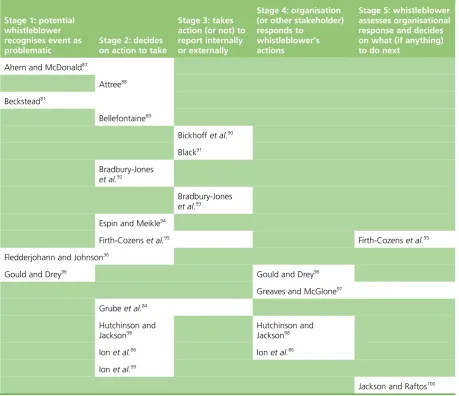
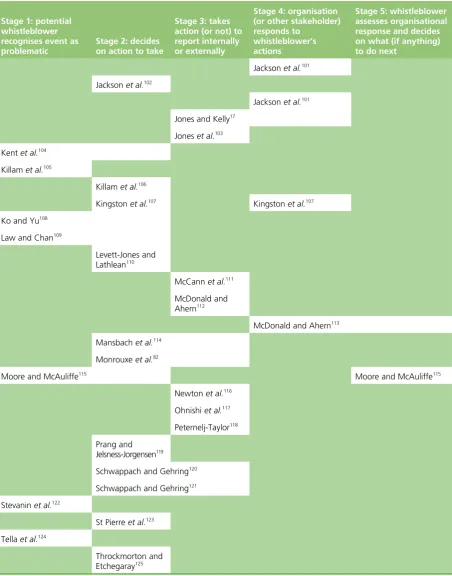
TABLE 1 Types of whistleblowing (from Parket al.) 6 TABLE 2 Assessing wrongdoing: two illustrative vignettes 10 TABLE 3 Steps in the whistleblowing process (from Near and Miceli) 11 TABLE 4 The seminal papers: citations up to 2016 (as calculated by Google Scholar) 18 TABLE 5 Mapping health-care-related studies onto the Near and Miceli stage
model of whistleblowing 22
TABLE 6 Summary of the key inquiries covered inChapter 4 40 TABLE 7 Reasons for and implications of whistleblowing for individuals and the NHS 41 TABLE 8 Summary of selected empirical literature exploring whistleblowing in
health care 112
List of figures
FIGURE 1 Dimensions for assessing wrongdoing (adapted from Skivenes and
Trygstad, p. 97) 9
List of boxes
List of abbreviations
A&E accident and emergency
BMA British Medical Association
CEO chief executive officer
CHI Commission for Health Improvement
CMO Chief Medical Officer
CQC Care Quality Commission
DHSC Department of Health and Social Care
ECHR European Convention on Human Rights
ERA Employment Rights Act
ERRA Enterprise Regulatory Reform Act
GMC General Medical Council
GP general practitioner
HCC Healthcare Commission
HR Human Resources
INO independent national officer
MP Member of Parliament
NCAA National Clinical Assessment Authority
NCAS National Clinical Assessment Service
NICE National Institute for Health and Care Excellence
NMC Nursing and Midwifery Council
NPSA National Patient Safety Agency
NSS NHS Staff Survey
PALS Patient Advice and Liaison Service
PCAW Public Concern at Work
PCS paediatric cardiac surgery
PCT primary care trust
PIDA Public Interest Disclosure Act 1998
POP perception of organisational politics
RCN Royal College of Nursing
Plain English summary
Scientific summary
Background
Recent inquiries and reports into poor standards of NHS care have highlighted the vital role that employee whistleblowing and speaking up can play in the detection and prevention of harm to patients. Although many concerns about poor or unsafe care are dealt with satisfactorily, there is compelling evidence to suggest that some staff (perhaps many) may feel unable to speak up, and that even when they do, their organisation may respond inappropriately. Against this background, we wanted to strengthen the theoretical and empirical evidence-base underpinning whistleblowing policy and practice in the NHS.
Objectives
The overall purpose of this study was to identify theoretically grounded and evidence-informed lessons for the design and implementation of employee whistleblowing policies in the NHS. The specific objectives were to:
1. explore the main strands of the academic and grey literature on whistleblowing and related concepts such as employee silence, and to identify the key theoretical and conceptual frameworks that can inform an understanding of employee whistleblowing
2. synthesise empirical evidence from different industries, sectors and countries with regard to the organisational processes, incentives and cultures that serve to facilitate (or impede) employees raising legitimate concerns
3. examine the UK legal framework(s) for whistleblowing in relation to health care, and review alternative approaches to whistleblowing in other European Union member states, considering what lessons can be learnt at a domestic level from such comparisons
4. distil the lessons for whistleblowing policies and practice from the findings of formal Inquiries into serious failings in NHS care
5. ascertain the views, expectations and experiences of a range of key stakeholders, including service user and carer representatives, about the development of effective whistleblowing policies in the NHS 6. on the basis of findings relating to points 1–5, develop theoretically grounded and evidence-informed
practical guidance for policy-makers, managers and others with responsibility for implementing effective whistleblowing policies in the NHS.
Methods
The study comprised four distinct but overlapping and interlocking strands.
1. A series of linked narrative literature reviews of the theoretical and empirical literature related to raising concerns, speaking up and whistleblowing across a range of sectors and contexts. We adopted a
narrative and interdisciplinary approach to reviewing, which sought to produce a synthesis that embraced the complexities and ambiguities associated with developing an understanding of whistleblowing. 2. An overview of the legal issues related to whistleblowing in an international context. Literature searches
of primary legal sources (statutory and case law materials) were conducted and secondary literature searches of legal databases were undertaken.
4. Interviews with 16 key informants comprising a mix of representatives of user and carer groups, policy advisors, academics, employee organisations, trade unions and the Royal Colleges. The interviews ascertained the views about current whistleblowing policies in the NHS and how these could be improved, and were used to inform and develop the other strands noted above.
Members of the research team liaised throughout the literature review process to discuss and synthesise the emergent findings and ensure that insights were shared and integrated across the work packages. For example, the review of conceptualisations and theories of whistleblowing informed the analysis of the Inquiry reports and the content of the key informant interviews.
Results
This section takes each of the research objectives in turn. We take the first two objectives together as they are informed by the same literature review; and we do not separate out the findings from objective 5 as these were used to shape and inform the wider work.
Research objectives 1 and 2: key conceptual issues and empirical findings
The key conceptual and empirical issues uncovered by our review with practical import for understanding, designing and improving whistleblowing and speaking up policies in the NHS include those detailed in the following sections.
Silence and voice
Policy prescriptions have tended to conceive the issue of raising concerns about unsafe care as a simple choice between deciding to‘blow the whistle’and determining to remain silent. Yet research suggests that such simple dichotomies are unhelpful; for example, health-care professionals may raise concerns internally within the organisation in more informal ways before (or instead of) utilising whistleblowing processes. Such a view highlights the different routes through which health-care employees are able to articulate their‘voice’, and challenges the pejorative notion, often promoted in the media, that health-care professionals are culpable bystanders who tolerate poor standards of care and are‘silent witnesses’to malpractice and mistreatment.
Hearing and acting
The effective voicing of concerns is but the first stage in reshaping better, safer health care: those with influence have to hear, and they have to act. In this regard, we discuss the‘deaf effect’, a concept that has been used in the management and organisation literature to describe the reluctance of senior managers to hear, accept or act on concerns about care raised by employees lower down the hierarchy. Our conclusion is that we need as sophisticated an understanding of these response dynamics as we do of the dynamics of whistleblowing itself.
Interactional processes
Linked to the above is the recognition that whistleblowing is a situated and interactional process and not just a one-off act by an identifiable whistleblower. Most previous research and policy around whistleblowing has focused on the whistleblower, in particular the factors that inhibit whistleblowing and determine who has ‘the courage’to speak up and under what circumstances. However, policy prescriptions need to better acknowledge the complexity and ambiguity of speaking out, and a greater research focus needs to be placed on why some managers respond effectively to concerns raised and others do not.
Whistleblowing, or bell-ringing?
workers). Potentially, this is a more significant issue for health care than for any other sector. As the NHS becomes ever more diverse in terms of collaboration with other sectors, and as social media and information-sharing technologies become more developed, external staff and other stakeholders are increasingly exposed to, and in a position to speak up about, poor-quality care. This is a key area for future research.
Personal factors in raising concerns
There is mixed evidence on the role and impact of personal factors in raising concerns. For example, in terms of length and security of tenure, some studies have found that the more embedded and socialised into a particular culture staff are, the less likely they are to spot poor practice and report it (perhaps because of personal and social links with colleagues). Similarly, the evidence is mixed on whether nurses who, over time, become more socialised and integrated members of the organisation become less likely (through de-sensitisation) or more likely (through better organisational knowledge and developed networks) to detect and report poor care.
Research objective 3: the legal frameworks for whistleblowing
Here, we consider alternative approaches that may be taken in relation to the statutory basis and regulation of whistleblowing.
Oversight from an independent agency
As part of a review of the law in this area, one approach is the creation of a specific national independent whistleblowing agency, a free-standing body or within an existing agency. Such a body could receive and investigate whistleblowing disclosures, collect information on workplace disclosures and have the power to obtain information from regulators for subsequent action. It could issue penalties when organisations have not followed up on information disclosure, order the cessation of retaliation against a whistleblower and be able to order compensation and reinstatement.
Statutory requirement to establish whistleblowing procedures
The establishment and maintenance of whistleblowing procedures could be made a legal requirement. In the Republic of Ireland, the Protected Disclosures Act 2014 (Republic of Ireland.Protected Disclosures Act 2014. Dublin: Government of Ireland; 2014) places a specific requirement on public bodies to create and maintain procedures for employees to make protected disclosures and provide them with information concerning this.
Early-stage protection for whistleblowers
Whistleblowers should be able to apply for whistleblower status to receive early-stage protection. Currently, an employee can apply under section 128 of the Employment Rights Act (Great Britain.Employment Rights Act 1996. London: The Stationery Office; 1996) to an employment tribunal and ask for an order that they can remain employed. This will maintain the contractual arrangement while waiting for the whistleblower’s case to be determined. However, this has limited utility: whistleblowers must act within 7 days, it is expensive and employers cannot be forced to allow the whistleblower to continue working.
Incentives for whistleblowing
One possible approach that can be taken to encourage whistleblowers to come forward is the provision of financial incentives, whether in the form of proportion of fines levied or other financial benefits obtained as a result of their disclosure. Incentives have been used in other contexts, notably in the USA, where the Dodd–Frank Wall Street Reform and Consumer Protection Act (United States of America.Dodd–Frank Wall Street Reform and Consumer Protection Act.Washington, DC: Library of Congress; 2010) provides substantial incentives of between 10% and 30% of monies of>US$1M recovered by the government.
Confidentiality/‘gagging’clauses
appropriate in the public sector, and in the past the Secretary of State for Health has indicated that these would be banned. Further work and/or guidance in this area may be necessary.
Using the criminal law to protect whistleblowers
The legislation in England and Wales does not provide for criminal penalties against those who commit reprisals against whistleblowers. In contrast, such provisions do apply in relation to certain other
jurisdictions. For example, the US Sarbanes–Oxley Act {Sarbanes–Oxley Act [2002] (Pub.L. 107–204, 116 Stat. 745, enacted July 30, 2002)} states that it is an offence to‘knowingly and with intent’take actions harmful to another person.
None of the potential avenues for legal innovation laid out above offers simple or swift remedial action to a patched and patchwork legal system. Nonetheless, they do lay out avenues for future discussion, consultation and empirical research.
Research objective 4: learning from the findings of formal inquiries
There have been numerous formal Inquiries into care failings in the NHS, and we reviewed what these had to say about whistleblowing, from the Kennedy inquiry up until the latest round of Francis Reports following the care failures in Mid Staffordshire NHS Foundation Trust.
Few specific recommendations on whistleblowing
It is perhaps surprising given their subject matter, but there is little specific discussion of, or recommendations concerning, whistleblowing across these Inquiries. The Inquiries focus (perhaps disproportionately) on patient complaints rather than on employee voice. Of some 820 recommendations across all of the Inquiries
reviewed, only eight are directly concerned with whistleblowing.
Diverse definitions of whistleblowing
There appear to be three dimensions to whistleblowing contained with formal Inquiry reports: (1) whether or not the person works for the organisation, (2) whether they raise concerns internally or externally (or escalate from internal to external, if the internal route produces no results) and (3) whether or not they are a whistleblower in the strict legal sense of the term and are making a‘qualifying statement’.
Cultural change over legal safeguards
It was notable that most Inquiry accounts focused on the‘system’rather than on the people within it. The most consistent system remedy drawn out from Inquiry recommendations is cultural reform and renewal rather than legal safeguards. By finding fault with culture and providing prescriptions for change, several Inquiry reports make assumptions that require examination. First, they presuppose that we can identify and assess common aspects of culture, as well as identify which aspects are supportive of, or inimical to, high-quality care. Second, they assume that these aspects of culture can be purposely changed, that any changes will lead to improvements, and that the costs and dysfunctions from such prescriptive changes will be outweighed by the benefits. However, much research shows more complex and nuanced relations between cultures, practices and outcomes than implied by Inquiry reports.
Reinvention and retreads
Evident from the Inquiry reports is a high degree of reinventing the wheel, with some return to similar solutions over time: a situation that has been described as‘Groundhog Day’as recommendations from previous Inquiries become recycled. The clearest example of this is the repeated identification of culture as both a culprit of and a solution to periodic failings in the quality of care in the NHS.
Optimism over improvements
that the deep-rooted and diverse challenges exposed by these Inquiries have yet to be fully addressed, and that the potential for effective whistleblowing policies has yet to be fully exploited.
Conclusions
Taken together, the arguments emerging through the various strands of this work highlight the need for a new socially situated research agenda, not just of whistleblowing as aberrant activity, but of the full range of organisationally embedded communications, sense-making, judgement-forming and responses. Although some form of whistleblowing–and the social, legal and structural arrangements in support of it–may always be necessary, a better understanding of these organisationally situated dynamics may, paradoxically, enable a diminution of its prominence.
Current policy prescriptions that seek to develop better whistleblowing policies and nurture open reporting cultures are in need of better evidence. Although we have set out a wide range of issues that need consideration in the development of whistleblowing policies, it is beyond the remit of this research to convert these concerns into specific recommendations of the ways in which current policies can be improved: that is a process that needs to be led from elsewhere, in the light of this new evidence summary, and in full partnership with the service. It is our view, however, that there is still much to learn regarding this important but under-researched area of health policy and management practice, and to this end we have highlighted a number of important gaps in knowledge that are in need of more sustained research.
Funding
Chapter 1
Introduction
Whistleblowing: a complex and contested issue
Employee whistleblowing–loosely, the raising of concerns or speaking up about unsafe, unethical or poor-quality care by employees to persons able to effect action–has emerged as a central issue in debates over quality and safety in many health systems.1In the English NHS, recent inquiries and reports into poor
standards of care have highlighted the vital contribution that whistleblowing can play in the detection and prevention of harm to patients.2Yet, for all its importance, the act of whistleblowing is no simple issue3
and is fraught with ambiguity. For example, individual whistleblowers may be perceived as heroes by some (for championing patients’interests, promoting better care and challenging management) but may be seen as villains by others (for denigrating services and damaging professional and organisational reputations). Indeed, in the popular media whistleblowers are often portrayed either as‘courageous employees’who act to maintain standards at great personal cost or as‘disloyal malcontents’who‘snitch’or‘grass’on colleagues and pursue their own interests regardless of the dysfunctional consequences for individuals and organisations. Moreover, it would be naive to assume that all whistleblowers are necessarily motivated entirely by genuine concerns about patient care. Some may be motivated in addition by work grievances or personality clashes; in the extreme, concerns may even be of a malicious nature. In fact, clear delineation between such labels is problematic. Whistleblowing may arise out of complex and contested circumstances, as what is‘safe’and what is‘acceptable’(in terms of quality) are disputable. Therefore, binary distinctions (such as hero/villain, loyal/disloyal and warranted/unwarranted) are often unhelpful, and disguise the complexity and ambiguity of whistleblowers and whistleblowing.
When concerns are raised, it is also important that organisations respond positively, learn from any mistakes of the past and put in place effective policies to prevent such mistakes from happening again. Unfortunately, in the NHS there have been all too many high-profile examples of front-line staff raising serious concerns that have not been adequately dealt with by the organisation. Patients have suffered as a result, and staff, too, may have been harmed from the direct and indirect consequences of their raising concerns. As Sir Robert Francis’independent review,Freedom to Speak Up, concluded:
. . . there is a culture within many parts of the NHS which deters staff from raising serious and sensitive concerns and which not infrequently has negative consequences for those brave enough to
raise them.
Contains public sector information licensed under the Open Government Licence v3.02
However, whistleblowing always happens in a deeply cultural and highly situated organisational and policy context, and involves managing ambiguity and handling contestation. Whistleblowing policies thus need very careful design, implementation and enacting to protect those raising legitimate concerns, as well as offering support in cases of fallout from more doubtful or even vexatious whistleblowing.
Numerous surveys across different professional groups confirm significant shortcomings (or, at least, perceptions of significant shortcomings) in the protection and support offered to whistleblowers seeking to raise legitimate concerns about poor or unsafe patient care in the NHS. A possible reason for this is the widely held perception among health professionals that they will be victimised, ostracised or bullied if they raise concerns about colleagues or poor standards of care.4This is not a new development. More than a
junior staff, remained silent in the face of poor care or wrongdoing as they feared raising concerns and/or challenging superiors because of the possible repercussions:
There is a real fear among staff (particularly among junior doctors and nurses) that to comment on colleagues, particularly consultants, is to endanger their future work prospects. The junior needs a reference and a recommendation; nurses want to keep their jobs. This is a powerful motive for keeping quiet.
Contains public sector information licensed under the Open Government Licence v3.05
These concerns remain current. The 2015 NHS Staff Survey (NSS) found that, when asked whether or not their organisation treated staff involved in near misses, errors and incidents fairly, fewer than half (43%) of staff reported that this was the case. In addition, only half (50%) of staff reported that feedback was given by their organisation about any changes that had been made in response to the reported error or incident.6In 2013, the Royal College of Nursing polled its members, with almost one-quarter (24%) saying
that they had been warned off or discouraged from whistleblowing and 45% saying that, even after they had spoken out, their employer had taken no action. Similarly, a survey of doctors undertaken in 2012 by the Medical Protection Society reported that only 11% of respondents said that they would be confident in the process if they were to blow the whistle, and 49% of doctors reported that‘fear of consequences’ is why the whistleblowing process is ineffective. Only one-third (33%) of doctors who had blown the whistle said that colleagues supported their decision and<40% felt that their concerns had been addressed (with, as a result, 18% feeling isolated, 14% moving location or job and 12% reporting health issues).4
That there should be so much uncertainty and disquiet about speaking out should not come as a surprise. Local discursive practices (e.g. on the nature of success, failure, risk and performance) and local operational contingencies (such as resource constraints, service rivalries and stakeholder pressure) will have a powerful influence on the willingness of employees to raise concerns and the ability and willingness of employers to respond appropriately. Of course, whatever the local contingencies and discourses, these play out within a larger political, policy and legal context, and it is to these that we now turn.
Policy and legal context
Currently, protection for whistleblowers in England is enshrined entirely within an employment context and is contained in the Employment Rights Act (ERA)7as amended by the Public Interest Disclosure Act 1998
(PIDA)8(seeChapter 5, which contains a fuller overview of the legal framework related to whistleblowing
in England). PIDA was passed to protect whistleblowers in the wake of the Bristol paediatric cardiac surgery scandal and provides legal protection against detriment for workers who raise concerns in the public interest (also known as making a disclosure) about a danger, risk, malpractice or wrongdoing in the workplace that affects others. For a whistleblower to be protected, the disclosure must be in the public interest, the worker must have a reasonable belief that the information shows the occurrence, or likely occurrence, of one of the categories of wrongdoing listed in the legislation, and the concern must be raised in the correct way. This is now enshrined in the NHS Constitution,9which mandates that:
l staff should raise concerns at the earliest opportunity
l NHS organisations should support staff by ensuring that their concerns are fully investigated and that there is someone independent, outside their team, who can provide support
l there is a legal right for staff to raise concerns about safety, malpractice or other wrongdoing without suffering any detriment.
Nursing and Midwifery Council (NMC), have professional codes that place obligations on registrants to report untoward incidents to their employers, and they have produced guidance for doctors, nurses, midwives and students raising concerns about quality of care. In 2012, NHS Employers launched theSpeaking Up Charter,10
which encouraged NHS organisations to pledge publicly a commitment to creating cultures and policies that support staff in raising concerns and a continuous review and evaluation of such policies to ensure that they remain effective. The Department of Health and Social Care (DHSC) has also commissioned a whistleblowing helpline that provides free advice and support to staff on whether or not and how to raise concerns at work. Since 2015, a statutory duty of candour has operated that requires NHS bodies and all Care Quality Commission (CQC)-registered providers (rather than individuals) to be open and honest when an unintended or unexpected incident has resulted in, or could result in, death, moderate or severe physical harm, or prolonged psychological harm. In such instances, providers must notify the patient involved, offer an apology and follow up the incident in writing.
The report of the independentFreedom to Speak Upreview, chaired by Sir Robert Francis,2identified 20
principles and associated actions that should underpin whistleblowing polices in the NHS and recommended that the Secretary of State for Health should review, at least annually, the progress made in their
implementation. These principles and actions include:
l a common policy and procedure for raising concerns, including better investigations and promoting a model of good practice in the handling of concerns
l training for managers and all staff in the raising and handling of concerns
l cultural change towards creating more open, transparent and learning cultures that value communication and staff engagement
l Freedom to Speak Up guardians to be appointed to each NHS organisation, supported by an independent national officer (INO)
l legal changes to antidiscrimination laws to protect whistleblowers from discrimination in recruitment
l additions to the list of prescribed persons to whom protected disclosures can be made.
In July 2015, the Secretary of State for Health confirmed the steps to be taken to develop a culture of safety, including the appointment of a national guardian alongside a local guardian in every NHS trust, with the goal of promoting the raising of concerns across the NHS. Although all NHS organisations are now required to have policies and procedures in place that urge staff to‘speak up’when necessary, there is no requirement for uniformity, and, as noted by Francis,11different sources of guidance express themselves differently and
there is, therefore, a risk that such a plethora of information, advice and guidance may be confusing for staff working in the NHS. For example, staff may not know where to go for the best advice or if, having spoken to a particular organisation, they still need to report their concerns elsewhere.
Aims and objectives of this study
Against this background, it is clear that there are serious uncertainties and challenges in relation to current whistleblowing and speaking up policies in the NHS. Our study addresses these concerns with the aim of developing theoretically grounded and evidence-informed guidance to assist policy-makers, managers and others responsible for designing/implementing effective whistleblowing and speaking up policies.
The specific objectives were to:
1. explore the main strands of the academic and grey literature on whistleblowing and related concepts such as employee silence, and to identify the key theoretical and conceptual frameworks that inform the understanding of employee whistleblowing
3. examine the legal framework for whistleblowing in relation to health care as a mechanism for promoting (or inhibiting patient safety) and review the approaches to whistleblowing in relation to European Union member states and consider what lessons can be learnt at a domestic level from such comparisons 4. distil the lessons for whistleblowing policies and practice from the findings of formal Inquiries into
serious failings in NHS care
5. ascertain the views, expectations and experiences of a range of key stakeholders, including service user and carer representatives, about the development of effective whistleblowing policies in the NHS and use these views to help structure and inform the desk research set out above
6. on the basis of findings relating to points 1–5, develop theoretically grounded and evidence-informed practical guidance for policy-makers, managers and others with responsibility for designing and implementing effective whistleblowing policies in the NHS.
Project overview and reporting structure
Full details of the methods used at each stage of the project are reported within the corresponding chapters, which broadly correspond to the six core objectives as set out above. In essence, the study comprised four distinct but overlapping strands:
1. a series of linked narrative literature reviews of the theoretical and empirical literature related to raising concerns, speaking up and whistleblowing across a range of sectors and contexts
2. an overview of the legal issues related to whistleblowing in an international context
3. a review of formal inquiry and government documents related to previous failings of NHS care 4. scoping interviews with key informants.
Throughout the project (completed in 1 year), the whole project team met extensively to discuss the emerging findings from each strand and to ensure that these emerging findings informed and complemented the ongoing work. In that sense, the work reported under separate chapter headings, although having a distinct focus that maps to the core objectives, has been informed by the parallel stands of work reported elsewhere. Supporting this, the scoping interviews with key informants were developed and implemented early in the project and helped to structure and inform the main desk research.
The chapters reporting the key aspects of the research are as follows:
l Chapter 2–the conceptual underpinnings of whistleblowing
l Chapter 3–empirical evidence on whistleblowing
l Chapter 4–the main whistleblowing inquiries and formal responses to inquiry recommendation
l Chapter 5–the legal underpinnings of whistleblowing
l Chapter 6–key informant interviews.
Chapter 2
The conceptual underpinnings
of whistleblowing
Introduction
Any study intending to explore whistleblowing in the NHS requires an understanding of the conceptual underpinnings of whistleblowing and the key theoretical and methodological debates within whistleblowing research. This chapter, therefore, begins the process of unpacking what is meant by whistleblowing and introduces some of the sources of the ideas, conceptual underpinnings and different approaches to
understanding whistleblowing and related terms such as‘speaking up’. The material draws on the systematic literature review detailed inChapter 3(see that chapter for an account of the methods by which the literature was uncovered and collated), as well as from the accumulated expertise of the research team and from discussions with leading researchers in the field.
The chapter is structured as follows. We begin by outlining how whistleblowing has developed as a distinctive field of enquiry, and explore how whistleblowing and related concepts such as speaking up have been defined in the literature. We then review the main theoretical perspectives on whistleblowing that have been seen in the literature, and examine emerging perspectives that have the potential to develop our understanding further. We then rehearse the key methodological challenges involved in whistleblowing research, before drawing out some of the implications of these for more thorough NHS-specific research.
The emergence of whistleblowing as a field of study
Whistleblowing was first brought to wide public awareness in the 1970s, and has become progressively more high profile. The release of the Pentagon Papers in 1971 was not the first example of whistleblowing, but it was arguably the first to be widely known. There are three competing explanations for the origins of the term‘whistleblowing’, and these provide useful insights into the tensions and ambiguities that still surround the practice. The most frequently encountered explanation is that it comes from an analogy with police officers blowing a whistle, to attract the attention of an individual to whom the officer wished to speak, or to bring other officers in the vicinity to the scene (in the days before mobile communications). Another suggested analogy is with the use of a whistle by referees in sport to call a halt to a game after a foul has been committed.
A third, perhaps less likely, but nonetheless intriguing, explanation, is that the term derives from 19th century US legislation that required train drivers to sound a whistle when they approached crossings. Failure to do so could lead to fines, and, moreover, citizens calling attention to these failures could receive payment for doing so. Indeed, in the US legal system it remains the case that those blowing the whistle on financial irregularities can sometimes stand to gain personally from the reporting of such wrongdoing. This articulation of whistleblowing speaks to the still-current concern that whistleblowers might be motivated by personal gain. Taken together, then, these putative etymologies describe whistleblowing variously as an act of calling for help, crying foul or informing the authorities (perhaps) for personal gain.
The academic interest in whistleblowing followed its greater public profile, with a handful of seminal articles published between 1983 and 1985 proving influential (seeChapter 3,Literature review methods). From the outset, whistleblowing research was inherently multidisciplinary, with scholars from law, management, public administration, sociology and psychology all interested in the phenomenon. An unusual feature of the whistleblowing field is the relative lack of definitional debates. Over 30 years ago, Near and Miceli12defined
illegitimate practices under the control of their employers, to persons or organizations that may be able to effect action’. This definition quickly gained almost universal acceptance and application, and remains the standard definition. The surprising lack of debates on definition among whistleblowing researchers stands in stark contrast to debates within wider society concerning the purpose and value of whistleblowing, the motivation of whistleblowers and the circumstances under which they should receive legal protection for their actions. The last issue is key: prospective whistleblowers are likely to be less concerned about how academics define whistleblowing, and more concerned about how the law defines it and whether or not they can expect protection under the law for their actions.13
The debate continues as countries around the world consider enacting whistleblowing protection legislation or revising existing laws.
Raising concerns, speaking up or blowing the whistle?
Academics typically define a given social phenomenon more narrowly and precisely than the way in which lay people talk about the phenomenon. Whistleblowing represents an unusual reversal of that pattern, as the most widely used definition12incorporates behaviour that most employees or citizens would be unlikely
to label whistleblowing. Parket al.,14who developed a typology of whistleblowing based on a decision
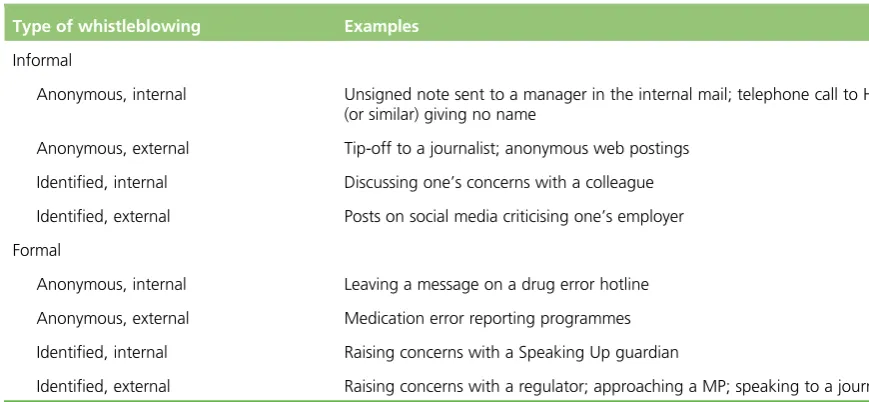
tree, illustrate this. They suggest that individuals who have decided to raise concerns face three key choices: to raise issues (1) informally or formally, (2) anonymously or on the record and (3) internally or externally. This typology suggests eight types of whistleblowing, only some of which would fit with how most people would understand the concept. For example, before deciding to blow the whistle employees usually find themselves trying to work out exactly what is happening, often through engaging in dialogue with colleagues.15Such behaviour could be consistent with the informal/identified/internal whistleblowing
pathway,14but it seems unlikely that staff would perceive such conversations as a form of whistleblowing. Table 1details how the Parket al.14typology might translate into a health-care context.
Notwithstanding the Parket al.14typology detailed above, the academic literature has traditionally focused
on a dichotomous choice between whistleblowing and silence; that is, when faced with wrongdoing, an employee makes a conscious choice either to remain silent or to act by raising concerns.16Yet, as
[image:34.595.77.512.532.733.2]highlighted by Jones and Kelly,17this simplistic dichotomy obscures a range of alternative strategies to
TABLE 1 Types of whistleblowing (from Parket al.14
)
Type of whistleblowing Examples
Informal
Anonymous, internal Unsigned note sent to a manager in the internal mail; telephone call to HR (or similar) giving no name
Anonymous, external Tip-off to a journalist; anonymous web postings
Identified, internal Discussing one’s concerns with a colleague
Identified, external Posts on social media criticising one’s employer
Formal
Anonymous, internal Leaving a message on a drug error hotline
Anonymous, external Medication error reporting programmes
Identified, internal Raising concerns with a Speaking Up guardian
Identified, external Raising concerns with a regulator; approaching a MP; speaking to a journalist
whistleblowing that may be just as effective in identifying and preventing wrongdoing. Such strategies might include interpersonal approaches such as the use of humour or sarcasm to signal discontent, or informal and off-the-record discussions with managers and employees. Jones and Kelly17suggest that these‘informal and
circumlocutory’channels of communication may be valuable organisational mechanisms for addressing poor standards of care. Indeed, they argue that these can prove more effective than formal reporting systems, as they are more likely to circumvent the‘deaf effect’(see below). This fits with the current emphasis in NHS policy debates on‘raising concerns’and‘speaking up’, rather than whistleblowing per se, consistent with our observations inChapter 3that the relevant literature within health care tends to emphasise voice behaviours rather than formal whistleblowing.
Francis11notes that many staff appear unhappy with the term whistleblowing, hence the suggestion that
terms like‘raising concerns’and‘speaking up’are to be preferred. However, it is useful to think of raising concerns, speaking up and whistleblowing as a continuum, even though, arguably, all can be subsumed under the academic definition of whistleblowing. We can differentiate between them in various ways, but it may be most useful to think about how employees might distinguish between them. An employee who has concerns about a particular issue that affects quality and safety of patient care might‘raise concerns’ with their line manager, possibly informally. If they get no response, they may choose to‘speak up’, potentially talking again to the same manager, but this time more formally and perhaps making clear that they expects their concerns to be a matter of record. If the issue is still not resolved, they may choose to ‘blow the whistle’to someone more senior, or perhaps go outside the organisation.
From an employee perspective, the act of‘raising concerns’may be relatively low risk, something that might be done routinely, perhaps even just in passing (e.g.‘I think the new health-care assistant is a little brusque with the older patients’). Speaking up is more serious: the very phrasing implies raising one’s voice or breaking a silence. The perceived level of risk may not be very great; in some cases the employee may only risk feeling foolish if they are mistaken, although their concern about this may, in itself, be enough to ensure that they remain silent.15Whistleblowing is a more significant act, to which the organisation may respond
negatively. Alford18has argued that whistleblowers are defined post hoc, by the organisation’s response to
their action. Using the NHS terminology, someone who thought they were just‘raising concerns’or‘speaking up’can discover that they are a whistleblower if the organisation responds negatively. The general perception among NHS staff and the wider public is that NHS whistleblowers tend to fare badly,19so staff thinking about
speaking up may, from the outset, be concerned that they will receive a very negative response. This may lead individuals with relatively low-level concerns to refrain from raising them.
In a health-care context, another important distinction between raising concerns/speaking up and whistleblowing may be the focus of the concern. The classic definition of whistleblowing specifies that it is about‘illegal, immoral or illegitimate practices’.20Many issues that could affect care quality and patient
safety, and about which we would hope staff would raise any concerns, do not necessarily come under any of those headings. Staffing levels, poor practice or poor performance (e.g. from a colleague dealing with personal problems) are all issues that could have a detrimental effect on patient care, but that staff would probably not view as‘wrongdoing’(see below for a more detailed discussion). Nevertheless, such issues may eventually lead to whistleblowing if they are not properly addressed. If a junior doctor raised concerns about a colleague’s confidence in dealing with challenging patients, they are clearly not concerned about‘illegal, immoral or illegitimate’behaviour. However, if those concerns are not addressed, and problems continue, a decision to speak to someone more senior about the issue is implicitly speaking up about the failure to address the problem. Such action is more consistent with whistleblowing. This is a subtle but important point that is often missed: whistleblowers are often described as blowing the whistle about a specific issue (e.g. poor practice), but they are often effectively blowing the whistle on management’s failure to act once made aware of the original issue.
Recent discussion of speaking up2,21,22has tended to frame the problem in terms of creating environments
in which staff feel more able to voice their concerns. Yet, as Francis11and Kelly and Jones19observe,
This is consistent with the‘deaf effect’, a term originally coined by Keil and Robey23to describe the
reluctance of senior managers to hear, acceptand act onchallenging observations from lower down the organisation. Vandekerckhoveet al.24suggest that researchers need to pay more attention to the question
of how recipients of whistleblowing respond, and in particular to‘hearer action’, which we might view as the antithesis of the deaf effect. Whereas it is widely recognised that it takes a degree of courage for someone to blow the whistle, it is less immediately obvious that it may also take courage for a manager to take on board the issues and act on them. Just as the whistleblower knows that the line manager may not want to hear bad news, so the line manager knows that more senior management may be similarly reluctant to be informed of breaches or the requirements of remediation. Whistleblowing recipients in management roles know that their actions in raising the whistleblower’s concerns may receive a negative response and may even lead to the sort of retaliation and victimisation that can sometimes be experienced by whistleblowers themselves. For this reason, Vandekerckhoveet al.24suggest that there is a need for
research into‘hearer courage’to understand‘which managers have the courage to hear, under which circumstances, and with regard to which wrongs’(p. 316). The same issues may pertain to the new Speaking Up guardian roles in the NHS, for whom a whistleblower’s report may feel like the whistleblower taking a burden off their own shoulders and placing it on the guardian’s.
Our analysis of the various public inquiries (seeChapter 4) suggests that senior management may sometimes also suffer from‘collective myopia’,25a shared inability to see a problem. This is potentially
more problematic than the deaf effect, as it leaves those in management positions genuinely unable to see what the whistleblower is trying to bring to their attention. This could lead an individual to proceed from raising concerns to speaking up to internal whistleblowing, not in search of‘someone willing to listen’but in search of‘someone able to see’. However, the NHS can be viewed as a single large organisation in many ways, and criticisms of regulator responses to cases such as that at the centre of the Mid Staffordshire NHS Foundation Trust Public Inquiry11suggest that even when the individual goes outside the immediate
organisation, they may still find people unable to see/unwilling to listen. There is a sense in which raising concerns and speaking up in health care adhere to both organisational‘etiquette’and the hierarchical chain of command, which inevitably means that management can choose to ignore the issue. There is also a sense that individuals may feel that they have done their duty in raising the issue.26Blowing the whistle, especially
externally, raises the stakes and is much harder to ignore.
Blowing the whistle on what?
Central to whistleblowing research has been the idea of wrongdoing, a catch-all term that includes everything from persistent acts of minor incivility to multibillion-pound corruption. Within any given organisation, there are various types of wrongdoing on which an individual might feel it necessary to blow the whistle. The focus of the present project is on issues pertaining to the quality and safety of patient care, but it is worth examining the ways in which perceptions of the nature of the wrongdoing might affect whistleblowing. The bulk of whistleblowing research has been concerned with pecuniary wrongdoing such as fraud and corruption, in which there is, in principle, a final legal judgement to be obtained as to whether or not wrongdoing has occurred. In contrast, issues around safety and quality can be much more ambiguous, a point illustrated by two cases that form part of NHS folklore on whistleblowing: the‘Graham Pink case’27
and Bristol Royal Infirmary.5
The Graham Pink case is generally remembered as an archetypal whistleblowing narrative. Pink (a nurse) raised concerns with the hospital’s management about dangerously low staffing levels; management would not listen and did not act, so Pink‘blew the whistle’and was eventually removed from his post for his trouble. Vinten28suggests a somewhat different interpretation, arguing that there was ample evidence that
staffing levels–about which there was (and is) considerable scope for experienced practitioners to reach very different views. Although there will be a level of staffing that everyone would agree is unsafe, it has proved difficult to develop an evidence-based metric to calculate minimum safe staffing levels and appropriate skill mix.29
The tragic events surrounding infant heart surgery at Bristol Royal Infirmary might appear to be more
amenable to an evidence-based analysis, given that the extensive use of clinical audit data allows comparisons of performance over time and between units. Yet, as Weick and Sutcliffe30observe, even with such
extensive data there is still a need for organisations to make sense of the data, and all sense-making is intentional and social. There was clearly a desire at Bristol Royal Infirmary to believe that the unit was performing acceptably, and management and senior clinicians interpreted the data in terms of a learning curve. They focused on evidence that the unit was improving, and overlooked evidence that it was still underperforming relative to comparable units and that it was improving only slowly.
As the analysis of public inquiries shows (seeChapter 4), issues that appear unambiguous after the event may have seemed open to interpretation of the event at the time. This creates a challenge for policy-makers: we are generally dealing not with malevolent individuals or corrupt systems, but with individuals and systems that are failing in some way, and resistant to hearing the messages about that failure. As the whole premise of whistleblowing is‘wrongdoing’, and wrongdoing appears a moral appellation, people are reluctant to use the term and recipients are reluctant to hear it. This underlines the importance of developing a greater understanding of hearer courage, particularly in a NHS context.
The inherent ambiguity of many of the situations complained about at the heart of whistleblowing in the NHS draws further attention to the importance of definitional issues. Brownet al.31suggest that wrongdoing
be defined as‘when a person or organisation does things that are unlawful, unjust, dangerous or dishonest enough to harm the interests of individuals, the organisation or wider society’. This definition is both more precise and more encompassing than the traditional‘illegal, immoral or illegitimate practices’,20and would
certainly cover actions/omissions that could have a negative impact on care quality and safety.
Taking this further, Skivenes and Trygstad32suggest that there are six‘intrinsic dimensions’that affect
individuals’assessment‘of an alleged act or practice of wrongdoing and the degree of importance (or
seriousness) of an act of wrongdoing’(p. 97). These dimensions are (1) whether the perception of wrongdoing is subject or objective, (2) whether it relates to values (such as dignity) or facts (such as clinical outcomes), (3) the frequency of the wrongdoing (e.g. a rare occurrence or an ongoing problem), (4) whether or not the wrongdoing was intentional, (5) whether or not there is a public interest dimension and (6) the persons/groups affected (e.g. are they vulnerable?). In a NHS context, the final two dimensions are arguably‘fixed’; the activities of the service always have a public interest dimension, and patients are by definition vulnerable persons even if they would not in the normal course of life be viewed in those terms. It is therefore only the first four dimensions that influence whether or not a situation is assessed as wrongdoing, and, if so, how serious it is (Figure 1;Table 2provides some simple vignettes that illustrate the opposite ends of these dimensions).
The main purpose of the two examples inTable 2is to illustrate the assessment dimensions, but vignettes like these are also useful in allowing us to place ourselves in the place of staff observing possible wrongdoing.
Subjective – Objective Values – Facts
[image:37.595.100.497.662.722.2]Happens rarely – Happens often Unintentional – Intentional
FIGURE 1 Dimensions for assessing wrongdoing (adapted from Skivenes and Trygstad,32