doi:10.4236/ajac.2011.24056 Published Online August 2011 (http://www.SciRP.org/journal/ajac)
Simultaneous Determination of Cadmium and Lead Using
PEDOT/PSS Modified Glassy Carbon Electrode
Sukeri Anandhakumar, Jayaraman Mathiyarasu*, Kanala Lakshmi Narasimha Phani, Venkataraman Yegnaraman
Electrodics and Electrocatalysis Division, Central Electrochemical Research Institute, Karaikudi, India E-mail: [email protected]
Received December 30, 2010; revised March 4, 2011; accepted May 16, 2011
Abstract
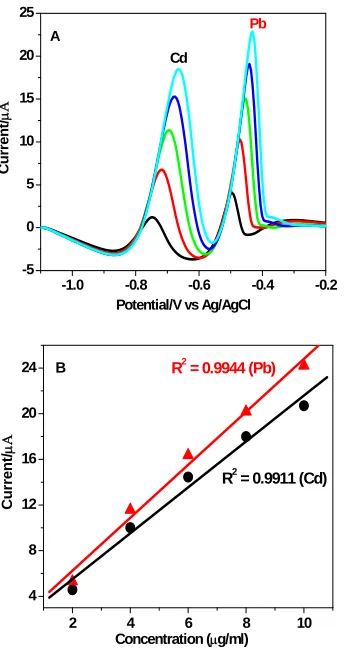
In this work, we report the simultaneous determination of cadmium and lead using glassy carbon electrodes (GCE) modified by poly(3,4-ethylenedioxythiophene) (PEDOT) for linear sweep anodic stripping voltam-metry (LSASV). The modification allows metal detection without involving oxygen removal, mechanical stirring and introduction of alloying additions such as Hg, Bi, Sb, etc. during the pre-concentration step. In-troduction of poly (4-styrenesulphonate) (PSS) as dopant in the PEDOT matrix improves reproducibility, stability and sensitivity in the detection. Both cadmium and lead peaks were readily quantifiable over the linear range of 2 - 10 g/ml and the detection limit being 1.47 g/ml and 1.15 g/ml respectively. The cali-bration plot shows a linear response with correlation coefficient of 0.9911 and 0.9944 for cadmium and lead respectively. Thus, the GC/PEDOT/PSS modified electrode suggested as a suitable matrix for rapid moni-toring of these heavy metals at trace levels.
Keywords:Stripping Voltammetry, Cadmium, Lead, Conducting Polymer, PEDOT-PSS, Heavy Metals
1. Introduction
Contamination of water by trace levels of heavy metals presents a major current environmental threat, resulting in an ever-increasing demand for the detection and mon-itoring of metal contaminants [1]. Electroanalytical tech-niques provide efficient, versatile and highly sensitive method of detecting a wide range of inorganic and or-ganic substances at very low concentrations [2]. Anodic stripping voltammetry (ASV) is one of the most efficient techniques in this field, owing to an effective cathodic pre-concentration step, in which the analyte metal ion is reduced and deposited onto the electrode surface as a thin layer, followed by a stripping step, the results of which are readily quantifiable.
During the development of ASV over the past 50 years, mercury film electrodes (MFE) and hanging mercury drop electrode have been used due to their high sensitiv-ity and remarkable reproducibilsensitiv-ity [3-5]. Due to its toxic-ity, the traditional mercury drop electrode is being pro-gressively replaced by modified glassy carbon electrode and screen-printed electrodes [6,7] Wang et al. [8] found that bismuth presents analogous analytical performance when compared to mercury for stripping analysis. This
similarity can be explained taking into account the fact that bismuth forms a “fused alloy” with metals [9].
Detection of trace heavy metals needs the removal of dissolved oxygen, stirring and addition of any external metals to improve the sensitivity of electrode surface. During miniaturization of the electroanalytical devices, the above condition needs to be avoided for the analyte detection. We report for the first time the conducting polymer modified electrode (GC/PEDOT/PSS) as a new alternative electrode material for heavy metals detection at micro- molar levels without involving the preparative steps. Further, simultaneous detection of cadmium and lead on a PEDOT/PSS modified glassy carbon electrodes is achieved employing linear sweep anodic stripping voltammetry in acetate buffer solution of pH 4.5.
case of microsensors. Among the numerous polymeric materials developed and studied over the past few dec-ades, polyanilines, polypyrroles and polythiophenes con-stitute an important class. Among these, polythiophenes have received a significant amount of attention as elec-trode modifiers in a variety of applications such as organic light-emitting devices, sensors, polymer batteries, electro-chromic windows, etc. [10,11]. Our group has extensively reported on the use of PEDOT modified electrodes for sensing of biologically important analyte molecules in the recent past [12,13].
2. Experimental
2.1. Materials
All chemicals were of analytical grade and used without further purification. 1000 g/ml stock solutions of Pb(NO3)2 and CdCl2 were prepared by dissolving the reagents in Milli-Q water (18.2 Ω) (Millipore). The mo-nomer, 3,4-ethylenedioxythiophene (EDOT, Aldrich), poly (4-styrenesulphonate) (PSS), tetrabutylammonium per-chlorate (TBAPC, Fluka), acetonitrile (E-Merck), were used as received. The acetate buffer solution (pH 4.5) was prepared by adding CH3COONa (E-Merck) to a CH3COOH (E-Merck) solution.
For voltammetric studies, a 3-mm diameter glassy carbon disk (BAS Inc.) served as the working electrode with a platinum wire and Ag/AgCl (3M NaCl) as auxil-iary and reference electrodes respectively.
2.2. Instrumentation
Voltammetric experiments were carried out using a PalmSens portable electrochemical analyzer (Palmsens BV, The Netherlands) at ambient temperature (25 ± 1oC). To record linear sweep voltammetry (LSV), the follow-ing input parameters were used: Scan rate: 50 mV·s–1, deposition potential: –1.1 V, deposition time: 120 s, equ- ilibration time: 5 s.
2.3. Preparation of PEDOT/PSS – Modified GCE
The GCE surface was polished first on a fine polishing cloth using 1.0 and 0.06 μm alumina powder, and finally sonicated in Milli-Q water for 5 minutes. Before elec-tropolymerization, the polished electrode was pretreated by cycling it between –0.9 to 1.5 V vs Ag wire at 50 mV s-1 in acetonitrile containing TBAPC for 10 minutes. PEDOT was electrodeposited on the GCE from a solu-tion of 50 mM EDOT + 0.1 M TBAPC in acetonitrile by cycling between –0.9 to 1.5 V vs Ag wire (pseudo-refer-
ence electrode). PEDOT film was allowed to grow on the GC surface over three successive scans, as seen from the increasing anodic and cathodic peak current density val-ues. The electropolymerization of EDOT was highly reproducible and the cyclic voltammograms obtained during the electropolymerization process agreed closely with that reported earlier [14].
To increase the anionic nature of GC/PEDOT film, the electrode was cycled between –0.9 to 1.2 V vs Ag/AgCl reference electrode at 50 mV·s–1 in 1% PSS solution. This modified electrode is hereafter referred as GC/ PEDOT/PSS.
3. Results and Discussion
Figure 1 shows the LSASV responses of 20 g/mlCd2+ and Pb2+ at bare, PEDOT, PEDOT-PSS modified glassy carbon electrodes. In Figure 1, a relatively small current response is observed at the PEDOT modified GCE (curve b), which shows difficulty for the metal ions to be adsorbed onto the PEDOT surface. This may be reasoned as the cationic nature of the PEDOT materials [15], which does not favor adsorption of cationic metal species on its surface. On the other hand, for the PEDOT-PSS modified GCE electrode, the stripping peak current val-ues for the two metal ions are larger than those obtained from the bare and PEDOT modified GCE electrodes. This can be explained that the PEDOT film doped with PSS exerts negative charges on the surface. These charges can favor accumulation of increasing amounts of the positively charged metal ion on its surface. Hence, the PEDOT film can be used as an excellent supporting material for heavy metal ion sensor. Thus the peak cur-rents of Cd2+ and Pb2+ at the GC/PEDOT/PSS are greatly enhanced, which are attributed to PSS doping of the po-lymer that exhibits a strong adsorptive power of the heavy metal ions and hence an improved surface sensi-tivity of the electrode is observed.
Since the preliminary experiments revealed the perti-nence of the PEDOT-PSS electrode for trace heavy metal detection by ASV, without involving oxygen removal, alloying additions and stirring, further investigations such as variable experimental conditions affecting the stripping response of the PEDOT-PSS modified GCE are also examined, including the film composition and depo-sition parameters are carried out.
-1.2 -1.0 -0.8 -0.6 -0.4 -0.2 0
20 40 60 80 100 120 140
c b
a
Cu
rr
e
n
t/
Potential/V vs Ag/AgCl (a) Bare GC
[image:3.595.331.516.78.401.2](b) GC/PEDOT (C) GC/PEDOT/PSS
Figure 1. LSASV of cadmium and lead (20 g/ml) in acetate buffer (pH 4.5) solution. Deposition at –1.1 V for 120 s, scan
rate 100 mV·s–1. (a) Bare GC (b) GC/PEDOT (c) GC/PE-
DOT/PSS.
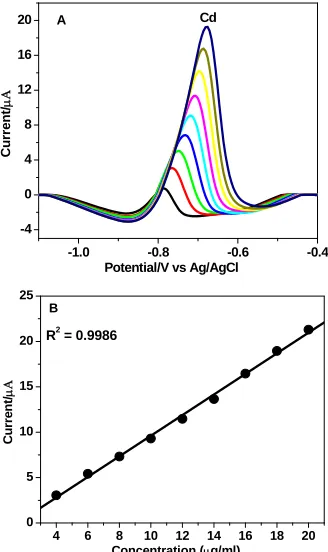
of 4 to 20 g/ml with a correlation co-efficient of 0.9986 and a calculated limit of detection of 0.96 g/ml of lead. The 2 g/ml addition of Pb2+ ion gave a stripping peak from the 4 g/ml addition and linear calibration plot through to 20 g/ml. The corresponding calibration plot for the additions was linear (R2 = 0.9972) and gave a
-1.0 -0.8 -0.6 -0.4
-4 0 4 8 12 16
20 A Cd
Cu
rr
en
t/
Potential/V vs Ag/AgCl
4 6 8 10 12 14 16 18 20
0 5 10 15 20 25
B
R2 = 0.9986
C
u
rre
nt/
Concentration (g/ml)
Figure 2. (A) Overlay of LSASVs at a GC/PEDOT/PSS modified electrode in acetate buffer solution (pH 4.5) fol-lowing the standard additions of Cd2+ over a 4 - 20 g/ml concentration range. Deposition at –1.1 V for 120 s, scan rate 50 mV·s–1. (B) Calibration plot of peak current versus Cd2+ concentration.
-0.8 -0.7 -0.6 -0.5 -0.4 -0.3 -0.2
-5 0 5 10 15 20 25
30 A Pb
C
u
rre
n
t/
Potential/V vs Ag/AgCl
4 6 8 10 12 14 16 18 20 5
10 15 20 25 30 35
B
R2 = 0.9972
Cur
rent/
A
Concentration (g/ml)
Figure 3. (A) Overlay of LSASVs at a GC/PEDOT/PSS modified electrode in acetate buffer solution (pH 4.5) fol-lowing the standard additions of Pb2+ over a 4 - 20 g/ml concentration range. Deposition at –1.1 V for 120 s, scan rate 50 mV·s–1. (B) Calibration plot of peak current versus Pb2+ concentration.
[image:3.595.88.254.79.226.2] [image:3.595.90.254.371.647.2]-1.0 -0.8 -0.6 -0.4 -0.2 -5
0 5 10 15 20 25
Pb
Cd A
C
u
rren
t/
Potential/V vs Ag/AgCl
2 4 6 8 10
4 8 12 16 20
24 B R2 = 0.9944 (Pb)
The authors thank the Department of Biotechnology, New Delhi for financial assistance [BT/PR-10459/BCE/ 08/651/2008].
R2 = 0.9911 (Cd)
C
u
rre
nt/
Concentration (g/ml)
Figure 4. (A) Overlay of LSASVs at a GC/PEDOT/PSS modified electrode in acetate buffer solution (pH 4.5) fol-lowing the standard additions of Cd2+ and Pb2+ over a 2 - 10 g/ml concentration range. Deposition at –1.1 V for 120 s, scan rate 50 mV·s–1. (B) Calibration plot of peak current versus Cd2+ and Pb2+ concentration.
4. Conclusions
The use of GC/PEDOT/PSS modified glassy carbon elec-trode for the simultaneous detection of cadmium and lead has been presented. In this preliminary investigation, we have achieved the detection of cadmium and lead simul-taneously down to 1.47 g/ml and 1.15 g/ml respec-tively, using conducting polymer modified glassy carbon electrode in acetate buffer (pH 4.5) without the removal of dissolved oxygen, stirring and any external metals like Hg, Bi, Sb, etc. The merits of polymer-modified electrode are: enhanced electroanalytical sensitivity, stability and increased mass transport that facilitate estimation of heavy metals at trace levels. Thus, the GC/PEDOT/PSS modified electrode can be a suitable candidate for the detection of heavy metals. Further optimization using this polymer modified electrode to detect nanomolar/sub- -nanomolar level of heavy metals and also the simultane-ously detection of other heavy metals without involving the pre-concentration step is in progress.
5. Acknowledgments
6. References
[1] M. Heitzmann, L. Basaez, F. Brovelli, C. Bucher, D. Limosin, E. Pereira, B. L. Rivas, G. Yal, E. Saint-Aman and J. C. Moutet, “Voltammetric Sensing of Trace Metals at a Poly (Pyrrole – Malonic Acid ) Film Modified Elec-trode,” Electroanalysis, Vol. 17, No. 21, 2005, pp. 1970- 1976. doi:10.1002/elan.200503325
[2] J. Wang, “Analytical Electrochemistry,” Wiley-VCH, New York, 1994.
[3] J. C. Ball and R. G. Compton, “Anodic Stripping Volt-ammetry at Hydrodynamic Mercury Electrodes. Square Wave Voltammetry: Numerical Theory for Electro-chemically Reversible Systems,” Journal of Physical Chemistry B, Vol. 102, No. 20, 1998, pp. 3967-3973.
doi:10.1021/jp980749k
[4] E. Fisher and C. M. G. Van den Berg, “Anodic Stripping Voltammetry of Lead and Cadmium Using a Mercury Film Electrode and Thiocyanate,” Analytica Chimica Ac-ta, Vol. 385, No. 1-3, 1999, pp. 273-280.
doi:10.1016/S0003-2670(98)00582-0
[5] V. P. Gladyshev, S. V. Kovaleva and N. A. Khramtsova, “Determination of Ammonium by Stripping Voltam-metry,” Journal of Analytical Chemistry, Vol. 56, No. 5, 2001, pp. 443-448. doi:10.1023/A:1016627003444
[6] J. Zen and Y. Ting, “Square-Wave Voltammetric Strip-ping Analysis of Lead (II) at a Nafion/Copper-Mercury Film Electrode,” Analytica Chimica Acta, Vol. 332, No. 1, 1996, pp. 59-65. doi:10.1016/0003-2670(96)00215-2
[7] J. Wang and B. Tian, “Screen-Printed Stripping Voltam-metric/Potentiometric Electrodes for Decentralized Test-ing of Trace Lead,” Analytica Chimica Acta, Vol. 64, No. 15, 1992, pp. 1706-1709.
[8] J. Wang, J. Lu, S. B. Hocevar and P. A. M. Farias, “Bis-muth – Coated Carbon Electrodes for Anodic Stripping Voltammetry,” Analytical Chemistry, Vol. 72, No. 14, 2000, pp. 3218-3222. doi:10.1021/ac000108x
[9] K. E. Toghil, G. G. Wildgoose, A. Moshar, C. Mulcahy and R. G. Compton, “The Fabrication and Characteriza-tion of a Bismuth Nanoparticle Modified Boron Doped Diamond Electrode and Its Application to the Simulta-neous Determination of Cadmium (II) and Lead (II),” Electroanalysis, Vol. 20, No. 16, 2008, pp. 1731-1737.
doi:10.1002/elan.200804277
[10] K. Krishnamoorthy, R. S. Gokhale, A. Q. Contractor and A. Kumar, “Novel Label – Free DNA Sensors Based on Poly (3,4-ethylenedioxythiophene),” Chemical Commu-nications, Vol. 10, No. 7, 2004, pp. 820-821.
doi:10.1039/b316794a
[image:4.595.89.262.77.402.2]Bio-sensor Application,” Journal of Electroanalytical Chem-istry, Vol. 397, No. 1-2, 1995, pp. 163-170.
doi:10.1016/0022-0728(95)04156-8
[12] S. Senthilkumar, J. Mathiyarasu and K. L. N. Phani, “Ex-Ploration of Synergism between a Polymer Matrix and Gold Nanoparticles for Selective Determination of Do-pamine,” Journal of Electroanalytical Chemistry, Vol. 578, No. 1, 2005, pp. 95-103.
doi:10.1016/j.jelechem.2004.12.023
[13] S. Senthilkumar, J. Mathiyarasu, K. L. N. Phani and Y. Yegnaraman, “Simultaneous Determination of Dopamine and Ascorbic Acid on Poly (3,4-Ethylenedioxythiophene) Modified Glassy Carbon Electrode,” Journal of Solid State Electrochemistry, Vol. 10, No. 11, 2006, pp. 905-
913. doi:10.1007/s10008-005-0041-7
[14] V. S. Vasantha and K. L. N. Phani, “Effect of Hy-droxypropyl-β-Cyclodextrin on the Electrochemical Oxi-dation and Polymerization of 3,4-Ethylenedioxythio- phene,” Journal of Electroanalytical Chemistry, Vol. 520, No. 1, 2002, pp. 79-88.
doi:10.1016/S0022-0728(01)00748-3
[15] M. M. de Kok, M. Buechel1, S. I. E. Vulto, P. van de Weijer, E. A. Meulenkamp, S. H. P. M. de Winter, A. J. G. Mank, H. J. M. Vorstenbosch, C. H. L. Weijtens and V. van Elsbergen, “Modification of PEDOT: PSS as Hole Injection Layer in Polymer LEDs,” Physica Status Solidi (A), Vol. 201, No. 6, 2004, pp. 1342-1359.