ISSN Online: 2153-120X ISSN Print: 2153-1196
DOI: 10.4236/jmp.2019.1011087 Oct. 12, 2019 1310 Journal of Modern Physics
Split Membrane 11D Spacetime = 1D Eleventh
Dimension Interval Space + 6D Rishon Space +
3D Higgs Space + 1D Einstein Time: Cosmology
Ding-Yu Chung
Utica, Michigan, USA
Abstract
The paper posits that the cyclic universe cosmology involves the split of the membrane 11D (11 dimensional) spacetime into the 1D eleventh dimension orbifold interval space to form gravity, the 6D discrete interior rishon space (TTT-VVV for positron-neutrino or TTV-TVV for u-d̅ quarks) to form the Standard Model, the 3D Higgs space (attachment space to attach matter or detachment space to detach matter) to form the Higgs or reverse Higgs field, and 1D Einstein time to be shared by all spaces. To establish particle masses, spacetime dimension number decreases with decreasing speed of light, de-creasing vacuum energy, and inde-creasing rest mass. The 4D and the 10D have zero and the highest vacuum energies, respectively. The cyclic universe cos-mology starts with the zero-energy 4D inter-universal void and the posi-tive-energy membrane and negaposi-tive-energy antimembrane 11D dual universe which is split into four equal 10D string branes, including the 10D posi-tive-energy weak-gravity brane with matter, negaposi-tive-energy strong-gravity brane, negative-energy weak-gravity brane with antimatter, and posi-tive-energy strong-gravity brane in the 11D bulk with the 1D eleventh di-mension interval space in between the strong and the weak-gravity branes. To form the home universe where we inhabit, the 10D positive-energy weak-gravity brane with attachment space absorbed the zero-energy 4D in-ter-universal void with detachment space, resulting in the combination of rest mass from attachment space and kinetic energy from detachment space, the formation of the 4D spacetime universe by transforming 6D connected exte-rior space into 6D discrete inteexte-rior rishon space, and cosmic inflation. The other three branes did not absorb the inter-universal void, resulting in the os-cillating dimension branes between 10D and 4D stepwise without kinetic energy. The three branes are hidden when D > 4, and they are dark energy when D = 4. The split 11D spacetime and cosmology provide the mat-How to cite this paper: Chung, D.-Y.
(2019) Split Membrane 11D Spacetime = 1D Eleventh Dimension Interval Space + 6D Rishon Space + 3D Higgs Space + 1D Einstein Time: Cosmology. Journal of Modern Physics, 10, 1310-1341.
https://doi.org/10.4236/jmp.2019.1011087 Received: August 30, 2019
Accepted: October 9, 2019 Published: October 12, 2019
Copyright © 2019 by author(s) and Scientific Research Publishing Inc. This work is licensed under the Creative Commons Attribution International License (CC BY 4.0).
DOI: 10.4236/jmp.2019.1011087 1311 Journal of Modern Physics ter-antimatter imbalance and the accurately calculated masses for leptons, quarks, hadrons, gauge bosons, the Higgs boson, gravity, dark matter, and dark energy.
Keywords
String Theory, Rishon, Cyclic Universe Cosmology, Dark Energy, Dark Matter, Particle Masses
1. Introduction
String theory proposes to produce a theory of everything that describes all known particles and forces [1]. String theory with the inclusion of the 11th di-mension is called M-theory. The extra didi-mensions of 11D (11 didi-mensional) M-theory or 10D string theory are the compact manifolds with sizes about the order of the Planck length, 10−33 cm, such that they remain hidden to the expe-riment, explaining why we see only four dimensions. The compactification of the extra space dimensions specifies a shape for the extra space dimensions. Dif-ferent shapes correspond to difDif-ferent possible universes. The number of the shapes is typically estimated to be around 10500, which can accommodate almost any phenomena [2].
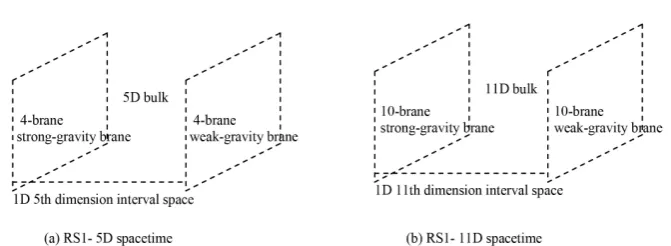
To avoid the problem of 10500 universes due to the compactification, an alter-native to the compactification is the Randall-Sundrum model for five dimen-sional spacetime [3]. In the RS1 (Randall-Sundrum model 1) of the Ran-dall-Sundrum model [4] [5], the fifth dimension as the extra space dimension is an orbifold interval space between the Planckbrane (strong-gravity brane) and the Tevbrane (weak-gravity brane) in the warped five dimensional bulk. In this warped spacetime which is only warped along the fifth dimension, the gravity is extremely high at the strong-gravity brane, but it drops exponentially as it moves closer towards the weak-gravity brane. Gravity on the weak-gravity brane is much weaker than on the strong-gravity brane. The weak-gravity brane contains matter as the Standard Model particles, while the strong-gravity brane is domi-nated by gravity. The Randall-Sundrum model explains the hierarchy problem between the weak-gravity and the strong electromagnetic force and the other fundamental forces. Using the Randall-Sundrum model, this paper posits that the 1D eleventh dimension interval space was the space between the two string branes (the weak-gravity string brane and the strong-gravity string brane) in the warped 11D membrane bulk. The two string 10-branes are the progenitors of the home universe where we inhabit and dark energy. The comparison between the RS1-5D spacetime and the RS1-11D spacetime is as Figure 1.
DOI: 10.4236/jmp.2019.1011087 1312 Journal of Modern Physics Figure 1. (a) RS1-5D spacetime: the 5D bulk with the two 4-branes (the weak-gravity brane and the strong-gravity brane) and 1D 5th dimension interval space. (b) RS1-11D spacetime: the 11D bulk with the two 10-branes (the weak-gravity brane and the strong-gravity brane) and 1D 11th dimension interval space.
gauge bosons have the gauge symmetry U(1) X SU(3) X SU(2)L. The Standard Model explains very well the relations among the 17 elementary particles, but the Standard Model cannot explain the masses of 17 elementary particles, the origins of the 17 elementary particles and the gauge symmetry, neutrino oscillation, the apparent matter-antimatter imbalance in the universe, gravity, dark matter, and dark energy.
To explain the origin of leptons and quarks in the Standard Model, preon models propose simple substructure particles in leptons and quarks [6] [7]. One of the preon models is the Rishon Model by Haim Harari [8] and Michael A. Shupe [9]. The two fundamental substructure particles are rishons consisting of T with 1/3 charge and ½ spin and neutral V with ½ spin. TTT is positron, while VVV is electron neutrino. TTV, TVT and VTT are the three colors of up quark, while TVV, VTV and VVT are the three colors of down quark. Hyperco-lor is required to confine rishons in leptons and quarks [10]. The Rishon Model provides the origin of the first generation fermions in the Standard Model, but there is no experimental evidence for the existence of rishons as the substructure particles Quarks and leptons have been found to be point-like particles without substructure particles [11].
To avoid the difficulty of substructure particles of the Rishon model, Sun-dance Bilson-Thompson proposes the Helon Model with the discrete topological properties of discrete trivalent twisted strand braids [12] [13]. Each rishon is a helon (H+, H-, or H0) which is a twisted strand, and three twisted strands form a braid in the Helon Model. H+ H+ H+, H0 H0 H0, H+ H+ H0, and H+H0H0 corres-pond to TTT, VVV, TTV, and TVV, respectively.
DOI: 10.4236/jmp.2019.1011087 1313 Journal of Modern Physics dimensional space in the 6D rishon space have the symmetry of isospin between TTT and VVV and between TTV and TVV. TTT represents one integer charge, VVV is neutral, and TTV and TVV represent fractional charges [14]. The reason for the confined trivalent rishon space is to match the confined trivalent 3D connected space in the observed 4D spacetime, so the trivalent discrete rishon space becomes the interior space to determine the properties (flavor, charge, isospin, and color) of leptons and quarks, while the trivalent connected space becomes the exterior space to determines the momenta and positions of leptons and quarks.
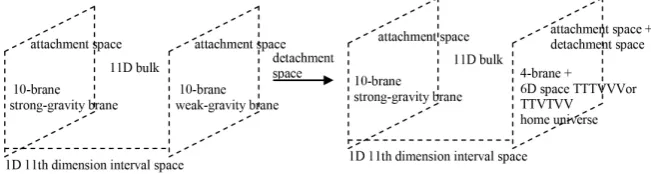
The transformation from 10D string spacetime into 4D observed by convert-ing the 6D connected space into the 6D Rishon Space with TTTVVV or TTVTVV is the continuation of the RS1-11D spacetime where the 10D weak-gravity brane is converted into the 4D home universe where we inhibit with the 6D rishon space as Figure 2.
[image:4.595.213.535.605.690.2]In conventional Higgs mechanism, the Higgs field is the place where a mass-less particle gains mass through spontaneous symmetry breaking. The scalar Higgs Field exists permanently in the universe. The problem with such perma-nent Higgs field is the cosmological constant problem from the huge gravita-tional effect by the Higgs field in contrast to the observation [15]. To avoid the cosmological problem, the previous paper [16] posits that the Higgs field is tran-sitional, and appears only during spontaneous symmetry breaking. The Higgs field disappears after spontaneous symmetry breaking. The permanent space precursor of the Higgs field is attachment space that attaches matter to space, and relates to rest mass. The permanent space precursor of the transitional re-verse Higgs field is 3D detachment space which detaches matter from space, and relates to kinetic energy. Attachment space and detachment space are the Higgs space which interacts with matter. Because the Higgs field and the reverse Higgs field are transitional, the cosmological constant problem disappears. The mixed Higgs spaces as the combinations of n units of attachment space (denoted as 1) and n units of detachment space (denoted as 0) consist of binary partition space, (1)n(0)n, as the space of wave-particle duality, binary miscible space, (1+0)n, as the space of relativity, and binary lattice space, (1 0)n, as the space of virtual gauge rishon boson in quantum field theory. The Higgs space is the interior space to determine the properties (attachment and detachment to matter) of
DOI: 10.4236/jmp.2019.1011087 1314 Journal of Modern Physics elementary particles, while the exterior space determines the momenta and posi-tions of elementary particles. A particle with the discrete interior rishon space moves with the different bound Higgs spaces under different conditions.
As shown later, detachment space is originally from the inter-universal void in the multiverse. To form the home universe where we inhabit, the 10D weak-gravity brane with attachment space absorbed the zero-energy 4D in-ter-universal void with detachment space, resulting in the combination of rest mass from attachment space and kinetic energy from detachment space and the formation of the 4D spacetime universe by transforming 6D connected exterior space into 6D discrete interior rishon space as Figure 3.
According to Johan Hansson, one of the ten biggest unsolved problems (quantum gravity, particle masses, the “measurement” problem, turbulence, dark energy, dark matter, complexity, the matter-antimatter asymmetry, friction, and the “arrow of time”) in physics [17] is the incalculable particle masses of leptons, quarks, gauge bosons, and the Higgs boson. The Standard Model of par-ticle physics contains the parpar-ticles masses of leptons, quarks, and gauge bosons which cannot be calculated or predicted theoretically. From a theoretical point of view the particle mass is a total unsolved problem—they might as well have been random numbers drawn from a hat. The repetition of leptons and quarks with increasing masses has also remained an unsolved problem. Max Jammer [18] concluded that nobody knows what particle masses really are. The mass pa-rameters experimentally measured for elementary particles have no theoretical explanation whatsoever. From the vantage point of theory the masses could just as well be a set of randomly generated numbers.
[image:5.595.210.536.595.682.2]In this paper, the masses of elementary particles are calculated accurately by dimension numbers. As discussed in the previous papers [19] [20], between 4D spacetime and 10D spacetime, dimension number decreases with decreasing speed of light, decreasing vacuum energy, and increasing rest mass. The 4D and the 10D have zero and the highest vacuum energies, respectively. Each spacetime dimension D associates with mass dimension d where D + d = 14 initially. All elementary particles for baryonic matter (leptons, quarks, gauge bosons, gravity, the Higgs boson, and cosmic rays) and dark matter (sterile neutrinos) can be placed in the periodic table of elementary particles based on the two sets of the seven mass dimensions [21] [22]. The periodic table of elementary particles
DOI: 10.4236/jmp.2019.1011087 1315 Journal of Modern Physics provide the accurate calculated masses for leptons, quarks, hadrons, gauge bo-sons, the Higgs boson, gravity, dark matter, and dark energy.
This paper posits that the origin of the split is from the cyclic universe cos-mology in the multiverse. As mentioned in the previous papers [19] [20], the multiverse consists of the zero-energy inter-universal void with 4D detachment space and the multiple 11D positive-energy membrane-antimembrane and neg-ative-energy anti-membrane dual universes with 11D attachment space. The to-tal energy of a dual 11D universe is zero. Detachment space in the in-ter-universal void prevents the collision of the 11D dual universes, while at-tachment space in a dual universe allows the existence of mass-energy in the space of the dual universe.
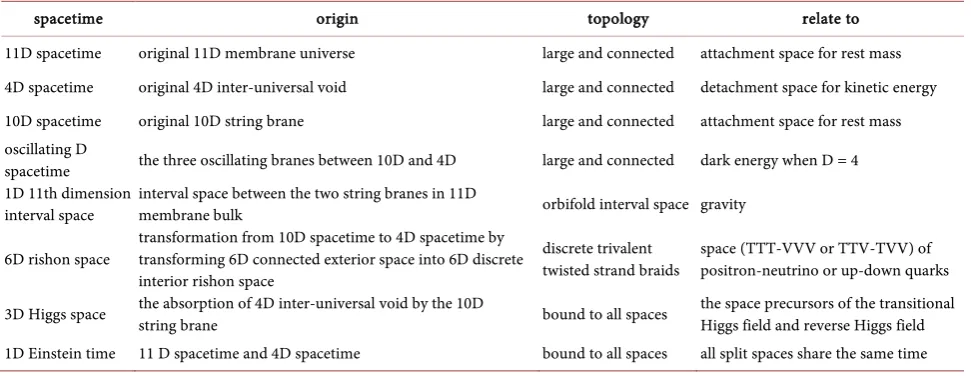
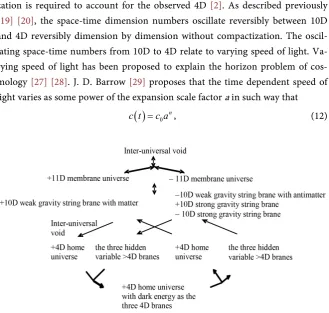
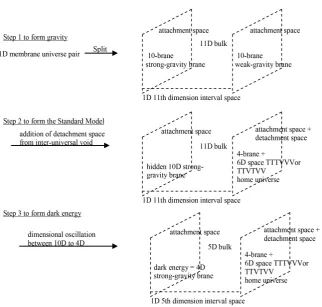
The cyclic universe cosmology starts with the zero-energy inter-universal void and the positive-energy membrane and negative-energy antimembrane 11D dual universe which is split into four equal 10D string branes, including the 10D pos-itive-energy weak-gravity brane with matter, negative-energy strong-gravity brane, negative-energy weak-gravity brane with antimatter, and positive-energy strong-gravity brane in the 11D bulk. The 1D eleventh dimension interval space is between the strong and the weak-gravity branes as in Randall-Sundrum model. To form the home universe where we inhabit, the positive-energy weak-gravity brane with attachment space absorbed the zero-energy 4D inter-universal void with detachment space, resulting in the combination of rest mass from attach-ment space and kinetic energy from detachattach-ment space and the formation of the 4D spacetime universe by transforming 6D connected exterior space into the 6D discrete interior rishon space. The result was cosmic inflation from high vacuum energy (10D) to zero vacuum energy (4D). The other three branes did not ab-sorb the inter-universal void, resulting in the oscillating dimension branes be-tween 10D and 4D stepwise without kinetic energy. The three branes are hidden when D > 4, and they are dark energy when D = 4. Afterward, when D > 4 for the three branes, the home universe and the three branes start to contract, and eventually return to the original four 10D string branes and then to the original 11D membrane-antimembrane dual universe for the cyclic universe cosmology. Different spacetimes are shown in Table 1.
Section 2 deals with the rishon space. Section 3 describes the Higgs space. Sec-tion 4 explains the spilt membrane 11D spacetime based on the cyclic universe cosmology in the multiverse. The 11D split spacetime and cosmology provides the matter-antimatter imbalance and the accurate calculated masses for all ele-mentary baryonic matter particles, dark matter, and dark energy.
2. The Rishon Space
DOI: 10.4236/jmp.2019.1011087 1316 Journal of Modern Physics Table 1. Spacetimes.
spacetime origin topology relate to 11D spacetime original 11D membrane universe large and connected attachment space for rest mass 4D spacetime original 4D inter-universal void large and connected detachment space for kinetic energy 10D spacetime original 10D string brane large and connected attachment space for rest mass oscillating D
spacetime the three oscillating branes between 10D and 4D large and connected dark energy when D = 4 1D 11th dimension
interval space interval space between the two string branes in 11D membrane bulk orbifold interval space gravity
6D rishon space transformation from 10D spacetime to 4D spacetime by transforming 6D connected exterior space into 6D discrete interior rishon space
discrete trivalent
twisted strand braids space (TTT-VVV or TTV-TVV) of positron-neutrino or up-down quarks
3D Higgs space the absorption of 4D inter-universal void by the 10D string brane bound to all spaces the space precursors of the transitional Higgs field and reverse Higgs field
1D Einstein time 11 D spacetime and 4D spacetime bound to all spaces all split spaces share the same time
Model. The Rishon Model proposes that the two fundamental substructure par-ticles are rishons consisting of T with 1/3 charge and ½ spin and neutral V with ½ spin. TTT is positron, while VVV is electron neutrino. TTV, TVT and VTT are the three colors of up quark, while TVV, VTV and VVT are the three colors of down quark. The Rishon Model provides the origin of the first generation fermions in the Standard Model, but there is no experimental evidence for the existence of rishons as the substructure particles. Quarks and leptons have been found to be point-like particles without substructure particles [11].
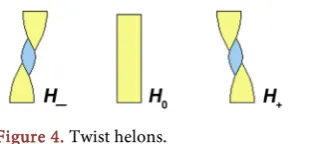
To avoid the difficulty of substructure particles, Sundance Bilson-Thompson proposes the Helon Model with the discrete topological properties of discrete trivalent twisted strand braids [12] [13]. Each rishon is a helon which is a twisted strand as H+, H-, or H0 as shown in Figure 4. In the helon model, helons are to-pological in nature, and helons are not considered as substructure particles. The integral twists of strands represent the quantized electric charges of particles. Three twisted strands form a braid in the Helon Model. H+ H+ H+, H0 H0 H0, H+ H+ H0, and H+H0H0 as the trivalent twisted strand braids represent positron, neutrino, up quark, and down quark, respectively. The permutations of twists on certain braids naturally account for the color charges of quarks and gluons.
DOI: 10.4236/jmp.2019.1011087 1317 Journal of Modern Physics Figure 4. Twist helons.
connected space in the observed 4D spacetime, so the trivalent discrete rishon space becomes the interior space to determine the properties (flavor, charge, isospin, and color) of leptons and quarks, while the trivalent connected space becomes the exterior space to determines the momenta and positions of leptons and quarks. The transformation from the 6D connected exterior space into 6D discrete interior rishon space is as follows.
(
)
from 10D to 4D
9D connected exterior space in 10D connected exterior spacetime for string 6D discrete interior rishon space TTTVVV for e- in 4D connected exterior spacetime or 6D discrete interior r
ν →
(
)
ishon space TTVTVV for u-d in 4D connected exterior spacetime TTT for e and VVV for ν or TTV for u and TVV for d in 4D connected exterior spacetime
→
(1)
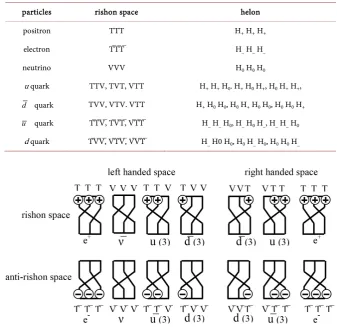
The rishon space and helon are shown in Table 2 and Figure 5. The interac-tions among leptons and quarks are through the 4 gauge bosons (photon, W boson, Z boson, and gluon). The 4 gauge bosons have the gauge symmetry U(1) X SU(3)c X SU(2)L.
3. The Higgs Space
The 3D Higgs space consists of attachment space as the space precursor of the transitional Higgs field and detachment space as the space precursor of the tran-sitional reverse Higgs field. Attachment space that attaches matter to the space relates to rest mass, detachment space that detaches matter from the space re-lates to kinetic energy. The Higgs space involves the Higgs mechanism for the transformation between massless particle and massive particle and the space structures from the combination of attachment space and detachment space. The Higgs space is the interior space to determine the properties (attachment and detachment to matter) of elementary particles, while the exterior space de-termines the momenta and positions of elementary particles.
3.1. The Higgs Mechanism
DOI: 10.4236/jmp.2019.1011087 1318 Journal of Modern Physics Table 2. The rishon space and helon.
particles rishon space helon positron TTT H+ H+ H+ electron T̅T̅T̅ H_ H_ H_ neutrino VVV H0 H0 H0
u quark TTV, TVT, VTT H+ H+ H0. H+ H0 H+, H0 H+ H+,
d quark TVV, VTV. VTT H+ H0 H0, H0 H+ H0 H0, H0 H0 H+ u quark T̅T̅V̅, T̅V̅T̅, V̅T̅T̅ H_ H_ H0, H_ H0 H_, H_ H_ H0
d quark T̅V̅V̅, V̅T̅V̅, V̅VT̅ ̅ H_ H0 H0, H0 H_ H0, H0 H0 H_
Figure 5. The fermions are represented by the rishon space and helon. Charged fermions have two handedness states each, while ν and ν have only one each. (3) denotes that there are three possible permutations, identified as the quark colors.
[
]
spontaneous symmetry breaking
massless particle
spontaneous sym
zero-energy groud state space nonzero-energyscalar Higgs field
the transitional nonzero-energy Higgs field particle composite
→ →
−
metry restoring massive particle with the longitudinal
component on zero-energy ground state space without the Higgs field
→
(2)
In conventional physics, the nonzero-energy scalar Higgs Field exists perma-nently in the universe. The problem with such nonzero-energy field is the cos-mological constant problem from the huge gravitational effect by the nonze-ro-energy Higgs field in contrast to the observation [15].
DOI: 10.4236/jmp.2019.1011087 1319 Journal of Modern Physics the transitional nonzero-energy Higgs field-particle composite is converted into massive particle with the longitudinal component on zero-energy attachment space without the Higgs field as follows.
[
]
spontaneous symmetry breaking
spontaneous symmetry restoring
masslessparticle zero-energy attachment space
the transitional non-zero energy Higgs field particle composite massive parti
+ →
−
→ cle with the longitudinal
component on zero-energy attachment space without the Higgs field
(3)
Detachment space is the space precursor of the reverse Higgs field. Unlike the conventional model, detachment space actively couples to massive particle. Un-der spontaneous symmetry breaking, the coupling of massive particle to ze-ro-energy detachment space produces the transitional nonzeze-ro-energy reverse Higgs field-particle composite which under spontaneous symmetry restoring produces massless particle on zero-energy detachment space without the longi-tudinal component without the reverse Higgs field as follows.
[
]
spontaneous symmetry breaking
spontaneous symmetry restoring
massive particle zero-energy detachment space
the transitional nonzero-energy reverse Higgs field particle composite massless
+ →
−
→ particle without the longitudinal
component on zero-energy detachment space without the reverse Higgs field
(4)
For the electroweak interaction in the Standard model where the electromag-netic interaction and the weak interaction are combined into one symmetry group, under spontaneous symmetry breaking, the coupling of the massless weak W, weak Z, and electromagnetic A (photon) bosons to zero-energy at-tachment space produces the transitional nonzero-energy Higgs fields-bosons composites which under partial spontaneous symmetry restoring produce mas-sive W and Z bosons on zero-energy attachment space with the longitudinal component without the Higgs field, massless A (photon), and massive Higgs boson as follows.
[
]
spontaneous symmetry breaking massless WZ zero-energy WZ attachment space massless A
zero-energy A attachment space A
the transitional nonzero-energy WZ Higgs field WZ composite nonzero-energy
+ +
+ →
−
+
[
A Higgs field A composite]
partial spontaneous symmetry restoring massive WZ with the longitudinal component on attachment space without the Higgs field massless A the nonzero energy massive− →
+ + Higgs boson
(5)
In terms of mathematical expression, the conventional permanent Higgs field model and the transitional Higgs field model are identical. The interpretations of the mathematical expression are different for the permanent Higgs field model and the transitional Higgs field model. The transitional Higgs field model avoids the cosmological problem in the permanent Higgs field model.
DOI: 10.4236/jmp.2019.1011087 1320 Journal of Modern Physics The paper posits that the left handed became massless through the reverse Higgs mechanism. For the symmetrical massive left handed neutrinos and right-handed neutrinos under spontaneous symmetry breaking, the coupling of the massive left handed neutrinos and the massive right handed neutrinos to ze-ro-energy detachment space produces the transitional nonzeze-ro-energy reverse Higgs fields-neutrinos composites which under partial spontaneous symmetry restoring produce massless left handed neutrinos on zero-energy detachment space without the longitudinal component without the reverse Higgs field, mas-sive right-handed neutrinos (dark matter), and the masmas-sive reverse Higgs boson as follows.
[
]
L L R
spontaneous symmetry breaking R
L L
R
massive zero energy detachment space massive
zero-energy detachment space
the transitional nonzero-energy reverse Higgs field composite
nonzero-energy reverse H
ν ν ν
ν
ν ν
ν
+ +
+ →
−
+
[
iggs field−νR composite]
partial spontaneous symmetry restoring
L
R
massless without the longitudinal component on det achment space without the Higgs field
massive the nonzero energy massive reverse Higgs boson
ν
ν
→
+ +
(6)
As described in the previous paper [21], the reverse Higgs boson was observed as the two unusual steeply upward-going ultra-high-energy (UHE) cosmic ray events with energies of ≈0.6 EeV [23] and ≈0.56 EeV [24] in the Antarctic Im-pulsive Transient Antenna (ANITA) experiment [25]. These shower events have the characteristics of the decay of a tau lepton, which emerges from the surface of the ice, and the tau lepton is explained as the product of a UHE parent tau neutrino by the charged-current interactions with the Earth matter. However, such UHE tau neutrino cannot survive the passage through the Earth. The pre-vious paper posits that the upward-going ANITA events are derived from the cosmic ray of the baryonic-dark matter reverse Higgs boson that travels through the Earth. The calculated value for the reverse Higgs boson is 0.47 EeV in good agreement with the observed 0.56 and 0.6 EeV. As shown in Section 4, dark matter (sterile neutrinos) is part of the periodic table of elementary particles for baryonic matter and dark matter.
3.2. The Space Structures
The symmetrical combination of n units of attachment space as 1 and n units of detachment space as 0 brings about three different space structures: binary parti-tion space, miscible space, or binary lattice space as below.
( )
1( )
0 combination( ) ( )
1 0 ,(
1 0)
, or( )
1 0attachment space detachment space binary partition space, miscible space, binary lattice space
+ → +
n n n n n n (7)
DOI: 10.4236/jmp.2019.1011087 1321 Journal of Modern Physics 0)n, consists of repetitive units of alternative attachment space and detachment space. In conventional physics, space does not couple with particles. In the rest-movement system, space couples with particles.
In binary partition space (1)n(0)n, an entity is both in constant motion as standing wave for detachment space and in stationary state as a particle for at-tachment space, resulting in the wave-particle duality. Such duality can be de-scribed by the uncertainty principle. The uncertainty principle for quantum mechanics is expressed as follows.
2
σ σ ≥x p (8)
The position, x, and momentum, p, of a particle cannot be simultaneously measured with arbitrarily high precision. The uncertainty principle requires every physical system to have a zero-point energy (non-zero minimum momen-tum) and to have a non-zero minimum wavelength as the Planck length. In terms of the binary partition space, detachment space relating to kinetic energy as momentum is σp, and attachment space relating to space (wavelength) for a particle is σx. In binary partition space, neither detachment space nor attachment space is zero in the uncertainty principle, and detachment space is inversely proportional to attachment space. Quantum mechanics for a particle follows the uncertainty principle defined by binary partition space. Binary partition space (1)n(0)n can also be described by the Schrodinger in quantum mechanics where total energy equals to kinetic energy related to (0)n plus potential energy related to (1)n.
In binary partition space, for every detachment space, there is its correspond-ing adjacent attachment space. Thus, no part of the mass-energy can be irre-versibly separated from binary partition space, and no part of a different mass-energy can be incorporated in binary partition space. Binary partition space represents coherence as wavefunction. Binary partition space is for cohe-rent system. Any destruction of the coherence by the addition of a diffecohe-rent mass-energy to the mass-energy causes the collapse of binary partition space in-to miscible space. The collapse is a phase transition from binary partition space to miscible space.
( ) ( )
0 1 collapse(
0 1)
binary partition space miscible space
→ +
n n n (9)
Another way to convert binary partition space into miscible space is gravity. Penrose [26] pointed out that the gravity of a small object is not strong enough to pull different states into one location. On the other hand, the gravity of large object pulls different quantum states into one location to become miscible space. Therefore, a small object without outside interference is always in binary parti-tion space, while a large object is never in binary partiparti-tion space.
DOI: 10.4236/jmp.2019.1011087 1322 Journal of Modern Physics observations in terms of measurements bring about the collapse of wavefunction, resulting in miscible space that leads to eigenvalue as definite quantized value. Such collapse corresponds to the appearance of eigenvalue, E, by a measurement operator, H, on a wavefunction, Ψ.
Ψ = Ψ
H E (10) In miscible space, attachment space is miscible to detachment space, and there is no separation of attachment space and detachment space. In miscible space, attachment space contributes zero speed, while detachment space contributes the speed of light. For a moving massive particle consisting of a rest massive part and a massless part, the massive part with rest mass, m0, is in attachment space, and the massless part with kinetic energy, K, is adjacent to detachment space. The combination of the massive part in attachment space and massless part in detachment leads to the propagation speed in between zero and the speed of light. To maintain the speed of light constant for a moving particle, the time (t) in moving particle has to be dilated, and the length (L) has to be contracted rela-tive to the rest frame.
2 2
0 0
0
2 2
0 0
1 ,
,
γ γ
γ
= − =
=
= + =
t t v c t
L L
E K m c m c
(11)
where γ =1 1
(
−v c2 2)
1 2 is the Lorentz factor for time dilation, and length contraction, E is the total energy, and K is the kinetic energy. Binary lattice space, (1 0)n, as the space of virtual gauge rishon boson in quantum field theory will be described in Section 4.4. Cosmology
The paper posits that the cyclic universe cosmology in the multiverse involves the split of the membrane 11D spacetime into the 1D eleventh dimension orbi-fold interval space to form gravity, the 6D discrete interior rishon space (TTT-VVV for positron-neutrino or TTV-TVV for u-d̅ quarks) to form the Standard Model, the 3D Higgs space (attachment space to attach matter or de-tachment space to detach matter) to form the Higgs or reverse Higgs field, and 1D Einstein time to be shared by all spaces.
4.1. The Multiverse
DOI: 10.4236/jmp.2019.1011087 1323 Journal of Modern Physics from the zero-energy inter-universe. Each of the positive-energy 11D universe and the negative-energy 11D universe does not conserve the energy-mass con-servation, but the energy sum of the positive-energy 11D universe and the nega-tive-energy 11D universe is zero which conserves the energy-mass conservation. The cyclic universe cosmology starts with the zero-energy inter-universal void and the positive-negative energy 11D membrane dual universe which is split into four 10D string branes as the dual two-string branes, including the posi-tive-energy weak-gravity string brane, the negaposi-tive-energy weak-gravity string brane, the positive-energy strong-gravity string brane, and the negative-energy strong-gravity string brane in the 11D dual universe bulk. The positive-energy weak string brane contains matter, while the negative-energy string brane con-tains antimatter. The matter-antimatter balance occurs in the balance between the matter in the positive-energy weak-gravity string brane and the antimatter in the negative-energy weak-gravity string brane as in Figure 6. Each brane has the matter-antimatter imbalance initially. Afterward, all subsequent events in each brane have the matter-antimatter balance for CP symmetry. The strong string branes are dominated by gravity. All four branes have equal mass-energy. The 1D interval space is between the 10D strong-gravity string brane and the 10D weak-gravity string brane in the 11D membrane bulk.
In conventional physics, space-time dimension numbers are fixed. Compacti-zation is required to account for the observed 4D [2]. As described previously [19] [20], the space-time dimension numbers oscillate reversibly between 10D and 4D reversibly dimension by dimension without compactization. The oscil-lating space-time numbers from 10D to 4D relate to varying speed of light. Va-rying speed of light has been proposed to explain the horizon problem of cos-mology [27] [28]. J. D. Barrow [29] proposes that the time dependent speed of light varies as some power of the expansion scale factor a in such way that
( )
= 0 n [image:14.595.210.540.375.688.2]c t c a , (12)
DOI: 10.4236/jmp.2019.1011087 1324 Journal of Modern Physics where c is the speed of light and n are constants. The increase of speed of light is continuous.
In this paper, the speed of light is invariant in a constant space-time dimen-sion number, and the speed of light varies with varying space-time dimendimen-sion number from 4 to 11 as follows.
D 4
D = α −
c c , (13) where c is the observed speed of light in the 4D space-time, cD is the quantized varying speed of light in space-time dimension number, D, from 4 to 10, and α is the fine structure constant for electromagnetism. The speed of light increases with the increasing space-time dimension number D. Since the speed of light for >4D particle is greater than the speed of light for 4D particle, the observation of >4D particles by 4D particles violates casualty. Thus, >4D particles are hidden particles with respect to 4D particles. Particles with different space-time dimen-sions are transparent and oblivious to one another, and separate from one another if possible.
As described previously [19] [20], the particle oscillation between 10D and 10D through 4D involves mass dimension (denoted as d) to represent the mass. In the initial condition for the oscillation, D + d =14 where D and d are between 4 and 10. For an example, a dimension has a dual spacetime-mass dimension numbers of 10D4d or 4D10d. The transformations for oscillating dimension number between 10D and 4D consist of the varying speed of light dimensional (VSLD) transformation for spacetime dimension D and the varying supersym-metry dimensional (VSD) transformation for mass dimension d. For the VSLD transformation for D, E = M0c2 modified by Equation (13) is expressed as
( )
(
2 D 4)
2 2
0 D 0
α
− ,= = ⋅
E M c M c (14)
2 0,D,d= 0,D ,d−n +nα n,
M M (15) 2
vacuum,D = − 0,D ,
E E M c (16)
(
) (
)
VSLD transformation
D,d→ Dn , d±n (17)
DOI: 10.4236/jmp.2019.1011087 1325 Journal of Modern Physics In the normal supersymmetry transformation, the repeated application of the fermion-boson supersymmetry transformation carries over a boson (or fermion) from one point to the same boson (or fermion) at another point at the same mass, resulting in translation without changing mass. Under the varying super-symmetry dimensional (VSD) transformation, the repeated application of the fermion-boson supersymmetry transformation carries over a boson from one point to the boson at another point at different mass dimension number at dif-ferent mass, resulting in translation and fractionalization or condensation. The repeated VSD transformation carries over a boson Bd into a fermion Fd and a fermion Fd to a boson Bd-1, which can be expressed as follows.
d,F= d,B d,Bα ,
M M (18)
d 1,B− = d,F d,Fα ,
M M (19) where Md,B and Md,F are the masses for a boson and a fermion, respectively, d is the mass dimension number, and αd,B or αd,F is the fine structure constant that is the ratio between the masses of a boson and its fermionic partner. where Md,B and Md,F are the masses for a boson and a fermion, respectively, d is the mass dimension number, and αd,B or αd,F is the fine structure constant that is the ratio between the masses of a boson and its fermionic partner. Assuming α’s are the same, it can be expressed as
2 d,B= d 1,B d 1+ α +
M M . (20) The varying supersymmetry transformation involves the translation and frac-tionalization from d to d − 1 or condensation from d to d + 1 at the same D. The translation and fractionalization-condensation account for the cosmic expan-sion-contraction for the oscillating universes.
The transformation during the oscillation between 10D particle and 4D par-ticle involves the stepwise two-step transformation consisting of the VSLD transformation and the VSD transformation. The VSLD transformation involves the transformation of spacetime dimension, D whose mass increases with de-creasing D for the decrease in vacuum energy. The VSD transformation involves the transformation of the mass dimension number, d whose mass decreases with decreasing d for the fractionalization of particle. The oscillating dimension number transformation between 10D4d and 10D4d through 4D4d involves both the VSLD transformation and the VSD transformation as the stepwise two-step transformation as follows.
(
) (
)
(
)
VSLD transformation
VSD transformation
stepwise two-step varying transformation
(1) D,d D 1 , d 1
(2) D,d D, d 1
←→ ±
←→ ±
(21)
The repetitive stepwise two-step dimension number oscillation between 10D4d and 10D4d through 4D4d as follows.
10D4d 9D5d 9D4d 8D5d 8D4d 7D5d 7D4d 6D5d
6D4d 5D5d 5D4d 4D5d 4D4d 5D4d 5D5d 6D4d
6D5d 7D4d 7D5d 8D4d 8D5d 9D4d 9D5d 10D4d
→ → → → → → →
→ → → → → → → →
→ → → → → → → →
DOI: 10.4236/jmp.2019.1011087 1326 Journal of Modern Physics As described previously [19] [20], the oscillation between 10D and 4D results in the reversible cyclic fractionalization-contraction for the reversible cyclic ex-pansion-contraction of the universe.
4.2. The Home Universe
To form the home universe where we inhabit, the 10D positive-energy weak-gravity string brane with attachment space absorbed the zero-energy 4D inter-universal void with 4D detachment space, resulting in the home universe which contains the Higgs space with both attachment space for rest mass and detachment space for kinetic energy. The home universe resulted from the transformation from a 10D spacetime brane into a 4D spacetime universe by transforming 6D connected exterior space into 6D discrete interior rishon space. The other three 10D string branes did not absorb detachment space. From 10−36 seconds after the entrance of detachment space to the time between 10−33 and 10−32 seconds after the entrance of detachment space, four important events oc-curred to transform the 10D positive-energy weak-gravity string brane into the 4D home universe where we inhabit. The four events are cosmic inflation de-rived from the transformation from 10D4d to 4D10d, the rishon space forma-tion by transforming 6D connected exterior space into 6D discrete interior ri-shon space, the Higgs space formation by the combination of attachment space and detachment space, and the Extend Standard Model from the periodic table of elementary particles based on the seven mass dimensions.
4.2.1. Cosmic Inflation
Cosmic inflation is derived the transformation from 10D4d to 4D10d imme-diately. Calculated from Equation (15), the rest mass of 4D10d is
( )
2 10 4 ? 12
0,10= 0,4 α − ≈137
M M times of the rest mass of 10D4d, resulting in cos-mic inflation as the exponential expansion of space from the high vacuum ener-gy 10D4d to the zero vacuum enerener-gy 4D10d as follows.
quick VSLD transformation inflation
10D4d spacetime 1D interval space for gravity 4D10d spacetime 1D interval space for gravity
+ →
+
(23)
4.2.2. The Rishon Space Formation
The home universe resulted from the transformation from a 10D spacetime brane into a 4D spacetime universe by transforming 6D connected exterior space into 6D discrete interior rishon space as follows.
(
)
from 10D to 4D 10D connected exterior spacetime for string
4D connected exterior spacetime 6D discrete interior rishon space TTTVVV for e- or 4D connected exterior spacetime
6D discrete interior rishon spac ν
→ +
+ e TTVTVV for u-d
(
)
TTT for e and VVV for or TTV for u and TVV for d in 4D connected exterior spacetime
ν
DOI: 10.4236/jmp.2019.1011087 1327 Journal of Modern Physics The rishon space formation produces the discrete space in addition to nected space. All elementary particles are in discrete space in addition to con-nected space, while gravity in the interval space continues to be in concon-nected ex-terior space without discrete inex-terior space for flavor, charge, isospin, and color. 4.2.3. The Higgs Space Formation
As discussed in Section 3, the space structures as the mixed Higgs spaces as the combinations of n units of attachment space (denoted as 1 from the posi-tive-energy weak-gravity string brane) and n units of detachment space (denoted as 0 from the inter-universal void) consist of binary partition space, (1)n(0)n, as the space of wave-particle duality, binary miscible space, (1+0)n, as the space of relativity, and binary lattice space, (1 0)n, as the space of virtual gauge boson in quantum field theory. Section 3 describes binary partition space and binary miscible space, and binary lattice space is described as follows.
Binary lattice space is derived from the slicing of mass dimension. Bounias and Krasnoholovets [30] propose that the reduction of dimension can be done by slicing dimension, such as slicing 3 space dimension object (block) into infi-nite units of 2 space dimension objects (sheets). Cosmic inflation involves the transformation from 10D4d with high vacuum energy into 4D10d with zero va-cuum energy at once. 4D10d particle was sliced into six different particles: 4D9d, 4D8d, 4D7d, 4D6d,4D5d, and 4D4d equally by mass. Baryonic matter is 4D4d which is the lowest spacetime-mass dimension from Equation (22), while dark matter consisted of the other five types of particles (4D9d, 4D8d, 4D7d, 4D6d, and 4D5d) as follows.
(
)
(
)
cosmic inflation the slicing
10D4d 4D10d
baryonic matter 4D4d dark matter 4D5d,4D6d,4D7d,4D8d,4D9d
→ →
+ (25)
As a result, the mass ratio of dark matter to baryonic matter is 5 to 1 in excel-lent agreement with the observed 4.98 to 1 derived from the observed 4.56% and 22.7% for baryonic matter and dark matter, respectively [19] [31].
The 10d (mass dimension) particle in attachment space denoted as 1 was sliced by detachment space denoted as 0. For example, the slicing of 10d particle into 4d particle is as follows.
(
)
10 slicing
10 4 4 4 ,d
d 5
1 1 0 1
10d particle 4d core particle binary lattice space
=
→
∑
n(26)
in-DOI: 10.4236/jmp.2019.1011087 1328 Journal of Modern Physics finite quantized units of binary lattice space represent the infinite units (n = ∞) of separate energy virtual orbitals (probabilities) for virtual particles in a gauge force field. There are six gauge fields from d = 5 to d =10. The three force fields, electromagnetism, the strong force, and the weak force are represented by d = 5, 6, and 7, respectively. For dark matter, d =5 for electromagnetism is not sliced, so dark matter does not have electromagnetism at d = 5, resulting in the dark-ness due to the absence of photon from electromagnetism.
The Higgs space produces the Higgs mechanism and the space structures. Quantum mechanics is derived from the Higgs space, so the simultaneous oc-currence of cosmic inflation and quantum mechanism produced cosmic quan-tum fluctuation in the home universe.
4.2.4. The Extend Standard Model
The Extend Standard Model includes leptons, quarks, gauge bosons, gravity, dark matter, and dark energy.
The Seven Mass Dimensions
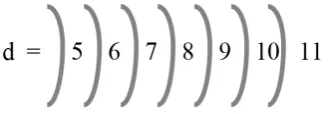
The masses in the Extend Standard Model are based on the seven mass di-mensions. Cosmic inflation produced 4D10d spacetime and 1D interval space for gravity which were transformed into 4D4d spacetime as the lowest space-time-mass dimension from Equation (22) + 1D interval space for gravity + 6 mass dimensions for non-gravity + 1mass dimension for gravity. The combina-tion results in 4D4d spacetime + 1D interval space for gravity + 7 mass dimen-sions as Equation (27) and in Figure 7.
cosmic inflation 10D4d 1D interval space for gravity
4D10d spacetime 1D interval space for gravity 4D4d spacetime 1D interval space for gravity 6 mass dimensions for non-gravity 1 mass dimension
+ →
+ →
+ +
+ for gravity combinasion 4D4d spacetime 1D interval space for gravity 7 mass dimensions
→
+ +
(27)
The seven mass dimensions are arranged as F5 B5 F6 B6 F7 B7 F8 B8 F9 B9 F10 B10 F11 B11, where Fd and Bd are mass dimensional fermion and mass dimensional boson, respectively. Under the varying supersymmetry dimensional (VSD) transformation, the mass of mass dimensional fermion and the mass of mass dimensional boson are related to each other with three simple formulas as fol-lows.
d,B= d,F αd
M M (28)
d 1,F+ = d,B αd 1+
M M (29) 2
d 1,B+ = d,B αd 1+
M M , (30) where d is the mass dimension number, F is fermion, and B is boson. Each di-mension has its own αd, and all αd’s except α7 (αw) of the seventh dimension (weak interaction) are equal to α, the fine structure constant of electromagnetism.
DOI: 10.4236/jmp.2019.1011087 1329 Journal of Modern Physics Figure 7. The 7 mass dimensions.
have charge particle. For baryonic matter, to represent the mixed rishon space (TTV-TVV) for charge u-d̅ quarks, the additional seven mass dimensions as the “auxiliary mass dimensions” (a’s) to represent quarks and unstable leptons in addition to the seven “principal mass dimensions” (d’s) to represent neutri-no-electron and gauge bosons as in Figure 8.
The Periodic Table of Elementary Particles
The periodic table of elementary particles [21] [22] is based on the seven prin-cipal mass dimensions (d’s) for stable baryonic matter leptons (electron and neutrinos), gauge bosons (all forces), gravity, and dark matter (five sterile dark matter neutrinos) and the seven auxiliary mass dimensions (a’s) for unstable leptons (muon and tau) and quarks (d, u, s, c, b, and t) as in Figure 8 and Table 3.
In the periodic table of elementary particles, the five dark matter particles are derived from Equation (24). Without electromagnetism at d = 5, dark matter does not have charge particle, and has to be neutrinos. Initially derived from Equation (25) and the symmetry between dark matter and baryonic matter, there were five dark matter massive right-handed neutrinos and one baryonic matter massive left-handed neutrino. Through the reverse Higgs mechanism as Equation (6), the left-handed neutrino becomes massless, while the right-handed neutrinos as sterile dark matter neutrinos remain massive. The reverse Higgs boson was observed [21]. All neutrinos and electron as well as gauge bosons are in the principal mass dimensions. All quarks and unstable leptons are in the aux-iliary mass dimensions. The three generations of baryonic matter lepton-quark is the maximum generations allowed for the seven principal dimensions and the seven auxiliary dimensions.
Gauge Bosons
In the periodic table of elementary particles, the given observed masses are the mass of electron for F6 and the mass of Z boson for B7. From Equations (28) and (30), αw=α7=α of week interaction =
(
6 7)
1 2
B B
M M =
(
MF6 α MB7)
1 2 =(
α)
1 2e Z
M M = 0.02771. Therefore, the masses of gauge bosons are as in Ta-ble 4.
DOI: 10.4236/jmp.2019.1011087 1330 Journal of Modern Physics Figure 8. The seven principal mass dimensions (solid lines) denoted by the principal mass dimension number d and the seven auxiliary mass dimensions (dash-dotted lines) denoted by the auxiliary mass dimension number a.
Table 3. The periodic table of elementary particles for baryonic matter and dark matter d = principal mass dimension number, a = auxiliary mass dimension number, DM = dark matter, BM = baryonic matter.
d a = 0 a = 0 1 2 1 2 3 4 5 a = 0 Stable Baryonic
Matter Leptons Dark Matter Leptons Unstable Leptons Quarks Bosons 5 νe νDM5 B5 = A electromagnetism 6 e νDM6 B6 = g* strong (basic gluon) 7 νµ νDM7 µ7 τ7 d7/u7 s7 c7 b7 t7 B7=Z0L left-handed BM weak
8 ντ νDM8 µ8 (absent) (absent) tb8 8 B8=Z0R right-handed DM weak
9 ν’τ (high-mass ντ) νDM9 B9 = BM-DM separation
10 B10 = matter-antimatter separation B10 = home universe-dark energy separation 11 gravitino B11 = gravity (interval space)
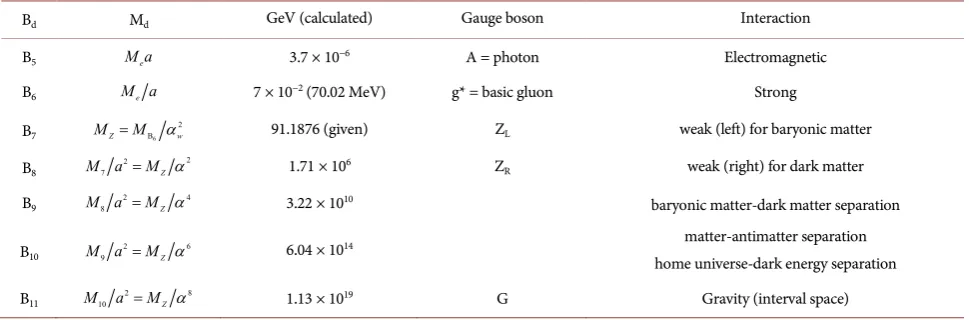
Table 4. The masses of the principal mass dimensions (gauge bosons).
Bd Md GeV (calculated) Gauge boson Interaction B5 M ae 3.7 × 10⁻⁶ A = photon Electromagnetic
B6 M ae 7 × 10⁻² (70.02 MeV) g* = basic gluon Strong
B7 6
2 B α =
Z w
M M 91.1876 (given) ZL weak (left) for baryonic matter
B8
2 2
7 Z
M a =M α 1.71 × 10⁶ Z
R weak (right) for dark matter B9 M a8 2=MZ α4 3.22 × 10¹⁰ baryonic matter-dark matter separation
B10 M a9 2=MZ α6 6.04 × 10¹⁴
matter-antimatter separation home universe-dark energy separation B11 M a10 2=MZ α8 1.13 × 10¹⁹ G Gravity (interval space)
[image:21.595.56.541.474.634.2]collec-DOI: 10.4236/jmp.2019.1011087 1331 Journal of Modern Physics tive fractional charges is integer [33]. As a result, fractional charges are confined and collective. The confinement force field includes gluons for collective tional charge quarks in hadrons and the magnetic flux quanta for collective frac-tional charge quasiparticles in the fracfrac-tional quantum Hall effect (FQHE) [34] [35] [36].
The third lowest boson (B7) at d = 7 is ZL for the left-handed weak interaction among leptons and quarks. Spontaneous symmetry breaking produces massive weak bosons, massless photon and the Higgs boson as Equation (5). Massive weak bosons produce short-distance interaction. B8 at d = 8 is ZR for the right-handed weak interaction among dark matter neutrinos as dark matter neutrino oscillation. The symmetry between ZR and ZL provides the neutrino os-cillation for both baryonic matter neutrinos [37] and dark matter neutrinos.
At B9, baryonic matter and dark matter are separated. Above B9, there is no baryonic matter and dark matter before the slicing as in Equation (25). B9 as the gauge boson represents the weak short-distance repulsive Yukawa force [38] between baryonic matter and dark matter. Long-distance attractive gravity among all particles in a random mixture of dark matter particles and baryonic matter particles overcomes the weak short-distance repulsive force between dark matter particles and baryonic matter particles. However, a large amount of ho-mogeneous dark matter particles repulses a large amount of hoho-mogeneous ba-ryonic matter particles in the short-distance interfacial region between a large amount of homogeneous dark matter particles and a large amount of homoge-neous baryonic matter particles. This repulsive force is same as the Yukawa force for baryonic matter [39] [40] in the Moffat's Modified Gravity (MOG) theory, and explains the evolution of galaxy [41]. This repulsive force prevents the catch and the direct detection of dark matter particles on earth with a large amount of homogeneous baryonic matter particles.
B10 at d = 10 is for the matter-antimatter separation. At B10, matter is in our home universe as the positive energy 10D string brane, while antimatter is in the negative energy 10D string brane. Above B10, there is no string brane as in Fig-ure 6. As in Figure 6, B10 at d = 10 is also for the home univerdark energy se-paration. Above B10, there is no separation between the home universe and the three string branes. B10 as the gauge boson represents the repulsive force between matter in the home universe and antimatter in the negative-energy weak gravity brane and between the home universe and dark energy in the three branes.
DOI: 10.4236/jmp.2019.1011087 1332 Journal of Modern Physics constant. Electromagnetism and gravity are long-distances forces, and all other forces are short-distance.
Leptons and Quarks
The lepton mass formula and the quark mass formula are derived from the incorporation of basic gluon (g* = B6 = 70 MeV) to electron. The incorporation of basic gluon as flux quanta follows the the composite fermion theory for the FQHE (fractional quantum Hall effect) [42] [43]. In the composite fermion model for FQHE, the formation of composite fermion is through the attachment of an even number of magnetic flux quanta to electron, while the formation of composite boson is through the attachment of an odd number of magnetic flux quanta to electron. In the same way, the formation of composite fermion is through the attachment of an even number of basic gluons to electron, while the formation of composite boson is through the attachment of an odd number of basic gluons to electron. The formation of composite boson is equal to the for-mation of composite di-leptons, so the forfor-mation of composite lepton is through the attachment of one half of an odd number of basic gluons to electron. As a result, the muon (µ) mass formula is as follows.
7 3 g* 2 3 2 105.5488 MeV
µ = e+ = e+ e α =
M M M M M , (31) which is in excellent agreement with the observed 105.6584 MeV [44] for the mass of muon. The masses of leptons follow the Barut lepton mass formula [45] as follows.
4 lepton
0 3
2α =
= + e
∑
ne
a
M
M M a , (32)
where a = 0, 1, and 2 are for e, μ7, and τ7, respectively. The calculated mass of τ7 is 1786.2 MeV in good agreement with the observed mass as 1776.82 MeV. Ac-cording to Barut, the second term, 4
0
=
∑
na a of the mass formula is for the
Bohr-Sommerfeld quantization for a charge-dipole interaction in a circular orbit. The more precise calculated mass of τ for the tau lepton mass formula is as fol-lows. 4 3 2 2 3 17 17 2 1777.47 MeV τ α α = + − = + − =
∑
e e e e e e MM M M
M
M M (33)
which is in excellent agreement with observed 1776.82 MeV, and means that during this dipole-interaction in a circular orbit forτ, an electron with total mass of 17Me is lost. 17Me is shown as the observed 17 MeV for 34Mein the light bo-son (17ee) [46] [47].
DOI: 10.4236/jmp.2019.1011087 1333 Journal of Modern Physics
(
)
(
6)
g* principal
B
principal mass dimensional oribital at d 6 3 3
1 or 2
3 2
3 3 1 or 2
3 2
1 or 2 9
3 2α
= = + = + = + e q e e e M M M M M M M (34)
For quarks in the auxiliary mass dimensions, 3-color basic gluons (3g*) be-come 3-color auxiliary basic gluons (3g*a7) at d = 7. Based on Equation (29), auxiliary basic gluon is derived from muon as follows.
7
g*a = µ7αw
M M (35) Similar to Equation (31), the masses of quarks in the auxiliary mass dimension are as follows.
(
7)
7
* 4 7 4
auxiliary
1 1
auxiliary mass dimensional orbital at d 7
3 3 9
2 2
µ α
= =
=
= ga
∑
n = w∑
nq
a a
M M
M a a (36) The quark mass formula at d = 7 is the combination of Equations (34) and (36) as follows.
7
7 4
1 9
1 or 2 9
3 2 2
µ α
α =
= e + e + w
∑
nq
a
M
M M
M a (37)
where a = 1, 2, 3, 4, and 5 for u7/d7, s7, c7, b7, and t7, respectively.
The quark mass at a = 5 for the auxiliary mass dimension at d = 7 is the maximum mass below the mass of B7, so the next auxiliary mass dimension has to start from B7. There are b and t at d = 8, so it is necessary to have μ8 for the masses of b and t. Like μ7 in Equation (31), the mass of μ8 is as follows.
0 7 8 0 g* B7 Z
2 3 2
2 3 2
2 3 2
136.78 GeV
µ = +
= + = + = e e e
M M M
M M
M M (38)
Since at d = 7, there are 3-color basic gluons, at d = 8, 3-color basic gluons are not needed, and only one basic gluon (g*7) at d = 7 is used. Similar to Equations (34) and (36), the quark mass formulas for the principal and auxiliary mass di-mensions are as follows.
7 7
principal quark *
principal mass dimensional orbital at d 7
3 2 3 2 3 2
=
= g = B = Z
M M M M (39)
(
*8)
4 80 4auxiliary quark
1 1
auxiliary mass dimensional orbital at d 8
3 3 2 2 µ α ′ ′ ′= ′= = ′ ′
= ga
∑
n =∑
na a
M
DOI: 10.4236/jmp.2019.1011087 1334 Journal of Modern Physics
0
8 4
8
1 3
3
2 2
µα ′
′= ′
= Z +
∑
nq
a M M
M a (41)
where a' = 1 and 2 for b8 and t8 , respectively.
Combining Equations (37) and (41), the quark mass formula is as follows.
0
7 4 8 4
quark
1 1
3 9
1 or 2 9 3
3 2 2 2 2
µα µ α
α
′
′
= =
′
= e + e + w
∑
n + Z +∑
na a
M M
M M M
M a a (42)
where a =1, 2, 3, 4, and 5 for d/u. s, c, b, and t, respectively, and a' = 1 and 2 for b and t respectively. The calculated masses for d, u, s, c, b, and t are 328.4 MeV, 328.6 MeV, 539 MeV, 1605.3 MeV, 4974.6 MeV, and 175.4 GeV, respectively. In the standard model, there are three generations of leptons. Extra-muon μ8 is outside of the three generations of leptons in the standard model, so μ8 is absent as shown in Table 2. As shown in Table 2, to be symmetrical to the absent µ8, b8 quark is also absent. The calculated mass of top quark is 175.4 GeV in good agreement with the observed 172.4 GeV [44]. The calculated masses are compa-rable to the quark masses proposed by De Rujula, Georgi, and Glashow [48], Griffiths [49], and El Naschie [50].
The periodic table of elementary particles calculates accurately the particle masses of all leptons, quarks, gauge bosons, the Higgs boson, and the cosmic rays by using only five known constants: the number (seven) of the extra spatial dimensions in the observed four-dimensional spacetime from the ele-ven-dimensional membrane, the mass of electron, the masses of Z and W bosons, and the fine structure constant [21] [22] [51]. The calculated masses are in ex-cellent agreements with the observed masses. For example, the calculated masses of muon, top quark, and the Higgs boson are 105.55 MeV, 175.4 GeV, and 126 GeV, respectively, in excellent agreements with the observed 105.65 MeV, 172.4 GeV, and 126 GeV, respectively. The calculated masses of hadrons based on the periodic table of elementary particles are in excellent agreement with the ob-served masses of hadrons [22]. For examples, the calculated masses of proton, neutron, pion (π±), and pion (π0) are 938.261, 939.425, 139.540, and 134.982 MeV in excellent agreement with the observed 938.272, 939.565, 139.570, and 134.977 MeV, respectively with 0.0006%, 0.01%, 0.02%, and 0.004%, respectively for the difference between the calculated and observed mass.
4.3. The Three Branes
The other three 10D string branes (negative energy weak-gravity brane, positive energy strong-gravity brane, and negative energy strong-gravity brane) did not absorb detachment space, but to synchronize the expansion of the posi-tive-energy string brane (home universe), the other three 10D string branes un-dergo the oscillation between 10D and 4D.
4.3.1. The Hidden Three Branes from 10D to 5D
DOI: 10.4236/jmp.2019.1011087 1335 Journal of Modern Physics
10D4d 9D5d 9D4d 8D5d 8D4d 7D5d
7D4d 6D5d 6D4d 5D5d 5D4d
→ → → → →
→ → → → → (43)
From Equation (21), under the VSLD transformation and the VSD transfor-mation, the three branes expand through the increasing rest mass and the trans-lation-fractionalization from 10D4d to 5D4d. To the 4D home universe, the three branes from 10D to 5D are hidden, because as Equation (13), particles with different space-time dimensions and different speeds of light are transparent and oblivious to one another to avoid the violation of causality due to differences in the speed of light. During this time, the home 4D universe expands normally. 4.3.2. The Three Branes as Dark Energy
When all three branes and the home universe become 4D, the three branes be-come dark energy as a part of the home universe.
4D5d→4D4d (44) The result is the accelerating expansion. Since the three branes have no de-tachment space to produce kinetic energy, dark energy is inert as the inert cos-mological constant. According to the theoretical calculation based on the alge-bras cosmology, dark energy started in 4.47 billion years ago [19] in agreement with the observed 4.71 ± 0.98 billion years ago [52]. The maximum dark energy is 75% for the three out of the four regions as the spacetime of three branes be-comes completely 4D.
4.3.3. The Three Hidden Branes from 5D to 10D
The three branes from 5D to 10D again become the hidden branes.
5D4d 5D5d 6D4d 6D5d 7D4d 7D5d
8D4d 8D5d 9D4d 9D5d 10D4d
→ → → → →
→ → → → → (45)
They contract by the decreasing rest mass and the translation-condensation. The home universe contracts through gravity. Through symmetry, all four un-iverses contract synchronically and equally.
4.3.4. The Three 10D Branes and the Original 4D Home Universe
Eventually, the three branes return to the original 10D three branes. The 4D home universe reaches cosmic deflation to lose all detachment space to become 10D4d. The four universes return to the step 3.
cosmic deflation In the home universe
4D home universe positive energy 10D4d weak gravity brane
In the three branes
9D5d branes the 10D4d branes
→
→
(46)
The four branes can undergo another cycle of the home universe and the three branes or can reverse to the 11D membrane-antimembrane dual universes, and ultimately, to the zero-energy inter-universal void as shown in Figure 6.
5. Summary
DOI: 10.4236/jmp.2019.1011087 1336 Journal of Modern Physics 11D (11 dimensional) spacetime into the 1D eleventh dimension orbifold inter-val space to form gravity, the 6D discrete interior rishon space (TTT-VVV for positron-neutrino or TTV-TVV for u-d̅ quarks) to form the Standard Model, the 3D Higgs space (attachment space to attach matter or detachment space to de-tach matter) to form the Higgs or reverse Higgs field, and 1D Einstein time to be shared by all spaces. The 1D eleventh dimension interval space was the space between the weak-gravity string brane and the strong-gravity string brane which are the progenitors of the home universe and dark energy, respectively.
The 6D discrete interior rishon space consists of the TTT-VVV or TTV-TVV as the discrete trivalent twisted strand braids for the spaces of positron-neutrino or u-d̅ quarks, respectively, in the Rishon Space Model with 1/3 charge T and neutral V. The trivalent discrete rishon space is the interior space to determine the properties (flavor, charge, isospin, and color) of leptons and quarks, while the trivalent connected space is the exterior space to determine the momenta and positions of leptons and quarks.
The 3D Higgs space consists of attachment space as the space precursor of the transitional Higgs field and detachment space as the space precursor of the tran-sitional reverse Higgs field. Attachment space that attaches matter to the space related to rest mass, detachment space that detaches matter from the space re-lates to kinetic energy. The combination of n units of attachment space (denoted as 1) and n units of detachment space (denoted as 0) produces binary partition space, (1)n(0)n, as the space of wave-particle duality, binary miscible space, (1+0)n, as the space of relativity, and binary lattice space, (1, 0)n, as the space of virtual gauge boson in quantum field theory. A particle with the rishon space is bound to the different Higgs spaces under different conditions. The Higgs space is the interior space to determine the properties (attachment and detachment to matter) of elementary particles, while the exterior space determines the momen-ta and positions of elemenmomen-tary particles.
Between 4D spacetime and 10D spacetime, dimension number decreases with decreasing speed of light, decreasing vacuum energy, and increasing rest mass. The 4D and the 10D have zero and the highest vacuum energies, respectively. Each spacetime dimension D associates with mass dimension d where D + d = 14.
This paper posits that the origin of the split is from the multiverse cosmology. The multiverse consists of the 4D zero-energy inter-universal void with detach-ment space and the multiple 11D positive-energy membrane and nega-tive-energy anti-membrane dual universes with 11D attachment space. The total energy of a dual 11D universe is zero. Detachment space in the inter-universal void prevents the collision of the 11D dual universes, while attachment space in a dual universe allows the existence of mass-energy in the space of the dual un-iverse. A dual universe with zero total energy can emerge from the zero-energy inter-universe.
nega-DOI: 10.4236/jmp.2019.1011087 1337 Journal of Modern Physics tive-energy antimembrane 11D dual universe which is split into four equal 10D string branes, including the 10D positive-energy weak-gravity brane with matter, negative-energy strong-gravity brane, negative-energy weak-gravity brane with antimatter, and positive-energy strong-gravity brane in the 11D bulk. The 1D eleventh dimension interval space is between the strong and the weak-gravity branes as in Randall-Sundrum model.
To form the home universe where we inhabit, the 10D positive-energy weak-gravity brane with attachment space absorbed the zero-energy 4D in-ter-universal void with detachment space, resulting in the combination of rest mass from attachment space and kinetic energy from detachment space, the formation of the 4D spacetime universe by transforming 6D connected exterior space into 6D discrete interior rishon space to form the extended Standard Model, and cosmic inflation from high vacuum energy (10D) to zero vacuum energy (4D). The other three branes did not absorb the inter-universal void, re-sulting in the oscillating dimension branes between 10D and 4D stepwise with-out kinetic energy. The three branes are hidden when D > 4, and they are dark energy when D = 4. Afterward, when D > 4 again for the three branes, the home universe and the three branes start to contract, and eventually return to the original four 10D string branes and then to the original 11D membrane dual universe for the cyclic universe cosmology as in Figure 6.
Consequently, the emergences of gravity, the Standard Model, and dark ener-gy as the three different phenomena take three steps. The Step 1 to form gravity involves the emergence of the 1D interval space to form gravity derived from the split of the 11D membrane universe into two branes with 1D interval space in between the two branes. The Step 2 to form the Standard Model involves the 6D rishon space to form the Standard Model derived from the addition of detach-ment space to the 10D weak-gravity brane to form the home universe consisting of the combination of attachment space and detachment space for the Higgs mechanism and the 4D spacetime with 6D TTTVVV or TTVTVV for the origin of elementary particles. The Step 3 to form dark energy involves the 4D strong-gravity brane to form dark energy derived from the dimensional oscilla-tion between 10D and 4D. The 3-step cosmic evoluoscilla-tion from the beginning of the cyclic universe to the present is as Figure 9.