doi:10.4236/opj.2011.12007 Published Online June 2011 (http://www.scirp.org/journal/opj)
Computer Generated Quadratic and Higher Order
Apertures and Its Application on Numerical Speckle Images
Abdallah Mohamed Hamed
Physics Department, Faculty of Science, Ain Shams University, Cairo, Egypt E-mail: [email protected]
Received March 14, 2011; revised April 12, 2011; accepted April 23, 2011
Abstract
A computer generated quadratic and higher order apertures are constructed and the corresponding numerical speckle images are obtained. Secondly, the numerical images of the autocorrelation intensity of the randomly distributed object modulated by the apertures and the corresponding profiles are obtained. Finally, the point spread function (PSF) is computed for the described modulated apertures in order to improve the resolution.
Keywords:Higher Order Modulated Apertures, Speckle Imaging, Resolution, Point Spread Function
1. Introduction
The modulated apertures were first suggested by the au-thors [1-5]. These apertures were proposed in order to im- prove the microscope resolution, in particular the coher-ent scanning optical microscopes (CSOM) [6-10].
The intensity pattern of speckle images may be con-sidered as a superposition of the aperture spread function of an optical system and the classical speckle pattern [11,12]. The contrast may be affected by the PSF and it may be understood by considering the far—field speckle produced by weak diffuser [13].
Electronic/Digital speckle pattern interferometer (ESPI/ DSPI) is a promising field that having a variety of appli-cations [14-17], for example in the measurement of dis-placement/deformation, vibration analysis, contouring, non-destructive testing etc. The capability of ESPI/DSPI in displaying correlation fringes on a TV monitor is one of its distinct features. The digital speckle interferometer [18] (DSI) has many advantages since it does not need the photographic film and the optical dark room which are necessary for the holographic interferometers and the speckle photographs. The DSI has been used to the study of the density field in an acoustical wave for quantitative diagnosis of the speckle intensity. Digital data treatment is based on the direct computer aided correlation analysis of the temporal evolution of dynamic speckle pattern [19]. The evaluation procedure uses the autocorrelation analy-sis of the speckle pattern obtained with FFT and low pass noise filtering to check the statistical function of speckle intensity distribution.
In this paper, the numerical quadratic and higher order apertures are considered as a replacer of the thin film techniques. These apertures are placed nearly in the same plane of the randomly distributed object and the numeri-cal speckle images are obtained. The difference between any two speckle images, for these different apertures, can be visualized by the human eye. Also, the autocorrelation intensity of the diffuser and the profile shapes are plotted. The autocorrelation intensity leads to the recognition of the aperture distribution in particular in case of the de-formed aperture [12].
2. Theoretical Analysis
An aperture of n distribution is represented as fol-lows:
0
( ) n with 1
n
P ρ
(1)
zero otherwise
With x2y2 is the radial coordinate in the
aperture plane. This radial aperture is constructed, using MATLAB program, and is represented as shown in Fig-ure 1, where n2, 4,6, ,etc . The point spread func-tion (PSF) or the amplitude impulse response is calcu-lated by operating the two dimensional Fourier transform to get h rn
as follows [3,20]:
0 2 n0 0 exp 2 cos d d
n
r
h r ρ j
f
With the help of recurrence relations and using nte-gration by parts [21], we get:
i
1
2
32 3
. 2
n
J w nJ w J w
w const n n
w w
(2)
h
w
Where J1 is the Bessel function of 1st order, and
2 2
r u v is the radial coordinate in the speck
pl
le
ane and w 2 r f
urface used as a randomly distributed ob-ject may b d as a statistical variation
is the reduced coordinate.
The rough s
e considere of the
random component in surface height relative to a certain reference surface. Therefore, the random object used in this study is represented as follows:
d( , ) expx y j x y( , ) exp 2 j rand ( , )N N (3)
j = –1
A matrix of dimensions
is considered to represent t nd
di bject of height on the
ra
1024 1024 N N he diffuser or the ra
variations depend rand
N N,
Equatipixels omly stributed o
ndomness of the function on (3). The height variation extends over the random range from zero up to maximum height equals unity.
The randomly distributed object y
is a matrix of dimensions 1024 × 1024 is placed nearly in contact with the radial distributed n
, d x aperture P x yn
, ence, for coherent illumination lik mitted from laser beam, the transmitted amplitude is written as fol-lows:( , ) d( , ). n( , )
H e that e
A x y x y P x y (4) The complex amplitude located in the focal plane of the lens L is obtained by operating the Fou
the complex amplitude
rier transform upon ( , )
A x y , Equati
ourier
Making use of the properties of convolution pr Equation (5) becomes:
on (4), to get:
( , ) . . , . . d , . n ,
B u v F T A X Y F T x y P x y (5)
Where F.T. refers to F transform operation. oduct,
( , ) . . d , * . . n ,
B u v F T x y F T P x y (5)
, *v h u vn
,( , )
B u v s u (6) Where s u v
,
is complex amplitude of tern formed in the focal plane of
givenby:
speckle the lens L and is
, . . d , s u v
lse resp
F T x y , wh tu
aperture and is given b
ile h(u,v) is ampli-de impu onse of the imaging system and is cal-culated by operating the Fourier transform upon the
modulated y:
, . .
,
n n
h u v F T P x y .
The recorded intensity of the sp
u v, is given by :
eckle image in the
Fourier plane
2 modul
, , * ,
I u v s u v h u v (7)
The symbol
* bolic Equationstands for convolution operation. This sym (7) is explicitly
tegral form as follows:
written in
in-
,
,
* modul
,
d d 2I u v s u u v v h u v u v
(8)The difference between any two speckle ima two different modulated apertures of the same nu aperture is obtained by subtraction,using formula (8),as fo
ges for merical
llows :
1 2
I I I
(9) Where I1 stands for the 1 speckle image and st I2
stands fo 2nd image.
We can reconstruct either of the diffuser image m
pl he n
upon Equation (6), to get: r the
ulti-ied by t modulated aperture or the autocorrelatio function of the diffuser.
Firstly, in order to reconstruct the diffuser which is modulated by the aperture it is sufficient to operate the inverse Fourier transform
,
. 1
,
A x y F T B u v (10)
x y ,
is the imaging or reconstruction plane.Substitute from Equation (6) in Equa
the diffuser function multiplied by the modulated
aper-ture sin ion
prod-uc
tion (10), we get
ce the Fourier transform of the convolut
t is transformed into multiplication [21,22]. Hence, we get in the Fourier plane
x y ,
:
,
d
,
. ,
A x y x y P x y (11)
Secondly, in order to reconstruct the autocorrelation function of the diffuser which is affected
lated radial aperture we are obliged to operate the Fourier tra
by the
modu-nsform upon the intensity distribution of the speckle pattern Equation (7), to get :
2 modul mod , . . , . . , * ,, d , . ,
auto
auto
A x y F T I u v F T s u v h u v
A x y x y P x y
* mod 2
* d , . ,
, auto ,
x y P x y
I x y A x y
(12)
Special case: If the impulse response of the ima system is approximated by Dirac-Delta distribution i.e.
ging
modul , ,
h u v h u v u v un
, which is valid only for
actly the Fourier transform of
iform illumination like that obtained from laser beam by spatial filtering, then the speckle image becomes
ex-the diffuser function as an object. Hence, Equation (7) becomes:
2
2, , * , ,
45 orrelation function
of the diffuser is exactly the Fourier transform Equation (13):
In this case, the reconstructed autoc
inverse of
,
d
,
*d*
,
autoA x y x y x y (14)
And the autocorrelation intensity is computed as the modulus square of Equation (14):
2, auto ,
I x y A x y (15)
3. Results and Discussion
MATLAB program is constructed to design two se-ic
A
lected radial apertures of quadrat 2, and 10
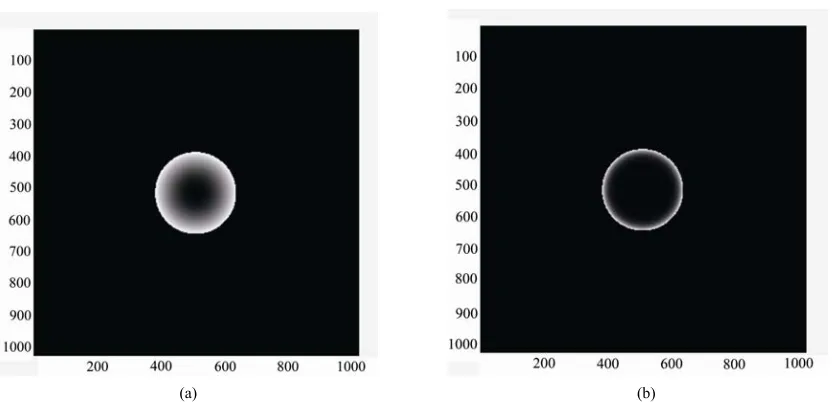
Figur distri-plotted as in e 1
[1 butions. These digital apertures are
(a) and (b) and compared with the uniform circular ap-erture and the linearly varied apap-erture 1].
Another MATLAB program is constructed to fabricate a diffuser as a randomly distributed object of dimensions 1024 × 1024 pixels shown in Figure 2.
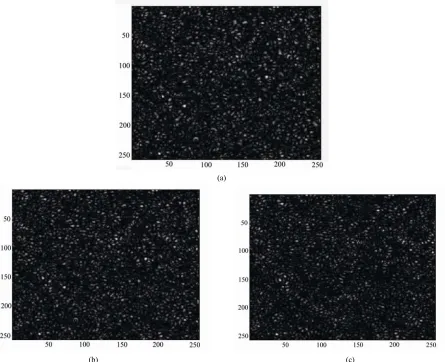
The parts of MATLAB program are used to obtain the different Figures (3)-(7). Digital speckle images for the randomly distributed objects which is modulated by the different apertures, using Equation (6), are represented in the Figure 3. The Figure 3(a) is plotted for the speckle image which is modulated by the linear aperture, the Figure 3(b) shows the speckle image modulated by the quadratic aperture, and the Figure 3(c) is given for higher order aperture 10. It is shown, for the naked eye, that the
three speckle images are different since they are modu-lated by different distributions of impulse responses or point spread func on (PSF) shown in Figures 9. Also, the comparative speckle image, shown in Figure 3(d), ob-tained for circular aperture is completely different from those speckle images shown in Figure 3(a), (b) and (c).
If the difference between the modulated speckle images is not obvious for the naked eye, hence the computation of the difference between any two different modulated sp
ti
e m
th
is obtained for m
ized if the sampling ra
(c). It is shown, from these im-ag
e profile corresponding to uniform circular aperture Figure 5(d) showing a great difference .
It is clear that the profile of the speckle image has a re- solution which is dependent upon the aperture distribution. It is shown that resolution improvement
odulated speckle images, in particular in case of radial distributed apertures. This is attributed due to the improve-ment occurred in the point spread function of the imaging system. A comparison of the different PSF in case of cir-cular, annular apertures, and radial distributed apertures is given later in Figure 10(d). The reconstructed images of the apertures are obtained from Equation (11) and plotted in Figures 6(a) and (b)and the corresponding profiles are plotted as in Figures 7(a), (b) and (c).
The difference between the actual analog image and the quantized digital image is called the quantization error. This quantization error may be minim
te is at least as great as the total spectral width w. Thus the critical sampling rate is just w called the Nyquist rate and the critical sampling interval is w–1 which is called
the Nyquist interval.
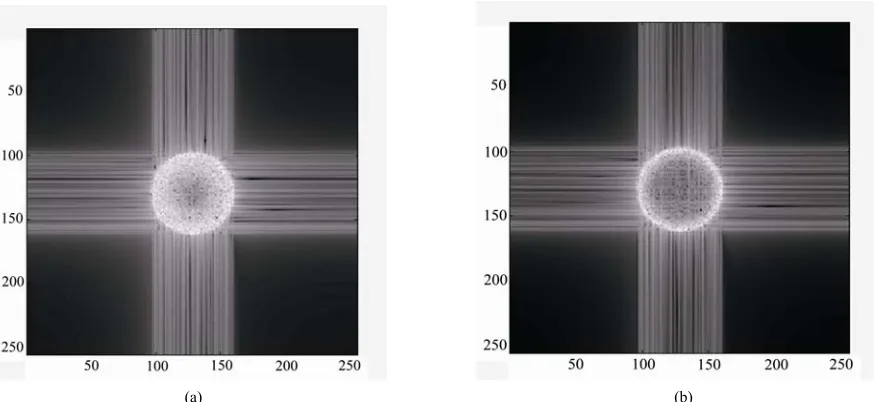
The autocorrelation intensity of the diffuser, in case of modulated apertures Equation (12), is plotted as shown in Figures 8(a), (b) and
es, that the diameter of the autocorrelation intensity is twice the diameter of the whole circular aperture. Also, the contrast of the autocorrelation intensity is improved for the radial apertures as compared with the correlation images obtained in case of uniform apertures. The pro-files of the autocorrelation intensity are plotted as in Figures 9(a), (b) and (c) which are taken at the slice x = [1,256,128,128], and the slice y = [1,256,128,128]. It is shown that two different profiles are obtained for the two different apertures of 2 and 10 distributions.
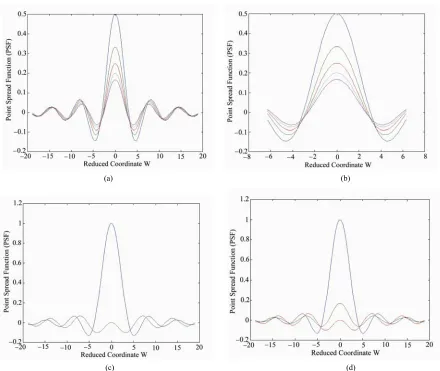
The point spread function is computed for apertures of ρn distribution usingEquation (2) for different powers of even values of n. we ta n = 2ke , 4, 6, 8, and 10. The PSF is represented graphically as shown in Figure 10(a) and (b). The comparative curves corresponding to circular and annular apertures are plotted as in Figure 10(c). It is shown, referring to the plotted results, that the best reso-lution is attained as n increases (n = 10) followed by n = 8 etc. Hence, the lowest resolution corresponds to the circular aperture and the best resolution corresponds to higher order aperture of n = 10 while the contrast of the image obtained in case of circular aperture is better than that obtained in case of higher order aperture. The Fig-ure 10(d) shows three curves where the best resolution is attained for annular aperture at the expense of the con-trast while the higher order aperture of ρ10 distribution
gives better resolution and contrast as compared with circular aperture.
eckle images is recommended. Figure 4(a), (b) and (c) is showing the difference beference between the two speckle images correspondintween images. The difg to circular and quadratic apertures is plotted as in Figure 4(a) and the difference corresponding to the linear and quadratic apertures is plotted as in Figure 4(b) while the difference corresponding to the quadratic and higher or-der apertures of 10 is shown in Figure 4(c). These
images which represent the difference between speckle images shown in Figure 4(a), (b) and (c) are clearly dif-ferent since they ar odulated by different apertures.
(a) (b)
[image:4.595.91.507.75.276.2]Figure 1. (a) The computer generated aperture having quadratic variations ρ2 of dimensions 1024 × 1024; (b) The computer generated aperture having quadratic variations ρ10 of dimensions 1024 × 1024.
Figure 2. The randomly distributed object behave as a diffuser constructed numerically of dimensions 1024 × 1024.
[image:4.595.172.425.318.504.2]
47
(c) (d)
Figure 3. (a) The numerical spe ed aperture; (b) Th
umeri-cal speckle image of the diffuser ob umerical speckle image of the ckle image of the diffuser obtained in case of a linearly distribut
tained in case of ρ2 quadratic distributed aperture; (c) The n e n diffuser obtained in case of ρ10 distributed aperture; (d) Speckle image of randomly distributed object of dimensions 1024 × 1024 pixels using circular uniform aperture.
(a)
(b) (c)
Figure 4. (a) The difference between the two speckle images corresponding to circular and quadratic apertures; (b) The dif-ference between the two speckle images corresponding to th ear and quadratic apertures; (c) The difference betwe the two speckle images correspondin
e lin en
[image:5.595.77.523.72.252.2] [image:5.595.76.521.315.677.2]
(a) (b)
(c) (d)
Figure 5. (a) The profile shape of the numerical speckle mage obtained using the linearly distributed aperture; (b) The profile shape of the numerical speckle image obtained using the quadratic aperture; (c) The profile shape of the numerical speckle image obtained in case of ρ10 distributed aperture; (d) The profile shape of the numerical speckle image obtained in case of uniform circular aperture.
(a) (b)
[image:6.595.92.504.80.411.2] [image:6.595.82.520.478.679.2]49
(a) (b)
Figure 7. (a) Profile shape of the reconstructed quadratic aperture; (b) Profile shape of the reconstructed ρ10 aperture.
(a) (b)
igure 8. (a) The numerical image of the autocorrelation intensity of the diffuser modulated by the quadratic ρ2 aperture; (b) The numerical image of the autocorrelation intensity of the diffuser modulated by ρ10 distributed aperture.
F
(a) (b)
[image:7.595.81.519.77.248.2] [image:7.595.95.501.285.462.2] [image:7.595.71.528.500.677.2]
(a) (b)
(c) (d)
Figure 10. (a) The plot of the p res. The highest blue curve is
y; (c) Two curves re plotted for the PSF where the highest curve is plotted for the circular aperture while the lowest is for the annular aper-ture of width 0.1. where is the radius of the circular aperaper-ture; (d) Three curves are plotted for the PSF where the highest curve is Plotted for the circular aperture while the lowest is for the annular aperture of width 0.1. Where is the radius of the circular aperture and the intermediate green curve corresponds to higher order aperture of n = 10.
4. Conclusions
We have computed numerically the autocorrelation in- tensity of the randomly distributed object, using three different apertures, from the speckle images. It is con-cluded that, from the shape of the autocorrelation inten-sity for both of the modulated apertures, the diameter of the autocorrelation peak is two times the diameter of the whole aperture as expected. Also, the contrast of the mo- dulated speckle images is affected by the modulated ap-ertures. It is shown that the
her order PSF curve is better in
resolu-tion than for the circular aperture since the central peak of the PSF for higher order aperture is sharper than the corresponding peak obtained for the circular aperture. The contrast is better for the circular aperture since it depends mainly on the numerical aperture without mo- dulation.
The PSF plot for higher order apertures of ρn distribu-tions showed a great improvement in resolution as com-pared with that obtained in case of uniform circular ap-erture.
of the computerized
modu-facility of fabrication as compared with the tedious work
oint spread function (PSF ) corresponding to five different apertu
plotted for the quadratic aperture of n = 2 .The green curve corresponds to n = 4, the red for n = 6, the lowers are plotted for n = 8 , and n = 10. The range of w equals [–6, 6]; (b) The same plot shown in Figure 9 but in the range of w extends from [–2,2]
or the sake of clarity and comparison. The resolution is improved by increasing the order n quadraticall f
a
contrast for quadratic aper- The potential application ture is better than the contrast obtained in case of higher
order aperture. The radial hig
[image:8.595.78.518.75.446.2]51 necessary in thin film techniques.
5. References
[1] J. J. Clair and A. M. Hamed, “Theoretical Studies on Optical Coherent Microscope,” Optik, Vol. 64, No. 2, 1983, pp. 133-141.
[2] A. M. Hamed and J. J. Clair, “Image and Su-per-Resolution in Optical Coherent Microscopes,” Optik, Vol. 64 , No. 4, 1983, pp. 277-284.
[3] A. M. Hamed and J. J. Clair, “Studies on Optical Proper-ties of Confocal Scanning Optical Microscope Using Pu-pils with Radial Transmission,” Optik, Vol. 65, No. 3, 1983, pp. 209-218.
[4] A. M. Hamed, “Resolution Optical Scanning Microscop
nology, Vol. 16, No. 2, 1984, pp. 93-96. doi:10.1016/0030-3992(84)90061-6
[11] A. M. Hamed, “Numerical Speckle Images Formed by Diffusers Using Modulated Conical and Linear Aper-tures,” Journal of Modern Optics, Vol. 56, No. 10, 2009, pp. 1174-1181. doi:10.1080/09500340902985379 [12] A. M. Hamed, “Formation of Speckle Images Formed For
Diffusers Illuminated by Modulated Aperture (Circular Obstruction),” Journal of Modern Optics, Vol. 56, No. 15, 2009, pp. 1633-1642. doi:10.1080/09500340903277792 [13] R. D. Bahuguna, “Speckle Patterns of Weak Diffusers:
Effect of Spherical Aberration,” Applied Optics, Vol. 19, No. 11, 1980, pp. 1874-1878. doi:10.1364/AO.19.001874 [14] H. El-Ghandoor and A. M. Hamed, “Strain Analysis Us-ing TV Interferometer,” International Symposium on the Technologies for Optoelectronics Conference, Cannes, Vol. 683, No. 30, 1987.
lysis of Fringe Contrast in Electronic Speckle Pattern Interferometer,” Optica Acta, Vol. 26, No. 3, 1979, pp. 313-327.
[16] G. A. Slettemoen, “Optimal Signal Processing in Elec-tronic Speckle Pattern Interferometer (ESPI),” Optics Communications, Vol. 23, No. 2, 1977, pp. 213-216. doi:10.1016/0030-4018(77)90309-1
and Contrast in Confocal es,” Optics and Laser
Tech-[5] A. M. Hamed, “A Study on Amplitude Modulation and an Application on Confocal Imaging,” Optik, Vol. 107 No. 4, 1998, pp. 161-164.
[6] T. Wilson, “Imaging Properties and Applications of Scanning Optical Microscopes,”Applied Physics, Vol. 22, No. 2, 1980, pp. 119-128. doi:10.1007/BF00885994 [7] C. J. R. Sheppard and A. Choudhary, “Image Formation
in the Scanning Microscope,” Journal of Modern Optics, Vol. 24, No. 10, 1977, pp. 1051-1073.
[8] G. Nomarski, The Journal of the Optical Society of America. Vol. 65, No. 10, 1975, p. 1166.
[9] C. J. R. Sheppard and T. Wilson, “Image Formation In Scanning Microscopes with Partially Coherent Source and Detector,” Journal of Modern Optics, Vol. 25, No. 4, 1978, pp. 315-325.
[10] I. J. Cox, C. J. R. Sheppard and T. Wilson, “Improvement in Resolution by Nearly Confocal Microscopy,” Applied Optics, Vol. 21, No. 5, 1982, pp. 778-781.
doi:10.1364/AO.21.000778
[15] G. A. Slettemoen, “General Ana
[17] R. S. Sirohi and A. R. Ganesan,“Holographic Systems, Components and Applications,” Proceedings of the 2nd International Conference on IEEE, 1989.
[18] Y. Z. Song and H. L. Zhang, etc., “Dynamic Digital Speckle Interferometry Applied to Optical Diagnosis of Gas-Liquid Phase Change,” The International Society for Optical Engineering, Vol. 4448, 2009, pp. 111-119. [19] C. Greated, E. Lavinskaya and N. Fomin, “Numerical
Simulation of Acoustical Wave Tracing,” Journal of Mathematical Modelling, Russian Academy of Science,
. Vol. 15, No. 7, 2003, pp. 75-80
[20] J. W. Goodmann, “Introduction to Fourier Optics and Holography,” McGraw-Hill book Company, New York, 1968.