Efficient Parsing for Head-Split Dependency Trees
Giorgio Satta
Dept. of Information Engineering University of Padua, Italy [email protected]
Marco Kuhlmann
Dept. of Linguistics and Philology Uppsala University, Sweden [email protected]
Abstract
Head splitting techniques have been success-fully exploited to improve the asymptotic runtime of parsing algorithms for project-ive dependency trees, under the arc-factored model. In this article we extend these tech-niques to a class of non-projective dependency trees, called well-nested dependency trees with block-degree at most 2, which has been previ-ously investigated in the literature. We define a structural property that allows head splitting for these trees, and present two algorithms that im-prove over the runtime of existing algorithms at no significant loss in coverage.
1 Introduction
Much of the recent work on dependency parsing has been aimed at finding a good balance between ac-curacy and efficiency. For one end of the spectrum, Eisner (1997) showed that the highest-scoring pro-jectivedependency tree under an arc-factored model can be computed in timeO.n3/, wherenis the length
of the input string. Later work has focused on mak-ing projective parsmak-ing viable under more expressive models (Carreras, 2007; Koo and Collins, 2010).
At the same time, it has been observed that for many standard data sets, the coverage of projective trees is far from complete (Kuhlmann and Nivre, 2006), which has led to an interest in parsing al-gorithms fornon-projectivetrees. While non-project-ive parsing under an arc-factored model can be done in timeO.n2/(McDonald et al., 2005), parsing with
more informed models is intractable (McDonald and Satta, 2007). This has led several authors to investig-ate ‘mildly non-projective’ classes of trees, with the
goal of achieving a balance between expressiveness and complexity (Kuhlmann and Nivre, 2006).
In this article we focus on a class of mildly non-projective dependency structures calledwell-nested dependency trees with block-degree at most 2. This class was first introduced by Bodirsky et al. (2005), who showed that it corresponds, in a natural way, to the class of derivation trees of lexicalized tree-adjoin-ing grammars (Joshi and Schabes, 1997). While there are linguistic arguments against the restriction to this class (Maier and Lichte, 2011; Chen-Main and Joshi, 2010), Kuhlmann and Nivre (2006) found that it has excellent coverage on standard data sets. Assum-ing an arc-factored model, well-nested dependency trees with block-degree 2 can be parsed in time
O.n7/using the algorithm of G´omez-Rodr´ıguez et
al. (2011). Recently, Pitler et al. (2012) have shown that if an additional restriction called1-inheritis im-posed, parsing can be done in timeO.n6/, without
any additional loss in coverage on standard data sets. Standard context-free parsing methods, when adap-ted to the parsing of projective trees, provideO.n5/
time complexity. TheO.n3/time result reported by
Eisner (1997) has been obtained by exploiting more sophisticated dynamic programming techniques that ‘split’ dependency trees at the position of their heads, in order to save bookkeeping. Splitting techniques have also been exploited to speed up parsing time for other lexicalized formalisms, such as bilexical context-free grammars and head automata (Eisner and Satta, 1999). However, to our knowledge no at-tempt has been made in the literature to extend these techniques to non-projective dependency parsing.
In this article we leverage the central idea from Eisner’s algorithm and extend it to the class of well-nested dependency trees with block-degree at most 2.
We introduce a structural property, calledhead-split, that allows us to split these trees at the positions of their heads. The property is restrictive, meaning that it reduces the class of trees that can be generated. However, we show that the restriction to head-split trees comes at no significant loss in coverage, and it allows parsing in timeO.n6/, an asymptotic
improve-ment of one order of magnitude over the algorithm by G´omez-Rodr´ıguez et al. (2011) for the unrestric-ted class. We also show that restricting the class of head-split trees by imposing the already mentioned 1-inherit property does not cause any additional loss in coverage, and that parsing for the combined class is possible in timeO.n5/, one order of magnitude
faster than the algorithm by Pitler et al. (2012) for the 1-inherit class without the head-split condition.
The above results have consequences also for the parsing of other related formalisms, such as the already mentioned lexicalized tree-adjoining gram-mars. This will be discussed in the final section.
2 Head Splitting
To introduce the basic idea of this article, we briefly discuss in this section two well-known algorithms for computing the set of all projective dependency trees for a given input sentence: the na¨ıve, CKY-style algorithm, and the improved algorithm with head splitting, in the version of Eisner and Satta (1999).1 CKY parsing The CKY-style algorithm works in a pure bottom-up way, building dependency trees by combining subtrees. Assuming an input string
w Da1 an,n 1, each subtreet is represented
by means of a finite signatureŒi; j; h, calleditem,
wherei; j are the boundary positions oft’s span over wandhis the position oft’s root. This is the only
information we need in order to combine subtrees under the arc-factored model. Note that the number of possible signatures isO.n3/.
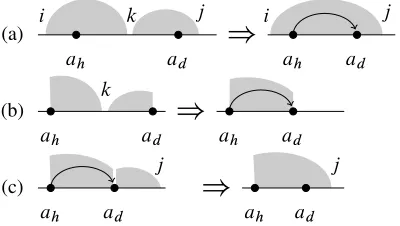
The main step of the algorithm is displayed in Figure 1(a). Here we introduce the graphical conven-tion, used throughout this article, of representing a subtree by a shaded area, with an horizontal line in-dicating the spanned fragment of the input string, and of marking the position of the head by a bullet. The illustrated step attaches a tree with signatureŒk; j; d
1Eisner (1997) describes a slightly different algorithm.
(a)
ah ad
i k j
)
ah ad
i j
(b)
ah ad
k
)
ah ad
(c)
ah ad
j
)
ah ad
[image:2.612.328.528.56.169.2]j
Figure 1: Basic steps for (a) the CKY-style algorithm and (b, c) the head splitting algorithm.
as a dependent of a tree with signatureŒi; k; h. There
can beO.n5/instantiations of this step, and this is
also the running time of the algorithm.
Eisner’s algorithm Eisner and Satta (1999) im-prove over the CKY algorithm by reducing the num-ber of position records in an item. They do this by ‘splitting’ each tree into a left and a right fragment, so that the head is always placed at one of the two boundary positions of a fragment, as opposed to be-ing placed at an internal position. In this way items need only two indices. Left and right fragments can be processed independently, and merged afterwards. Let us consider a right fragmentt with headah.
Attachment att of a right dependent tree with head ad is now performed in two steps. The first step
at-taches a left fragment with headad, as in Figure 1(b).
This results in a new type of fragment/item that has both headsahandad placed at its boundaries. The
second step attaches a right fragment with headad,
as in Figure 1(c). The number of possible instanti-ations of these steps, and the asymptotic runtime of the algorithm, isO.n3/.
3 Head-Split Trees
In this section we introduce the class of well-nested dependency trees with block-degree at most 2, and define the subclass of head-split dependency trees.
3.1 Preliminaries
For non-negative integersi; j we writeŒi; j to
de-note the setfi; iC1; : : : ; jg; wheni > j,Œi; j is the
empty set. For a stringw Da1 an, wheren1
and eachai is a lexical token, and fori; j 2 Œ0; n
withi j, we writewi;j to denote the substring
aiC1 aj ofw;wi;i is the empty string.
A dependency tree t over w is a directed tree
whose nodes are a subset of the tokensai inwand
whose arcs encode a dependency relation between two nodes. We write ai ! aj to denote the arc
.ai; aj/int; here, the nodeai is the head, and the
nodeaj is the dependent. If each tokenai,i 2Œ1; n,
is a node oft, thentis calledcomplete. Sometimes
we writetai to emphasize that treetis rooted in node
ai. Ifai is a node oft, we also writet Œaito denote
the subtree oftcomposed by nodeai as its root and
all of its descendant nodes.
The nodes of t uniquely identify a set of
max-imal substrings ofw, that is, substrings separated
by tokens not int. The sequence of such substrings,
ordered from left to right, is theyieldoft, written
yd.t /. Letai be some node oft. Theblock-degree
ofai int, writtenbd.ai; t /, is defined as the number
of string components ofyd.t Œai/. The block-degree
oft, writtenbd.t /, is the maximal block-degree of
its nodes. Tree t is non-projective if bd.t / > 1.
Treetiswell-nestedif, for each nodeai oft and for
every pair of outgoing dependenciesai !ad1 and
ai !ad2, the string components ofyd.t Œad1/and yd.t Œad2/do not ‘interleave’ inw. More precisely,
it is required that, if some component ofyd.t Œadi/,
i 2 Œ1; 2, occurs inwin between two components s1; s2 ofyd.t Œadj/,j 2 Œ1; 2andj ¤ i, thenall
components ofyd.t Œadi/occur in betweens1; s2.
Throughout this article, whenever we consider a dependency treet we always implicitly assume that t is overw, thatt has block-degree at most 2, and
that t is well-nested. Let tai be such a tree, with bd.ai; tai/D2. We call the portion ofwin between
the two substrings ofyd.tai/thegapoftai, denoted
bygap.tai/.
ah ad3 ad4
ad2
ad1
[image:3.612.333.516.59.133.2]m.tah/
Figure 2: Example of a nodeahwith block-degree2in a
non-projective, well-nested dependency treetah. Integer
m.tah/, defined in3.2, is also marked.
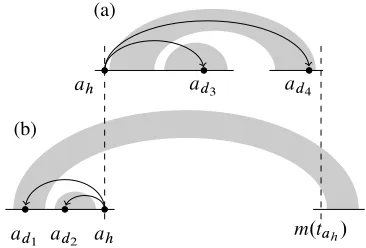
Example 1 Figure 2 schematically depicts a well-nested treetah with block-degree 2; we have marked
the root nodeahand its dependent nodesadi. For
each nodeadi, a shaded area highlightst Œadi. We
havebd.ah; tah/ D bd.ad1; tah/ Dbd.ad4; tah/ D
2andbd.ad2; tah/Dbd.ad3; tah/D1.
3.2 The Head-Split Property
We say that a dependency treet has thehead-split
property if it satisfies the following condition. Let
ah!ad be any dependency int withbd.ah; t /D bd.ad; t /D2. Whenevergap.t Œad/containsah, it
must also containgap.t Œah/. Intuitively, this means
that ifyd.t Œad/‘crosses over’ the lexical tokenahin
w, thenyd.t Œad/must also ‘cross over’gap.t Œah/.
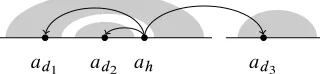
Example 2 Dependencyah!ad1in Figure 3
viol-ates the head-split condition, sinceyd.t Œad1/crosses
over the lexical tokenahinw, but does not cross over gap.t Œah/. The remaining outgoing dependencies of
ahtrivially satisfy the head-split condition, since the
child nodes have block-degree 1.
Lettahbe a dependency tree satisfying the
head-split property and withbd.ah; tah/D2. We specify
below a construction that ‘splits’tahwith respect to
the position of the headah inyd.tah/, resulting in
two dependency trees sharing the rootahand having
all of the remaining nodes forming two disjoint sets. Furthermore, the resulting trees have block-degree at most 2.
ah
ad1 ad2 ad3
[image:3.612.346.506.644.681.2](a)
ah ad3 ad4
(b)
ah
ad2
[image:4.612.93.276.57.181.2]ad1 m.tah/
Figure 4: Lower tree (a) and upper tree (b) fragments for the dependency tree in Figure 2.
Let yd.tah/ D hwi;j; wp;qi and assume thatah
is placed within wi;j. (A symmetric construction
should be used in caseahis placed withinwp;q.) The mirror imageofahwith respect togap.tah/, written m.tah/, is the largest integer inŒp; qsuch that there
are no dependencies linking nodes in wi;h 1 and
nodes in wp;m.tah/ and there are no dependencies
linking nodes inwh;j and nodes inwm.tah/;q. It is
not hard to see that such an integer always exists, sincetahis well-nested.
We classify every dependent ad of ahas being
an ‘upper’ dependent or a ‘lower’ dependent of
ah, according to the following conditions: (i) If
d 2Œi; h 1[Œm.tah/C1; q, thenadis an upper
dependent ofah. (ii) Ifd 2ŒhC1; j [Œp;m.tah/,
thenad is a lower dependent ofah.
The upper tree of tah is the dependency tree
rooted in ah and composed of all dependencies
ah ! ad in tah with ad an upper dependent of
ah, along with all subtreestahŒadrooted in those
dependents. Similarly, thelower treeoftah is the
dependency tree rooted inah and composed of all
dependenciesah ! ad intah withad a lower
de-pendent ofah, along with all subtreestahŒadrooted
in those dependents. As a general convention, in this article we writetU;ah andtL;ahto denote the upper
and the lower trees oftah, respectively. Note that, in
some degenerate cases, the set of lower or upper de-pendents may be empty; thentU;ahortL;ah consists
of the root nodeahonly.
Example 3 Consider the tree tah displayed in
Fig-ure 2. Integerm.tah/denotes the boundary between
the right component of yd.tahŒad4/ and the right
component ofyd.tahŒad1/. Nodesad3 andad4 are
lower dependents, and nodesad1 andad2are upper
dependents. TreestL;ah andtU;ah are displayed in
Figure 4 (a) and (b), respectively.
The importance of the head-split property can be informally explained as follows. Letah!ad be a
dependency intah. When we take apart the upper and
the lower trees oftah, the entire subtreetahŒadends
up in either of these two fragments. This allows us to represent upper and lower fragments for some head independently of the other, and to freely recombine them. More formally, our algorithms will make use of the following three properties, stated here without any formal proof:
P1 TreestU;ahandtL;ahare well-nested, have
block-degree2, and satisfy the head-split property.
P2 TreestU;ahandtL;ahhave their headahalways
placed at one of the boundaries in their yields.
P3 LettU;ah0 andtL;ah00 be the upper and lower trees
of distinct treestah0 andtah00 , respectively. Ifm.tah0 /D
m.ta00
h/, then there exists a treetahsuch thattU;ahD
tU;ah0 andtL;ah DtL;ah00 .
4 Parsing Items
Letw D a1 an,n 1, be the input string. We
need to compactly represent trees that span substrings ofwby recording only the information that is needed
to combine these trees into larger trees during the parsing process. We do this by associating each tree with a signature, calleditem, which is a tuple
Œi; j ; p; q; hX, whereh2Œ1; nidentifies the token
ah,i; j with0i j nidentify a substringwi;j,
andp; qwithj < p q nidentify a substring wp;q. We also use the special settingpDqD .
The intended meaning is that each item repres-ents some tree tah. If p; q ¤ then yd.tah/ D
hwi;j; wp;qi. Ifp; q D then
yd.tah/D
8 ˆ <
ˆ :
hwi;ji ifh2ŒiC1; j
hwh;h; wi;ji ifh < i
hwi;j; wh;hi ifh > j C1
The two cases h < i and h > j C1 above will
be used when the root nodeah of tah has not yet
collected all of its dependents.
Note that h 2 fi; j C 1g is not used in the
which is undesired for the specification of our al-gorithm. As an example, itemsŒi; j ; ; ; iC1X
andŒiC1; j ; ; ; iC1Xboth represent a
depend-ency treetaiC1 withyd.taiC1/ D hwi;ji. This and
other similar cases are avoided by the ban against
h 2 fi; j C1g, which amounts to imposing some normal form for items. In our example, only item
Œi; j ; ; ; iC1X is a valid signature.
Finally, we distinguish among several item types, indicated by the value of subscriptX. These types
are specific to each parsing algorithm, and will be defined in later sections.
5 Parsing of Head-Split Trees
We present in this section our first tabular algorithm for computing the set of all dependency trees for an input sentencew that have the head-split property,
under the arc-factored model. Recall thattai denotes
a tree with rootai, andtL;ai andtU;ai are the lower
and upper trees oftai. The steps of the algorithm
are specified by means of deduction rules over items, following the approach of Shieber et al. (1995).
5.1 Basic Idea
Our algorithm builds trees step by step, by attaching a treetah0 as a dependent of a treetah and creating
the new dependency ah ! ah0. Computationally,
the worst case for this operation is when bothtah
andtah0 have a gap; then, for each tree we need to
keep a record of the four boundaries, along with the position of the head, as done by G´omez-Rodr´ıguez et al. (2011). However, if we are interested in parsing trees that satisfy the head-split property, we can avoid representing a tree with a gap by means of a single item. We instead follow the general idea of2 for
projective parsing, and use different items for the upper and the lower trees of the source tree.
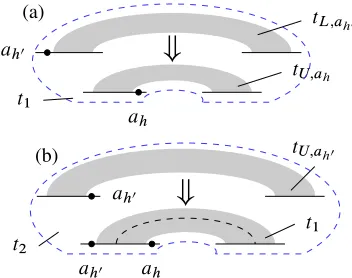
When we need to attachtah0 as an upper dependent
oftah, defined as in3.2, we perform two consecutive
steps. First, we attachtL;ah0 totU;ah, resulting in a
new intermediate treet1. As a second step, we attach
tU;ah0 tot1, resulting in a new treet2which istU;ah
withtah0 attached as an upper dependent, as desired.
Both steps are depicted in Figure 5; here we introduce the convention of indicating tree grouping through a dashed line. A symmetric procedure can be used to attach tah0 as a lower dependent totL;ah. The
ah
tU;ah
ah0
tL;ah0
+
t1
(a)
t1
ah0 ah
ah0
tU;ah0
+
t2
[image:5.612.337.513.56.195.2](b)
Figure 5: Two step attachment oftah0 attU;ah: (a) attach-ment oftL;ah0; (b) attachment oftU;ah0.
correctness of the two step approach follows from properties P1 and P3 in3.2.
By property P2 in 3.2, in both steps above the
lexical headsahandah0 can be read from the
bound-aries of the involved trees. Then these steps can be implemented more efficiently than the na¨ıve method of attachingtah0 totah in a single step. A more
de-tailed computational analysis will be provided in5.7.
To simplify the presentation, we restrict the use of head splitting to trees with a gap and parse trees with no gap with the na¨ıve method; this does not affect the computational complexity.
5.2 Item Types
We distinguish five different types of items, indicated by the subscriptX 2 f0; L; U; =L; =Ug, as described
in what follows.
IfX D0, we havep Dq D andyd.ah/is
specified as in4.
IfX DL, we use the item to represent some
lower tree. We have thereforep; q ¤ and h2 fiC1; qg.
IfX D U, we use the item to represent some
upper tree. We have thereforep; q ¤ and h2 fj; pC1g.
IfX D =Lor X D =U, we use the item to
represent some intermediate step in the parsing process, in which only the lower or upper tree of some dependent has been collected by the head
ah, and we are still missing the upper (=U) or
We further specialize symbol =U by writing=U<
(=U>) to indicate that the missing upper tree should
have its head to the left (right) of its gap. We also use
=L<and=L>with a similar meaning.
5.3 Item Normal Form
It could happen that our algorithm produces items of type0that do not satisfy the normal form condition
discussed in4. To avoid this problem, we assume
that every item of type 0 that is produced by the
algorithm is converted into an equivalent normal form item, by means of the following rules:
Œi; j ; ; ; i 0
Œi 1; j ; ; ; i 0 (1)
Œi; j ; ; ; j C10
Œi; j C1; ; ; j C10 (2)
5.4 Items of Type0
We start with deduction rules that produce items of type0. As already mentioned, we do not apply the
head splitting technique in this case.
The next rule creates trees with a single node, rep-resenting the head, and no dependents. The rule is actually an axiom (there is no antecedent) and the statementi 2Œ1; nis a side condition.
Œi 1; i ; ; ; i 0
˚
i 2Œ1; n (3)
The next rule takes a tree headed inah0and makes
it a dependent of a new headah. This rule
imple-ments what has been called the ‘hook trick’. The first side condition enforces that the tree headed inah0
has collected all of its dependents, as discussed in4.
The second side condition enforces that no cycle is created. We also writeah ! ah0 to indicate that a
new dependency is created in the parse forest.
Œi; j ; ; ; h00
Œi; j ; ; ; h0
8 <
:
h02ŒiC1; j h62ŒiC1; j ah!ah0
(4)
The next two rules combine gap-free dependents of the same headah.
Œi; k; ; ; h0 Œk; j ; ; ; h0
Œi; j ; ; ; h0 (5)
Œi; h; ; ; h0 Œh 1; j ; ; ; h0
Œi; j ; ; ; h0 (6)
We need the special case in (6) to deal with the con-catenation of two items that share the headahat the
concatenation point. Observe the apparent mismatch in step (6) between index hin the first antecedent
and indexh 1 in the second antecedent. This is
because in our normal form, both the first and the second antecedent have already incorporated a copy of the shared headah.
The next two rules collect a dependent ofahthat
wraps around the dependents that have already been collected. As already discussed, this operation is performed by two successive steps: We first collect the lower tree and then the upper tree. We present the case in which the shared head of the two trees is placed at the left of the gap. The case in which the head is placed at the right of the gap is symmetric.
Œi0; j0; ; ; h0
Œi; i0; j0; j ; iC1L
Œi; j ; ; ; h=U<
h62ŒiC1; i0
[Œj0C1; j (7)
Œi0; j0; ; ; h=U<
Œi; i0C1; j0; j ; i0C1U
Œi; j ; ; ; h0
8 <
:
h62ŒiC1; i0C1 [Œj0C1; j ah!ai0C1
(8)
Again, there is an overlap in rule (8) between the two antecedents, due to the fact that both items have already incorporated copies of the same head.
5.5 Items of TypeU
We now consider the deduction rules that are needed to process upper trees. Throughout this subsection we assume that the head of the upper tree is placed at the left of the gap. The other case is symmetric. The next rule creates an upper tree with a single node, rep-resenting its head, and no dependents. We construct an item for all possible right gap boundariesj.
Œi 1; i ; j; j ; i U
i 2Œ1; n
j 2ŒiC1; n (9)
The next rule adds to an upper tree a group of new dependents that do not have any gap. We present the case in which the new dependents are placed at the left of the gap of the upper tree.
Œi; i0; ; ; j 0 Œi0; j ; p; q; j U
The next two rules collect a new dependent that wraps around the upper tree. Again, this operation is performed by two successive steps: We first collect the lower tree, then the upper tree. We present the case in which the shared head of the two trees is placed at the left of the gap.
Œi0; j ; p; q0; j U Œi; i0; q0; q; iC1L
Œi; j ; p; q; j =U< (11)
Œi0; j ; p; q0; j =U<
Œi; i0C1; q0; q; i0C1U
Œi; j ; p; q; j U
˚
aj !ai0C1 (12)
5.6 Items of TypeL
So far we have always expanded items (type0orU)
at their external boundaries. When dealing with lower trees, we have to reverse this strategy and expand items (type L) at their internal boundaries. Apart
from this difference, the deduction rules below are entirely symmetric to those in5.5. Again, we
as-sume that the head of the lower tree is placed at the left of the gap, the other case being symmetric. Our first rule creates a lower tree with a single node, representing its head. We blindly guess the right boundary of the gap of such a tree.
Œi 1; i ; j; j ; i L
i 2Œ1; n
j 2ŒiC1; n (13)
The next rule adds to a lower tree a group of new dependents that do not have any gap. We present the case in which the new dependents are placed at the left of the gap of the lower tree.
Œj0; j ; ; ; iC10 Œi; j0; p; q; iC1L
Œi; j ; p; q; iC1L (14)
The next two rules collect a new dependent with a gap and embed it within the gap of our lower tree, creating a new dependency. Again, this operation is performed by two successive steps, and we present the case in which the common head of the lower and upper trees that are embedded is placed at the left of the gap, the other case being symmetric.
Œi; j0; p0; q; iC1L Œj0; j ; p; p0; j U
Œi; j ; p; q; iC1=L< (15)
Œi; j0; p0; q; iC1=L<
Œj0 1; j ; p; p0; j0L
Œi; j ; p; q; iC1L
˚
aiC1!aj0 (16)
ah
ad1 ad2 ad3 ad4 ad5
[image:7.612.322.532.55.129.2]tU;ah tLL;ah tLR;ah
Figure 6: Nodeahsatisfies both the 1-inherit and
head-split conditions. Accordingly, treetah can be split into three fragmentstU;ah,tLL;ahandtLR;ah.
5.7 Runtime
The algorithm runs in timeO.n6/, wheren is the
length of the input sentence. The worst case is due to deduction rules that combine two items, each of which represents trees with one gap. For instance, rule (11) involves six free indices ranging overŒ1; n,
and thus could be instantiatedO.n6/many times. If
the head-split property does not hold, attachment of a dependent in one step results in timeO.n7/, as seen
for instance in G´omez-Rodr´ıguez et al. (2011).
6 Parsing of 1-Inherit Head-Split Trees
In this section we specialize the parsing algorithm of5 to a new, more efficient algorithm for a
restric-ted class of trees.
6.1 1-Inherit Head-Split Trees
Pitler et al. (2012) introduce a restriction on well-nes-ted dependency trees with block-degree at most 2. A treetsatisfies the1-inheritproperty if, for every
node ah int withbd.ah; t / D 2, there is at most
one dependency ah ! ad such that gap.t Œad/
contains gap.t Œah/. Informally, this means that yd.t Œad/‘crosses over’gap.t Œah/, and we say that
ad ‘inherits’ the gap ofah. In this section we
in-vestigate the parsing of head-split trees that also have the 1-inherit property.
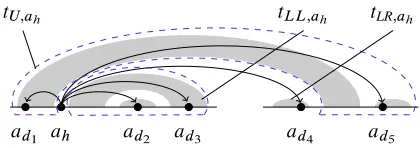
Example 4 Figure 6 shows a head node ah along
with dependentsadi, satisfying the head-split
condi-tion. Onlytad1 has its yield crossing overgap.tah/.
Thusahalso satisfies the 1-inherit condition.
6.2 Basic Idea
Lettah be some tree satisfying both the head-split
property and the 1-inherit propery. Assume that the dependent nodead which inherits the gap of tah
dependencyah ! ad intL;ah, yd.t Œad/does not
cross over gap.tL;ah/. Then we can further split
tL;ahinto two trees, both with rootah. We call these
two trees thelower-lefttree, writtentLL;ah, and the lower-righttree, writtentLR;ah; see again Figure 6.
The basic idea behind our algorithm is to splittah
into three dependency treestU;ah,tLL;ah andtLR;ah,
all sharing the same rootah. This means that tah
can be attached to an existing tree through three suc-cessive steps, each processing one of the three trees above. The correctness of this procedure follows from a straightforward extension of properties P1 and P3 from3.2, stating that the tree fragmentstU;ah,
tLL;ah andtLR;ah can be represented and processed
one independently of the others, and freely combined if certain conditions are satisfied by their yields.
In casead is placed withintL;ah, we introduce
the upper-left and the upper-right trees, written
tUL;ahandtUR;ah, and apply a similar idea.
6.3 Item Types
When processing an attachment, the order in which the algorithm assembles the three tree fragments of
tahdefined in6.2 is not always the same. Such an
order is chosen on the basis of where the headah
and the dependentadinheriting the gap are placed
within the involved trees. As a consequence, in our algorithm we need to represent several intermediate parsing states. Besides the item types from5.2, we
therefore need additional types. The specification of these new item types is rather technical, and is therefore delayed until we introduce the relevant de-duction rules.
6.4 Items of Type0
We start with the deduction rules for parsing of treestLL;ahandtLR;ah; treestUL;ahandtUR;ah can be
treated symmetrically. The yields oftLL;ahandtLR;ah
have the form specified in4 for the casepDq D .
We can therefore use items of type0to parse these
trees, adopting a strategy similar to the one in5.4.
The main difference is that, when a treetah0 with a
gap is attached as a dependent to the headah, we
use three consecutive steps, each processing a single fragment oftah0. We assume below thattah0 can be
split into treestU;ah0, tLL;ah0 and tLR;ah0, the other
case can be treated in a similar way.
We use rules (3), (4) and (5) from5.4. Since in
ad ah
„ƒ‚…
1
„ƒ‚…
2
„ƒ‚…
3
„ƒ‚…
4
[image:8.612.323.530.55.134.2]tad tU;ad tLL;ad tLR;ad
Figure 7: TreetU;ahis decomposed intotadand subtrees covering substringsi, i 2 Œ1; 4. Treetad is in turn decomposed into three fragments (treestLL;ad,tLR;ad, andtU;ad in this example).
the treestLL;ah andtLR;ahthe head is never placed in
the middle of the yield, rule (6) is not needed now and it can safely be discarded. Rule (7), attaching a lower tree, needs to be replaced by two new rules, processing a lower-left and a lower-right tree. We assume here that the common head of these trees is placed at the left boundary of the lower-left tree; we leave out the symmetric case.
Œi; i0; ; ; iC10
Œi0; j ; ; ; h0
Œi; j ; ; ; h=LR<
˚
h62ŒiC1; i0 (17)
Œj0; j ; ; ; i C10
Œi; j0; ; ; h=LR<
Œi; j ; ; ; h=U<
˚
h62Œj0C1; j (18)
The first antecedent in (17) encodes a lower-left tree with its head at the left boundary. The consequent item has then the new type =LR<, meaning that a
lower-right tree is missing that must have its head at the left. The first antecedent in (18) provides the missing lower-right tree, having the same head as the already incorporated lower-left tree. After these rules are applied, rule (8) from5.4 can be applied
to the consequent item of (18). This completes the attachment of a ‘wrapping’ dependent ofah, with the
incorporation of the missing upper tree and with the construction of the new dependency.
6.5 Items of TypeU
We now assume that node ad is realized within
tU;ah, so thattahcan be split into treestU;ah,tLL;ah
andtLR;ah. We provide deduction rules to parse of
tU;ah; this is the most involved part of the algorithm.
In case ad is realized within tL;ah, tah must be
split intotL;ah,tUL;ahandtUR;ah, and a symmetrical
ad ah
1 2 3 4
tU;ad tLL;ad tLR;ad
[image:9.612.84.291.58.147.2]rule (19) rule (20)
Figure 8: Decomposition oftU;ah as in Figure 7, with highlighted application of rules (19) and (20).
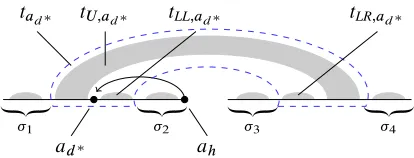
We start by observing that yd.tad/ splits
yd.tU;ah/ into at most four substrings i; see
Fig-ure 7.2 Because of the well-nested property, within
the treetU;ah each dependent ofahother thanad
has a yield that is entirely placed within one of the
i’s substrings. This means that each substringi
can be parsed independently of the other substrings. As a first step in the process of parsingtU;ah, we
parse each substringi. We do this following the
parsing strategy specified in6.4. As a second step,
we assume that each of the three fragments resulting from the decomposition of treetad has already been
parsed; see again Figure 7. We then ‘merge’ these three fragments and the trees for segmentsi’s into
a complete parse tree representing tU;ah. This is
described in detail in what follows.
We assume thatahis placed at the left of the gap
oftU;ah (the right case being symmetrical) and we
distinguish four cases, depending on the two ways in whichtad can be split, and the two side positions of
the headadwith respect togap.tad/.
Case 1 We assume thattad can be split into trees
tU;ad,tLL;ad,tLR;ad, and the headad is placed
at the left ofgap.tad/; see again Figure 7.
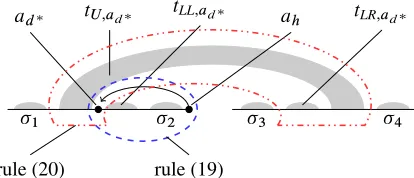
Rule (19) below combinestLL;ad with a parse for
segment2, which has its headahplaced at its right
boundary; see Figure 8 for a graphical representation of rule (19). The result is an item of the new typeHH. This item is used to represent an intermediate tree fragment with root of block-degree 1, where both the left and the right boundaries are heads; a dependency
2According to our definition ofm.t
ah/in3.2,3is always
the empty string. However, here we deal with the general formu-lation of the problem in order to claim in8 that our algorithm can be directly adapted to parse some subclasses of lexicalized tree-adjoining grammars.
ah
ad
1 2 3 4
tU;ad
tLL;ad
tLR;ad
rule (22) rule (23)
Figure 9: Decomposition oftU;ah as in Figure 7, with highlighted application of rules (22) and (23).
between these heads will be constructed later.
Œi; i0; ; ; iC10 Œi0; j ; ; ; j 0
Œi; j ; ; ; j HH (19)
Rule (20) combinestU;ad with a type 0 item
rep-resentingtLR;ad; see again Figure 8. Note that this
combination operation expands an upper tree at one of its internal boundaries, something that was not possible with the rules specified in5.5.
Œi; j ; p0; q; j U Œp; p0; ; ; j 0
Œi; j ; p; q; j U (20)
Finally, we combine the consequents of (19) and (20), and process the dependency that was left pending in the item of typeHH.
Œi; j0; p; q; j0U
Œj0 1; j ; ; ; j HH
Œi; j ; p; q; j U
˚
aj !aj0 (21)
After the above steps, parsing oftU;ahcan be
com-pleted by combining itemŒi; j ; p; q; j U from (21)
with items of type0representing parses for the
sub-strings1,3and4.
Case 2 We assume thattad can be split into trees
tU;ad,tLL;ad,tLR;ad, and the headad is placed
at the right ofgap.tad/, as depicted in Figure 9.
Rule (22) below, graphically represented in Fig-ure 9, combinestU;ad with a type0item
represent-ing tLL;ad. This can be viewed as the symmetric
version of rule (20) of Case 1, expanding an upper tree at one of its internal boundaries.
Œi; j0; p; q; pC1U Œj0; j ; ; ; pC10
[image:9.612.317.546.58.157.2]Arabic Czech Danish Dutch Portuguese Swedish
Number of trees 1,460 72,703 5,190 13,349 9,071 11,042
WN2 O.n7/ 1,458 99.9% 72,321 99.5% 5,175 99.7% 12,896 96.6% 8,650 95.4% 10,955 99.2% Classes considered in this paper
WN2 + HS O.n6/ 1,457 99.8% 72,182 99.3% 5,174 99.7% 12,774 95.7% 8,648 95.3% 10,951 99.2% WN2 + HS + 1I O.n5/ 1,457 99.8% 72,182 99.3% 5,174 99.7% 12,774 95.7% 8,648 95.3% 10,951 99.2% Classes considered by Pitler et al. (2012)
WN2 + 1I O.n6/ 1,458 99.9% 72,321 99.5% 5,175 99.7% 12,896 96.6% 8,650 95.4% 10,955 99.2% WN2 + 0I O.n5/ 1,394 95.5% 70,695 97.2% 4,985 96.1% 12,068 90.4% 8,481 93.5% 10,787 97.7% Projective O.n3/ 1,297 88.8% 55,872 76.8% 4,379 84.4% 8,484 63.6% 7,353 81.1% 9,963 90.2%
Table 1: Coverage of various classes of dependency trees on the training sets used in the CoNLL-X shared task (WN2 = well-nested, block-degree2; HS = head-split; 1I = 1-inherit; 0I = 0-inherit, ‘gap-minding’)
Next, we combine the result of (22) with a parse for substring2. The result is an item of the new type
=LR>. This item is used to represent an intermediate
tree fragment that is missing a lower-right tree with its head at the right. In this fragment, two heads are left pending, and a dependency relation will be eventually established between them.
Œi; j0; p; q; pC1U Œj0; j ; ; ; j 0
Œi; j ; p; q; j =LR> (23)
The next rule combines the consequent item of (23) with a treetLR;ad having its head at the right
bound-ary, and processes the dependency that was left pending in the=LR>item.
Œi; j ; p0; q; j =LR>
Œp; p0C1; ; ; p0C10
Œi; j ; p; q; j U
˚
aj !ap0C1 (24)
After the above rules, parsing oftU;ahcontinues by
combining the consequent itemŒi; j ; p; q; j U from
rule (24) with items representing parses for the sub-strings1,3and4.
Cases 3 and 4 We informally discuss the cases in which tad can be split into trees tL;ad, tUL;ad,
tUR;ad, for both positions of the headad with
re-spect to gap.tad/. In both cases we can adopt a
strategy similar to the one of Case 2.
We first expandtL;ad externally, at the side
op-posite to the headad, with a tree fragmenttUL;ad
or tUR;ad, similarly to rule (22) of Case 2. This
results in a new fragment t1. Next, we merge t1
with a parse for2containing the headah, similarly
to rule (23) of Case 2. This results in a new frag-mentt2where a dependency relation involving the
headsadandahis left pending. Finally, we merge
t2 with a missing treetUL;ad or tUR;ad, and
pro-cess the pending dependency, similarly to rule (24). One should contrast this strategy with the alternative strategy adopted in Case 1, where the fragment of
tad having block-degree 2cannotbe merged with a
parse for the segment containing the headah(2in
Case 1), because of an intervening fragment oftad
with block-degree 1 (tLL;ad in Case 1).
Finally, if there is no nodeadintU;ahthat inherits
the gap ofah, we can splittU;ahinto two dependency
trees, as we have done fortL;ah in6.2, and parse
the two fragments using the strategy of6.4.
6.6 Runtime
Our algorithm runs in time O.n5/, wheren is the
length of the input sentence. The reason of the im-provement with respect to theO.n6/result of5 is
that we no longer have deduction rules where both antecedents represent trees with a gap. In the new al-gorithm, the worst case is due to rules where only one antecedent has a gap. This leads to rules involving a maximum of five indices, ranging overŒ1; n. These
rules can be instantiated inO.n5/ways.
7 Empirical Coverage
In connection with the 1-inherit property, this even increases to two orders of magnitude. However, as already stated in2, this improvement is paid for by
a loss in coverage; for instance, trees of the form shown in Figure 3 cannot be parsed any longer.
7.1 Quantitative Evaluation
In order to assess the empirical loss in coverage that the restriction to head-split trees incurs, we evaluated the coverage of several classes of dependency trees on standard data sets. Following Pitler et al. (2012), we report in Table 1 figures for the training sets of six languages used in the CoNLL-X shared task on dependency parsing (Buchholz and Marsi, 2006). As we can see, theO.n6/class of head-split trees has
only slightly lower coverage on this data than the baseline class of well-nested dependency trees with block-degree at most 2. The losses are up to 0.2
percentage points on five of the six languages, and 0.9 points on the Dutch data. Our even more restricted
O.n5/class of 1-inherit head-split trees has the same
coverage as ourO.n6/class, which is expected given
the results of Pitler et al. (2012): TheirO.n6/class
of 1-inherit trees has exactly the same coverage as the baseline (and thereby more coverage than our
O.n6/class). Interestingly though, theirO.n5/class
of ‘gap-minding’ trees has a significantly smaller coverage than ourO.n5/ class. We conclude that
our class seems to strike a good balance between expressiveness and parsing complexity.
7.2 Qualitative Evaluation
While the original motivation behind introducing the head-split property was to improve parsing complex-ity, it is interesting to also discuss the linguistic relev-ance of this property. A first inspection of the struc-tures that violate the head-split property revealed that many such violations disappear if one ignores gaps caused by punctuation. Some decisions about what nodes should function as the heads of punctuation symbols lead to more gaps than others. In order to quantify the implications of this, we recomputed the coverage of the class of head-split trees on data sets where we first removed all punctuation. The results are given in Table 2. We restrict ourselves to the five native dependency treebanks used in the CoNLL-X shared task, ignoring treebanks that have been con-verted from phrase structure representations.
Arabic Czech Danish Slovene Turkish
with 1 139 1 2 2
[image:11.612.316.541.57.99.2]without 1 46 0 0 2
Table 2: Violations against the head-split property (relative to the class of well-nested trees with block-degree2) with and without punctuation.
We see that when we remove punctuation from the sentences, the number of violations against the head-split property at most decreases. For Danish and Slovene, removing punctuation even has the ef-fect thatallwell-nested dependency trees with block-degree at most 2 become head-split. Overall, the
absolute numbers of violations are extremely small— except for Czech, where we have139violations with
and46without punctuation. A closer inspection of
the Czech sentences reveals that many of these fea-ture rather complex coordinations. Indeed, out of the46violations in the punctuation-free data, only9
remain when one ignores those with coordination. For the remaining ones, we have not been able to identify any clear patterns.
8 Concluding Remarks
In this article we have extended head splitting tech-niques, originally developed for parsing of projective dependency trees, to two subclasses of well-nested dependency trees with block-degree at most 2. We have improved over the asymptotic runtime of two existing algorithms, at no significant loss in coverage. With the same goal of improving parsing efficiency for subclasses of non-projective trees, in very recent work Pitler et al. (2013) have proposed an O.n4/
time algorithm for a subclass of non-projective trees that are not well-nested, using an approach that is orthogonal to the one we have explored here.
Other than for dependency parsing, our results have also implications for mildly context-sensitive phrase structure formalisms. In particular, the al-gorithm of 5 can be adapted to parse a subclass
of lexicalized tree-adjoining grammars, improving the result by Eisner and Satta (2000) fromO.n7/to
O.n6/. Similarly, the algorithm of6 can be adapted
References
Manuel Bodirsky, Marco Kuhlmann, and Mathias M¨ohl. 2005. Well-nested drawings as models of syntactic structure. InProceedings of the 10th Conference on Formal Grammar (FG) and Ninth Meeting on Mathem-atics of Language (MOL), pages 195–203, Edinburgh, UK.
Sabine Buchholz and Erwin Marsi. 2006. CoNLL-X shared task on multilingual dependency parsing. In Proceedings of the Tenth Conference on Computational Natural Language Learning (CoNLL), pages 149–164, New York, USA.
Xavier Carreras. 2007. Experiments with a higher-order projective dependency parser. InProceedings of the CoNLL Shared Task Session of EMNLP-CoNLL 2007, pages 957–961, Prague, Czech Republic.
Joan Chen-Main and Aravind K. Joshi. 2010. Unavoid-able ill-nestedness in natural language and the adequacy of tree local-MCTAG induced dependency structures. InProceedings of the Tenth International Conference on Tree Adjoining Grammars and Related Formalisms (TAG+), New Haven, USA.
Jason Eisner and Giorgio Satta. 1999. Efficient parsing for bilexical context-free grammars and Head Auto-maton Grammars. InProceedings of the 37th Annual Meeting of the Association for Computational Linguist-ics (ACL), pages 457–464, College Park, MD, USA. Jason Eisner and Giorgio Satta. 2000. A faster parsing
algorithm for lexicalized Tree-Adjoining Grammars. In Proceedings of the Fifth Workshop on Tree Adjoining Grammars and Related Formalisms (TAG+), pages 14– 19, Paris, France.
Jason Eisner. 1997. Bilexical grammars and a cubic-time probabilistic parser. InProceedings of the Fifth Inter-national Workshop on Parsing Technologies (IWPT), pages 54–65, Cambridge, MA, USA.
Carlos G´omez-Rodr´ıguez, John Carroll, and David J. Weir. 2011. Dependency parsing schemata and mildly non-projective dependency parsing. Computational Lin-guistics, 37(3):541–586.
Aravind K. Joshi and Yves Schabes. 1997. Tree-Adjoining Grammars. In Grzegorz Rozenberg and Arto Salomaa, editors,Handbook of Formal Languages, volume 3, pages 69–123. Springer.
Terry Koo and Michael Collins. 2010. Efficient third-order dependency parsers. InProceedings of the 48th Annual Meeting of the Association for Computational Linguistics (ACL), pages 1–11, Uppsala, Sweden. Marco Kuhlmann and Joakim Nivre. 2006. Mildly
non-projective dependency structures. InProceedings of the 21st International Conference on Computational Linguistics (COLING) and 44th Annual Meeting of the Association for Computational Linguistics (ACL) Main
Conference Poster Sessions, pages 507–514, Sydney, Australia.
Wolfgang Maier and Timm Lichte. 2011. Characteriz-ing discontinuity in constituent treebanks. In Philippe de Groote, Markus Egg, and Laura Kallmeyer, editors, Formal Grammar. 14th International Conference, FG 2009, Bordeaux, France, July 25–26, 2009, Revised Selected Papers, volume 5591 ofLecture Notes in Com-puter Science, pages 167–182. Springer.
Ryan McDonald and Giorgio Satta. 2007. On the com-plexity of non-projective data-driven dependency pars-ing. InProceedings of the Tenth International Confer-ence on Parsing Technologies (IWPT), pages 121–132, Prague, Czech Republic.
Ryan McDonald, Fernando Pereira, Kiril Ribarov, and Jan Hajiˇc. 2005. Non-projective dependency parsing using spanning tree algorithms. InHuman Language Techno-logy Conference (HLT) and Conference on Empirical Methods in Natural Language Processing (EMNLP), pages 523–530, Vancouver, Canada.
Emily Pitler, Sampath Kannan, and Mitchell Marcus. 2012. Dynamic programming for higher order parsing of gap-minding trees. InProceedings of the 2012 Joint Conference on Empirical Methods in Natural Language Processing (EMNLP) and Computational Natural Lan-guage Learning (CoNLL), pages 478–488, Jeju Island, Republic of Korea.
Emily Pitler, Sampath Kannan, and Mitchell Marcus. 2013. Finding optimal 1-endpoint-crossing trees. Transactions of the Association for Computational Lin-guistics.
Giorgio Satta and William Schuler. 1998. Restrictions on tree adjoining languages. InProceedings of the 36th Annual Meeting of the Association for Computational Linguistics (ACL) and 17th International Conference on Computational Linguistics (COLING), pages 1176– 1182, Montr´eal, Canada.