Cross-Domain Sentiment Classification using Vector Embedded
Domain Representations
Nicolaj Filrup Rasmussen IT University of Copenhagen
Kristian Nørgaard Jensen IT University of Copenhagen
Marco Placenti IT University of Copenhagen
Thai Wang
IT University of Copenhagen [email protected]
Abstract
Due to the differences between re-views in different product categories, creating a general model for cross-domain sentiment classification can be a difficult task. This paper pro-poses an architecture that incorporates domain knowledge into a neural senti-ment classification model. In addition to providing a cross-domain model, this also provides a quantifiable rep-resentation of the domains as numeric vectors. We show that it is possible to cluster the domain vectors and pro-vide qualitative insights into the inter-domain relations. We also a) present a new data set for sentiment classifica-tion that includes a domain parameter and preprocessed data points, and b) perform an ablation study in order to determine whether some word groups impact performance.
1 Introduction
In recent years the amount of text data has been growing exponentially. With the growth of social media and the success of e-commerce, large websites such as Amazon have developed great interest in online user re-views, which the users are able to write about every product. The task of classifying review sentiments poses little challenge for humans.
However, with large amount of data comes the necessity of automating such tedious classifi-cation tasks, which proves to be a challenge that needs careful development and consider-ation.
This challenge arises because reviewers use different registers when writing reviews across product domains. Consequently, ma-chines are not well equipped to catch those differences. The differences are easy to detect when users reference domain-specific words or other products in the same category. This belongs to a domain-specific knowledge that a neural network needs to learn in order to fully understand the differences and the similarities within the context of the reviews. Thus, for a classifier to perform well at this task, it may be important to include a way for it to represent these domains.
In this paper, we propose a novel, yet effec-tive way of representing domains in sentiment classification. Using this representation we will show that it is possible to visualize rela-tions between domains. This will allow clus-tering of similar product categories in the fea-ture space of the domain representations. We also attempt to evaluate whether these group-ings are similar to those made by humans.
de-velop a cross-domain sentiment classification model achieving comparable performance to those of existing methods, with the added benefit of insights into the inter-domain re-lations. Additionally we have developed a small but interesting data set building on top of McAuley et al. (2015). Our main contri-bution being balancing and preprocessing the data, as well as adding the domain in an easy to parse way. The data set is available at https://static.nfz.dk/data.zip.
2 Related Work
Sentiment classification is a well-established and -researched field within natural language processing. Pang et al. (2002) tested three machine learning algorithms for performing sentiment classification on sampled movie re-view data. Go et al. (2009) also tested three machine learning algorithms. However, they wanted to test the performance on documents that include emoticons which are sampled from Twitter data.
Including domain knowledge in models is nothing new either. Alum¨ae (2013) has used domain information to train a language model that responds differently in different domains. Tilk and Alum¨ae (2014) presented a Recur-rent Neural Language model used for train-ing an Automatic Speech Recognition system. Ammar et al. (2016) presented a multilingual model for parsing sentences, in which lan-guages are encoded in their own variable.
Peng et al. (2018) presented a method for performing cross-domain sentiment classifi-cation on sparse labeled domains using do-main adaption. The paper proposes a co-learned model which uses target specific fea-tures and domain invariant feafea-tures to classify sentiment. Performing multi-domain classifi-cation has received little attention within Nat-ural Language Processing. Nam and Han (2016) used multi-domain classification for
visual tracking. More recently Jia et al. (2019) performed cross-domain NER by using a pa-rameter generation network to learn domain and task correlations. They did this in an un-supervised setting and achieved state-of-the-art results among the supervised counterpstate-of-the-arts. Li and Zong (2008) proposed two differ-ent ways of performing multi-domain sdiffer-enti- senti-ment classification. One was combining the domains at the feature level and the other was combining it at the classifier level. When combining at the classifier level, one could also think of using a multiple classifier sys-tem (MCS). Li et al. (2011) proposed using an MCS for performing multi-domain senti-ment classification. Here they applied both fixed and trained rules for combining the out-put of the classifiers. Liu et al. (2018) pro-posed that multi-domain sentiment classifica-tion can be done for both abundant and sparse labeled domains, using domain specific rep-resentations. They produced domain general representations using a Bi-LSTM and learn-ing domain descriptors uslearn-ing an attention net-work. Moreover, they trained a separate do-main classifier using the dodo-main general rep-resentations. The whole model was trained us-ing a minimax game.
The model proposed in this paper uses a structure similar to the latter but distinguishes itself by being simpler, allowing for faster training or training on more modest hard-ware. The proposed architecture excludes the domain classifier and approaches the task of learning domain specific features using vec-tor embeddings. In addition, great emphasis is put on the embedded vectors produced dur-ing traindur-ing and what they can tell us about the relations of the domains.
3 Methodology
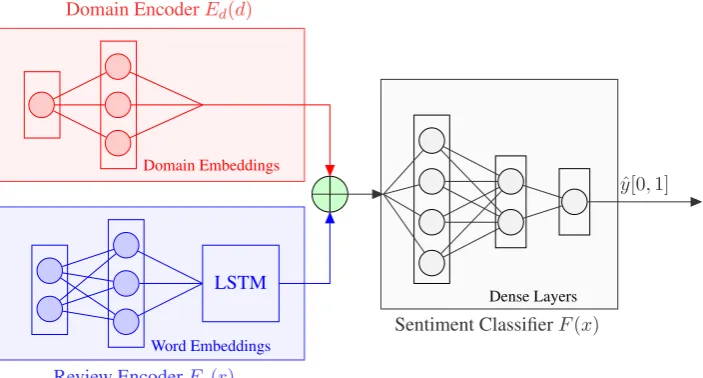
Domain EncoderEd(d)
Domain Embeddings
Review EncoderEr(r)
LSTM
Word Embeddings
Sentiment ClassifierF(x) Dense Layers
[image:3.595.121.473.104.293.2]ˆ y[0,1]
Figure 1: Our proposed model architecture
• Domain encoderEd(d)
• Review encoderEr(r)
• Sentiment classifierF(x)
Two of the blocks,Ed(d) andEr(r), work
as encoders, encoding the incoming data and making it usable for the final classifier. The classifier is a simple feed forward neural net-work that uses the encoded data to classify the review as either positive or negative. The blocks are described in more details in Sec-tions 3.2 to 3.4.
3.1 Data set generation
The data used in this paper has been collected from Amazon (McAuley et al., 2015). All of the collected reviews are in English.
12 domains were selected and 200,000 re-views were sampled from each (100,000 pos-itives and 100,000 negatives). The reviews were sampled at random. In total, 2.4 million reviews were collected from the 12 domains (See Table 1). The data set is structured such that each data point consists of the follow-ing four attributes: y,review,topic,length.
Here y corresponds to the correct sentiment label, review is the tokenized review which is also segmented into sentences,topicis the domain label andlengthdenotes the number of sentences in the review.
Category Negative Positive Total Automotive 100K 100K 200K Baby 100K 100K 200K Beauty 100K 100K 200K CD’s and Vinyl 100K 100K 200K Cell Phones 100K 100K 200K Electronics 100K 100K 200K Personal Care 100K 100K 200K Movies and TV 100K 100K 200K Office Products 100K 100K 200K Sports 100K 100K 200K Toys and Games 100K 100K 200K Video Games 100K 100K 200K
Table 1: List of domains sampled from (McAuley et al., 2015)
[image:3.595.308.505.424.582.2]When the review and summary have been concatenated, we segment the text into sen-tences using a sentence segmenter from NLTK.1 The segmenter is trained on the full data set in order to fit the style and abbrevia-tions used in the reviews. This enables identi-fication of a part-of-speech (POS) tag for each word using a pre-trained POS tagger. The POS tagger is fromNLTKand uses the Penn Treebank tagset. Using these tags it is possi-ble to create new data sets with certain word groups ablated. Each sentence is subsequently tokenized into words with the exception of digits and some punctuation.2 The sentence split is not used in this model but is available in the data set for future research.
[image:4.595.90.262.327.381.2]Data set Unique tokens Full data set 27,112 Ablated adjectives 24,225 Ablated stop words 26,962
Table 2: Vocab sizes of the constructed data sets
Lastly, we choose to only include words that occur more than 100 times in the vocab-ulary and represent the discarded tokens with an<UNK>token. This is done purely to limit the size of the vocabulary. The vocabulary size for each of the three data sets can be seen in Table 2. The three vocabularies mentioned here are the full set with all word groups: the set where adjectives have been removed and the set where stop words have been removed. The stop word list used is fromNLTK.
3.2 Domain Encoder
The Domain Encoder takes one of the 12 do-mains presented in Table 1 and encodes it into its own internal representation. The idea be-hind this architecture is to make the model
1
http://www.nltk.org
2Included punctuation: ... : ; , ( ) ! ? ” ’
learn its own representations for each domain (Mikolov et al., 2013) and how they relate to each other. There are several ways of imple-menting this representation, but the choice to use vector embeddings was made because it is simple and because they are easy to inter-pret compared to some of the more abstract methods of representation. Each domain is represented by a 50-dimensional vector that is learned during training. A 50-dimensional vector is chosen to match the size of the pre-trained word vectors in the Review Encoder (Section 3.3). The domain representations are randomly initialized using a uniform distribu-tion.
3.3 Review Encoder
This encoder takes a vector of variable length for the input layer, meaning that the layer adapts itself continuously according to the sentence given as input. We set a threshold to 500 tokens, effectively truncating sequences longer than this. Each token in the sequence is represented by pre-trained GloVe embeddings (Pennington et al., 2014). The output of the Review Encoder is an LSTM layer with 64 neurons (Hochreiter and Schmidhuber, 1997).
3.4 Sentiment Classifier
3.5 Hyper Parameters
The model’s hyper parameters are tuned using random search. The implementation is pro-vided by an open source project (Autonomio, 2019).
The data set used for the hyper parame-ter tuning consists of 150,000 samples, which were sampled from the full training set. From this, 50,000 samples are sampled for valida-tion and the remaining 100,000 samples are used for training. This split is performed 5 times resulting in 5 different validation/train splits. When sampling we make sure the re-sulting data sets are balanced between the sen-timent labels. For each run, one of the splits is selected at random in order not to fit to a specific data set. We evaluate each set of pa-rameters based on the accuracy score achieved by the model on the sampled validation set.
3.6 Experiments
We analyze the relevance that the domain em-bedding has in our model by testing our model twice, once with the Domain Encoder and once without. These two experiments are run 4 times and the mean is reported. Further-more, we test the proposed architecture by ab-lating adjectives and stop words separately. In total we conduct 4 different experiments on the model. We split the data set such that we have around 2 million reviews for train-ing, 200,000 for validation and 200,000 as a hidden test set. In all four cases we run 10 epochs of training while validating in between epochs. Finally, we evaluate on the hidden test set.
The experiments are executed on a machine with an NVIDIA Tesla T4 GPU, 8 CPUs, 16GB of RAM, Keras 2.2.4 and TensorFlow 1.13.1.
4 Results
In this section the results of our experiments will be presented.
4.1 Domain Encoder
In this section, we will outline the perfor-mance of the model with and without the do-main encoder.
Model Accuracy Recall Precision F1 W/ domains 0.8910 0.8914 0.8992 0.8953 W/o domains 0.8929 0.9143 0.8752 0.8943
Table 3: Model performance with and without the domain encoder
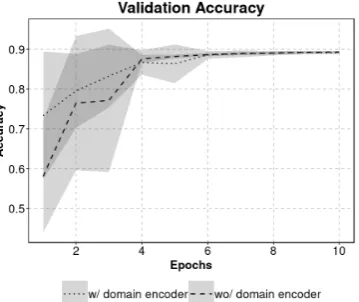
The performance impact of the domain en-coder is outlined in Table 3. The results in the table are mean accuracy, recall, precision and F1 for 4 runs of 10 epochs for both con-figurations. As can be seen, the inclusion of the domain encoder does not seem to signifi-cantly impact performance, with the exception of slightly slower convergence as visualized in Figure 2. The shaded areas around the curves denote mean±1 standard deviation.
The model with the domain encoder has a smoother learning curve (fewer jumps) during the first couple of epochs. The spike in stan-dard deviation around epoch 5 is caused by a single outlier run.
The accuracy and recall with the domain encoder are slightly worse, whereas the pre-cision is slightly improved. Moreover, when looking at the F1 score we see a slight favor for using the domain encoder. This, in com-bination with the small differences, makes it hard to determine if performance is impacted either way. This will be discussed further in section 5.
4.2 Ablation Studies
re-(a) The mean loss learning curves for the two con-figurations of the model
[image:6.595.316.496.108.259.2](b) The mean accuracy learning curves for the two configurations of the model
Figure 2: Loss and accuracy of the model with and without the domain encoder
[image:6.595.101.286.110.261.2](a) Using all features (b) Ablating adjectives (c) Ablating stop words (d) Ablating domains
Figure 3: Confusion matrices
view data. We wanted to do this to understand which word groups are particularly important for performing sentiment classification across multiple domains.
We hypothesized that adjectives and stop words were two important feature groups for determining sentiment and thus performed an ablation study on these.
The hypothesis for the stop words was based on the knowledge that the list of stop words used contains many negations such as ’not’, which will distort the data. The rea-son for choosing adjectives was that certain descriptors of products might be negative or positive and that we may therefore see an im-pact in performance once those have been re-moved.
The domain encoder is included during the ablation experiments. The performance of a model in each of the studies plus a baseline, which is a model using all features of the data, can be found in tabular form in Table 4. These performance metrics are calculated on an unseen test set after training each model. For comparison the model without domain en-coder is included as well.
Model Loss Accuracy Using all features 0.2940 0.8910 Ablating stop words 0.4015 0.8185 Ablating adjectives 0.3803 0.8605 Without domain encoder 0.2943 0.8929
[image:6.595.86.505.328.420.2]To further investigate these results, confu-sion matrices have been produced. They can be seen in Figure 3.
4.3 Domain Representations
The learned domain representations are ex-tracted from the model and reduced in dimen-sionality using the PCA algorithm. To inter-pret the similarities between the representa-tions, we employ hierarchical clustering anal-ysis using ward linkage. In Figure 4 the result of the clustering analysis is displayed in a den-drogram.
5 Discussion
In this section, the implications of Section 4 will be discussed.
5.1 Domain Encoder
As discussed in Section 4.1, the performance does not seem to be greatly impacted by the addition of the domain encoder. In this sec-tion, we will attempt to highlight a few inter-esting observations about the architecture that could be potential points of further research.
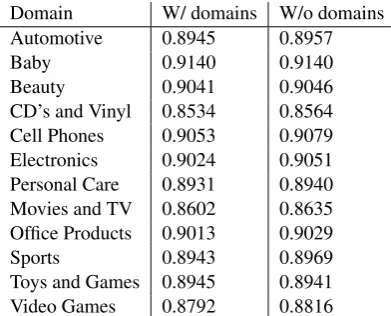
Table 5 shows that the difference in accu-racy is small. The accuaccu-racy after adding the domain encoder is slightly worse for almost all classes, but there does not appear to be a large inter-class difference in performance im-pact.
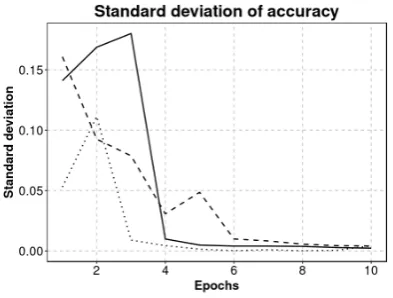
In Figure 5, we see the standard deviation of accuracy during training. The lower this value, the more consistent the model performs across runs.
What we see here is that the model with the domain encoder has a lower standard devia-tion initially. This suggests that the model is more consistent. Here we can also study the impact of the outlier observed in Section 4.1. We see clearly that the outlier has a large im-pact and that the rest of the runs are much more in agreement.
[image:7.595.309.505.100.258.2]Domain W/ domains W/o domains Automotive 0.8945 0.8957 Baby 0.9140 0.9140 Beauty 0.9041 0.9046 CD’s and Vinyl 0.8534 0.8564 Cell Phones 0.9053 0.9079 Electronics 0.9024 0.9051 Personal Care 0.8931 0.8940 Movies and TV 0.8602 0.8635 Office Products 0.9013 0.9029 Sports 0.8943 0.8969 Toys and Games 0.8945 0.8941 Video Games 0.8792 0.8816
Table 5: Per domain accuracy performance with and without the domain encoder
Based on these results it could be argued that stability is increased, but without ensur-ing that the outlier observed is as rare as we assume, this cannot be concluded with any certainty. In addition, this stability seems to be inconsequential in this case as convergence is reached around the same time anyway.
5.2 Ablation Studies
Since we are developing a new model, and subsequently a new data set, we want to inves-tigate whether or not all features (word groups in this case) of the data are important for sen-timent classification across domains. In the case of this research, we theorized that both stop words and adjectives would be important for the performance. The aim of this part of the study is to verify some assumptions about the data set.
Figure 4: Dendrogram showing the clusters created by the HCA algorithm
Figure 5: Standard deviation over time (DE = Domain Encoder)
fact, it predicts that 32%of all positive sam-ples in the test set are negative. This is a ma-jor flaw with this model, as it predicts negative samples very well.
In Table 4, we see that ablating adjectives has less impact than ablating stop words. Also when looking at Figure 3b we see that ablating
adjectives decreases overall performance thus not penalizing one class over the other.
These observations lead us to believe that our initial hypothesis of certain adjectives be-ing used as a polarity marker, seems to not hold. However, the overall performance with-out adjectives is worse than with, so there might be some specific words that could be found during further research.
5.3 Domain Representations
As mentioned in Section 4.3, we use Hierar-chical Cluster Analysis (HCA) to get insights into the similarities of the domain representa-tions.
Doing this we get statistical insights into the similarities between the generated domain representations. These insights are presented in the dendrogram in Figure 4. The clustering provides us with three groups of domains that it finds the most similar. These three are the “green” (group 1), “red” (group 2) and “light blue” (group 3) groups.
[image:8.595.91.288.369.518.2]con-tent domains: “Movies and TV”, “CD’s and Vinyls” and “Video Games”. It seems reason-able from a human point of view that these domains would be closely related. However, as can be seen in Figure 4, “Video Games” is the most distant domain in Group 1, merging with the others late in the clustering process.
Group 2 consists mainly of consumer elec-tronics, with the odd one out being cars. It makes sense that cars is the least close of the bunch, but with the recent trend of adding a lot of electronics to cars, it is certainly not unrea-sonable that automotive reviews would share a lot of language with consumer electronics. Moreover, a lot of accessories, such as phone holders and chargers, are sold in the automo-tive category, leading to higher similarity.
Group 3 is definitely the most diverse of the three, containing seemingly unrelated do-mains like “Beauty” and “Toys and Games”. What the results suggest is that these cate-gories may share some language characteris-tics at least in the context of determining the sentiment of the reviews. As we see though, the category of “Toys and Games” is less sim-ilar to any of the other domains within the group than the rest of the domains are to each other. However, it is more similar to the do-mains within its own group than to dodo-mains in other groups. We also see that the similar-ity between the two inner clusters of group 3 is small.
6 Conclusion
In the present work we have presented a model which represents domains as vectors and a way of understanding how the classifier is dis-criminating between different domains. The results seem to suggest that the model accu-rately captures the inter-domain relationships. The model achieves performance compara-ble to that of a model without the proposed domain encoder, with hints at possible
stabil-ity gains early in training.
Moreover, we find that stop words is an im-portant feature group when performing sen-timent classification. This is especially true when comparing to the importance of adjec-tives. While the performance does take a hit by removing the adjectives, it is not nearly as bad as with the stop words.
The convergence characteristics of the model would be an interesting point of further research. Moreover, looking into the use of the domain embeddings as a way of doing do-main adaptation would also be a logical next step for this model.
7 Acknowledgement
References
Tanel Alum¨ae. 2013. Multi-domain neural net-work language model. In INTERSPEECH-2013, pages 2182–2186.
Waleed Ammar, George Mulcaire, Miguel Balles-teros, Chris Dyer, and Noah A. Smith. 2016. Many languages, one parser. Transactions of the Association for Computational Linguistics, 4:431–444.
Autonomio. 2019. Talos. Retrieved from http://github.com/autonomio/talos.
Alec Go, Richa Bhayani, and Lei Huang. 2009. Twitter sentiment classification using distant supervision. CS224N Project Report, Stanford, 1(12):2009.
Sepp Hochreiter and J¨urgen Schmidhuber. 1997. Long short-term memory. Neural Comput., 9(8):1735–1780.
Chen Jia, Xiaobo Liang, and Yue Zhang. 2019. Cross-domain ner using cross-domain language modeling. InProceedings of the 57th Confer-ence of the Association for Computational Lin-guistics, pages 2464–2474.
Shou-Shan Li, Chu-Ren Huang, and Cheng-Qing Zong. 2011. Multi-domain sentiment classifi-cation with classifier combination. Journal of Computer Science and Technology, 26(1):25– 33.
Shoushan Li and Chengqing Zong. 2008. Multi-domain sentiment classification. In Proceed-ings of the 46th Annual Meeting of the Associa-tion for ComputaAssocia-tional Linguistics on Human Language Technologies: Short Papers, HLT-Short ’08, pages 257–260, Stroudsburg, PA, USA. Association for Computational Linguis-tics.
Qi Liu, Yue Zhang, and Jiangming Liu. 2018. Learning domain representation for multi-domain sentiment classification. Proceedings of the 2018 Conference of the North Ameri-can Chapter of the Association for Computa-tional Linguistics: Human Language Technolo-gies, Volume 1 (Long Papers).
Julian McAuley, Christopher Targett, Qinfeng Shi, and Anton Van Den Hengel. 2015. Image-based recommendations on styles and substi-tutes. InProceedings of the 38th International
ACM SIGIR Conference on Research and De-velopment in Information Retrieval, pages 43– 52. ACM.
Tomas Mikolov, Ilya Sutskever, Kai Chen, Greg S Corrado, and Jeff Dean. 2013. Distributed representations of words and phrases and their compositionality. InAdvances in neural infor-mation processing systems, pages 3111–3119.
Hyeonseob Nam and Bohyung Han. 2016. Learn-ing multi-domain convolutional neural net-works for visual tracking. InProceedings of the IEEE conference on computer vision and pat-tern recognition, pages 4293–4302.
Bo Pang, Lillian Lee, and Shivakumar Vaithyanathan. 2002. Thumbs up?: Senti-ment classification using machine learning techniques. In Proceedings of the ACL-02 Conference on Empirical Methods in Natural Language Processing - Volume 10, EMNLP ’02, pages 79–86, Stroudsburg, PA, USA. Association for Computational Linguistics.
Minlong Peng, Qi Zhang, Yu-gang Jiang, and Xu-anjing Huang. 2018. Cross-domain sentiment classification with target domain specific infor-mation. In Proceedings of the 56th Annual Meeting of the Association for Computational Linguistics (Volume 1: Long Papers), pages 2505–2513.
Jeffrey Pennington, Richard Socher, and Christo-pher Manning. 2014. Glove: Global vectors for word representation. In Proceedings of the 2014 conference on empirical methods in natural language processing (EMNLP), pages 1532–1543.
Ottokar Tilk and Tanel Alum¨ae. 2014. Multi-domain neural network language model. In