Byte-based Neural Machine Translation
Marta R. Costa-juss`a, Carlos Escolano and Jos´e A. R. Fonollosa TALP Research Center, Universitat Polit`ecnica de Catalunya, Barcelona
[email protected],[email protected], [email protected]
Abstract
This paper presents experiments compar-ing character-based and byte-based neural machine translation systems. The main motivation of the byte-based neural ma-chine translation system is to build multi-lingual neural machine translation systems that can share the same vocabulary. We compare the performance of both systems in several language pairs and we see that the performance in test is similar for most language pairs while the training time is slightly reduced in the case of byte-based neural machine translation.
1 Introduction
Multilingual neural machine translation is raising interest in the community because it re-opens the possibility of an interlingual architecture. the main advantage of the current setting is that interlingua is not manually designed but it seems that it can be automatically extracted (Johnson et al.,2016). In addition, this multilingual environment seems to allow to build translation systems among lan-guage pairs that do not have parallel corpus avail-able (Johnson et al.,2016), what is called “zero-shot translation”.
These two motivations (interlingua and zero-shot translation) are strong enough to motivate the entire commmunity to experiment towards mul-tilingual architectures. Recently, there have ap-peared works in multilingual word representations (Schwenk et al.,2017;Espa˜na-Bonet et al.,2017) Most multilingual works are at the level of words. As multilingual character research we can find (Lee et al., 2016) which goes from many-to-one languages in translation and achieves im-provements for several language pairs. Previous work on character-based neural machine
transla-tion includes (Ling et al., 2015; Costa-juss`a and Fonollosa,2016), among others.
We want to explore multilingual character-based neural machine translation with a diversity of languages, including languages as Chinese. In case of using languages with different alphabets, the character dictionary can not be shared or it has to be considerably augmented. In order to keep the dictionary to the order of hundreds, we want to ex-plore how byte-based neural machine translation behaves. In this paper, we propose to use the fully-character neural machine translation architecture (Lee et al.,2016) but using bytes instead of char-acters. We compare the performance of charac-ter against byte-based neural machine translation among similar languages (Catalan/Spanish and Portuguese/Brazilian) and relatively far languages (in terms of alphabet) (German/Finnish/Turkish-English).
As far as we are concerned, we are not aware of any research work in neural machine transla-tion that has experimented with bytes. Related work can be found int the area of natural language processing. Gillick et al. (2016) propose an neu-ral network that reads text as bytes and use this model in tasks of Part-of-Speech and Named En-tity Recognition. The recent investigation of Irie et al (2017) describes the use of a byte-level con-volutional layer (instead of character-level) in the neural language model (Irie et al.,2017), which is applied to low resource speech recognition.
2 Character-based Neural Machine Translation
Our system uses the architecture from (Lee et al.,
2016) where a character-level neural MT model that maps the source character sequence to the target character sequence. The main difference in the encoder architecture of the standard neural
MT model from (Bahdanau et al.,2015) is that in-stead of using word embeddings, the system uses character embeddings based on previous works like (Kim et al.,2015;Costa-juss`a and Fonollosa,
2016). The architecture uses character embed-dings include convolution layers, max pooling and highway network layers. The character embed-dings from the decoder are the input of the bidirec-tional recurrent neural network. The main differ-ence in the decoder architecture is that the single-layer feedforward network computes the attention score of next target character (instead of word) to be generated with every source segment represen-tation. And afterwards, a two-layer character-level decoder takes the source context vector from the attention mechanism and predicts each target char-acter.
3 Byte-based Neural Machine Translation
The byte-based Neural Machine Translation changes the character representation of words to the byte representation. Each sentence is repre-sented as the concatenation of bytes that form its characters inutf-8encoding. No explicit vocabu-lay is used but we can consider the byte represen-tation as a vocabulary of 256 positions in which every possible byte can be represented. This mod-ifications provides the following improvements over the previously seen architecture.
• Both languages share the same representa-tion. If a word is identical in the source and in the target language they share the same rep-resentation when converted into sequences to be fed in the network. This is an advan-tage over the character-based representation, which dictionary is language-dependent.
• This representation uses a limited set of to-kens of size 256 independently of the lan-guage. Therefore, the system is not affected by the size of character vocabulary. Note that there are languages that have a very rich explicit morphological representation or that have a wide range of characters (e.g. Chi-nese). However, the byte-based decoding also produces a sequence of correct bytes in a similar way that character level translation works compared to word-based systems.
• All words are theoretically representable by the system even if they have not been
previ-uosly seen in the training. This is due to the fact that every single character of word can be seen as a concatenation of bytes and the full range of possible bytes is covered by the system.
4 Experimental Framework
In this section we detail experimental corpora, ar-chitecture and parameters that we used.
4.1 Data and Preprocessing
For Catalan-Spanish, We use a large corpus ex-tracted from ten years of the paper edition of a bilingual Catalan newspaper, El Peri´odico ( Costa-juss`a et al., 2014). The Spanish-Catalan corpus is partially available via ELDA (Evaluations and Language Resources Dis-tribution Agency) in cat-alog number ELRA-W0053. Development and test sets are extracted from the same corpus.
For Portuguese-Brazilian, we used the OPUS corpus (Tiedemann,2012) which is a growing col-lection of translated texts from the web. In par-ticular, for Portuguese-Brazilian the source corpus are from Ubuntu and GNOME. We extracted the parallel text from translation memories (TMX for-mat) and from the complete text, we extracted a collection of development and test set.
Finally, we used WMT 2017 1 corpus data for German, Finish and Turkish to English. For the three language pairs, we used all data parallel data provided in the evaluation. For German-English, we used: europarl v.7, news commentary v.12, common crawl andrapid corpus of EU press re-leases. For Finnish-English, we usedeuroparl v.8, wiki headlines andrapid corpus of EU press re-leases. For Turkish-English, we used setimes2. The German and Finish test set is the news 2015 evaluation set, for Turkish the test set is the news 2016 evaluation set.
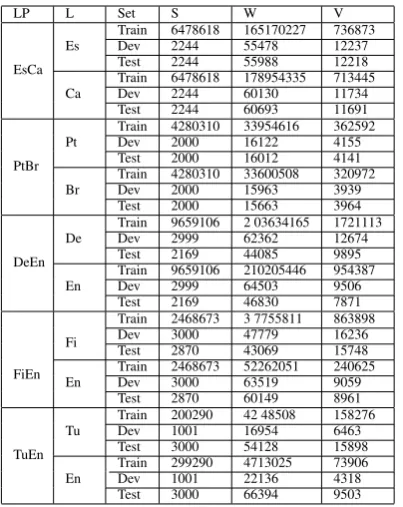
Preprocessing consisted in cleaning empty sen-tences, limiting sentences up to 50 words, tok-enization and truecasing for each language using tools from Moses (Koehn et al., 2007). Table 1
shows details about the corpus statistics after pre-processing.
4.2 Parameters
Both character and byte-based systems share the same parameters. Further research may explore different parameters for the byte-based system,
LP L Set S W V
EsCa
Es TrainDev 64786182244 16517022755478 73687312237 Test 2244 55988 12218
Ca TrainDev 64786182244 17895433560130 71344511734 Test 2244 60693 11691
PtBr
Pt TrainDev 42803102000 3395461616122 3625924155 Test 2000 16012 4141
Br TrainDev 42803102000 3360050815963 3209723939 Test 2000 15663 3964
DeEn
De TrainDev 96591062999 2 0363416562362 172111312674 Test 2169 44085 9895
En TrainDev 96591062999 21020544664503 9543879506 Test 2169 46830 7871
FiEn Fi
Train 2468673 3 7755811 863898 Dev 3000 47779 16236 Test 2870 43069 15748
En TrainDev 24686733000 5226205163519 2406259059 Test 2870 60149 8961
TuEn
Tu TrainDev 2002901001 42 4850816954 1582766463 Test 3000 54128 15898
[image:3.595.82.284.60.314.2]En TrainDev 2992901001 471302522136 739064318 Test 3000 66394 9503
Table 1: Corpus Statistics. Number of sentences (S),words (W), vocabulary (V).
since we are adopting for the byte-based systems the character-based parameters from previous re-search (Lee et al.,2016).
For the embedding of the source sentence, we use set of convolutional layers which number ker-nels are (200-200-250-250-300-300-300-300) and their lengths are (1-2-3-4-5-6-7-8) respectively. Additionally 4 highway layers are employed. And a bidirectional LSTM layer of 512 units for encod-ing. The maximum souce sentence’s length is 450 during training and 500 for decoding both during training and sampling.
4.3 Byte differences among language pairs Characters may be represented by a single or sev-eral bytes. English and its close languages usually have a correspondance of character and byte (a character is represented by a single byte). There-fore, these languages are not really affected by this representation, mainly because the ASCII encod-ing makes possible to represent all possible char-acters in a single byte which results in a simi-lar length representation in both baseline and pro-posed system.
However, in other languages (e.g. Turkish, Finnish...) which contain stressed characters (among other modifications), a single character inutf-8 may be a concatenation of several bytes. For these cases, the performance of the byte-based
Language Bytes
Spanish 1.026
Catalan 1.040
German 1.015
Finnish 1.044
Turkish 1.087
English 1.000
Portuguese 1.027
Brazilian Portuguese 1.028
[image:3.595.345.488.60.204.2]Chinese 2.108
Table 2: Mean bytes for character for all the lan-guages tested, Chinese added for comparison.
system differs from the character-based system. Table 2 shows the mean number of bytes for character changes for different languages. As the languages are more similiar to English the differ-ence between bytes and characters changes. For all the languages tested in our experiments using all latin alphabet the differences are small and re-sultant sentence length is similar to its character counterpart.
On the other hand for languages that use a dif-ferent alphabet such as Chinese we can observe how for each character more than two bytes have to be correctly generated.
5 Results
This section compares the performance of the byte-based neural machine translation system with the character-based in terms of translation quality and training time. In order to compare training times all systems have been trained in the same machine using anNVIDIA TITAN Xwith 12GB of RAM.
Table 3 shows BLEU results and number for close languages Catalan-Spanish and Portuguese-Brazilian in both directions. Comparison between character and byte-based models shows that by us-ing a byte-base system comparable results to the ones obtained using a character-based system. In our experiments, we have observed that the byte-based system tends to converge at least a couple of hundred iterations earlier than the character-based system.
us-Language System BLEU
esca char 87.12
byte 86.91
caes char 82.43
byte 81.27
ptbr char 48.54
byte 48.28
brpt char 46.41
[image:4.595.108.251.61.189.2]byte 47.20
Table 3: Close languages. BLEU results.
Language System BLEU
tren char 5.87
byte 4.75
deen char 28.63
byte 25.29
fien char 14.75
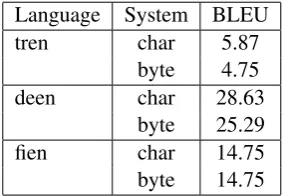
byte 14.75 Table 4: Distant languages. BLEU results.
ing the byte-based system. For the case of Turk-ish and EnglTurk-ish (and training for an equal number of iterations), results are lower than the ones ob-tained by the char-based system but given the re-duced size of the corpus variance in the results can be caused by other factors. For Finnish-English, we achieved the same results with several hun-dred training iterations less. In the case of the German-English pair, results show that the char-based approach provides quite better results than the proposed byte-based system but also it is worth mentioning that when using bytes, the results con-verged several hundred training iterations before than when using the baseline system.
6 Conclusions
This paper shows an experimental comparison be-tween char-based neural machine translation and byte-based neural machine translation. Variability has been found in the results for different language pairs ranging for−3.3to+0.8BLEU points. Also the main advantage of the proposed system com-pared to the baseline system is that it tends to re-quire less training iterations which translates in a reduction of training time that can vary from sev-eral days to even two weeks.
Further work includes the experimentation of multilingual neural machine translation using byte-based system. In addition, we want to include
in our experimentation languages with complete different alphabets such as Chinese and we will in-vestigate if byte-based neural machine translation system proposes malformed characters. In future research, we will test different parameters such as changing the number of convolutional filters. Acknowledgements
This work is supported by the Spanish Ministe-rio de Econom´ıa y Competitividad and Fondo Eu-ropeo de Desarrollo Regional, through contract TEC2015-69266-P (MINECO/FEDER, UE) and the postdoctoral senior grantRam´on y Cajal.
References
Dzmitry Bahdanau, Kyunghyun Cho, and Yoshua Bengio. 2015. Neural machine translation by
jointly learning to align and translate. volume
abs/1409.0473. http://arxiv.org/abs/1409.0473. Marta R. Costa-juss`a and Jos´e A. R. Fonollosa. 2016.
Character-based neural machine translation. In
Proceedings of the 54th Annual Meeting of the Association for Computational Linguistics (Vol-ume 2: Short Papers). Association for Computa-tional Linguistics, Berlin, Germany, pages 357–361.
http://anthology.aclweb.org/P16-2058.
Marta R. Costa-juss`a, March Poch, Jos´e A.R. Fonol-losa, Mireia Farr´us, and Jos´e B. Mari˜no. 2014. A large Spanish-Catalna parallel corpus release for Machine Translation. Computing and Informatics Journal33.
Cristina Espa˜na-Bonet, ´Ad´am Csaba Varga, Al-berto Barr´on-Cede˜no, and Josef van Genabith. 2017. An empirical analysis of nmt-derived in-terlingual embeddings and their use in parallel
sentence identification. CoRR abs/1704.05415.
http://arxiv.org/abs/1704.05415.
Dan Gillick, Cliff Brunk, Oriol Vinyals, and Amarnag Subramanya. 2016. Multilingual language process-ing from bytes. InProceedings of the 2016 Confer-ence of the North American Chapter of the Associ-ation for ComputAssoci-ational Linguistics: Human Lan-guage Technologies. San Diego, California, pages 1296–1306.
Kazuki Irie, Pavel Golik, Ralf Schlter, and Hermann Ney. 2017. Investigations on byte-level convolu-tional neural networks for language modeling in low resource speech recognition page 5.
Melvin Johnson, Mike Schuster, Quoc V. Le, Maxim Krikun, Yonghui Wu, Zhifeng Chen, Nikhil Tho-rat, Fernanda B. Vi´egas, Martin Wattenberg, Greg Corrado, Macduff Hughes, and Jeffrey Dean. 2016.
Google’s multilingual neural machine translation
system: Enabling zero-shot translation. CoRR
[image:4.595.110.254.221.319.2]Yoon Kim, Yacine Jernite, David Sontag, and Alexander M. Rush. 2015. Character-aware
neu-ral language models. CoRR abs/1508.06615.
http://arxiv.org/abs/1508.06615.
Philipp Koehn, Hieu Hoang, Alexandra Birch, Chris Callison-Burch, Marcello Federico, Nicola Bertoldi, Brooke Cowan, Wade Shen, Christine Moran, Richard Zens, Chris Dyer, Ondˇrej Bojar, Alexandra Constantin, and Evan Herbst. 2007. Moses: Open source toolkit for statistical machine translation. In Proceedings of the 45th Annual Meeting of the ACL on Interactive Poster and Demonstration Ses-sions. Association for Computational Linguistics, Stroudsburg, PA, USA, ACL ’07, pages 177–180.
http://dl.acm.org/citation.cfm?id=1557769.1557821. Jason Lee, Kyunghyun Cho, and Thomas
Hof-mann. 2016. Fully character-level neural machine
translation without explicit segmentation. CoRR
abs/1610.03017.http://arxiv.org/abs/1610.03017. Wang Ling, Isabel Trancoso, Chris Dyer, and Alan W.
Black. 2015. Character-based neural machine trans-lation.CoRRabs/1511.04586.
Holger Schwenk, Ke Tran, Orhan Firat, and Matthijs Douze. 2017. Learning joint mul-tilingual sentence representations with neural
machine translation. CoRR abs/1704.04154.
http://arxiv.org/abs/1704.04154.