Evaluating rail suicide prevention measures
Brendan RYAN¹, Urszula WRONSKA¹ and Ian STEVENS²
¹Human Factors Research Group, University of Nottingham, UK
²Programme Manager – Suicide Prevention, Network Rail, UK
Abstract.Many rail safety interventions are implemented without sufficient consideration of the
effectiveness of the intervention or the degree to which the intervention has been implemented. This paper describes a programme of work to develop, test and implement a simple framework and associated research tools that can be used by rail staff to collect better data for evaluating the effectiveness of rail suicide prevention measures. Problems that have been encountered in attempting to embed this framework within organisational processes are described.
Keywords.Evaluation, rail suicide, engagement with industry.
1. Introduction
There are many examples of rail suicide prevention measures (e.g. physical measures such as fencing, training to help people know what to do if they suspect that someone may be
contemplating suicide, technological surveillance systems to identify the presence of people in an area where they should not be). Often, these are implemented in response to a number of
incidents that occur at a location. In many cases a solution is applied without considering how to investigate the effectiveness of the intervention. Even where it is recognised that better data are needed, staff may not know what to do to carry out thorough evaluation in real world contexts. The following scenario is illustrative of the current problem for the industry.
A station manager is considering fitting blue lights at a station because they have heard that this is effective for prevention of rail suicide. What do they need to do to know that the lights will be fit for purpose (i.e. in relation to design and implementation)? What do they need to do to know that they work, in their specific context or situation (i.e. for evaluation)?
There are a number of published frameworks for programme evaluation (e.g. PRECEDE,
PROCEED, RE-AIM, Fink, 2015). These have the capacity to be used with complex, large scale programmes. Where the programme or intervention is of a narrower scope (e.g. an item of new technology) there is still a multitude of evaluation questions that can be considered and relevant data types that can be collected to demonstrate the effectiveness, cost, quality and value of the programme. In this piece of work a simple approach has been developed, based on important components of evaluation programmes (Fink 2015).
This paper provides an overview of a programme to produce, test and implement a simple evaluation framework for use by industry staff to collect better data to evaluate rail suicide prevention measures. The work has been developed in conjunction with Network Rail to respond to a perceived industry need for clear guidance and relevant research resources to support
The overall philosophy of the programme of work is shown below.
• Produce an evaluation framework that is appropriate for interventions in this context • Develop and test resources for evaluation (e.g. questionnaires)
• Support the use of the resources (includes wider pilot testing) • Provide user friendly guidance for industry use
• Disseminate the framework and associated resources in UK and Europe.
2. Developing the preliminary evaluation framework
2.1. Initial requirements for the framework
A set of requirements for the framework were proposed at the start of the project, developed in conjunction with Network Rail. These were that the framework should be:
• Easy to use and understandable
• Capable of being used by people who are not experts in evaluation or research
• Relate to technologies (e.g. blue lighting, CCTV, Virtual assistant) as well as other safety interventions (physical barriers)
• Likely to incorporate a step-by-step guide, leading people through what needs to be done, before, during and after implementation of the intervention
• Based around things that can be done quite quickly (e.g. in response to recent incidents), easily deployed and without a lot of additional work for operational staff.
This is intended to be a practical framework and guide to help improve the ability of operational staff to plan for, introduce and start to evaluate the effectiveness of preventative measures at locations under their control. More ambitious, in-depth programmes for implementation and evaluation could be carried out by drawing on expertise (externally or internally in the industry) on each occasion that a programme is initiated. At present, there is a need within the industry to try to react quickly to minimise the effects of incidents at stations. This programme of work therefore attempts to meet the need for guidance for those involved in the design and
implementation of suicide prevention interventions, so that better information about the likely effectiveness of these interventions can be collected routinely by the industry.
2.2. Review of existing processes for implementing a safety intervention
The investigation of use of blue lighting at two stations was used to understand important considerations in planning and implementing a safety intervention (Ryan and Philippou, 2015a). This has included the following:
• Review of available documents, such as: investigations or inspections at stations where interventions will be applied; descriptions and photographs of problematic locations;
newsletters and company presentations explaining the rationale for the lighting intervention; product specifications and a summary report on the project
• Summary statistics on numbers of incidents at stations
of the lighting on behaviours and reactions from people at the station.
This review identified evidence of good initial research carried out by staff in the industry, with attempts to replicate a preventative measure that has been reported to be effective in other railway contexts. Some weaknesses were identified. There is evidence of wide variation in the way that the lighting was designed and implemented at the two stations that were studied. The most significant difference was in the design of the lighting (one using overhead lighting and the other using lighting studs on the platform floor), to the extent that these are likely to be two very different interventions. If they do work (i.e. if they can be shown to be having an effect on preventing incidents) it is likely that they will work in very different ways. It is not clear in either of the cases that there has been sufficient consideration given to how the lighting may work in the prevention of railway suicide. There was little evidence of systematic efforts at either of the stations to collect relevant data on things such as the behaviours of passengers at the stations, their reactions and responses to the new lighting, their feedback and comments on the new visual environment at the station. There are potential gaps in current understanding of the effectiveness of the preventative measures. Difficulties in the design and development of the lighting programmes were experienced in each of the station projects. In both cases, it has been reported that there was some resistance from train operating companies to use of blue lighting at the stations and compromises that were needed in the fitting of the lighting. The extent to which the final programme achieves any target levels of blue lighting that were envisaged at the start of the programme is not clear.
The findings from this review were an important step in identifying wide ranging factors that can influence decisions in the design and development of a new technology and the
opportunities for collecting relevant data (e.g. data types, what, where, how) on the implementation and outcomes of a safety intervention in this type of context. It has been important to have knowledge of these when considering how to provide support for industry staff in planning and evaluating similar interventions.
2.3 Constructing the preliminary evaluation framework
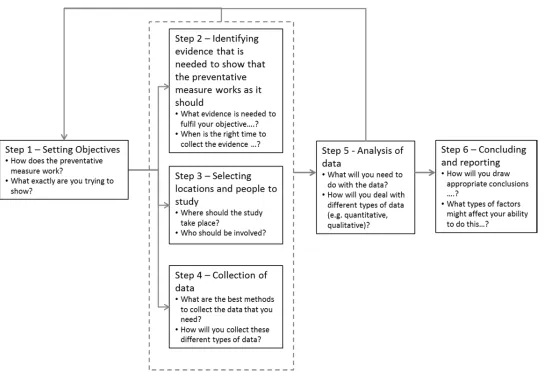
These findings have been used to produce a simple framework and associated guidance for operational staff to collect relevant data for the purpose of evaluation in similar situations (Ryan and Philippou, 2015b). The six stages of the framework are outlined in Figure 1. It was clear from this work that designing and evaluating technologies in this type of context is not a
Figure 1. Flowchart showing the main steps in the evaluation framework
Efforts were therefore made to provide guidance for application of the proposed framework, using a series of prompt questions. The simple framework was also applied to produce two worked examples of how this can be used in the evaluation of technology interventions: (i) the study of a new blue light initiative and (ii) the study of the use of a new Smart CCTV camera system on the railway. These worked examples (reported in Ryan and Philippou, 2015b), tested the potential for wider use of this type of structured approach to evaluation and demonstrated the utility of the framework and highlighted the types of data and research methods that are needed for evaluation.
It was acknowledged at this stage that the extent to which this framework can be adopted in practice would need further testing with potential users and with a wider set of examples. This would help to confirm the utility of the framework for industry staff and collect feedback on additional amendments that might be needed before this was made more widely available to other stakeholders in the industry.
3. Initial testing of the framework with industry staff
The framework was tested in a facilitated workshop setting with a group of industry staff, using a new example of a safety intervention. Six participants, nominated by representatives of an industry suicide prevention working group, gave their informed consent to take part in this workshop. All participants had some kind of operational responsibility for the planning, design or operation of safety interventions in the rail industry and were familiar with the issue of rail suicide as part of their daily job.
Participants were given background information about the framework (the report by Ryan and Philippou, 2015), prior to the workshop. The workshop was carried out over a three hour period. Participants were given an overview of the proposed intervention and then asked to work in a small group (two small groups of three) to try to apply this new approach to the use of speaking signs as a safety intervention at a mainline station (this was a fictitious station, based loosely on the situation at a real station). The participants worked through the suggested evaluation process, providing as much detail as possible to explain their proposals for
the exercise. Participants also provided verbal feedback in discussion sessions and through completion of a survey form, commenting on whether they thought that the approach can be used by themselves and their colleagues, whether changes were needed and whether more guidance and training was needed, to assist with the development of the framework.
The observations confirmed that each group made great progress with the study scenario in a short period of time at the workshop and were very satisfied with what they had produced in the time available. The framework and associated resources gave the participants the confidence and guidance to get started on the problem that was posed in the scenario. The structure within the framework seemed to help the participants to think more deeply about the evaluation process, the evidence that was needed (e.g. relating to effectiveness and quality of potential
interventions), and a wide range of factors that can affect a study of this kind. It was observed how the participants were engaged and enjoyed the exercise. Very positive responses were received from those involved (e.g. relating to ease of use of the framework, the consistency that it offers, the opportunities for collaboration and for evidence based decisions) and they reported how they were keen to use this in future work related situations.
There was occasionally some deviation from the process (e.g. parts of the discussion were not strictly linked to their stated objectives of the proposed study, some steps were considered out of sequence) and some of the available resources were not used without prompting. It is likely that more support is needed in some areas. It can be hard to clearly specify a set of comprehensive and coherent objectives, even for those who have experience of doing this in research projects. These objectives can become clearer during later the parts of the process (e.g. after thought has been given to what types of data could or should be collected). More assistance may also be needed to help with making decisions on how evidence is used to understand the likely success of an intervention and the types of evidence and analyses that are essential in achieving the study objectives. Some more support was requested, such as presenting the framework in the form of a flow chart, checklists, standard question sets for surveys or interviews, guidance on interpretation of data and findings from the study, especially qualitative data. Presentation of the framework and resources in a website was requested as a longer term goal.
This evaluation process can be used effectively with some flexibility, without prejudicing the outcome, potentially giving participants an opportunity to move back and forth in the stages in the process. Users of this framework may have different needs, with different levels of expertise or knowledge of the evaluation of safety measures. The framework can be used in a step by step format by a relatively inexperienced user, prompting a structured approach to planning for and implementing a study to evaluate a new preventative measure in a given set of circumstances. Someone who is more experienced in this type of evaluation study may want to short-cut some parts of the process, but may benefit by using the framework as a guide or checklist to ensure that all relevant issues have been considered.
It was apparent that the initial linear representation of the framework could be refined to more clearly demonstrate the iterative nature of the process of evaluation, as shown in Figure 1. For example, steps 2, 3 and 4 could be executed in sequence, concurrently or in a different sequence. In applying the framework in a more flexible way, the clarity of the objectives and the
It was evident that the framework would need to undergo more substantial testing within the industry. There were known to be several on-going projects in which rail suicide prevention interventions were being considered and these would be suitable to test wider application of the framework in a series of pilot studies with a larger number of potential users. Several benefits were likely to arise from this: development of common checklists and survey materials; building of experience in setting up working groups; enabling familiarity / dissemination of knowledge of the framework; identifying gaps in knowledge and relevant experience within the industry, such as data collection and analysis (quantitative and qualitative data) in this type of context; identifying issues which can impact on interpretation of findings.
Overall, the workshop established that the participants liked the framework and expressed an eagerness to test this in their day to day jobs. Some minor changes were made to the
representation of the framework, though there were no major changes in the content of the framework. Additional guidance in use of the framework was produced. It was concluded that effort was needed to give people the confidence to use the framework and enable more flexible use of the framework, whilst keeping people focused on achieving the objectives of their study. It was also emphasised by participants that management support would be needed to overcome a common desire to rush into implementing potential solutions in the industry, without sufficient thought being given to measuring the likely success of the intervention.
4. Supporting the industry in use of the framework
There were some initial efforts within Network Rail to promote the use of the framework via industry working groups on suicide prevention. The framework and associated guidance was published in a booklet format and attempts were made to encourage staff to take advantage of opportunities to use this as new safety interventions were introduced. However, limited progress was made in starting these pilot projects, partly due to what seemed to be a lack of some of the basic research skills to conduct the evaluation. An opportunity arose to obtain funding from within the University of Nottingham to support engagement projects with industry. This appeared to be a perfect opportunity to try to expand and embed the evaluation programme in Network Rail. Funding was secured for a 6 month project, working with the corporate suicide prevention team at Network Rail as a liaison point with the company and wider industry.
An initial project meeting was held, including representatives from the University, the corporate suicide prevention team and other industry staff who were keen to consider use of the evaluation framework in up-coming projects. Several candidate projects (explained in 4.1 and 4.2) were discussed and provisional plans were put in place to provide support for these projects, such as developing relevant research resources (e.g. interview question sets, observation protocols) and providing support for the industry in collecting and interpreting findings from data collection exercises in the proposed pilot studies. Regular telephone meetings were scheduled between the researchers and the industry liaison staff to maintain dialogue during the course of the project.
4.1. Evaluating the effectiveness of blue lights at several railway stations
A programme was already in progress in the industry to fit blue lighting at additional stations, building on reports of the apparent success of this measure as a safety intervention. Perceived difficulties in progressing with the earlier use of the framework centered around gaps in
that the University staff would follow the steps in the framework and create relevant research resources and then support the industry in using these. The following activities were conducted: • Preliminary information was collected from the industry about the sites at which lighting was
being fitted, along with details of the blue lighting intervention. Literature was reviewed on the potential influence of lighting on mood, emotion and behaviour.
• A questionnaire survey was developed, covering the following topics: The level of exposure to the lights at the station (i.e. whether people were frequent visitors or first-time visitors); people’s mood in the platform area (two scales: good/ bad, calm/tense); perceptions of the environment of the platforms; attitudes towards the lights (three scales: like/dislike, pleasant/unpleasant, calming/agitating).
• Observation protocols were developed to study behaviour at the station, supporting observations of: People’s behaviour in the study area (i.e. do they react to the blue lights, such as noticing/staring at the lights); the locations and movements of people on the platform. The survey was piloted at a station, collecting data from a modest number of people.
Observations were carried out over a limited timeframe. The experience of conducting these limited pilot studies, in conjunction with a member of operational staff, enabled minor adaptions to the research materials. There were unsuccessful efforts to arrange wider piloting and support for industry staff in using the resources at additional locations where blue lighting was fitted, with the intention of providing further guidance after testing and final revision of the data collection materials and method.
In drawing preliminary conclusions from this part of the work a useful set of data collection tools has been created and further data collection can be carried out at pilot sites. It is thought that there is likely to be wide variation in how the lighting has been implemented (within and between stations) and wide variation in how people respond to this, so plans to collect data will need to take account of these sources of variation.
4.2. Cameras and audible warning
It was anticipated that once a robust set of research tools were created (e.g. questionnaires, observation protocols) that these could be adapted and applied to a new context. An opportunity arose to support a trial at another station where cameras with an audible warning (when
someone moves too close to the platform edge) were being fitted.
Preliminary information was collected about the site and the camera and audible warning safety intervention. A visit to the railway station was carried out, with an opportunity to see a
5. Reflection on the programme and suggestions for future use of the framework and associated materials
5.1. What has been produced during the programme?
A simple evaluation process has been developed and described, outlining the most important data requirements and activities for data collection and analysis. This has been tested through desk-top exercises and through collection of preliminary data for one type of intervention. Sets of research resources have been produced (e.g. observation protocols, questionnaire survey forms and interview questions), with small sample datasets, preliminary analyses and preliminary guidance on how to develop new research resources from other core research resources. The framework and guidance has been shared with colleagues in Belgium and the Netherlands, though at the time of writing there is no indication of whether there are any plans to consider using elements of the framework more widely in Europe.
5.2. Problems encountered during the programme
Unfortunately, not as much progress has been made as had been anticipated in terms of embedding the new evaluation methodology within Network Rail and the wider industry. Barriers that have been encountered in applying this type of participatory project within this industry setting are principally around difficulties securing the necessary commitment of time from industry staff to provide the required support, information and the access to study locations. Very simple things seemed to block or disrupt progress on the work (e.g.
unavailability of staff contacts, difficulties getting permission for site based work). These issues arose, in spite efforts to engage important stakeholders at the outset of the project and even where people were enthusiastic about the need for, and likely benefits from, the work. It is also likely that the project was under-resourced, attempting to take on too much work in what was only a six month project.
5.3. Need to explore routes to better industry engagement and participation
Whilst the outcomes from the project have in some ways been disappointing, there are important lessons that can be learned about interacting with various parts of the industry in this type of research context. An essential part of the work is around engagement with industry staff to ensure their participation in the programme of work. Generating initial enthusiasm, ensuring that there was a belief in the potential value of the programme, gaining support from the corporate suicide prevention team, providing free access to research support and resources, all seemed at first sight to be valuable ingredients in overcoming perceived weaknesses in the existing approach to evaluation in the industry. Whilst these were anticipated at the outset to be sufficient to carry the project forwards, all could be overcome quite easily. There were
There will be benefit from continuing to develop the engagement with the industry and efforts to embed the evaluation approach, both in the UK and European rail industries. As a remedy to the problems that have been encountered, demand for the work needs to be created from within, identifying a wider range of relevant stakeholders and working together on a strategy for
evaluation that recognises the need for the evaluation approach in everyday work and goals (Dul and Neumann, 2009; Dul et al, 2012). Future work with the industry could explore how to create this demand for a more rigorous and structured approach to evaluation, rather than trying to promote the value of the work with people who have many commitments on their time. In this way, the evaluation related work would be recognised as an essential part of day to day work, rather than an extra piece of work that can get in the way of the day job.
The analysis of the factors that may have influenced the outcomes of the programme is based on the self-reflection of the researchers. It would be helpful to expand upon the analysis through consultation with stakeholders in the industry, to understand more about their perspectives of the factors that have blocked progress, especially within the final stage of implementing and
embedding the evaluation process in the programme of work.
6. Conclusions
This programme has produced and carried out preliminary testing of a simple evaluation framework and associated guidance and resources. This provides a structured approach for collection of better data for the evaluation of the implementation and effectiveness of rail suicide prevention measures. There is now a clearer vision for what is needed to achieve better evaluation activities in the industry, but there are a number of challenges that remain in
implementing these successfully across the industry.
References
Ashraf, N., Berry, J. & Shapiro, J.M. (2010). Can Higher Prices Stimulate Product Use? Evidence from a Field Experiment in Zambia. American Economic Review, 100, 2383–2413. Dul, J., Bruder, R., Buckle, P., Carayon, P., Falzon, P., Marras, W.S., Wilson, J.R. & van der Doelen, B. (2012). A strategy for human factors/ergonomics: developing the discipline and profession, Ergonomics, 55:4, 377-395.
Dul, J. & Neumann, W.P. (2009). Ergonomics contributions to company strategies. Applied Ergonomics, 40 (4), 745–752.
Fink, A. (2015). Evaluation Fundamentals, Insights into Program Effectiveness, Quality and Value, third edition. USA: Sage.
Hills, D. & Junge, K. (2010). Guidance for transport impact evaluations. The Tavistock Institute, London. Retrieved 11 July 2017 from
http://www.tavinstitute.org/wp-content/uploads/2013/01/Tavistock_Report_Guidance_for_Transport_Evaluations_2010.pdf Ryan, B. & Philippou, A. (2015). Evaluation of rail safety interventions – a review of use of blue lighting at two stations, Report for Network Rail, UK.