1 Perspective effects during reading: Evidence from text change-detection
Jason Bohan
School of Psychology, University of Glasgow, Glasgow, UK
Ruth Filik
School of Psychology, University of Nottingham, Nottingham, UK
Correspondence to: Jason Bohan
School of Psychology University of Glasgow 58 Hillhead Street Glasgow G12 8QB Scotland, UK
2 Abstract
We report two text change-detection studies in which we investigate the influence of reading perspective on text memory. In Experiment 1, participants read from the perspective of one of two characters in a series of short stories, and word changes were either semantically close or distant. Participants correctly reported more changes to perspective-relevant than -irrelevant words, and for distant than close changes. However, distance and perspective did not interact, suggesting that adopting a particular perspective did not lead to a more fine-grained analysis of perspective-relevant information. In Experiment 2, participants read one long narrative from the perspective of either a burglar or house-buyer. Results showed that only participants with a low working memory span showed perspective effects, suggesting that
3 Introduction
The term ‘reading perspective’ refers to the mental frame of reference that readers adopt whilst reading a text. For example, while reading a story a reader may identify with one central character and the perspective they read from is in respect of “what happens next?” to that character. Early evidence that reading perspective can
influence behaviour was reported by Pichert and Anderson (1977), who demonstrated that participants asked to read short descriptions of houses from the perspective of either a burglar or a house-buyer had better memories for perspective-relevant than perspective-irrelevant information (e.g., an expensive stereo versus a damp patch on a wall). Therefore, adopting a reading perspective affects a reader’s representation of a text evidenced in enhanced recall of perspective-relevant information. In the current paper, we investigate the influence of reading perspective on text memory using a method developed by Sanford and colleagues; text change-detection. This method was developed to demonstrate that semantic processing is not uniform and that the resulting text representation is influenced by factors such as focussing devices and sentential load. Here we utilise this method to investigate the influence of perspective on readers’ representation of texts.
Eye movement studies have demonstrated that perspective may directly influence encoding of a piece of text (see e.g., Filik, Brightman, Gathercole, & Leuthold, 2017, for recent discussion). For example, Kaakinen, Hyönä, and Keenan (2002) asked participants to read expository texts on four countries from the
4 results suggest that reading perspective exerts an organising influence as soon as new information is encountered; directing attention to, and increasing encoding time for perspective-relevant information.
Whether reading perspective directly affects depth of semantic processing was investigated by Kaakinen and Hyönä (2008) using narrative text. They monitored participants’ eye movements while they read a short story in which an estate agent showed two characters (Susanna and Olli) around a house. Participants were
5 Whilst these findings clearly show a classic reading perspective effect, the conflicting memory and eye movement results limit the interpretation that reading perspective modulates depth of semantic processing. In Kaakinen and Hyönä’s (2008) study, memory effects were measured via a final surprise free recall test which
appeared to aid the recall of long term memories consistent with stereotypical knowledge of burglars, rather than demonstrating that reading perspective guides attention and encoding of text information. Furthermore, as the authors acknowledge, the information classed as burglar-relevant was generally found to be memorable and relatively immune to their perspective manipulation and so their results may be the result of stereotypical knowledge for these scenarios rather than memory for the text itself. What is required, therefore, is a technique which limits the effects of long-term memories interfering with perspective effects of text encoding whilst also illustrating variable depth of processing due to reading perspective. One such technique that would permit this and that we have adopted here is text change-detection (e.g., Sanford & Sturt, 2002).
6 more extensive processing, and if this word is changed across presentations, then changes to this word are more likely to be detected than changes to a word that has been less extensively processed. As such, this technique permits the experimenter to assess depth of semantic processing after every experimental item, rather than employing a final surprise recall test thus limiting the influence of schema-driven memory effects.
The Sanford lab demonstrated that text change-detection is sensitive to influences of contrastive focus (Sturt, Sanford, Stewart, & Dawydiak, 2004), cleft focussing devices (Sanford, Price, & Sanford, 2009); syntactic complexity, referential load (Sanford, Sanford, Filik, & Molle, 2005), discourse context (Koh, Sanford, Clifton, & Dawydiak, 2008), and “attention capturing” devices such as italics, prosodic emphasis (Sanford, Sanford, Molle, & Emmott, 2006) and sentence
7 meaning to a finer grain of specification, leading to more detections when cider is changed to beer (see Sanford et al., 2006 for similar findings, and Filik, Paterson, & Sauermann, 2011, for a recent overview of the influence of focus on on-line language processing).
Sanford et al. (2005) utilised text change-detection to investigate whether sentential load influenced the detection of changes, specifically, whether semantic processing proceeds at a ‘cruder’ level under conditions of high compared to low load. Load was manipulated through syntactic complexity (Experiment 1) or referential load (Experiments 2 and 3). Results showed that higher load conditions reduced performance in a change-detection task. However, in contrast to the studies discussed above, the effect of load did not interact with semantic distance. The authors concluded that the effect of load is qualitatively different from the effect of focus on lexical-semantic processing, specifically, that load effects cannot be explained in terms of the Granularity Hypothesis. One alternative hypothesis put forward was that under manipulations of load, the accessibility of the memory trace for the critical word is reduced, rather than the granularity of its semantic
representation.
8 whether readers are more likely to notice that a target word has changed when this word is ‘perspective-relevant’ than when it is not. If so, it would suggest that this word has been more extensively processed in the perspective-relevant condition. A further question addressed in Experiment 1 is whether reading perspective works in a similar way to linguistic focus, by increasing the level of granularity in which the reader encodes the text. If so, we would expect an interaction between perspective and semantic distance, with more changes noticed to semantically close words when they are perspective-relevant (see Sturt et al., 2004). Alternatively, it may be the case that perspective works by capturing attention and results in a uniform processing style, so that any main effect of perspective does not interact with semantic distance (following Sanford et al. 2005). An additional question addressed in Experiment 2 is whether any observed perspective effect is modulated by a reader’s working memory capacity.
Experiment 1 Method
Participants: Thirty-two native English speakers were recruited from the University of Glasgow undergraduate population.
Materials and Design: There were two within-subjects independent variables: perspective (relevant vs. irrelevant), and semantic distance (close vs. distant change). The dependent variable was the number of changed words correctly identified by the participant.
9 during the second presentation. The word that changed was always situated in the centre of the second or third sentence, either relating to the perspective-relevant character or the perspective-irrelevant character. The change was either to a semantically related word, or to a semantically distant word. See Table 1 for an example item. A full list of materials is available on request from the authors.
[INSERT TABLE 1 HERE]
Four stimulusfiles were created so that each material appeared once only in any given file,and each file contained six materials in each of the fourconditions (relevant/close change; relevant/distant change; perspective-irrelevant/close change; perspective-irrelevant/distant change). Each file also
contained 48 fillers items; 12 of which contained a single word change in either sentence one or four to balance out the experimental changes which were in sentences two and three, and 36 that contained no changes. Thus, 50% of materials contained a change. Materials were initially presented in 32 point Arial font as black text on a white background. For the second presentation the font changed to Times New Roman so that participants would not simply use the physical appearance of the text to detect changes.
Pre-test: Materials were pre-tested to ensure that the semantic distance
10 distant pair (e.g., cakes and buns vs. cakes and sweets). Results showed that
semantically close words (M = 2.3, SD = 0.9) were judged as being significantly more related to the target than semantically distant words (M = 4.9, SD = 1.1), t(89) = 18, p < .001. There was no difference in word frequency (based on CELEX norms, Baayen, Piepenbrock, & Gulikers, 1995) between original words (M = 90.5, SD = 108.7) and semantically close words (M = 95.9, SD = 186.1), t < 1, or distant words (M = 74.9, SD = 125.5), t < 1. There were no significant differences in length between the original words (M = 6.0, SD = 2.2) and the semantically close words (M = 5.6, SD = 1.7), t < 1, or distant words (M = 6.5, SD = 2.3), t < 1.3.
Procedure: Participants were presented with a series of texts, with each text displayed twice, and asked to read from a specific character’s perspective. They were instructed to read normally and at their own pace. They were informed that they would be asked a question relating to their character and that they must try to answer these correctly. Participants were also informed that a word may have changed across presentations, and that they should report any changes to the experimenter.
Materials were presented to the participant using PowerPoint on a PC. The participant read the first text and pressed the return key when finished. This brought up the second presentation of the text. The participant read the second text and pressed the return key when finished. This brought up a question screen and the participant told the experimenter the answer and also reported any changes within the text.
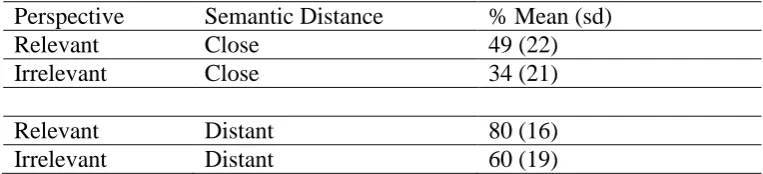
11 Participants scored on average 95% correct on comprehension questions, indicating that they were reading for comprehension. Table 2 summarises the mean detection rates across all four conditions.
[INSERT TABLE 2 HERE]
Two 2 (perspective-relevant vs. perspective-irrelevant) x 2 (close vs. distant) ANOVAs were performed on arcsine transformed data (Winer, 1971). There was a main effect of perspective, with more correct detections in the relevant than irrelevant condition F1(1,31) = 52.1, p < .001; F2(1,23) = 6.8, p < .02. This suggests that when participants were instructed to read a story from the perspective of one character, information relevant to that character was afforded greater attention than perspective-irrelevant information, making readers more sensitive to perspective-relevant word changes. There was also a main effect of semantic distance (as found in previous studies e.g., Sanford et al., 2006; Sturt et al., 2004), with more correct detections for semantically distant than semantically close changes F1(1,31) = 142.2, p < .001; F2(1,23) = 42.6, p < .001. There was no interaction (Fs < 2).
12 pattern of effects observed when cognitive load was manipulated in a
change-detection experiment reported by Sanford et al. (2005). They hypothesised that cognitive load may have a general dampening effect in that the task is generally made harder, perhaps due to less-accessible memory traces for word meanings. In a similar way, perspective may signal that a section of text requires additional attention, leading to a relative dampening effect for perspective-irrelevant information in general.
One question raised by these results is to what extent all readers utilise perspective-based information (whether reading expository text for a specific goal or following the events of a narrative from the perspective of the main character). It is fair to assume that not all readers are equally affected by reading perspective, and therefore it is an important question whether some readers utilise this information more than others. One factor that may affect the degree to which readers are influenced by perspective manipulations is differences in verbal working memory capacity (WMC). For example, readers with greater WMC may utilise perspective information more effectively. Alternatively, perhaps readers with low WMC may be more ‘perspective-bound’ due to limited resources. In Experiment 2 we investigate the influence of individual differences in WMC on perspective effects. To explore this question and allow easier comparison to much of the existing literature, we developed one story centred around a potential house-buyer and burglar. The story was arguably also more naturalistic since that the reader progressed through the same story over successive paragraphs/trials rather than reading a series of discrete vignettes.
13 Experiment 2 investigates whether working memory capacity (WMC) modulates the perspective effect. Language processing is assumed to place a demand on working memory, which is a limited capacity system (Just & Carpenter, 1992). Individuals with a low WMC might find that some linguistic processes are compromised in some way due to limited available resources. Lee-Sammons and Whitney (1991) reported that low-WMC readers were more likely to recall just perspective-relevant
information, whereas high-WMC readers recalled both perspective-relevant and irrelevant text information. They concluded that low-WMC readers compensate for WMC deficits by efficiently using perspective information to guide the
comprehension process. In contrast, Kaakinen et al. (2002) found no overall difference in perspective effects as measured by memory recall. However, eye movement data revealed that perspective effects were observed in both early and late measures with high-WMC participants, but only late measures demonstrated
perspective effects for low-WMC participants. This suggests that readers with a high-WMC are faster at recognising relevant information and devote more processing time to perspective-relevant information than do low-WMC individuals (see also,
Kaakinen, Hyönä , & Keenan, 2005).
Therefore, the question of exactly how WMC modulates perspective effects is far from resolved. This question was investigated in Experiment 2 using a text
14 classed as having a high-WMC are more susceptible to perspective effects, possibly because they use perspective cues more effectively (as in Kaakinen et al., 2005).
Method
Participants: Thirty native English speakers were recruited from the University of Glasgow undergraduate population.
Materials and Design: Participants were instructed to read all of the passages from the perspective of either a burglar (Olli) or a house-buyer (Susanna). Thus, perspective was a between-subjects factor. Word changes were either to burglar-relevant or house-buyer-burglar-relevant words (within-subjects factor). WMC was also measured and participants were classified as having either high or low-WMC, resulting in a 2 perspective (burglar vs. house-buyer) x 2 word change (burglar vs. house-buyer) x 2 WMC (high vs. low) design. As before, the dependent variable was the number of changed words correctly identified by the participant.
15 Of the 60 paragraphs, 36 contained a word change across presentations; 12 changes were more relevant to the perspective of the burglar character, 12 relevant to the house-buyer, and 12 were classified as neutral. Twenty-four paragraphs contained no changes, giving an overall composition of 60% change, 40% no change
(comparable to Sanford et al., 2005). Word changes were randomly distributed throughout the story. See Table 3 for an example item. A full list of materials is available on request from the authors.
[INSERT TABLE 3 HERE]
16 Working Memory: Verbal working memory was assessed using Daneman and Carpenter’s (1980) reading span test. Participants read aloud a set of unrelated sentences presented serially on printed cards and at the end of each set they were requested to recall the last word of each sentence in the set. Testing ended when the participant was unable to recall the final word of the sentences for all three repetitions of a particular set size.
Procedure: The procedure was identical to Experiment 1.
Results and Discussion
An average of 98% correct responses to comprehension questions indicated that participants had read for comprehension.
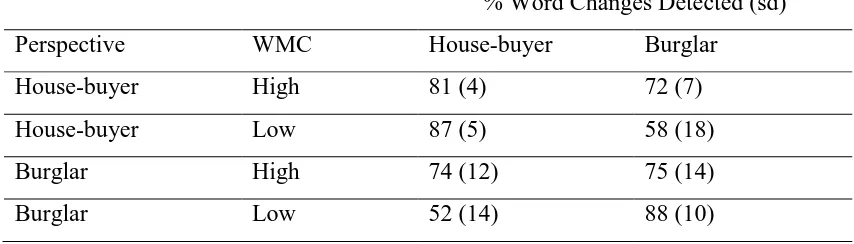
Data were partitioned into categories corresponding to high or low-WMC. Participants’ WMC scores ranged from four to seven, with an average score of five. Based on this distribution, high-WMC was defined as scores of six and seven, and low-WMC was defined as a score of four. This resulted in 13 participants in the high WM group, and 11 in the low group. Data from those who scored five were excluded from the analyses. Table 4 summarises detection rates for perspective and word change type partitioned into high and low-WMC.
17 A 2 WMC (high vs. low) x 2 perspective (house-buyer vs. burglar) x 2 word change (house-buyer- vs. burglar-relevant) ANOVA was performed on arcsine transformed data. There was a significant 3-way interaction, F(1,19) = 30.6, p < 0.001. To investigate this further, the data were separated into high- and low-WMC groups and two separate 2 perspective (house-buyer- vs. burglar-relevant) x 2 word change (house-buyer vs. burglar) ANOVAs were performed.
In the low-WMC group there was significant interaction between perspective and word change, F(1, 8)= 138.1, p < 0.001. Decomposing this interaction revealed that reading from the perspective of a house buyer resulted in more house-buyer related changes being detected, F(1, 8) = 68.8, p < 0.001, and reading from the perspective of a burglar resulted in more burglar-related changes being detected, F(1,8) = 69.3, p < 0.001. In the high-WMC group there were no significant effects (all Fs < 2).
Our findings suggest that readers with a low-WMC are more likely to focus their attention on perspective-relevant information and process this to a suitable depth to at least detect word changes across presentations. However, it would appear that these readers have fewer resources available to process less relevant information, resulting in fewer detections of perspective-irrelevant word changes. Participants with a high-WMC on the other hand appear to be able to process both perspective-relevant and -irrelevant information equally well.
18 We have reported the results of two studies that investigated how reading perspective may affect the quality of the overall semantic representation of a text. In Experiment 1 we used a series of discrete vignettes where readers were instructed to read from the perspective of one character. Readers were more likely to report text changes when relevant to their character’s perspective. In Experiment 2 we investigated the impact that WMC had on readers’ ability to utilise perspective information, and found perspective effects for low-WMC participants only.
Perspective effects on memory for text have a long history in reading research, with the consistent conclusion that reading from an adopted perspective produces a memory advantage for perspective-relevant information (e.g., Anderson & Pichert, 1978; Baillet & Keenan, 1986). The assumption is that readers devote more
processing resources to perspective-relevant information. This conclusion is supported by eye-movement data, where longer fixation times are reported for perspective-relevant information (Kaakinen et al., 2002), and the finding that readers rehearse perspective-relevant information more readily, as assessed through think-aloud procedures (Kaakinen et al., 2005).
One potential difficulty with interpreting previous findings is that the standard procedure for assessing text memory is via a surprise memory test. However, readers’ prior knowledge may influence the recall of text information, as suggested by
19 information. We hypothesised that using a text change-detection paradigm was less likely to be influenced by long-term memory in this way because testing is more immediate. In addition, we employed materials that used non-stereotypical contexts (Experiment 1) as well as the ‘classic’ burglar/house-buyer context (Experiment 2). It is to the authors’ knowledge the first time that this paradigm has been employed to investigate perspective effects and in both experiments our findings replicated a classic perspective effect.
In Experiment 1, in addition to perspective we manipulated the nature of the word change (close vs. distant). Sanford et al. (2006) reported that close semantic changes were more likely to be detected when in focus, but distant changes were equally likely to be detected whether in focus or not (see also Sturt et al., 2004). They argued that focussing devices help to direct attention to key information which is then preferentially processed to a greater semantic depth, resulting in more detailed
information being incorporated into the overall representation of the text. The results from Experiment 1 did not conform to this and instead illustrated that perspective resulted in an additive effect, leading to an advantage in detecting all perspective-relevant changes, whether close or distant. This pattern of results mirrors that found for the effect of memory load on text change-detection as reported by Sanford et al. (2005) which was explained as being due to load making it harder to access the memory of the text. Therefore, manipulations of linguistic focus and of memory load appear to have different effects on the nature of the resulting text representation.
20 memory for all perspective-relevant information. On-line studies have illustrated that this information is largely utilised at time of encoding and behavioural changes result in longer reading times and rehearsal strategies (Kaakinen et al., 2002). This may be a different strategy to that observed with linguistic focus which may modulate depth of processing at time of encoding but not result in elaborate rehearsal strategies as observed when adopting a reading perspective. However, an alternative explanation may be that the interaction between focus and semantic distance reported by Sanford et al. (2006) and Sturt et al. (2004) is instead the result of a ceiling effect observed in the distant conditions. Scrutiny of their data suggests that distant semantic changes were at near 100% in focus and non-focus conditions and that these obvious changes were ‘popping-out’ to readers because they were so obviously different. Further work could explore this issue further with graded semantic distance to investigate the reliability of the effect of semantic distance on focus manipulations.
In Experiment 2 we investigated the role of WMC on the utilisation of perspective information. This was to explore conflicting results reported in the literature, which on the one hand suggest that readers with low-WMC are more likely to utilise perspective-relevant information (Lee-Sammons & Whitney, 1991),
21 adopt, but rather to what WMC readers do. For example, it may be that high-WMC readers are just more likely to use rehearsal strategies when reading for a purpose compared to low-WMC readers. Future work should explore how the differential effects observed are not simply explained as due to differences in set storage capacity, but rather the behavioural differences readers adopt when adopting a perspective, and whether different strategies can be employed by readers.
22 References
Anderson, R.C., & Pichert, J.W (1978) Recall of previously unrecallable information following a shift in perspective, Journal of Verbal Learning and Verbal Behaviour 17, 1-12
Baillet S.D., & Keenan J.M., (1986). The role of encoding and retrieval processes in the recall of text. Discourse Process, 9, 247-268.
Baayen, R. H., Piepenbrock, R., & Gulikers, L. (1995). The CELEX lexical database [CD-ROM]. Philadelphia: University of Pennsylvania, Linguistic Data Consortium.
Borland, R., & Flammer, A. (1985). Encoding and retrieval processes in memory for prose. Discourse Processes, 9, 247-268.
Daneman, M., & Carpenter, P.A. (1980). Individual Differences in working memory and reading. Journal of Verbal Learning and Verbal Behaviour, 19, 450-466. Emmott, C., Sanford, A. J., & Morrow, L. I. (2006). Capturing the attention of
readers? Stylistic and psychological perspectives on the use and effect of text fragmentation in narratives. Journal of Literary Semantics, 35, 1–30.
Filik, R., Brightman, E., Gathercole, C., & Leuthold, H. (2017). The emotional impact of verbal irony: Eye-tracking evidence for a two-stage process. Journal of Memory and Language, 93, 193-202.
Filik, R., Paterson, K. B., & Sauermann, A. (2011). The influence of focus
23 Goetz, E. T., Schallert, D.L., Renolds, R.E., & Radin, I.I. (1983). Reading in
perspective: What real cops and pretend burglars look for in a story. Journal of Educational Psychology, 75, 500-510.
Hobbs, J. R. (1985, August). Granularity (pp. 432–435). Paper presented at the 9th International Joint Conference on Artificial Intelligence, Los Angeles. Just, M.A., & Carpenter, P.A. (1980). A theory of reading: from eye fixations to
comprehension. Psychological Review, 87, 329–354.
Kaakinen, J. K., & Hyönä, J. (2008). Perspective-driven text comprehension. Applied Cognitive Psychology, 22, 319-334.
Kaakinen, J. K., Hyönä, J., & Keenan, J. M. (2002). Perspective effects on on-line text processing. Discourse Processes, 33, 159-173.
Kaakinen, J. K., Hyönä, J., & Keenan, J. M. (2005). Perspective effects on expository text comprehension: Evidence from think-aloud protocols, eyetracking, and recall. Discourse Processes, 40, 239-257.
Koh, S., Sanford, A. J., Clifton, C. Jr., & Dawydiak, E. J. (2008). Good-enough Representation in Plural and Singular Pronominal Reference: Modulating the Conjunction Cost. In J.K. Gundel and N. Hedberg (Eds.). Reference:
Interdisciplinary perspectives on reference processing (pp. 123-39). Oxford: Oxford University Press.
Lee-Sammons, W.H., & Whitney, P. (1991). Reading perspectives and memory for text: An individual differences analysis, Journal of Experimental Psychology: Learning, Memory and Cognition, 17, 1074-1081.
Newsome, G.L., III. (1986). The effects of reader perspective and cognitive style on remembering important information from texts. Journal of Reading
24 Pichert, J. W., & Anderson, R. C. (1977). Taking different perspectives on a story.
Journal of Educational Psychology, 69, 309-315.
Sanford, A.J.S., Price, J., & Sanford, A.J. (2009). Enhancement and suppression effects resulting from information structuring in sentences. Memory & Cognition, 37, 880-888.
Sanford, A.J.S., Sanford, A.J., Filik, R., & Molle J. (2005). Depth of lexical-semantic processing and sentential load. Journal of Memory and Language, 53, 378-396.
Sanford, A.J.S., Sanford, A.J., Molle J., & Emmott, C. (2006). Shallow processing and attention capture in written and spoken discourse. Discourse Processes, 42, 109-130.
Sanford, A.J., & Sturt, P. (2002). Depth of processing in language comprehension: not noticing the evidence. Trends in Cognitive Sciences, 6, 382-386.
Sturt, P., Sanford, A. J., Stewart, A., & Dawydiak, E. J. (2004). Linguistic focus and good-enough representations: an application of the change-detection paradigm Psychonomic Bulletin and Review, 11, 882-888.
25 Table 1: Example item for Experiment 1
Read from John’s/Jane’s perspective.
John and Jane went to a weekend cookery school. John thought he was good at making [cakes -> buns/sweets] and biscuits. Jane felt she was good at making sauces and soup but struggled with seafood. The chef was surprisingly a very friendly man who encouraged them both.
Comprehension question: What is John good at making? Read from John’s/Jane’s perspective.
John and Jane went to a weekend cookery school. John thought he was good at making cakes and biscuits. Jane felt she was good at making sauces and [soup ->broth/pasta] but struggled with seafood. The chef was surprisingly a very friendly man who encouraged them both.
26 Table 2: Mean word change-detection rates in Experiment 1
Perspective Semantic Distance % Mean (sd)
Relevant Close 49 (22)
Irrelevant Close 34 (21)
Relevant Distant 80 (16)
27
Table 3: Example items for Experiment 2 House buyer relevant change:
Susanna was excited to view the house. She had already looked at the pictures on the estate agent’s website and thought the house looked beautiful. She thought it was very [spacious > roomy] and would be perfect for raising her children.
Burglar relevant change:
28 Table 4: Mean detection rates for participants with high- and low-WMC for
perspective-relevant and irrelevant word changes.
% Word Changes Detected (sd)
Perspective WMC House-buyer Burglar
House-buyer High 81 (4) 72 (7)
House-buyer Low 87 (5) 58 (18)
Burglar High 74 (12) 75 (14)