Synthesis and cell-free cloning of DNA libraries using
programmable microfluidics
Tuval Ben Yehezkel
1, Arnaud Rival
2, Ofir Raz
1, Rafael Cohen
1, Zipora Marx
1,
Miguel Camara
3, Jean-Fr ´ed ´eric Dubern
3, Birgit Koch
4, Stephan Heeb
3, Natalio Krasnogor
4,
Cyril Delattre
2and Ehud Shapiro
1,*1Applied Mathematics and Computer Science and Biological Chemistry, Weizmann institute of science, Rehovot,
Israel,2Illumina Inc., Grenoble, France,3Centre for Bio-molecular Sciences, University of Nottingham, Nottingham,
UK and4School of Computing Science, Claremont Tower, Newcastle University, Newcastle, UK
Received March 24, 2015; Revised September 24, 2015; Accepted October 03, 2015
ABSTRACT
Microfluidics may revolutionize our ability to write synthetic DNA by addressing several fundamental limitations associated with generating novel genetic constructs. Here we report the firstde novo synthe-sis and cell-free cloning of custom DNA libraries in sub-microliter reaction droplets using programmable digital microfluidics. Specifically, we developed Pro-grammable Order Polymerization (POP), Microfluidic Combinatorial Assembly of DNA (M-CAD) and Mi-crofluidic In-vitro Cloning (MIC) and applied them to
de novosynthesis, combinatorial assembly and cell-free cloning of genes, respectively. Proof-of-concept for these methods was demonstrated by program-ming an autonomous microfluidic system to con-struct and clone libraries of yeast ribosome bind-ing sites and bacterial Azurine, which were then re-trieved in individual droplets and validated. The abil-ity to rapidly and robustly generate designer DNA molecules in an autonomous manner should have wide application in biological research and develop-ment.
INTRODUCTION
The study of biology has accelerated to an unprecedented pace due to the development of methods for massively par-allel cell-free cloning and DNA sequencing and their inte-gration into miniaturized hardware in desktop next genera-tion sequencing (NGS) machines (1).
Conversely, the engineering of biology is still largely re-strained by fundamental limitations of gene synthesis and cloning methodologies (2–5). The development of novel ap-proaches and apparatus for gene synthesis and cloning and their integration into desktop devices is positioned to im-prove our ability to write genetic code to the extent that
NGS technology improved our ability to read it. Specifi-cally, microfluidics is positioned to improve our ability to write custom DNA molecules by increasing the throughput of gene synthesis through parallelization, reducing its cost through miniaturization and simplifying complex synthesis through autonomous liquid handling. The development of novel methods and hardware for microfluidic gene synthesis is the subject of intensive ongoing research. Specifically, sev-eral studies have already shown that genes can be madede novousing various microfluidic technologies that run one-pot enzymatic gene synthesis methodology (6–8).
However, for microfluidic gene synthesis to advance it should overcome the limitation of strictly assembling genes in one pot reactions (6–8) and accommodate a wider range of assembly methods, despite the fact that they require more complex liquid handling schemes. These could be realized by programmable microfluidic platforms that executead hoc microfluidic gene synthesis methodologies. Crucially, ad-vanced microfluidic platforms for gene synthesis must have programmability over droplet routing. This would enable the implementation of complex, parallelized liquid han-dling schemes which are challenging to execute both man-ually and on liquid handling robots and offer the flexibility required to accommodate different construction protocols. Programmable microfluidic platforms open opportuni-ties for developing novelad hocgene synthesis methodolo-gies that utilize the advantages of programmability. How-ever, these have not been developed, primarily due to pro-grammability limitations of microfluidic technologies used for gene synthesis to date––specifically in supporting ran-dom access, complex droplet routing schemes that are of-ten required in more advanced, hierarchical gene synthe-sis methods (9–11). To this end, we demonstrate how com-plex gene synthesis schemes associated with the parallel hi-erarchical DNA library synthesis (9–11) of multiple ratio-nally designed variants, each made and retrieved individu-ally, can be accomplished through programmable microflu-idic droplet routing technology (see M-CAD section),
ef-*To whom correspondence should be addressed. Tel: +97289344494; Fax: +97289344484; Email: [email protected]
C
The Author(s) 2015. Published by Oxford University Press on behalf of Nucleic Acids Research.
This is an Open Access article distributed under the terms of the Creative Commons Attribution License (http://creativecommons.org/licenses/by/4.0/), which permits unrestricted reuse, distribution, and reproduction in any medium, provided the original work is properly cited.
at University of Nottingham on July 12, 2016
http://nar.oxfordjournals.org/
fectively overcoming the one-pot assembly barrier of exist-ing microfluidic gene synthesis (6–8). Additionally, we de-veloped anad hocDigital Micro Fluidic (DMF) gene syn-thesis method forde novoDNA construction from oligonu-cleotides that utilizes droplet routing programmability (see POP assembly).
Cloning of synthetic constructs is the second and final phase in the pipeline of generating synthetic genetic mate-rial. Despite the development of new cloning approaches it is still a major bottleneck in gene synthesis and remains largely un-addressed with microfluidics. Instead, microflu-idic gene synthesis typically resorts to traditional cloning of the assembled genes into bacteria off-chip (12,13). Only re-cently has electroporation-mediated transformation of bac-teria and yeast been demonstrated using microfluidics for the first time (14). However, fully harnessing the poten-tial of microfluidic gene synthesis will require the devel-opment of on-chip methods for cell-free cloning of DNA constructs that bypass the need for bacterial/yeast trans-formation. These could, theoretically, have throughput sim-ilar to that of NGS cell-free cloning. However, since gene synthesis and cloning are preparative rather than analyti-cal procedures, they (in contrast to NGS cell-free cloning) must also enable the physical retrieval of cloned DNA molecules in individual droplets. Cell-free cloning of syn-thetic genes was first accomplished by us (15) and later by others with higher throughput (16–18). However, it has not yet been accomplished using microfluidic technology. Here we demonstrate the first microfluidic cell-free cloning of synthetic genes, including retrieval and validation off-chip. Applying microfluidic technology for cloning and gene syn-thesis remains a major untapped source of innovation in synthetic biology and bio-engineering. Electro-Wetting On Dielectric (EWOD) technology, also known as DMF, has been demonstrated in the past to offer the programmabil-ity required to implement molecular biology protocols (19– 22), but has not been applied to the controlled synthesis and cloning of designer genes and their libraries. In this manuscript we present a programmable DMF device and the accompanying ad hoc methodologies for (i) synthesis of genes de novo (POP assembly), (ii) construction of ra-tionally designed combinatorial DNA libraries with each variant individually retrieved (M-CAD) and (iii) cell-free cloning of assembled synthetic DNA. The methods were ex-ecuted using a desktop DMF device and the resulting DNA molecules produced were inspected and validated both at the sequence level using cloning and DNA sequencing and for functionality downstream.
MATERIALS AND METHODS
DMF DNA construction
POP assembly. Each assembly droplet is 0.3l and con-tains at each phase of the assembly process: a pair of the correct (different pair for each phase of construction) ex-ternal overlap extension primers (0.1 pmol each), 1 fmol of the correct template molecule template (different template molecule for each phase of construction), 1X hot start KOD buffer, 0.02U KOD Hot Start enzyme, 200M of dNTP.
EWOD Cartridge Thermal Cycler program: Enzyme ac-tivation at 95◦C for 10 min, 4 cycles of thermal cycling per
each primer pair and template (denaturation 95◦C 5 s, an-nealing atTmof primers 5 s, extension 72◦C 15 s/kb) with
64X dilution between POP assembly phases. The purpose of the dilution between stages of POP assembly is to dilute out the primers from the previous POP stage and, as a re-sult, avoid a purification step between POP stages.
POP assembly programs were uploaded to the instru-ment and ran once cartridges were filled with the filler fluid, loaded with the POP reagents at the appropriate wells and the cartridge placed inside the device. Surfactant was added to the POP assembly reactions on cartridge to avoid the for-mation of stationary droplets. POP Assembly products were eluted manually from the dedicated collection wells.
The program used for POP assembly droplet processing (POP.ade) can be downloaded and used to execute POP as-sembly on commercially available instruments.
Single molecule polymerase chain reaction (smPCR)-based cell-free cloning. smPCR was performed with KOD hot start (Novagen) polymerase on the EWOD cartridge. Sin-gle molecule templates were obtained via limiting dilution and amplified through shuttling of droplets between tem-perature zones. smPCR reactions were performed in various volumes on cartridge ranging between 0.3l and 1.2l fi-nal volume. Primers containing only CA bases (no GT) were used for smPCR amplification to avoid primer dimer forma-tion. Each (0.3–1.2l) reaction droplet Reaction contains: 1X hot start KOD buffer, 0.02U-0.08U KOD Hot Start en-zyme, 0.1–0.4 pmol of the CA primer, 200M of dNTP.
EWOD Cartridge Thermal Cycler program: Enzyme ac-tivation at 95◦C for 10 min, denaturation 95◦C 5 s, anneal-ing atTmof primers 5 s, extension 72◦C 15 s/kb, 50 cycles. It
is important that the PCR is prepared in sterile environment using sterile equipment and uncontaminated reagents. POP assembly programs were uploaded to the instrument and ran once cartridges were filled with the filler fluid, loaded with the POP reagents at the appropriate wells and the car-tridge placed inside the device. Surfactant was added to the POP assembly reactions on cartridge to avoid the formation of stationary droplets. smPCR products were eluted manu-ally from the dedicated collection wells.
The program used for POP assembly droplet processing (POP.ade) can be downloaded and used to execute POP as-sembly on commercially available instruments.
M-CAD –microfluidic combinatorial assembly of DNA. M-CAD was performed with KOD hot start (Novagen) poly-merase on the EWOD cartridge. DNA templates used for generating the library building blocks on cartridge were plasmids purified from bacteria. Overlapping PCR build-ing blocks were assembled usbuild-ing thermal cyclbuild-ing as follows: EWOD Cartridge Thermal Cycler program: denaturation 95◦C 5 s, annealing atTm of primers−5, extension 72◦C
15 s/kb, 10 cycles. Each 300 nl reaction droplet Reaction contains: 1X hot start KOD buffer, 0.02U-0.08U KOD Hot Start enzyme, two overlapping PCR building blocks and 200M of dNTP.
The Assembled is then serially diluted on-cartridge and PCR amplified with external primers using EWOD Car-tridge Thermal Cycler program: denaturation 95◦C 5 s, an-nealing atTm of primers−5, extension 72◦C 15 s/kb, 30
at University of Nottingham on July 12, 2016
http://nar.oxfordjournals.org/
cycles. M-CAD assembly programs were uploaded to the instrument and ran once cartridges were filled with the filler fluid, loaded with the M-CAD reagents (tempaltes, primers, polymerase mix) at the appropriate wells and the cartridge placed inside the device. Surfactant was added to the M-CAD assembly reactions on cartridge to avoid the forma-tion of staforma-tionary droplets. Assembled target molecules of the Azurin combinatorial library were eluted manually from the dedicated collection wells and verified by sequencing.
The program used for POP assembly droplet processing (POP.ade) can be downloaded and used to execute POP as-sembly on commercially available instruments.
Azurin library western blot. For detection of Azurin by western blot, Pseudomonas aeruginosa PAO1 wild type and azurin in frame deletion mutant (published else-where) were grown in 10 ml LB (Luria Bertani) broth for 16h under vigorous shaking (200 rpm). A volume of 1 ml culture was centrifuged and cell pellets suspended in sodium dodecyl sulphate (SDS) sample buffer containing 6% -mercaptoethanol. Samples were run on 30% SDS-polyacrylamide gel and blotted to Hybond-ECL nitrocel-lulose membrane (Amersham) in a BioRad Mini-Protean system. The blot buffer consisted of (12.5 mM) Tris-Base, 96 mM glycine and 20% methanol. After blotting the mem-brane was incubated overnight at 4oC in TBST (1 mM Tris-HCl, 150 mM NaCl, 0.05% Tween 20, pH 7.4) containing 5% milk (from non-fat milk powder) and azurin antibody (1:2000) (Yamada et al., 2005). The membrane was washed once with TBST and incubated for a further 60 min at room temperature with TBST containing anti-goat IgG alkaline phosphatase conjugate (1:5000). Azurin was detected using ECL chemiluminescence detection kit (Amersham). Com-mercial azurin (Sigma) was used as a standard.
DMF protocol validation. A validation process is applied for each protocol before it is routinely used. Droplets typi-cally fail to move because of improper surface tension and viscosity with respect to voltage applied. Each reagent in a protocol is made to be compatible with the voltage sent: sur-factant concentration is adjusted to enable correct droplets operations such as dispenses or moves. Electrode actuation sequence, i.e. timing between each actuation/de-actuation of the electrodes, is also of importance, and we experimen-tally determine the right timing before locking down a pro-tocol. Electrode failure never occurred for the timescale of the experiments. Once a protocol is validated the frequency of droplet failure is essentially zero.
Transformations to yeast. The POP-generated variants were transformed into the yeast master strain using the LiAc/SS carrier DNA/PEG method. Cells were plated on solid agar SD-URA selective media and incubated at 30◦C for 3–4 days. Transformant colonies were handpicked and patched on SD-URA + NAT (Werner BioAgents) agar plates. Correct transformation was verified for all variants by PCR amplification from the yeast’s genome, gel elec-trophoresis and verified by sequencing
Yeast gene expression measurements. POP library strains were arrayed on SD-URA+NAT agar plates in 96 colony
format using a robotic colony arrayer (RoToR, Singer instruments). The colony arrayer was used to inoculate the library into SD-URA in 96 well microplates (Greiner bio-one, 781162). Following over-night incubation, strains were diluted 1:20 into SD complete media and cultured. A microplate reader (Neotec Infinite M200 monochroma-tor) was set to measure growth (Absorbance at 600 nm), mCherry (E.x. 570 E.m. 630) and YFP expression (E.x. 500 E.m. 540) in 10 min intervals. Each cycle contained 4 min of orbital shaking at amplitude of 3 mm. The number of cy-cles was set to 100 (16h) and the temperature to 30◦C. The entire procedure was performed in three times.
The library transformation master strain was generously provided by the lab of Prof. Eran Segal. The master strain was created by integrating into the yeast genome a cas-sette expressing the fluorescent mCherry under a TEF2 promoter and a promoter-less YFP, followed by a NAT (Nourseothricin) resistance marker under its own promoter. The entire sequence was inserted into the his31 locus of strain Y8205 (A strain derived from S. cerevisiaeS288C, BY4741, mat alpha, Charlie Boone lab).
A microplate reader (Neotec Infinite M200 monochro-mator) was then set to measure the following parameters in cycles of 10 min: Cell growth (as extracted from absorbance at 600 nm) and YFP expression (Ex. 500 Em. 540). Each cycle contained 4 min of orbital shaking at amplitude of 3 mm. The number of cycles was set to 100 (16h) and the tem-perature to 30◦C.
DNA sequencing. Sequencing of the POP DNA library and the smPCR products was performed standard Sanger sequencing at the Weizmann institute sequencing facility.
DNA oligos. All DNA oligos for POP assembly were or-dered as Ultramers from Integrated DNA technologies (IDT). Oligos for smPCR and for the construction of the Azurin library were ordered as standard desalted oligos from IDT.
DNA oligo design. The DNA oligos used for POP assem-bly were designed to have a minimalTmof 60 degrees to the
oligos of the subsequent POP step (so that optimization of annealing temperature is possible) and to be under 120 bp in length (since Ultramers longer than 120 bp do not function as good primers in our experience). All primer sequences are available from the supplementary file, pages 11–12.
RESULTS
Digital microfluidics system
We designed a microfluidic desktop device that assembles synthetic genes and clones them using a combination of ex-isting andad hocmethodologies. The device uses electro-wetting on dielectric (EWOD) technology, also known as DMF, to manipulate in parallel multiple 300nl droplets in a programmable manner by the application of an electric field under direct software control (23–28). LH operations such as dispense, transport, split and merge are combined to im-plement complex LH protocols without the use of pumps, valves or moving parts.
The system (Figure1) consists of (i) a DMF cartridge on
at University of Nottingham on July 12, 2016
http://nar.oxfordjournals.org/
Figure 1. Overview of DMF cartridge design. Top: dimensions and general layout of the cartridge, with annotated reservoirs names. Bottom (magnified): annotated schematics of a section of the microfluidics cartridge layout. Different regions corresponding to different functions are highlighted. Dilution buffer reservoir contains the reagent used to perform dilutions to reach single molecule DNA concentrations/PCR Mix. Other reservoirs are used to hold master mixes that contain the appropriate pairs of primers. During each phase of the DMF program the storage area is continually loaded with the droplets required for the following stages of the run to speed up the protocols. The dilution zone is used to perform the serial dilutions for POP assembly, M-CAD and smPCR basedin vitrocloning. The PCR lane consist of three temperatures zones at 62◦C, 72◦C and 95◦C. Temperature ramping is accomplished by DMF-based droplet shuttling between temperature zones.
which liquid droplets are shuttled and reactions takes place (Figure1, top left) and (ii) a microfluidics apparatus into which the cartridge is mounted that embeds the electronics for generating the EWOD phenomenon.
The cartridge consists of two parts: (i) a printed circuit board bottom plate and (ii) a plastic injected-molded cover plate where througholes are used as wells for liquid load-ing into the workload-ing area of cartridge. The core of the car-tridge, the PCB, comprises typical material stack used in electrowetting devices, i.e. a conductive layer defining the electrodes, a dielectric layer used to build up the capacitive force and a hydrophobic coating that exerts a contact an-gle of 106◦in air, of 160◦ in the filler fluid without voltage and 60◦ at maximum voltage applied for water with 0.01% Tween 20. Tween 20 at 0.01–0.05% final concentrations fa-cilitates robust droplet routing and is also an integral part of standard DNA polymerase buffers and therefore does not interfere with DNA polymerase-based assembly meth-ods. The voltage used was 200–300V and the frequency used was 10–1000 Hz. Current stack and voltage provide to the droplet a typical capacitive energy of 0.039J.m-2. The car-tridge contains a gap space of 300um between the cover plates and is filled with 5 ml of 5cSt silicone oil filler fluid, which facilitates robust droplet transport and reduces evap-oration during temperature cycling. The electrode structure layout of the cartridge is defined in Figure 1 (top right)
and can also be seen in Video’s S1–S3. We used the same DMF cartridge layout (Figure1, top right) to perform both DNA assembly methods andin vitrocloning. The distribu-tion of througholes in the cartridge plastic injected-molded cover are depicted as A, C, D and E wells (each containing 7–8 wells) in Figure1 and Videos 1–3. These througholes (30 in total) are used as input/output channels for man-ual loading using a standard manman-ual micropipette to the hydrophobic-coated bottom plate (see Video S4 for load-ing and retrievload-ing reagents from the cartridge). The opera-tional volumes of these reservoirs range from 2l to 40l, with the dead volume varying between 0% and 10% of the total input depending on the liquid properties. Manual col-lection of droplets containing the assembled products was performed using 10l pipette tips and was visually guided by the merging of droplets with dyed droplets prior to their transport to the collection well where they are retrieved. The AC voltage sent to each electrode is provided by a dedicated instrument from Illumina, consisting of an electro-wetting effector instead of using traditional voltage generators and relays (25). Additionally, three independent heater bars lo-cated at defined zones (see Figure 1) directly underneath the cartridge are used to perform reactions (such as PCR) by shuttling the droplets between the different temperature zones (Figure1, bottom right). Temperature calibration of the heater bars and the gradient between them is performed
at University of Nottingham on July 12, 2016
http://nar.oxfordjournals.org/
once and for all at the instrument reception using miniature thermocouples (150um thick, Thin Leaf-Type Thermocou-ples, 88309, Omega Engineering Inc.) inserted between the PCB board and the plastic top plate inside the filler fluid using the open through hole of the top plate. The heater bars set-points were calculated to reach the needed temper-ature inside the cartridge (the set-points are therefore higher than the measured temperature, i.e. 60C, 72C, 95C). Tem-perature decreases gradually between the different zones in-side the cartridge without going below the targeted tem-perature. Compared to IR temperature measurement this method provides a more accurate account of droplet tem-peratures since it is not possible to image the PCB board with an IR camera when the cartridge is filled with silicone oil. By measuring the temperature with miniature thermo-couples inside the filler fluid that surrounds the droplets, we obtained the most accurate indication of droplet tempera-ture. Videos S1–S3 depicting POP, M-CAD and MIC were filmed using a Chameleon CMLN-13S2C-CS USB color camera (Point Grey Research) with a Xenoplan 23/1,4 mag-nification lens (Schneider-Kreuznach).
Programmable order polymerization (POP) assembly
We set out to test whether control over droplet maneuver-ing with EWOD enables the implementation of complex mi-crofluidic LH schemes for gene synthesis. We designed POP DNA synthesis, anad hoc de novo gene synthesis method specifically tailored for DMF. We show how a synthetic li-brary of YFP 5’ UTR variants can be autonomously built de novousing POP assembly on-chip. We then demonstrate how these synthetic YFP variants can be clonedin vitroon the same assembly chip using smPCR-basedin vitrocloning and retrieved from the chip for downstream validation of the method using transformation, sequencing and gene ex-pression measurement.
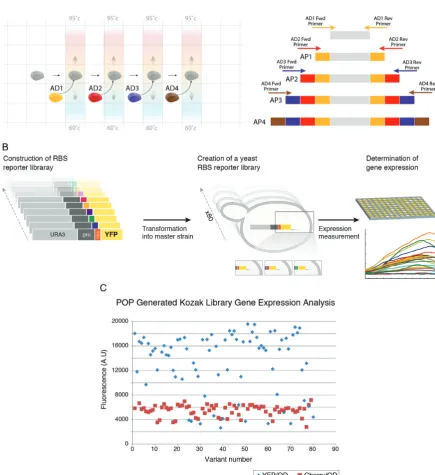
Specifically, in POP assembly (Figure 2A) a synthetic construct is built inside–out from an initial DNA template (which can be either natural or synthetic) via an ordered set of serial elongation reactions. In each of the elongation re-actions only two DNA oligos extend the synthetic dsDNA construct from both its termini through several cycles of polymerase-based overlap-extension. Once a pair (for ex-ample, AD1 in Figure2) of oligos has completed extend-ing the construct a fresh droplet containextend-ing the next specific oligo pair (in this case AD2 in Figure2) is programmed to merge into the assembly reaction. Each oligo pair uses the extensions created by the former pair as hybridization sites and further extends the construct inside-out using over-lap extension. Specifically, primers from Assembly Droplet 2 (AD2) use hybridization sites created by primers from AD1, primers from AD3 use hybridization sites created by primers from AD2 and so on. This process of temporally ordered, distinct overlap extension events is iterated, each time using the correct assembly droplet until the full length molecule is constructed. The process depends on the accu-rate integration of specific assembly droplets into the POP assembly reaction at specific times on chip and is completely pre-programmed.
In contrast to one-pot gene synthesis methods carried out in general (29,30) and specifically in microfluidic devices
(6–8), POP assembly substantially reduces the complexity and increases reliability of the assembly reaction. It sim-plifies the assembly by reducing to the minimum the num-ber of components that are simultaneously assembled, en-abling individual reaction condition optimization for each DNA component in the system. This is in contrast to one-pot assembly methods that face the problem of simulta-neously optimizing specificity and reaction conditions for multiple DNA components (6–8). Additionally, one-pot as-sembly methods face the problem of miss-hybridization be-tween the multiple DNA components present in the re-action. This complexity is often mitigated through vari-ous computational and biophysical methodologies aimed at controlling the correct order and hybridization speci-ficity between multiple oligos that exist in a single reaction (30). However, avoiding cross-hybridizations when multi-ple DNA fragments are mixed and amplified in a single assembly reaction has proven a challenge and one-pot as-sembly remains prone to construction failure, often result-ing in labor-intensive siftresult-ing through multiple clones that harbor non-specific assembly products. POP assembly us-ing DMF mitigates this problem by integratus-ing a dilution step between each assembly phase that effectively reduces the concentration of previous assembly components that are no longer required in the reaction. This is followed by a specific increase in the concentration of the components that are required specifically for the next stage. This fine control over the components of the assembly reaction at every stage of the construction process reduces the genera-tion of off-track assembly products. Physical and temporal separation between assembly components relieves compu-tational design constraints on the oligos sequences, enabling us to use simple design rules for the oligo components. We set the DMF system to implement POP assembly protocols for thede novoconstruction of a YFP reporter gene fused to a 5UTR library (Video S1). For comparative purposes, we compared the POP assembly of the YFP library head-to-head to a typical one pot-assembly reaction using Gib-son assembly (31) of the same YFP molecule. Gibson as-sembly resulted in an increasing fraction of spurious assem-bly reactions with an increase in the number of DNA frag-ments (7 in total) in the assembly reaction (Supplementary Figure S1, from left to right). In contrast, POP assembly showed almost no spurious assembly products in any of its construction stages (Supplementary Figures S2–S5), start-ing from POP assembly level 1 (Supplementary Figure S2) and up to the final POP assembly level 4 (Supplementary Figure S5). DMF POP assembly used nine Ultramer (IDT DNA) oligonucleotides as building blocks in total and pro-ceeded according to the principles of POP assembly, with each POP stage adding approximately 160 bp of synthetic DNA to the construct. Each step in the assembly process was monitored separately using gel electrophoresis to ver-ify its success (Supplementary Figures S2–S5). The com-plete POP assembly plan and its execution are shown in full detail in Video S1 (simulation) and Video S1, respec-tively. Following assembly, 300 nl droplets containing the final YFP ribosome binding site (RBS) library were com-bined on-cartridge with a dyed 300 nl droplet to ease man-ual collection of the droplet from the elution well. The DNA was amplified off-cartridge with external primers to
at University of Nottingham on July 12, 2016
http://nar.oxfordjournals.org/
Figure 2. DNA Synthesis using DMF. (A) POP assembly schematics. A droplet containing template DNA (gray) is combined with assembly droplet 1 (AD1) that contains the primers and assembly mix to form a reaction droplet (thermo-cycled, in gray) in which assembly product 1 (AP 1) is generated. The AP1 containing droplet is then combined with assembly droplet 2 (AD2) that contains the primers and assembly mix to form a new reaction droplet (thermo-cycled, in gray) in which assembly product 2 (AP2) is generated. The process is iterated (with AD3, AD4, etc.) until the full length molecule (AP4) is constructed. (B) Schematic representation of the RBS DNA library, its transformation into yeast and its gene expression measurement in 96-well format using a plate reader. (C) Gene expression measurements of POP-generated 5UTR library showing a 10-fold variation in gene expression across library variants. (D) Overview of M-CAD, a method that receives a set of DNA molecules as input and copies segments from them to create variants according to specification in a digital microfluidic device. A. M-CAD enables the implementation of the basic text editing operations on DNA molecules such as Cut, Copy, Paste, Cut and Paste, and Copy and Paste. B. The text editing operations required for constructing a DNA library from a set of DNA inputs (top of the tree) are translated into a tree in which vertices are DNA molecules and edges are the editing operations (cut, paste, etc.) for generating the vertices. Purple represents DNA that was originally present on the input DNA molecules and red represents synthetic DNA added during the editing process (from PCR primers for example). Vertices V1–V10 are the final 10 variant DNA molecules in this example of –CAD construction C. various input DNA molecules and primers are loaded onto the device and droplets generated from them (colored droplets) are routed on cartridge to assemble the target DNA molecules in a pre-defined manner (as determined in B).
at University of Nottingham on July 12, 2016
http://nar.oxfordjournals.org/
vide sufficient DNA for downstream processing. The POP-generated DNA library was fused using previously devel-oped methods (9,32) off-cartridge with a URA selection marker copied from a yeast intron library (33) to yield a 2.5 Kb fragment (Figure2B, left). We transformed this con-struct into the genome of a Saccharomyces cerevisiae (S. cerevisiae) master strain using homologous recombination downstream of a TEF promoter at the his31 locus and recorded their YFP gene expression (see methods). The se-quence of POP assembly constructs was validated from 56 clones by amplification of the corresponding part of the genome and Sanger sequencing (see supplementary mate-rial for representative Sanger sequencing data). The POP sequencing error-rate was 1/450 and was determined by di-viding the total number of errors (22), all of which were sub-stitutions, by the total number of sequenced bp (9710 bp). This error-rate is expected and fits nicely within the range of error-rates widely reported in the literature forde novoDNA synthesis methods (8–18) and is also similar to the error-rate that we obtained using otherde novoDNA synthesis methods in our lab (9,15)., demonstrating that the use of DMF technology does not introduce unexpected error into the DNA construction process. To test whether POP assem-bly interfered in any way in generating library variability we tested whether the randomized 14 bases we inserted at the 5UTR ribosome binding site (RBS) directly upstream of the ATG translation start site were maintained throughout the construction process and onto the yeast clones that were generated from them. Our results show that none of the clones that we sequenced (we sequenced 56 clones) had the same sequence (Supplementary Figure S6), indicating that, if POP assembly interferes with generating diversity it is to a very small extent. To validate the functionality of POP gen-erated construct we also analyzed the variants gene expres-sion profiles in yeast (detailed later in the manuscript). The time required to complete a parallel POP assembly of 8 indi-vidually retrievable genes of this length is approximately 1.5 h using the current cartridge design, with the limiting fac-tor being the number of reservoirs for loading and sfac-toring reagents. Assembly throughput increases when construct-ing combinatorial DNA libraries since reagents are shared between different constructs. For example, the number of final targets can be increased if different target constructs share DNA building blocks between them, as in the case of the Azurine library (Supplementary Figures S7–S9) and as is often the case when constructing variants of a tar-get molecule. A single cartridge run enables the construc-tion of approximately 30 individually retrievable combina-torial constructs made from nine plasmids and a set of cor-responding primers shared between library members (as in the Azurine library assembly below) within 3 h. Once the assembly is completed the cartridge can be re-used for ad-ditional runs of POP assembly (we have tried up to three runs on the same cartridge). POP assembly enables thede novoproduction of eight genes every 2 h (including loading and unloading time), with the limiting factor being the num-ber of input and storage reservoirs for reagents required for construction.
Validating the integrity of the POP-generated DNA library
In order to add a second layer of validation to the construc-tion of the POP-generated YFP variants we planned the re-porters to have completely randomized RBS and verified RBS diversity through DNA sequencing (Supplementary Figure S6). Comparison of Hamming distance between the RBS sequences of every library clone to all other library clones (see Supplementary Figure S11 for one specific but typical comparison) showed that each RBS clone is very dif-ferent from all other library clones, indicating that POP as-sembly was able to capture a high degree of diversity in the RBS. We went on to transform the library into the genome ofS. cerevisiae (see methods) downstream of a TEF pro-moter at the his31 genomic locus. To validate that POP YFP variant reporter clones are functional we measured their YFP fluorescence output using a 96-well plate reader (Tecan Infinite) in two independent duplicates which corre-lated very well (Supplementary Figure S12). The resulting YFP gene expression of the POP-generated reporter strains varied over 10-fold (Figure2C), further validating the het-erogeneity of the library.
While the focus of this work was to validate the construc-tion methodology and not to study 3UTR regulation, see supplementary file S13 for additional downstream process-ing data and basic methodological validation of this library. While POP assembly of the YFP variants as presented in this paper is a relatively small scale, proof of concept driven technological demonstration, it highlights the potential of usingad hocmicrofluidic gene synthesis methodology for generating genetic material on demand. While it is useful for the study of synthetic genetic elements in general, it is most prominently useful for the study of rationally designed con-structs that are required to be produced, retrieved and stud-ied individually, in contrast to one-pot studies (34) which can be performed relatively easily without necessitating au-tomation or computer aided design and manufacturing. To this end, we further set out to test whether microfluidics could be used for combinatorial gene synthesis and individ-ual retrieval of rationally designed variants from existing plasmid templates (9–11) (in contrast tode novosynthesis demonstrated by POP assembly). This would enable for the first time the microfluidic synthesis and individual retrieval of rationally designed combinatorial variants that are made by copying DNA segments from different plasmids, assem-bling them into final constructs in different pre-determined combinations while editing their sequence with mutated oli-gos. To this end we implemented M-CAD, as discussed be-low.
Microfluidic combinatorial assembly of DNA (M-CAD)
We developed procedures for M-CAD, which enable the in-dividual construction of combinatorial, rationally designed DNA libraries and their retrieval as individual, separated variants from the cartridge (Supplementary Figure S8). We developed and validated M-CAD through the construc-tion of a 24 variant library of the Pseudomonas aeruginosa azurin gene (azu). This library was rationally designed to ex-plore the sequence of potential recognition sites for an RNA binding protein on the azurin mRNA coding region by al-tering its DNA\RNA sequence without altering its amino
at University of Nottingham on July 12, 2016
http://nar.oxfordjournals.org/
acid sequence. The basic building blocks of these rationally designed variants were available from a set of existing plas-mids. They were amplified from the plasmids and assem-bled in different combinations (see Supplementary Figures S9 and S10) in a 2 step assembly process that also included performing PCR-based site directed mutations to these seg-ments. In total, the microfluidic process was designed to construct 24 individually constructed and retrievable vari-ants of the Azurin gene from a set of primers and plasmids. To develop M-CAD we exploited our control over droplet manipulation in the DMF system to implement a complex microfluidic DNA assembly process, involving (i) the combinatorial re-use of DNA reagents in the assem-bly process, (ii) parallel multi-stage, multi-target DNA con-struction, (iii) utilization of multiple DNA inputs into the construction process, (iv) the development of on-cartridge, intermediate assembly-product storage strategies required for multi-stage DNA assembly schemes and (v) that the library variants can be accurately and individually eluted off the cartridge using simple manual pipetting operations with no detectible cross-target contamination. The com-plete protocol for the library assembly required 59 enzy-matic reactions to run autonomously using a single DMF cartridge (see Supplementary Figure S14 for a summary of the design process). The 59 reactions were staggered in three successive assembly stages including up to 24 individual re-action droplets simultaneously. To facilitate throughput we developed a new droplet manipulation scheme dubbed ‘cir-cular permutation PCR’ that enables PCR with multiple droplets on the same cartridge PCR lane. Shuttling of mul-tiple droplets between temperature zones of a single PCR lane by using circular permutations (see video S2 and video S2 for its simulation), effectively triples (in this case) the throughput of each lane on DMF cartridges.
Hydrophobic proteins may, over time, foul the sur-face. However, the type of contamination that is problem-atic for DNA synthesis and cloning, as presented in this manuscript, is not protein contamination, but DNA con-tamination. Electrode tracks that pick up polymerase en-zymes constituents from previous droplets do not pose a problem to the methods described in this manuscript since fresh droplets contain exactly the same polymerase. In con-trast, DNA contamination could theoretically pose a prob-lem, but DNA is hydrophilic and is widely acknowledged not to foul the hydrophobic coating of DMF cartridges. We cloned and sequenced 24 variants of the M-CAD library (which were all constructed together on the same cartridge) with no evidence of cross-contamination. Each of the M-CAD assemblies eluted individually off the cartridge had its expected variant sequence upon cloning and sequencing. If DNA cross contamination occurred we would expect at least one out of the 24 assemblies to produce a clone with the sequence of a contaminating variant. This result is ex-pected due to the hydrophobic nature of the surface of the cartridge which is, if any, expected to be cross-contaminated with hydrophobic proteins, not hydrophilic DNA. We can-not rule out that trace amounts of DNA contamination may be present and could potentially be detected if deeper cloning and sequencing are performed. However, from the functional perspective of obtaining error-free variants of
the 24 variants that we built (which is the focus of this method) DNA contamination did not pose a problem.
We used M-CAD to generate a library of 22 rationally designed variants of the Azurine gene by programming a DMF LH scheme that enabled the parallel assembly and individual retrieval of explicitly specified gene vari-ants from the microfluidic cartridge. Assembly was accom-plished through binary overlap extension reactions between PCR products. To design an appropriate DNA library con-struction scheme and the corresponding oligonucleotides used in the construction process we performed a shared component computational analysis of the Azurine library using a heuristic for maximizing DNA reuse in DNA li-brary construction (35) and computational oligonucleotide design tools (9,32,36). These were also used for automat-ically generating a construction plan for the same library using a Tecan liquid handling robot controlled by a high level programming language (9). We translated this plan into two protocols for the construction of the library, one using liquid handling robots and the other using M-CAD (see Video S2 for simulation) and executed both. The M-CAD Azurine library construction process (Video S2) fol-lowed the aforementioned plan and consisted of PCR am-plification of building blocks from three different plasmid templates using 6 different primers (Supplementary ure S9), generating 12 PCR products (Supplementary Fig-ure S9, blue nodes a and b). These 12 PCR products were further assembled in a combinatorial fashion using binary overlap extension to yield 24 out of the 27 possible target combinations and a final PCR amplification of the 24 full length assembled targets using external primers was also performed (see Video S3). All 24 library targets were then individually eluted from the cartridge, sized using gel elec-trophoresis following off-cartridge amplification (Supple-mentary Figure S10) and DNA sequenced to verify their sequence. Their sequence was identical to the same con-structs made using a control construction of the same target molecules using liquid handling robot program (see supple-mentary sequencing file) and construction methodologies (27). To demonstrate that the method produced functional variants we analyzed one of the variants effect on the post-transcriptional control by an RNA binding protein. This was achieved by monitoring the production of the variant azurin protein in bacterial extracts by western blot analy-sis (Supplementary Figure S10). It shows that the mutant tested (which had relatively minor, synonymous alterations to an RNA binding site on the azurin mRNA coding re-gion) was functional and had substantially altered azurin protein expression.
The sequence of 22 of the M-CAD variants was verified by cloning into E.coli and Sanger sequencing. In total 30 individual clones had to be sequenced to obtain a complete set of 22 clones with the correct, intended sequences. Once all the 22 variants were obtained error-free an additional 43 clones were sequenced in order to more accurately de-termine the error-rate. The sequencing results show an ef-fective misincorporation rate of≈6×10⁻⁴. This is calcu-lated as follows: 73 (clones) x 477 bp=34 821 bp; 19 errors in 34 821 bp is a frequency of 5.4 errors for 10 000 bp or 1/1832. The lower error-rate of M-CAD compared to POP is expected and in-line with the literature (32) since M-CAD
at University of Nottingham on July 12, 2016
http://nar.oxfordjournals.org/
is not ade novoDNA synthesis method which strictly uses synthetic oligos as building blocks. Instead, in addition to oligos M-CAD uses error-free plasmids as building block templates for synthesis, which reduce the error rate of the final construct.
Constructing and individually retrieving this 24 variant combinatorial azurin library using manual methods is not impossible, but would be a challenging effort due to its complexity––each of the 24 variants is made from a specific combination of 3–4 PCR fragments that are amplified from a specific subset of plasmids out of 9 different plasmids and requires the selection of specific sets mutating primers which are different for each fragment. In total it requires hundreds of liquid handling operations with a large set of fragment-specific reagents, which is challenging to execute manually. Constructing it using robotics is also possible but requires automation expertise and large scale liquid handling robots.
Microfluidic in-vitro cloning (MIC)
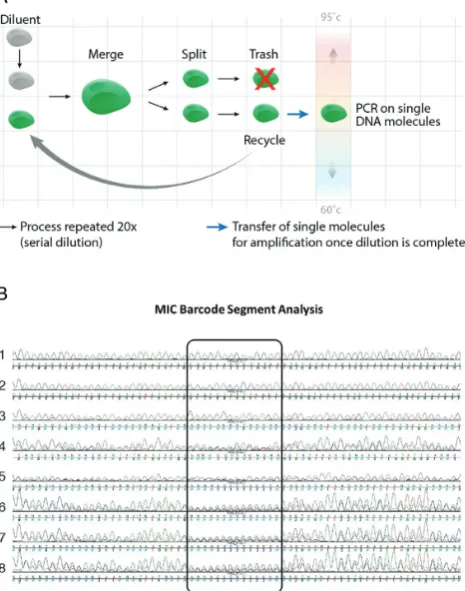
Once synthetic genes are made they are most often se-quenced following cloning into bacteria or yeast, which is a major bottleneck for generating novel, error-free genetic material. To break this limitation methods for sequencing synthetic DNA clones without resorting to cellular cloning are needed (5,6). To this end, we utilized the same DMF car-tridge design used for POP and M-CAD to clone the POP-generated DNA library using Microfluidic In-vitro Cloning (MIC) based on single-molecule PCR (see Video S3 for sim-ulation). We employed a simple barcode region of consec-utive Nbases that, when Sanger sequenced, enables clear and simple verification of single molecules (see Figure3B). The dilution of gene assembly products required to achieve single molecule concentrations is not known exactly (but is known approximately) in advance. Therefore, we employ an on cartridge serial dilution PCR that enables us to scan a large range of concentrations in one run of the microfluidic PCR, eventually resulting in at least one PCR that is clonal per construct.
We used the gold-standard method in validating that populations ofin vitrogenerated DNA molecules originate from single DNA molecules by bar-coding the population of initial molecules with unique DNA barcodes. Using this method, if single molecules are amplified then their ampli-fication products should all contain the same barcode se-quence of the single molecule from which they all origi-nated. If more than a single molecule was amplified in a reaction then the population amplified from them will have at least two different sequences at the barcode region. This methodology is widely accepted over multiple domains of molecular biology for validating single DNA molecules (see for example references (1,14,16) from this manuscript and many others in the field of cell-free cloning).
[image:9.612.331.564.76.372.2]While DNA molecules may adhere to the surface fol-lowing dilution, according to our sequencing results they are not amplified. Our dilution-based methods do not aim at generating single molecules per reaction chamber, but instead aim at generating dilutions that result in the sub-sequent amplification of single DNA molecules per reac-tion. It is often referred to as the effective dilution for sin-gle molecule amplification, not meaning that the amplified
Figure 3. Scheme of cell free cloning using DMF. (A) The full length con-struct generated by POP assembly is subjected to DMF-basedin vitro
cloning using smPCR. A POP assembly product is iteratively diluted 2-fold using the following DMF operations: (i) merge (with diluent), (ii) split, (iii) trash (one half) and (iv) recycling of the second half back into the se-rial dilution. Once diluted, droplets are calculated to contain an average of one target DNA molecule per droplet and the single molecule droplets are programmed to travel to the PCR zone. In the PCR zone, single DNA molecule PCR droplets are amplified by PCR via their travel between the temperature zones. (B) Zoomed in view on the randomized 5UTR region of a sequencing reaction from the DMF smPCR reactions. The sequenc-ing chromatograms validate that ssequenc-ingle POP generated molecules were am-plified on chip since the randomized 5UTR sequence also functions as a barcode that verifies clonality (lanes 1–3). In contrast, negative con-trol smPCR experiments (concon-trols with many template molecules) show a clear pattern of variability in the 5UTR/barcode region (center of chro-matogram, lanes 4–8).
molecule was the only DNA template molecule present in the single molecule amplification reaction, just that it was the only one detectibly amplified. The reliability of this method has been extensively tested in multiple fields includ-ing, for example, next-generation-sequencing in which the same principle of DNA barcoding is used to validate clon-ality (single molecules).
To this end, we barcoded the DNA molecules with a com-binatorial DNA code of 414 options (14 N bases). Our re-sults show (see Figure3B) that MIC reactions that origi-nated from a single DNA molecule show a single barcode sequence in Sanger sequencing (top three chromatograms). In contrast, MIC reactions in which we deliberately inserted more than a single molecule show multiple sequences in their chromatograms
at University of Nottingham on July 12, 2016
http://nar.oxfordjournals.org/
Specifically, we programmed a DMF protocol that per-forms a limiting serial dilution scheme of the POP assem-bly products to concentrations that lead to the amplifica-tion of single molecules. Diluted droplets calculated to pro-duce amplification from single molecules are subsequently amplified, eight smPCR reactions at a time (Video S3). We retrieved the amplification products from the cartridge and Sanger sequenced their barcode region that contained 14 consecutive N bases, which enabled us to verify whether am-plification indeed originated from single DNA molecules. The extreme variability of the barcode region (414optional
sequences) ensures that if more than a single molecule is am-plified in each reaction this would show up a heterogeneous bases in the sequencing chromatogram of that amplifica-tion. The sequencing results show that POP assembled sin-gle molecules were indeed amplified (Figure3B, lanes 1–3) since they contained a single sequence at the barcode region. In contrast, negative control amplifications in which we in-cluded more than a single molecule per reaction showed the expected heterogeneous sequencing pattern at the barcode region (Figure 3B, lanes 6, 7, 8). Not all reactions calcu-lated to contain concentrations that lead to the amplifica-tion of single molecules resulted in amplificaamplifica-tion products that originated from single molecules (Figure 3B, lanes 4 and 5). This is expected due to the natural distribution of the number of molecules per volume, even at concentrations that maximize the fraction of droplets with a single DNA molecule, as previously discussed by us (15). MIC provides a fast means for obtaining sequenced clones of synthetic, POP generated genes without resorting to cellular cloning and using the same microfluidic chip. False positive sm-PCR amplifications (reactions with more than one DNA molecule) can be kept to a minimum by working under di-lution regimes of well under 1 molecule per PCR volume. Circular permutation PCR accommodates the required in-crease in reaction numbers and the low reaction volume (300nl) alleviates the cost associated with performing non-productive reactions (PCRs with no template DNA). Fu-ture work should also include Syber Green based real-time detection of which droplets PCR amplified and which do not so that only positive reaction are processed without the need for testing off-chip.
DISCUSSION
Biological code is written, to a large extent, in DNA. Leapfrogging our ability to engineer this code, specifically within the realm of synthetic biology, depends on the devel-opment of reliable DNA construction biochemistry as well as efficient, reliable and programmable hardware to execute it. Our ability to read the DNA code has advanced consider-ably during the past decade due to the development and in-tegration of biochemistry and machinery for DNA sequenc-ing. Analogous machinery for rapid, in-house prototyping of synthetic genes is positioned to revolutionize the engi-neering of biological systems. The development of meth-ods that combine rapidde novo DNA synthesis with cell-free cloning using microfluidic technology, as presented in this manuscript, potentially paves a path for simple DNA synthesis and cloning machines that could widely broaden the access to synthetic genetic code. While our system
im-proves on the parallelization, volume and programmabil-ity limits of current gene synthesis practice, it is currently limited by several factors, as discussed below. The maximal length of DNA assembly possible is not limited by DMF technology, but by the DNA construction biochemistry it executes. Our EWOD methods of synthesis are subject to the general length, efficiency and error rate limitations of PCR-based DNA construction methodologies. Specifically, the limitations of oligo and polymerase error-rate, which re-sult in the classical exponential correlation between DNA length and the number of clones one needs to sequence to obtain an error free instance (15). Future work could in-volve the integration of enzymatic error correction method-ologies (37). The throughput of gene synthesis using DMF technology presented in this work is limited by the spe-cific cartridge hardware design and its feature sizes (300 nl droplets). An additional order of magnitude improvement on the throughput of our current cartridge and droplet size is feasible but would entail the design and fabrication of ad hocDMF cartridges. Other droplet based technologies could potentially achieve even several orders of magnitude improvement in droplet size (such as Raindance), but do not enable the level of complexity and programmability re-quired for the execution of the protocols presented here. To demonstrate the versatility and robustness of our meth-ods we focused on producing libraries of constructs of dif-ferent types, including both de novo DNA assembly and DNA assembly that is based on the modification of exist-ing, natural DNA fragments. The libraries made had several key features: (i) target genes had pre-designed sequences, according to user specification, (ii) complex DNA library structure (Supplementary Figure S9, azurin) that is chal-lenging for manual labor-based construction and (iii) con-struction strategy utilized two important concepts: (a) re-using fragments that are shared between target molecules and (b) maximizing the use of existing fragments as start-ing material for construction (Supplementary Figure S9). We went on to demonstrate DMF DNA construction by producing and sequence validating more than 70 distinct gene assemblies. Gel electrophoresis and DNA sequencing analysis over all assembled constructs show that spurious assembly products were rare (Supplementary Figures S1– S6) in our hands and sequencing errors are in-line with the expected error rates originating from the error rate of syn-thetic oligonucleotides and proof-reading polymerases used in the construction. The assemblies demonstrate EWOD can be used to execute challenging liquid handling schemes (Videos S1–S3), providing proof of principle for a sub-microliter scale, microfluidic device for DNA assembly on demand. The DNA construction methodologies described in the manuscript can be carried out manually, however, es-pecially in the case of large DNA libraries, would be highly labor intensive, subject to complex liquid handling user er-rors, more expensive due to larger reaction volumes and not parallelized. For comparative purposes, the M-CAD DNA library was also constructed manually (it was not selected in advance for comparative reasons, but was a DNA library constructed in our lab for other purposes). In this compar-ison between EWOD and traditional manual gene synthe-sis reagent costs were reduced by a factor of 50 due to 50-fold reduction in reaction volume (0.3l) compared to
at University of Nottingham on July 12, 2016
http://nar.oxfordjournals.org/
ical manual pipetting reactions of 15l. Turn-around time was decreased by a factor of 10 due to three factors: (i) an improvement in parallelization of assembly reactions––in this demonstration 24 assembly reactions, each containing multiple reagents were performed in parallel. In our hands (a skilled DNA construction lab), one person cannot reli-ably perform more than 8 complex DNA assembly tasks in parallel. (ii) A 2-fold reduction in PCR-time due to rapid droplet routing between temperature zones, in contrast to the relatively slow temperature cycling of regular PCR ma-chines. (iii) The avoidance of time-consuming manual steps required between steps of a multi-step protocol, such as: la-beling of vials, writing protocols, and various operations related to the proper and reliable handling of plates and vials in complex protocols that involve the handling of many reagents and reactions. Future work should focus on proto-typing ad hocDMF cartridge designs dedicated and opti-mized for parallel construction of large DNA libraries and the possible integration of additional DNA construction biochemistries. Additional future work could demonstrate that the methods presented here are amenable to pairing with inexpensive chip-based oligo synthesis, which can be used as input template for POP assembly and/or M-CAD. Finally, cartridges were designed with standard micro-well plate and well dimensions in order to ease future work on interfacing of the cartridges with liquid handling robots for automated loading and retrieval of samples.
SUPPLEMENTARY DATA
Supplementary Dataare available at NAR Online.
FUNDING
Funding for open access charge: European Union (EU) FP7 Information and Communication (ICT) program for Future Emerging Technologies (FET), CADMAD Grant [265505].
Conflict of interest statement.A patent describing this work has been filed.
REFERENCES
1. Metzker,M.L. (2010) Sequencing technologies––the next generation.
Nat. Rev. Genet.,11, 31–46.
2. Heinemann,M. and Panke,S. (2006) Synthetic biology–putting engineering into biology.Bioinformatics,22, 2790–2799. 3. Khalil,A.S. and Collins,J.J. (2010) Synthetic biology: applications
come of age.Nat. Rev. Genet.,11, 367–379.
4. Andrianantoandro,E., Basu,S., Karig,D.K. and Weiss,R. (2006) Synthetic biology: new engineering rules for an emerging discipline.
Mol. Syst. Biol.,2, 2006.0028.
5. Purnick,P.E. and Weiss,R. (2009) The second wave of synthetic biology: from modules to systems.Nat. Rev. Mol. Cell. Biol.,10, 410–422.
6. Quan,J., Saaem,I., Tang,N., Ma,S., Negre,N., Gong,H., White,K. and Tian,J. (2011) Parallel on-chip gene synthesis and application to optimization of protein expression.Nat. Biotechnol.,29, 449–452. 7. Tian,J., Ma,K. and Saaem,I. (2009) Advancing high-throughput
gene synthesis technology.Mol. Biosyst.,5, 714–722.
8. Zhou,X., Cai,S., Hong,A., You,Q., Yu,P., Sheng,N., Srivannavit,O., Muranjan,S., Rouillard,JM., Xia,Y.et al.(2004) Microfluidic PicoArray synthesis of oligodeoxynucleotides and simultaneous assembling of multiple DNA sequences.Nucleic Acids Res.,32, 5409–5417.
9. Linshiz,G., Ben-Yehezkel,T., Kaplan,S., Gronau,I., Ravid,S., Adar,R. and Shapiro,E. (2008) Recursive construction of perfect DNA molecules from imperfect oligonucleotides.Mol. Syst. Biol.,4, 191.
10. Kim,H., Jeong,J. and Bang,D. (2011) Hierarchical gene synthesis using DNA microchip oligonucleotides.J. Biotechnol.,151, 319–324. 11. Kosuri,S., Eroshenko,N., Leproust,E.M., Super,M., Way,J., Li,J.B.
and Church,G.M. (2010) Scalable gene synthesis by selective amplification of DNA pools from high-fidelity microchips.Nat. Biotechnol.,28, 1295–1299.
12. Huang,M.C., Ye,H., Kuan,Y.K., Li,M.H. and Ying,J.Y. (2009) Integrated two-step gene synthesis in a microfluidic device.Lab Chip,
9, 276–285.
13. Kong,D.S., Carr,P.A., Chen,L., Zhang,S. and Jacobson,J.M. (2007) Parallel gene synthesis in a microfluidic device.Nucleic Acids Res.,
35, e61.
14. Shih,Steve C.C., Goyal,Garima, Kim,Peter W., Koutsoubelis,Nicolas, Keasling,Jay D., Adams,Paul D., Hillson,Nathan J. and Singh,Anup K. (2015) A Versatile
Microfluidic Device for Automating Synthetic Biology.ACS Synth Biol.,4, 1151–1164.
15. Ben Yehezkel,T., Linshiz,G., Buaron,H., Kaplan,S., Shabi,U. and Shapiro,E. (2008) De novo DNA synthesis using single molecule PCR.Nucleic Acids Res.,36, e107.
16. Kim,H., Han,H., Ahn,J., Lee,J., Cho,N., Jang,H., Kim,H., Kwon,S. and Bang,D. (2012) ‘Shotgun DNA synthesis’ for the
high-throughput construction of large DNA molecules.Nucleic Acids Res.,40, e140.
17. Schwartz,J.J., Lee,C. and Shendure,J. (2012) Accurate gene synthesis with tag-directed retrieval of sequence-verified DNA molecules.Nat. Methods,9, 913–915.
18. Matzas,M., St¨ahler,P.F., Kefer,N., Siebelt,N., Boisgu´erin,V., Leonard,J.T., Keller,A., St¨ahler,C.F., H¨aberle,P., Gharizadeh,B.
et al.(2010) High-fidelity gene synthesis by retrieval of sequence-verified DNA identified using high-throughput pyrosequencing.Nat. Biotechnol.,28, 1291–1294.
19. Keng,P.Y., Chen,S., Ding,H., Sadeghi,S., Shah,G.J., Dooraghi,A., Phelps,M.E., Satyamurthy,N., Chatziioannou,A.F., Kim,C.J.et al.
(2012) Micro-chemical synthesis of molecular probes on an electronic microfluidic device.Proc. Natl. Acad. Sci. U.S.A.,109, 690–695. 20. Eydelnant,I.A., Betty Li,B. and Wheeler,A.R. (2014) Microgels
on-demand.Nat. Commun.,5, 3355.
21. Hua,Z., Rouse,J.L., Eckhardt,A.E., Srinivasan,V., Pamula,V.K., Schell,W.A., Benton,J.L., Mitchell,T.G. and Pollack,M.G. (2010) Multiplexed real-time polymerase chain reaction on a digital microfluidic platform.Anal. Chem.,82, 2310–2316.
22. Welch,E.R., Lin,Y.Y., Madison,A. and Fair,R.B. (2011) Picoliter DNA sequencing chemistry on an electrowetting-based digital microfluidic platform.Biotechnol. J.,6, 165–176.
23. Pollack,M.G., Shenderov,A.D. and Fair,R.B. (2002) Electrowetting-based actuation of droplets for integrated microfluidics.Lab Chip,2, 96–101.
24. Fair,R.B. (2007) Digital Microfluidics: is a true lab on chip possible?
Microfluid Nanofluid. Springer, Berlin, Vol.3, pp. 245–281. 25. Delattre,C., Allier,C.P., Fouillet,Y., Jary,D., Bottausci,F.,
Bouvier,D., Delapierre,G., Quinaud,M., Rival,A., Davoust,L. and Peponnet,C. (2012) Macro to microfluidics system for biological environmental monitoring.Biosens. Bioelectron.,36, 230–235. 26. Fouillet,Y., Jary,D., Chabrol,C., Claustre,P. and Peponnet,C. (2013)
Digital microfluidic design and optimization of classic and new fluidic functions for lab on a chip systems.Microfluidics and Nanofluidics,4, 159–165.
27. Nelson,W.C. and Kim,C.-J.C. (2012) Droplet Actuation by Electrowetting-on-Dielectric (EWOD): A Review. J. Adhes. Sci. Technol.,26, 1747–1771.
28. Sista,R.S., Eckhardt,A.E., Wang,T., Graham,C., Rouse,J.L., Norton,S.M., Srinivasan,V., Pollack,M.G., Tolun,A.A., Bali,D.et al.
(2011) Digital microfluidic platform for multiplexing enzyme assays: implications for lysosomal storage disease screening in newborns.
Clin. Chem.,57, 1444–1451.
29. Ye,H., Huang,M.C., Li,M.H. and Ying,J.Y. (2009) Experimental analysis of gene assembly with TopDown one-step real-time gene synthesis.Nucleic Acids Res.,37, e51.
at University of Nottingham on July 12, 2016
http://nar.oxfordjournals.org/
30. Gao,X., Yo,P., Keith,A., Ragan,T.J. and Harris,T.K. (2003) Thermodynamically balanced inside-out (TBIO) PCR-based gene synthesis: a novel method of primer design for high-fidelity assembly of longer gene sequences.Nucleic Acids Res.,31, e143.
31. Gibson,D.G., Young,L., Chuang,R.Y., Venter,J.C., Hutchison,CA. and Smith,H.O. (2009) Enzymatic assembly of DNA molecules up to several hundred kilobases.Nat. Methods,6, 343–345.
32. Shabi,U., Kaplan,S., Linshiz,G., Ben-yehezkel,T., Buaron,H., Mazor,Y. and Shapiro,E. (2010) Processing DNA molecules as text.
Syst. Synth. Biol.,4, 227–236.
33. Yofe,I., Zafrir,Z., Blau,R., Schuldiner,M., Tuller,T., Shapiro,E. and Ben-Yehezkel,T. (2014) Accurate, model-based tuning of synthetic gene expression using introns in S. cerevisiae.PLoS Genet.,10, e1004407.
34. Dvir,S., Velten,L., Sharon,E., Zeevi,D., Carey,L.B., Weinberger,A. and Segal,E. (2013) Deciphering the rules by which 5-UTR sequences affect protein expression in yeast.Proc. Natl. Acad. Sci. U.S.A.,110, E2792–E801.
35. Blakes,J., Raz,O., Feige,U., Bacardit,J., Widera,P., Ben-Yehezkel,T., Shapiro,E. and Krasnogor,N. (2014) Heuristic for maximizing DNA reuse in synthetic DNA library assembly.ACS Synth. Biol.,3, 529–542.
36. Markham,N.R. and Zuker,M. (2008) UNAFold: software for nucleic acid folding and hybridization.Methods Mol. Biol.,453, 3–31. 37. Ma,S., Saaem,I. and Tian,J. (2012) Error correction in gene synthesis
technology.Trends Biotechnol.,30, 147–154.
at University of Nottingham on July 12, 2016
http://nar.oxfordjournals.org/