Abstract—This paper proposes an advanced Si3N4
ceramic-based structure with through vias designed and filled with brazing alloy as a reliable interconnect solution in planar power modules. Finite element (FE) modeling and simulation were first used to predict the potential of using the proposed Si3N4
ceramic-based structure to improve the heat dissipation and reliability of planar interconnects. Power cycling tests and non-destructive microstructural characterization were then performed on Si3N4 ceramic-based structures, flexible printed
circuit boards (PCB) and conventional Al wire interconnect samples to evaluate the FE predictions. Both the FE simulations and experimental tests were carried out on single Si diode samples where both the ceramic-based structures and flexible PCBs were bonded on the top sides of Si diodes with eutectic Sn-3.5Ag solder joints. The results obtained demonstrate that Si3N4 ceramic-based
structures can significantly improve the reliability of planar interconnects. The experimental average lifetimes and FE simulated maximum creep strain accumulations for the ceramic-based structure and flexible PCB interconnect samples can reasonably be fitted to existing lifetime models for Sn-3.5Ag solder joints. Discrepancies between the models and experimental results can be attributed to defects and poor filling of the brazing alloy in the vias through the Si3N4 ceramic.
Index Terms—Materials reliability, electronics packaging,
planar power module, finite element method, power cycling, X-ray computation tomography.
I. INTRODUCTION
n a typical conventional power module, Si or SiC power devices are attached on a ceramic-based substrate with solder joints for achieving sufficient mechanical support and electrical insulation between the electrical circuit tracks and the cooling unit; commonly including a base plate and heat sink [1]. Ultrasonically bonded Al wires in combination with soldered bus bars are generally used to achieve the interconnections. However, wire bonds and bus bars have limited ability to
This work was supported by the UK Engineering and Physical Sciences Research Council (EPSRC) through the Centre for Power Electronics [research grants EP/K035304/1 (hub) and EP/K034804/1 (components theme)].
H. Zhang, X. J. Liu, Y. Liu and Z. R. Huang are with Shanghai Institute of Ceramics, Chinese Academy of Sciences, 588 HeshuoRoad, Jiading District, Shanghai 201899, China (e-mail: [email protected], [email protected]. ac.cn, [email protected], [email protected])
J. F. Li (corresponding author), J. R. Dai, M. Corfield and C. M. Johnson are with the Department of Electrical and Electronic Engineering, The University of Nottingham, University Park, Nottingham NG7 2RD, UK (e-mail: [email protected], [email protected], Martin. [email protected], Mark.Johnson@ nottingham.ac.uk).
dissipate heat and have relatively high parasitic inductance which often restricts the thermal and electrical performance of the power module [2,3]. Furthermore, from the viewpoint of manufacturing, multiple soldering and wire bonding steps are not efficient and cost effective for assembling power modules which often have hundreds of wire bonds. To overcome these problems for the development of high power density and high reliability power modules, several alternative packaging structures based on different interconnect technologies have been proposed and investigated. These interconnect technologies include ribbon bond [2], embedded chip technology [4,5], metal post-interconnect parallel-plate structure [1,6,7], dimple array interconnect [3], planar interconnect technology [8-10], pressure contact technology [11], flexible printed circuit board (PCB) based packaging technology [12-14] and press pack technology [15-17].
The planar interconnect power modules have been demonstrated not only to obtain dramatic improvement in the thermal and electromagnetic performance, but also allow for efficient and low cost manufacturing processes [8-10]. However, despite promising work in the selection of materials, manufacturability and reliability for the implementation of this interconnect technology is still needed for wider acceptance and commercialization. For example, metals, alloys or flexible PCBs (metal/polymer laminates) have been used as interconnect materials, and joined on the top sides of Si or SiC devices and/or ceramic-based substrates. These joints may be formed using conventional Sn-based solder alloys, i.e. eutectic or near eutectic Sn-Ag or Sn-Ag-Cu alloys, or the emerging Ag sintering technology. Because of the mismatch in coefficients of thermal expansion (CTEs) between the interconnect materials with higher CTEs and the power devices and the substrates with lower CTEs, thermal stress and inelastic strain develop in the solder joints and the sintered Ag joints during the assembly process and in subsequent service environments. In such a case, the solder joints or the sintered Ag joints (whichever is used to join the interconnect structure) will be potential thermo-mechanical weak points in the assembled planar interconnect power modules.
In the present work, advanced Si3N4 ceramic with designed through vias has been proposed to provide the necessary insulation and to control the CTE of conductive Cu tracks for achieving reliable planar interconnects. The through vias are filled with a conductive brazing alloy with subsequent conductive Cu tracks bonded on the ceramic using active
Improved Reliability of Planar Power
Interconnect with Ceramic-Based Structure
Hui Zhang, Jianfeng Li, Jingru Dai, Martin Corfield, Xuejian Liu, Yan Liu, Zhengren Huang, and
Christopher Mark Johnson,
Member, IEEE
brazing technology. The main objective of this paper is to demonstrate the reliability of such an innovative ceramic-based interconnect technology through comparison with conventional Al wire bond technology and flexible PCB interconnect technology under similar power cycling conditions. A comparison has been carried out using both finite element (FE) simulations and experimental tests on single Si diode samples where both the ceramic-based and flexible PCB interconnects were bonded on the top sides of Si diodes with eutectic Sn-3.5Ag solder joints. However, the results obtained can readily be applied to power modules which contain multiple power devices constructed with these interconnect technologies.
II. FINITE ELEMENT MODELING AND SIMULATION Before preparation of any samples, FE thermal and thermo-mechanical modeling and simulation have been used to predict the potential of the proposed Si3N4 ceramic-based structure to improve the heat dissipation and reliability of planar interconnects using commercial available finite element (FE) analysis software Abaqus 6.14-1 and its graphic user interface CAE.
(a)
(b)
[image:2.612.68.276.335.697.2](c)
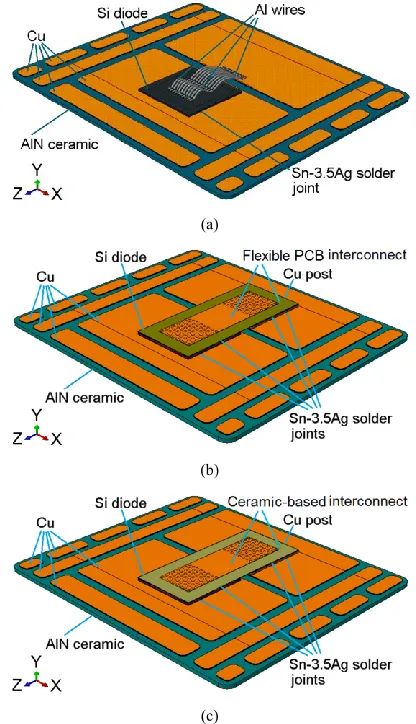
Fig. 1. Computer aided design graphs of the single Si diode samples with the three types of interconnect technologies (a) Al wire; (b) flexible PCB; and (c) Si3N4 ceramic-based structure.
A. Description of Samples for Power Cycling Tests
The present work is mainly concerned with ceramic-based interconnect technology, where conventional Al wire bonding and emerging flexible PCB interconnect technologies are employed as benchmarks. Fig. 1 shows computer aided design images of single Si diode samples which are constructed with the three interconnect technologies for both the FE simulation and the power cycling tests. For all samples, the Si diode is attached on an AlN-based substrate with 100 µm thick Sn-3.5Ag solder joint. The Si diode is 13.5 mm × 13.5 mm × 0.5 mm in size, and the AlN-based substrate is 58.2 mm 49.5 mm × 1 mm thick AlN ceramic tile with 0.3 mm thick Cu tracks actively brazed on both sides.
For each of the Al wire bond interconnect samples, 10 Al wires (375 µm in diameter) are bonded on the top anode of the diode at one end, and on the substrate at the other end. In each of the flexible PCB interconnect samples, a 13.5 mm × 13.5 mm × 0.5 mm Cu post is attached with a 100 µm thick Sn-3.5Ag solder joint on a Cu island of the substrate. A 30 mm 13.5 mm flexible PCB is soldered on the top sides of both the Si diode and the Cu post with Sn-3.5Ag solder joints for achieving the interconnect, where the thickness of the solder joints is also 100 µm. The flexible PCB consists of 100 µm thick polyimide laminated with 50 µm thick Cu tracks on both sides. As shown in Fig. 2(a), the vias (0.5 mm in diameter) in the flexible PCB are through the bottom Cu tracks and the polyimide layer, and are filled with Sn-3.5Ag solder alloy.
(a)
(b)
Fig. 2. Cross-sectional schematics of thesingle Si diode samples with planar interconnects: (a) flexible PCB; and (b) ceramic-based structure.
[image:2.612.338.539.391.581.2]different combinations of Cu tracks and insulation/support layers considered for the flexible PCB and the Si3N4
ceramic-based ceramic structures are listed in Table I.
TABLE I
CODES AND THE CORRESPONDING COMBINATIONS OF CU TRACKS AND INSULATION/SUPPORT LAYERS IN THE FLEXIBLE PCB AND CERAMIC-BASED STRUCTURE
Code Bottom Cu tracks Insulation/support Top Cu tracks Via filling Flex PCB 0.05 mm thick Cu 0.1 mm thick polyimide 0.05 mm thick Cu
ACT1 0.1 mm thick Cu 0.3 mm thick Si3N4 with true CTE of 3 ppm/C 0.1 mm thick Cu Perfect ACT2 0.2 mm thick Cu 0.3 mm thick Si3N4 with true CTE of 3 ppm/C 0.2 mm thick Cu Perfect ACT3 0.1 mm thick Cu 0.3 mm thick Si3N4 with true CTE of 3 ppm/C 0.1 mm thick Cu Imperfect ACT4 0.05 mm thick Cu 0.3 mm thick Si3N4 with true CTE of 3 ppm/C 0.2 mm thick Cu Perfect ACT5 0.1 mm thick Cu 0.3 mm thick Si3N4 with assumed CTE of 6 ppm/C 0.1 mm thick Cu Perfect ACT6 0.1 mm thick Cu 0.3 mm thick Si3N4 with assumed CTE of 9 ppm/C 0.1 mm thick Cu perfect
It should be noted that AlN ceramic which has a higher thermal conductivity and is more commonly used as a support substrate in power electronic packaging is not suitable for forming through vias designed and filled with brazing alloy. This is because it has a relatively weak mechanical strength, and is easily broken during laser drilling/cutting to produce the through vias. In previous work [18], Si3N4-based substrates with 4 through vias mechanically filled with Cu cylinders were used to construct planar half bridge modules. However, the vias were not directly on the top sides of the power devices, and the reliability of the constructed modules were not tested.
On the other hand, it is well known that Si3N4 ceramic has better reliability but poorer thermal performance than AlN ceramic under similar thermo-mechanical loads. The present work is concerned with the reliability of top side interconnects of 0.5 mm thick Si diodes which have been attached on AlN-based substrates. In the case of conventional Al wire bonds as top side interconnects, failure is dominated by the in-elastic strain development in the Al wire bond due to mismatch of CTEs between Al and Si. If the substrate is changed to thinner Si3N4 ceramic (i.e. 0.32 mm or 0.64 mm thick) from thicker AlN ceramic (i.e. 1 mm thick), heating current pulses with lower amplitude have to be used for achieving similar temperature profiles during the power cycling tests, while the in-elastic strain development and hence the reliability of the Al wire bonds would remain similar.
B. FE Models
For all the single Si diode samples described above, FE thermal models have been developed to simulate the temperature fields during 50 power cycles. In each sample, the top one third thickness of the Si diode was considered as the active region generating electrical heat, and two different volumetric heating sources were considered. The latter being the product of 50 current pulses with an amplitude of 90 A multiplied by the voltage drop across either a 2.5 kV Si diode (referred to as lower power diode because of lower forward voltage drop and power dissipation) or a 4.5 kV Si diode (referred to as higher power diode because of higher forward voltage drop and power dissipation) during the power cycling test. For each of the two heating sources, the on time and off time during every current pulse was determined by achieving 40 C and 120 C as the low and high limits of the average temperatures on the hottest 5 mm × 5 mm top surface area on the sample. A convection heat exchange condition with a heat exchange coefficient of 575 Wm-2k-1 was applied on the
bottom surface of the AlN-based substrate.
The thermo-mechanical model is mainly concerned with the stress/strain developments within the solder joints in the flexible PCB and ceramic-based interconnect samples. During the simulation, each of the samples was first subjected to a predefined temperature profile of 192C down to 25 C within 3 min to simulate the reflow process. The initial heating up stage of the reflow process was found to have negligible effects on the simulated stress/strain development in solder joints [19] and was therefore not considered. The eutectic Sn-3.5Ag solder alloy has a melting point of 221 ºC, and the solidification of the molten solder generally occurs at a super-cooling temperature of 192 ºC [20]. The temperature field simulated with the aforementioned thermal model was then used as inputs to simulate the further stress/strain developments in the sample during the 50 current pulses.
(a)
(b)
Fig. 3. A representative meshing system to discretize a ceramic-based interconnect sample: (a) overview; and (b) locally enlarged view.
[image:3.612.57.565.98.185.2]model and the thermo-mechanical models where applicable. Fig. 3 presents a representative meshing system consisting of 481820 DC3D6E linear triangular prism elements and C3D4 linear tetrahedron elements to discretize one ceramic-based interconnect sample. The smallest and the largest element sizes in the plane directions of the substrate are respectively 0.25 mm and 1 mm, and the smallest and the largest element sizes in the through-thickness direction are respectively 0.025 mm and 0.428 mm. In all the simulation cases, the elements used in the critical domains all have the same dimensions. For example, the sizes of the triangular prism elements used to discretize the critical solder joints whose maximum von Mises stress and creep strain accumulation will be used to assess the thermo-mechanical reliability are all 0.25 mm in the plane directions, and 0.025 m in the through-thickness direction. This is necessary because longer computing times would be required if meshing size-independent solutions were implemented for the present three-dimensional model with a much finer meshing system. Therefore, relatively coarse meshing systems with the same size of elements (in the critical domains for all the simulation cases) have been employed to achieve acceptable computing times.
The thermal and thermo-mechanical properties of the polyimide in the flexible PCB and the Si3N4 ceramic and brazing alloys in the ceramic–based structures are given in Table II. The brazing alloy between the Cu and AlN ceramic tile is ignored. The properties of the other materials used for the simulations were taken from existing literature [21-23], and are not repeated here. Of them, Chaboche’s plastic model was used to describe the mechanical properties of both Al and Cu, and Anand’s creep model was used to describe the mechanical properties of the Sn-3.5Ag solder joints. Only elastic deformation was considered for Si and AlN in all the samples.
TABLE II
THERMAL AND THERMO-PHYSICAL PROPERTIES OF PART MATERIALS IN THE SINGLE SI DIODE SAMPLES
Polyimide Si3N4 Ag35.25Cu1.75Ti Thermal conductivity (WK-1m-1) 0.12 90 180 Specific heat (Jkg-1C-1) 1150 691 292 Density (kgcm-3) 1.43 3.20 9.80 Young’s modulus (GPa) 3.2 312 83 Poisson ratio 0.34 0.27 0.30
Yield strength (MPa) 271
Tensile/flexual strength (MPa) 700 346
Elongation (%) 20
CTE (ppmC-1) 11.6+0.12T 3.0 18.5 T is temperature in C.
For the Al wire bonds, flexible PCB and ceramic-based structures ACT1 and ACT2 interconnect samples, both lower and higher power Si diodes were considered, and the simulations are referred to as main simulations. For the ceramic-based structures ACT3, ACT4, ACT5 and ACT6, only higher power Si diode were taken, and the simulations are referred to as additional simulations. All the thermal and thermo-mechanical simulations have been executed on a PC computer with Intel[R] Core[TM] i7-3820 CPU @ 3.60 GHz processor and 64 GB RAM. The running times for the thermal simulations were approximately 2 hours and for the
thermo-mechanical simulations 33 to 48 hours for all cases. C. FE Simulation Results
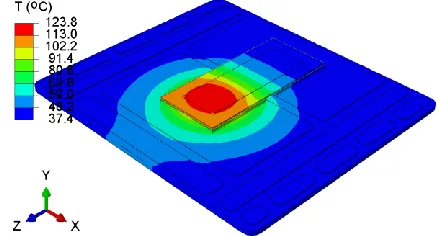
During the thermal simulation, the heat is generated within the active region of the Si diode, and hence this region is at a higher temperature than the rest of the regions in the sample. During the early stage of the transient simulation, the low and high limits of the average temperatures on the hottest 5 mm × 5 mm top surface area of all the samples were somewhat lower and gradually increased with increasing number of power cycles (current pulse with an amplitude of 90 A). After about 60 s of the transient simulation, they all reached the specified 40 C and 120 C during every power cycle. Fig. 4 shows one example of the simulated distribution of the temperatures in a sample during one such power cycle. Fig. 5 presents the heating power (heating source during the simulation) and the simulated evolution of the cyclic average temperatures on the hottest 5 mm × 5 mm top surface area of the flexible PCB interconnect sample for both lower power Si diode and higher power Si diode.
Fig. 4. The simulated distribution of temperature in the hottest ACT1 interconnected sample during one power cycle, where the Si diode is a lower power diode.
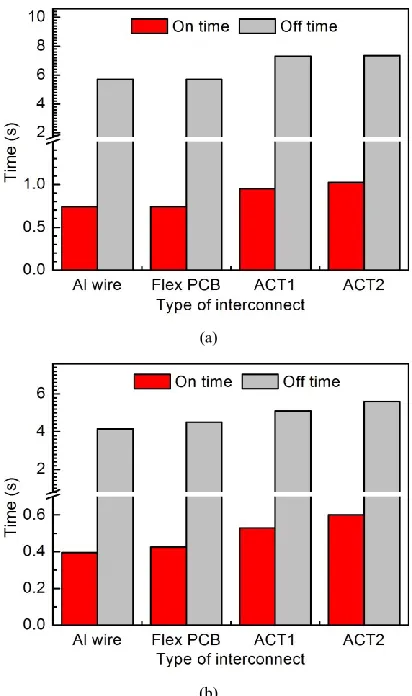
[image:4.612.327.546.300.418.2]side of the AlN-based substrate for all the samples. Therefore, it can be concluded that the ceramic-based interconnects indeed improve the ability of the samples to dissipate heat.
(a)
(b)
Fig. 5. Thermal simulation results of the flexible PCB interconnect sample with both lower power and high power Si diodes: (a) heating power; and (b) evolution of the cyclic average temperatures on the hottest 5 mm × 5 mm top surface area.
The thermo-mechanical simulation results indicate that in all the as-reflowed samples, the maximum Mises stress and maximum creep strain accumulation occur in the solder joints used to attach the Cu posts on the AlN-based DBC substrates. This can be ascribed to the mismatch of CTEs between the Cu post and DBC substrate. During the power cycling, the maximum stress and creep strain accumulation have been moved to the solder joint used to bond the flexible PCB or the Si3N4 ceramic-based structures on the top sides of the diodes in all the simulation cases, especially near the interface between the solder and the Si diode. This can be explained by the higher cyclic temperatures encountered by this solder joint as shown in Fig. 4, while both the flexible PCB and the Si3N4 ceramic-based structures still have higher CTEs than the Si diodes. Fig. 7 presents the simulated distributions of Mises stress and creep strain accumulation in all the solder joints in the ACT1 ceramic-based interconnect sample after 50 power cycles. The solder joint with the maximum Mises stress and the maximum creep strain accumulation is hence identified as the weakest solder joint.
(a)
[image:5.612.335.541.58.406.2](b)
Fig. 6. Comparison of on time and off time of pulse current during every power cycle for the different samples with: (a) lower power Si diode; and (b) higher power Si diode to achieve the specified temperature profile.
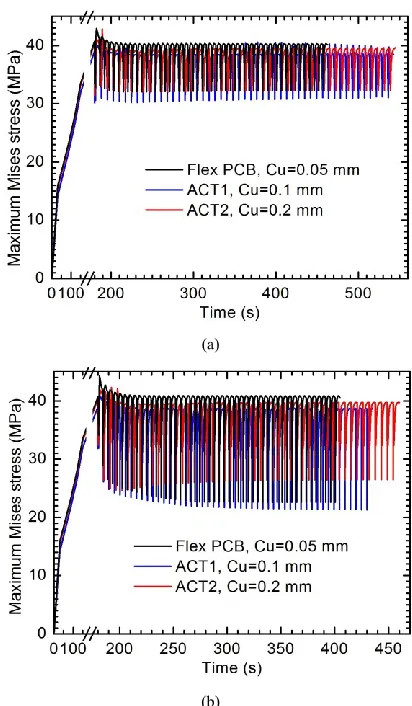
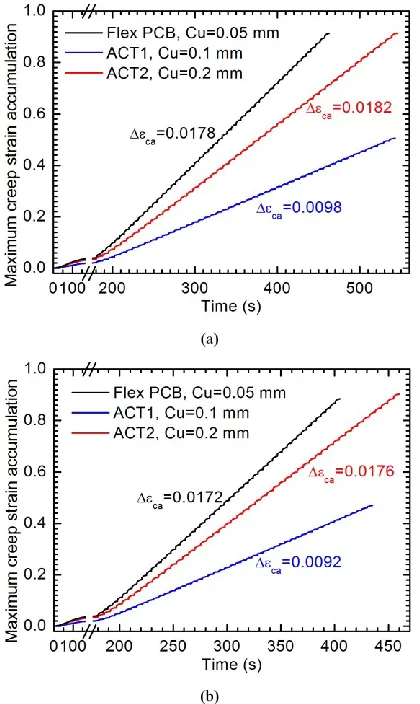
Figures 8 and 9 further compare the evolutions of the maximum Mises stress and the maximum creep strain accumulation in the weakest Sn-3.5Ag solder joint in all main simulations, where Δεca stands for the stable creep strain
accumulation per power cycle. It can be seen that the cyclic range of the maximum Mises stress in the solder joint is remarkably affected by the cycle time. The sample with higher power Si diode and shorter cycle period has larger cyclic range of the maximum Mises stress than the corresponding sample with lower power Si diode and longer cycle period. This can readily be understood because the solder joints experience relatively low time-dependant creep deformation and relatively high elastic recovery with shorter cycle time than with longer cycle time.
as expected, while the ACT2 ceramic-based structure also has higher CTE mismatch with the Si diode. The Si3N4 ceramic tile with the designed vias is less effective to control the CTE of 0.2 mm thick Cu tracks than 0.1 mm thick Cu tracks. In addition, it should be iterated that the thickness of the Cu tracks on the flexible PCB is 0.05 mm. If thicker, e.g. 0.1 mm thick Cu tracks are applied, the creep strain accumulation in the solder joint will be significantly higher than the values presented in Fig.9 for the flexible PCB.
(a)
(b)
Fig. 7. Thermo-mechanical simulation results in all the solder joints in the ACT1 ceramic-based interconnect sample with higher power Si diode after 50 power cycles: (a) distribution of Mises stress; and (b) distribution of creep strain accumulation.
In the thermo-mechanical simulation, the mechanical property of the solder joints have been described by the Anand viscoplastic model, and the simulated creep strains include both the creep and plastic deformation developments in the solder joints subjected to the power cycling. The lifetimes of the solder joints may hence be predicted with the following Engelmaier model [24]:
2
/ 1
1
) 2 ( 2
1 cr C
f
C
N (1)
Where Nf is number of cycle to failure, Δεca is the maximum
creep strain accumulation per power cycle, C1 is fatigue
ductility coefficient, and C2 is fatigue ductility exponent. As
reported in the existing literature [24-28], the fatigue ductility exponents for the eutectic or near eutectic Sn-Ag and Sn-Ag-Cu solder alloys are generally negative constants with absolute values less than one. Therefore, the present thermo-mechanical
simulation results predict that the proposed Si3N4 ceramic-based structure with 0.1 mm thick Cu tracks can significantly improve the reliability of the planar interconnect.
(a)
[image:6.612.334.540.91.444.2](b)
Fig. 8. The simulated maximum Mises stress in the weakest Sn-3.5Ag solder joint during the reflow process and 50 power cycles in the flexible PCB and ACT1 and ACT2 ceramic-based interconnect samples with: (a) lower power Si diode; and (b) higher power Si diode.
III. EXPERIMENTAL EVALUATION
A. Sample Preparation and Power Cycling Tests
As shown in Fig. 6, the Al wire and flexible PCB interconnect samples with lower power Si diode and the ACT1 and ACT2 Si3N4 ceramic-based structure interconnect samples with higher power Si diode have similar cycle times when subjected to the simulated power cycling conditions, and thus they were constructed and experimentally tested. The Al wire interconnect samples and both the lower power and higher power Si diodes were obtained from Dynex Semiconductor Ltd (Lincoln, UK). The as-received Si diodes have ~0.1/1/1 m thick Ti/Ni/Ag metallization on the cathode (back side) and ~5m thick Al metallization on the anode (top side). They were processed to add ~0.1/1/1 m thick Ti/Ni/Ag tri-metal on the existing ~5m thick metallization on the top sides for making the flexible PCB and ceramic-based interconnect samples.
[image:6.612.65.285.178.486.2]and DOWA Metaltech Co., Ltd (Tokyo, Japan), respectively. For making the ceramic-based structure, 0.3 mm thick Si3N4 ceramic tiles were prepared using the sintering process which is well established in Shanghai Institute of Ceramics. They were machined into the specified size of 30 mm 13.5 mm and the designed vias were drilled with laser cutting. The ACT1 and ACT2 Si3N4 ceramic-based structures were formed by bonding 0.1 mm and 0.2 mm thick Cu tracks on both sides of the machined Si3N4 ceramic tiles with Ag-25.25Cu-1.75Ti brazing alloy. The amount of the brazing alloy used on each structure was determined based on the total volume of the designed vias and 25 µm thick brazing alloy between the ceramic tile and the Cu tracks. The brazing process was carried out in vacuum of 10-3 Pa and at 880 C for 10 minutes.
(a)
(b)
Fig. 9. The simulated maximum creep strain accumulation in the weakest Sn-3.5Ag solder joint during the reflow process and 50 power cycles in the flexible PCB and ACT1 and ACT2 ceramic-based interconnect samples with: (a) lower power Si diode; and (b) higher power Si diode.
The flexible PCB and ceramic-based interconnect samples were assembled using the same solder reflow process. 100 µm thick Sn-3.5Ag solder performs were placed between the surfaces to be bonded together as shown in Fig. 2. The Sn-3.5Ag solder joints were formed by reflowing in vacuum of 500 Pa and at a peak temperature of 260 C for 5 minutes.
Power cycling tests were carried out on prepared single Si diode samples using a bespoke power cycling rig, where 10 to
[image:7.612.68.278.235.587.2]12 samples for each of the 4 types of samples were tested. Fig. 10 shows an example image of 4 samples installed on the testing rig; heated by passing current pulses with a ampitude of 90 A through the diodes and cooled by mecahnically mounting on a cold plate of a water-based heat sink. The temperatures on the top sides of the samples were monitored with infrared sensors. The cyclic temperatures were set between 40 C and 120 C for all the samples, while the switching of the current pulses through each of the sanples were controlled independently. During the test, the cycle number, cycle time, duty cycle (ratio of heating time to cycle time) and forward voltage drop across the diode at 120 C were collected. The failure of the samples was considered by a 20% increase in the forward voltage.
Fig. 10. Photograph of 4 samples installed on the power cycling test rig.
After the power cycling test, both visual observation and non-destructive structural characterization were used to check the location and mechanism of any failures. The lattter was carried out using three-dimensional (3D) X-ray computed tomography (CT) imaging on an Xradia Versa XRM-500 CT system.
B. Experimental Results
During the power cycling tests, typical average cycle times for all the samples were in the range of 5 to 6 seconds, and duty cycles of between 9% to 12%. These were in reasonable agreement with the thermal simualtion results as shown in Figs. 5 and 6. Fig. 11 presents representative cycle times and forward voltage measurements collected during the power cycling tests. The flutuations (or noise) on the curves of cycle time versus number of power cycles were mainly associated with the thermal interface between the samples and cold plate of the water-based heat sink. This is becasue the samples were only mechanically mounted on the cold plate to achieve sufficient thermal resistance and hence short cycle times. The criterion of power cycling to failure was set as 20% increase in the forward voltage drop across the Si diode. Once the forward voltage drop of a sample increased to 20%, it further increased rapidly and significantly until the sample failed to open circuit as can be seen from Fig. 11(b).
[image:7.612.334.548.238.396.2]Logarithm-Normal probability coordinates for the lifetimes obtained from the 4 types of samples during the power cycling test. Here the R values stand for the coefficients of correlation for the linear data fittings. The cumulative probability for each measured data set, f (i ), was calculated from placing the data of the lifetimes in ascending order and letting:
(a)
(b)
Fig. 11 Representative curves of the collected parameters versus number of power cycle during the power cycling tests: (a) cycle time; and (b) forward voltage drop across the Si diode.
% 100 5 . 0 )
(
n i i
f (2)
where n is the total number of data points for each type, and i is the ith order in ascending data set [10]. The lifetimes of the 4 types of samples statistically follow the Logarithm-Normal distribution quite well. In particular, the planar flexible PCB and ACT2 ceramic-based interconnect samples have lifetimes shorter and thus less reliable than conventional Al wire interconnect samples. By contrast, the ACT1 ceramic-based samples have lifetimes comparable with and significantly longer than the conventional Al wire interconnect samples.
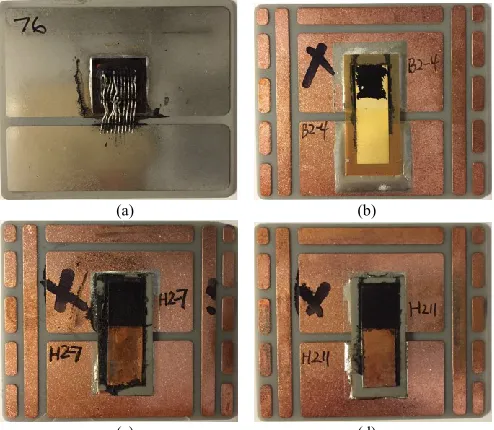
[image:8.612.334.549.70.217.2]Both visual observation and microstructure characterization reveal that all the samples failed within the interconnects during the power cycling test. Fig. 13 shows photographs taken from 4 failed samples. The Al wire interconnect samples failed due to wire-bond lift off from the top sides of the Si diodes. The relevant mechanisms are well investigated in the existing
Fig. 12. Comparison of the lifetimes of all the samples obtained during the power cycling tests.
(a) (b)
[image:8.612.68.283.130.479.2]
(c) (d)
Fig. 13. Photographs taken from the failed samples interconnected with: (a) Al wire; (b) flexible PCB; (c) ceramic-based ACT1; and (d) ceramic-based ACT2.
[image:8.612.316.563.249.464.2]shown in Fig. 4. This can easily be explained because the solder alloy at higher temperatures has lower resistance to grain
boundary sliding than at lower temperatures.
[image:9.612.88.527.82.578.2]
(a) (b)
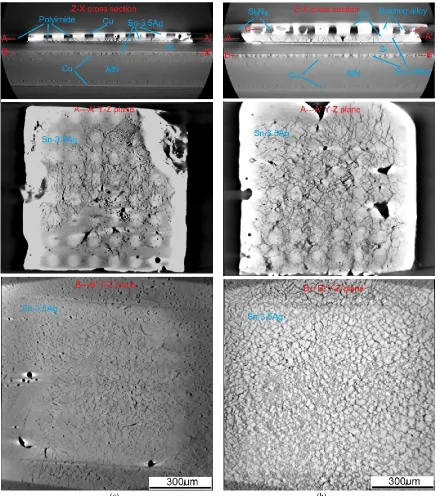
Fig. 14. Reconstructed X-ray CT images obtained from: (a) flexible PCB interconnect sample with lifetime of 49,347 power cycles; and (b) ACT1 ceramic-based interconnect sample with lifetime of 850,062 power cycles.
Further structural characterization reveals that the filling of the brazing alloy in the vias through the Si3N4 ceramic tile in the samples with shorter lifetimes was relatively poor and less uniform than that in the samples with longer lifetimes. Fig. 15 shows reconstructed X-ray CT images obtained from 2 ACT1 ceramic-based interconnect samples with significantly different lifetimes. Here the white phase around the vias indicates good filling of the brazing alloy, while dark phases indicate poor or lack of filling of the brazing alloy in the vias. Poor or lack of filling of the brazing alloy in the vias made the Si3N4 ceramic
simulation, both the bottom and top Cu tracks were assumed to be bonded on the Si3N4 ceramic tile perfectly, and hence the actual increase in the maximum creep strain accumulation might be higher if local imperfect bonding between the Cu tracks and the Si3N4 ceramic tile also exists. Practically, work is still ongoing to improve the filling of the brazing alloy in the through vias by considering different supplies of the brazing alloy and better process control. Another possibility may be the pre-deposition of thin metallic film, e.g. Ti/Ni/Ag or Ti/Ni/Au, to improve the wettability of the brazing alloy on the side walls of the through vias.
(a) (b)
Fig. 15. Reconstructed C---C’ Y-Z plane (labeled in Fig. 14b) X-ray CT images obtained from the ACT1 ceramic-based interconnect samples with lifetimes of: (a) 125,890 power cycles; and (b) 447,971 power cycles.
Fig. 16. Additional FE simulation results comparing the maximum creep strain accumulation in the weakest solder joint with the different ceramic-based interconnect structures during the reflow process and 50 power cycles.
C. Discussion
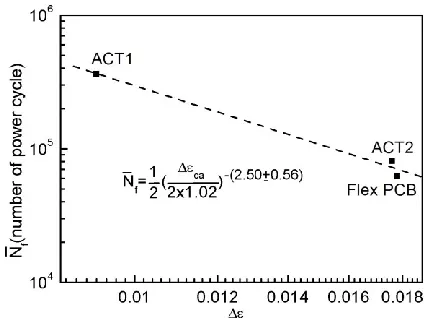
As all the flexible PCB, and ceramic-based interconnect samples failed at the weakest solder joints through creep-induced fatigue cracks due to grain boundary sliding, the lifetimes of these samples can be described and predicted with an established lifetime model. e.g. Eq. (1) or other similar equations for Sn-3.5Ag solder joints. Combining the experimental average lifetimes with the simulated creep strain accumulations presented in Fig. 9, the fatigue ductility coefficient, C1, and fatigue ductility exponent, C2, in Eq. (1) can
be extracted through data fitting as shown in Fig. 17. The present C1=1.02 and C2=[-0.516 to -0.327] (90% confidence
[image:10.612.335.547.73.232.2]interval of C2) are obtained.
Fig. 17. Data fitting of the experimental average lifetimes and the FE simulated maximum creep strain accumulations to the lifetime model of the Sn-3.5Ag solder joint.
In the existing literature [24-28], the values of C1=0.045 to
0.205 and C2=-0.697 to -0.323 for eutectic or near eutectic
Sn-Ag and Sn-Ag-Cu solder alloys were reported or can be calculated from the relevant data reported. The present fatigue ductility exponent is comparable with, but the present fatigue ductility coefficient is somewhat higher than those values. This may be related to the fact that the present power cycling tests with cycle times of 5 to 6 seconds and cyclic temperatures between 40 and 120 C were quite different from reported previous tests. They reported passive thermal cycling tests with cycle times of half an hour to one hour between -40 °C and 125 °C, -55 °C and 125 °C and 0 °C and 100 °C [25], or isothermal tensile tests from 11 to 90 °C and strain rate range from 5×10⁻⁵ to 2×10⁻² s−1 [28], or low-cycle fatigue tests at room temperature and strain ranges of 1.4, 3, 4 and 7.5% [26].
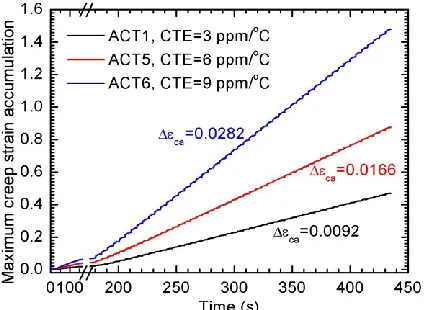
[image:10.612.47.299.191.334.2] [image:10.612.65.278.378.537.2]in the ceramic-based structure, see Fig. 18. Therefore, both the FE simulation results and the experimental tests demonstrate that the proposed Si3N4 ceramic-based structure is valid to control the CTE and hence improve the reliability of planar power interconnects.
Fig. 18. Additional FE simulation results considering the effect of assumed CTE of the ceramic tile in the ceramic-based structure on the maximum creep strain accumulation in the weakest solder joint during the reflow process and 50 power cycles.
Increasing the thickness of either the polyimide or the Cu tracks in the flexible PCB would result in lifetimes and reliability worse than those presented in Fig. 12 for the flexible PCB. Conversely decreasing the thickness of the polyimide and/or the Cu tracks in the flexible PCB may improve lifetime and reliability. However, this would also reduce the insulation or current carrying capability of the interconnect. In previous work [3], dimple array interconnect based on dimples preformed on flexible PCB and solder bump as electrical connection was employed to eliminate the structural singularity at the solder/silicon interface and thus improve the reliability of the interconnect. However, the reported lifetime of 12,700 power cycles from 10 to 100 C for this interconnect technology was still quite low. This can probably be attributed to the fact that the dimple array did not eliminate the mismatch of CTEs between the flexible PCB and the Si device, and the creep or in-elastic strain development in the solder joint could still be quite high if the flexible PCB was above a certain thickness.
The Ag-Cu-Ti brazing alloy has a thermal conductivity and electrical conductivity much higher than the eutectic or near eutectic Sn-Ag and Sn-Ag-Cu solders alloys. With improved filling of the brazing alloy in the vias through the Si3N4 ceramic tile, the ceramic-based structure is expected to further improve the heat dissipation and thermo-mechanical reliability of planar power interconnects over conventional Al wire interconnects. For carrying higher currents, the ceramic-based structure can be designed with thinner Cu tracks on the side which will be bonded on to the power device and thicker Cu tracks on the other side, so as to still achieve high thermo-mechanical reliability. This assumption can be supported by the FE simulated maximum creep strain accumulation in the weakest solder joint for a ACT4 ceramic-based structure which is much lower than that for a ACT2 ceramic-based structure, as shown
in Fig. 16. In addition, the ceramic-based structure also facilitates efficient and cost effective manufacturing process to assemble planar power modules. The power die attachment and interconnect can be formed with a single soldering reflow step, rather than multiple soldering and wire bonding steps as used in assembling conventional power modules. Therefore, the presently proposed ceramic-based structure is promising as an alternative interconnect for the development of high performance, high reliability and cost-effective planar power modules.
In addition, it should also be pointed out that the current carrying capability of the flexible PCB and ceramic structure mainly depends on the cross-sectional area of their top side Cu tracks. In the present single Si diode samples, 0.05 mm thick Cu track on the flexible PCB has current carrying capability worse than the Al wire bond consisting of 10 Al wires (375 µm in diameter). 0.1 mm thick Cu track on the ceramic structure has current carrying capability similar to, and 0.2 mm thick Cu track on the ceramic structure has current carrying capability better than the Al wire bond.
IV. CONCLUSION
Using conventional Al wire bonding technology and the flexible PCB technology as benchmarks, the proposed Si3N4 ceramic-based structure as a reliable interconnect solution in planar power modules has been investigated with both FE simulation and experimental tests. They have been carried out on single Si power diode samples, where both the ceramic-based structure and flexible PCB were bonded on the top sides of Si diodes with eutectic Sn-3.5Ag solder joints.
FE thermal simulation results predict that the Si3N4 ceramic-based structures with 0.1 and 0.2 mm thick Cu tracks can both improve the heat dissipation during power cycling tests when compared with 0.375 mm diameter Al wires and flexible PCB with 0.050 mm thick Cu track as the interconnect. This can be ascribed to the fact that the ceramic-based structures have higher thermal mass and thermal conductivity.
FE thermo-mechanical simulation results also predict that Si3N4 ceramic-based structures with 0.1 mm thick Cu tracks can significantly reduce the creep strain accumulation and thus improve the thermo-mechanical reliability of the Sn-3.5Ag solder joint on the top side of the Si diode when compared with the flexible PCB with 0.05 mm thick Cu tracks as the interconnect. This can simply be attributed to the effective constraint of CTE of the Cu tracks by the Si3N4 ceramic.
Power cycling tests verify that even with defects and poor filling of brazing alloy in the through vias, the prepared Si3N4 ceramic-based structure with 0.1 mm thick Cu tracks can significantly improve the thermo-mechanical reliability of the Sn-3.5Ag solder joint on the top side of the Si diode when compared with the flexible PCB with 0.05 mm thick Cu tracks as the interconnect. Single Si diode samples with ceramic-based interconnects have lifetimes which are comparable to and significantly longer than conventional Al wire interconnect samples.
structure and flexible PCB interconnect samples can reasonably be fitted to existing lifetime models of Sn-3.5Ag solder joints, Discrepancies between the model and experimental can be attributed to defects and poor filling of the brazing alloy in the vias through the Si3N4 ceramic.
Further discussion also suggests future design of the ceramic-based structure interconnect with thicker Cu tracks for carrying higher currents, and highlights that the ceramic-based structure facilitates an efficient and cost effective manufacturing process to assemble planar power modules.
REFERENCES
[1] C .M. Johnson, C. Buttay, S.J. Rashid, F. Udrea, G. A .J. Amaratunga, P. Ireland, R.K. Malhan, “Compact Double-Side Liquid-Impingement-Cooled Integrated Power Electronic Module,” in
Proceedings of the 19th International Symposium on Power
Semiconductor Devices & ICs, May 27-30, 2007 Jeju, Korea, pp.53-56. [2] C. Luechinger, “Ribbon Bonding – A Scalable Interconnect for Power
QFN Packages,” in Proceedings of 9th Electronics Packaging Technology Conference, December 10-12, 2007, Singapore, pp. 47-54. [3] G. Q. Lu, X. Liu, S. Wen, J. N. Calata, J. G. Bai, “Strategies for
improving the reliability of solder joints on power semiconductor devices,” Soldering and Surface Mount Technology, vol. 16, issue 2, pp. 27-40, 2004..
[4] J. Yin, Z. Liang, J. D. van Wyk, “High Temperature Embedded SiC Chip Module (ECM) for Power Electronics Applications,” IEEE Transactions on Power Electronics, vol. 22, issue 2, pp. 392-398, March 2007. [5] Z. Liang, B. Lu, J. D. van Wyk, F.C . Lee, “Integrated CoolMOS
FET/SiC-Diode Module for High Performance Power Switching,” IEEE Transactions on Power Electronics, vol. 20, issue 3, pp. 679-686, May 2005.
[6] L. Menager, M. Soueidan, B. Allard, V. Bley, B. Schlegel, “A Lab-Scale Alternative Interconnection Solution of Semiconductor Dice Compatible with Power Modules 3-D Integration,” IEEE Transactions on Power Electronics, vol. 25, issue 7, pp. 1667-1671, July 2010.
[7] J. Lee, D.M. Fernandez, M. Paing, Y.C. Yeo, S. Gao, “Electroless Ni Plating to Compensate for Bump Height Variation in Cu–Cu 3-D Packaging,” IEEE Transactions on Components, Packaging and Manufacturing Technology, vol. 2, issue 6, pp. 964-970, June 2012. [8] R. Fisher, R. Fillion, J. Burgess, W. Hennessy, "High frequency, low cost,
power packaging using thin film power overlay technology," in Applied Power Electronics Conference and Exposition, 1995. APEC '95. Conference Proceedings, Tenth Annual, vol. 1, pp. 12-17, May 1995. [9] B. Ozmat, C. S. Korman, P. McConnelee,M. Kheraluwala, E. Delgado, R.
Pillion, "A new power module packaging technology for enhanced thermal performance," in Thermal and Thermomechanical Phenomena in Electronic Systems, 2000. ITHERM 2000. The Seventh Intersociety Conference on, vol. 2, pp. 287-296, May 2000.
[10] K. Weidner, M. Kaspar, "Planar Interconnect Technology for Power Module System Integration," in Integrated Power Electronics Systems (CIPS), 2012 7th International Conference on, pp. 459-463, March 2012. [11] C. G, J. Faltenbacher, "Low temperature sinter technology die attachment for power electronic applications," in Integrated Power Electronics Systems (CIPS), 2010 6th International Conference on, paper 10.1, pp. 1-5, March 2010.
[12] N. Pluschke and P. Beckedahl, "Novel packaging technology for power modules," in Industrial Electronics (ISIE), 2012 IEEE International Symposium on, pp. 420-424, May 2012.
[13] U. Scheuermann, "Reliability of Planar SKiN Interconnect Technology," in Integrated Power Electronics Systems (CIPS), 2012 7th International Conference on, pp. 4641-471, March 2012.
[14] T. Stockmeier, P. Beckedahl, C. Göbl, T. Malzer, "SKiN: Double side sintering technology for new packages," in Power Semiconductor
Devices and ICs (ISPSD), 2011 IEEE 23rd International Symposium on, pp. 324-327, May 2011.
[15] F. J. Wakeman and G. W. Lockwood, "Electromechanical evaluation of a bondless pressure contact IGBT," Circuits, Devices and Systems, IEE Proceedings -, vol. 148, pp. 89-93, April 2001.
[16] F. J. Wakeman, W. Findlay, G. Li, "Press-pack IGBTs, semiconductor switches for pulse power," in Pulsed Power Plasma Science, 2001. PPPS-2001. Digest of Technical Papers, vol. 2, pp. 1051-1054, June 2001.
[17] S. Eicher, M. Rahimo, E. Tsyplakov, D. Schneider, A. Kopta, U. Schlapbach, E. Carroll., "4.5kV press pack IGBT designed for ruggedness and reliability," in Industry Applications Conference, 2004. 39th IAS Annual Meeting. Conference Record of the 2004 IEEE, vol. 3, pp. 1534-1539, 2004.
[18] A. K. Solomon, A. Castellazzi, N. Delmonte, P. Cova, “Highly integrated low-inductive power switches using double-etched substrates with through-hole viases,” in Proceedings of the 27th International Symposium on Power Semiconductor Devices & IC's, Kowloon Shangri-La, Hong Kong, pp. 329-332, May 10-14, 2015.
[19] J. F. Li, A. Castellazzi, T. X. Dai, M. Corfield, A. Solomon, C. M. Johnson, “Built-in reliability design of highly integrated solid-state power switches with metal bump interconnects,” IEEE Transactions on Power Electronics, vol. 30, issue 5, pp. 2587-2600, May 2015.
[20] Z. Mei, “Microstructual evolution and interfacial interaction in lead-free solder interconnects,” in Lead-Free Solder Interconnect Reliability, Edited by D. Shangguan, ASM International, 2005, pp. 29-66.
[21] A. Zéanh, O. Dalverny, M. Karama, E. Woirgard, S. Azzopardi, A. Bouzourene1, J. Casutt, M.M. Guyennet, “Thermomechanical Modelling and Reliability Study of an IGBT Module for an Aeronautical Application,” in Proceedings of 9th Int. Conf. on Thermal, Mechanical
and Multiphysics Simulation and Experiments in Micro-Electronics and Micro-Systems, EuroSimE 2008, Freiburg-im-Breisgau, Germany, April 21-23, 2008.
[22] A. Zeanh, O. Dalverny, M. Karama, A. Bouzourene, “Lifetime and reliability assessment of AlN substrates used in harsh aeronautic environments power switch modules,” Advanced Materials Research, vol. 112, pp 113-127, May 2010.
[23] W.W. Sheng and R.P. Colino, Power Electronic Modules: Design and Manufacture, CRC Press LLC, Florida, USA, 2005.
[24] Q. Zhang, A. Dasgupta, “Constitutive properties and durability of selected lead-free solders,” in Leed-Free Electronics, Edited by S. Ganesan and M. Pecht, John Wiley & Sons, Inc, 2006, pp. 237-382. [25] A. Syed, “Accumulated creep strain and energy density based thermal
fatigue life prediction models for SnAgCu solder joints,” in Proceedings of ECTC 2004 Conference, Las Vegas, USA, 2004, pp.737-746. [26] C. Andersson, Z. Lai, J. Liu, H. Jiang, Y. Yu, “Comparison of isothermal
mechanical fatigue properties of lead-free solder joints and bulk solders,”
Materials Science and Engineering A, vol. 394, pp. 20-27, March 2005. [27] X. Chen, D. Zhou, “Modeling and Reliability Analysis of Lead-Free
Solder Joints of Bottom Leaded Plastic (BLP) Package,” in Proceedings of 2006 Conference on High Density Microsystem Design and Packaging and Component Failure Analysis (Hdp '06), June 27-30, 2006, Shanghai University, Shanghai, China.
[28] P. Zhou, B.T. Hu, J.M. Zhou, Y. Yang, “Parameter fitting of constitutive model and FEM analysis of solder joint thermal cycle reliability for lead-free solder Sn-3.5Ag,” Journal of Central South University, vol. 16, issue 3, pp. 0339−0343, June 2009.
[29] S. Kraft, A. Schletz, M. Marz, “Reliability of silver sintering on DBC and DBA substrates for power electronic applications,” In: Proceedings of 7th
International Conference on Integrated Power Electronics Systems, March 6-8, 2012, Nuremberg, Germany, pp. 439-444.