Gender Matters: Physical Activity Patterns
of Schoolchildren in Scotland
Leslie Alexander, Candace Currie and Joanna Todd
Child & Adolescent Health Research Unit, The University of Edinburgh
HBSC is the Health Behaviour in School-Aged Children: WHO Collaborative Cross-National Study
Introduction
For adolescents and children, regular participation in physical
activity is known to have many positive effects. Physical activity
stimulates blood flow and can increase the aerobic capacity of the
heart. It can help to strengthen muscle, enhance flexibility and
endurance. Reasons for engaging in physical activity are numerous,
and might include, for example: sheer enjoyment of an activity, a
sense of achievement or ability; ‘feeling better’; weight control or
body building and increased mental well-being and acuity1.
There is a considerable body of evidence which shows that
regular participation in moderate to vigorous activity is an essential
part of a healthy lifestyle2, 3, 4, 5. Active young people are more
likely to report better general health6. In addition, many argue that
physical activity patterns established in childhood are reflected later
in life. In short, active young people may be more likely to be active
adults2. The health-related implications of physical activity can span
a lifetime; habits established during childhood and adolescence can
also affect health-related outcomes during adulthood2, 6, 7, 8.
There is, however, a growing concern over the small and irregular
amounts of physical activity reported by many young people5, 7, 9.
This, combined with increasing levels of obesity, is of international
concern. Another matter of note is the apparent gender difference
in reported patterns of activity10.
What constitutes sufficient activity? This has been a topic of
debate for many years and guidelines have not remained fixed.
Current guidelines for young people are as follows:
a) ideally, all young people should participate in physical activity of
at least a moderate intensity for one hour each day for not less
than five days a week#
b) for those young people currently undertaking little activity, the
guidelines recommend a daily target of 30 minutes, initially
c) furthermore, it is recommended that activities specifically aimed
at improving muscular strength, flexibility and bone health
should be undertaken two or more days a week6, 11.
Results from the 1998 Scottish Health Survey showed that at
age 10-11, 77% of boys met the moderate to vigorous physical
activity (MVPA) guideline as defined in (a) as compared with 66% of
girls. Participation waned for 12-13 year olds to 70% for boys and
50% for girls. Among 14-15 year olds, 65% of boys and 36% of
girls met the MVPA guideline10.
A better understanding of the physical activity patterns of young
people in Scotland, and gender differences in particular, is necessary
to promote greater participation and reduce this gender divide in
adolescence. This understanding will also assist in efforts aimed at
meeting the targets set by the Physical Activity Task Force5.
In this Briefing Paper, data from the Health Behaviour in
School-Aged Children (HBSC): WHO Collaborative Cross-National Study are
presented. The average number of days young people described being
active for 60 minutes or more is reported and then characterised as
meeting or not meeting the 60 minute MVPA guideline. Activity
patterns are reported in relation to gender, health and well-being as
well as other psychological, environmental and social determinants.
#Moderate intensity was defined as being equivalent to brisk walking
which might leave the participant feeling ‘…warm and slightly out of breath’.
Values of statistical significance are reported as *(P<0.05), **(P<0.01) and ***(P<0.001). Results reported for the entire sample were weighted by age.
Main findings
~ Boys report more physical activity than girls at ages 11, 13 and 15.
~ Boys are significantly more likely than girls to meet the current 60 minute activity guideline.
~ Health status is significantly associated with meeting the guideline for boys but not girls.
~ A range of psychological, social and environmental factors were also significantly associated with meeting
Details of the 2002 Survey in Scotland
The Health Behaviour in School-Aged Children (HBSC): WHO
Collaborative Cross-National Study was conducted in 35 countries
during 2001/212. A nationally representative sample of mixed ability
classes in Scotland was drawn from both state and independent
schools. In total, responses from 4,404 young people comprised the
final sample of pupils in Primary 7 (11 year olds), Secondary 2 (13
year olds) and Secondary 4 (15 year olds).
Moderate-to-vigorous physical activity (MVPA) was measured
using two items13, and was preceded by a definition of physical
activity.
Physical activity is any activity that increases your heart rate and
makes you get out of breath some of the time. Physical activity can
be done in sports, school activities, playing with friends, or walking to
school. Some examples of physical activity are running, walking
quickly, cycling, dancing, skateboarding, swimming, football, and
gymnastics. For these next two questions, add up all the time you
spend in physical activity each day.
(a) Over the past 7 days, on how many days were you physically
active for a total of at least 60 minutes per day?
(b) Over a typical or usual week, on how many days are you physically
active for a total of at least 60 minutes per day?
Response categories to the above items were: 0 days, 1, 2, etc.
…up to 7 days.
An average score (a+b/2) of five or more identifies a respondent
as meeting the primary guideline of at least 60 minutes of MVPA on
five or more days.
Analyses presented here were carried out on 4,080 pupils; 1,600,
1,405 and 1,075 aged 11, 13 and 15 years, respectively. This represents
a 92.6% subsample of survey respondents, for whom no missing
data were recorded for the items presented, and therefore findings
reported here may vary slightly from those reported elsewhere.
Average Days of Physical Activity
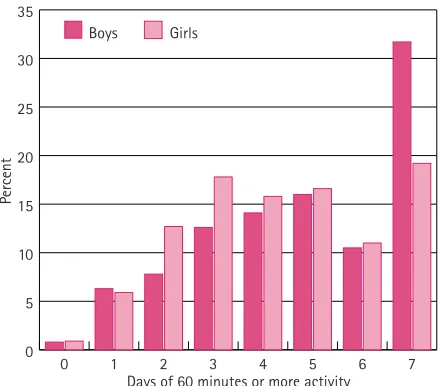
Activity patterns varied markedly by gender and age as shown in
Figures 1-3. Overall, the average number of days that boys reported
at least 60 minutes of physical activity during the week prior to the
survey was 4.5 compared to 3.7 for girls.
While many young people reported that they often engaged in
60 minutes of moderate-to-vigorous physical activity (MVPA), a
substantial number reported little activity of this sort throughout a
week. Boys reported more activity than girls and these gender
differences became more pronounced with age.
At age 11, 27.6% of boys reported three or fewer days which
included 60 minutes of MVPA during the previous week, compared
to 37.4% for girls. This represents a gender gap of 9.8% (***).
By age 15, this gap rises to 23.7% (***), with 37.8% of boys and
61.5% of girls reporting three or fewer days which included 60
minutes of MVPA during the previous week. Health Behaviour in School-Aged Children: WHO Collaborative Cross-National 2001/02 Survey in Scotland
Percent
0 5 10 15 20 25 30 35
Girls Boys
7 6 5 4 3 2 1 0
[image:2.595.307.527.116.309.2]Days of 60 minutes or more activity
[image:2.595.308.527.341.537.2]Figure 1:MVPA patterns among 11 year olds
Figure 2:MVPA patterns among 13 year olds
Percent
0 5 10 15 20 25 30 35
Girls Boys
7 6 5 4 3 2 1 0
[image:2.595.309.527.565.760.2]Days of 60 minutes or more activity
Figure 3:MVPA patterns among 15 year olds
Percent
0 5 10 15 20 25 30 35
Girls Boys
7 6 5 4 3 2 1 0
The 60-minute Guideline
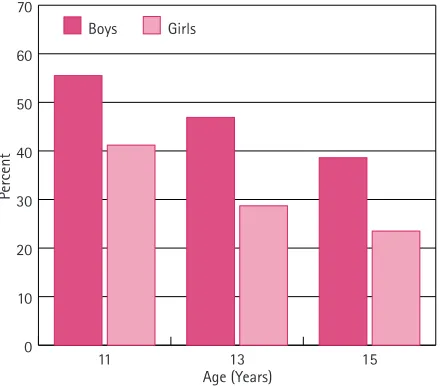
Not only do general patterns of physical activity fall off as children
move through adolescence, the proportion meeting the current
physical activity guideline also declines significantly between 11 and
15 years both for boys (***) and girls (***) (Figure 4). At age 11,
55.5% of boys and 41.2% of girls reported meeting the 60 minute
MVPA guideline compared with 46.9% of boys and 28.7% of girls
aged 13 and 38.6% and 23.5% of boys and girls aged 15.
Significantly more boys than girls reported meeting the guideline
(47.1% vs. 30.9%,***). Indeed, significant gender differences are
found across all three age groups (***). By the age of 15, two in five
boys reach the recommended level of MVPA compared to about one
in five girls.
Boys who met the 60 minute MVPA guideline were more likely
than girls to report good or excellent health (***).
The likelihood of an 11, 13 or 15 year old girl meeting the 60
minute MVPA guideline was not related to her perceived health
status. For boys, however, perceived health status was strongly
associated with meeting the guideline (***).
Psychological, Environmental and Social Factors
There are a number of other factors that may be associated with
activity patterns3, 4, 5, 14. Those measured can be classified as:
psychological: enjoyment of physical activity and confidence in
one’s own ability; environmental: perceptions of safety and local
opportunity; and social: participation in physical activities with
parents and friends. Each was examined through the survey using
the following statements:
Here are some statements about physical activity. Please show how
much you agree or disagree with each one.
I really enjoy doing physical activities.
I feel confident about my skills when I am doing physical activity.
I feel safe when I take part in physical activity in the area where
I live.
There are plenty of places where I can take part in physical
activity in the area where I live.
I take part in physical activity with my parents.
I take part in physical activity with my friends.
Response categories were: agree a lot; agree a bit; neither agree nor
disagree; disagree a bit and disagree a lot and were recoded into
agree, neither agree nor disagree, and disagree.
Percent
Age (Years) 0
10 20 30 40 50 60 70
Girls Boys
15 13
[image:3.595.307.527.132.328.2]11
Figure 4:Percent boys and girls meeting the five day 60 minute
MVPA guideline
Health and well-being
A person’s perception of their own health status is likely to affect a
number of factors within their daily life, including levels of physical
activity. Conversely, participation in MVPA may affect perceived
health status. Health and well-being is but one context in which
physical activity might be considered6.
General health status was measured with the following item:
Would you say your health is …Excellent; Good; Fair; or Poor?
The majority of young people in the HBSC study reported their
health status to be good or excellent (80.0%). For the sample as a
whole, there was a significant association between reported
participation in physical activity and feeling well (***). Figure 5
illustrates that those who define their health as good or excellent
[image:3.595.59.279.332.525.2]were more likely to report meeting the 60 minute MVPA guideline. Health Behaviour in School-Aged Children: WHO Collaborative Cross-National 2001/02 Survey in Scotland
Figure 5:Percent boys and girls meeting the 60 minute MVPA
guideline and self reported health status
Pe
rcent
0 10 20 30 40 50 60 70
good/excellent fair/poor
Girls Boys Girls
Boys Girls
Boys
Age 11 Age 13 Age 15
Boys and girls differed significantly in the proportion that agreed
with each statement (with the exception of taking part in physical
activity with parents). Boys were more likely to respond positively
than girls. The percentages are as follows:
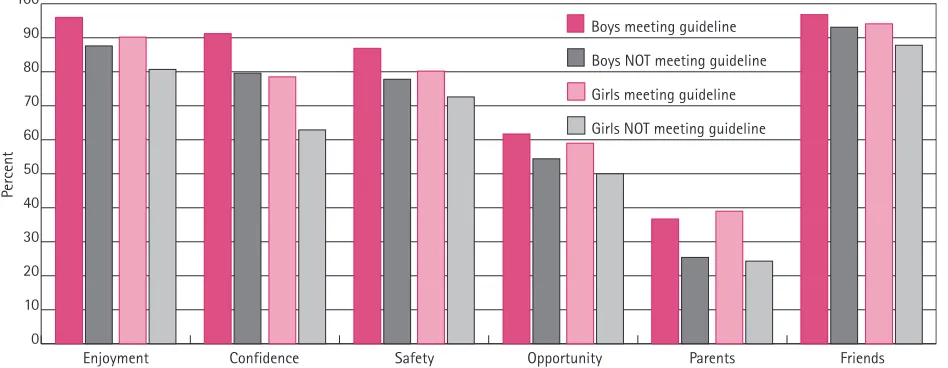
Agreement on each factor was also significantly associated with
meeting or not meeting the 60-minute physical activity guideline
both for boys (**) and girls (***). In other words, those young people
meeting the MVPA guideline were more likely to give positive
responses than those who did not meet the guideline. In Figure 6, the
percentages of boys meeting and not meeting the guideline; and girls
meeting or not meeting the guideline are presented for each factor.
The gender difference in positive responses persists among those
meeting the guideline for four out of the six factors. Comparisons
between boys and girls who met the guideline highlighted that
significantly more boys than girls reported that they enjoyed
Percent
0 10 20 30 40 50 60 70 80 90 100
[image:4.595.57.531.594.778.2]Girls NOT meeting guideline Girls meeting guideline Boys NOT meeting guideline Boys meeting guideline
Figure 6:Psychological, Environmental and Social factors
associated with meeting the 60 minute MVPA guideline or not
meeting the guideline
Health Behaviour in School-Aged Children: WHO Collaborative Cross-National 2001/02 Survey in Scotland Psychological, Environmental % Agreement
and Social Factors Boys Girls p
I really enjoy doing physical activities
(Enjoyment) 91.6 83.6 ***
I feel confident about my skills when I am
doing physical activity (Confidence) 85.1 67.7 ***
I feel safe when I take part in physical activity
in the area where I live (Safety) 82.1 75.0 ***
There are plenty of places where I can take part in physical activity in the area where
I live (Opportunity) 58.4 52.7 ***
I take part in physical activity with my parents
(Parents) 30.8 28.8 NS
I take part in physical activity with my friends
(Friends) 94.8 89.7 ***
physical activity (96.0% vs. 90.2%, ***), felt confident in their
physical activity abilities (91.3% vs. 78.5%, ***), felt safe taking part
in physical activity locally (86.9% vs. 80.2%, **) and engaged in
physical activities with their friends (96.8% vs. 94.1%, *). Responses
to the statements about local opportunity for physical activity and
taking part in physical activity with parents, however, were similar
for both genders among those meeting the guideline.
Discussion
There is general agreement that reported levels of physical activity are
low, and the data presented here support this contention. However,
the focus of this Briefing Paper is to highlight gender differences in
physical activity patterns among young people in Scotland.
Gender differences are not a new phenomenon and have been
frequently reported in spite of methodological differences in survey
design3, 4, 5, 9, 13. In 1998 the Scottish Health Survey, which relied
on proxy reporting of physical activity patterns, reported consistent
gender inequalities9. Comparison of the above survey in 1998 with
the 2001/2 HBSC survey, which relied upon self-reporting, reveals
similar gender differences.
While it is not possible to say, for example, that the precise
difference in the percent of boys and girls who meet the guideline is
14.3% at age 11 or 15.1% at age 15, current findings suggest that
the magnitude of the real gender difference lies between 9.5% and
20.5%. Any effort to reduce inequalities and achieve the National
Physical Activity Strategy Targets5for young people must address
these inequalities.
The finding that girls are less likely to meet the guideline
appears to be affected by a range of variables including those of a
psychological, environmental and social nature. This would suggest
that interventions aimed at promoting physical activity and
reducing the gender gap should have multiple components and seek
to address these inequalities. While many people are actively
working to reduce these differences, efforts should continue and in
all cases strive to be sensitive to the needs of girls as well as boys.
5. Physical Activity Task Force 2003. Let’s make Scotland more active.
A strategy for physical activity, Scottish Executive, Edinburgh.
6. Biddle S, Sallis, J, Cavill N. Policy framework for young people
and health-enhancing physical activity. In Biddle S, Sallis J, Cavill
N. (Eds.) Young and Active? Young people and health-enhancing
physical activity-evidence and implications. London, Health
Education Authority, 1998.
7. WHO (2002) A physically active life through everyday transport
with a special focus on children and older people and examples
of approaches from Europe., WHO, Copenhagen, 47pp.
8. Prentice AM, Jebb SA. (1995) Obesity in Britain: gluttony or sloth?
BMJ, 311, 437-439.
9. Sportscotland (2003). Sport 21 2003-2007: The National
Strategy for Sport. Sport Scotland, Edinburgh.
10. Shaw A, McMunn A, Field J (Eds.). (2000) Scottish Executive
Health Department (1998) Scottish Health Survey, Volume 1,
Scottish Executive, Edinburgh.
11. Pate R, Trost S, Williams C. Critique of existing guidelines for
physical activity in young people. In Biddle S, Sallis J, Cavill N.
(Eds.) Young and Active? Young people and health-enhancing
physical activity-evidence and implications. London, Health
Education Authority, 1998.
12. Currie C, Samdal O, Boyce W, Smith B. (2001) Health Behaviour
in School-Aged Children: a World Health Organization
Cross-National Study: Research Protocol for the 2001/02 Survey. Child
and Adolescent Health Research Unit, University of Edinburgh,
Scotland.
13. Prochaska JJ, Sallis JF & Long B (2001) A physical activity
screening measure for use with adolescents in primary care.
Archives of Pediatric and Adolescent Medicine 155: 554-559.
14. Sallis JF, Prochaska JJ, Taylor W. (2000) A review of correlates of
physical activity of children and adolescents. Medicine and
Science in Sports and Exercise, 32(5), 963-975.
Acknowledgements
We thank the Regional and Island Authorities for granting permission
for their schools to participate in the survey; and all the young people
who completed questionnaires; and the schools and teachers who
kindly agreed to administer the survey. Acknowledgement is also made
of the international HBSC research group who prepared the HBSC
protocol and the support of the WHO Regional Office for Europe.
The HBSC study in Scotland is funded by NHS Health Scotland.
We are grateful to Mary Allison, Physical Activity Coordinator at
the Scottish Executive, Jo Inchley, Evaluation Coordinator for the
European Network of Health Promoting Schools at CAHRU and
Serena Meloni, Research and Evaluation specialist in physical
activity at NHS Health Scotland for their comments on earlier drafts
of this paper.
Further statistical information
Further statistical information will be available in the form of tables
and a technical report. These will be available on the HBSC page of
the CAHRU website (www.education.ed.ac.uk/cahru/projects/hbsc)
or directly from CAHRU.
References
1. Parsons TJ, Power C, Logan S, Summerbell CD. (1999) Childhood
predictors of adult obesity: a systematic review. International
Journal of Obesity and Related Metabolic Disorders, 23(S8),
S1-S107.
2. Blair SN, Clark DG, Cureton KJ & Powell KE. Exercise and fitness
in childhood: implications for a lifetime of health. In: CV Gisolfi
& DR Lamb (Eds) Perspectives in Exercise Science and Sports
Medicine. New York: McGraw-Hill, 1989.
3. Health Education Authority. Young and Active? Young People and
Health-Enhancing Physical Activity – Evidence and Implications.
London: HEA, 1998.
4. Sallis JF and Owen N. (1999) Physical activity and behavioural
medicine. Thousand Oaks, Sage.
Summary of 2002 HBSC findings
The current guideline for physical activity among young people is
that young people should participate in physical activity of at
least a moderate intensity for 60 minutes a day for not less than
five days a week6
• Boys are significantly more likely to meet the guideline than girls (47.1% vs. 30.9%,***)
• Percentages meeting the guideline decline with age among both boys and girls
Age 11, boys 55.5% vs. girls 41.2%
Age 13, boys 46.8% vs. girls 28.7%
Age 15, boys 38.6% vs. girls 23.5%
• Boys who meet the guideline are more likely to report feeling healthy than those who do not meet the guideline
• Among girls, no relationship is found between meeting the guidelines and feeling healthy
• Boys report higher levels of enjoyment and confidence in relation to physical activity than girls, and are more likely to
take part in physical activity with friends, to report more local
opportunities for physical activity and to feel safe taking part
in physical activity locally
• Young people who meet the guideline report higher levels of enjoyment and confidence than those who do not meet the
guideline, and are more likely to take part in physical activity
with friends and to feel safe taking part in physical activity
Designed and produced for CAHRU by Susan Halcro,
Communications and Public Affairs
,
The University of Edinburgh.
Contact for information
Joanna Todd
Child & Adolescent Health Research Unit (CAHRU),
The Moray House School of Education
The University of Edinburgh
St Leonard’s Land, Holyrood Road
Edinburgh EH8 8AQ
Joanna Todd Tel: 0131 651 6268
Email: [email protected]
HBSC publications and HBSC information
See CAHRU website (www.education.ed.ac.uk/cahru/projects/hbsc)
and also the International Study website (www.hbsc.org). CAHRU is
the International Coordinating Centre of the HBSC Study.
Reports from this and earlier surveys include
Todd J, and Currie C. (2003). HBSC Briefing Paper 2. Mental
well-being among schoolchildren in Scotland: age and gender patterns,
trends and cross-national comparisons. Child & Adolescent Health
Research Unit (CAHRU), Edinburgh.
Todd J, Currie C and Smith R. (2003). HBSC Briefing Paper 1.
Introduction, background and dissemination of the 2002 HBSC survey
in Scotland. Child & Adolescent Health Research Unit (CAHRU),
Edinburgh.
Todd J, Currie C and Smith R. (2000) Health Behaviours of Scottish
Schoolchildren: Technical Report 3: Eating Patterns and Physical
Activity in the 1990s
Todd J, Currie C and Smith R. (1999) Health Behaviours of Scottish
Schoolchildren: Technical Report 2: Sexual Health in the 1990s.
Edinburgh: RUHBC and HEBS.
Todd J, Currie C and Smith R. (1999) Health Behaviours of Scottish
Schoolchildren: Technical Report 1: Smoking, Drinking and Drug Use