Computational Grid Infrastructures
John Walsh BA(Mod) MSc
School of Computer Science and Statistics
Trinity College, University of Dublin
A thesis submitted for the degree of
Doctor of Philosophy (PhD)
I declare that this thesis has not been submitted as an exercise for a degree at this or any other university and it is entirely my own work.
I agree to deposit this thesis in the University’s open access institutional repository or allow the library to do so on my behalf, subject to Irish Copyright Legislation and Trinity College Library conditions of use and acknowledgement.
Grid infrastructures have been central to some of the largest computation-ally intensive scientific investigations in recent times. As the complexity of computational simulations and models increases, the dependency on faster processing power and massively parallel computing also increases. In syn-ergy, faster processing power drives advancements in computational simu-lations and models. The emergence of several new types of computational resources, such as GPGPUs, Intel’s Xeon Phi, FPGAs and other types of accelerators are a manifestation of this. These resources have diverse char-acteristics (e.g. physical properties) and there is currently no uniform way to discover or specify them in a grid job.
The diversity of the systems that make up Grids is managed by adherence to common standards that define how systems, services and users interact with Grids. While this helps provide for long-term stability, the downside is that Grids cannot handle rapid changes to the standards and grid middle-ware. Thus, a Resource Integration Problem arises, which can be summed
up as a question of how to deal with the integration of new and diverse com-putational resources in a massive distributed grid computing environment that conversly requires stability.
I would like to thank my supervisor Dr Jonathan Dukes for all the effort, guidance and help throughout the production of this thesis and our publica-tions. I would like to thank Dr Brian Coghlan and Dr Gabriele Pierantoni, whose friendship, advice and help have been invaluable to me. I would also like to express my gratitude to all of my former friends and colleagues in Grid-Ireland, the Ops Centre and CAG – David, Eamonn, Geoff, John R., Kathryn, Keith, Oliver, Peter, Ronan, Soha, Stephen and Stuart. Their effort ensured that we deployed and ran a national grid service for almost a decade and pursued interesting grid architectures. Thanks to Dr Stefan Weber, Paul Duggan, Andriana Ioannou and Dr Michael Clear for helping me settle into Room 008.
My thanks to Prof.Donal O’Mahony. This work was carried out on behalf of the Telecommunications Graduate Initiative (TGI) project. TGI is funded by the Higher Education Authority (HEA) of Ireland under the Programme for Research in Third-Level Institutions (PRTLI) Cycle 5 and co-funded under the European Regional Development Fund (ERDF).
Contents iii
List of Figures vii
List of Tables ix
List of Listings xii
List of Algorithms xiii
Acronyms xv
Glossary xix
1 Introduction 1
1.1 Motivations . . . 2
1.2 Objectives and Research Question . . . 5
1.3 Scientific Contribution of the Work . . . 5
1.4 Related Peer-Reviewed Publications . . . 6
1.5 Structure of the Thesis . . . 8
2 Towards Accelerated Computing on Grid Infrastructures 13 2.1 Cluster Computing . . . 15
2.2 Accelerated Computing . . . 17
2.2.1 From Single- to Multi-Core and Manycore Computing . . . 18
2.2.2 Accelerating Applications . . . 25
2.2.3 LRMS Support for Accelerators . . . 27
2.2.4 Accelerated Computing: Top 500 Case Study . . . 30
2.3.1 Machine Virtualisation . . . 36
2.3.2 GPGPU Virtualisation . . . 39
2.3.3 Cloud Computing . . . 41
2.4 Grid Computing . . . 43
2.4.1 Introduction to Grid Computing . . . 43
2.4.2 Integrating New Hardware into a Grid . . . 54
2.4.3 The EGI GPGPU Surveys . . . 56
2.4.4 Survey of the EGI Grid Information . . . 59
2.5 Other Related Work . . . 67
2.6 Summary . . . 68
3 CPU-Dependent Execution Resources in Grid Infrastructures 71 3.1 Introduction . . . 71
3.2 Abstract Approach to Resource Integration . . . 73
3.2.1 Conceptual CDER Discovery Strategies . . . 80
3.2.2 Two-Phase Job Submission . . . 83
3.2.3 Analysis . . . 85
3.3 CDER Case Study: GPGPU Integration . . . 93
3.3.1 Discovery: GPGPU Schema and Information Providers . . . 95
3.3.2 Independence: Satisfying GPGPU Job Requirements . . . 96
3.3.3 Exclusivity: Restricting Visibility of GPGPU Resources . . . 100
3.3.4 Direct Job Submission . . . 106
3.3.5 Two-Phase Job Submission . . . 106
3.4 Other Related Work . . . 108
3.5 Summary and Conclusions . . . 111
4 Grid-enabled Virtual GPGPUs 115 4.1 Abstract Virtual GPGPU Architecture . . . 117
4.2 vGPGPUs as LRMS Resources . . . 121
4.2.1 The vGPGPU Factory – Logical GPGPU Isolation . . . 123
4.2.2 vGPGPU Registry Service . . . 124
4.2.3 LRMS Integration and Job Specification . . . 124
4.3.2 Grid Support for vGPGPUs . . . 129
4.3.3 Implementation . . . 131
4.3.4 The Grid Resource Integration Principles . . . 135
4.4 Evaluation . . . 135
4.4.1 The Performance of Multi-Layered Virtualisation . . . 135
4.4.2 Batch Workload Performance using the LRMS . . . 137
4.5 Other Related Work . . . 142
4.6 Summary and Conclusions . . . 143
5 Conclusions and Future Prospects 145 5.1 Summary and Contributions . . . 145
5.2 Limitations and Alternatives . . . 149
5.3 Further Evaluation . . . 153
5.4 Enhanced Functionality . . . 155
5.5 Potential Research and Development Directions . . . 157
5.6 Conclusions . . . 158
Appendices 161
A Resource Deployment Data 163
B Accounting for Resource Usage 165
C LRMS GPGPU Utilisation Function 167
2.1 A Multi-core CPU with four Cores . . . 21
2.2 The Intel Xeon Phi (Knight’s Corner) Architecture . . . 23
2.3 The Many-Core Nvidia GPGPU Architecture . . . 24
2.4 The Growth of Accelerated Systems by type in the Top500 (2011-2015) 31 2.5 The Growth of Accelerated Systems sub-grouped into Top 10, 20, 100, 200 and 500 (2011-2015) . . . 33
2.6 Frequency distribution of Accelerators in Top 500 (June 2011 to June 2015) . . . 34
2.7 A representation of full-machine virtualisation . . . 37
2.8 A representation of OS-level (Container) Virtualisation . . . 38
2.9 Main Grid Services managed by a resource-provider (Site) . . . 46
2.10 A Simple Grid Infrastructure . . . 47
2.11 The Job Submission Chain . . . 50
2.12 Abstract Information Provider Model . . . 53
2.13 The Hierarchical Grid Information System . . . 53
2.14 Cumulative frequency of LRMS deployed per grid middleware . . . 61
2.15 Cumulative frequency of grid middleware deployed per LRMS . . . 62
3.1 An example worker node with several CDERs (a GPGPU and an FPGA). The LRMS is responsible for assigning CPUs to each job, and each CDER resource can only be used by one and only one job at any one time. 75 3.2 A resource specification must be translated into an LRMS specific re-source specification. . . 76
3.3 An abstract model of the two-phase submission of a grid job with CDER requirements. . . 85
Element are extended to support GPGPU CDERs. An extension con-verts the declaration GPGPUPerNode=2 into a TORRQUE/MAUI
GPGPU CDER request. . . 101 3.6 Batch System GPGPU allocation process. . . 102 3.7 Worker Node GPGPU allocation subsystem . . . 105
4.1 An component-based view of the abstract model for vGPGPU LRMS Integration . . . 119 4.2 vGPGPU Registry Service Interface . . . 125 4.3 The flow of a vGPGPU job through the SLURM LRMS . . . 126 4.4 The flow of a vGPGPU job through the TORQUE/MAUI LRMS . . . 127 4.5 Abstract model for the integration of virtual GPGPUs with existing grid
infrastructures . . . 128 4.6 Overview of the vGPGPU Registry Service . . . 130 4.7 Average workload completion time (including waiting time) for a vGPGPU
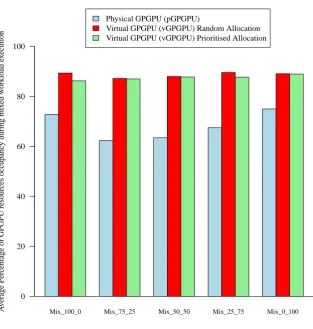
and pGPGPU deployment and for workloads with varying relative pro-portions of one-GPGPU, two-GPGPU jobs. . . 139 4.8 Average GPGPU utilisation for a vGPGPU and pGPGPU deployment
2.1 Overview of LRMS for Accelerators . . . 28
2.2 Environment variables supporting accelerator visibility . . . 29
2.3 LRMS Accelerator support using environment variables . . . 29
2.4 The number of Top 500 supercomputers using Computational Acceler-ators within the Top 10, 20, 100, 200 and 500 subgroups. . . 32
2.5 The percentage of Top 500 supercomputers using Computational Accel-erators within Top 10, 20, 100, 200 and 500 sub-groups. . . 32
2.6 Middleware support for Job Description Language Formats . . . 48
2.7 Grid ComputeElement middleware deployments and their LRMS type . 60 3.1 Summary of CDER Strategy Evaluation . . . 86
3.2 Schema representing typical properties of a GPGPU CDER . . . 88
3.3 Overhead of publishing typical data under LDAP Data Interchange Format 88 3.4 Average system-time cost, measured in seconds, of matching a sample ClassAd GPGPU Resource Request against 100 Resource Offers gener-ated from GLUE 2.0 BDII LDAP queries. . . 89
3.5 Initial State . . . 104
3.6 Example of a single job running on a node with two GPGPUs . . . 104
4.1 Extended JDL specification processed by the LRMS . . . 134
4.2 GLUE 2.0 Entities . . . 134
gression test with step-size=1000, 2 CPU threads and Verlet Cutoff Scheme (pGPGPU) . . . 140 4.7 Average runtime (seconds) of 20 invocations of GROMACS angle1
re-gression test with step-size=1000, 2 CPU threads and Verlet Cutoff Scheme (vGPGPU) . . . 140 4.8 Average runtime (seconds) of 20 invocations of GROMACS angle1
re-gression test with step-size=1000, 2 CPU threads and Verlet Cutoff Scheme (vGPGPU) with prioritised vGPGPU allocation . . . 140 4.9 Average Cost of Docker/rCUDA Virtualisation for 20 invocations of
2.1 Addition of two vectors in CUDA . . . 25
2.2 Addition of two vectors in OpenCL . . . 26
2.3 Addition of two vectors in OpenACC . . . 27
2.4 Example JDL Hello World specification . . . 47
2.5 JSDL Hello World Application . . . 48
2.6 Example xRSL and RSL Hello World Application . . . 48
2.7 A list of ComputeElements using the name of a queue to indicate GPGPU deployment. The results show only Compute Element queue endpoints matching the term “GPU” . . . 63
2.8 Deployment of GPGPUs indicated by publishing a simple GLUE Appli-cation Tag . . . 63
3.1 An example Named-Queue grid job specification . . . 81
3.2 An example GLUE 1.X Tagged-Environment advertising both software (CUDA) and hardware (NVIDIA-KEPLER) capabilities. . . 81
3.3 Example Tagged-Environment job specification requiring the NVIDIA-KEPLER hardware capability . . . 81
3.4 An example of the publication of static and dynamic GPGPU informa-tion by extending GLUE 2.0 an Execuinforma-tionEnvironment instance using OtherInfo attributes. . . 82
3.5 A single GLUE 2.0 Extension instance that is associated with a par-ent ComputingShare instance. The extension is used to publish the GPGPUPerNode=2 Key/Value pair. . . 83
3.6 Sample Data for Tagged-Environment Strategy . . . 91
3.7 Example Job Description in gLite JDL format for a job that requires two GPGPUs per worker node . . . 99
ALU Arithmetic and Logic Unit.
APEL Accounting Processor for Event Logs.
API Application Programming Interface.
ARC Advanced Resource Connector.
BDII Berkeley Database Information Index.
BOINC The Berkeley Open Infrastructure for Network Computing.
CDER CPU-dependent Execution Resource.
CE Compute Element.
CPU Central Processing Unit.
CREAM Computing Resource Execution And Management.
CUDA Compute Unified Device Architecture.
DIRAC Distributed Infrastructure with Remote Agent Control.
EC European Commission.
EDG European Data Grid.
EGEE Enabling Grids for E-Science.
EGI European Grid Infrastructure.
EGI-InSPIRE EGI Integrated Sustainable Pan-European Infrastructure for Researchers
FGCR Floating Generic Consumable Resource.
FPGA Field Programmable Gate Array.
GIP Grid Information Provider.
GIS Grid Information Service.
GLUE Grid Laboratory for a Uniform Environment.
GPGPU General-Purpose Computation on Graphics Processing Unit.
GPU Graphics Processing Unit.
HPC High Performance Computing.
HSA Heterogeneous System Architecture.
HSAIL HSA Intermediate Language.
HTC High Throughput Computing.
HTTP Hypertext Transfer Protocol.
JDL Job Description Language.
JSDL Job Submission Description Language.
JSON JavaScript Object Notation.
LCG LHC Computing Grid (now WLCG).
LCU Latency Compute Unit.
LDAP Lightweight Directory Access Protocol.
LDIF LDAP Data Interchange Format.
LHC Large Hadron Collider.
LRMS Local Resource Management System.
MIMD Multiple Instruction, Multiple Data.
MISD Multiple Instruction, Single Data.
MPI Message Passing Interface.
NGI National Grid Initiative.
OGF Open Grid Forum.
OS Operating System.
OSG Open Science Grid.
PCI Peripheral Component Interconnect.
PCI-E PCI Express.
pGPGPU Physical GPGPU (i.e. not virtualised).
PS3 Sony PlayStation 3.
ReSS Resource Selection Service.
RGMA Relational Grid Monitoring Architecture.
RSL Resource Specification Language.
SE Storage Element.
SGE Sun Grid Engline.
SHOC Scalable HeterOgeneous Computing.
SIMD Single Instruction, Multiple Data.
SISD Single Instruction, Single Data.
SM Streaming Multi-Processor.
SPEC Standard Performance Evaluation Corporation.
TCU Throughput Compute Unit.
TORQUE Terascale Open-Source Resource and Queue Manager.
UI User Interface.
UMD Unified Middleware Distribution.
UNICORE Uniform Interface to Computing Resources.
URI Uniform Resource Identifier.
URL Uniform Resource Locator.
USB Universal Serial Bus.
UUID Universal Unique Identifier.
vGPGPU Virtual-GPGPU.
VM Virtual Machine.
VMM Virtual Machine Monitor.
VO Virtual Organisation.
WLCG Worldwide LHC Computing Grid.
WMS Workload Management System.
WN Worker Node.
XML Extensible Markup Language.
BOINC The Berkeley Open Infrastructure for Network Computing (BOINC) is an
open-source middleware that supports coordinated distributed volunteer comput-ing applications.
CERN The Conseil Européen pour la Recherche Nucléaire (CERN) is the European
Organisation for Nuclear Research. It is a world-class research facility based near Geneva on the Franco-Swiss border. Research concentrates on fundamental atomic and sub-atomic physics. It activities are funded by European member states.
CREAM A Web Service based Compute Element for the UMD/gLite grid
middle-ware.
EGEE A European-based Grid Infrastructure (2004-2010). It was established to
sup-port distributed collaberative eSciences in Europe and beyond.
EGI A European-based Grid Infrastructure (2010-). It is has an administative and
coordinating function for its NGI members, and helps shape the direction of grid-based collaboratice eScince.
gLite a lightweight grid middleware developed for the LCG/WLCG and EGEE/EGI.
Globus The Globus Toolkit is an standards-based open-source suite for building grids.
Grid-Ireland An Irish Goverenment funded and supported project to developed a
National Grid Initiatve and Grid Operations Centre for Ireland (1999-2012).
SPEC Standard Performance Evaluation Corporation.
VO A Virtual Organisation (VO) is a managed collection of distributed users sharing
Introduction
Grid computing [1] is a standards-based computing architecture that facilitates con-trolled, secure sharing of computational and related resources (e.g. storage and appli-cation software) among many users distributed across the Internet. The motivating factors driving Grids forward include: the ability to increase the scale and variety of resources available to users and their applications; improved resource utilisation by the smart distribution of application workloads (jobs) throughout the Grid – selection is determined based upon user specified requirements; and to allow distributed collections of collaborating users to securely share access to their common data. Grids have been successfully used by tens of thousands of users (predominantly research scientists), who have used them to investigate problems that are intractable on isolated, single-site re-sources. The most notable and successful scientific outcome involving Grids was the confirmation of the existence of the Higgs Boson – an endeavour that led to the joint awarding of a Nobel Prize in Physics to Professor Peter Higgs in October 2013, some 50 years after his original theory was proposed [2]. The Grid was used to process and analyse the 15 petabytes of data produced annually by the LHC experiments [3].
in-frastructures [8]. However, the emergence of both many-core and massively-parallel computational accelerators, for example General-Purpose Computation on Graphics Processing Units (GPGPUs), has led to users seeking access to these resources on grid infrastructures [9].
This thesis is concerned with the problem of integrating many new types of
com-putational accelerators into Grids. The term “integration” is used in this context to refer to discovering those new resources, and selecting them for workload execution in a manner that grid users are already familiar with. The integration problem arises because Grid infrastructures, which require operational stability, are adverse to the rapid changes that the integration of many new types of resources require.
1.1
Motivations
The integration of massively-parallel computing resources into Grids, such as the Euro-pean Grid Infrastructure (EGI), has thus far been ‘ad-hoc’ in nature, and no community-accepted solution has been forthcoming. Furthermore, the integration attempts that have been made to date overlook some very important advantages of Grid Comput-ing – namely, the ability to “discover” these new resources based on their particular properties (e.g. memory, capacity, and utilisation), and the ability to specify those properties in the user’s grid applications in the same way that users currently specify Grid resources based on specific CPU properties or utilisation characteristics. It should be noted that use of the term “Grid” in this thesis refers to particular coordinated collections of distributed computing resources that use the Open Grid Forum (OGF) Grid Laboratory for a Uniform Environment (GLUE) standards to publish information about the state of their resources and services.
can be developed.
In addition to the demand for access to new resources, the emergence of the Cloud Computing paradigm over the last decade is also influencing the provision of resources in grid infrastructures [11]. Cloud Computing is aimed at delivering greater flexibility, utilisation and security in how computational resources are provided and used. Virtu-alisation is the fundamental technology underlying Cloud Computing. In some cases, virtualisation can enable a degree of resource “mobility” – i.e. the resource can be transparently accessed from another remote machine. Resource mobility has the po-tential to be exploited in a number of distinct ways: (i) creating computing environ-ments with dynamically allocated hardware; (ii) using dynamic allocation to improve resource utilisation; and (iii) constructing complex machine environments from these virtual resources that may not have been possible with conventional physical hardware. There has been a shift within the Grid community towards a more Cloud-like delivery of computing services to users. In the case of EGI, a new infrastructure that runs alongside the existing Grid was established. Neither of these infrastructures consider the potential benefits and application of resource mobility.
There are several motivating factors behind the work presented in this thesis, some are based on fulfilling immediate needs, some are based on having to work within the limitations of slowly changing infrastructures, while others include the potential for improved resource allocation and performance. These motivations include:
(i) the need to incorporate the use of massively-parallel computing resources. These resources are needed to support innovation in the sciences.
(ii) the need to support these resources in a manner that current users are accustomed to;
(iii) the need to avoid radical changes to the grid (infrastructure and middleware);
(iv) the opportunity to develop unconventional computer systems that simplify appli-cation development; and
Personal Perspective
I have been professionally involved in the Grid community and the provision of grid services and infrastructures since mid-2003. Since then, I have seen Grid Computing growing from its experimental beginnings (delivering computational power to a small number of both large and small scientific communities), to the creation of the EGI, a massive, but coordinated, pan-European infrastructure. As one of the Irish repre-sentatives in a sequence of successive co-funded European grid projects, I also played a small role in the EGI’s development and in the development of grid software (also called grid middleware).
1.2
Objectives and Research Question
The core objective set out in this thesis is to conceptualise, investigate and develop a flexible, dynamic approach to the integration of new (and yet to be conceived) resources into existing grid infrastructures. On the basis of developing such an approach, it will be further investigated to see if it can be extended to virtual resources, and whether the use of these virtual resources can improve resource utilisation on the Grid.
1.3
Scientific Contribution of the Work
The contributions of the work presented can be categorised into two distinct areas: (i) the development of an abstract approach to the integration of accelerator-based resources into Grids (Chapter 3); and (ii) an extension of this abstraction to virtual resources, exemplified by the development new services supporting the integration of virtual-GPGPU computational resources into Grids (Chapter 4). A comprehensive list of individual contributions are detailed below.
Abstract Approach to Resource Integration
(i) The development of an abstract classification of non-CPU computational re-sources – these will be referred to asCPU-Dependent Execution Resources (CDERs).
This definition is intended to exclude applications or software (these are already facilitated in Grids) but include hardware resources such as GPGPUs, Field Pro-grammable Gate Array (FPGAs) and other hardware accelerators. The definition is also intended to exclude software that may be “node-locked” due to licensing restrictions – these play no role in the actual execution of computational instruc-tions.
(ii) An investigation into a set of Conceptual Strategies that aid the description and advertisement of CDERs within a Grid that is consistent with community-accepted standards.
(iii) The development of a two-phase process that facilitates the discovery of the
(iv) The development of a new solution that allows GPGPU resources to be incorpo-rated into a popular resource management system – GPGPUs are not currently well supported by this resource management system. The solution is extended to Grids by way of the previously mentioned investigation.
Abstract Extension to Virtual Computational Resources
(v) The design of an abstract architecture for managing a class of virtual-CDER – the virtual GPGPU.
(vi) A concrete realisation of this abstract architecture, which is applied for use by several (more general) computer systems.
(vii) The extension of the abstract virtual-GPGPU model to a grid context.
(viii) A concrete realisation of the abstract virtual-GPGPU grid model that incorpo-rates the two-phase model.
1.4
Related Peer-Reviewed Publications
The body of work presented in this thesis is based on a series of peer reviewed publi-cations.
• Supporting grid-enabled GPU workloads using rCUDA and StratusLab[12]
This preliminary work presented a very early conception that featured both GPGPUs and virtual-GPGPU resources on a grid infrastructure. The publication included an initial study of the challenges that the grid community would need to tackle in order to make GPGPU resources available on the Grid. Furthermore it presented and demonstrated a simple application that transparently executed GPGPU kernels (i.e. instructions that execute on GPGPUs) on several remote virtual-GPGPUs as if they were locally installed. Finally, a system architecture that supported virtual-GPGPUs was proposed.
• Overview and Evaluation of Conceptual Strategies for Accessing CPU-Dependent Execution Resources in Grid Infrastructures[13]
greatest flexibility for publishing both static and dynamic CDER information and identifying CDERs that satisfy specific job requirements. Furthermore, a two-phase approach to job-submission was developed for jobs requiring access to CDERs.
• Supporting job-level secure access to GPGPU resources on existing grid infrastructures [14]
This publication introduced an update to grid infrastructures using the gLite [15] grid middleware. The update supported GPGPU resource discovery and job specification on the grid. The publication presented a technical discussion on the implementation details behind the application of a conceptual strategy [13] to GPGPU resources. A new service was developed to help manage the allocation of GPGPU resources and ensure additional GPGPU resource access protections that had not been available in the popular TORQUE/MAUI resource allocation system. This system is the most popular resource management system deployed on the Grid (see Section 2.4.4).
• GPGPU Virtualisation with Multi-API Support using Containers [16]
This publication described a multi-layered approach to GPGPU virtualisation where user applications could transparently access many non-local GPGPU resources. A new multi-component system that supports multiple remote virtual-GPGPU im-plementations on several resource management systems was proposed. The system consisted of: (a) a Factory component that produces Virtual Machines with access to a unique single GPGPU; (b) a Registry service that managed allocation of the Factory produced resources; and, (c) a set of plug-in scripts that bridge between the resource management system and the Registry. This paper evaluated the per-formance of GPGPU benchmarks on the prototype.
• Application Support for Virtual GPGPUs in Grid Infrastructures [17]
This publication built upon the results of the previous publications ([13], [14], [16]), to extend grids with support for virtual-GPGPU resources. The support included virtual-GPGPU resource discovery, job description, and selection. Performance re-sults suggested that improved resource utilisation could compensate for the overhead of access to the virtual-GPGPUs.
• Many-core on the Grid: From exploration to production [18]1.
1.5
Structure of the Thesis
Chapter 2 – Towards Accelerated Computing on Grids
Chapter 2 presents a layered view of the background and state of the art of grid computing using computational accelerators.
Section 2.1 introduces the fundamental concepts and terminology behind Cluster Computing and cluster resource management. As efficient resource management is a crucial aspect of how clusters function, an overview of the state of the art is presented, illustrating the differences between the numerous resource management systems in use today. Support for non-CPU resources, such as physically-bound GPGPUs or machine-independent resources (software licences, virtual resources) is also reviewed.
Section 2.2 begins with a description of the basics of accelerated computing, and the reasons why it has become important to contemporary scientific computing. With much focus on accelerating applications using GPGPUs, a basic overview of GPGPU parallel computing models is presented. The different application development and runtime frameworks (APIs), hardware and examples of user applications are also reviewed.
Section 2.3 explores topics in machine and resource virtualisation. Machine vir-tualisation has led to the rapid development of computing paradigms such as Cloud Computing, which has transformed how computing resources are shared and used. This section also looks into the fundamentals of virtualising the GPGPU. Machine and resource virtualisation is utilised in Chapter 4 to support the integration of virtual-GPGPUs into the Grid. One goal of GPGPU virtualisation in this thesis is to improve GPGPU resource utilisation.
Grids are comprised of many clusters distributed across the Internet. The funda-mentals of Grid Computing are introduced in Section 2.4, describing how a coordinated ensemble of distributed resources can be used to tackle problems that are otherwise in-feasible at a local level. A basic introduction to resource discovery and job submission is introduced and will be used to illustrate the differences between some grid systems. These differences are exemplified in how the various grids support job submission with automatic resource selection. Section 2.4 also discusses how current grids lack the flexibility to support accelerated computing, and sets out how this work contributes towards alleviating this problem. In addition, Section 2.4 surveys current trends in
accelerator deployment and usage in computing environments. It also examines the deployment of grid midddleware and their resource management systems. This is used to evaluate which grid systems currently support accelerator integration at the resource management level, and the extent to which the solutions presented in Chapter 3 and Chapter 4 can apply. This section will also review where previous attempts have been made to integrate accelerators, and how the solutions presented in this thesis over-come problems associated with those solutions. Finally, the responses to two surveys are analysed to gather further information about accelerator deployment and how grid users intend to use them.
Section 2.5 examines other research that has similar goals (albeit, focussed on more narrow problems) to the accelerator integration problem. A summary of the differences between the work presented in this thesis and the related work will be provided.
Chapter 3 – CPU-Dependent Execution Resources in Grid
In-frastructures
Chapter 3 is a greatly expanded and updated treatment of the work presented in the “Overview and Evaluation of Conceptual Strategies for Accessing CPU-Dependent Execution Resources in Grid Infrastructures” [13] and “Supporting job-level secure access to GPGPU resources on existing grid infrastructures” [14] papers. It evaluates the current grid information model, which is a core component in how grid resources are discovered and selected for use. This chapter introducesCPU-Dependent Execution Resources (CDERs) – an abstraction of a set of resources that require the allocation
Chapter 4 – Grid-enabled Virtual GPGPUs
Similar to the approach in Chapter 3, Chapter 4 is based on a merged and expanded treatment of two peer-reviewed papers: “GPGPU Virtualisation with Multi-API Sup-port using Containers” [16] and “Application SupSup-port for Virtual GPGPUs in Grid In-frastructures” [17]. A derivation of the CPU-Dependent Execution Resources (CDER)
concept is developed that allows the inclusion of non-CPU computing resources that can be exclusively accessed fromany machine in a cluster. These resources still require
one or more CPUs to access them. In addition, because the resources can be accessed from any machine, they can be regarded asmobile orfloating resources1. A motivation
for developing this derivation is to facilitate the management of floating virtualised resources, in particular a new class of virtual-GPGPUs resources.
Section 4.1 examines how an abstract multi-layered approach to GPGPU virtu-alisation may be used to describe an architecture that can support virtual-GPGPU resources across many cluster systems. It is then shown in Section 4.2 how to apply this abstraction to a couple of contemporary resource management systems. The im-plementation is supported through a set of new components that add a new lightweight system for constructing, managing and integrating these virtual-GPGPUs.
The ability to support virtual-GPGPUs with multiple cluster resource management systems is central to its potential for adaptation on grid infrastructures – Grids are managed collections of diverse clusters. Section 4.3 proposes how the abstract cluster model can be extended to Grids, while Section 4.3.3 presents an implementation.
The speed and throughput of virtual-GPGPU applications is studied in Section 4.4 to determine under what conditions their virtual-GPGPUs are effective.
Chapter 5 – Conclusions and Future Prospects
This final chapter recalls the research question of how to deal with the integration of new computational resources in a massive distributed grid computing environment that (somewhat conversely) requires stability. A summary of how an abstract approach (one of the key contributions) to this resource integration question recaps how this problem is addressed – first, in the context of (physical) GPGPU resources, and then in the context of an extension to virtual-GPGPU resources.
those limitations, is addressed. For example, through the development of additional resource management services, the question of how to expand the new services to deal with other resources is discussed, as well as the potential of investigating alternative resource allocation schemes that may increase utilisation.
Towards Accelerated Computing on
Grid Infrastructures
Computational- and data-based sciences (the so-called e-Sciences) are becoming more reliant on parallel processing to deal with increasingly complex simulations and data-sets. Such parallel processing applications are typically executed on multiple CPUs across a network of computers, or executed on large multi-processor computers. How-ever, with the slowdown in the growth of processor performance, alternative solutions that use additional specialised computational resources to supplement the computa-tional power of the CPU have also emerged – namely coprocessors and computational accelerators. One of the big challenges for grid infrastructures is that these resources
are neither easily nor quickly integrated into grids in such a way that it is supported by typical higher-level grid functions (e.g. resource discovery and the ability to specify the need for that resource in a grid job). Indeed, based on previous experience in developing a standard for parallel application support using MPI on European grids (under the auspices of the EGEE MPI-Working Group), it took several years before our initial recommendations were fully supported in the grid middleware (e.g. WholeNodes support that allowed grid jobs to request all CPUs of a machine).
to process large quantities of calculations in parallel – the many-core accelerator based on general purpose computations on graphics processing units. However, the general method is intended to be able to support other resources, such as Field Programmable Gate Arrays.
The approach taken in this chapter is to present the background material in a layered, bottom-up fashion. Grids are built upon collections of distributed clusters
of computing resources, so Section 2.1, which introduces the basics of cluster-based computing, is a natural starting point. This introduction sets forth key concepts and terminology. These concepts are also important in understanding the low-level details of how Grids work. In particular, knowledge of basic cluster computing concepts is required for the work presented in Chapters 3 and 4.
Section 2.2 looks at the topic of accelerated computing. This examines the transi-tion from the classic CPU-based serial computing architecture (i.e. only one computer program instruction can be executed at any instant) to parallel-based computing ar-chitectures (where several, or indeed many, instructions can be executed concurrently). An overview of the subsequent serial and parallel computing architectures is presented. Furthermore, as there are several types of CPU and accelerator hardware, with each of these implementing a different approach to parallel computing, a review of some com-mon CPU and accelerator implementations, and how these relate to the aforementioned parallel computing architectures, is also presented. The remainder of this section in-vestigates different application interfaces that are required to access accelerators, and how they are currently supported by several cluster resource management systems.
An overview of current methods for benchmarking accelerators is presented in Sec-tion 2.2.5. Benchmarking has two major funcSec-tions in this thesis: (i) it provides key information about resource capabilties in a grid (which in turn enhance resource se-lection); and (ii) it helps evaluate the impact of virtualising GPGPUs. This section investigates some common accelerator benchmarking suites, looking at several individ-ual benchmarking applications and what key performance measurements they make.
The fundamentals of grid computing are described in Section 2.4, with particular attention being paid to job submission and the information model. This section also reviews previous work that has attempted to introduce additional computational (non-accelerator) resources into the grid. Finally, an analysis of key results from the EGI Resource Centre and Users survey is presented. This examined whether there was a
need for GPGPU resources on the grid, and what those needs were. A grid integration solution that takes the survey results into account is presented in Chapter 3 and de-veloped further in Chapter 4. This is followed by a survey of the actual composition of the EGI via its information system.
Finally, Section 2.5 looks at the state of the art and related work to examine what previous and current works attempt to solve similar problems to the work proposed in this thesis. Where similar work exists, it shall be compared to the proposed solution.
2.1
Cluster Computing
A Cluster is the general term used to describe a collection of locally inter-connected
computers (i.e. all computers are in the same physical location) that act together to complete large-scale computational tasks. The local inter-connection between the com-puters ensures that when two or more comcom-puters are communicating with one another during the execution of a common task, the amount of time that it takes to send data from one computer to another is minimised, and that the impact on communication by events external to the local network (e.g. network outages) is minimised. Each computer in the cluster that participates in the processing of computational tasks is known as a Worker Node (WN).
The operational cost (e.g. expert staff, electricity, maintenance, equipment depreci-ation) of running a cluster is high. To reduce these costs, and to achieve the best return on investment, it is important to ensure that the resources are used as much as possible. One way to ensure greater utilisation is to share the cluster resources between many
users. Indeed in some instances, clusters may have hundreds or thousands of users.
To effectively share the cluster between those users, some form of resource (e.g. CPU cores, memory) management is required. Such a system is called a Local Resource Management System (LRMS) or Batch System. There are many LRMS application
The LRMS service runs on a Head Node, whose function is to allocate the worker
node resources in such a way that the users can complete their task with the desired number of resources. By managing when each users application executes, the LRMS ensures that user applications do not concurrently compete for the same resources, thereby ensuring that there is no over-commitment of individual resources. Further-more, the LRMS may be configured toschedule tasks according to some predefined
pol-icy. Preference may, for example, be given to tasks that require the smallest amount of resources, or may be given to certain groups of users. Some LRMS’s allow the schedul-ing function to be handled by an external manager. For example, MAUI [25], and its commercial successor MOAB [26], implement advanced scheduling policies such as
Fair Shares, that ensure certain groups of users have a guarantee of a fixed amount of
resources over a fixed period of time.
Collections of worker nodes may be arranged into groups (Queues or Partitions).
Queues are just one of several ways to manage access policies or set limits on how users access the worker node resources. For example, Queues can limit which users can access particular worker nodes, how long their job may execute for, or how much memory they may use.
The user’s workload is called aJob. Each Job is specified by using aJob Description
orJob Specification. The job description should includeBatch-System Directives which
state the job’s resource requirements. Jobs are submitted from a Job Submission Node
– in many cases the Head Node and Job Submission Node run services on the same machine.
A typical job specification may include a directive for how many Worker Nodes are required (a Node or Task). In most batch systems, this actually translates into a
request for the number of CPU cores (or Processors), and those cores may be allocated on a single worker node, or spread out across multiple worker nodes. However, the specification can be refined to ensure that a set of CPU cores are on the same worker node. This is called Processors Per Node.
Each job requires one or more CPU cores to execute. For this reason, the CPU core is the primary resource managed by the LRMS. However, users may be interested in using other types of resources – for example GPGPUs or software licences. In the first case, the resource is physically attached to a worker node, whilst in the latter case, the resource may be accessed from any worker node. These are respectively known as
Cluster systems can range from very small collections of worker nodes to huge sys-tems with over 100,000 CPUs that are interconnected through high-speed components. Some of these more important differences can be classified into the following computing models:
High Performance Computing (HPC) uses computer components that are focussed
on delivering the optimal computational power and capability possible, thereby allowing user jobs to execute as quickly as possible. HPC jobs and systems are normallytightly-coupled, i.e. there is significant inter-dependence between
differ-ent parts of the application executing on the system (e.g. shared memory). HPC systems may be shared among hundreds or thousands of users from different sci-entific backgrounds and with different application needs. HPC systems require an LRMS to optimise utilisation without overcommitting resources.
High Throughput Computing (HTC) places less emphasis on execution speed,
but is focussed mainly on the execution of many loosely-coupled (the converse of tightly coupled) user jobs over an extended period of time. Collections of user jobs can be be executed over months and years, rather than hours and days (e.g. LHC [3]).
Although HPC systems are primarily intended for large multi-worker node appli-cations that depend upon fast inter-node communication, they have also been used for large collections of single processor applications. Similarly, HTC systems are primarily aimed at processing large numbers of single processor or small multi-core jobs, but have also been used for multi-processor applications. Indeed, some cluster systems are intended to manage a diverse range of applications, so they must embrace elements of HPC and HTC system architectures. The inclusion of accelerators on worker nodes is just one of the ways to achieve this.
2.2
Accelerated Computing
mathematical operations at a time when the typical CPU could only handle floating-point calculations in software. Such coprocessors provided a much needed boost to application performance, but were generally fixed-purpose and limited in their func-tion. Moreover, access to the coprocessor wasn’t always transparent, as it often had to be accessed using an additional API. Some coprocessor functions, such as the floating-point unit, are now integrated directly into the CPU logic, and consequently do not need to be provided by an external coprocessor.
It is clear from the above example that a coprocessor may have a fixed function (e.g operate on floating-point numbers). For accelerated general-purpose processing a more precise definition is required. In this thesis, Volodymy Kindratenko’s definition of a
Computational Accelerator is adopted. He defines a computational accelerator to be
“a reprogrammable, stand-alone processor capable of executing an arbitrarily complex, but functionally limited code, offering the benefit of faster execution as compared to the general-purpose processor. The functional limitation comes from its inability to directly interact with some of the hardware resources that are typically accessible by the main processor, such as disk or network interface. It is not a fixed hardware designed to accelerate the execution of a particular instruction (e.g., a vector unit) or a particular fixed function (e.g., H.264 media decoding)” [27]. However, in the body of this thesis, the shorter term of accelerator may be used, with the understanding that
this refers to a computational accelerator.
The crucial points to be taken from this definition is that accelerators are separate
from the CPU, but are dependent on the CPU to interact with the rest of the machine. Furthermore, accelerators will have their own set of states and properties that are distinguishable from the CPU. It is this separation property that has the effect that accelerators (and coprocessors) are not catered for in contemporary grid infrastructures. The term Heterogeneous Computing is used to describe a system architecture that
is composed of several different processing units. Such systems will include one or more (not necessarily identical) CPUs, but may also include one or more general purpose accelerators, as well as digital signal processors or other fixed purpose coprocessors.
2.2.1
From Single- to Multi-Core and Manycore Computing
18 months. A side effect of this miniaturisation was that the rate at which processors can execute instructions also doubled. This rule-of-thumb is known as Moore’s law. However, since 2005 that growth rate has effectively plateaued because of the physical difficulties in manufacturing at nano-scale. While instruction processing techniques such as super-scaling, instruction pipe-lining and caching [28] have helped improve performance, these have not been sufficient in themselves to maintain expected perfor-mance increases. The use of parallel computing techniques is regarded as one of the best available ways to overcome some of these limitations.
Parallelisation is by no means a recent concept and many examples of its use can be found in the natural world (e.g. independent worker bees in a hive), as well as in man-ufacturing processes such as assembly lines (that are based around complex workflows that depend on synchronisation in order to efficiently assemble the intermediate- and end-products). In computer science, one of the first taxonomies of computing architec-tures that describes how serial and parallel processing may be approached has come to be known as Flynn’s Taxonomy [29] [30]. This divides computational architectures into one of four types:
SISD Single Instruction, Single Data – programs execute sequentially: One instruction
operates on one piece of data, and then moves onto the next. This has no parallel computing capabilities.
SIMD Single Instruction, Multiple data – in which the same instruction is applied
to a set of data in parallel. A well-known example of this architecture is vector processing.
MISD Multiple Instruction, Single Data – this is deemed to be a less likely
compu-tational scenario. However, it has uses in fault-tolerant systems [31], where the redundancy of executing the same instruction in parallel on the same data can be used to ensure better confidence that an error has not occurred, or can be detected (and eliminated) through checksumming or consensus.
MIMD Multiple Instruction, Multiple Data – this is the broadest parallel computing
As the MIMD architecture is very broad in its classification, further refinements of MIMD have been adopted. This helps distinguish between significantly different MIMD architectures [31]. The extended Flynn’s taxonomy defines the following additional categories for parallel processing:
Shared Memory MIMD All the memory is shared between each processing unit.
This category includes CPUs with multiple processing cores on a single processor, and machines with multiple processors which may also have multiple processing cores. When all processing cores are equivalent, this form of Shared Memory architecture is called a Symmetric Multi-Processor (SMP) model. An alternate
shared memory MIMD is the master/worker model where some of the processors are assigned to execute specialised workloads or software. This model includes accelerators (including fixed function accelerators such as H.264 decoders).
Distributed Memory MIMD This includes processors that communicate through
message passing. Memory is not directly shared by any of the processors, and data is shared by sending messages from one processor to another. This is also referred to as a Single Program, Multiple Data (SPMD) architecture, and has been popularised on Clusters through the popular MPI application development interface.
The use of these classifications is dependent on the specific context (granularity) in which a computer architecture is set. So for example, if a program executes on a uniprocessor machine, then it follows an SISD architecture, but when it is part of a set of distributed processes executing on a cluster it operates in an SPMD environment. SIMD and MIMD architectures have always been at the forefront of performance com-puting. With the slowdown in SISD performance growth, computing based on both SIMD and MIMD architectures are now key to satisfying the computational processing needs for eScience, industry and users alike.
Processor and Accelerator Architectures
coprocessors/accelerators can seem to be somewhat blurred (e.g Intel Xeon Phi in
native mode). The LRMS that manages the worker node resources will have to
han-dle whether such accelerators are treated as a large multi-core worker node or as an accelerator.
Single-core CPUs
The most basic of these processor architectures is the uniprocessor (single core proces-sor). This implements the SISD architecture, by executing a single instruction on its data at a time. The single core processor is also a fundamental resource managed by an LRMS. To execute parallel code, unicore processors either have to support vector instructions, or use message passing across a network (e.g. MPI).
Multi-core CPUs
Multi-core CPUs allow several independent processing cores on the same CPU to act independently of each other by executing their own SISD instruction streams. As illistrated in Figure 2.1, each core acts like a uniprocessor and has its own control-unit, registers, and arithmetic and logic unit. Fast access to data is managed through the core’s local cache, and a higher-level shared memory cache ensures that data can be consistently shared between two more cores.
Shared Memory Cache Core
Core Core
Core Local Cache Local Cache
Local Cache Local Cache
Multi-core CPU
Figure 2.1: A simplified Multi-core CPU with 4 Cores.
more identical cores are physically on the same machine (or even processor). This is often referred to as the SMP size or SMP granularity. Multi-core machines can be used as the basis of Distributed MIMD and Shared MIMD architectures.
Manycore Accelerators – Xeon Phi
Intel’s Many Integrated Core (MIC) Xeon Phi [32] was introduced in 2012 as a periph-eral device that can be added to an existing physical machine (the host). It is an ac-celerator composed of 61 modified Intel Pentium processors, which are inter-connected through a high-throughput bi-directional communication ring. The processors can exe-cute x86-compatible applications, and they share “on-accelerator” global memory. This memory is not available for direct use by the host. Furthermore, each core supports four simultaneous threads and it shares its cache memory between those threads. In addition, each core supports 512-bit SIMD vector processing. A simplified overview of the Intel Xeon Phi (Knight’s Corner) is illustrated in Figure 2.2, where only a small sample of the all the components is included.
The Xeon Phi can operate as a networked host using an embedded Linux operating system (leveraging the physical machine). This host operates like a large SMP machine in its own right (users can log on and execute x86-compatible applications). This is known as native mode. In this mode, the Xeon Phi can act as worker node in a
cluster. Symmetric mode uses both the physical host and the Xeon Phi’s native mode
to execute applications across both sets of processor resources. Finally, inoffload mode,
regions of application code can be offloaded to execute on the Xeon Phi using either
Compiler Assisted Offload (i.e. implicit or explicit compiler directives) or at runtime
usingAutomatic Offload. In Automatic Offload the Intel Math Kernel Library manages
when regions of the application are executed on the host or on the Xeon Phi.
ALU - Arithmetic and Logic Unit CU - Control Unit
Ca. - Cache (L2).
Vec - Vector processor
MC - Memory Controller
Key GDDR5 DRAM ALU CU Ca. V e c ALU CU Ca. V e c ALU CU Ca. V e c ALU CU Ca. V e c GDDR5 DRAM ALU CU Ca. V e c ALU CU Ca. V e c ALU CU Ca. V e c ALU CU Ca. V e c MC MC MC MC
Figure 2.2: The Intel Xeon Phi (Knight’s Corner) Architecture. This includes 61 en-hanced Pentium processors, each capable of executing 4 threads and performing vector operations. The processors are interconnected on a 6-lane data and instruction bus. Ad-vanced shared global memory management is supported through a set of inter-connected memory controllers (MC)
Manycore Accelerators – Nvidia GPGPUs
The Nvidia GPGPU is one of the most successful and enduring accelerators on the market. It reuses and extends hardware originally designed and intended for graphics rendering, and applies it to more general numeric computational processing. The success of GPGPUs is partly due to their low cost – a basic Nvidia GPGPU can be purchased for less than fifty euro, but more advanced models may cost several thousand euro.
A fundamental processing unit in a GPGPU is theStreaming Multi-Processor (SM).
The number of streaming multi-processors varies from one GPGPU model to the next. Each of these Streaming Multi Processors have their own local cache and control units, as well as a large number of smaller arithmetic and logic cores (Streaming Processors) that perform the numerical calculations. Each SM conforms to the SIMD architecture. A simplified overview of the GPGPU’s architecture is depicted in Figure 2.3, where each of the Streaming Multi-processor ALU cores executes the same instruction on its own data.
ALU CU
Ca. ALU ALU ALU ALU ALU ALU ALU ALU ALU ALU ALU ALU ALU ALU ALU
ALU CU
Ca. ALU ALU ALU ALU ALU ALU ALU ALU ALU ALU ALU ALU ALU ALU ALU
ALU CU
Ca. ALU ALU ALU ALU ALU ALU ALU ALU ALU ALU ALU ALU ALU ALU ALU
ALU CU
Ca. ALU ALU ALU ALU ALU ALU ALU ALU ALU ALU ALU ALU ALU ALU ALU
DRAM ALU
CU
Cac ALU ALU ALU ALU ALU ALU ALU ALU ALU ALU ALU ALU ALU ALU ALU
ALU CU
Ca. ALU ALU ALU ALU ALU ALU ALU ALU ALU ALU ALU ALU ALU ALU ALU
ALU CU
Ca. ALU ALU ALU ALU ALU ALU ALU ALU ALU ALU ALU ALU ALU ALU ALU
ALU CU
Ca. ALU ALU ALU ALU ALU ALU ALU ALU ALU ALU ALU ALU ALU ALU ALU
Figure 2.3: The Many-Core Nvidia GPGPU Architecture
Heterogeneous System Architecture
The Heterogeneous System Architecture (HSA) is a multi-vendor initiative that seeks to transparently amalgamate the processing power of distinct processing units (e.g. CPUs and GPUs) on the same physical machine.
Normally, the CPU and the accelerator on a non-HSA system have distinct memory management. This is particularly true when the accelerator is an attached device. When the accelerator needs to process a large set of data, the data must first be copied from the host’s memory to that of the accelerator. Even when the the CPU and accelerator share the same physical memory (e.g. the GPU is incorporated into the CPU), the memory will be partitioned between the host and the device, so the data copying operation is still required. The HSA architecture defines a unified virtual address space, that helps avoid the need to copy the data.
2.2.2
Accelerating Applications
There are two commonly used methods to access accelerators. The first uses Appli-cation Programming Interfaces (APIs) while the second uses compiler directives. In the former case, APIs such as the Compute Unified Device Architecture (CUDA) [33], OpenCL [34] and GPU Ocelot [35] provide a set of interface libraries that help hide the complexity of moving data between the machine (orhost) and the accelerator (device);
executing the accelerator code (kernel); and moving the results back to the host. In
the latter case, the application developer will use “hints” in the application source code to suggest how the compilation of the code should be handled. These hints can, for example, direct the compiler to treat certain types of serial loops as parallel operations. CUDA was developed for GPGPU computing on Nvidia hardware. It is not a portable application development interface and will not work with other vendor’s GPG-PUs, such as AMD and Intel. To execute instructions on an Nvidia GPGPU the ap-plication developer defines a lightweight kernel. The kernel code looks like a segment
of a serial application (i.e. there is no direct reference to parallel execution) with the exception that the kernel will refer to a variable that indexes a thread identifier. A simple example program that adds two index-wise paired elements of two 1-dimensional arrays (vectors) using CUDA is illustrated in Listing 2.1.
Listing 2.1: Addition of two vectors in CUDA
// Kernel definition
__global__ void AddVectors(float* InputVector1, float* InputVector2, float* OutputVector)
{
int i = threadIdx.x;
OutputVector[i] = InputVector1[i] + InputVector2[i]; }
int main() {
...
// Kernel invocation with N threads -- indicates size of vector. AddVectors<<<1, N>>>(Vector1, Vector2, Result);
... }
Where application portability across a range of different accelerators is desirable, APIs such as OpenCL and OpenACC are a better choice.
OpenCL is an evolving set of standards that have been defined with the backing of a diverse range of hardware vendors, software development companies, research and development companies and academia. The goal is to support cross-platform parallel computing on a wide range of hardware including Nvidia, AMD and Intel GPUs, Intel’s Xeon Phi, Intel and AMD x86-based CPUs, ARM-based devices and some FPGAs [36]. Furthermore, OpenCL defines a hierarchy of Vendor, Platform and Device that allows the application to use all OpenCL compatible devices simultaneously or to allow the application select particular hardware based on the vendor (e.g AMD), platform (e.g. CPU, GPU or both) and the device (e.g. the second of four AMD GPGPUs). Listing 2.2 illustrates the Vector addition kernel written in OpenCL. As with Listing 2.1, the OpenCL kernel code assuages the complexity of the defining parallel operations. Indeed, the Nvidia and OpenCL kernels are almost identical, a minor difference being how the data elements are indexed.
Listing 2.2: Addition of two vectors in OpenCL
__kernel void AddVectors(__global float4* InputVector1, __global float4* InputVector2, __global float4* Result, unsigned int vector_size) { int ThreadID = get_global_id(0);
if (ThreadID < vector_size)
Result[ThreadID] = InputVector1[ThreadID]+InputVector2[ThreadID]; }
int main() {
...
// OpenCL Kernel invocation with N threads -- indicates size of vector. AddVectors(Vector1, Vector2, Result,N);
... }
may be offloaded from a host CPU to the accelerator. OpenACC’s design and phi-losophy are based on the success of OpenMP, which hides the complexity of writing parallel code for multi-core SMP machines. Like OpenCL, OpenACC is designed for portability across operating systems, host CPUs, and a wide range of accelerators. OpenACC is supported on Nvidia and AMD GPGPUs/APUs, as well as the Xeon Phi. Unlike CUDA or OpenCL, OpenACC allows programmers to develop hybrid CPU and accelerator applications without the need to explicitly initialize the accelerator, man-age data or program transfers between the host and accelerator, or initiate accelerator start-up and shut-down.
Listing 2.3: Addition of two vectors in OpenACC
#define SIZE 100000 float Vector1[SIZE]; float Vector2[SIZE]; float Result[SIZE]; # an iterator variable unsigned int i;
... int main() {
...
#pragma acc kernels copyin(Vector1,Vector2) copy(Result) for(i=0;i<SIZE;i++)
{
Result[i] = Vector1[i] + Vector2[i]; }
... }
2.2.3
LRMS Support for Accelerators
In a shared cluster (see Section 2.1) the principal resource managed by all LRMSs is the CPU. In addition to the allocation status of the CPU, the choice of worker node on which to schedule a job may also be influenced, for example, by a set of other factors, such as the number of CPU cores the job requires, the number of CPU cores available, the system load of the worker node, the disk space or memory available, or access policies.
The schedulers may allow the cluster administrators to define their own resource types and associate a number of those resources with a given worker node, i.e as a consumable resource (p. 16). Alternatively, the scheduler may specifically support the accelerator. While the latter is preferable from a resource management point of view, newer types of resources are not always supported. Although there have been some attempts to categorise and compare LRMSs [37] and their capabilities [38] [39], there does not appear to have been a comprehensive study analysing whether these LRMSs support accelerators. Table 2.1 attempts to fill that void. The table indicates whether the three most popular accelerators, namely the Xeon Phi, Nvidia GPGPUs and AMD GPGPUs, can be specifically micro-managed by the LRMS, or whether there is a method to manage them as a type of consumable resource.
Table 2.1: Overview of LRMS for Accelerators
LRMS Xeon Phi Nvidia AMD Consumable Resource
TORQUE Yes Yes No Yes
SLURM Yes Yes Yes Yes
Sun Grid
Engine No No No Yes
HTCondor No Yes Yes Yes
LSF Yes Yes Yes Yes
The problem with using a consumable resource is that the LRMS does not actually micro-manage the resources themselves. The LRMS will only manage the number of resources allocated from each node. Furthermore, the user also needs prior knowledge about the (arbitrary) name given to that consumable resource and how it is used in the job specification.
While micro-management may not be a problem on clusters that only have only one accelerator of each type on its worker nodes, it is a problem when there are several accelerators of the same type on the same worker node – there is no micro-management to assign individual accelerators to the job [40] [41] [14]. This may lead to inadvertent resource contention.
accelerator-based application executes any call to the accelerator’s runtime library (e.g. CUDA, OpenCL). Only the devices assigned to the variable are visible and accessible to the user, all other accelerators are hidden. The format of the variable’s value is a comma-separated list of integer values, and each integer uniquely corresponds to an accelerator. Table 2.3 lists whether popular LRMSs automatically enforce accelerator assignment through the use of environment variables.
Table 2.2: Environment variables supporting accelerator visibility
Accelerator Environment Variable
Xeon Phi OFFLOAD_DEVICES [42] Nvidia CUDA_VISIBLE_DEVICES [43] AMD GPGPU GPU_DEVICE_ORDINAL [44]
Table 2.3: LRMS Accelerator support using environment variables
Xeon Phi Nvidia AMD GPGPU
TORQUE Yes1 Yes2 No
SLURM Yes Yes Yes
Grid Engine No No No
HTCondor No Yes Yes
LSF Yes Yes ?
Actual LRMS accelerator support is more complex than these tables show. For ex-ample, to enable full GPGPU resource management and monitoring in TORQUE, the TORQUE software must be recompiled and linked against the TESLA Software De-velopment Kit [45]. Even then, this is only supported by particular high-end NVIDIA GPGPUs. Integration of cheaper mid-range GPGPUs under TORQUE is not fully supported. In addition, with older versions of TORQUE, the user was responsible for setting the CU DA_V ISIBLE_DEV ICES variable themselves [46]. Furthermore, there is no official support for GPGPU resources under TORQUE when it is combined with the more advanced MAUI resource manager. This presents a significant challenge for Grids, as the combination of TORQUE and MAUI is the most popular LRMS deployed on the Grid (see Section 2.4.4). A solution to this problem is presented in Chapter 3.
1From Version 4.2.2 onwards
2.2.4
Accelerated Computing: Top 500 Case Study
The biannually published Top 500 High Performance Computing Systems [47] list ranks the fastest computing systems in production use worldwide based on a standard Lin-pack benchmark [48]. Although the list is concerned with the pinnacle of high perfor-mance computer systems, it is often seen as a key indicator of the type of systems that filter down to non-Top500 research and commercial resource centres within a five to ten year time span. For example, the first Top500 system to achieve 1.6 teraflops was the Intel ASCI Red [49] in 1997. This system consisted of almost 10,000 processors. How-ever, by 2009 a single PS3 games console was capable of executing 218 gigaflops [50] – a single machine performed almost one eighth of the work that the world’s fastest machine performed just over a decade previously.
The first contemporary accelerator-based system made it onto the Top 500 list in 2006. This system used the ClearSpeed CSX600 [51], a PCI-e card that supported 96 cores called Processing Elements. This was followed in 2008 by a small number of
IBM Cell-based systems. The first set of Nvidia GPGPU-based systems made their appearance on the Top 500 list in November 2010, however it was only after June 2011 that accelerated systems started to have a significant impact, growing from nineteen accelerated systems in June 2011 to 88 in June 2015 (Figure 2.4). It should be noted that although Nvidia GPGPUs have been the predominant accelerator in use over this period, in 2015 there has been a drop in the number of systems using Nvidia (51) and a sharp rise in the number of systems using Intel’s Xeon Phi (33), and three systems are deployed with both Nvidia and the Xeon Phi.
J
un'11
No
v'11
J
un'12
No
v'12
J
un'13
No
v'13
J
un'14
No
v'14
J
un'15
Top 500 − Accelerated Co−processor Systems
T
otal
0 10 20 30 40 50 60 70 80 90 100
NVIDIA Phi&Nvidia Intel Xeon Phi ATI/AMD Cell PEZY
Jun11 Nov11 Jun12 Nov12 Jun13 Nov13 Jun14 Nov14 Jun15
Top 10 4 4 3 3 4 4 4 5 4
Top 20 5 6 5 5 5 7 8 9 8
Top 100 10 12 16 20 24 25 27 28 26
Top 200 13 31 32 30 33 39 43 45 49
Top 500 19 39 58 62 54 53 64 75 88
Table 2.4: The number of Top 500 supercomputers using Computational Accelerators within the Top 10, 20, 100, 200 and 500 subgroups.
Jun11 Nov11 Jun12 Nov12 Jun13 Nov13 Jun14 Nov14 Jun15
Top 10 40% 40% 30% 30% 40% 40% 40% 50% 40%
Top 20 25% 30% 25% 25% 25% 35% 40% 45% 40%
Top 100 10% 12% 16% 20% 24% 25% 27% 28% 26%
Top 200 6.5% 15.5% 16% 15% 16.5% 19.5% 21.5% 22.5% 24.5% Top 500 3.8% 7.8% 11.6% 12.4% 10.8% 10.6% 12.8% 15% 17.6%
Table 2.5: The percentage of Top 500 supercomputers using Computational Accelera-tors within Top 10, 20, 100, 200 and 500 sub-groups.
systems using Accelerators in June 2011 to 17.6% in June 2015.
If the sub-ranges of Top 100, 101-200, 201-300, 301-400, 401-500 systems are con-sidered, then the histograms of Accelerator deployments (Figure 2.6) show that while Accelerators have been mostly deployed in the Top 100 and Top 200 systems, the most recent June 2015 data shows that the distribution is becoming more evenly spread across each sub-range. Although this may indicate growth of Accelerated systems out-side the Top 500 (by inference), the lack of sales data for the Intel Xeon Phi and server-class Nvidia GPGPUs make it difficult to confirm this.
The increasing importance and popularity of using accelerators for massively-parallel pr