INFOTAINMENT FRAMEWORKS FOR VANETS
1
Reshma, S.,
*,1
Asst. Prof, Department
2Prof. and Head, Dep
ARTICLE INFO ABSTRACT
The infotainment system
as navigation and multimedia systems, working in parallel with the moving vehicle. The most important factor to consider while designing such an interface is driver safety, even before im the systems functionality and the other features. This paper proposes a literature survey on various user interface designs for an infotainment system, by taking the advantages of some existing infotainment systems and proposing the best among them
Copyright©2016, Reshma et al. This is an open access article distributed under the Creative Commons Att distribution, and reproduction in any medium, provided the original work is properly cited.
INTRODUCTION
VANET (Vehicle Ad-hoc Networks) is emergent technologies that they deserve, recently, the attention of the industry and the academics institutions. The vehicular communications (VC) meet in the centre of numerous initiatives of the research that enhance the security and the efficiency of transportation systems, supplying, for example, acknowled
ambient conditions (snow, fire, etc.), traffic in the road conditions (emergency, construction sites, or congestion) (Tarik Al-Ani et al., 2012). The main characteristic of the VANET is the infrastructure absence, such as access point or base stations, existing in the Wi-Fi,GSM or UMTS.
are said to assist to make roads safer, and offer convenience. The Intelligent Transportation Systems (ITS) have proposed the Wireless Access in Vehicular Environments (WAVE) standards that define an architecture that collectively enables vehicle-to- 2 vehicle (V2V) and vehicle-to-infrastructure (V2I) wireless communications.
Infotainment Systems
Infotainment is a combination of Information and Entertainment, which means information and entertainmen served together. In the context of vehicles, an infotainment system can provide applications for navigation and music, in order to enhance the driver and/or passenger experience.
*Corresponding author: Haseeba Yaseen,
Asst. Prof, Dept., of CSE, Global Academy of Technology, Bangalore
ISSN: 0975-833X
Vol.
Article History:
Received 17th September, 2016
Received in revised form 24th October, 2016
Accepted 17th November, 2016
Published online 30th December,2016
Key words:
Infotainment System, Vehicular Adhoc Networks (VANET), V2V,V2R,V2I.
Citation: Reshma, S., Haseeba Yaseen and Dr. Chetana Prakash Research, 8, (12), 44243-44247.
RESEARCH ARTICLE
INFOTAINMENT FRAMEWORKS FOR VANETS
,1
Haseeba Yaseen and
2Dr. Chetana Prakash
artment of CSE, Global Academy of Technology, Bangalore
Prof. and Head, Department of MCA, B.I.E.T., Davangere
ABSTRACT
The infotainment system is in the vehicle information system, and provides multiple functions such as navigation and multimedia systems, working in parallel with the moving vehicle. The most important factor to consider while designing such an interface is driver safety, even before im the systems functionality and the other features. This paper proposes a literature survey on various user interface designs for an infotainment system, by taking the advantages of some existing infotainment systems and proposing the best among them.
is an open access article distributed under the Creative Commons Attribution License, which distribution, and reproduction in any medium, provided the original work is properly cited.
hoc Networks) is emergent technologies attention of the industry and the academics institutions. The vehicular communications (VC) meet in the centre of numerous initiatives of the research that enhance the security and the efficiency of transportation acknowledgments of the ambient conditions (snow, fire, etc.), traffic in the road conditions (emergency, construction sites, or congestion) The main characteristic of the VANET is the infrastructure absence, such as access point or Fi,GSM or UMTS. VANETs are said to assist to make roads safer, and offer convenience. The Intelligent Transportation Systems (ITS) have proposed the Wireless Access in Vehicular Environments (WAVE) architecture that collectively enables infrastructure (V2I)
Infotainment is a combination of Information and Entertainment, which means information and entertainment served together. In the context of vehicles, an infotainment system can provide applications for navigation and music, in order to enhance the driver and/or passenger experience.
Global Academy of Technology, Bangalore.
Figure 1.2 shows the development history of the in
infotainment system. The first infotainment system was introduced in vehicles by Motorola in the form of a radio in 1930 (http://www.caranddriver.com/ fea
car-radios, 2010). Chrysler introduced a record player in their cars, and in 1965, Ford released the first tape. With the development of Bluetooth and hardware storage, the in infotainment system has integrated satellite radio, mob devices, and local stored multimedia together. The navigation application provides entertainment and allowing the users to follow the route dynamically. Future cars will certainly be able to communicate with each other through VANETs.
RELATED WORK
Infotainment systems play a significant role in making our travel comfortable and enjoyable. Many research attempts have been made to improve infotainment systems from various aspects. We review existing commercial infotainment systems and related research works. Most in
systems still rely on locally stored data and some tele (GPS data and radio data) .In most vehicles, the map data of the navigation system is stored locally. A lot of live traffic data or road conditions data can therefore not be used by the system in a timely fashion. In addition, users do not want to pay for a whole new map, every time there are few small roads that are built. Since our mobile phone can access the Internet, vehicles can also get the Internet data through the Bluetooth connection. But, unstable bandwidth and limited speed cannot satisfy the all requirements of the infotainment systems in future.
International Journal of Current Research
Vol. 8, Issue, 12, pp.44243-44247, December, 2016
INTERNATIONAL
OF CURRENT RESEARCH
Reshma, S., Haseeba Yaseen and Dr. Chetana Prakash, 2016. “Infotainment Frameworks for VANETS
Prakash
of CSE, Global Academy of Technology, Bangalore
the vehicle information system, and provides multiple functions such as navigation and multimedia systems, working in parallel with the moving vehicle. The most important factor to consider while designing such an interface is driver safety, even before improving the systems functionality and the other features. This paper proposes a literature survey on various user interface designs for an infotainment system, by taking the advantages of some existing
ribution License, which permits unrestricted use,
Figure 1.2 shows the development history of the in-vehicle infotainment system. The first infotainment system was introduced in vehicles by Motorola in the form of a radio in http://www.caranddriver.com/
features/the-history-of-. Chrysler introduced a record player in their cars, and in 1965, Ford released the first tape. With the development of Bluetooth and hardware storage, the in-car infotainment system has integrated satellite radio, mobile devices, and local stored multimedia together. The navigation application provides entertainment and allowing the users to follow the route dynamically. Future cars will certainly be able to communicate with each other through VANETs.
Infotainment systems play a significant role in making our travel comfortable and enjoyable. Many research attempts have been made to improve infotainment systems from various aspects. We review existing commercial infotainment systems works. Most in-vehicle infotainment systems still rely on locally stored data and some tele-data (GPS data and radio data) .In most vehicles, the map data of the navigation system is stored locally. A lot of live traffic data herefore not be used by the system in a timely fashion. In addition, users do not want to pay for a every time there are few small roads that are built. Since our mobile phone can access the Internet, vehicles through the Bluetooth connection. But, unstable bandwidth and limited speed cannot satisfy the all requirements of the infotainment systems in future.
INTERNATIONAL JOURNAL OF CURRENT RESEARCH
We researched the infotainment systems that invoke Internet sources using web services. Currently, there are two ways for the systems to use the Internet sources. One is directly invoking web services from the Internet, as described in (Sandro Rodriguez Garzon, 2012). In their prototypical implementation, they directly display the route calculation results from BingMaps web services. The other approach is to create a middleware server to customize services so that the server grabs the data from the Internet. Among these cases, most do not use cloud. We show several cases to make a detailed comparison:
A PROTOTYPICAL IMPLEMENTATION
Daimler proposed a prototypical implementation of an intelligent in-car-infotainment system. It is a context-aware infotainment system. This can adapt the service results based on the context-dependent daily routines of the user. For the services, they invoked the BingMaps webs services.
[image:2.595.148.454.53.371.2]For this system, Sandro proposed a contextual and personalized design for user interface, but they only implemented user’s pattern recognition and context clustering the client side. There is no further talk of the context aware design for service feedback. Figure 2.1 is a screenshot of their system.
[image:2.595.326.539.660.771.2]Figure 2.1. Prototypical implementation of an in-car-infotainment system
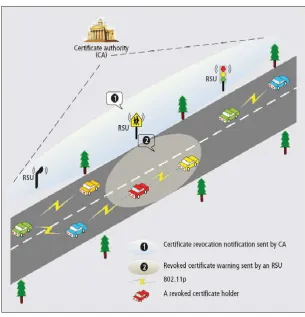
Fig.1.1. VANET System architecture
The android-based automotive infotainment system
Minyoung Kim and his team proposed a design with additional functions such as black box and self-diagnosis, which they added to the automotive infotainment systems, based on the android platform embedded hardware (Minyoung
Kim et al., 2014). The highlight of their work is the set up of
[image:3.595.117.483.71.179.2]an architecture using an Android platform that is independent from current automotive development platforms like GENIVI. The open source android platform allows the addition of adaptive third-party applications based on user preferences. The figure 2.2 describes an Android-based auto infotainment system.
Figure 2.2. Android-based auto infotainment system
Infotainment system architecture based on google android
Gianpaolo Macario also proposed an Android based architecture for in-vehicle infotainment (Gianpaolo Macario et al., 2009). Similar to Minyoung’s work, they proposed an architecture that can attach third-party applications based on the Android platform. In this work, they proposed a safe mechanism for third-party applications to access vehicle data. They used Google Android features to handle inter-application communication. To verify the feasibility, they implemented a prototype system using this architecture. Unfortunately, they did not provide related experiment results and their architecture doesn’t adopt the cloud technology. The figure 2.3 represents an android based infotainment system based on google android as below.
Figure 2.3. Android-based Infotainment system based on Google Android
Integrated embedded system architecture for infotainment
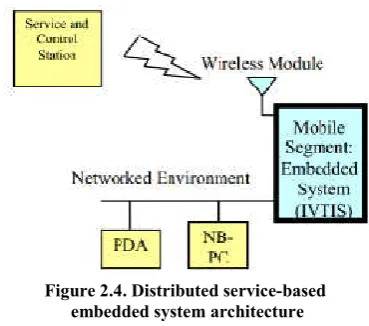
[image:3.595.40.273.362.424.2]National Chia-Yi University developed a system called Mayday, which provided location based services for vehicles through Wifi and (General Packet Radio Service) GPRS .GPRS is a packet oriented mobile data service on the 2G and 3G cellular communication system’s global system for mobile communications (http://www.gsmworld.com/technology/gprs/ intro.shtml, 2000). To meet the need for vehicle the Internet access from anywhere, a distributed service-based architecture was proposed based on Jini middleware technology. They proposed an embedded system architecture, as shown in figure 2.4 which consists of the service and control station segment (SCS), and the mobile segment (MS). This system took the location information from a GPS receiver. For infotainment purposes, the system had an in-vehicle network that worked as a LAN server to provide a connection to stream data with other devices such as PC, PDA, and tablet. However, this paper didn’t mention the middleware server and customized services model. The middleware server plays an important role in telematics.
Figure 2.4. Distributed service-based embedded system architecture
Other in-vehicle infotainment related works
[image:3.595.340.525.454.617.2]Besides these principal related works, we also skimmed through another infotainment works. To make the point clear, we created a Table 3.1, which compares these previous works to our proposed work. We mainly consider these related work from two aspects. One aspect is efficiency and versatility of the infotainment system. Hackbarth (2003) proposed a modular architecture for infotainment systems, mainly designed to meet the needs of various hardware and configurations. Macario et al. (5) argue for am Android platform for infotainment system development, to make it accessible to most users. Al-Ani (2012) also proposed an android-based infotainment system. While Android provides a generic platform for infotainment applications, car manufacturers still prefers their own platform
Table 3.1. Comparision of Work on infotainment system design
Work Vanet Cloud Mashup & fushion Dynamic resource selection Gianpaolo Macario (2009) NO NO NO NO
Hackbarth (2003) NO NO NO NO
Al-Ani (2012) NO NO NO NO
Festag et al. (2008) YES NO NO NO Cheng et al. (2011) YES NO NO NO Lattanzi et al. (2009) YES NO NO NO Hussain et al. (2013) YES YES NO NO Minyoung Kim (2014) YES YES NO NO Rangarajan et al. (2013) YES YES NO NO
[image:3.595.43.286.645.768.2]because of specific requirements and features. Another important aspect considered by researchers is the networking protocols of VANETs. Festag et al. (2008) proposed a geocast routing protocol customized for safety, efficiency, and infotainment messages, Huang et al. also proposed a routing mechanism for infotainment messages, Cheng et al. (2011) proposed a link layer optimization for infotainment messages. Also, Salvo et al. (2012) provide forwarding rules so that infotainment messages reach maximum nodes, and Amadeo et al. propose an enhancement of IEEE 802.11p to better accommodate the traffic information that is generated through the infotainment application. Researchers have proposed several techniques to improve the user interface of infotainment systems. Sharma et al. (2008) proposed a component-based human-machine interface framework that adapts the interface of infotainment systems according to vehicular context. Different ways of connecting external devices to car infotainment systems have also been explored (Jan Sonnenberg, 2010). Ohn-Bar et al. proposed a vision-based control for infotainment systems. where the driver and the passengers can interact with the system with gestures rather than with a tactile interface. To cope with the processing needs of infotainment applications, Hsu et al. (2005) and Lattanzi et al. (2009) proposed the use of high power embedded processors.
We argue that such a solution would not be scalable. Also, processing Internet data in the cloud would reduce the bandwidth requirements, as only the results would be sent to the infotainment system over VANETs. Recently, Hussain et al. (2013) briefly discussed the idea of using cloud over VANETs, but no framework is proposed. The authors merely discuss the idea that the vehicle can use RSU as a gateway to the Internet cloud, but there needs to be a detailed investigation of the approach. Kim et al. delegates a malware detection process to the cloud in infotainment systems. Rangarajan et al. (2012) discuss security on cloud-based infotainment. A comparison of the proposed work with previous works is provided in Table 2.1, based on the following aspects: Network or VANETs considered or not? Cloud used or not? Internet resources fused or not? If includes a data filtering step or not? And have the authors identified cloud services for current infotainment systems or not? In this work, we propose a cloud-based infotainment framework for VANETs and explore the design issues of such a framework. We further validate our framework by building three infotainment applications based on the proposed framework where we consider resource information adaptors, data unification, data fusion, and service identification.
With respect to the previous literature, our goals are to:
Use new approaches to collect Internet data.
Design a data fusion strategy.
Implement the proposed architecture and validate it through experiments. We determined that it would be beneficial to our work to incorporate the features of the customized services model into our model. One advantage is that our system works for on demand data integration which can reduce data size by dropping the redundant data. Another advantage is improved system efficiency; since we move the data processing part and services model to the server, it reduces the delay and reaction times. It reduces hardware requirement on the client side and is therefore for manufacturers to adopt.
Moreover, we designed our system as an Internet resource accessible system.
Conclusions and Future Works
With the development of VANET, the users of vehicles can enjoy multimedia information and news through Internet. Motivated by Cloud computing and mashup services, Haolin proposed a cloud based middleware framework for vehicular infotainment application development. In the framework, all the services are either hosted in the Road Side Unit or in the common cloud.
Future work
Automtic Resource Selection.
Compatible for Urban and Rural environment.
Live traffic indication.
Enhance Numa's work to design user interface
Acknowledgement
I express my immense gratitude to my guide Dr. Chetana Prakash., Professor and H O D of MCA, BI E T, for her estimated guidance and valuable suggestions in bringing out this work successfully.
REFERENCES
Tarik Al-Ani. 2012. Android In-Vehicle Infotainment System (AIVI). PhD thesis, University of Otago.
Justin Berkowitz. The history of car radios. http://www.caranddriver.com/features/the-history-of-car-radios, 2010.
Sandro Rodriguez Garzon. 2012. Intelligent in-car-infotainment system: A prototypical implementation. pages 371–374, June.
Minyoung Kim, Jung-eun Lee, and Jong-wook Jang. 2014. Implementation of the androidbased automotive infortainment system for supporting drivers safe driving. In Ubiquitous Information Technologies and Applications, pages 501–508. Springer.
Gianpaolo Macario, Marco Torchiano, and Massimo Violante. 2009. An in-vehicle infotainment software architecture based on google android. pages 257–260. IEEE.
SIMON Buckingham. What is gprs. http://www. gsmworld.com/ technology/gprs/ intro.shtml, 2000.
Kai Hackbarth. Osgiservice-delivery-platform for car telematics and infotainment systems. In Advanced Microsystems for Automotive Applications 2003, pages 497– 507. Springer, 2003.
Andreas Festag, Roberto Baldessari, Wenhui Zhang, Long Le, Amardeo Sarma, and Masatoshi Fukukawa. Car-2-x communication for safety and infotainment in europe. NEC
Technical Journal, 3(1):21–26, 2008.
Ho Ting Cheng, Hangguan Shan, and Weihua Zhuang. Infotainment and road safety service support in vehicular networking: From a communication perspective. Mechanical Systems and Signal Processing, 25(6):2020– 2038, 2011.
Hemant Sharma, Roger Kuvedu-Libla, and A.K Ramani. Component oriented human machine interface for in-vehicle infotainment applications. In Proceedings of the World Congress on Engineering, volume 1. Citeseer, 2008. Jan Sonnenberg. Service and user interface transfer from
nomadic devices to car infotainment systems. pages 162– 165. ACM, 2010.
Roy Chaoming Hsu and Liang-Rui Chen. An integrated embedded system architecture for in-vehicle telematics and infotainment system. volume 4, pages 1409–1414. IEEE, 2005.
Lattanzi, A., Bettarelli, F. Toppi, R. and Capucci, E. 2009. Implementing a car infotainment system using nu-tech framework. pages 452–456. IEEE.
Sathyanarayanan Rangarajan, Monica Verma, Anand Kannan, Ayush Sharma, and Ingmar Schoen. V2c: a secure vehicle to cloud framework for virtualized and ondemand service provisioning. In Proceedings of the International Conference on Advances in Computing, Communications and Informatics, pages 148–154. ACM, 2012.
Rasheed Hussain, Fizza Abbas, Junggab Son, and Heekuck Oh. 2013. Tiaas: Secure cloudassisted tra c information dissemination in vehicular ad hoc networks. In Cluster, Cloud and Grid Computing (CCGrid), 2013 13th IEEE/ACM International Symposium on, pages 178–179. IEEE.