ISSN Online: 2327-4379 ISSN Print: 2327-4352
DOI: 10.4236/jamp.2019.71011 Jan. 17, 2019 123 Journal of Applied Mathematics and Physics
On the Equivalence of Implicit Kirk-Type
Fixed Point Iteration Schemes for a
General Class of Maps
Alfred Olufemi Bosede
1, Hudson Akewe
2, Omolara Fatimah Bakre
3, Ashiribo Senapon Wusu
11Department of Mathematics, Lagos State University, Ojo, Nigeria 2Department of Mathematics, University of Lagos, Akoka, Nigeria
3Department of Mathematics & Statistics, Federal College of Education (Technical), Akoka, Nigeria
Abstract
In this paper, a modified implicit Kirk-multistep iteration scheme and a strong convergence result for a general class of maps in a normed linear space was established. It was also shown that the convergence of this itera-tion scheme is equivalent to the convergency of some other implicit Kirk-type iteration (implicit Kirk-Noor, implicit Kirk-Ishikawa and implicit Kirk-Mann iterations) for the same class of maps. Some numerical exam-ples were considered to show that the equivalence of convergence results to the fixed point is true. The results unify most equivalence results in litera-ture.
Keywords
Implicit Kirk-Multistep, Implicit Kirk-Mann Iterations, Strong Convergence, Equivalence, General Class of Maps
1. Introduction
In 1971, Kirk introduced the Kirk iterative scheme as follows: Let
(
E, .)
be a normed linear space and D a non-empty, convex, closed subset of E and:
T D→D be a selfmap of D, let x0∈E, the sequence
{ }
xn n1∞
= is defined by
1
0 , 0, 0 1
k k
i
n i n i
i i
x+ αT x n α
= =
=
∑
≥∑
=(1)
Various authors have written inspiring papers on Kirk-type iterative schemes.
Worthy to mention are the following: the explicit Kirk-Mann, Olatinwo [1],
ex-plicit Kirk-Ishikawa, Olatinwo [1], Kirk-Noor, Chugh and Kumar [2] and
How to cite this paper: Bosede, A.O., Akewe, H., Bakre, O.F. and Wusu, A.S. (2019) On the Equivalence of Implicit Kirk- Type Fixed Point Iteration Schemes for a General Class of Maps. Journal of Applied Mathematics and Physics, 7, 123-137.
https://doi.org/10.4236/jamp.2019.71011 Received: December 16, 2018
Accepted: January 14, 2019 Published: January 17, 2019
Copyright © 2019 by author(s) and Scientific Research Publishing Inc. This work is licensed under the Creative Commons Attribution International License (CC BY 4.0).
DOI: 10.4236/jamp.2019.71011 124 Journal of Applied Mathematics and Physics
Kirk-multistep, Akewe, Okeke and Olayiwola [3] iterative schemes.
In 2014, Akewe, Okeke and Olayiwola [3] proposed an explicit Kirk-multistep
iterative schemes and proved strong convergence and stability results for con-tractive-like operators in a normed linear space, the researchers also gave useful numerical examples to back up their schemes. The authors in Chugh, Malik and
Kumar [4] made the following statements in their introduction: “Implicit
itera-tions have an advantage over explicit iteraitera-tions for nonlinear problems as they provide better approximation of fixed points and are widely used in many ap-plications when explicit iterations are inefficient. Approximation of fixed points in computer oriented programs by using implicit iterations can reduce the computational cost of the fixed point problems”. They considered a new implicit iteration and study its strong convergence, stability, and data dependence and also proved through numerical examples that newly introduced iteration has better convergence rate than well known implicit Mann iteration as well as im-plicit Ishikawa iteration and that imim-plicit iterations converge faster as compared to corresponding explicit iterations. However, it was observed that little work has been done on equivalence of implicit scheme.
The main aim of this work is in three folds: firstly, to develop a modified im-plicit Kirk-multistep scheme and prove strong convergence results for a general
class of mapping introduced by Bosede and Rhoades [5]. Secondly, to show that
the convergence of the implicit Kirk-multistep iteration scheme is equivalent to the convergency of implicit Kirk-Noor, implicit Kirk-Ishikawa and implicit Kirk-Mann iterations for the same class of mapping under consideration.
Let
(
E, .)
be a normed linear space and D a non-empty, convex, closedsubset of E and T D: →D be a selfmap of D, let x0∈D. Then, the sequence
{ }
xn n∞=0 defined by1 1
1 1
1
1 ,0 1 , 1 0 ,
1
,0 1 , 0 ,
1 1 1 1 1
,0 1 , 0 ,
, 1
, 1, 1,2, , 2,
, 1, 2, 1
j j
k k
q i q n n n i n i n i n i
q q
j j j j i j j n n n i n i n i n i
q q
k k k i k k n n n i n i n i n i
x x T x
x x T x j k
x x T x k n
α α α
β β β
β β β
+ +
+ = + =
+
= =
− − − − −
= =
= + =
= + = = −
= + = ≥ ≥
∑
∑
∑
∑
∑
∑
(2)
where q1≥q2≥q3 ≥≥qk, for each j, αn i, ≥0, αn,0≠0,
β
n ij, ≥0,β
nj,0≠0,for each j,
α β
n i,, n ij, ∈[ ]
0,1 for each j and q1, qj are fixed integers (for each j). (2) is called implicit Kirk-multistep iterations.Equation (2) serves as a general formula for obtaining other implicit Kirk-type iterations. Infact, if k=3 in (2), we obtain a three step (implicit Kirk-Noor) iteration as follows:
1 1
2 2
3 3
1
1 ,0 1 , 1 0 ,
1 1 2 1 1 1
,0 1 , 0 ,
2 2 2 2 2
,0 1 , 0 ,
, 1
, 1,
, 1,
q i q n n n i n i n i n i
q i q n n n i n i n i n i
q i q n n n i n i n i n i
x x T x x x T x x x T x
α α α
β β β
β β β
+ = + =
= =
= =
= + =
= + =
= + =
∑
∑
∑
∑
∑
∑
(3)
where q1≥q2≥q3, αn i, ≥0, αn,0≠0,
β
n i1, ≥0,β
1n,0≠0,β
n i2, ≥0,β
n2,0 ≠0,[ ]
1 2 ,, ,, , 0,1
n i n i n i
DOI: 10.4236/jamp.2019.71011 125 Journal of Applied Mathematics and Physics
If k=2 in (2), we obtain a two step (implicit Kirk-Ishikawa) iteration as
follows:
1 1
2 3
1
1 ,0 1 , 1 0 ,
1 1 1 1 1
,0 1 , 0 ,
, 1
, 1,
q i q n n n i n i n i n i
q i q n n n i n i n i n i
x x T x x x T x
α α α
β β β
+ = + =
= =
= + =
= + =
∑
∑
∑
∑
(4)where q1≥q2, αn i, ≥0, αn,0 ≠0,
β
n i1, ≥0,β
n1,0 ≠0,α β
n i,, 1n i, ∈[ ]
0,1 and 1q and q2 are fixed integers.
Finally, if k=2 and q2 =0 in (2), we obtain a one step (implicit Kirk-Mann)
iteration as follows:
1 1
1
1 ,0 , 1 ,
1 , 0 1,
q q
i
n n n n i n n i
i i
x+ α x α T x+ α
= =
= +
∑
∑
=
(5) where αn i, ≥0, αn,0≠0,
α
n i, ∈[ ]
0,1 and q1 is a fixed integer.Equations (3)-(5) will be rewritten in the following forms to help us prove our equivalence result:
Let
(
E, .)
be a normed linear space and D a non-empty, convex, closedsubset of E and T D: →D be a selfmap of D, let y0∈D. Then, the implicit
Kirk-Noor scheme is a sequence
{ }
yn n∞=0 defined by1 1
2 2
3 3
1
1 ,0 1 , 1 0 ,
1 1 2 1 1 1
,0 1 , 0 ,
2 2 2 2 2
,0 1 , 0 ,
, 1
, 1
, 1
q i q n n n i n i n i n i
q i q n n n i n i n i n i
q i q n n n i n i n i n i
y y T y
y y T y y y T x
α α α
β β β
β β β
+ = + =
= =
= =
= + =
= + =
= + =
∑
∑
∑
∑
∑
∑
(6)
where q1≥q2≥q3, αn i, ≥0, αn,0 ≠0,
β
n i1, ≥0,β
n1,0 ≠0,β
n i2, ≥0,β
n2,0 ≠0,[ ]
1 2 ,, ,, , 0,1
n i n i n i
α β β
∈ and q q1, 2 and q3 are fixed integers.Also, for z0∈D, the two step (implicit Kirk-Ishikawa) iteration scheme is a
sequence
{ }
zn n∞0= defined as follows:
1 1
2 2
1
1 ,0 1 , 1 0 ,
1 1 1 1 1
,0 1 , 0 ,
, 1
, 1
q i q n n n i n i n i n i
q i q n n n i n i n i n i
z z T z z z T z
α α α
β β β
+ = + =
= =
= + =
= + =
∑
∑
∑
∑
(7)
where q1≥q2, αn i, ≥0, αn,0 ≠0,
β
n i1, ≥0,β
n1,0 ≠0,α β
n i,, 1n i, ∈[ ]
0,1 and 1q and q2 are fixed integers.
Finally, for u0∈D, the implicit Kirk-Mann iteration scheme is a sequence
{ }
un n∞=0 defined by:1 1
1
1 ,0 , 1 ,
1 , 0 1
q q
i
n n n n i n n i
i i
u + α u α T u+ α
= =
= +
∑
∑
=(8) where αn i, ≥0, αn,0≠0,
α
n i, ∈[ ]
0,1 and q1 is a fixed integer. We shall nowconsider some of the contractive mappings useful in proving our main results. Let E be a normed linear space and D a non-empty, convex, closed subset of E
and T D: →D be a selfmap of D. There exists a real number a∈
[
0,1)
andall x y D, ∈ such that
x Ty− ≤a x y−
(9)
DOI: 10.4236/jamp.2019.71011 126 Journal of Applied Mathematics and Physics
condition:
2
Tx Ty− ≤
δ
x y− +δ
x Tx−
(10)
where
δ
∈[ )
0,1 . Inequality (10) becomes (9) if x is a fixed point of T.Osilike [7] proved several stability results which are generalizations and ex-tensions of most of the results of Rhoades [8] using the following contractive de-finition: for each x y E, ∈ , there exist a∈
[ )
0,1 and L≥0 such thatTx Ty a x y L x Tx− ≤ − + −
(11)
In 2003, Imoru and Olatinwo [9] proved some stability results using the
fol-lowing general contractive definition: for each x y E, ∈ , there exists
δ
∈[
0,1)
and a monotone increasing function
ϕ
:R+ →R+ withϕ
( )
0 =0 such that(
)
.Tx Ty− ≤δ x y− +ϕ x Tx−
(12)
In 2010, Bosede and Rhoades [5], made an assumption implied by (9) and one
which attempted to put an end to all generalizations of the form (12). That is if
x p= (is a fixed point) then (12) becomes inequality (9).
In 2014, Chidume and Olaleru [10] gave several examples to show that the
class of mappings satisfying (9) is more general than that of (10), (11) and (12) provided the fixed point exists.
We shall need the following lemma in proving our result.
Lemma 1.2 [11]: Let δ be a real number satisfying 0≤ <δ 1 and
{ }
n n∞=0a sequence of positive numbers such that limn→∞n=0, then for any sequence
of positive numbers
{ }
un n 0∞
= satisfying
1 ; 0,1,2,
n n n
u+ ≤δu + n=
(13)
we have limn→∞un =0.
Lemma 1.3 [12]: Let
{ }
an n 0∞
= and
{ }
en n 0∞
= be nonnegative real sequences
satisfying the following inequality an+1≤ −
(
1λ
n)
a en+ n, whereλ
n∈( )
0,1 , forall n n≥ 0, n 0λn
∞
= = ∞
∑
and en =o( )
λ
n . Then limn→∞an =02. Main Result
Theorem 2.1. Let
(
E, .)
be a normed linear space, D a non-empty, convex, closed subset of E and T D: →D, a self map satisfying the inequality:i i
T x Tp− ≤a x p−
(14)
where ai∈
[ )
0,1 and p F T∈( )
. For0
x ∈D , let
{ }
xn be the implicit Kirk-multistep iteration scheme defined by (2) with n 1(
1 αn,0)
∞
= − = ∞
∑
. Theni) the fixed point p of T defined by (14) is unique;
ii) the implicit Kirk-multistep iteration scheme converges strongly to the unique fixed point p of T.
Proof:
DOI: 10.4236/jamp.2019.71011 127 Journal of Applied Mathematics and Physics
Suppose there exist p p1, 2∈FT, and that p1≠ p2, with p p1− 2 >0, then,
(
1−a p pi)
1− 2 ≤0.(15)
Since ai∈
[ )
0,1 , then 1−ai >0 and1 2 0
p p− ≤ . Since norm is
nonnega-tive we have that p p1− 2 =0. That is, p1= p2 = p (say). Thus, T has a
unique fixed point p.
ii) Next, we prove that (2) converges strongly to p. In veiw of (2) and (14),
( ) ( ) ( ) 1 1 1 1
1 ,0 , 1
1 1
,0 , 1
1 ,0 1 , 1 1 q i i n n n n i n
i q
i n n n i n
i n n q i n i i
x p x p T x T p x p a x p
x p a α α α α α α + + = + = = − ≤ − + − ≤ − + − ≤ − −
∑
∑
∑
(16)
Also, using (2) and (14), we have:
( ) ( ) ( ) ( ) ( ) ( ) ( ) ( ) ( ) ( ) ( ) ( ) 2 2 2
1 1 2 1 1
,0 ,
1
1 2 1 1
,0 , 1 1 ,0 2 1 , 1 1 q i i n n n n i n
i q
i n n n i n
i n n q i n i i
x p x p T x T p x p a x p
x p a β β β β β β = = = − ≤ − + − ≤ − + − ≤ − −
∑
∑
∑
(17)Again, using (2) and (14), we have:
( ) ( ) ( ) ( ) ( ) ( ) ( ) ( ) ( ) ( ) 3 3 3
2 2 3 2 2
,0 ,
1
2 3 (2) 2
,0 , 1 2 ,0 3 2 , 1 1 q i i n n n n i n
i q
i n n n i n
i n n q i n i i
x p x p T x T p x p a x p
x p a β β β β β β = = = − ≤ − + − ≤ − + − ≤ − −
∑
∑
∑
(18)Continuing the process using (2) and (14), we have
( ) ( ) ( ) ( ) ( ) ( ) ( ) ( ) ( ) ( ) ( ) 1 1 1
2 2 1 2 2
,0 ,
1
2 1 2 2
,0 , 1 2 ,0 1 2 , 1 1 k k k q
k k k k i k i
n n n n i n
i q
k k k i k n n n i n
i k
n k
n q k i
n i i
x p x p T x T p
x p a x p
x p a β β β β β β − − − − − − − − = − − − − = − − − = − ≤ − + − ≤ − + − ≤ − −
∑
∑
∑
(19)Finally, using (2) and (14) for
(
k−1)
, we have:( ) ( ) ( ) ( )
( ) ( ) ( ) ( )
( )
( ) ( )
1 1 1
,0 ,
1
1 1 1
,0 , 1 1 ,0 1 , 1 1 k k k q
k k k k i k i n n n n i n
i q
k k k i k n n n i n
i k
n k
n q k i
n i i
x p x p T x T p x p a x p
DOI: 10.4236/jamp.2019.71011 128 Journal of Applied Mathematics and Physics
Substituting (20) in (19), (19) in (18), (18) in (17) and (17) in (16), we obtain:
( )
( )
( )
( )
( )
( )
( )
( ) ( )
1 2 3
1
1 2
,0 ,0 ,0
1 1 2
, , ,
1 1 1
2 1
,0 ,0
2 1
, ,
1 1
1 1 1
1 k 1 k
n n n
n q i q i q i
n i n i n i
i i i
k k
n n k
n q k i q k i
n i n i
i i
x p
a a a
x p
a a
α β β
α β β
β β
β β
−
+
= = =
− −
− −
= =
− ≤
− − −
⋅ −
− −
∑
∑
∑
∑
∑
(21)
Note that
1
1
1 1
, ,0 1
,0
, ,0 1
, ,
1 1
1
1 1
1 1
q i q
n i n i
n i
n i n
q i q i i
n i n i
i i
a
a
a a
α α
α
α α
α α
=
=
= =
− +
− = ≥ − +
− −
∑
∑
∑
∑
(22)hence
1 1
,0
, ,0 1
, 1
1
q
n i
n i n q i i
n i i
a a
α
α
α
α
==
≤ +
−
∑
∑
Let ai< <a 1, then
(
)
1
, ,0 ,0 ,0
1 1
q i
n i n n n
i a a
α α α α
=
+ ≤ − +
∑
(23)
That is,
(
)
1
,0
,0 ,0 ,
1
1 1
n
n n q i
n i i
a a
α
α
α
α
=≤ − +
−
∑
(24)
Therefore,
(
)
(
( ))
( )(
( ))
( )( )
(
)
( )(
( ))
( )(
)
(
)
1 1 2 2
1 ,0 ,0 ,0 ,0 ,0 ,0
2 2 1 1
,0 ,0 ,0 ,0
,0
1 1 1
1 1
1 1 1
n n n n n n n
k k k k
n n n n n
n n
x p a a a
a a x p
a x p
α
α
β
β
β
β
β
β
β
β
α
+− − − −
− ≤ − + − + − +
⋅ − + − + −
≤ − − − −
(25)
Hence, using Lemma 1.2 in (25), then limn→∞ xn−p =0 This ends the
proof.
Theorem 2.1 leads to the following corollary:
Corollary 2.2. Let
(
E, .)
be a normed linear space, D a non-empty, convex, closed subset of E and T D: →D, with p F T∈( )
, such that:i i
T x p− ≤a x p−
(26)
where ai∈
[ )
0,1 . For0 0 0
y =z =u ∈D, let
{ }
yn{ }
zn{ }
un be the implicitKirk-Noor, implicit Kirk-Ishikawa and implicit Kirk-Mann iteration scheme re-spectively defined by (6), (7) and (8) with n1
(
1 αn,0)
∞
= − = ∞
∑
,(
1)
,0
1−βn = ∞,
(
2)
,0
1−βn = ∞. Then
i) T defined by (26) has a unique fixed point p;
ii)
{ }
yn (6) converges strongly to the unique fixed point p of T;iii)
{ }
zn (7) converges strongly to the unique fixed point p of T;iv)
{ }
un (8) converges strongly to the unique fixed point p of T.DOI: 10.4236/jamp.2019.71011 129 Journal of Applied Mathematics and Physics
closed subset of E and T D: →D an operator satisfying
i i
T x Tp− ≤a x p−
(27)
where ai∈
[ )
0,1 and p F T∈( )
. If0 0
u =x ∈D, then the following are
equiv-alent: the
i) implicit Kirk-Mann iterative scheme
{ }
un n∞=0 (8) converges strongly to p; ii) implicit Kirk-multistep iterative scheme{ }
xn n 0∞
= (2) converges strongly to p.
Proof:
We prove that (i) ⇒ (ii).
Assume limn→∞un= p, then using (8), (2) and (27), we have
( )
(
)
( )
1 1
1
1
1 1 ,0 , 1 , 1
1 1
1
,0 , 1 1
1 .
q q
i i
n n n n n n i n n i n
i i
q
i i n n n n i n n
i
u x u x T u T x u x T u T x
α
α
α
α
α
+ + + +
= =
+ +
=
− = − + −
≤ − + −
∑
∑
∑
(28)
Using condition (27) in (28), we have
( )
( )
1
1
1
1 1 ,0 , 1 1
1
,0 1
, 1
1
q i
n n n n n n i n n
i
n
n n
q i
n i i
u x u x a u x
u x a
α α
α α
+ + + +
=
=
− ≤ − + −
≤ −
−
∑
∑
(29)
From (29),
( ) ( ) ( ) ( ) ( )
( ) ( ) ( ) ( ) ( )
( ) ( ) ( ) ( )
2
2 2
2 2
1 1 2 1 1
,0 ,
1
1 2 1 1 1
,0 , ,
1 1
1 2 1 (1) 1
,0 , ,
1 1
q
i i i n n n n n n i n n n n
i
q q
i i i
n n n n i n n n i n n
i i
q q
i i
n n n n i n n n i n n
i i
u x u x u T u T u T x u x u T u T u T x u x u T u a u x
β β
β β β
β β β
=
= =
= =
− ≤ − + − + −
≤ − + − + −
≤ − + − + −
∑
∑
∑
∑
∑
(30)
From (30),
( ) ( )
( ) ( )
( )
( )
2
2 2
1 1
,
1 ,0 2 1
1 1
, ,
1 1
1 1
q n i
n i i
n n q i n n q i n n
n i n i
i i
u x u x u T u
a a
β
β
β
β
=
= =
− ≤ − + −
− −
∑
∑
∑
(31)But from (31),
i i i
n n n n n n
u T u− = u − +p Tp T u− ≤ u −p + Tp T u−
(32) Applying condition (27) on (31), we get
(
1)
i i
n n n
u T u− ≤ +a u −p
(33)
Using (33) in (31), we have
( ) ( )
( ) ( )
( )
( )
(
)
2
2 2
1 1
,
1 ,0 2 1
1 1
, ,
1 1
1
1 1
q n i
n i i
n n q i n n q i n
n i n i
i i
u x u x a u p
a a
β
β
β
β
=
= =
− ≤ − + + −
− −
∑
∑
∑
(34)DOI: 10.4236/jamp.2019.71011 130 Journal of Applied Mathematics and Physics ( ) ( ) ( ) ( ) ( ) ( )
(
)
3 3 3 2 2 ,2 ,0 3 1
2 2 , , 1 1 1 1 1 q n i
n i i
n n q i n n q i n
n i n i
i i
u x u x a u p
a a
β
β
β
β
= = = − ≤ − + + − − −∑
∑
∑
(35)Also ( ) ( ) ( ) ( ) ( ) ( )
(
)
4 4 4 3 3 ,3 ,0 4 1
3 3 , , 1 1 1 1 1 q n i
n i i
n n q i n n q i n
n i n i
i i
u x u x a u p
a a
β
β
β
β
= = = − ≤ − + + − − −∑
∑
∑
(36)Continuing (k − 2) times, we have
( ) ( ) ( ) ( ) ( ) ( )
(
)
1 1 1 22 ,0 1
2 , 1 2 , 1 2 , 1 1 1 1 k k k k
k n k
n n q k i n n n i
i q k
n i i i
n q k i
n i i
u x u x
a
a u p a
β
β
β
β
− − − − − − − = − = − = − ≤ − − + + − −∑
∑
∑
(37)Moving a step more, we have
( ) ( ) ( ) ( ) ( ) ( )
(
)
1 1 ,1 ,0 1
1 1 , , 1 1 1 1 1 k k k q k k n i
k n k i i
n n q k i n n q k i n
n i n i
i i
u x u x a u p
a a
β
β
β
β
− − − = − − = = − ≤ − + + − − −∑
∑
∑
(38)Substituting (35) into (34), (34) into (33), (33) into (32) and (32) into (31) re-spectively, we obtain
( ) ( ) ( ) ( ) ( ) ( ) ( ) ( ) ( ) ( ) ( )
1 2 3 4
1
1 1
1 2 3
,0 ,0 ,0 ,0
1 2 3
, , , ,
1 1 1 1
2 1 ,0 ,0 2 1 , , 1 1 1 ,0
1 1 1 1
1 1
1
k k
n n
n n n n
q i q i q i q i n i n i n i n i
i i i i
k k
n n
n n q k i q k i
n i n i
i i
n
u x
a a a a
u x
a a
α β β β
α β β β
β β β β β − + + = = = = − − − − = = − ≤ − − − − − − − + −
∑
∑
∑
∑
∑
∑
( ) ( ) ( ) ( ) ( ) ( ) ( ) ( ) ( ) ( ) ( ) ( ) 42 3 4
1 2
3 2
,
,0 1
1 2 3
, , ,
1 1 1
1
2 1
,
,0 1 ,0
2 1 1
, , ,
1 1 1
2 , 1
1 1
1 1 1
k
k k
q n i
n i
q i q i q i n i n i n i
i i i
q k k
n i
n i n
q k i q k i q i n i n i n i
i i i
k n i i
a a a
a a a
β β
β β β
β
β β
β β β
β − = = = = − − = − − = = = − = − − + − − −
∑
∑
∑
∑
∑
∑
∑
∑
( ) ( ) ( )(
)
1 21 2 1
1
, ,0
1
2 1
, , ,
1 1 1
1
1 1 1
k k
q q
n i n i
i
n q k i q i q i
n i n i n i
i i i
a u p
a a a
β α
β β α
− − = − = = = + + − − − −
∑
∑
∑
∑
∑
(39) Recall that 1 1 ,0 , ,0 1 , 1 1 q n in i n q i i n i i a a
α
α
α
α
= = ≤ + −∑
∑
(40)
Let ai< <a 1, then
(
)
1
, ,0 ,0 ,0
1 1
q i
n i n n n
i a a
α α α α
=
+ ≤ − +
∑
(41)
DOI: 10.4236/jamp.2019.71011 131 Journal of Applied Mathematics and Physics
(
)
(
( ))
( )(
( ))
( )(
( ))
( ) ( )(
)
( )(
( ))
( ) ( )(
)
( )(
( ))
( )(
( ))
( ) ( )(
)
1 11 1 2 2 3 3
,0 ,0 ,0 ,0 ,0 ,0 ,0 ,0
2 2 1 1
,0 ,0 ,0 ,0
1 1 2 2 3 3
,0 ,0 ,0 ,0 ,0 ,0
2 ,0
1 1 1 1
1 1
1 1 1
1
n n
n n n n n n n n
k k k k
n n n n n n
n n n n n n
k n
u x
a a a a
a a u x
a a a
α α β β β β β β
β β β β
β β β β β β
β + + − − − − − − ≤ − + − + − + − + − + − + − + − + − + − + − ( ) ( ) ( )
(
( ))
( ) 1 ,2 1 1 1
,0 1 ,0 ,0
, 1 1 1 k k q k n i k i
n q k i n n
n i i
a a
a
β
β β β
β − − = − = + + − + −
∑
∑
( ) ( ) ( ) ( )(
)
(
)
(
)
(
)
(
( ))
( )(
( ))
( ) ( )(
)
( )(
( ))
1 2 1 2 2 1 , , 1 1 ,0 ,0 2 1 , , 1 11 1 2 2
,0 ,0 ,0 ,0 ,0
3 3 2
,0 ,0 ,0
1 1
1 1
1 1 1 1 1
1 1
k k
q k q
n i n i i
i i
n n n
q k i q i n i n i
i i
n n n n n n n
k
n n n
a a u p
a a
a u x a a
a a
β β
α α
β β
α β β β β
β β β
− − − = = − = = − + − + + − − − ≤ − − − − + − + − + ⋅ − + −
∑
∑
∑
∑
( ) ( ) ( ) ( )(
)
( ) ( ) ( ) ( ) ( )(
)
(
)
1 2 1 2 1 , 2 1 ,0 1 , 1 2 1 , ,1 1 1 1
,0 ,0 2 1
, , 1 1 ,0 ,0 1 1 1 1 1 1 k k k k q k n i k i
n q k i n i i
q k q
n i n i
i i
n n q k i q i n i n i
i i
i
n n n
a a
a a
a a u p
β β β β β β β β β α α − − − − = − = − = = − = = + − + − + + − − ⋅ − + + −
∑
∑
∑
∑
∑
∑
(42)Let λn= −
(
1 αn,0)
(
1−a)
and ( )(
)
( )(
( ))
( )(
( ))
( ) ( )(
)
( ) ( ) ( ) ( )(
)
( ) ( ) ( ) ( ) 1 21 1 2 2 3 3
,0 ,0 ,0 ,0 ,0 ,0
1 ,
2 2 1
,0 ,0 1
, 1
2 1
, ,
1 1 1 1
,0 ,0 2
, ,
1
1 1 1
1 1 1 1 1 k k k k
n n n n n n n
q k
n i
k k i
n n q k i
n i i
q k q
n i n i
i i
n n q k i
n i n
i
e a a a
a
a
a
a
β β β β β β
β β β β β β β β β β − − − − = − = − = = − = = − + − + − + − + − + − + + − −
∑
∑
∑
∑
∑
( )(
)
(
)
2 1 1 ,0 ,0 1 1 q i i i in n n
a
a a u p
α α = ⋅ − + + −
∑
(43)Replacing (40) in (39), we have
(
)
1 1 1
n n n n n n
u+ −x+ ≤ −
λ
u −x +e(44) By Lemma 1.3 in (41), it follows that
lim n n 0
n→∞ u −x = (45)
Since by the assumption, limn→∞un= p,
then xn−p ≤ un−xn + un−p →0 as
n
→ ∞
Hence limn→∞xn = p.
Next is to show that (ii) implies (i).
DOI: 10.4236/jamp.2019.71011 132 Journal of Applied Mathematics and Physics ( )
(
)
(
)
( ) ( ) 1 1 1 11 1 ,0 , 1 1
1 1
,0 , 1 1
1 ,0 1 , 1 1 q i i n n n n n n i n n
i q
i i i n n n n i n n
i n n n q i n i i
x u x u T x T u x u a T x T u
x u a α α α α α α + + + + = + + = = − ≤ − + − ≤ − + − ≤ − −
∑
∑
∑
(46) ( ) ( )(
( ))
( )(
( ))
( ) ( ) ( ) ( ) ( ) ( ) ( ) ( ) ( ) ( ) ( ) ( ) ( ) ( ) 2 2 2 2 2 21 1 2 1 1
,0 ,
1
1 2 1 1
,0 ,
1
1 2 1 1 1
,0 , ,
1 1
1 2 1 1 1
,0 , ,
1 1
q
i
n n n n n n i n n
i q
i i i
n n n n i n n n n
i
q q
i i i
n n n n i n n n i n n
i i
q q
i i
n n n n i n n n i n n
i i
x u x u T x u
x u T x T u T u u
x u T x T u T u u
x u a x u T u u
β β
β β
β β β
β β β
= = = = = = − ≤ − + − ≤ − + − + − ≤ − + − + − ≤ − + − + −
∑
∑
∑
∑
∑
∑
(47)By simplifying (42), we obtain
( ) ( ) ( ) ( ) ( ) ( ) 2 2 2 1 1 ,
1 ,0 2 1
1 1 , , 1 1 1 1 q n i
n i i
n n q i n n q i n n
n i n i
i i
x u x u T u u
a a
β
β
β
β
= = = − ≤ − + − − −∑
∑
∑
(48)But,
(
1)
i i i
n n n n
i i n n i n n i n
T u u T u T p p u T u T p p u a u p u p
a u p
− ≤ − + − ≤ − + − ≤ − + − ≤ + −
(49)
Substituting (44) in (43), we have
( ) ( ) ( ) ( ) ( ) ( )
(
)
2 2 2 1 1 ,1 ,0 2 1
1 1 , , 1 1 1 1 1 q n i
n i i
n n q i n n q i n
n i n i
i i
x u x u a u p
a a
β
β
β
β
= = = − ≤ − + + − − −∑
∑
∑
(50)Similarly, ( ) ( ) ( ) ( ) ( ) ( )
(
)
3 3 3 2 2 ,2 ,0 3 1
2 2 , , 1 1 1 1 1 q n i
n i i
n n q i n n q i n
n i n i
i i
x u x u a u p
a a
β
β
β
β
= = = − ≤ − + + − − −∑
∑
∑
(51)Also, ( ) ( ) ( ) ( ) ( ) ( )
(
)
4 4 4 3 3 ,3 ,0 4 1
3 3 , , 1 1 1 1 1 q n i
n i i
n n q i n n q i n
n i n i
i i
x u x u a u p
a a
β
β
β
β
= = = − ≤ − + + − − −∑
∑
∑
(52)Continuing the process upto (k − 2), we have
( ) ( ) ( ) ( ) ( ) ( )
(
)
1 1 1 2 2 ,2 ,0 1 1
2 2 , , 1 1 1 1 1 k k k q k k n i
k n k i i
n n q k i n n q k i n
n i n i
i i
x u x u a u p
a a
β
β
β
β
− − − − − − − = − − = = − ≤ − + + − − −∑
∑
∑
(53)DOI: 10.4236/jamp.2019.71011 133 Journal of Applied Mathematics and Physics
( ) ( )
( )
( )
( )
(
)
1 1
,
1 ,0 1
1 1
, ,
1 1
1
1 1
k
k k
q k k
n i
k n i i
n n q k i n n q k i n
n i n i
i i
x u x u a u p
a a
β
β
β
β
− −
− =
− −
= =
− ≤ − + + −
− −
∑
∑
∑
(54)Substituting accordingly from (41) to (48), we get
(
)
(
( ))
( )(
( ))
( )(
( ))
( )( )
(
)
( )(
( ))
( )1 1
1 1 2 2 3 3
,0 ,0 ,0 ,0 ,0 ,0 ,0 ,0
2 2 1 1
,0 ,0 ,0 ,0
1 1 1 1
1 1
n n
n n n n n n n n
k k k k
n n n n n n
x u
a a a a
a a x u
α α β β β β β β
β β β β
+ +
− − − −
−
≤ − + − + − + − +
− + − + −
( )
(
)
( )(
)
(
(
( ))
( ))
(
(
( ))
( ))
( )
( )
(
(
( ))
( ))
( )
( )
( )
( )
(
(
)
)
1 1
2 2
1 1 2 2 2 2
,0 ,0 ,0 ,0 ,0 ,0
1 2
, 1 1 ,
1 1
,0 ,0
1 2
, ,
1 1
1 , 1
,0 ,0 1
, 1
1 1 1
1
1 1
1 1
k k
k k
k k
n n n n n n
q k q k
n i n i
i i
n n
q k i q k i
n i n i
i i
q n i i
n n q i
n i i
a a a
a
a a
a a
β β β β β β
β β
β β
β β
β
α α
β
−
−
− −
− −
= =
− −
= =
=
=
+ − + − + − +
⋅ + − +
− −
+ − +
−
∑
∑
∑
∑
∑
∑
(
i 1)
n
a + u −p
(55)
(50) can be written as:
(
)
(
)
(
)
(
)
1 1 ,0
,0 ,0
1 1 1
1 1 1
n n n n n
i
n n n
x u a x u
a a u p
α
α α
+ − + ≤ − − − −
+ − − + + −
(56)
Let
(
1 ,0)
(
1)
1 1(
,0)
,0(
i 1)
n n a en n a n a un p
λ = −α − = − − α +α + −
Therefore,
(
)
1 1 1
n n n n n n
x+ −u + ≤ −
λ
x u− +e (57)It follows from Lemma 1.3 that: limn→∞ x un− n =0
Since by assumption, limn→∞un= p Then,
0,
n n n n
u −p ≤ x u− + x −p → n→ ∞.
This implies that limn→∞un= p.
Since (i) → (ii) and (ii) → (i), it shows that the convergence of implicit Kirk-Mann iterative scheme (8) is equivalent to the convergence of implicit Kirk-multistep iterative scheme (2) when applied to the general class of map (14). This ends the proof.
Theorem 2.3 leads to the following Corollaries:
Corollary 2.4. Let
(
E, .)
be a normed linear space, D a non-empty, convex, closed subset of E and T D: →D, with p F T∈( )
, satisfyingi i
T −p ≤a x p−
(58)
where ai∈
[ )
0,1 . If0 0 0
u =z =y ∈D, then the following are equivalent: the
a) (i) implicit Kirk-Mann iterative scheme
{ }
un n∞=0 (8) converges strongly top;
DOI: 10.4236/jamp.2019.71011 134 Journal of Applied Mathematics and Physics p.
b) (i) implicit Kirk-Mann iterative scheme
{ }
un n∞=0 (8) converges strongly top;
(ii) implicit Kirk-Noor iterative scheme
{ }
yn n∞=0 (6) converges strongly to p. Proof. The proof of Corollary 2.4 is similar to that of Theorem 2.3.This ends the proof.Corollary 2.5. Let
(
E, .)
be a normed linear space, D a non-empty, convex, closed subset of E and T D: →D an operator satisfyingi i
T −p ≤a x p−
(59)
where ai∈
[ )
0,1 . If0 0 0 0
u =z =y =x ∈D, then the following are equivalent:
i) implicit Kirk-Mann iterative scheme
{ }
un n 0∞
= (8) converges strongly to p;
ii) implicit Kirk-Ishikawa iterative scheme
{ }
zn n∞=0 (7) converges strongly top;
iii) implicit Kirk-Noor iterative scheme
{ }
yn n∞=0 (6) converges strongly to p; iv) implicit Kirk-multistep iterative scheme{ }
xn n 0∞
= (2) converges strongly to p.
3. Numerical Examples
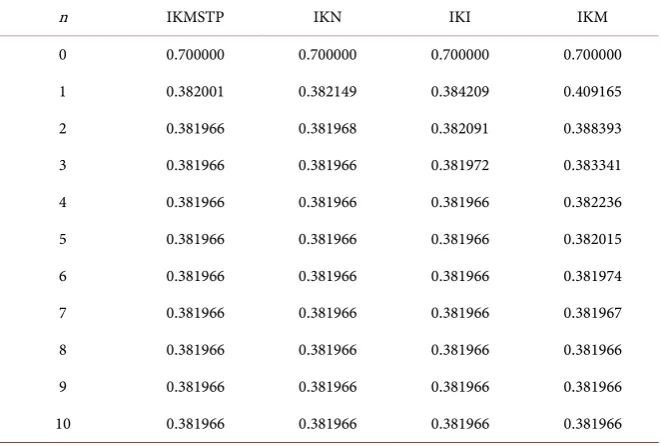
In this section, we use some examples to demonstrate the equivalence of con-vergence between implicit Kirk-multistep (IKMST) iterative scheme (2) and other implicit Kirk-type [implicit Kirk-Noor (IKN)(6), implicit Kirk-Ishikawa (IKI)(7) and implicit Kirk-Mann (IKM)(8)] iterative schemes with the help of computer programs in PYTHON 2.5.4. We shall consider our results for
in-creasing and dein-creasing functions. The results are shown in Table 1 and Table
2.
3.1. Example of Increasing Function (See 5.12 of [4])
Let f : 6,8
[ ] [ ]
→ 6,8 be defined by( )
32
x
f x = + . Then f is an increasing
func-tion with fixed point p=6.000000. By taking initial approximation as
0 0 0 0 7.000000
x =y =z =u = (mid point of x and y) and
,1 ,1 1
5 1
j n n n
n
α =β =β =
+ , (for j=1,2,3, , k−2),
1
,0 1 0 ,
q n i n i
α = −
∑
=α ,2
1 1
,0 0 ,
q n i n i
β =
∑
= β , , 1 1,0 0 , k
q
k k
n i n i
β − β −
=
=
∑
for all the iterative schemes. Theequiva-lence of convergence results to the fixed point p=6.000000 are shown in
Ta-ble 1.
3.2. Example of Decreasing Function (See 5.11 of [4])
Let f : 0,1
[ ] [ ]
→ 0,1 be defined by f x( ) (
= −1 x)
2. Then f is a decreasingfunction with fixed point p=0.381966. By taking initial approximation as
0 0 0 0 0.700000
x =y =z =u = and ,1 ,1 1
4
j n n n
n
α =β =β =
DOI: 10.4236/jamp.2019.71011 135 Journal of Applied Mathematics and Physics
1,2,3, , 2
j= k− ), 1
,0 1 0 ,
q n i n i
α = −
∑
=α , 1 2 1,0 0 ,
q n i n i
β =
∑
= β , , 1 1,0 0 , k
q
k k
n i n i
β − β −
= =
∑
[image:13.595.208.542.161.458.2]for all the iterative schemes. The equivalence of convergence results to the fixed point p=0.381966 are shown in Table 2.
Table 1. Numerical example for increasing function:
( )
3 2 x f x = + .n IKMSTP IKN IKI IKM
0 7.000000 7.000000 7.000000 7.000000 1 6.000124 6.194906 6.336163 6.579796 2 6.000001 6.019386 6.072164 6.268634 3 6.000000 6.001241 6.011546 6.107454 4 6.000000 6.000057 6.001482 6.038496 5 6.000000 6.000002 6.000159 6.012624 6 6.000000 6.000000 6.000015 6.003844 7 6.000000 6.000000 6.000001 6.001098 8 6.000000 6.000000 6.000000 6.000297 9 6.000000 6.000000 6.000000 6.000076 10 6.000000 6.000000 6.000000 6.000019 11 6.000000 6.000000 6.000000 6.000004 12 6.000000 6.000000 6.000000 6.000001 13 6.000000 6.000000 6.000000 6.000000 14 6.000000 6.000000 6.000000 6.000000
Table 2. Numerical example for decreasing function:
( ) (
)
21 f x = −x .
n IKMSTP IKN IKI IKM
[image:13.595.209.540.499.722.2]DOI: 10.4236/jamp.2019.71011 136 Journal of Applied Mathematics and Physics
4. Remark
i) From Table 1, it is observed that for increasing function
( )
32
x
f x = + , the
convergence of implicit Kirk-multistep iterative scheme (2) to the fixed point 6.000000 is equivalent to the convergence of other implicit Kirk-type [implicit Kirk-Noor (IKN) (6), implicit Kirk-Ishikawa (IKI) (7) and implicit Kirk-Mann (IKM) (8)] iterative schemes to the same fixed point 6.000000;
ii) from Table 2, it is observed that for decreasing function f x
( ) (
= −1 x)
2,the convergence of implicit Kirk-multistep iterative scheme (2) to the fixed point 0.381966 is equivalent to the convergence of other implicit Kirk-type [implicit Kirk-Noor (IKN)(6), implicit Kirk-Ishikawa (IKI) (7) and implicit Kirk-Mann (IKM)(8)] iterative schemes to the same fixed point 0.381966.
5. Conclusion
The numerical examples considered in this paper justified our claim on the equivalence results obtained. These results show that our implicit Kirk-type hy-brid iterative schemes have good potentials for further applications.
Conflicts of Interest
The authors declare no conflicts of interest regarding the publication of this pa-per.
References
[1] Olatinwo, M.O. (2008) Some Stability Results for Two Hybrid Fixed Point Iterative Algorithms of Kirk-Ishikawa and Kirk-Mann Type. Journal of Advanced Mathe-matical Studies, 1, 87-96.
[2] Chugh, R. and Kumar, V. (2012) Stability of Hybrid Fixed Point Iterative Algo-rithms of Kirk-Noor Type in Normed Linear Space for Self and Nonself Operators. International Journal of Contemporary Mathematical Sciences, 7, 1165-1184. [3] Akewe, H., Okeke, G.A. and Olayiwola, A. (2014) Strong Convergence and Stability
of Kirk-Multistep-Type Iterative Schemes for Contractive-Type Operators. Fixed Point Theory Appications, 45, 24 p.
[4] Chugh, R., Malik, P. and Kumar, V. (2015) On a New Faster Implicit Fixed Point Iterative Scheme in Convex Metric Space. Journal of Function Spaces, Article ID: 905834.
[5] Bosede, A.O. and Rhoades, B.E. (2010) Stability of Picard and Mann Iteration for a General Class of Functions. Journal of Advanced Mathematical Studies, 3, 1-3. [6] Zamfirescu, T. (1972) Fixed Point Theorems in Metric Spaces. Archiv der
Mathe-matik (Basel), 23, 292-298. https://doi.org/10.1007/BF01304884
[7] Osilike, M.O. (1995) Stability Results for Ishikawa Fixed Point Iteration Procedure. Indian Journal of Pure and Applied Mathematics, 26, 937-941.
[8] Rhoades, B.E. (1990) Fixed Point Theorems and Stability Results for Fixed Point Iteration Procedures. Indian Journal of Pure and Applied Mathematics, 21, 1-9. [9] Imoru, C.O. and Olatinwo, M.O. (2003) On the Stability of Picard and Mann
DOI: 10.4236/jamp.2019.71011 137 Journal of Applied Mathematics and Physics
[10] Chidume, C.E. and Olaleru, J.O. (2014) Picard Iteration Process for a General Class of Contractive Mappings. Journal of Nigerian Mathematical Society, 33, 19-23. [11] Berinde, V. (2004) On the Convergence of Ishikawa Iteration in the Class of Quasi
Contractive Operators. Acta Mathematica Universitatis Comenianae, 73, 119-126. [12] Soltuz, S.M. (2005) The Equivalence of Picard, Mann and Ishikawa Iterations